
Automatic Content Recognition Market Size and Share
Market Overview
| Study Period | 2020 - 2031 |
|---|---|
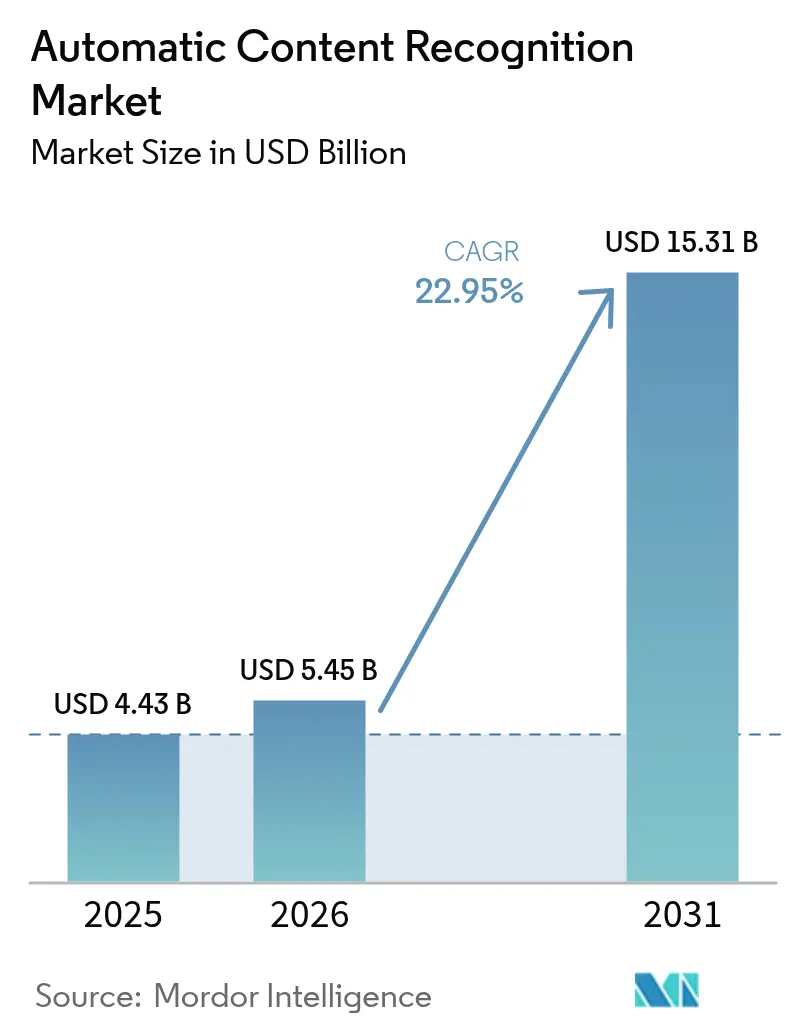
| Market Size (2026) | USD 5.45 Billion |
| Market Size (2031) | USD 15.31 Billion |
| Growth Rate (2026 - 2031) | 22.95 % |
| Fastest Growing Market | Asia-Pacific |
| Largest Market | North America |
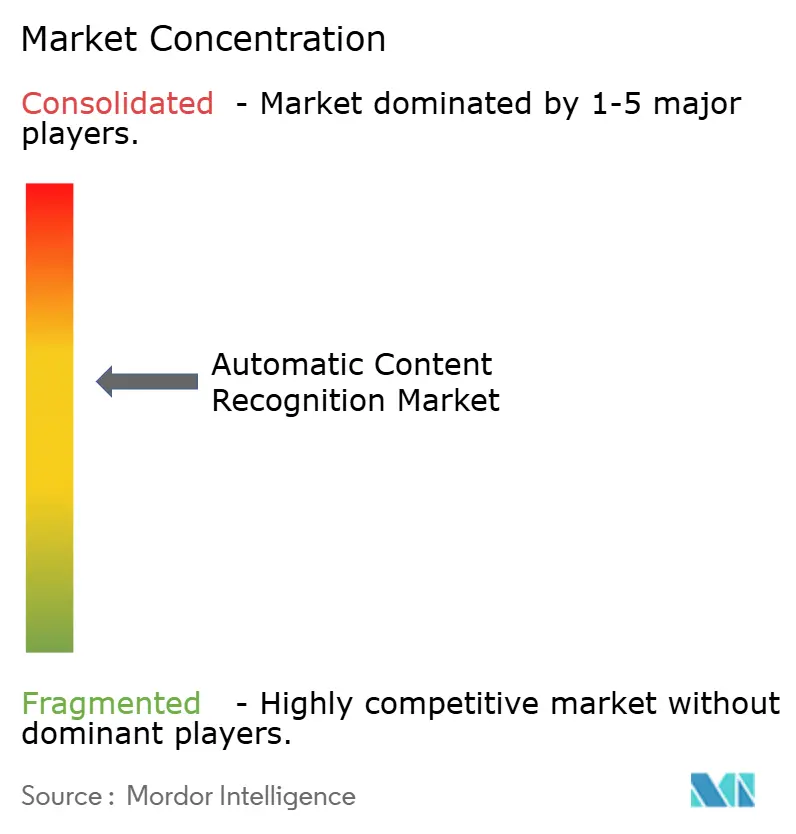
| Market Concentration | Medium |
Major Players *Disclaimer: Major Players sorted in no particular order Image © Mordor Intelligence. Reuse requires attribution under CC BY 4.0. | |
Automatic Content Recognition Market Analysis by Mordor Intelligence
Automatic Content Recognition market size in 2026 is estimated at USD 5.45 billion, growing from 2025 value of USD 4.43 billion with 2031 projections showing USD 15.31 billion, growing at 22.95% CAGR over 2026-2031.
The 2025 baseline reflects broad-based adoption of smart TVs, a decisive budget shift toward addressable advertising, and steady improvements in edge AI that allow fingerprinting tasks to run locally with minimal energy draw. Milestone deployments such as Apple’s Shazam logging 100 billion cumulative song recognitions in 2024 showcase the scale now achieved in everyday consumer settings. Device makers routinely embed ACR silicon at the board level, enabling continuous signature extraction from linear broadcasts, streaming apps, and HDMI inputs without user intervention. This hardware pivot enlarges the Automatic Content Recognition market addressable data pool while lowering latency, a combination that keeps advertisers, broadcasters, and analytics providers firmly invested in the technology.
Key data points confirm this momentum. Software still accounts for 64% revenue but managed cloud services are expanding at a 24.48% pace as brands outsource compliance and model tuning. Audio and video fingerprinting remains the leading technology with 46% share, yet speech-driven use cases in cars and healthcare are widening fastest at 24.11% CAGR. Security and copyright protection dominate solution spending with 29% share, although real-time analytics for FAST channels is the quickest riser at 23.89% CAGR. End-user mix is led by media and entertainment at 38%, while automotive infotainment is closing the gap at 23.78% CAGR thanks to voice commerce pilots. Regionally, North America commands 41% value share, whereas Asia Pacific is compounding at 24.63% through 2030—together reinforcing the Automatic Content Recognition market’s vitality across both mature and emerging geographies.
Key Report Takeaways
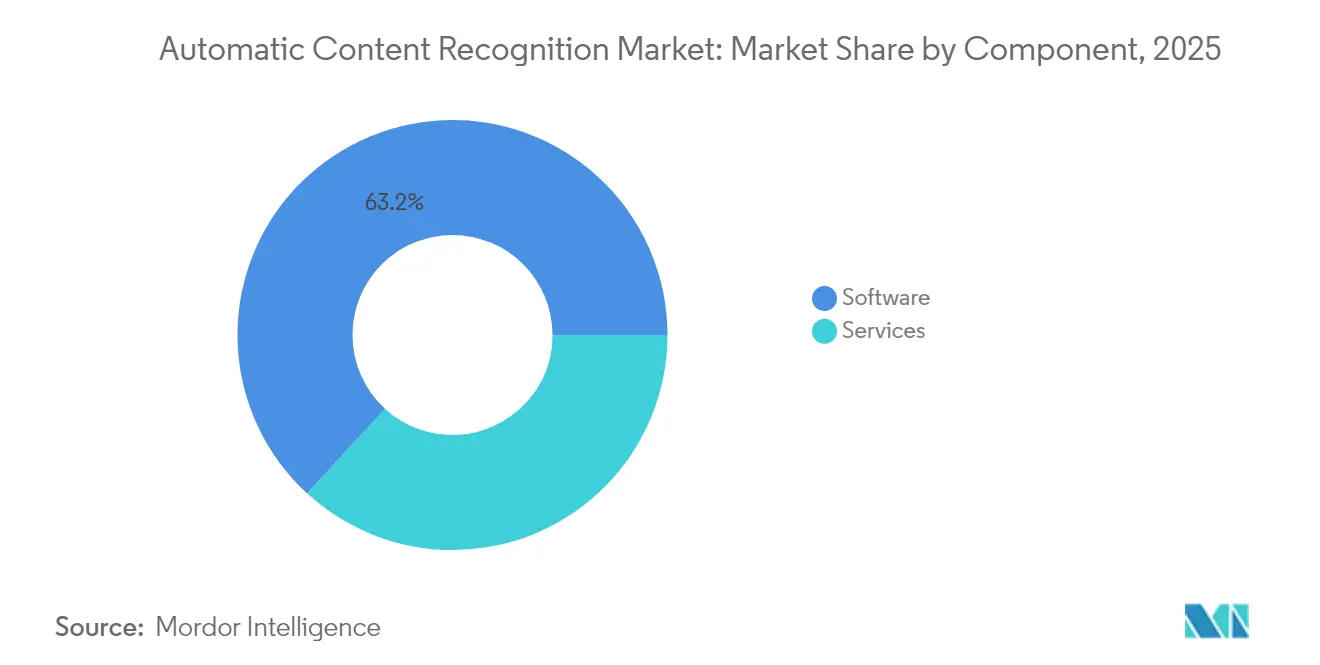
- By component, software platforms captured 63.20% of the Automatic Content Recognition market share in 2025; services are forecast to expand at a 23.95% CAGR to 2031.
- By technology, audio and video fingerprinting led with 45.30% revenue share in 2025, while speech and voice recognition is projected to accelerate at a 23.62% CAGR through 2031.
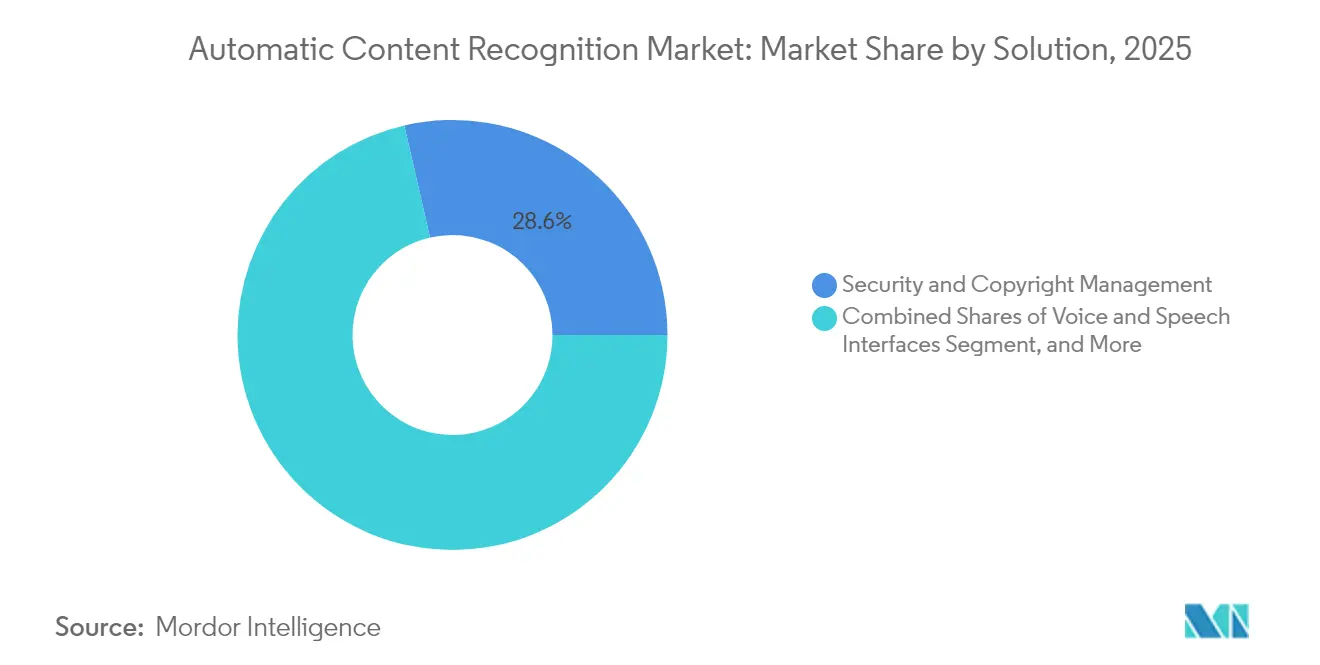
- By solution, security and copyright management accounted for 28.60% of the Automatic Content Recognition market size in 2025 and real-time content analytics is advancing at a 23.35% CAGR to 2031.
- By end-user industry, media and entertainment held 37.20% share of the Automatic Content Recognition market size in 2025; automotive applications are pacing the fastest at a 23.21% CAGR over the same horizon.
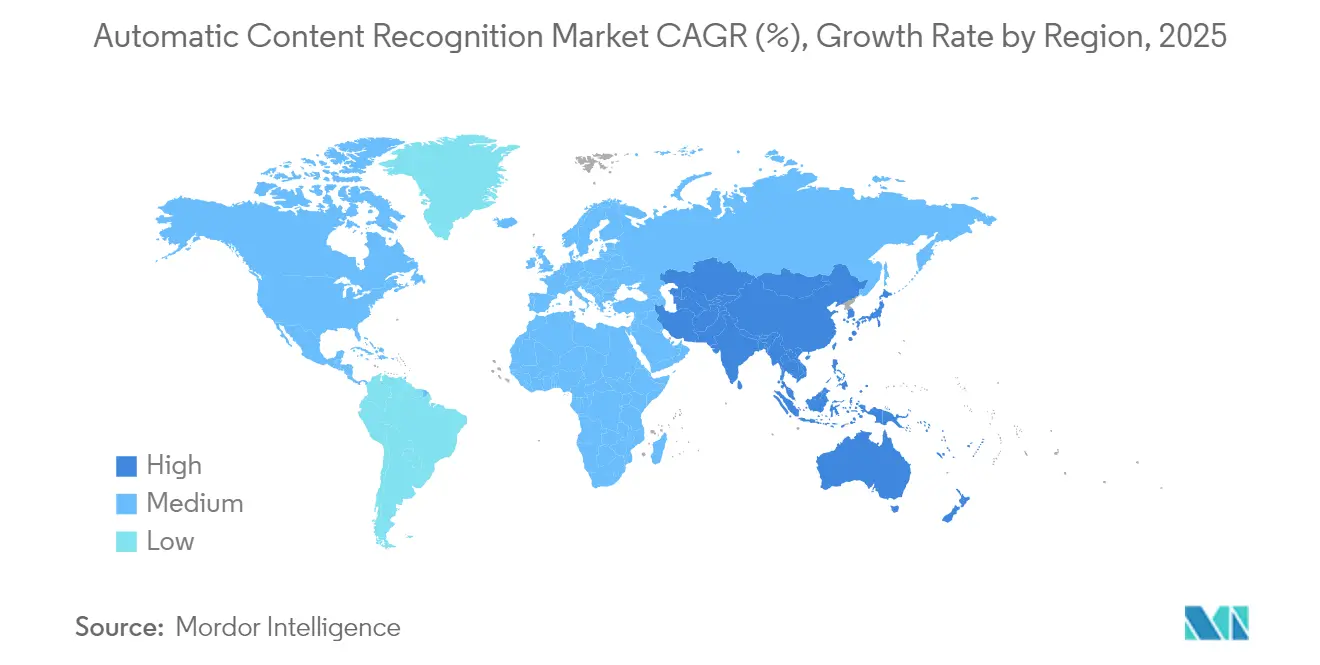
- By region, North America commanded 40.60% of the Automatic Content Recognition market share in 2025, whereas Asia Pacific is projected to post the highest regional CAGR of 24.05% through 2031.
Note: Market size and forecast figures in this report are generated using Mordor Intelligence’s proprietary estimation framework, updated with the latest available data and insights as of 2026.
Market Trends and Insights
Drivers Impact Analysis of Automatic Content Recognition Market*
| Driver | (~) % Impact on CAGR Forecast | Geographic Relevance | Impact Timeline |
|---|---|---|---|
| Proliferation of smart TVs with embedded ACR chips | +6.2% | Global; highest in North America and Asia Pacific | Medium term (2–4 years) |
| Expansion of addressable-TV advertising budgets | +5.8% | North America and Europe core; quick uptake in Asia Pacific | Medium term (2–4 years) |
| Integration of ACR into automotive infotainment systems | +4.1% | Global; premium models in North America and Europe lead | Long term (≥ 4 years) |
| Growth of FAST channels | +3.9% | Global; rapid adoption in North America and Asia Pacific | Short term (≤ 2 years) |
| Edge AI optimization lowering device power draw | +2.7% | Global; mobile and automotive benefit most | Medium term (2–4 years) |
| Emerging privacy-preserving federated learning models | +1.8% | Starts in Europe and North America; scales globally | Long term (≥ 4 years) |
| Source: Mordor Intelligence | |||
Proliferation of Smart TVs with Embedded ACR Chips
Smart-TV brands now route ACR processing through system-on-chip blocks situated beneath the application layer, allowing continuous fingerprint capture even when privacy toggles are off. Samsung units dispatch signatures roughly every minute, while LG models do so every 15 seconds, creating an uninterrupted telemetry stream that spans live broadcasts, streaming apps, and any HDMI source. These low-latency pipelines shorten the feedback loop for ad optimization and broaden the Automatic Content Recognition market’s data inventory.
Expansion of Addressable-TV Advertising Budgets
Advertisers are redirecting spend toward addressable formats that exploit frame-level ACR insights. Budgets dedicated to addressable TV surpassed one-third of total TV outlays in 2025 and are on track for 42% by 2027. FAST distributors pair these insights with programmatic workflows to lift engagement beyond demographic targeting, while new HbbTV-TA certifications in Europe standardize technical baselines. The Automatic Content Recognition market benefits as every incremental ad insertion relies on precise, real-time content labeling.[1]
Integration of ACR into Automotive Infotainment Systems
Vehicle platforms are embedding ACR engines to drive voice search, content recommendations, and commerce. HARMAN’s Ready Connect 5G TCU blends Qualcomm’s digital chassis and local fingerprinting, and SoundHound AI’s agentic voice commerce stack recognizes ambient media to trigger transactions. Edge inference ensures continuity during patchy coverage, underscoring how mobility-centric deployments expand the Automatic Content Recognition market horizon.[2]
Growth of FAST (Free Ad-Supported Streaming TV) Channels
Unique FAST channels reached 1,943 as of May 2024, only 1% shy of the record, firing a 28% annual jump in ad impressions. ACR allows server-side insertion matched to scene-level context, lifting monetization without subscription fees. Yet, 31% of libraries still lack adequate genre tags, spotlighting metadata gaps that providers like Gracenote aim to close.[3]
Restraints Impact Analysis of Automatic Content Recognition Market*
| Restraint | (~) % Impact on CAGR Forecast | Geographic Relevance | Impact Timeline |
|---|---|---|---|
| Stricter opt-in consent rules under refreshed ePrivacy law | -3.4% | Europe with spillover globally | Short term (≤ 2 years) |
| Apple/Google anti-fingerprinting moves in OS updates | -2.8% | Global; mobile and connected TV ecosystems | Medium term (2–4 years) |
| Limited SKU-level analytics from legacy linear STBs | -1.9% | North America and Europe cable networks | Long term (≥ 4 years) |
| Royalty disputes over watermark IP portfolios | -1.3% | Global; most acute in content-heavy territories | Medium term (2–4 years) |
| Source: Mordor Intelligence | |||
Stricter Opt-in Consent Rules Under Refreshed ePrivacy Law
European authorities began enforcing refined consent banners and “consent-or-pay” guidance in late 2024, pressuring smart-TV vendors to create granular toggles that isolate ACR data from core functions. Compliance adds engineering overhead and may shrink data volumes, dampening the Automatic Content Recognition market growth outlook within the bloc.
Apple/Google Anti-Fingerprinting Moves in OS Updates
Apple’s App Tracking Transparency and Google’s evolving Privacy Sandbox now curb device-level identifiers. ACR providers must shift toward privacy-preserving hashes and cohort methods, adding cost and potential latency. Litigations alleging covert fingerprinting illustrate the high stakes, particularly for firms lacking scale to overhaul stacks.
*Our forecasts treat driver/restraint impacts as directional, not additive. The impact forecasts reflect baseline growth, mix effects, and variable interactions.
Automatic Content Recognition Market Segment Analysis
By Component:
Services Acceleration Outpaces Software DominanceSoftware revenue formed the lion’s share of the Automatic Content Recognition market size in 2025, thanks to code tightly woven into TV operating systems and streaming SDKs. However, cloud-hosted managed offerings are scaling at 23.95% CAGR as OEMs and broadcasters outsource model tuning, compliance, and uptime management. Digimarc’s 44% jump in annual recurring revenue to USD 23.9 million underlines how subscription billing is resonating with customers who prefer turnkey compliance amid changing privacy rules.
The services surge mirrors a broader pivot in enterprise IT toward OPEX-friendly contracts that bundle maintenance, audit logs, and SLA guarantees, for many mid-tier device brands, licensing an end-to-end service beats building an in-house stack that must keep pace with region-specific consent frameworks. Accordingly, analysts expect services to nibble incremental Automatic Content Recognition market share each year through 2031 while software remains foundational yet slower growing.

By Technology:
Voice Recognition Disrupts Fingerprinting DominanceAudio and video fingerprinting still anchors 45.30% of revenue due to its maturity and proven accuracy across live TV and on-demand libraries. Yet speech-centric recognition is the Automatic Content Recognition market’s quickest riser, compounding at 23.62% on the back of in-car voice assistants, tele-health monitoring, and contact-center analytics. NTT’s ultra-low-latency voice conversion work highlights how real-time quality now meets enterprise thresholds.
Edge silicon capable of shaving 92% power relative to cloud chains makes voice analytics feasible in battery-run devices and automotive ECUs. Meanwhile, watermarking gains renewed importance for rights holders, and optical character recognition adds incremental volume in retail. Together, these trajectories diversify the Automatic Content Recognition industry toolkit without displacing staple fingerprinting algorithms.
By Solution:
Real-Time Analytics Challenge Security ApplicationsSecurity and anti-piracy suites held a 28.60% beachhead in 2025, driven by urgent needs to curb illegal restreaming, especially for live sports. Japan’s state-backed manga piracy initiative exemplifies government involvement. Nonetheless, FAST operators and connected-TV ad networks are fueling demand for sub-second analytics that let spots be stitched into a stream aligned to actual on-screen moments. This real-time segment is on a 23.35% climb and is steadily closing the revenue gap, signaling that optimization use cases now rival protection motives in steering Automatic Content Recognition market outlays.
By End-User Industry:
Automotive Acceleration Challenges Media LeadershipMedia and entertainment produced 37.20% of revenue in 2025 as studios, broadcasters, and OTT apps mined viewer telemetry for recommendation and rights management tasks. Automotive OEMs, however, are chalking up a 23.21% expansion trajectory by bundling voice commerce, context-aware audio search, and in-cabin personalization. SoundHound AI’s leap to USD 34.5 million Q4 2024 sales, largely underpinned by car deals, underscores this shift. Healthcare pilot projects that marry ACR to patient monitoring and retail pilots that layer watermark-based inventory audit further disperse the Automatic Content Recognition market across verticals previously outside classical media boundaries.
Geography Analysis
North America Automatic Content Recognition Market
North America generated 40.60% of Automatic Content Recognition market revenue in 2025, benefiting from smart-TV household penetration above 75% and a well-established addressable-advertising supply chain. Platforms integrate server-side insertion that leans heavily on frame-level recognition, amplifying the region’s data advantages. While federal privacy bills remain in draft form, state-level rules and greater consumer awareness could temper data flows mid-term, prompting vendors to reinforce consent flows.
APAC Automatic Content Recognition Market
Asia Pacific is the automatic growth engine, expanding at 24.05% CAGR through 2031. Mass-market smart-TV adoption, rising disposable incomes, and policy backing for AI labs act in concert. Korea’s SK Telecom and LG CNS are adding multilingual real-time translation layers that rely on the same underlying ACR voices. Japan’s AI Bill, now progressing through the Diet, is poised to set balanced R&D guardrails, giving suppliers regulatory clarity. In China, domestic chip fabrication and algorithm houses spur localized stacks even as international players navigate export hurdles. The cumulative effect keeps the Automatic Content Recognition market vibrant across APAC sub-regions.
Europe Automatic Content Recognition Market
Europe offers a mix of opportunity and constraint. HbbTV-TA certification has harmonized technical pathways for ad replacement, but the continent’s reinforced ePrivacy and GDPR regimes make opt-in rates a swing factor. Vendors experimenting with federated learning expect to reconcile accuracy with anonymity, potentially birthing best practices that later export to other territories. The Automatic Content Recognition market outlook in Europe therefore hinges on the industry’s ability to align with regulators while sustaining data-rich workflows critical for monetization.
Mordor Intelligence provides coverage of the automatic content recognition market across other key regional markets. Detailed country-level analysis extends to United States incorporating local coverage and market participation, as required.
Regulatory Landscape
ACR is increasingly governed through privacy, AI governance, and copyright enforcement frameworks rather than a single dedicated global regime. In the United States, state-level privacy enforcement has put ACR collection on smart TVs under direct scrutiny: in January 2026, Texas Attorney General Ken Paxton initiated legal action alleging privacy violations tied to ACR data collection involving major TV brands (Sony, Samsung, LG, Hisense, and TCL). Kentucky followed with a targeted amendment, with Governor Andy Beshear signing HB-692 in April 2026 to regulate ACR-related data collection under the state privacy law (effective July 1, 2027), adding compliance design work around notice, consent, and controls for connected-TV ecosystems.
In Europe, ACR deployment intersects with GDPR and evolving interpretations around consent UX, alongside content-law obligations. EU copyright directives relevant to online content use (Directive (EU) 2019/790 and Directive (EU) 2019/789) continue to shape platform and broadcaster responsibilities around rights management tooling, while EU-level AI governance adds another layer: the EU AI Act becomes fully applicable in August 2026, bringing risk management, transparency, and governance expectations for AI-enabled systems used in content identification and processing workflows. Together, these regimes push vendors toward privacy-preserving identifiers, auditable data governance, and clear user controls without breaking measurement and ad-replacement use cases.
Value Chain Analysis
The automatic content recognition (ACR) value chain starts with content capture and signal sampling on endpoints, then moves through recognition, enrichment, and activation. On-device layers include smart TV OEM firmware/OS integrations and silicon/edge AI blocks that extract audio/video signatures; upstream content inputs come from broadcasters, OTT/FAST services, and rights holders that provide reference libraries, watermarks, and metadata. Recognition engines (fingerprinting, watermark detection, speech and voice recognition, and OCR) match signatures to reference databases, after which metadata providers and analytics platforms normalize identifiers, resolve program-level context, and deliver measurement, ad-decisioning, or compliance outputs to advertisers, agencies, and publishers.
Control points in the chain split between OEM-owned stacks and independent providers. OEM monetization paths (for example, Vizio Inscape, Samsung Tizen, and LG Ad Solutions) prioritize first-party viewership data and direct integrations with ad-tech and retail-media ecosystems, while independent software players such as Samba TV compete on cross-device reach, interoperability, and managed services. Standards and industry bodies influence interoperability and redistribution scenarios: the ATSC published the updated A/300 ATSC 3.0 System Standard in April 2026, explicitly incorporating ACR-based content recovery methods (audio/video watermarking and fingerprinting), and CIMM launched an initiative in February 2026 to assess how smart TV ACR data can be enhanced for broader measurement applications. Key bottlenecks remain consent-gated data availability, identity resolution without persistent device identifiers, and the operational burden of maintaining accurate reference libraries and audit trails across fragmented regulatory requirements.
Competitive Landscape
Industry structure is moderately fragmented because each layer—chip, algorithm, metadata, and application—hosts distinct specialists. Shazam and Gracenote anchor audio fingerprinting, whereas edge-AI newcomers are disrupting voice and contextual analytics with lightweight models. Several players pursue vertical stacks: device makers insert proprietary chips, cloud platforms integrate recognition APIs, and content owners license enriching metadata. Patent fences remain central; filings around digital watermark resiliency and neural-network-based signature hashing are rising as firms guard differentiated IP.
Recent strategic moves highlight this dynamic. SoundHound AI nearly doubled its 2024 revenue by pushing beyond pure automotive into restaurants and finance while retaining core patents around conversational AIs. Digimarc’s anti-counterfeit suite demonstrates value in logistics and luxury goods, carving white-space outside media. The Automatic Content Recognition market, therefore, rewards both depth in a niche and breadth across converging verticals, with M&A likely as companies aim to assemble end-to-end portfolios under tightening privacy and ROI lenses.
Automatic Content Recognition Industry Leaders
-
Apple Inc. (Shazam Entertainment Ltd.)
-
Audible Magic Corporation
-
Digimark Corporation
-
ACRCloud
-
Nuance Communications Inc.
- *Disclaimer: Major Players sorted in no particular order
Automatic Content Recognition Market Companies Covered in this Report
- Apple Inc. (Shazam)
- Audible Magic Corp.
- ACRCloud
- Digimarc Corp.
- Vobile Group Ltd.
- Nuance Communications Inc.
- Kantar Media SAS
- Signalogic Inc.
- VoiceInteraction SA
- Beatgrid BV
- Gracenote (Nielsen)
- SoundHound AI Inc.
- Clarivate (ComScore ACR)
- Yospace Ltd.
- Alphonso (Verizon Media)
- Sorenson Media
- Enswers Inc.
- Intrasonics Ltd.
- Audible Insights LLC
- Civolution BV
Market Opportunities and Future Outlook
Interoperable ACR for next-generation broadcast and complex redistribution scenarios is a clear whitespace tied to standards adoption and measurement needs. The April 2026 edition of the ATSC A/300 ATSC 3.0 System Standard explicitly includes fingerprint-based ACR and watermarking for content recovery, providing a concrete technical anchor for vendors that can deliver reliable recognition when signals are redistributed (for example, across HDMI/set-top box paths and mixed delivery chains). This creates room for solution bundles that pair on-device recognition with managed cloud services for reference library updates, latency controls, and auditable logs that measurement providers and broadcasters can use across linear, streaming, and FAST workflows.
A second opportunity centers on compliance-grade recognition that supports both copyright obligations and privacy-by-design. EU copyright directive implementation discussions around platform liability under Article 17 reinforce the need for high-accuracy fingerprinting and filtering to manage infringing uploads at scale, while privacy enforcement attention (including IAPP coverage of ACR in smart TV scrutiny and state actions such as Texas) elevates demand for transparent, consent-aware data handling. Vendors that combine derivative-work detection, AI-generated audio detection, and privacy-preserving processing (for example, on-device hashing, minimized telemetry, and configurable retention) can serve platforms and distributors seeking pre-publication or pre-delivery clearance, reducing downstream takedown and dispute workloads while maintaining performance in real-time identification use cases.
Recent Industry Developments in Automatic Content Recognition Market
- April 2026: ATSC publishes updated A/300 ATSC 3.0 System Standard explicitly including fingerprint-based ACR and watermarking for content recovery, enabling broader measurement across redistributed signals. The specification creates a concrete technical anchor for vendors and broadcasters pursuing reliable recognition in HDMI/set-top box paths and mixed delivery chains.
- February 2026: CIMM launches initiative to assess how smart TV ACR data can be enhanced for broader measurement applications. The program aims to improve data interoperability and establish standards for cross-device measurement across broadcast and streaming ecosystems.
- June 2025: AMD agreed to acquire Brium to improve AI model performance on Radeon-class hardware. The deal strengthens the compute stack used for speech and audio recognition workloads that ACR providers increasingly run in edge and hybrid deployments.
Automatic Content Recognition Market Report Scope and Research Methodology
Market Definition and Coverage
For this study, the automatic content recognition (ACR) market covers software and related services that identify audio, video, or other media content in near real time, so the content can be matched, measured, protected, or acted on across devices and platforms.
Scope exclusions: Hardware-only costs and generic media production tools are excluded when they are not directly used for content identification and matching.
Segments Covered in This Report
- By Component
- Software
- Services
- By Technology
- Audio and Video Fingerprinting
- Digital Watermarking
- Speech and Voice Recognition
- Optical Character Recognition
- By Solution
- Real-time Content Analytics
- Security and Copyright Management
- Voice and Speech Interfaces
- Data Management and Metadata
- Others
- By End-User Industry
- Media and Entertainment
- Consumer Electronics OEMs
- Advertising and Marketing
- Telecom and IT
- Automotive
- Healthcare
- Others (Retail, Education)
- By Geography
- North America
- United States
- Canada
- Mexico
- South America
- Argentina
- Brazil
- Rest of South America
- Europe
- United Kingdom
- France
- Germany
- Rest of Europe
- Asia Pacific
- China
- Japan
- South Korea
- India
- Rest of Asia Pacific
- Middle East
- United Arab Emirates
- Saudi Arabia
- Turkey
- Rest of Middle East
- Africa
- Nigeria
- South Africa
- Rest of Africa
- North America
Data Sources, Market Sizing, and Validation
Desk Research
Desk research starts by aligning the market boundary with how ACR is deployed in media, advertising measurement, copyright, and device ecosystems. We reference public sources such as US Federal Communications Commission releases, US Copyright Office materials, OECD digital economy statistics, ITU indicators, and standards guidance from bodies such as ISO or ETSI, along with peer reviewed papers covering watermarking and fingerprinting performance.
To turn those signals into a usable model, we also review company filings, investor decks, product documentation, and reputable press coverage that describes rollout timing and pricing motion in broad terms. Where needed, we use paid subscriptions for company financials and news context, and another paid subscription to scan patent activity, since ACR is IP heavy and product changes can shift pricing. These sources are illustrative only, and additional references are used for data collection, validation, and clarification.
Primary Interviews and Surveys
Primary work is used to confirm adoption levels, pricing structure, and what is actually counted as ACR revenue across media owners, device ecosystems, and solution providers. We also pressure test regional demand differences across APAC, EMEA, and the Americas, and we revisit assumptions when interview feedback shows material gaps versus desk signals.
Distribution of primary research fieldwork respondents
| Company type | Respondent position | Region |
|---|---|---|
| Top tier: 30% | CXOs: 12% | APAC: 52% |
| Mid tier: 48% | Functional/Unit leaders: 37% | EMEA: 30% |
| Smaller Players: 22% | Managers: 51% | Americas: 18% |
Market-Sizing & Forecasting
Sizing is built mainly using a top-down model where device and platform adoption signals are reconstructed into an addressable demand pool, and then converted into ACR revenue through penetration and pricing assumptions. The total is cross-checked with selective bottom-up approximations, such as sampled vendor revenue mapping, channel checks with integrators, and volume times ASP estimates for typical use cases, and adjustments are made when a mismatch persists.
Key inputs that shape the model include smart TV and connected device installed base trends, OTT and streaming consumption growth, growth in ad supported video and addressable ad spend direction, the mix shift between fingerprinting and watermarking based deployments, and licensing patterns by region and end user. For forecasting, scenario analysis is used with a base case plus faster and slower adoption paths, since rollout pace is sensitive to privacy rules, integration cycles, and content owner priorities. When bottom-up signals are incomplete, the gap is filled using comparable contract structures and conservative ramp curves that were validated in interviews.
Data Validation & Update Cycle
Validation happens through triangulation between model outputs, interview feedback, and independent market signals that should move in the same direction, such as connected device penetration and media consumption shifts. Outliers are investigated by checking definitions, currency treatment, and whether one-off contracts are being mistakenly annualized, and then the assumptions are reviewed again before sign-off.
Reports are refreshed each year, and interim revisions are triggered when major events occur, such as regulatory changes, step changes in platform coverage, or pricing model shifts. Before delivery, a fresh analyst pass is completed so the final numbers reflect the most recent information available at that time.
Mordor Intelligence's Automatic Content Recognition Market Size Measured Against Other Published Estimates
It is normal to see different market sizes for ACR because sources may not count the same revenue streams, and the timing of updates also varies. In this market, even a small change in pricing assumptions or what is treated as recurring licensing can shift the total meaningfully.
The spread is usually driven by how each publisher treats ASP progression for licensing versus services, the exchange-rate month used for conversion, and whether device embedded deployments are counted only when monetized. A refresh-led step that helps keep the numbers consistent is rechecking currency timing and revalidating the price-per-device and price-per-stream logic with recent buyer feedback, and then locking that into the model, which is how Mordor Intelligence arrives at the 2026 starting point used in this report.
Benchmark comparison
| Source | Market Size | Gaps in Research Methodology |
|---|---|---|
| Mordor Intelligence | USD 5.45 B (2026) | |
| Global Consultancy A | USD 4.03 B (2025) | Uses a different base year and forecast window, and the scope appears to blend platform and component views, which can reduce comparability with a licensing-led ACR revenue boundary. |
| Industry Publisher B | USD 5.05 B (2026) | Keeps 2026 close to this study, but the longer forecast horizon suggests different adoption ramp and pricing step-up assumptions, and currency timing is not clearly stated in the public snapshot. |
Overall, the table shows that year selection and pricing logic explain most of the gap, more than any single demand driver. When the scope is kept tight to monetized ACR use cases and the inputs are refreshed with clear currency and ASP rules, the resulting number is easier to trace and repeat.
Key Questions Answered in the Report
What was the Automatic Content Recognition market size in 2026?
The market reached USD 5.45 billion in 2026, reflecting strong uptake across smart-TV, advertising, and automotive domains.
How fast is the Automatic Content Recognition market expected to grow through 2031?
It is projected to advance at a 22.95% CAGR, swelling to USD 15.31 billion by the end of the forecast period.
Which technology segment is growing the quickest
Speech and voice recognition is the fastest, expanding at a 23.62% CAGR on the back of automotive and healthcare deployments.
Which region holds the largest share today?
North America leads with 40.60% revenue share owing to high smart-TV penetration and mature addressable advertising frameworks.
What is the main restraint affecting growth in Europe?
Stricter opt-in consent requirements under the updated ePrivacy law are increasing compliance costs and restricting data collection volumes.
Why are services gaining ground over software in component terms?
Enterprises prefer managed cloud services that bundle regulatory compliance, model updates, and scalability, pushing services toward a 23.95% CAGR.