
Australia Retail Bags Market Size and Share
Market Overview
| Study Period | 2020 - 2031 |
|---|---|
| Forecast Data Period | 2026 - 2031 |
| Base Year Market Size (2025) | USD 1.03 Billion |
| Market Size (2026) | USD 1.09 Billion |
| Market Size (2031) | USD 1.41 Billion |
| Growth Rate (2026 - 2031) | 5.28 % |
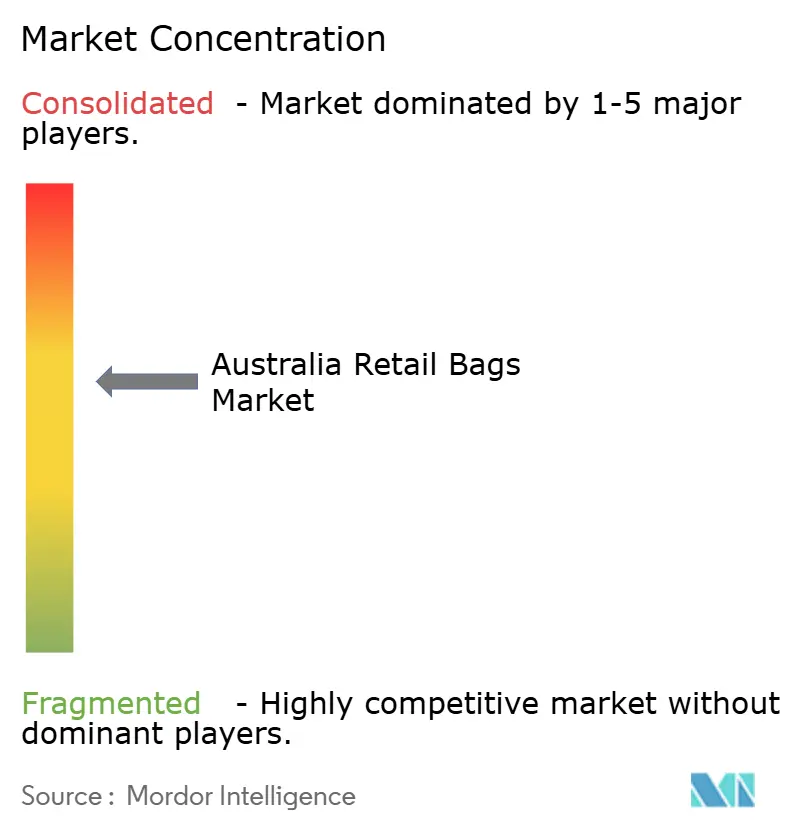
| Market Concentration | Medium |
Major Players *Disclaimer: Major Players sorted in no particular order Image © Mordor Intelligence. Reuse requires attribution under CC BY 4.0. | |
Australia Retail Bags Market Analysis by Mordor Intelligence
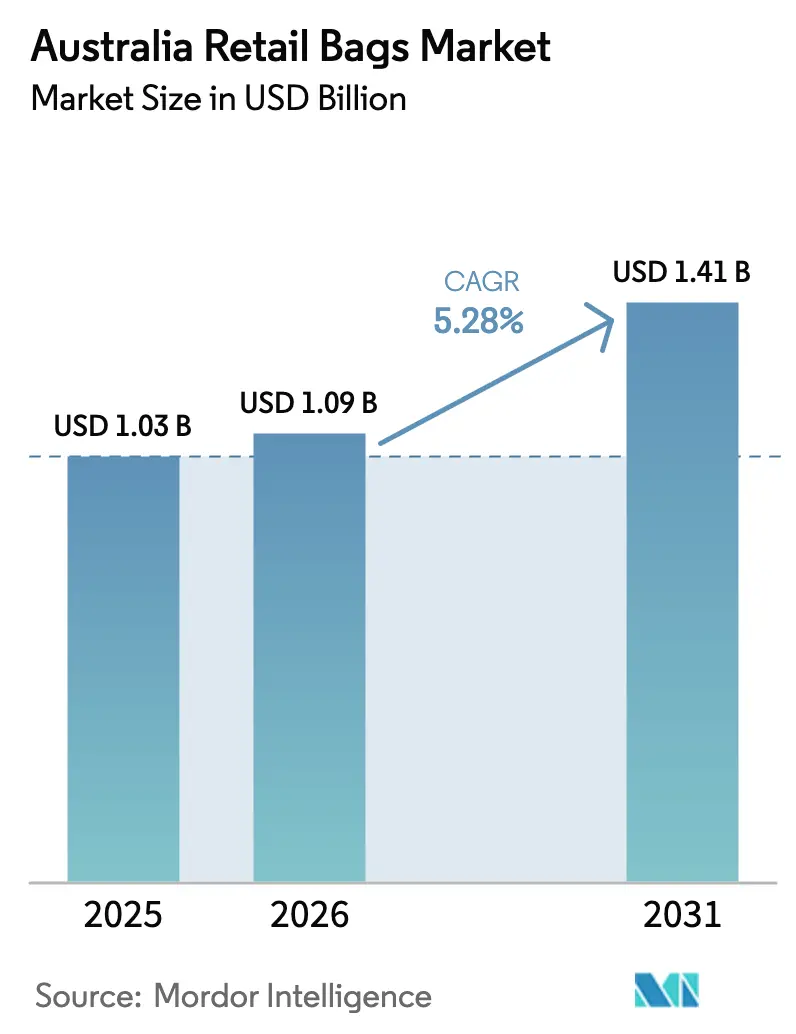
The Australia retail bags market size is expected to grow from USD 1.03 billion in 2025 to USD 1.09 billion in 2026 and is forecast to reach USD 1.41 billion by 2031 at 5.28% CAGR over 2026-2031. Rising state-level bans on single-use plastics, rapid growth of online grocery fulfilment, and supermarket circular-economy pilots are reshaping procurement preferences and prompting material substitution toward paper and natural fabrics. Converter margins have tightened because kraft-pulp and resin price volatility has outpaced retail pass-through, while consumer sustainability awareness is prompting retailers to accelerate reusable-bag programs even though reuse infrastructure remains limited. Foodservice operators are driving demand for tamper-evident, insulated formats that protect meal integrity during delivery, and innovations such as home-compostable aqueous barriers are narrowing the performance gap between paper and plastic. At the same time, imported low-cost plastic bags from Asia continue to undercut domestic producers on price, intensifying competition and encouraging local converters to pursue higher-margin compostable and reusable niches.
Key Report Takeaways
- By material, plastics dominated with 53.48% Australia retail bags market share in 2025, while paper and natural-fabric alternatives are projected to post the highest 5.83% CAGR through 2031.
- By bag type, disposable formats held 61.18% of the Australia retail bags market size in 2025, yet reusable bags are expected to expand at a 6.21% CAGR to 2031.
- By distribution channel, offline retail captured 77.62% of 2025 revenue, whereas online retail is forecast to lead growth at 6.84% CAGR over 2026-2031.
- By size, mid-sized 5–20-liter bags commanded 48.59% of demand in 2025 and large bags above 20 liters are advancing at a 5.91% CAGR.
- By end-user industry, grocery and convenience stores generated 42.46% of revenue in 2025, but foodservice is positioned for the fastest 6.33% CAGR through 2031.
Note: Market size and forecast figures in this report are generated using Mordor Intelligence’s proprietary estimation framework, updated with the latest available data and insights as of 2026.
Australia Retail Bags Market Trends and Insights
Drivers Impact Analysis*
| Driver | (~) % Impact on CAGR Forecast | Geographic Relevance | Impact Timeline |
|---|---|---|---|
| Surge in Single-Use Plastic Bans Across Australian States | +1.20% | National, with early enforcement in NSW, Victoria, Queensland, WA, SA | Medium term (2-4 years) |
| Growth of Online Food Delivery Demanding Take-Away Packaging | +0.90% | National, concentrated in metropolitan Sydney, Melbourne, Brisbane | Short term (≤ 2 years) |
| Retail Sector Shift Toward Sustainable Branding Initiatives | +0.70% | National, led by Woolworths, Coles, IGA | Medium term (2-4 years) |
| Rising Adoption of Bag-Sharing Libraries in Metropolitan Areas | +0.30% | Metropolitan Sydney, Melbourne, Monash | Long term (≥ 4 years) |
| Emergence of Home-Compostable Barrier Coatings Improving Paper Bag Durability | +0.80% | National, with early adoption in foodservice and premium retail | Medium term (2-4 years) |
| Circular Economy Pilot Programs by Major Supermarkets Driving Reusable Bag Demand | +0.60% | National, anchored by Woolworths, Coles, ALDI soft-plastics taskforce | Medium term (2-4 years) |
| Source: Mordor Intelligence | |||
Surge in Single-Use Plastic Bans Across Australian States
Australian jurisdictions tightened plastic-reduction laws between 2024 and 2025, creating a cascade of compliance deadlines. New South Wales issued Plastics Plan 2.0 in November 2025, which schedules additional bag phase-outs starting 2026.[1] Victoria and Queensland are funding infrastructure and closing enforcement gaps, while federal consultation shows 65% stakeholder support for mandatory extended producer responsibility. These overlapping mandates are pushing retailers to adopt paper and certified-compostable bags but also splinter standards, raising inventory complexity and labelling costs. The Australian Packaging Covenant Organisation recorded a rise to 31% recycled content in plastic packaging during 2024, yet absolute plastic tonnage fell only marginally, underscoring the scale of transition still required.[2]
Growth of Online Food Delivery Demanding Take-Away Packaging
Online takeaway ordering soared at a 15.3% compound rate from 2019 to 2023, reaching USD 9.19 billion, while delivery revenue jumped 22.6% annually to USD 4.70 billion.[3] Drive-through transactions grew to USD 2.99 billion in 2023 and are on track for USD 4.32 billion by 2028, fuelling demand for tamper-evident, insulated, and stackable bags that preserve product temperature and integrity en route. Limited-service restaurants, heavily dependent on packaging, are projected to rise 5.7% annually through 2028. Although operators need advanced bag specifications, restaurant margins of 3.8% and cafe margins of 3.3% restrict their willingness to pay premiums, forcing converters to balance performance with affordability.[4]
Retail Sector Shift Toward Sustainable Branding Initiatives
Supermarkets are weaving plastic-reduction pledges into brand equity to meet consumer and investor expectations. Woolworths cut virgin plastic by 3,200 tonnes and hit 31% recycled plastic across its packaging portfolio in 2025, while Coles released its R3 Packaging Framework targeting diversion and recycled content. The Australian Competition and Consumer Commission cleared Woolworths, Coles, and ALDI to form the Soft Plastics Taskforce, obliging quarterly updates through July 2026. BioPak’s compostable sugarcane trays and aqueous-lined paper sushi packs have entered bakery, seafood, and ready-meal aisles, proving performance parity with plastics. However, an audit revealed that 73% of loose produce was priced above pre-packed produce, reinforcing single-use reliance and highlighting misalignment between sustainability rhetoric and shelf strategy.
Emergence of Home-Compostable Barrier Coatings Improving Paper Bag Durability
Advances in biopolymer science have delivered leak-proof and grease-resistant coatings that meet AS5810 and NFT51-800 home-composability standards. BioPak’s polyhydroxyalkanoate-lined coffee cups and PFAS-free plant-fiber lids illustrate how aqueous and bio-based barriers now handle hot liquids and oily foods without fossil-based laminates. Retail pilots show paper bags with these coatings withstand chill-chain condensation, widening their applicability beyond dry goods. The Australian Institute of Food Science and Technology reports surging demand for consultants who can validate shelf life and regulatory compliance for compostable formats. Yet uneven kerbside compost collection limits end-of-life certainty outside jurisdictions like South Australia, moderating adoption where disposal pathways remain unclear.
Restraints Impact Analysis*
| Restraint | (~) % Impact on CAGR Forecast | Geographic Relevance | Impact Timeline |
|---|---|---|---|
| Volatility in Kraft Paper and Resin Prices | -0.60% | National, with exposure to global pulp and petrochemical markets | Short term (≤ 2 years) |
| Dominance of Imported Low-Cost Alternatives From Asia | -0.50% | National, concentrated in price-sensitive retail and foodservice segments | Medium term (2-4 years) |
| Limited Recycling Infrastructure for Multi-Layer Paper-Plastic Laminates | -0.30% | National, with acute gaps in regional and remote areas | Long term (≥ 4 years) |
| Small Business Adaptation Costs to Reusable Bag Regulations | -0.20% | National, with higher burden on independent cafes, restaurants, and small retailers | Short term (≤ 2 years) |
| Source: Mordor Intelligence | |||
Volatility in Kraft Paper and Resin Prices
Spot prices for bleached softwood kraft pulp and polyethylene swung sharply during 2024-2025 as energy markets fluctuated, compressing converter margins just as bag demand pivoted toward paper. Local producers often lack long-term feedstock contracts, so sudden upticks in pulp or resin costs cannot be offset quickly through retail price adjustments. Petrochemical capacity additions in Asia depressed resin prices intermittently, but freight disruptions reversed the trend in early 2025, amplifying budgeting uncertainty. Thin foodservice margins mean restaurants cannot absorb packaging cost hikes, so converters risk volume loss if price increases exceed operators’ tolerance. BioPak’s 2024 sustainability report candidly acknowledges raw-material volatility as a strategic challenge even while it pursues scope-1 emissions cuts.
Dominance of Imported Low-Cost Alternatives from Asia
Chinese and Vietnamese factories enjoy scale efficiencies and lower labour costs that let them price lightweight plastic and produce bags 15-25% below domestic equivalents. Imports flood commodity tiers, leaving local converters to compete mainly on service responsiveness or sustainability features. The federal House of Representatives inquiry into food and beverage manufacturing observed that domestic purchasers still default to lowest-cost options despite branding Australia as clean and green. Excess cheap supply exacerbates litter volumes, with the 2025 audit showing packaging represents 57.8% of recorded litter. Pending extended producer responsibility with eco-modulated fees could internalize environmental costs, narrowing the price gap, but nationwide rollout is still under consultation.
*Our forecasts treat driver/restraint impacts as directional, not additive. The impact forecasts reflect baseline growth, mix effects, and variable interactions.
Segment Analysis
By Material: Paper Alternatives Gain Ground Despite Plastic Dominance
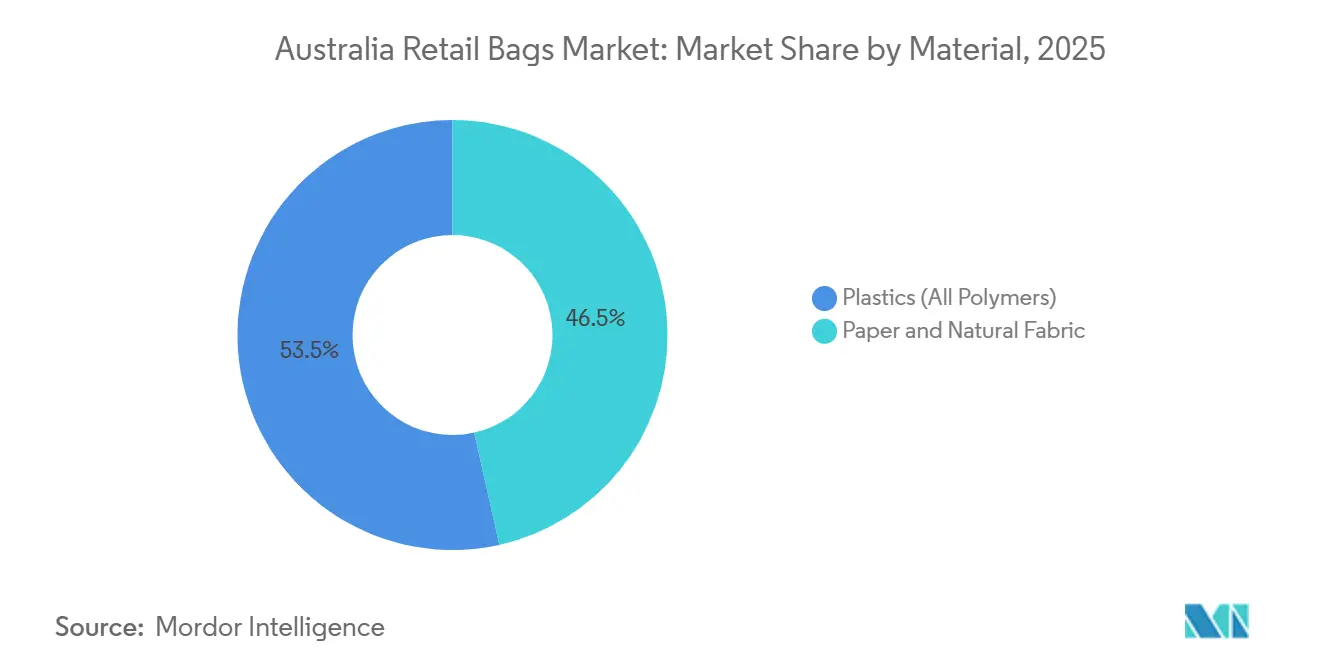
Plastics retained 53.48% share of the Australia retail bags market in 2025 because of cost efficiency and moisture resistance. Recycled polyethylene terephthalate volumes rose in tandem with supermarket recycled-content pledges, while high-density and low-density polyethylene remained staples for checkout and produce bags. Paper and natural-fabric formats are, however, expected to log the fastest 5.83% annual advance from 2026, reflecting regulatory pressure and retail sustainability targets. The Australia retail bags market size for paper and natural fabrics is projected to widen as aqueous-lined paper trays, PFAS-free plant-fiber lids, and sugarcane pulp bakery trays meet performance hurdles once dominated by plastic.
Plastic demand will persist where tensile strength and barrier performance are critical, yet statewide bans are limiting future growth. Retailers are trailing bag-free produce aisles and selling loose produce, though price premiums still discourage plastic reduction. Polypropylene reusable bags continue to leverage durability advantages, especially within supermarket loyalty programs. Natural fabrics such as cotton and jute occupy premium niches, where brand storytelling offsets higher costs. As legislation tightens, converters are likely to blend recycled polymers with advanced biopolymers to maintain performance while reducing fossil content, further segmenting material choices across the Australia retail bags market.
By Bag Type: Reusable Formats Accelerate as Disposables Plateau
Disposable bags still commanded 61.18% of 2025 volume, yet growth is flattening as regulations and consumer sentiment favour reuse. The Australia retail bags market share held by reusable formats is anticipated to climb steadily, backed by supermarket buy-back schemes and in-store collection pilots authorized by the ACCC. Coles and Woolworths plan to standardize reusable bags and introduce design-for-recyclability standards by 2027, which could further compress disposable volumes.
Foodservice reliance on single-use bags remains high because hygiene and convenience outweigh environmental concerns. Online delivery growth, particularly in metropolitan areas, accentuates demand for leak-proof, tamper-evident plastics or insulated paper hybrids. Reusable carrier pilots in quick-service chains are in early stages but face logistical hurdles, notably bag return and sanitation workflows. Converters targeting the reusable tier are differentiating through higher GSM polypropylene fabrics, embedded QR codes for traceability, and closed-loop take-back programs, underscoring a shift toward service-based revenue models within the Australia retail bags market.
By Distribution Channel: Offline Retail Holds Share as Online Accelerates
Brick-and-mortar outlets generated 77.62% of 2025 value, reflecting the physical checkout point where bag purchases are habitual. Promotional pricing of reusable polypropylene totes at supermarket checkouts encourages impulse uptake, while in-store soft-plastic collection points help drive circular messaging. The Australia retail bags market size contributed by online retail is expected to grow fastest at 6.84% annually, propelled by expanding grocery e-commerce and dark store fulfilment centers.
E-grocers currently over-package orders to minimize in-transit damage, often deploying extra produce bags. Advocacy groups are pressing for mandatory opt-out options and packaging disclosure, and any resulting regulation could curb excess bag use. Quick-commerce models using micro-warehouses rely on insulated carrier bags that stabilize temperature for 15–30-minute delivery windows. Successful differentiation in online channels will likely hinge on delivery-optimized designs, such as gusseted square bases and integrated insulation panels, offering new volume niches within the Australia retail bags market.
By Size: Mid-Sized Bags Lead, Large Formats Gain Traction
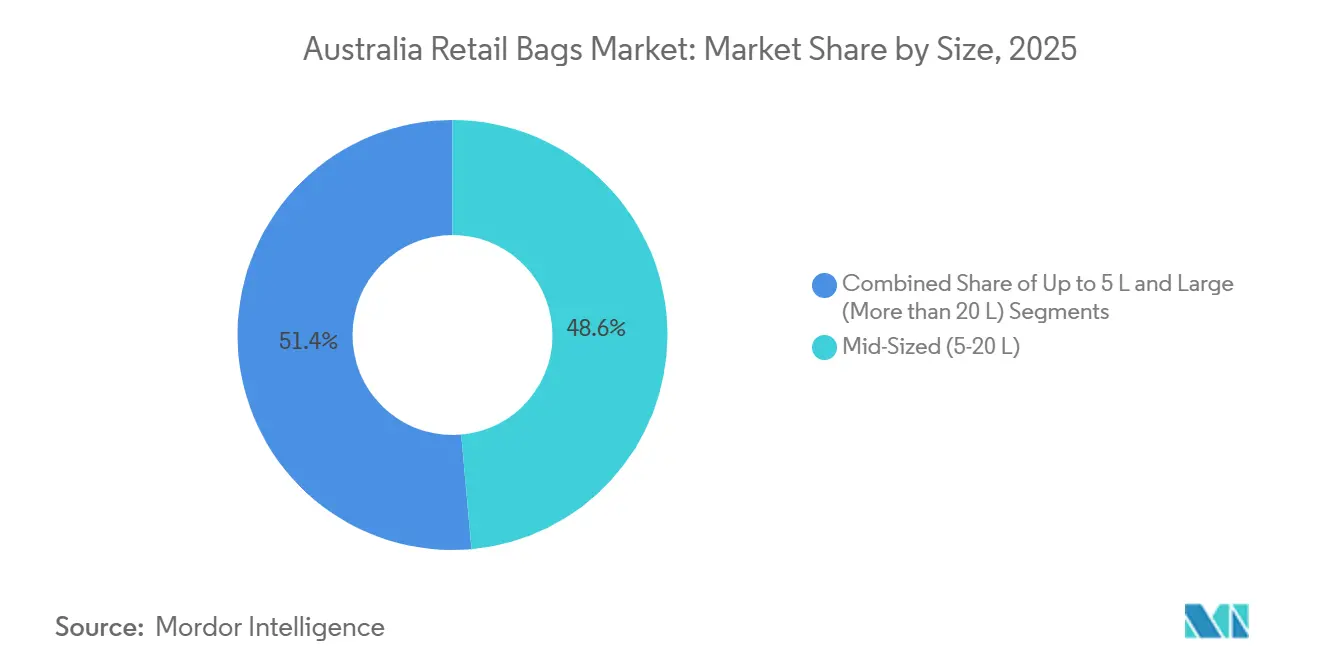
Bags between 5-20 liters represented 48.59% of 2025 demand owing to versatility across grocery and takeaway applications. The Australia retail bags market size for large formats above 20 liters is projected to expand at 5.91% annually as bulk grocery orders and industrial uses climb. Retailers packing multiple chill-chain products in fewer, larger bags reduce picker time and shrink film costs, driving volume shift toward the upper-capacity tier.
Small produce and bakery bags face the tightest regulatory scrutiny and rising unit costs, which could nudge some demand to mid-sized bags that consolidate loose items. Industrial customers require heavy-duty large bags with puncture resistance for textiles and construction materials. Brand owners are experimenting with recycled-content stretch handles and reinforced bottom seams to boost load limits, signalling technical upgrades across the Australia retail bags market.

By End-User Industry: Foodservice Outpaces Grocery as Delivery Surges
Grocery and convenience accounted for 42.46% of 2025 sales, yet foodservice is on course for a market-leading 6.33% CAGR through 2031. Drive-through lanes and delivery apps have entrenched single-use bag dependence for hot meals, beverages, and combo boxes. The Australia retail bags industry also serves nearly 56,000 restaurant and cafe sites, were tight margins spur demand for competitively priced solutions. Limited-service chains negotiate national contracts, tilting volume to converters capable of just-in-time delivery and consistent branding.
Grocery growth remains steady as retailers invest in reusable bag merchandising and digital loyalty incentives. However, price-sensitive consumers replace lost polypropylene totes frequently, blunting sustainability gains. Industrial and commercial users contribute niche but stable demand for high-strength bags in linen services, chemicals, and agricultural supplies, expanding diversification opportunities for manufacturers within the Australia retail bags market.
Geography Analysis
New South Wales retains leadership at 38.15% market share, underpinned by Sydney’s concentrated retail and corporate base, where bag turnover remains elevated. Post-2022 regulatory alignment triggered a swift transition from HDPE to paper and rPET, taxing supply chains initially but ultimately harmonizing specification standards statewide. Victoria follows, buoyed by Melbourne’s multi-channel retail landscape and proximity to major fiber-processing sites that reduce freight cost for paper bags.
Early legislative adoption matured consumer habits sooner, enabling retailers to pilot reusable loyalty integrations that later migrated nationwide. Tourism inflows reinforce demand for souvenir-grade carriers, while mining, agriculture, and logistics clusters support industrial bulk orders.
Western Australia’s bag demand peaks around mining-town provisioning and Perth retail hubs, but shipping distances inflate landed costs, nudging import reliance. South Australia leverages its historic leadership in bag bans to foster small-scale paper converters serving local supermarkets. Tasmania’s eco-tourism brand catalyzes premium recycled-paper sales, though its limited population tempers absolute volumes. The Australian Capital Territory’s government procurement policies mandate high-recycled content, offering stable contract volumes for compliant suppliers.
Regulatory Landscape
Australia retail bags regulation is shaped by overlapping federal, state, and territory measures that increasingly penalize single-use plastics and tighten packaging stewardship. At the federal level, the National Environment Protection (Used Packaging Materials) Measure 2011 sets recovery-related obligations for used packaging, while the Department of Climate Change, Energy, the Environment and Water (DCCEEW) is progressing packaging-reform work that emphasizes circular design and recovery outcomes. In New South Wales, Plastics Plan 2.0 (released in November 2025) schedules additional phase-outs beginning in 2026, which adds another compliance layer for retailers operating nationally.
For food-contact retail bags and liners used in grocery and foodservice, Food Standards Australia New Zealand (FSANZ) requirements under the Food Standards Code (including Standard 3.2.2) influence material selection and contamination controls. Labeling and consumer-information rules, including Australian Consumer Law and Country of Origin Food Labelling requirements under Country of Origin Food Labelling Information Standard 2016, add operational requirements for packaged goods and affect packaging formats used at shelf and checkout. Policy momentum around extended producer responsibility is also visible at the national level, with an Extended Producer Responsibility Scheme for Packaging (No Time to Waste) Bill 2026 introduced in the Senate on 13 May 2026 and referred to committee with a reporting date of 6 August 2026, reinforcing the direction of travel toward fee-and-performance-based stewardship frameworks.
Competitive Landscape
The Australia retail bags market is moderately concentrated, with established converters Detmold Group, Visy Industries, and Amcor leveraging integrated paper mills and film plants to supply national supermarket chains. Specialist compostable supplier BioPak reported a 300% surge in sugarcane-based product demand over two years and broadened its reach by acquiring Huskee and decent packaging in 2024, creating the BioPak Group that offers compostable and reusable portfolios. Better Packaging Co and Opal Packaging focus on premium e-commerce and industrial niches, respectively, often partnering with disruptors like Great Wrap, which distributes certified compostable pallet wrap under an exclusive Opal alliance.
Import pressure from China and Vietnam continues to squeeze margins, prompting local converters to automate production lines and pursue recycled-content certification. Retailers increasingly demand supplier audits on traceability, labour practices, and carbon disclosure, raising entry barriers.
Innovation is rotating toward delivery-ready formats featuring modular insulation, smart-label temperature trackers, and QR-enabled recyclability instructions, offering white-space for agile entrants. Strategic collaborations, such as supermarket-backed recycling taskforces and material-science partnerships, demonstrate that ecosystem alignment rather than pure scale is becoming a decisive differentiator in the Australia retail bags market.
Australia Retail Bags Industry Leaders
-
Detmold Group Pty Ltd.
-
United Paper Pty Ltd.
-
Gispac Pty Ltd.
-
Pacific National Industries Pty Ltd.
-
Bag People Pty Ltd.
- *Disclaimer: Major Players sorted in no particular order
Market Opportunities and Future Outlook
Compliance-led material substitution continues to create room for paper, natural-fabric, and certified compostable retail-bag formats that can meet performance and end-of-life requirements. In foodservice and online fulfillment, demand for tamper-evident, insulated, and moisture-tolerant carry solutions is rising, and home-compostable barrier coatings aligned with AS5810 and NFT51-800 are helping paper address grease and chill-chain use cases. Suppliers that can provide validated food-contact performance aligned with FSANZ expectations, supported by clear labeling and disposal guidance, are positioned to support standardization efforts across grocery, convenience, and takeaway chains that are trying to reduce SKU complexity while navigating state-by-state rule variations.
A second opportunity is building around circularity and local supply resilience as governments consult on packaging reforms and the market responds to resin and pulp input volatility. Retailers and converters have a growing incentive to increase recycled content and strengthen traceability to meet supermarket procurement requirements and taskforce-style reporting, while also reducing exposure to imported commodity bags that compete primarily on price. Detmold Group's actions reinforce this direction, including a long-horizon sustainability roadmap and on-site solar deployments at Regency Park, which point to emissions and energy-cost management becoming part of bid competitiveness for large retail and foodservice contracts alongside functional performance and compliance.
Recent Industry Developments
- July 2026: Detmold Group subsidiary Detpak opened a 16,300 square metre manufacturing facility in Spartanburg, South Carolina to support North American customers with locally produced paper-based packaging. The facility began full production in August 2026.
- February 2026: Detmold Group reported progress on its 2025-2050 sustainability roadmap, including rooftop solar installations at Regency Park, Australia, and Heshan, China. It also received a C score from the Carbon Disclosure Project.
- June 2025: Detmold Group began construction on its new global headquarters in Regency Park, Adelaide, with completion scheduled for October 2026 to consolidate eight metropolitan sites. The move consolidates eight metropolitan sites.
Research Methodology Framework and Report Scope
Market Definition and Coverage
This market covers retail bags sold or supplied in Australia for carrying goods at checkout or for fulfillment, across common materials and formats used by retail and adjacent consumer-facing outlets.
Scope exclusions: This sizing excludes industrial bulk sacks and non-retail transport packaging that is not intended to be handed to shoppers as a carry bag.
Segmentation Overview
- By Material
- Paper and Natural Fabric
- Plastics (HDPE, LDPE, PP, rPET etc.)
- By Bag Type
- Reusable Bags
- Disposable Bags
- By Distribution Channel
- Offline Retail (In-Store)
- Online Retail
- By Size
- Up to 5 L
- Mid-Sized (5-20 L)
- Large (>20 L)
- By End-User Industry
- Foodservice
- Grocery and Convenience Stores
- Industrial and Commercial
- Hospitality and Tourism
- Other End-User Industries
Data Sources, Market Sizing, and Validation
Desk Research
Desk research was used to build the fact base on demand drivers and supply constraints that shape retail bag usage and pricing in Australia. We relied on public statistics and policy sources to track how retail activity, packaging rules, and waste outcomes are shifting, then translated those signals into realistic volume and value ranges.
Sources typically include government and regulator publications such as the Australian Bureau of Statistics for retail trade indicators, the Department of Climate Change, Energy, the Environment and Water for packaging and waste policy updates, and state environment agencies for single-use plastic restrictions. We also reference APCO publications, customs and trade data where relevant for bag imports, peer-reviewed packaging and materials papers, and company filings or investor presentations to confirm product mix and pricing commentary. Select paid subscriptions are used for company financials and intelligence, patent lookups, and shipment or trade line item checks when public data is not detailed enough. This desk research source list is illustrative rather than exhaustive, and other public documents and industry references were also used to collect, validate, and clarify inputs.
Primary Interviews and Surveys
Primary work was used to stress-test what we built from desk research, especially around changes in bag mix, observed price movements, and the pace of regulatory substitution at store level. We spoke with a spread of converters, distributors, and large retail buyers, then checked how assumptions vary by state, channel (store versus online fulfillment), and use case (grocery, pharmacy, and specialty retail).
Distribution of primary research fieldwork respondents
| Company type | Respondent position |
|---|---|
| Top tier: 26% | CXOs: 17% |
| Mid tier: 56% | Functional/Unit leaders: 28% |
| Smaller Players: 18% | Managers: 55% |
Market-Sizing & Forecasting
Sizing starts from a market-specific top-down build where retail activity and packaging usage signals are reconstructed into an addressable demand pool for carry bags, then translated into value using price points observed in-market. To keep the totals realistic, the model is cross-checked with selective bottom-up views, including sampled supplier revenue disclosures, channel checks on bag pricing, and simple volume times average selling price calculations for a few high-frequency bag types.
Key inputs that move the model include Australia retail sales momentum by channel, state-level single-use bag restrictions and timelines, consumer reuse behavior that changes bags per transaction, the split between paper, plastic, and reusable materials, and raw material cost indicators that influence converter pricing. For forecasting, we run scenario analysis around regulation adoption speed and channel mix changes, then anchor to expert views from interviews so short-term spikes and drop-offs are not over-projected. When bottom-up signals are missing for smaller local players, we fill gaps using capacity and distribution reach proxies, followed by a reasonableness check against observed pricing bands.
Data Validation & Update Cycle
Validation is done through triangulation across independent signals, so the final values do not depend on a single dataset or one interview set. We run variance checks on implied bag usage per transaction, material mix shares, and price progression, then review outliers until the underlying driver is understood and documented.
Before sign-off, the numbers go through a multi-step internal review, and respondents are re-contacted when a new policy change or a sharp raw material move creates a break from prior assumptions. Reports are refreshed annually, with interim updates when material events occur, and a final pre-delivery review is completed to reflect the latest available information.
Mordor Intelligence's Australia Retail Bags Market Size Compared Against Other Published Estimates
Published market sizes for retail bags in Australia can differ across sources because the scope line is not always drawn in the same place, and because pricing and regulation timing assumptions update at different speeds. In practice, a small change in what is counted as a retail carry bag, and how imports and domestic production are treated, can shift the value materially.
Garbage bags and bin liners are often grouped into some packaging totals, but they sit outside Mordor Intelligence's scope here, which is limited to bags supplied for retail carry-out and fulfillment use. The market value is then estimated using mix and price checks tied to current state restriction rollouts and channel shift patterns.
Benchmark comparison
| Source | Market Size | Gaps in Research Methodology |
|---|---|---|
| Mordor Intelligence | USD 1.09 B (2026) | |
| Industry Association A | USD 0.95 B (2026) | Typically reflects member-reported sales only, which can undercount imports and smaller converters, and it may apply a narrower coverage of non-grocery retail channels. |
| Trade Journal B | USD 1.24 B (2026) | Often uses broad packaging definitions that can pull in adjacent bag uses, and it may rely on generalized price escalation without validating bag mix changes by state rules and retail channel. |
The spread in values mainly comes from what gets included as a retail bag, along with how price and mix are updated when regulations accelerate substitutions. Our view stays traceable because the inputs are tied to observable retail demand signals, policy timelines, and interview-backed pricing bands, which makes the steps repeatable when assumptions need to be refreshed.
Key Questions Answered in the Report
How large will Australia retail bags demand be by 2031?
It is projected that the Australia retail bags market will reach USD 1.41 billion by 2031, expanding at 5.28% CAGR from 2026.
Which bag materials are growing fastest in Australian retail use?
Paper and natural-fabric bags are predicted to post the highest 5.83% annual growth through 2031 as state bans on single-use plastics tighten.
What drives the sharp rise in foodservice bag consumption?
Rapid expansion of online food delivery and drive-through transactions is boosting demand for tamper-evident, insulated bags that protect meal quality.
How are supermarkets responding to regulatory pressure on plastics?
Chains such as Woolworths and Coles are increasing recycled content, launching reusable-bag programs, and coordinating soft-plastic collection under an ACCC-authorized taskforce.
Are imports impacting local bag manufacturers?
Yes, low-cost plastic bags from China and Vietnam undercut domestic prices by up to 25%, pressuring Australian converters to innovate and automate to stay competitive.
What innovations are emerging to improve bag sustainability?
Home-compostable barrier coatings, marine-degradable films, and QR-enabled traceability labels are among the key advances reaching commercial trials.