
Market Overview
| Study Period | 2020 - 2031 |
|---|---|
| Forecast Data Period | 2026 - 2031 |
| Base Year Market Size (2025) | USD 465.99 Million |
| Market Size (2026) | USD 476.11 Million |
| Market Size (2031) | USD 530.08 Million |
| Growth Rate (2026 - 2031) | 2.17 % |
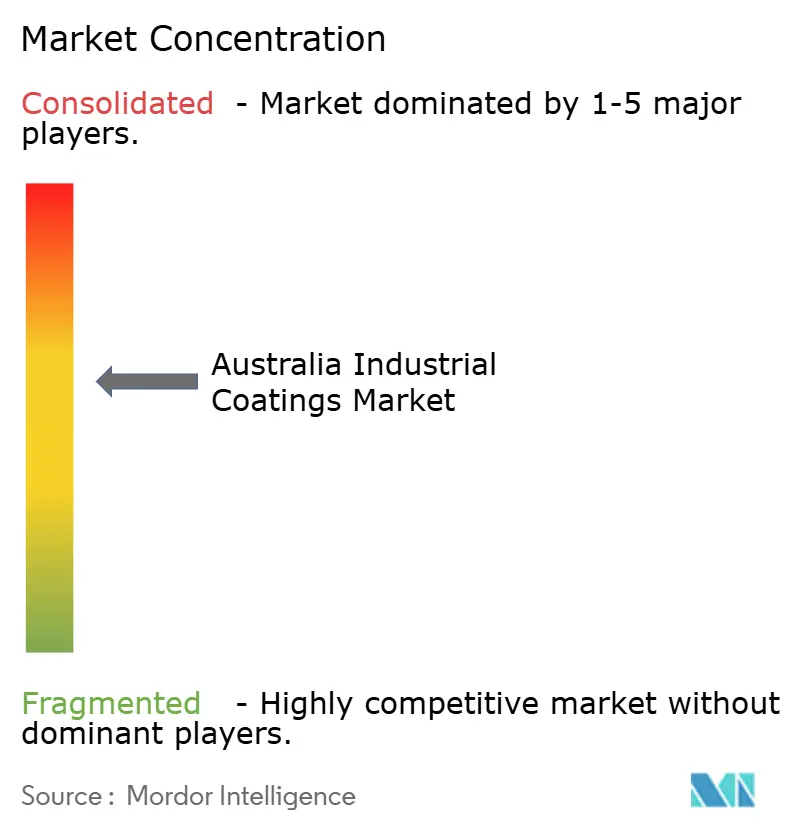
| Market Concentration | Medium |
Major Players *Disclaimer: Major Players sorted in no particular order Image © Mordor Intelligence. Reuse requires attribution under CC BY 4.0. | |
Australia Industrial Coatings Market Analysis by Mordor Intelligence
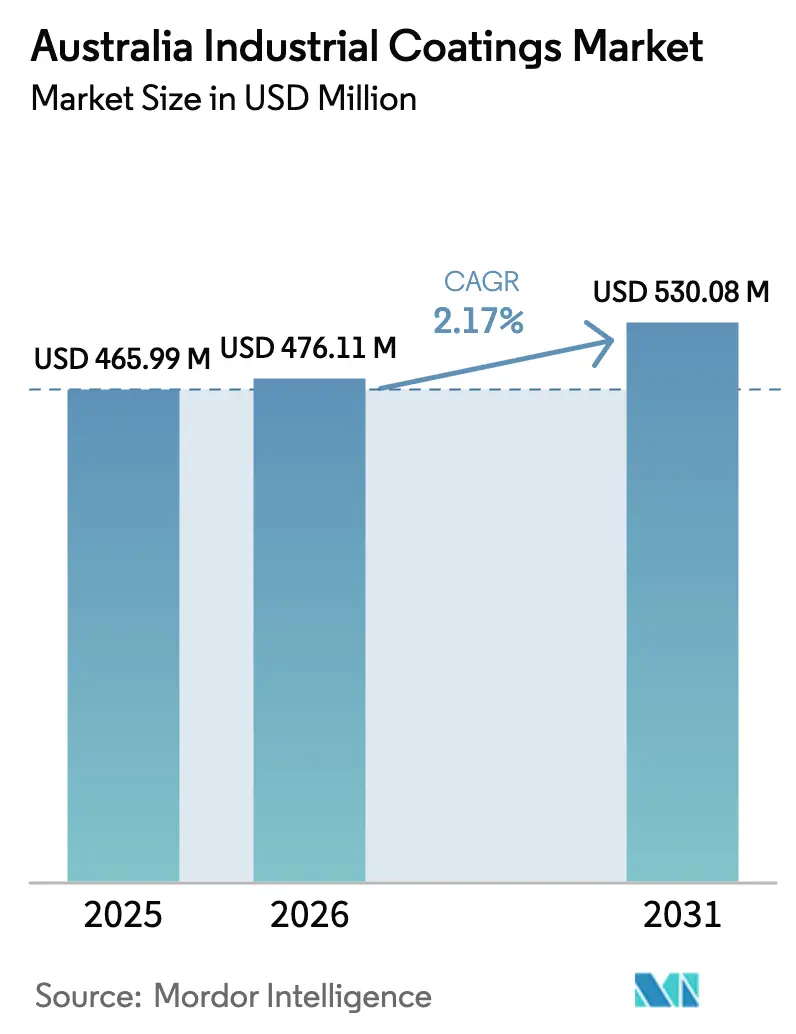
The Australia Industrial Coatings Market size was valued at USD 465.99 million in 2025 and estimated to grow from USD 476.11 million in 2026 to reach USD 530.08 million by 2031, at a CAGR of 2.17% during the forecast period (2026-2031). Sustained capital expenditure in mining, stricter emission regulations, and rising electrification of heavy equipment anchor this steady trajectory, while fragmentation among suppliers cushions cyclical swings in construction and manufacturing demand. Battery-electric haul trucks, autonomous mining vehicles, and offshore wind foundations now influence resin and pigment selection, prompting suppliers to adopt water-borne, high-solids, and powder technologies that reduce volatile organic compound emissions. Regulatory cost pressures from the Australian Industrial Chemicals Introduction Scheme are accelerating the adoption of lower-solvent chemistries; yet, solvent-borne systems remain entrenched in harsh resource environments where ultimate corrosion resistance is non-negotiable[1]. Import penetration from Asia intensifies price competition in commodity grades, but local distributors continue to prevail through fast turnaround and on-site technical support in remote mining hubs. White-space opportunities arise in battery housing, thermal management, and anti-fouling solutions for offshore renewables, signaling scope for differentiated offerings even as the overall Australia industrial coatings market matures.
Key Report Takeaways
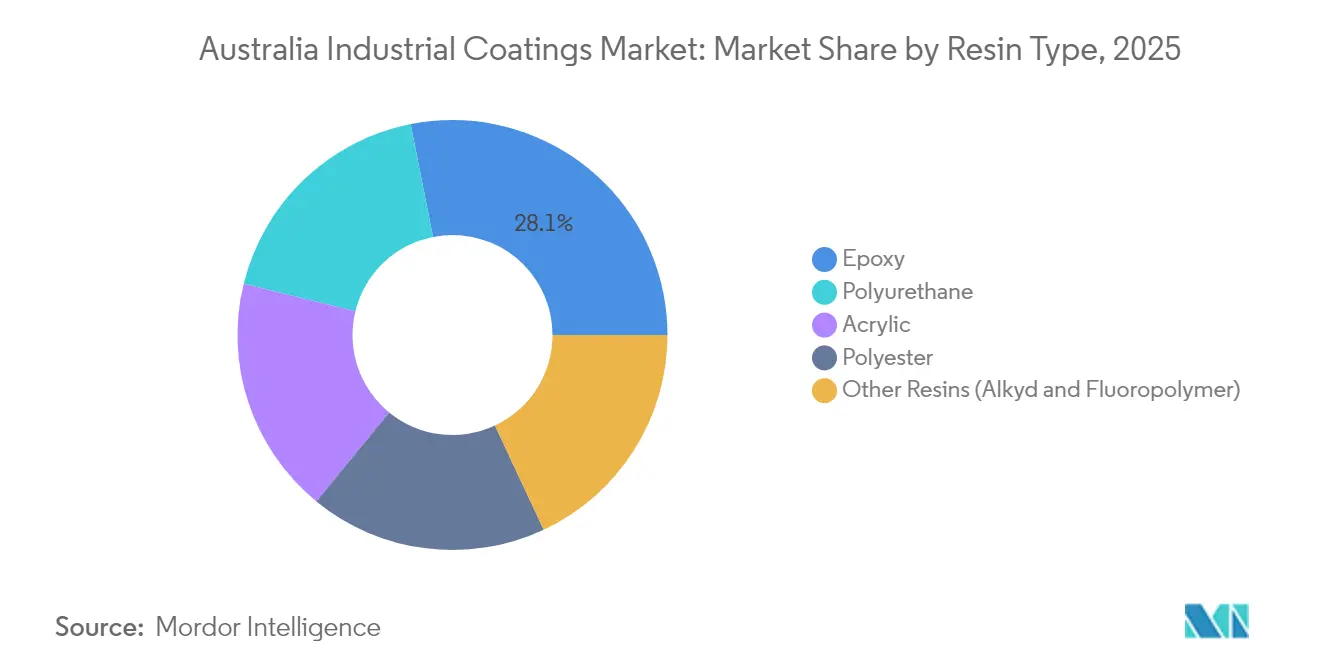
- By resin type, epoxy held 28.12% of the Australia industrial coatings market share in 2025, while polyurethane recorded the highest projected CAGR at 2.66% through 2031.
- By technology, solvent-borne systems led with a 33.85% revenue share in 2025, whereas water-borne coatings are forecast to grow at the fastest rate, with a 2.78% CAGR, to 2031.
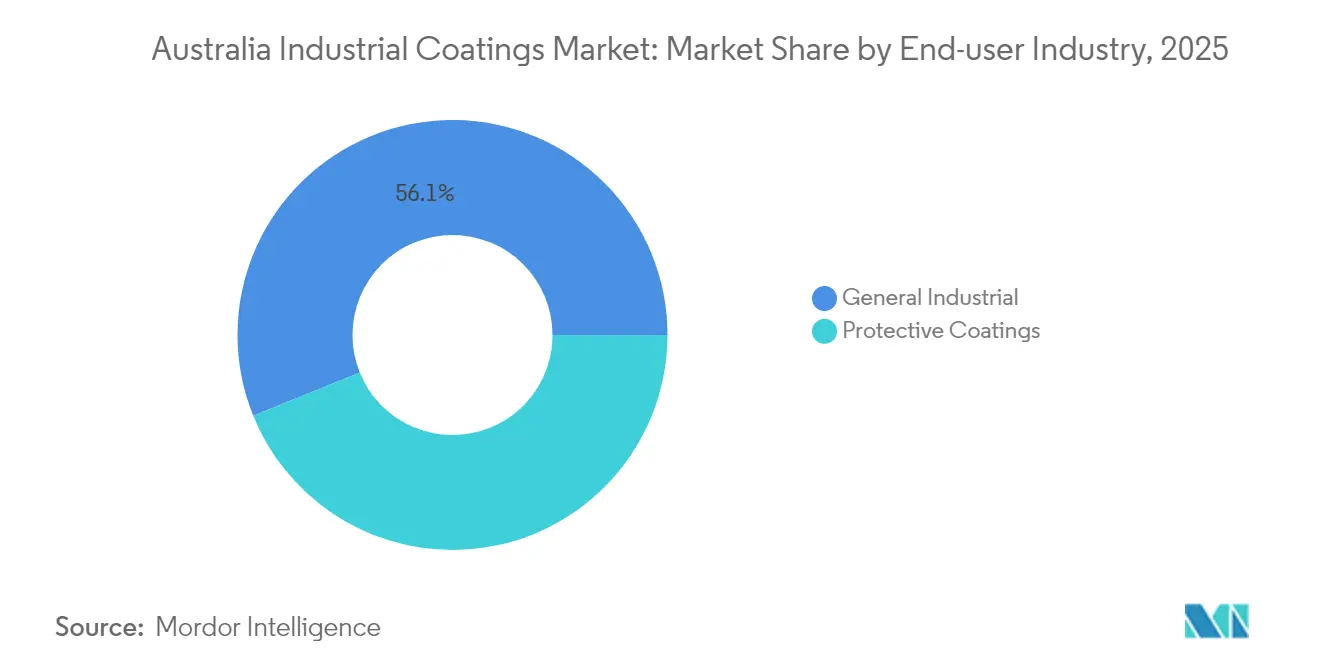
- By end-user industry, general industrial applications captured 56.12% of the Australia industrial coatings market share in 2025 and are projected to grow at a 2.36% CAGR through 2031.
Note: Market size and forecast figures in this report are generated using Mordor Intelligence’s proprietary estimation framework, updated with the latest available data and insights as of 2026.
Australia Industrial Coatings Market Trends and Insights
Drivers Impact Analysis*
| Driver | (~) % Impact on CAGR Forecast | Geographic Relevance | Impact Timeline |
|---|---|---|---|
| Shift to low-/zero-VOC technologies | +0.4% | National, with early adoption in NSW, VIC metropolitan areas | Medium term (2-4 years) |
| Renewed mining CAPEX cycle | +0.6% | WA, QLD mining regions, with spillover to SA | Short term (≤ 2 years) |
| Infrastructure stimulus (Roads, Rail, Defence) | +0.5% | National, concentrated in defense manufacturing hubs | Medium term (2-4 years) |
| Fleet electrification raising OEM paint volumes | +0.3% | Mining regions WA, QLD, urban transport corridors | Long term (≥ 4 years) |
| Growth of on-site powder-coating jobbers | +0.2% | Regional Australia, mining service centers | Short term (≤ 2 years) |
| B2B e-commerce platforms accelerating small-lot sales | +0.2% | National, strongest in regional markets | Short term (≤ 2 years) |
| Source: Mordor Intelligence | |||
Shift to Low-/Zero-VOC Technologies
Regulatory fees tied to solvent volume under the Australian Industrial Chemicals Introduction Scheme tilt cost structures toward water-borne and high-solids chemistries. Mining companies now specify water-borne systems for underground gear to minimize ventilation loads and worker exposure. Corporate sustainability mandates from major companies such as Rio Tinto and BHP cascade to suppliers, compelling them to disclose solvent-reduction roadmaps. Recent polymer advances enable water-borne epoxies to approach the durability of solvent-borne epoxies, easing specification hurdles for splash-zone, chemical-process, and high-temperature applications. As a result, low-VOC formulations are gaining market share, even where Australia’s severe climate once favored high-solvent blends, positioning waterborne chemistries for sustained uptake despite lingering performance gaps in extreme heat.
Renewed Mining CAPEX Cycle
An investment pipeline exceeding USD 22 billion through 2026 spans lithium, rare earths, and critical minerals projects across Western Australia and Queensland. Battery-electric haul trucks need thermally conductive and dielectric coatings, creating premium niches for formulation specialists. Autonomous operations push demand for sensor-compatible coatings that maintain reflectivity and cleanliness under continuous lidar scanning. Mining operators seek longer-life protective systems to limit maintenance-related emissions, enhancing the value proposition for next-generation hybrids such as glass-flake epoxies. Regional applicators leverage proximity and rapid deployment to secure refurbishment projects, while multinational suppliers focus on factory-applied systems for new-build equipment. The combination of volume growth and specification complexity underpins robust demand for coatings through the forecast period.
Infrastructure Stimulus (Roads, Rail, Defence)
Federal transport upgrades, naval shipbuilding, and land-based defence programs collectively allocate USD 17-22 billion to coated steel, composite, and concrete assets[2]. Ship hulls built in South Australia require marine coatings with 25-year maintenance cycles and robust anti-fouling performance. Metro rail modernisation drives sales of graffiti-resistant polyurethanes that retain gloss under ultraviolet exposure. Defence localisation goals favor Australian suppliers that can document secure supply chains, prompting global brands to forge joint ventures or licensing deals with domestic partners. These multiyear programs offer demand predictability and enable plant capacity investments beyond day-to-day maintenance work. Consequently, infrastructure remains a stabilising force for the Australia industrial coatings market during commodity downturns.
Fleet Electrification Raising OEM Paint Volumes
Electric buses, trucks, and mining vehicles expand the surface area, complexity, and functional requirements of OEM coatings. Battery enclosures require flame-retardant and heat-dissipating finishes that endure thermal cycling and resist electrolyte spills. Charging stations and cabling hardware require UV-stable, abrasion-resistant powders that complement urban design aesthetics. In mining, explosion-proof coatings meet stringent safety rules for underground battery equipment. These applications command premium pricing and encourage long-term technology partnerships between coaters and equipment makers. As fleet electrification accelerates toward 2030, functional coatings specific to electrical powertrain architecture are set to form a distinct high-growth pocket within the wider Australia industrial coatings market.
Restraints Impact Analysis*
| Restraint | (~) % Impact on CAGR Forecast | Geographic Relevance | Impact Timeline |
|---|---|---|---|
| Solvent-borne VOC compliance costs rise | -0.3% | National, strongest impact in urban areas | Short term (≤ 2 years) |
| Skilled applicator shortage in remote regions | -0.2% | WA, QLD, NT mining regions | Medium term (2-4 years) |
| Epoxy raw-material price volatility | -0.4% | National, supply chain dependent | Short term (≤ 2 years) |
| Import penetration from low-cost Asian suppliers | -0.3% | National, strongest in commodity segments | Medium term (2-4 years) |
| Source: Mordor Intelligence | |||
Solvent-Borne VOC Compliance Costs Rise
Fee increases of 3.1% for 2024-25, under the cost-recovery framework, raise the total bill for solvent-based imports and force distributors to revisit their pricing models. Small batch specialty suppliers struggle to absorb or pass through higher overheads, heightening consolidation risk and reducing customer choice in niche formulations. Urban projects already face local air-quality limits that restrict solvent emissions during application, prompting a shift toward water-borne options despite performance concerns. Compliance paperwork for classification, record-keeping, and annual reporting diverts technical staff time away from product development. Collectively, these costs and resource burdens erode the competitiveness of traditional solvent-borne portfolios in the Australian industrial coatings market.
Skilled Applicator Shortage in Remote Regions
Mining expansions in the Pilbara and Bowen Basin outpace the availability of certified coating professionals, driving up labor premiums and extending project schedules. Fly-in-fly-out crews fill gaps but raise travel and accommodation costs, squeezing margins for maintenance contractors. Government workforce strategy papers classify industrial coating application as a priority skill, yet training capacity remains insufficient to meet near-term demand. Delays in routine maintenance and refurbishment elevate the risk of corrosion, forcing operators to allocate contingencies for unplanned outages. Although advances in spray robotics and drone-applied touch-ups offer partial relief, the human resource bottleneck persists as a structural restraint on growth across remote nodes of the Australia industrial coatings market.
*Our forecasts treat driver/restraint impacts as directional, not additive. The impact forecasts reflect baseline growth, mix effects, and variable interactions.
Segment Analysis
By Resin Type: Epoxy Dominance Reflects Harsh Environment Demands
Epoxy systems captured 28.12% of Australia industrial coatings market share in 2025, a position underpinned by their proven chemical resistance on mine site assets and coastal infrastructure. The breadth of epoxy chemistries enables formulators to tailor barrier properties against sulfuric acid, brine, and hydrocarbon exposure, thereby minimizing downtime in heavy-duty service. Polyurethane resins, although currently smaller in volume, are advancing at a 2.66% CAGR due to their flexibility and UV stability, which are essential for equipment that cycles between scorching daytime heat and cooler nights. Acrylics continue to cater to lower-demand shop primers and architectural elements where cost discipline prevails, while polyester powders dominate white-goods and outdoor furniture lines produced in Victoria and New South Wales.
A wave of bio-based epoxy initiatives has emerged as suppliers target reductions in Scope 3 emissions. BASF’s launch of a bio-derived ethyl acrylate feedstock provides formulators with a renewable pathway that does not compromise mechanical performance. Downstream, mining majors are piloting graphene-enhanced epoxy topcoats that increase abrasion resistance and reduce film thickness without compromising longevity. Raw-material volatility for bisphenol A and epichlorohydrin remains a profit headwind, encouraging supply-chain diversification toward southeast Asian intermediates. Consequently, the resin landscape balances entrenched epoxy demand with innovation-led growth segments, reinforcing steady value expansion across the Australia industrial coatings market.

By Technology: Solvent-Borne Resilience Despite Environmental Pressure
Solvent-borne systems maintained a 33.85% revenue lead in 2025, illustrating the enduring preference for tried-and-tested performance in cyclone-prone, abrasive contexts. High-solid alkyds and polyurethanes enable thicker films per pass, reducing application time on towering dump trucks and process tanks. That said, water-borne chemistries post the fastest gains at 2.78% CAGR to 2031, aided by regulatory fees linked to solvent tonnage and cleaner-air commitments from tier-one miners. Powder coatings are gaining momentum in regional job shops, where overspray capture and energy-efficient infrared ovens help equalize piece-part costs against liquid lines. Other technologies, notably UV-cured topcoats, find footholds in electronics enclosures that require rapid turnaround and minimal footprint.
The compliance fee logic of the Industrial Chemicals Introduction Scheme exacerbates the total cost gap between solvent-borne and low-VOC systems, thereby reinforcing water-borne uptake in each budget cycle. Underground mining specifications now embed solvent-content limits to trim ventilation horsepower, a hidden but significant operating expense in deep orebodies. Meanwhile, powder coaters near Kalgoorlie and Mackay extend booth footprints to handle larger drivetrain components previously shipped to Perth or Brisbane, tightening local supply loops and embedding service proximity as a strategic moat. This technology mix underscores a dual-track dynamic where solvent-borne robustness coexists with compliance-driven migration to cleaner formats within the Australia industrial coatings market.
By End-user Industry: General Industrial Leadership Masks Protective Coating Opportunities
General industrial customers collectively generated 56.12% of Australia industrial coatings market revenue in 2025 and will grow 2.36% annually through 2031, bolstered by machinery refurbishments, fabricated metal exports, and modular equipment builds. OEMs value one-coat direct-to-metal systems that reduce booth cycles, resulting in polyaspartic hybrids that achieve hardness and gloss targets in half the cure time. Appliance makers in Melbourne and Adelaide are upgrading to low-energy polyester powders that align with state decarbonisation roadmaps. Concurrently, the protective subsegment gains strategic significance as rail, bridge, and LNG assets demand coating lifetimes of 20 years or more, underpinning demand for glass-flake epoxies and zinc-rich primers.
Marine and offshore wind installations tip the balance toward premium multi-layer protective stacks designed for 25-year life with minimal dry-dock intervals. Onshore wind towers near Port Augusta feature fluoropolymer topcoats that protect against ultraviolet degradation, while solar farms in the Riverina region utilize anti-soiling silicones to minimize cleaning cycles. Defence land platforms seek chemical-agent-resistant coatings, carving out specialised runs for low-observable polyurethanes. These high-value niches, though smaller in tonnage, yield above-average margins and anchor R&D partnerships, reinforcing the role of protective finishes as the emergent growth engine inside the broader Australia industrial coatings market size dialogue.
Geography Analysis
Western Australia and Queensland remain the twin pillars of demand, thanks to their dense clusters of iron ore, gold, coal, and critical mineral operations. Nearby job shops in Karratha and Newman apply quick-turn epoxies, capturing value that once flowed to metro applicators. Queensland’s Bowen Basin follows, driven by coal handling and the ramp-up of graphite and vanadium projects that call for high-temperature pipeline linings and battery enclosure coatings optimized for thermal diffusion.
New South Wales retains a diverse demand base, blending fabricated metal exports, rail rolling-stock refurbishments, and building interiors upgraded to low-VOC standards. Victoria contributes a steady volume through appliance powders, packaging coatings, and a resurging aftermarket for commercial vehicle refinishing, aligned with metropolitan fleet electrification policies. South Australia’s defence corridor around Adelaide and Whyalla deepens its appetite for solvent-free marine primers specified by the continuous-build frigate program, while adjacent wind farm projects keep demand for weather-resistant polyurethanes on an upward slope. Collectively, these zones illustrate the geographic mosaic that defines the Australia industrial coatings market.
Remote Northern Territory gas plants and emerging Tasmanian critical-minerals hubs add diversity, though their share remains modest. Logistical remoteness makes local warehousing and rapid dispatch essential, pushing distributors to hold multi-week inventory buffers despite working-capital implications. B2B e-commerce platforms close distance gaps, with independent suppliers listing thousands of SKUs and same-day dispatch for consumables under 25 kilograms, unlocking incremental penetration in sparsely populated regions. As a result, while consumption is geographic-ally concentrated, demand growth pockets appear wherever resource, defence, or infrastructure projects ignite, reinforcing the fragmented yet opportunity-rich profile of the Australia industrial coatings market.
Regulatory Landscape
Australia regulates industrial coating chemistries primarily through the Australian Industrial Chemicals Introduction Scheme (AICIS), established under the Industrial Chemicals Act 2019. It governs industrial chemical import and manufacture via categorization and reporting obligations (for example, exempted, reported, and assessed introductions). The AICIS cost-recovery approach, referenced in the report context through the 2024-25 fee update, reinforces compliance costs for solvent-heavy portfolios and increases the administrative burden around record-keeping and annual reporting for formulators and distributors.
Environmental and health controls also shape formulation choices. The Industrial Chemicals Environmental Management (Register) Instrument 2022 and the IChEMS minimum standards provide a national reference point that Commonwealth, state, and territory environmental regulators apply when managing chemical risks across industrial uses. In parallel, the Uniform Paint Standard restricts certain lead compounds in surface coatings, tightening allowable chemistries for specific applications and pushing suppliers to maintain compliant pigment and additive selections across general industrial and protective coating systems.
Value Chain Analysis
The value chain starts with upstream feedstocks, including resins (epoxy, polyurethane, acrylic, polyester), pigments, solvents, and performance additives. Australia relies on a mix of domestic manufacturing and significant imports for higher-volume products and specialized chemistries. Formulation and manufacturing involve dispersion and compounding for liquid coatings, and steps such as extrusion, grinding, and classification for powder coatings, followed by quality control and packaging into product formats used by OEM lines, maintenance contractors, and site-applied protective systems.
Downstream, distributors and applicators take on an outsized role because demand is geographically dispersed and often remote, notably mining regions. Local inventory, tinting, and field technical support are critical to winning refurbishment and shutdown work. Manufacturing and warehousing activity is concentrated around major hubs in New South Wales, Victoria, and Queensland, while key local operating platforms include DuluxGroup (Nippon Paint Holdings) and Wattyl (Hempel). End users include general industrial OEMs and job shops, plus protective-coating buyers in mining, infrastructure, and marine environments, where specification compliance and application capability can be as decisive as product price.
Competitive Landscape
The Australia Industrial Coatings Market is moderately consolidated. International multinationals, including PPG, AkzoNobel, Jotun, and Sherwin-Williams, account for a significant market share. These firms leverage global R&D and broad portfolios, but geographic spread and specialized performance requirements keep regional independents relevant. Domestic suppliers differentiate themselves through field service, faster color matching, and a nimble response to rush orders in mining camps, thereby mitigating the pricing leverage of imported commodity grades. Digital ordering platforms accelerate small-lot transactions, eroding the historical advantage large distributors held in order aggregation.
Australia Industrial Coatings Industry Leaders
-
The Sherwin-Williams Company
-
Akzo Nobel N.V.
-
PPG Industries, Inc.
-
Nippon Paint Holdings Co., Ltd.
-
Jotun
- *Disclaimer: Major Players sorted in no particular order
Market Opportunities and Future Outlook
Compliance-driven migration toward lower-VOC systems keeps creating whitespace for water-borne, high-solids, and powder technologies that reduce solvent handling and reporting overhead under AICIS, while aligning with tightening chemical controls, including IChEMS-aligned expectations. A practical commercialization signal already appears in AkzoNobel making graphene-enhanced Interzone 954 protective coating available in Australia using ecosparc, which shows premium protective performance upgrades being productized locally rather than staying limited to pilots. Specification-led pull-through is also strengthening through digital channels, with AkzoNobel Interpon becoming a NATSPEC product partner in 2026, potentially shortening the path from compliance requirements to specified powder-coating selections across industrial and adjacent project work.
Functional and asset-life-extension niches also map directly to the report’s demand drivers, including mining CAPEX, electrification-linked requirements (battery enclosures, thermal management, and dielectric needs), and long-life protective stacks for infrastructure and marine assets. Suppliers that pair product performance with on-site support and rapid delivery in Western Australia and Queensland service corridors can win more refurbishment and shutdown cycles. Differentiated offerings, such as abrasion-resistant epoxies, edge-protection powders, and corrosion systems designed around longer maintenance intervals, align with buyer goals to reduce downtime and total coating system cost in harsh operating environments.
Recent Industry Developments
- July 2026: Sherwin-Williams completed its acquisition of New Zealand-based DBNZ to strengthen its position in the automotive refinish market across Australia and New Zealand. The acquisition broadens its coatings portfolio across ANZ and expands the regional footprint.
- July 2026: PPG Industries Australia achieved Global GreenTag GreenRate Level A certification for Taubmans Pure Performance and water-based enamel products. The certification supports product credibility and broadens specification opportunities in the Australian coatings market.
- July 2026: Sherwin-Williams commenced a new partnership with Paragon Filling to support protective and marine coatings in the ANZ market. The collaboration expands service capability and extends reach in high-margin protection segments.
Research Methodology Framework and Report Scope
Market Definition and Coverage
This market covers industrial coatings consumed in Australia for protecting and finishing industrial assets and components. Demand is tied to manufacturing activity and maintenance cycles in key end use industries.
Scope exclusions: Decorative architectural paints, purely automotive refinish coatings, and retail DIY coating sales are excluded from this sizing.
Segmentation Overview
- By Resin Type
- Epoxy
- Polyurethane
- Acrylic
- Polyester
- Other Resins (Alkyd, Fluoropolymer)
- By Technology
- Water-borne
- Solvent-borne
- Powder Coatings
- Other Technologies (UV-/EB-Cured and High Solids)
- By End-user Industry
- General Industrial
- Protective Coatings
- Oil and Gas
- Power Generation
- Infrastructure
- Mining
- Other Protective Coatings
Data Sources, Market Sizing, and Validation
Desk Research
Desk research helped us set the demand context and keep assumptions anchored to observable industrial activity. We used public statistics and industry references such as the Australian Bureau of Statistics (manufacturing output and construction work done), Australian Customs trade data for coating related imports and exports, and safety or chemical handling references from Safe Work Australia.
To avoid modeling in a vacuum, we also reviewed standards and sector references such as ASTM and ISO coating test standards (to align typical product performance requirements with end use needs), plus peer reviewed corrosion and materials journals that discuss durability and recoat intervals in marine and industrial environments. Company annual reports, investor presentations, and reputable business press were used to understand pricing actions, capacity announcements, and mix shifts. Paid subscriptions were used selectively for company financials and intelligence, patent look ups, and shipment level trade checks where labels and codes were clear. These are illustrative sources only, and many other public references were also used for data collection, validation, and research clarification.
Primary Interviews and Surveys
Our Australia fieldwork includes expert interviews and surveys with CXOs, functional and unit leaders, managers, coating suppliers, distributors, applicators, and industrial buyers. Respondents help test secondary data and clarify resin, technology, end-use, pricing, and channel assumptions within the Australian market. Their input is also used to adjust the final model, while unusual answers are rechecked before inclusion in the estimate.
Distribution of primary research fieldwork respondents
| Company type | Respondent position |
|---|---|
| Top tier: 30% | CXOs: 15% |
| Mid tier: 45% | Functional/Unit leaders: 30% |
| Smaller Players: 25% | Managers: 55% |
Market-Sizing & Forecasting
Sizing starts with a top-down reconstruction of Australia demand, where manufacturing output and industrial maintenance activity are translated into coating consumption, then valued using realistic price bands. To keep the totals grounded, we ran selective bottom-up checks using supplier revenue exposure to Australia, channel discussions on volumes, and sampled average selling price assumptions for major coating families.
Inputs that mattered most included manufacturing production indices, infrastructure and industrial construction work done, import and export flows for coating related categories, typical dry film thickness and coverage rates by application, and repaint or recoat intervals in harsh environments (especially marine and heavy industry). Where data was incomplete, gaps were handled using conservative proxy ratios from adjacent industrial categories and then adjusted only after interview feedback aligned on direction and magnitude.
For forecasting, we used scenario analysis tied to forward indicators like public infrastructure pipelines, manufacturing sentiment, and expected maintenance schedules, then blended these views into the base case. Price progression was treated separately from volume, using a mix of raw material pass through expectations and channel feedback so growth is not overstated in inflationary periods.
Data Validation & Update Cycle
Model outputs were checked against independent signals, including trade movement direction, major project timing, and whether implied consumption per end use looked reasonable against known application norms. When large variances appeared, we reviewed assumptions step by step, and triggered follow up calls to recheck the specific driver instead of rewriting the whole model.
Before sign off, a second analyst review is completed to confirm math, units, and year alignment. We then run a final consistency pass across sections so the narrative matches the numbers. Reports are refreshed annually, and interim updates are made when material events occur, such as major capacity shifts, regulatory changes, or sharp pricing moves. Right before delivery, we do a fresh pass so clients receive the latest updated view.
Mordor Intelligence's Australia Industrial Coatings Market Size Compared With Other Published Estimates
Published market sizes for Australia industrial coatings can look far apart because scope is not always the same, and the value build often mixes pricing effects with true volume change. Differences also come from how firms treat imports, contractor applied coatings, and the year used for currency conversion.
The main gap comes from whether estimates fold decorative building paints and broader paint manufacturing revenue into the same total, while Mordor Intelligence counts only industrial coating demand tied to industrial end uses and validates it with trade checks and realistic coverage and recoat assumptions.
Benchmark comparison
| Source | Market Size | Gaps in Research Methodology |
|---|---|---|
| Mordor Intelligence | USD 465.99 M (2025) | |
| Industry Research Publisher A | USD 992.48 M (2024) | Often uses a wider definition that can blend industrial coatings with broader paint categories, and may apply a single year value without separating price inflation from volume movement. |
| Industry Report Publisher B | USD 865.50 M (2024) | Can rely more on high level revenue mapping and aggressive end use expansion assumptions, with limited adjustment for Australia specific maintenance cycles and import mix timing. |
The spread in the table is mostly explained by scope and by how pricing is handled year to year, rather than a true disagreement on industrial activity direction. By keeping inclusions tight and checking the demand math against practical consumption drivers, the estimate stays traceable to inputs a reader can understand and challenge.
Key Questions Answered in the Report
How big is the Australia industrial coatings market in 2026?
The Australia industrial coatings market size reached USD 476.11 million in 2026 and is set to grow to USD 530.08 million by 2031.
Which resin type leads sales in Australia?
Epoxy resins lead, accounting for 28.12% of Australia industrial coatings market share in 2025 due to strong chemical and corrosion resistance.
What technology is growing fastest?
Water-borne formulations post the highest growth at a 2.78% CAGR through 2031 as fees linked to solvent content push users toward low-VOC options.
Which industries drive demand?
General industrial manufacturers represent the largest end-user block at 56.12% of revenue, with mining and infrastructure projects providing steady volume.
Why does geography matter in supply strategy?
Remote mine sites in Western Australia and Queensland rely on nearby applicators and distributors for rapid turnaround, shaping regional service models in the Australia industrial coatings market.