Market Overview
| Study Period | 2021 - 2031 |
|---|---|
| Forecast Data Period | 2026 - 2031 |
| Base Year Market Size (2025) | USD 67.34 Billion |
| Market Size (2026) | USD 74.94 Billion |
| Market Size (2031) | USD 127.85 Billion |
| Growth Rate (2026 - 2031) | 11.29 % |
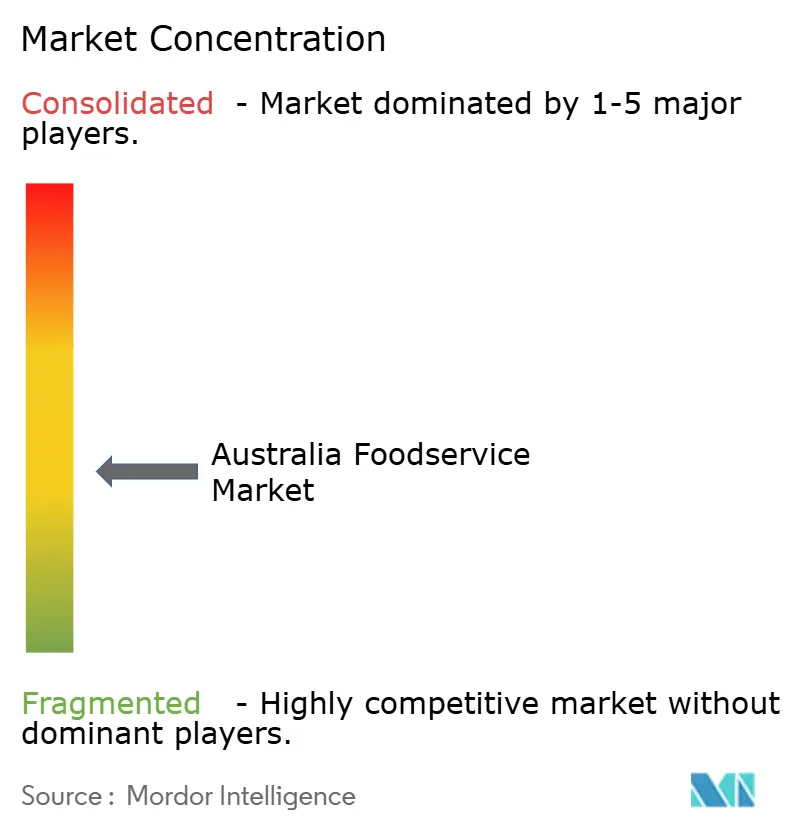
| Market Concentration | Medium |
Major Players
*Disclaimer: Major Players sorted in no particular order Image © Mordor Intelligence. Reuse requires attribution under CC BY 4.0. |
|
Australia Foodservice Market Analysis by Mordor Intelligence
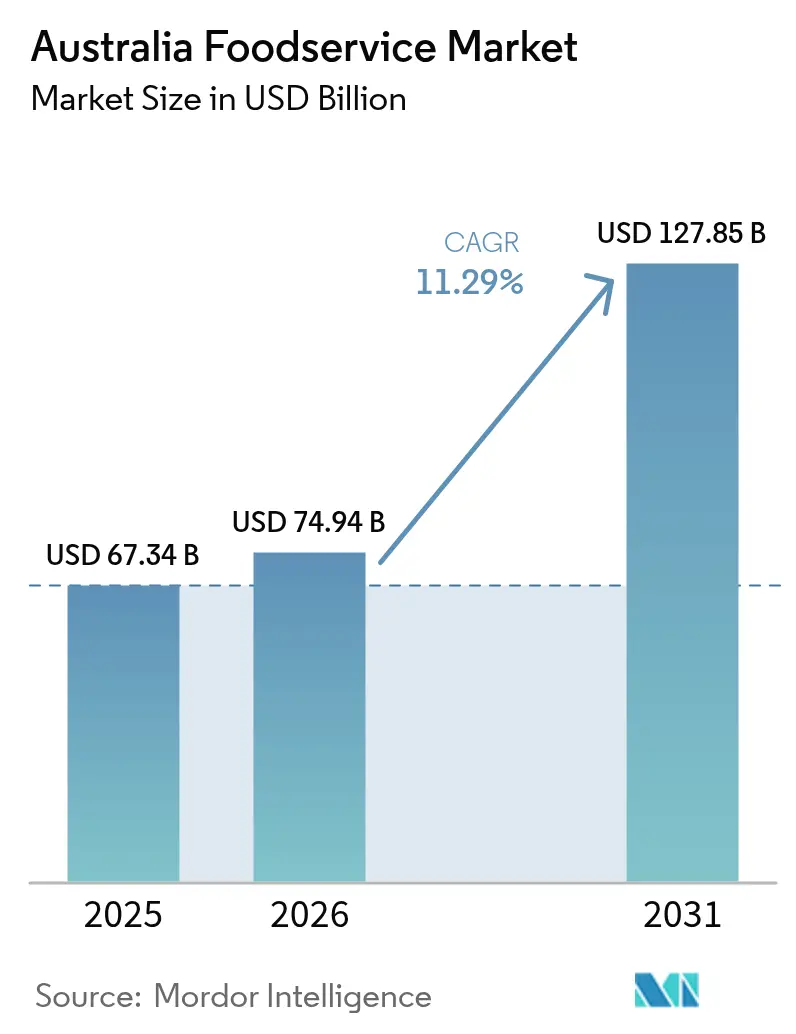
Australia's foodservice market size in 2026 is estimated at USD 74.94 billion, growing from 2025 value of USD 67.34 billion with 2031 projections showing USD 127.85 billion, growing at 11.29% CAGR over 2026-2031. This growth trajectory reflects the sector's resilience amid evolving consumer preferences and the strategic pivot toward convenience-driven dining formats. The sector benefits from Australia's tourism recovery, with domestic tourism reaching a peak of pre-COVID levels, while international visitor flows remain below historical peaks, creating asymmetric demand patterns across metropolitan and regional markets. Labor market constraints, including over 200,000 hospitality vacancies and 4.2% wage inflation, are prompting automation investments and efficiency initiatives across segments, while rising digital ordering penetration, menu localization, and automation support growth even as energy costs and compliance obligations compress margins [1]Source: Australian Government, “Food and Grocery Code of Conduct Review 2023–24”, treasury.gov.au. Rising digital ordering penetration, menu localization, and automation investments underpin growth while energy costs and compliance obligations compress margins. Operators that integrate data-centric supply chains and agile service formats gain pricing power and expansion flexibility, accelerating capital inflows into the Quick Service Restaurants market. Competitive intensity remains moderate, with consolidation pressure creating white-space opportunities for well-positioned mid-tier players.
Key Report Takeaways
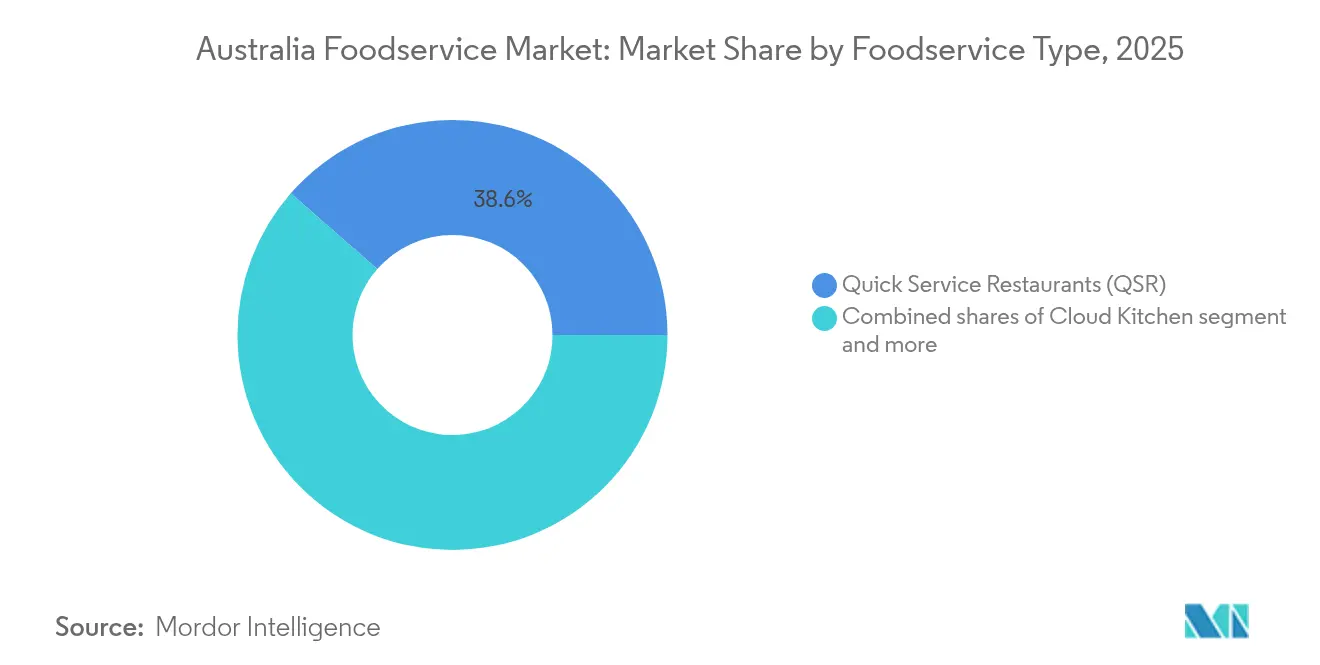
- By foodservice type, Quick Service Restaurants led with a 38.55%, and Cloud Kitchen is forecast to expand at a 12.25% CAGR through 2031, the fastest among all foodservice formats.
- By outlet, independent operators captured a 65.60% share in 2025, while chained outlets posted the highest growth trajectory at 11.56% CAGR.
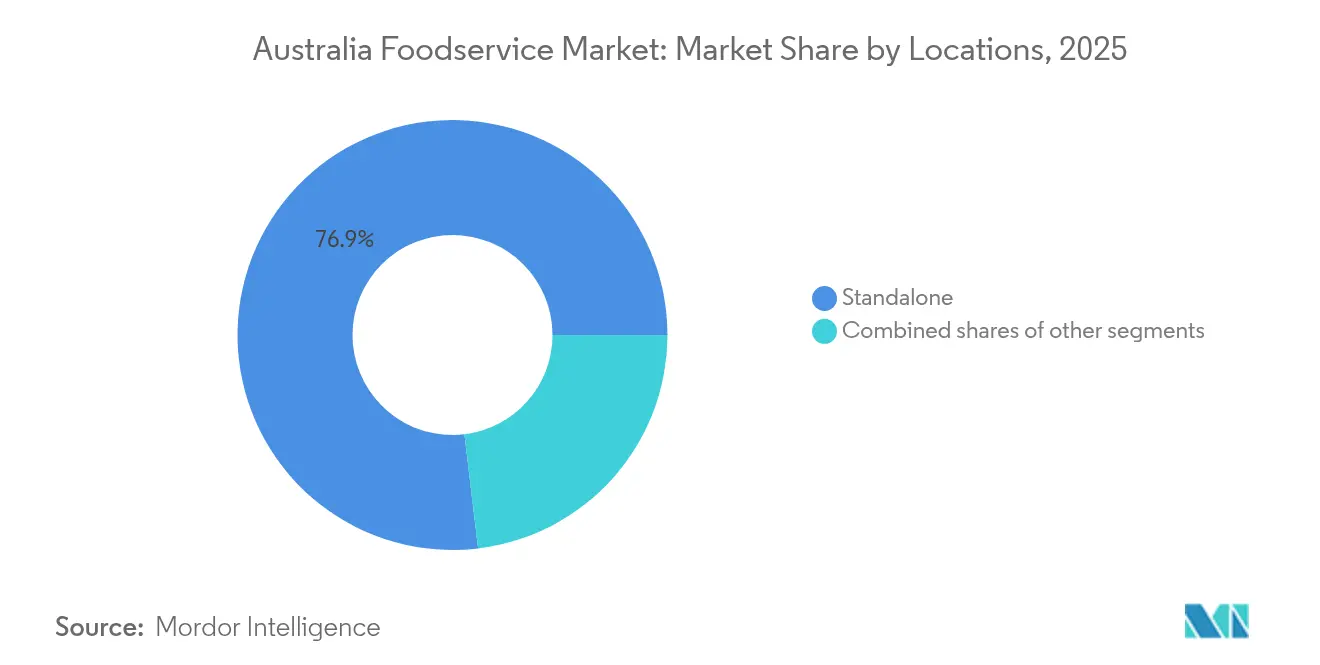
- By location, standalone restaurants accounted for 76.90% of the Quick Service Restaurants market size in 2025 and are advancing at a 12.41% CAGR through 2031.
- By service type, dine-in retained 46.05% share of the Quick Service Restaurants market size in 2025; takeaway records the strongest momentum at 11.89% CAGR.
Note: Market size and forecast figures in this report are generated using Mordor Intelligence’s proprietary estimation framework, updated with the latest available data and insights as of 2026.
Australia Foodservice Market Trends and Insights
Drivers Impact Analysis*
| Driver | (~) % Impact on CAGR Forecast | Geographic Relevance | Impact Timeline |
|---|---|---|---|
| Acceleration of branded café formats and specialty coffee-chain rollout | +2.1% | National, with concentration in Sydney, Melbourne, Brisbane | Medium term (2-4 years) |
| Progressive localization of menus by international operators | +1.8% | National, with early adoption in multicultural urban centers | Short term (≤ 2 years) |
| Entrenched dine-out habits supported by socializing-driven consumption | +1.5% | National, stronger in metropolitan areas | Long term (≥ 4 years) |
| Rapid scale-up of dark-kitchen and delivery-only operating models | +2.3% | Metropolitan areas, expanding to suburban corridors | Short term (≤ 2 years) |
| Growing prominence of halal-compliant positioning in brand architecture | +1.2% | National, concentrated in diverse metropolitan areas | Medium term (2-4 years) |
| High penetration and fluency of mobile-app-based ordering behavior | +1.9% | National, with higher adoption in urban demographics | Short term (≤ 2 years) |
| Source: Mordor Intelligence | |||


Acceleration of Branded Café Formats and Specialty Coffee-Chain Rollout
The proliferation of specialty coffee chains represents a strategic response to Australia's sophisticated coffee culture, with operators like Zarraffa's Coffee expanding through franchise partnerships and Urban Baristas targeting premium positioning in metropolitan markets. This trend capitalizes on consumer willingness to pay premiums for artisanal experiences, with specialty coffee commanding 15-20% higher margins than traditional QSR beverages. International entrants such as Kopi Kenangan's Australian debut signal intensifying competition for market share in the premium coffee segment. The rollout acceleration is supported by favorable lease terms in mixed-use developments and shopping centers seeking to enhance tenant mix diversity. Local coffee chains are responding by investing heavily in barista training programs and sourcing premium single-origin beans to maintain their competitive edge.
Progressive Localization of Menus by International Operators
International QSR chains are adapting menu offerings to Australian palates and cultural preferences, exemplified by McDonald's introduction of the Steakhouse Stack featuring Australian beef and Jack cheese, demonstrating strategic localization beyond generic global offerings. This adaptation strategy addresses consumer preferences for locally-sourced ingredients while maintaining brand consistency and operational efficiency. The localization trend extends to portion sizing, flavor profiles, and seasonal menu rotations that align with Australian agricultural cycles and cultural celebrations. Successful localization requires sophisticated supply chain partnerships with Australian producers and distributors, creating competitive moats for operators who establish these relationships early. The strategy proves particularly effective in multicultural urban centers where diverse consumer bases demand authentic flavors alongside familiar international brands.
Entrenched Dine-Out Habits Supported by Socializing-Driven Consumption
Australian consumers maintain strong social dining preferences despite economic pressures, with Gen Z leading the rebound through AUD 5.8 billion in foodservice spending, representing 11% of total traffic. This demographic shift reflects evolving social behaviors where dining experiences serve as primary social interaction venues, particularly in suburban markets where 40% of consumers visit CBD locations less than once monthly. The trend supports premium pricing strategies for experiential dining formats while creating opportunities for community-focused restaurant concepts. Social media integration and Instagram-worthy presentations have become essential components of successful restaurant positioning, driving both initial trial and repeat visitation patterns. The socializing imperative creates natural resistance to pure delivery models, supporting hybrid concepts that blend convenience with experiential elements.
Rapid Scale-Up of Dark-Kitchen and Delivery-Only Operating Models
Cloud kitchen operations are transforming foodservice economics through reduced real estate costs and enhanced delivery efficiency, with virtual brands enabling operators to test new concepts without traditional brick-and-mortar investments. The model particularly benefits from Australia's high delivery app penetration, with majority of consumers utilizing food delivery platforms and 67% preferring app-based ordering over direct restaurant contact. Dark kitchens enable rapid geographic expansion and menu diversification while maintaining centralized quality control and inventory management systems. The operational model proves especially effective in high-density urban areas where real estate costs exceed traditional restaurant viability thresholds. Technology integration through AI-driven inventory systems and automated kitchen equipment reduces labor requirements by up to 25%, addressing workforce shortage challenges while improving order accuracy and fulfillment speed.
Restraints Impact Analysis*
| Restraint | (~) % Impact on CAGR Forecast | Geographic Relevance | Impact Timeline |
|---|---|---|---|
| Heightened competitive pressure from independents and street-food operators | -1.4% | National, intensified in urban food precincts | Short term (≤ 2 years) |
| Variability in food-safety practices and hygiene compliance | -0.8% | National, with regional enforcement variations | Medium term (2-4 years) |
| Rapid imitation of concepts leading to differentiation fatigue | -1.1% | Metropolitan markets with high restaurant density | Medium term (2-4 years) |
| Reliability constraints in cold-chain and perishable logistics | -0.9% | National, acute in regional and remote areas | Long term (≥ 4 years) |
| Source: Mordor Intelligence | |||
Heightened Competitive Pressure from Independents and Street-Food Operators
Independent restaurants maintain majority dominance in the broader dining sector, creating intense competitive pressure through localized menu offerings, community connections, and operational flexibility that chain operators struggle to replicate. Street food and food truck operations have evolved beyond traditional casual formats, incorporating gourmet ingredients and sophisticated preparation techniques that challenge QSR value propositions. The competitive intensity is amplified by independent operators' ability to rapidly adjust pricing, menu offerings, and service formats in response to local market conditions and consumer preferences. Independent restaurants benefit from lower overhead structures and direct customer relationships that enable premium pricing for perceived authenticity and uniqueness. This competitive dynamic forces chain operators to invest heavily in differentiation strategies, local marketing, and community engagement initiatives that increase operational complexity and reduce standardization benefits [2]Source: Parliament of Australia, "Chapter 9 - Retail markets", aph.gov.au.
Variability in Food-Safety Practices and Hygiene Compliance
Inconsistent food safety standards across the fragmented foodservice landscape create consumer confidence challenges and regulatory compliance costs that disproportionately impact smaller operators and emerging concepts. FSANZ (Food Standards Australia New Zealand) regulatory framework updates, including new standards for berries, leafy vegetables, and melons, require significant operational adjustments and training investments across diverse operator categories. The compliance variability creates competitive advantages for well-capitalized chains with established quality assurance systems while creating barriers for independent operators and new market entrants. Food safety incidents can rapidly damage brand reputation and consumer trust, particularly in the age of social media amplification and online review platforms. The regulatory environment continues evolving with enhanced enforcement mechanisms and penalty structures that increase operational risk for non-compliant operators.
*Our forecasts treat driver/restraint impacts as directional, not additive. The impact forecasts reflect baseline growth, mix effects, and variable interactions.
Segment Analysis
By Foodservice Type: Cloud Kitchen Disrupts Traditional Models
Quick Service Restaurants command 38.55% market share in 2025, reflecting consumer preferences for speed, convenience, and value positioning that align with economic pressures and lifestyle demands. Cloud Kitchen operations, while representing a smaller current base, accelerate at 12.25% CAGR through 2031, demonstrating the transformative potential of delivery-optimized business models that eliminate traditional real estate constraints. Full-service restaurants face margin compression from labor costs and rent pressures, yet maintain relevance through experiential positioning and social dining occasions that cannot be replicated through delivery channels. The segmentation reveals a fundamental shift toward operational efficiency and convenience, with successful operators increasingly adopting hybrid models that combine physical presence with delivery optimization.
Cafés and Bars benefit from Australia's sophisticated coffee culture and social consumption patterns, particularly in metropolitan markets where specialty coffee commands premium pricing and drives high-frequency visitation. The emergence of automated vending solutions, including robotic coffee machines and cake dispensers, signals technology adoption that addresses labor shortages while extending service hours and geographic reach. Regulatory compliance under FSANZ (Food Standards Australia New Zealand) standards ensures consistent quality across diverse operational formats, while licensing requirements create barriers that protect established operators from casual market entry.


By Outlet: Independent Dominance Faces Chain Consolidation
Independent outlets maintain 65.60% market share in 2025, reflecting Australia's diverse culinary landscape and consumer preferences for authentic, locally connected dining experiences that resist homogenization. Chained outlets expand at 11.56% CAGR through 2031, driven by superior access to capital, operational efficiency, and brand recognition that enables rapid scaling and market penetration strategies. The dynamic creates a bifurcated market where successful independents focus on differentiation and community engagement while chains leverage standardization and economies of scale to achieve cost advantages. Technology adoption varies significantly between segments, with chains investing in integrated POS systems, loyalty programs, and delivery optimization while independents often rely on simpler operational approaches.
The franchise model emerges as a hybrid solution that combines brand recognition with local ownership, exemplified by successful concepts like Guzman y Gomez's expansion strategy that targets over 1,000 locations through franchise partnerships. Independent operators face increasing challenges from rising labor costs, regulatory compliance requirements, and supply chain complexity that favor larger, more sophisticated operations. The competitive landscape suggests continued consolidation pressure, yet consumer preferences for authenticity and local connection create sustainable niches for well-positioned independent concepts.
By Locations: Standalone Dominance Reflects Real Estate Strategy
Standalone locations capture 76.90% market share in 2025 while simultaneously driving the fastest growth at 12.41% CAGR through 2031, indicating successful operators' preference for controlled real estate strategies that maximize visibility and operational flexibility. Retail locations provide foot traffic advantages and shared marketing benefits, yet face higher occupancy costs and operational constraints that limit menu flexibility and service customization. Travel locations benefit from captive audiences and premium pricing opportunities, particularly in airports and major transport hubs where convenience commands significant price premiums. Lodging partnerships create steady revenue streams through hotel restaurants and room service operations, though these relationships require specialized operational capabilities and service standards.
Leisure locations, including shopping centers and entertainment precincts, offer high-traffic environments but face intense competition and seasonal demand fluctuations that require sophisticated inventory and staffing management. The location strategy increasingly reflects consumer mobility patterns and lifestyle preferences, with successful operators selecting sites that align with target demographic behaviors and accessibility requirements. Standalone operations provide maximum operational control and brand presentation opportunities, enabling customized customer experiences that support premium positioning and loyalty development .
By Service Type: Takeaway Momentum Reshapes Operations
Dine-in services maintain 46.05% market share in 2025, reflecting enduring consumer preferences for social dining experiences and full-service hospitality that cannot be replicated through alternative channels. Takeaway operations accelerate at a 11.89% CAGR through 2031, driven by convenience demands, mobile ordering adoption, and operational efficiency advantages that reduce labor requirements and real estate needs. Delivery services face margin pressure from platform fees and logistics costs, yet provide geographic reach expansion and customer acquisition opportunities that justify the investment for many operators. The service type evolution reflects fundamental changes in consumer behavior and operational economics that favor flexibility and convenience over traditional hospitality models.
Mobile app ordering reaches the majority of consumer adoption, with 67% preferring app-based ordering over direct restaurant contact, creating competitive advantages for operators with sophisticated digital platforms and integrated loyalty programs. The shift toward takeaway and delivery creates operational challenges, including packaging costs, food quality maintenance during transport, and customer service complexity that requires specialized systems and training. Successful operators increasingly adopt omnichannel strategies that optimize operations for multiple service types while maintaining consistent brand experience and food quality across all touchpoints.
Competitive Landscape
Australia's foodservice market exhibits moderate concentration, creating strategic opportunities for both consolidation and disruption across diverse operational segments. The competitive dynamics favor operators with sophisticated technology integration, supply chain optimization, and brand differentiation capabilities that enable sustainable competitive advantages in increasingly crowded markets. The major players include Yum! Brands, Inc., Guzman y Gomez Limited, McDonald's, Craveable Brands, and Starbucks Corporation.
Emerging disruptors leverage delivery-optimized formats, automated service technologies, and niche positioning strategies that challenge traditional operational models and customer acquisition approaches. Opportunities exist in suburban markets, specialized dietary segments, and hybrid service formats that combine convenience with experiential elements. The ACCC's (Australian Competition and Consumer Commission) ongoing supermarket inquiry and Food and Grocery Code review signal potential regulatory changes that could affect supplier relationships and competitive dynamics across the broader food ecosystem.
Restaurants are increasing investment in automation technologies, with a growing share adopting AI for analytics, inventory management, and scheduling to ease labor shortages and improve operational efficiency. The competitive landscape benefits from moderate regulatory barriers that protect established operators while enabling innovation and market entry for well-capitalized new entrants. Technology adoption creates competitive differentiation through enhanced customer experience, operational efficiency, and data-driven decision making that enables rapid adaptation to changing market conditions.
Australia Foodservice Industry Leaders
-
Yum! Brands, Inc.
-
Guzman y Gomez Limited
-
McDonald's
-
Craveable Brands
-
Starbucks Corporation
- *Disclaimer: Major Players sorted in no particular order

Recent Industry Developments
- June 2025: Nando's opened its first-ever drive-thru in Australia, with a flagship restaurant in Melbourne's northern suburbs. The store opened in Roxburgh Park in Melbourne's north, giving hungry customers the chance to pick up some Peri Peri chicken for lunch without leaving their car.
- May 2025: Following a highly successful trial across regional Hungry Jack's locations in New South Wales and the Australian Capital Territory (ACT), Krispy Kreme doughnuts headed to select Hungry Jack's restaurants in Sydney's metro locations. Krispy Kreme's offered most-loved varieties – including Original Glazed, Strawberry Sprinkle and Chocolate Iced – delivered fresh daily and available all day, in-store, via drive-thru, and through delivery partners at Hungry Jack's.
- January 2025: Wendy's opened its first location on the Gold Coast of Australia, in Queensland. The restaurant served its famous square-shaped hamburgers, Frosty treats, chicken burgers, and loaded fries, and was the first of 200 restaurants that were anticipated to operate in Australia by 2034. The flagship location, located in Paradise Centre at 2 Cavill Ave., was the first to offer menu items exclusive to the Australian market, such as innovative double hand-breaded chicken tenders and a proprietary dipping sauce.


Australia Foodservice Market Report Scope
The foodservice market is the industry encompassing businesses that prepare and serve meals for immediate consumption outside the home. The Australia foodservice market is segmented by foodservice type, outlet, location, and service type. By foodservice type, the market is divided into cafes and bars, cloud kitchens, full-service restaurants, and quick-service restaurants. By outlet, it is divided into outlet-chained outlets and independent outlets. By location, it is segmented into leisure, lodging, retail, standalone, and travel. By service type, it is bifurcated into dine-in, takeaway, and delivery.
By Foodservice Type
| Café and Bars | By Cuisine | Bars and Pubs |
| Café | ||
| Juice/Smoothie/Desserts Bars | ||
| Specialist Coffee and Tea Shops | ||
| Cloud Kitchen | ||
| Full Service Restaurants | By Cuisine | Asian |
| European | ||
| Latin American | ||
| Middle Eastern | ||
| North American | ||
| Other FSR Cuisines | ||
| Quick Service Restaurants | By Cuisine | Bakeries |
| Burger | ||
| Ice Cream | ||
| Meat-based Cuisines | ||
| Pizza | ||
| Other QSR Cuisines |
By Outlet
| Chained Outlets |
| Independent Outlets |
By Locations
| Leisure |
| Lodging |
| Retail |
| Sandalone |
| Travel |
By Service Type
| Dine-in |
| Takeaway |
| Delivery |
| By Foodservice Type | Café and Bars | By Cuisine | Bars and Pubs |
| Café | |||
| Juice/Smoothie/Desserts Bars | |||
| Specialist Coffee and Tea Shops | |||
| Cloud Kitchen | |||
| Full Service Restaurants | By Cuisine | Asian | |
| European | |||
| Latin American | |||
| Middle Eastern | |||
| North American | |||
| Other FSR Cuisines | |||
| Quick Service Restaurants | By Cuisine | Bakeries | |
| Burger | |||
| Ice Cream | |||
| Meat-based Cuisines | |||
| Pizza | |||
| Other QSR Cuisines | |||
| By Outlet | Chained Outlets | ||
| Independent Outlets | |||
| By Locations | Leisure | ||
| Lodging | |||
| Retail | |||
| Sandalone | |||
| Travel | |||
| By Service Type | Dine-in | ||
| Takeaway | |||
| Delivery | |||


Market Definition
- FULL-SERVICE RESTAURANTS - A foodservice establishment where customers are seated at a table, give their order to a server and are served food at a table.
- QUICK SERVICE RESTAURANTS - A foodservice establishment that provides customers convenience, speed, and food offerings at lower prices. Customers usually help themselves and carry their own food to their tables.
- CAFES & BARS - A type of foodservice business that include bars and pubs that are licensed to serve alcoholic drinks for consumption, cafes that serve refreshments and light food items, as well as specialty tea and coffee shops, dessert bars, smoothie bars, and juice bars.
- CLOUD KITCHEN - A foodservice business that utilizes a commercial kitchen for the purpose of preparing food for delivery or takeout only, with no dine-in customers.
| Keyword | Definition |
|---|---|
| Albacore Tuna | It is one of the smallest species of tuna found in the six distinct stocks known globally in the Atlantic, Pacific, and Indian oceans, as well as the Mediterranean Sea. |
| Angus beef | It is beef derived from a specific breed of cattle indigenous to Scotland. It requires certification from the American Angus Association to receive the "Certified Angus Beef" quality mark. |
| Asian cuisine | It includes full-service offerings in restaurants that serve cuisines from cultures such as Chinese, Indian, Korean, Japanese, Bengali, Southeast Asian, etc. |
| Average Order Value | It is the average value of all orders made by the customers at a foodservice establishment. |
| Bacon | It is salted or smoked meat that comes from the back or sides of a pig. |
| Bars & Pubs | It is a drinking establishment that is licensed to serve alcoholic drinks for consumption on the premises. |
| Black Angus | It is beef derived from a black-hided breed of cows that don't have horns. |
| BRC | British Retail Consortium |
| Burger | It is a sandwich consisting of one or more cooked beef patties, placed inside a sliced bread roll or bun roll. |
| Café | It is a foodservice establishment serving various refreshments (mainly coffee) and light meals. |
| Cafes & Bars | It is a type of foodservice business that include bars and pubs that are licensed to serve alcoholic drinks for consumption, cafes that serve refreshments and light food items, as well as specialty tea and coffee shops, dessert bars, smoothie bars, and juice bars. |
| Cappuccino | It is an Italian coffee drink that is traditionally prepared with equal parts double espresso, steamed milk, and steamed milk foam. |
| CFIA | Canadian Food Inspection Agency |
| Chained Outlet | It refers to a foodservice establishment that shares brands, operates in several locations, has central management, and standardized business practices. |
| Chicken Tender | It refers to chicken meat prepared from the pectoralis minor muscles of a chicken bird. |
| Cloud Kitchen | It is a foodservice business that utilizes a commercial kitchen for the purpose of preparing food for delivery or takeout only, with no dine-in customers. |
| Cocktail | It is an alcoholic mixed drink made with either a single spirit or a combination of spirits, mixed with other ingredients such as juices, flavored syrups, tonic water, shrubs, and bitters. |
| Edamame | It is a Japanese dish prepared with soybeans (harvested before they ripen or harden) and cooked in its pod. |
| EFSA | European Food Safety Authority |
| ERS | Economic Research Service of the USDA |
| Espresso | It is a concentrated form of coffee, served in shots. |
| European cuisine | It includes full-service offerings in restaurants that serve cuisines from cultures such as Italian, French, German, English, Dutch, Danish, etc. |
| FDA | Food and Drug Administration |
| Fillet Mignon | It is a cut of meat taken from the smaller end of the tenderloin. |
| Flank Steak | It is a cut of beef steak taken from the flank, which lies forward of the rear quarter of a cow. |
| Foodservice | It refers to the part of the food industry which includes businesses, institutions, and companies which prepare meals outside the home. It includes restaurants, school and hospital cafeterias, catering operations, and many other formats. |
| Franks | Also known as frankfurter or Würstchen, it is a type of highly seasoned smoked sausage popular in Austria and Germany. |
| FSANZ | Food Standards Australia New Zealand |
| FSIS | Food Safety and Inspection Service |
| FSSAI | Food Safety and Standards Authority of India |
| Full service restaurant | It refers to a foodservice establishment where customers are seated at a table, give their order to a server, and are served food at a table. |
| Ghost Kitchen | It refers to a cloud kitchen. |
| GLA | Gross Leasable Area |
| Gluten | It is a family of proteins found in grains, including wheat, rye, spelt, and barley. |
| Grain-fed beef | It is beef derived from cattle that have been fed a diet supplemented with soy and corn and other additives. Grain-fed cows can also be given antibiotics and growth hormones to fatten them up more quickly. |
| Grass-fed beef | It is beef derived from cattle that have only been fed grass as feed. |
| Ham | It refers to the pork meat taken from the leg of a pig. |
| HoReCa | Hotels, Restaurants and Cafes |
| Independent Outlet | It refers to a foodservice establishment that operates with a single outlet or is structured as a small chain with no more than three locations. |
| Juice | It is a drink made from the extraction or pressing of the natural liquid contained in fruit and vegetables. |
| Latin American | It includes full-service offerings in restaurants that serve cuisines from cultures such as Mexican, Brazilian, Argentinian, Colombian, etc. |
| Latte | It is a milk-based coffee that is made up of one or two shots of espresso, steamed milk, and a thin layer of frothed milk. |
| Leisure | It refers to foodservice offered as a part of a recreation business, such as sports arenas, zoos, movie theaters, and museums. |
| Lodging | It refers to foodservice offerings at hotels, motels, guesthouses, holiday homes, etc. |
| Macchiato | It is an espresso coffee drink with a small amount of milk, usually foamed. |
| Meat-based cuisines | This inlcudes food items like fried chicken, steak, ribs, etc. where meat is the primary ingredient for the dish. |
| Middle Eastern cuisine | It includes full-service offerings in restaurants that serve cuisines from cultures such as Arabic, Lebanese, Iranian, Israeli, etc. |
| Mocktail | It is an non-alcoholic mixed drink. |
| Mortadella | It is a large Italian sausage or luncheon meat made of finely hashed or ground heat-cured pork, which incorporates at least 15% small cubes of pork fat. |
| North American | It includes full-service offerings in restaurants that serve cuisines from cultures such as American, Canadian, Caribbean, etc. |
| Pastrami | It refers to a highly seasoned smoked beef, typically served in thin slices. |
| PDO | Protected Designation of Origin: It is the name of a geographical region or specific area that is recognized by official rules to produce certain foods with special characteristics related to location. |
| Pepperoni | It is an American variety of spicy salami made from cured meat. |
| Pizza | It is a dish made typically of flattened bread dough spread with a savory mixture usually including tomatoes and cheese and often other toppings and baked. |
| Primal cuts | It refers to the major sections of the carcass. |
| Quick service restaurant | It refers to a foodservice establishment that provides customers convenience, speed, and food offerings at lower prices. Customers usually help themselves and carry their own food to their tables. |
| Retail | It refers to a foodservice outlet inside a mall. shopping complex or a commercial real estate building, where there are other businesses operating as well. |
| Salami | It is a cured sausage consisting of fermented and air-dried meat. |
| Saturated fat | It is a type of fat in which the fatty acid chains have all single bonds. It is generally considered unhealthy. |
| Sausage | It is a meat product made of finely chopped and seasoned meat, which may be fresh, smoked, or pickled and which is then usually stuffed into a casing. |
| Scallop | It is an edible shellfish that is a mollusk with a ribbed shell in two parts. |
| Seitan | It is a plant-based meat substitute made out of wheat gluten. |
| Self-service kiosk | It refers to a self-order point-of-sale (POS) system through which customers place and pay for their own orders at kiosks, enabling totally contactless and frictionless service. |
| Smoothie | It is a beverage made by placing all the ingredients in a container and processing them together, without removing the pulp. |
| Specialty coffee & tea shops | It refers to a foodservice establishment that serves only various types of tea or coffee. |
| Standalone | It refers to a restaurants that have an independent infrastructure setup and not connected to any other business. |
| Sushi | It is a Japanese dish of prepared vinegared rice, usually with some sugar and salt, accompanied by a variety of ingredients, such as seafood—often raw—and vegetables. |
| Travel | It refers to foodservice offerings such as airplane food, dining on long-distance trains, and foodservice on cruise ships. |
| Virtual Kitchen | It refers to a cloud kitchen. |
| Wagyu Beef | It is beef derived from any of four strains of a breed of black or red Japanese cattle that are valued for their highly marbled meat. |


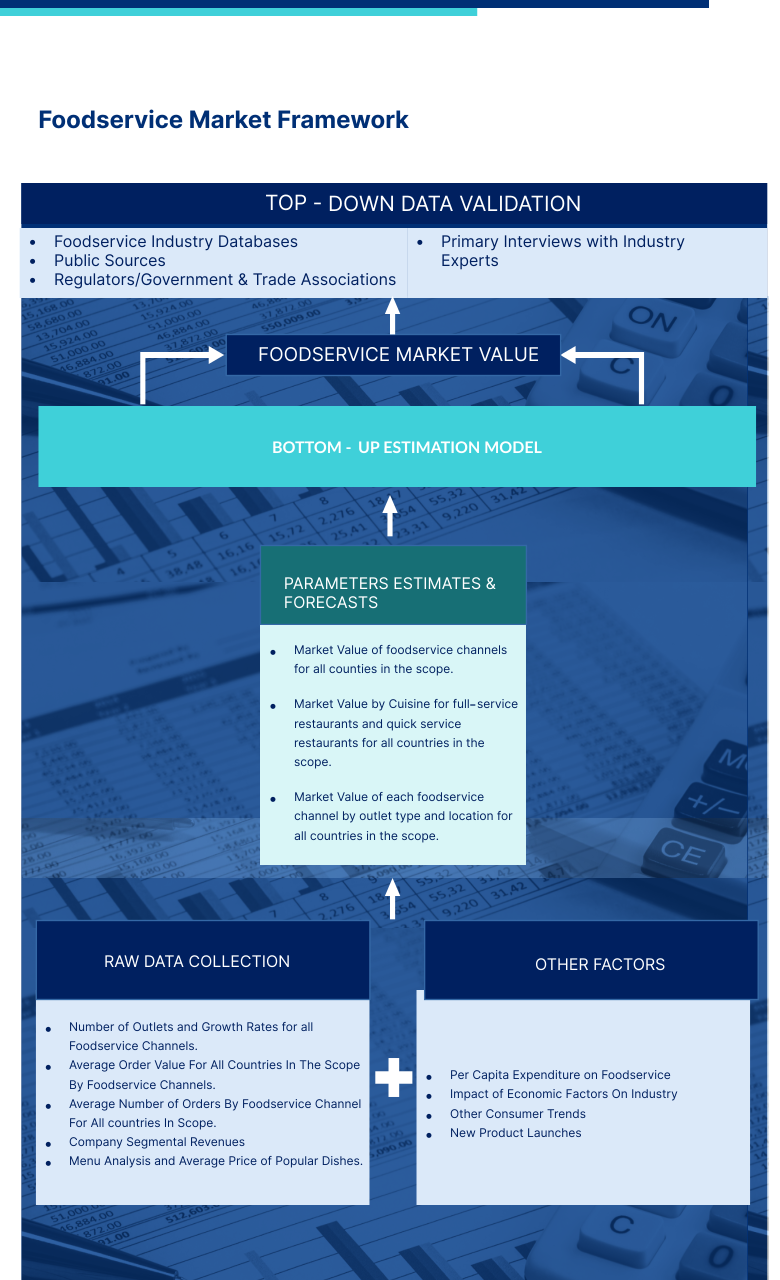
Research Methodology
Mordor Intelligence follows a four-step methodology in all our reports.
- Step-1: Identify Key Variables: In order to build a robust forecasting methodology, the variables and factors identified in Step 1 are tested against available historical market numbers. Through an iterative process, the variables required for the market forecast are set, and the model is built on the basis of these variables.
- Step-2: Build a Market Model: Market size estimations for the forecast years are in nominal terms. Inflation is considered for average order value, and it is forecasted as per predicted inflation rates in the countries.
- Step-3: Validate and Finalize: In this important step, all market numbers, variables, and analyst calls are validated through an extensive network of primary research experts from the market studied. The respondents are selected across levels and functions to generate a holistic picture of the market studied.
- Step-4: Research Outputs: Syndicated Reports, Custom Consulting Assignments, Databases & Subscription Platforms