
Asia Pacific Small Cell Tower Market Size and Share
Market Overview
| Study Period | 2020 - 2031 |
|---|---|
| Forecast Data Period | 2026 - 2031 |
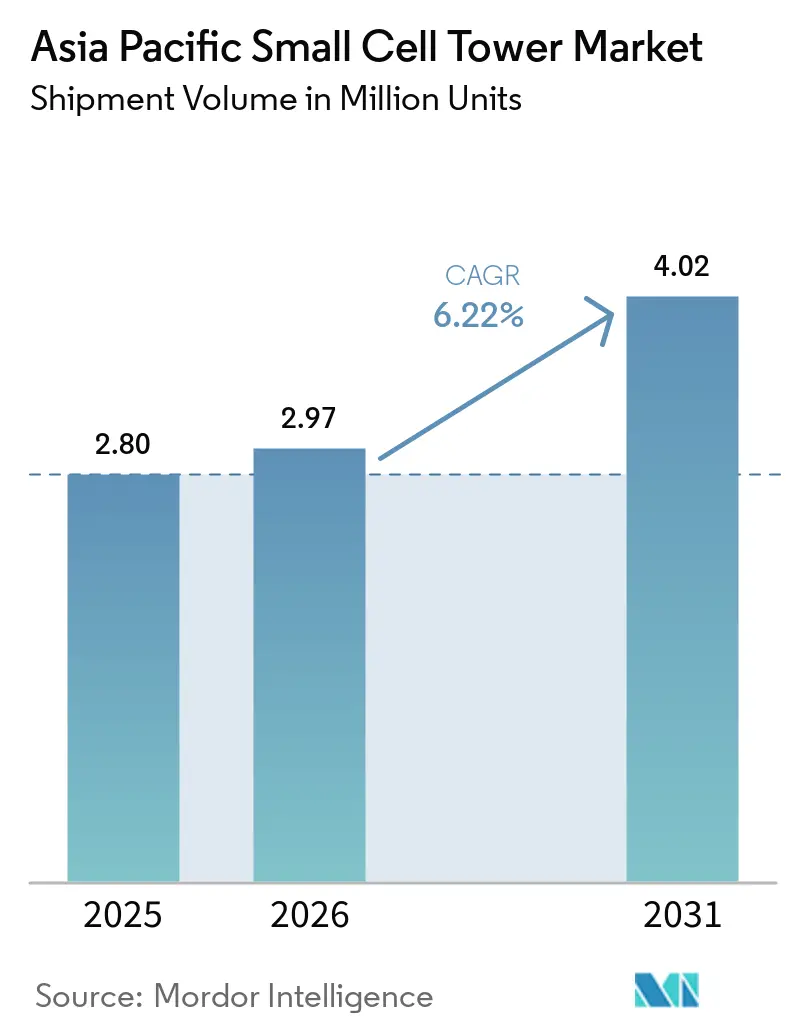
| Base Year Market Size (2025) | 2.80 Million units |
| Market Volume (2026) | 2.97 Million units |
| Market Volume (2031) | 4.02 Million units |
| Growth Rate (2026 - 2031) | 6.22 % |
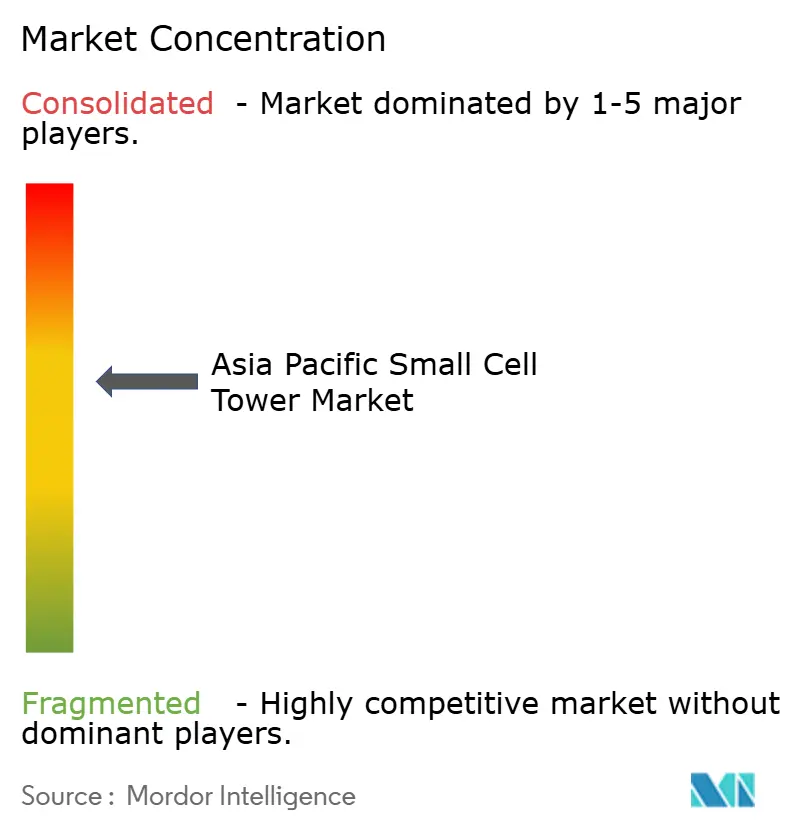
| Market Concentration | Medium |
Major Players *Disclaimer: Major Players sorted in no particular order Image © Mordor Intelligence. Reuse requires attribution under CC BY 4.0. | |
Asia Pacific Small Cell Tower Market Analysis by Mordor Intelligence
The Asia Pacific small cell tower market size is expected to grow from 2.80 million units in 2025 to 2.97 million units in 2026 and is forecast to reach 4.02 million units by 2031 at 6.22% CAGR over 2026-2031. Rising data traffic density, accelerated 5G timelines, and state-led spectrum reforms have placed network densification at the center of operator strategy, driving continuous demand for compact radio sites. The need to relieve macro-layer congestion in business districts, transit hubs, and entertainment venues is encouraging large-scale outdoor rollouts, while emerging private 5G campus networks are strengthening indoor demand. Equipment vendors are responding with integrated 4G/5G radios, automated site-optimization software, and Open RAN-ready architectures that curb the total cost of ownership. Competitive intensity is increasing as neutral-host specialists and software-centric challengers court operators with capex-light deployment models. The combination of policy momentum, enterprise digitization, and technology modularity signals a multi-year expansion phase for the Asia Pacific small cell tower market.
Key Report Takeaways
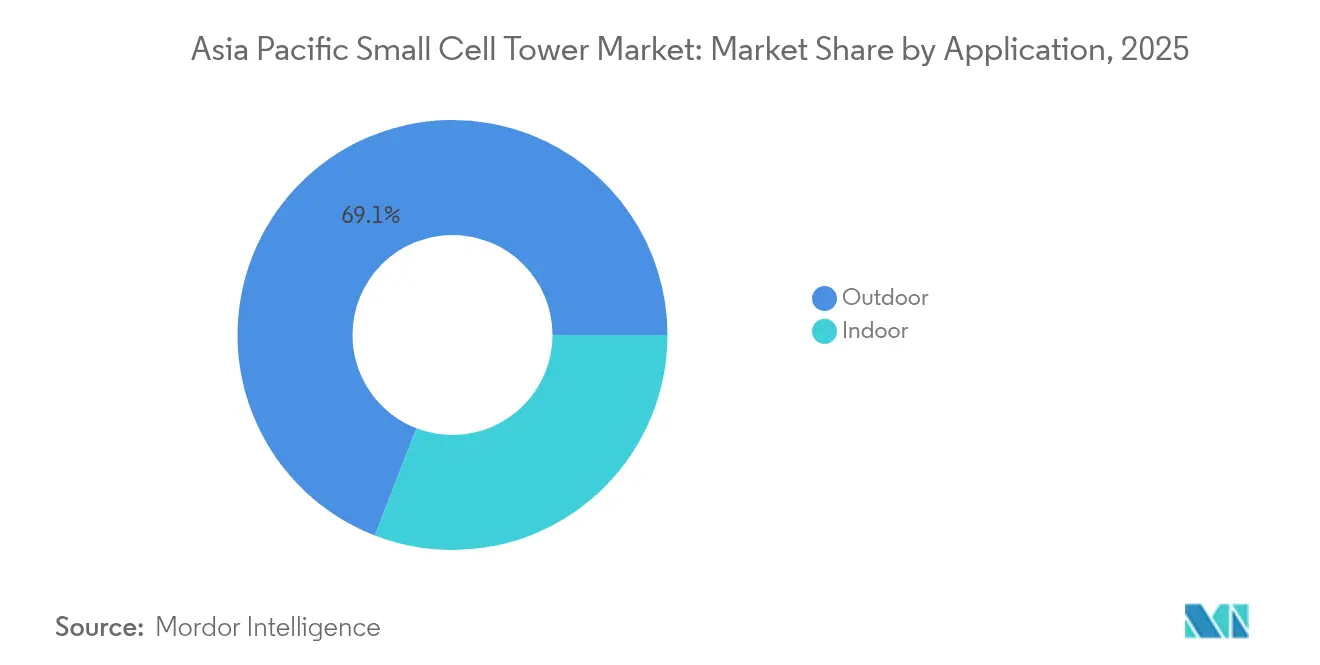
- By application, outdoor installations led with 69.12% of the Asia Pacific small cell tower market share in 2025; indoor deployments are projected to advance at a 7.32% CAGR through 2031.
- By network technology, 4G/LTE accounted for 50.32% of the Asia Pacific small cell tower market size in 2025, while 5G implementations are forecast to expand at an 7.98% CAGR through 2031.
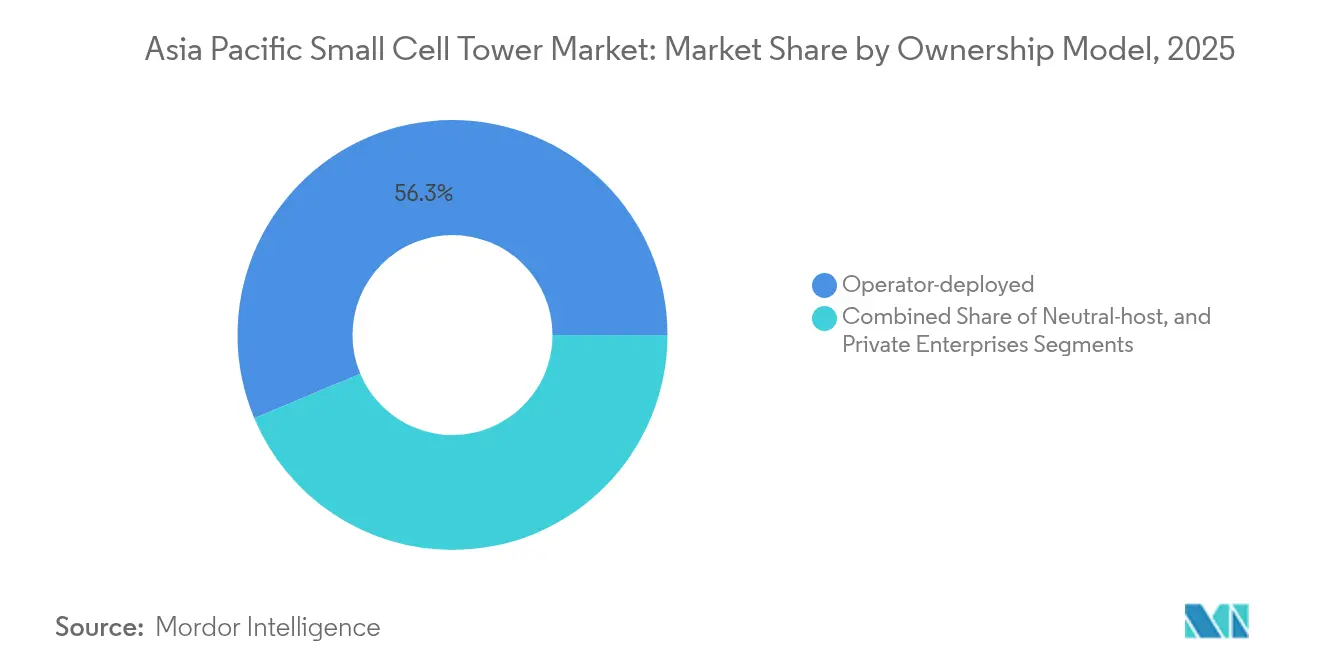
- By ownership model, operator-deployed sites held a 56.32% share of the Asia Pacific small cell tower market in 2025; private enterprise rollouts are set to grow at an 7.74% CAGR to 2031.
- By deployment location, urban nodes captured a 66.35% share of the Asia Pacific small cell tower market in 2025, whereas rural implementations are projected to grow at a 7.55% CAGR over the forecast horizon.
- By country, China accounted for a 39.76% share of the Asia Pacific small cell tower market in 2025, and India is projected to have the fastest growth at an 8.43% CAGR through 2031.
Note: Market size and forecast figures in this report are generated using Mordor Intelligence’s proprietary estimation framework, updated with the latest available data and insights as of 2026.
Market Trends and Insights
Drivers Impact Analysis of Asia Pacific Small Cell Tower Market*
| Driver | (~) % Impact on CAGR Forecast | Geographic Relevance | Impact Timeline |
|---|---|---|---|
| Rapid surge in mobile data traffic and densification requirements | +2.1% | China, India | Medium term (2-4 years) |
| Accelerated 5G rollout timelines across Asia Pacific | +1.8% | Asia Pacific core, emerging markets | Short term (≤ 2 years) |
| Government initiatives and supportive spectrum policies | +1.3% | Japan, Korea, Singapore | Long term (≥ 4 years) |
| Emergence of private 5G networks in manufacturing corridors | +0.9% | Southeast Asia, China | Medium term (2-4 years) |
| AI-powered self-optimizing networks lowering OPEX | +0.6% | Japan, Korea, Australia | Long term (≥ 4 years) |
| Source: Mordor Intelligence | |||
Rapid Surge in Mobile Data Traffic and Densification Requirements
Mobile video streaming, cloud gaming, and workplace collaboration tools have triggered year-over-year traffic spikes of 40–60% in key metropolitan areas, exceeding the capacity of macro sites beyond their engineered limits.[1] Operators now view dense grids of small cells as the most cost-efficient lever to add spectral reuse in real estate-constrained neighborhoods. Street-level poles, bus shelters, and building facades host these radios, minimizing landlord negotiations while shortening installation cycles. The densification imperative extends to airports, malls, and entertainment venues, where per-user throughput demands remain highest during peak hours. Vendors able to supply compact, multi-band radios that integrate 4G anchor carriers with 5G NR are securing preferred-supplier status. As a result, the Asia Pacific small cell tower market continues to mature from pilot deployments toward mass-scale grid planning.
Accelerated 5G Rollout Timelines Across Asia Pacific
Competitive announcements have condensed national 5G roadmaps by as much as 18 months, forcing operators to compress site-acquisition, civil works, and integration activities.[2] Governments in China and South Korea have linked infrastructure development to broader economic growth targets, releasing funds and public properties for accelerated deployment. Because small cells cover limited radii, they enable rapid 5G coverage overlays without waiting for new macro towers. Multi-technology radios that switch between NSA and SA modes help operators satisfy near-term coverage promises while laying groundwork for standalone cores. Integrated antennas, digital front-haul, and zero-touch provisioning tools are shortening time-to-revenue, underpinning robust demand for the Asia Pacific small cell tower market.
Government Initiatives and Spectrum Policies Supporting Small Cell Deployments
Regulators have reduced administrative friction by standardizing permit templates, increasing EIRP thresholds, and authorizing shared infrastructure frameworks. Japan’s Ministry of Internal Affairs and Communications reduced the license-processing window from three months to under four weeks, immediately increasing operator build rates. Singapore mandates neutral-host systems in high-footfall buildings, creating a guaranteed addressable base for shared small cell assets. Preferential spectrum blocks for industrial 5G in Korea and China further expand opportunities for private network suppliers. Policy clarity reduces business-case risk, enabling vendors and tower companies to invest capital in high-volume manufacturing and prefabricated site kits.
Emergence of Private 5G Networks in Manufacturing Corridors
Automotive, electronics, and logistics enterprises are funding dedicated 5G networks to automate production lines, track assets, and enable autonomous vehicles. Unlike operator deployments, these projects prioritize indoor coverage, deterministic latency, and high uplink capacity. Small cells act as the local-access layer, backhauled to on-premise 5G cores that safeguard intellectual property. Vendors offering pre-integrated radio-core packages and simplified spectrum-licensing support are winning contracts across Vietnam’s electronics clusters and Malaysia’s automotive parks. The private-network pivot diversifies the Asia Pacific small cell tower industry’s revenue streams beyond carrier capex cycles.
Restraints Impact Analysis of Asia Pacific Small Cell Tower Market*
| Restraint | (~) % Impact on CAGR Forecast | Geographic Relevance | Impact Timeline |
|---|---|---|---|
| Complex site acquisition and permitting hurdles | −1.4% | India, Indonesia | Medium term (2-4 years) |
| High upfront capital expenditure | −1.1% | Emerging Asia Pacific | Short term (≤ 2 years) |
| Interference management in shared spectrum | −0.8% | Dense metros | Long term (≥ 4 years) |
| Semiconductor supply-chain disruptions | −0.7% | Global | Short term (≤ 2 years) |
| Source: Mordor Intelligence | |||
Complex Site Acquisition and Permitting Hurdles
Municipal zoning disparities prolong approval cycles and inflate leasing charges, especially across tier-1 Indian cities where building owners demand premium rents.[3] Some jurisdictions require separate no-objection certificates from fire, aviation, and heritage departments, which can extend project timelines. The absence of standardized fee structures complicates network planning, as per-site cost variability challenges return-on-investment calculations. Operators often negotiate rooftop access on an ad-hoc basis, delaying grid densification and capping near-term shipment volumes for the Asia Pacific small cell tower market.
High Upfront Capital Expenditure for Dense Deployments
Site hardware, fiber backhaul, power provisioning, and installation labor lift per-node capex to USD 15,000–40,000. Operators in low-ARPU territories struggle to absorb such outlays while simultaneously bidding for mid-band spectrum. Financing constraints, therefore, skew deployments toward cash-rich incumbents, limiting competitive parity and stalling overall grid-density gains. Multilateral funding initiatives and equipment-leasing models are emerging, yet economic pressures remain a brake on volume growth.
*Our forecasts treat driver/restraint impacts as directional, not additive. The impact forecasts reflect baseline growth, mix effects, and variable interactions.
Asia Pacific Small Cell Tower Market Segment Analysis
By Application:
Indoor Deployments Broaden Coverage HorizonsIndoor sites captured 30.88% of shipments in 2025, equivalent to approximately 0.86 million units of the Asia Pacific small cell tower market size, and are projected to track a 7.32% CAGR to 2031. Enterprises view robust indoor 5G as non-negotiable for customer engagement tools, cashier-less checkouts, and immersive retail displays. Consequently, shopping malls, airports, and stadiums allocate capital expenditure budgets exclusively for small cell layers rather than Wi-Fi upgrades. Neutral-host operators bundle these systems into long-term service agreements, easing budget approval while ensuring multi-carrier access.
Outdoor deployments continue to anchor the Asia Pacific small cell tower market, accounting for 69.12% of the 2025 volumes. Operators use pole-mount and wall-mount radios in alleyways and transit corridors to alleviate macro-sector congestion during peak commuting hours. Integrated street-furniture designs blend radios, power modules, and backhaul links into aesthetically pleasing housings, thereby satisfying municipal ordinances. Although outdoor grids remain the dominant revenue stream, the rising momentum in indoor grids underscores the market’s dual-track growth narrative.

By Network Technology:
5G Adds Momentum as 4G Persists4G/LTE radios comprised 50.32% of 2025 shipments, equivalent to 1.41 million units in the Asia Pacific small cell tower market size, reflecting operators’ preference for maximizing existing spectrum allocations. Yet 5G radios are expanding at an 7.98% CAGR as carriers introduce mid-band and mmWave layers, supporting the growth of the asia-pacific small cell 5g market and enabling multi-gigabit peak throughput. Combo radios that deliver dual-standard coverage preserve site rent outlays and accelerate user migration.
Multi-technology platform adoption also addresses the realities of device mix. In late 2025, 5G smartphone penetration sits below 45% in many Southeast Asian markets, compelling operators to retain 4G anchor links for voice services and IoT endpoints. Gradual sunset plans for 3G free additional spectrum, enabling carriers to refarm bandwidth for 5G NR, thus reinforcing demand for software-upgradable radios.
By Ownership Model:
Enterprise Capital Unlocks New Revenue PoolsOperator-owned assets generated 56.32% of 2025 shipments but face share dilution as enterprises finance private grids. Manufacturing plants, logistics depots, and office campuses are turning to on-premise networks to satisfy deterministic service-level agreements. This category is expected to grow at an 7.74% CAGR, adding approximately 372,000 units by 2031.
Neutral-host providers enter as intermediary landlords, leasing spectrum slices and fiber backhaul to multiple operators within a shared radio network. This model aligns with public policy goals in Singapore and Australia, where governments aim to avoid redundant street furniture clutter. By alleviating capex burdens, neutral hosts speed nodal density, indirectly boosting shipment volumes for the Asia Pacific small cell tower market.
By Deployment Location:
Rural Expansion Adds Incremental VolumeUrban municipalities accounted for 66.35% of 2025 shipments, driven by dense population clusters and persistent mobile video usage. However, rural rollouts are forecast to grow at a 7.55% CAGR as universal-service programs release subsidies for digital inclusion. Governments in India and Indonesia allocate grants covering up to 30% of the costs for radio, power, and trenching, thereby de-risking operator participation.
Suburban belts form an intermediate growth layer. New housing developments in Thailand and Vietnam bundle fiber backhaul and smart-city services, prompting carriers to deploy small cells alongside smart-lighting poles. As suburban economies mature, per-capita data consumption climbs, unlocking fresh densification budgets and sustaining shipment momentum.
Geography Analysis
China Small Cell Tower Market
China shipped approximately 1.11 million units in 2025, accounting for a 39.76% share of the Asia Pacific small cell tower market. China’s leadership arises from a synchronized ecosystem of equipment suppliers, tower companies, and municipal authorities. Central funding lowers borrowing costs, while urban planning bodies allocate standardized pole designs, accelerating the average deployment interval to under 45 days. Large-scale procurement contracts unlock volume discounts, enabling nationwide coverage sweeps that surpass those of regional competitors. Industrial parks in Shenzhen and Chongqing host dedicated private 5G networks, each featuring hundreds of indoor small cells that support machine-vision quality control and AGV fleets.
India Small Cell Tower Market
India, although trailing in absolute volume, is projected to have an 8.43% CAGR through 2031, driven by Jio’s 50,000-site rural order book and Airtel’s enterprise-centric expansion. India’s momentum builds on competitive rivalry and an expanded spectrum roadmap. Airtel’s deal with Ericsson for 10,000 urban small cells emphasizes enterprise service differentiation through assured indoor performance. Jio’s USD 500 million rural program combines commercial incentives with universal-service obligations, ensuring revenue visibility and alignment with social impact. State-level right-of-way harmonization further trims lead times.
Japan and South Korea Small Cell Tower Market
Japan and South Korea serve as technological bellwethers. KT’s USD 300 million mmWave contract with Samsung uses pole-mounted 28 GHz radios to support autonomous-vehicle corridors in Seoul’s CBD. NTT DOCOMO’s AI-driven optimization trial with Nokia demonstrates contiguous self-healing clusters, reducing call-drop rates by 30% during festivals. These pioneering deployments shape global standards and vendor roadmaps, enhancing the reputational value of successful suppliers.
ASEAN Small Cell Tower Market
Southeast Asian nations, led by Thailand and Vietnam, adopt neutral-host models to sidestep capex limitations. Regulatory clarity on cost-sharing and pole aesthetics encourages tower companies to aggregate demand across carriers. Baicells’ Open RAN certification in Thailand opens a low-cost equipment avenue for emerging ISPs, democratizing access to the Asia Pacific small cell tower market.
Regulatory Landscape
Asia Pacific regulation is increasingly shaping small-cell economics through infrastructure sharing, in-building readiness, and equipment compliance. In April 2026, Japan's Ministry of Internal Affairs and Communications (MIC) initiated institutional and regulatory amendments to the Telecommunications Business Act to establish a new certification system for tower-sharing businesses, strengthening formal frameworks for shared deployment alongside densification programs.
Building-side and co-location rules are also being updated to accommodate denser radio layers. In 2026, Singapore's Info-communications Media Development Authority (IMDA) commenced a public consultation to review the Code of Practice for Info-Communication Facilities in Buildings (COPIF) to facilitate deployment of active equipment and small cells across a wider range of building types. IMDA technical specifications for cellular base station and repeater systems also continue to anchor radio equipment compliance. In February 2026, New Zealand's Commerce Commission issued a final decision noting reasonable grounds to commence an investigation into whether mobile co-location on cellular mobile transmission sites should be omitted from Schedule 1 of the Telecommunications Act 2001, signaling active oversight of access and competition settings that can influence co-location and rollout pace.
Value Chain Analysis
The small cell tower value chain in Asia Pacific spans radio and antenna vendors (for example, Huawei, Ericsson, Nokia, ZTE, and regional ODM/EMS players), backhaul and fiber providers, site engineering and construction firms, and tower or neutral-host companies that aggregate multi-operator demand. Distribution and deployment are executed through mobile network operators, neutral-host providers, and enterprise system integrators for private 5G campuses, with recurring value increasingly captured in software layers such as SON/AI optimization, remote provisioning, and multi-vendor or Open RAN integration.
Key friction points sit in site acquisition and municipal processes rather than component availability alone. Non-standardized right-of-way rules, variable pole or street-furniture rentals, and multi-agency approvals (utilities, fire, aviation, heritage) elongate cycles and raise per-node costs. This is especially material in dense urban grids where outdoor deployments dominate volumes. Regional localization efforts are also visible in the supply chain, including collaborations such as VVDN Technologies and Sterlite Technologies (STL) to design, develop, and manufacture 5G solutions, which supports faster lead times and local compliance needs. Neutral-host platforms such as EdgePoint Infrastructure also expand the commercialization route for shared indoor and outdoor nodes.
Competitive Landscape
Supplier dynamics reveal a mid-tier concentration wherein the top five vendors control roughly 62% of shipments, leaving meaningful whitespace for software-defined entrants. Huawei leverages vertically integrated silicon and optics to deliver cost-efficient turnkey packages. Ericsson and Nokia differentiate themselves through multi-standard radios and cloud-native RAN software, attracting operators who are pursuing vendor diversity. Samsung’s silicon control positions it favorably for mmWave grids.
Parallel Wireless and Baicells leverage Open RAN interfaces to separate hardware and software, reducing bill-of-materials costs in price-sensitive markets. Patent race intensity escalates as firms register antenna array innovations that mitigate interference in densely populated urban areas.[4] Neutral-host tower firms partner with equipment vendors on revenue-share deals, bundling installation, fiber backhaul, and AI analytics into end-to-end managed services.
The Asia Pacific small cell tower market, therefore, balances scale economics with rapid technological evolution. Vendors that fuse R&D heft, channel depth, and agile software roadmaps are best positioned to capture incremental volume and margin upside.
Asia Pacific Small Cell Tower Industry Leaders
-
Huawei Technologies Co., Ltd.
-
Telefonaktiebolaget LM Ericsson
-
Nokia Corporation
-
ZTE Corporation
-
Samsung Electronics Co., Ltd.
- *Disclaimer: Major Players sorted in no particular order
Asia Pacific Small Cell Tower Market Companies Covered in this Report
- Huawei Technologies Co., Ltd.
- Telefonaktiebolaget LM Ericsson
- Nokia Corporation
- ZTE Corporation
- Samsung Electronics Co., Ltd.
- Parallel Wireless Inc.
- Airspan Networks Inc.
- Baicells Technologies Co., Ltd.
- NEC Corporation
- Comba Telecom Systems Holdings Limited
- Fujitsu Limited
- JMA Wireless
- CommScope Holding Company, Inc.
- Mavenir Systems, Inc.
- Rakuten Symphony, Inc.
- Qucell Networks Co., Ltd.
- ip.access Ltd.
- Corning Incorporated
- Sercomm Corporation
- Dali Wireless, Inc.
Market Opportunities and Future Outlook
Near-term whitespace centers on regulatory-enabled sharing and in-building readiness, where compliance frameworks and licensing models translate into repeatable deployment programs. Singapore's 2026 IMDA COPIF review targets broader building types for active equipment and small-cell enablement, extending the addressable indoor base beyond the largest high-footfall properties that already prioritize coverage layers. Neutral-host licensing momentum also provides a clearer pathway for multi-operator small-cell rollout where individual-operator economics are constrained, including Sri Lanka's TRCSL issuing the first Telecommunications Infrastructure Services Licence to Edotco Services Lanka in September 2025.
Operator capex and AI-led RAN modernization are creating demand pools for dense radio layers and software-defined operations. Bharti Airtel's May 2026 plan to invest INR 120 billion to add over 100,000 new 5G sites in India strengthens the downstream pipeline for compact sites, particularly where urban capacity and enterprise indoor performance drive specification decisions. India's Telecommunication Engineering Centre (TEC) has also positioned small cells as critical for 5G, especially in higher spectrum bands that require denser deployments. On the vendor-operator side, Nokia's June 2026 commercial contract with Indosat for a nationwide AI-RAN rollout in Indonesia points to AI-native operations and optimization tooling being packaged alongside small-cell densification, as operators prioritize operational efficiency alongside capacity growth.
Recent Industry Developments in Asia Pacific Small Cell Tower Market
- July 2026: Nokia signed an agreement with Taiwan Mobile for a network-wide commercial rollout of an AI-native 5G network, moving beyond earlier limited-scope deployments. The program places AI-driven automation and optimization deeper into day-to-day RAN operations, strengthening the software and services layer that increasingly accompanies dense small-cell architectures.
- July 2026: Samsung reported a field trial on KDDI's 5G SA network in Tokyo that demonstrated up to a 52% downlink throughput improvement using its AI-powered RAN Speed Optimizer. The result underscores operator interest in software-led performance uplift on existing radio footprints, supporting the business case for dense urban node grids managed with AI tooling.
- March 2026: ZTE completed deployment of over 20,000 multi-operator core network (MOCN) sites for XLSMART in Indonesia over an eight-month period. The large-scale shared-network build highlights how MOCN and multi-operator frameworks can compress time-to-coverage while improving infrastructure utilization, a pattern that supports broader neutral-host and shared small-cell rollouts.
Asia Pacific Small Cell Tower Market Report Scope and Research Methodology
Market Definition and Coverage
For this study, the market covers small cell tower deployments across Asia Pacific, counted as installed or added small cell sites used to extend mobile coverage and capacity in indoor and outdoor settings. The market is sized in volume terms (units) and tracked consistently across the forecast period.
Scope exclusions: We exclude macro towers, in-building distributed antenna systems counted as separate DAS projects, and core network upgrades that do not translate into identifiable small cell site additions.
Segments Covered in This Report
- By Application
- Outdoor
- Indoor
- By Network Technology
- 3G
- 4G/LTE
- 5G
- By Ownership Model
- Operator-deployed
- Neutral-host
- Private enterprises
- By Deployment Location
- Urban
- Suburban
- Rural
- By Country
- China
- South Korea
- Japan
- India
- South-East Asia
- Rest of Asia Pacific
Data Sources, Market Sizing, and Validation
Desk Research
Desk research starts with building a country level rollout view, and it is then connected back to demand signals like mobile data traffic, spectrum actions, and coverage obligations. We rely on public references such as national telecom regulators and spectrum auction documents, ITU indicators, GSMA publications, and OECD broadband and mobile connectivity series, which help keep definitions and timelines aligned.
To tighten the model, we also review operator and tower company filings, investor presentations, and reputable press coverage of network densification and 4G/5G expansion plans, which are useful for checking pace and priority markets. In addition, we use paid company financials and intelligence subscriptions, and a patent database, mainly to track supplier activity and validate technology shifts that can change unit additions. The desk research sources listed here are illustrative, and many other public and subscription sources were also used for data collection, validation, and clarification.
Primary Interviews and Surveys
Primary work was used to confirm how small cell sites are counted in practice, and to validate rollout timing differences across dense metros versus secondary cities in APAC. We spoke with a mix of network planning, deployment, and commercial roles across operators, neutral hosts, and ecosystem participants across APAC markets, which helped fill gaps where public reporting is often high level. Feedback was also used to challenge assumptions on indoor versus outdoor mix and the pace at which planned sites translate into commissioned units.
Distribution of primary research fieldwork respondents
| Company type | Respondent position |
|---|---|
| Top tier: 29% | CXOs: 13% |
| Mid tier: 53% | Functional/Unit leaders: 35% |
| Smaller Players: 18% | Managers: 52% |
Market-Sizing & Forecasting
Sizing begins with a top-down build where country level mobile network densification plans, spectrum and coverage obligations, and urban traffic pressure are used to reconstruct the likely pool of small cell site additions. Inputs that are tracked (illustrative) include 4G/5G rollout timelines, announced small cell program targets, urban population density proxy indicators, mobile data usage growth, and the indoor versus outdoor deployment split because it changes the site count pattern.
Those totals are then corroborated with selective bottom-up approximations, such as sampled operator site additions, channel checks on deployment pace, and sanity checks using typical small cell nodes per high traffic area, followed by adjustments where gaps appear. When some countries have limited disclosure, we bridge using peer market rollout ratios, then re-test the implied unit intensity in expert calls so the extrapolation stays reasonable. Forecasts are built using scenario analysis, where a base case rollout path is stress tested against spectrum timing changes, permit and fiber readiness constraints, and shifts in operator capex priorities, and then a final view is chosen after rechecking with interview consensus.
Data Validation & Update Cycle
Validation is done through repeated variance checks across countries and years, where outliers are reviewed against independent signals like spectrum milestones, operator coverage commitments, and public rollout announcements. We also check that indoor and outdoor unit splits do not drift unrealistically when compared with the type of networks being expanded in each market.
Before sign-off, the model and key assumptions go through multi step analyst reviews, and any large swing triggers follow-up outreach to recheck the logic with knowledgeable respondents. The report is refreshed annually, and interim updates are made when material events occur such as major spectrum awards, policy shifts, or delayed deployments. Right before delivery, a fresh review pass is completed so clients receive the most current view available.
Mordor Intelligence's Asia Pacific Small Cell Tower Market Size Measured Against Other Published Estimates
Published sizing for APAC small cell towers can vary a lot, because some sources mix definitions and reporting units, and they also differ on whether they count sites, radios, or broader network equipment value. Differences also show up when one publisher assumes a faster 5G densification curve, or uses older rollout targets that were later revised.
Some external estimates fold small cells together with adjacent assets like DAS nodes or even macro tower additions, and they may report revenue value rather than unit volumes. The mismatch is easiest to see when the scope is limited to indoor and outdoor small cell site units (and not broader tower or in-building systems), which is the counting rule applied by Mordor Intelligence.
Benchmark comparison
| Source | Market Size | Gaps in Research Methodology |
|---|---|---|
| Mordor Intelligence | USD 2.80 M (2025) | |
| Trade Journal A | USD 2.35 M (2023) | Uses an earlier base year and treats the count as deployed units within a narrower time window, which can understate sites that are planned and commissioned later in the cycle. |
| Infrastructure Insights B | USD 1.90 M (2020) | Combines small cells with other smaller infrastructure categories and relies on a point in time installed base snapshot, which can miss the faster ramp in 5G driven densification after 2020. |
The spread across the table is mainly explained by how each source defines a countable unit and which year is treated as the starting point. By keeping the unit count tied to visible deployment drivers and then cross-checking it with rollout signals shared in interviews, the final totals remain repeatable and easy to reconcile when updates are made.
Key Questions Answered in the Report
What shipment volume is forecast for Asia Pacific small cell towers by 2031?
The region is projected to reach 4.02 million units by 2031, expanding from 2.97 million units in 2026.
Which application category is growing fastest for small cells in Asia Pacific?
Indoor deployments, especially in malls and airports, are advancing at a 7.32% CAGR through 2031.
How large is China’s share of Asia Pacific small cell tower demand?
China commanded 39.76% of 2025 shipments, underpinned by state-backed infrastructure programs.
Why are private 5G networks important to small cell suppliers?
Manufacturing and logistics enterprises are financing their own grids, pushing an 7.74% CAGR for private deployments to 2031.
What is the main hurdle slowing urban small cell rollouts?
Lengthy site-acquisition and permitting processes can extend deployment timelines by up to 12 months in major cities.
Which new technology feature is cutting operating costs for dense small cell networks?
AI-powered self-optimizing software reduces manual retuning visits and can lower OPEX by 30%.