
Market Overview
| Study Period | 2021 - 2032 |
|---|---|
| Forecast Data Period | 2027 - 2032 |
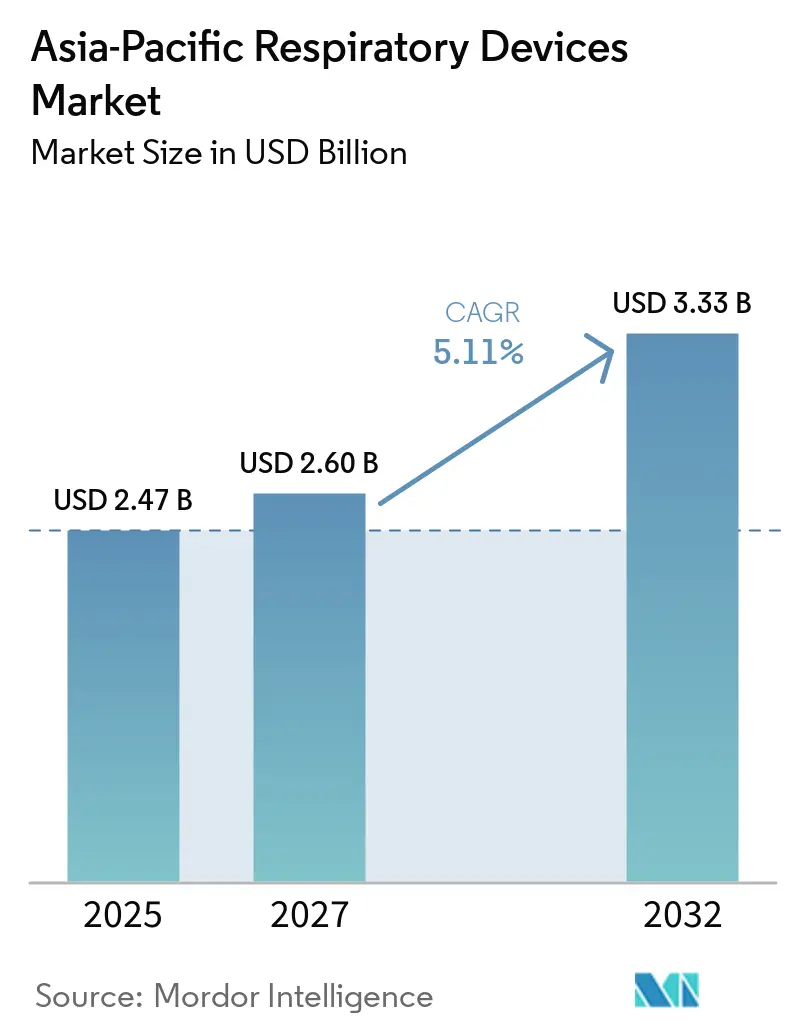
| Base Year Market Size (2025) | USD 2.47 Billion |
| Market Size (2027) | USD 2.60 Billion |
| Market Size (2032) | USD 3.33 Billion |
| Growth Rate (2027 - 2032) | 5.11 % |
| Market Concentration | Medium |
Major Players *Disclaimer: Major Players sorted in no particular order Image © Mordor Intelligence. Reuse requires attribution under CC BY 4.0. | |
Asia-Pacific Respiratory Devices Market Analysis by Mordor Intelligence
The Asia-Pacific Respiratory Devices Market size was valued at USD 2.47 billion in 2026 and is estimated to grow from USD 2.60 billion in 2027 to reach USD 3.33 billion by 2032, at a CAGR of 5.11% during the forecast period (2027-2032).
COVID-19 has impacted the growth of the respiratory devices market in Asia-Pacific. For instance, according to a paper published in the British Journal of Surgery, an estimated 585,000 elective procedures were postponed in India alone during the 12-week shutdown, and 28.4 million elective procedures were canceled or postponed globally by May 2020. Moreover, major respiratory devices, such as ventilators, nebulizers, CPAP, BiPAP, and oxygen concentrators, witnessed high demand initially, as they are widely being used for COVID-19 patients. Thus, with the increased severity of COVID-19 in the region, several companies have increased their ventilator production to combat the pandemic. For instance, in April 2020, MEKICS Co. Ltd, a South Korean company, partnered with BIOLASE Inc. to supply ICU-grade portable ventilators through BIOLASE's FDA-registered manufacturing facility in California. Such partnerships have increased the production of portable ventilators in the country, hence impacting the market growth. Hence, the COVID-19 pandemic had a favorable impact on the market initially; currently, as the pandemic has subsided, the market has lost some traction and is expected to have stable growth during the forecast period of the study.
Factors such as the increasing prevalence of respiratory diseases such as chronic obstructive pulmonary diseases, TB, asthma, and sleep apnea, and technological advancements, as well as increasing applications in healthcare settings, are boosting market growth.
The prevalence and incidence of respiratory diseases such as asthma, chronic obstructive pulmonary diseases, and others among the population are increasing rapidly, which is anticipated to increase the demand for respiratory devices, hence propelling market growth. For instance, according to an article published in the WHO in March 2022, it has been observed that the prevalence of COPD was highest in North India and Bangladesh. In addition, as per the same source, the prevalence of chronic bronchitis ranged between 3% to 5%. Thus, the prevalence of COPD, a serious public health issue, is expected to rise, especially in emerging countries which is anticipated to increase the demand for different respiratory devices such as inhalers, nebulizers, ventilators, and others. This, in turn, is anticipated to fuel the market growth over the forecast period.
Additionally, the rising government activities and initiatives to donate respiratory devices to other countries to combat the coronavirus pandemic have also increased the production of respiratory devices in the region. This is also contributing to the market growth. For instance, in March 2022, the Ministry of Health and Family Welfare, as part of the National Health Mission's Reproductive, Maternal, Newborn, Child, Adolescent, and Adolescent Health and Nutrition (RMNCHA+N) program, developed the SAANS (Social Awareness and Actions to Neutralize Pneumonia Successfully) Initiative to reduce deaths from Childhood Pneumonia in both rural and urban areas which are expected to show significant growth over the forecast period. Also, in June 2021, the South Korean government donated 350 oxygen concentrators and 35 ventilators to help Indonesia cope with an exponential spike in COVID-19 cases. South Korea disbursed USD 4 million in funds to help Indonesia as a manifestation of cooperation to increase its capacity to handle the COVID-19 pandemic.
Furthermore, the rising company activities are also contributing to market growth. For instance, in November 2021, HoneyNaps, a South Korea-based healthcare startup, launched its medical software that uses artificial intelligence to diagnose sleep disorders. The device is called SOMNUM, the deep learning-based analysis program that enables real-time, multi-channel, large-capacity signal analysis. It automatically provides polysomnography readings that are said to be more accurate than conventional autoscoring.
Moreover, the increasing product launches in the region are expected to boost market growth. For instance, in March 2021, Vyaire Medical launched the AioCare (HealthUp SA, Poland) mobile spirometry system in more than 15 countries, including Australia and other countries. This new technology allows physicians to promptly diagnose pulmonary diseases, including asthma and COPD, as accurately as hospital-grade spirometers and performs high-quality patient monitoring via advanced digital connectivity at home.
Therefore, owing to the aforementioned factors, such as the high burden of respiratory diseases, government initiatives, and rising company activities, the studied market is anticipated to grow over the forecast period. However, the high cost of devices is likely to hinder the growth of the respiratory devices market in the Asia-Pacific region over the forecast period.
Note: Market numbers in this report are based on Mordor Intelligence's proprietary estimation framework, which combines nine months of actuals with Q4 projections for base year 2026.
Asia-Pacific Respiratory Devices Market Trends and Insights
Ventilator Segment is Expected to Hold Significant Market Share Over the Forecast Period
The ventilator segment is expected to witness significant growth in the respiratory devices market over the forecast period, owing to factors such as the rising prevalence of asthma, COPD, allergic rhinitis, brain injuries, cardiac arrest, and strokes among the population.
The ventilator segment includes devices that provide mechanical breathing support to patients who cannot breathe adequately on their own. These devices deliver controlled airflow and oxygen and are used in intensive care, emergency medicine, anesthesia, and home care.
The rising burden of chronic obstructive pulmonary disease (COPD), coupled with the growing geriatric population, is expected to increase demand for respiratory devices, thereby supporting segment growth. Older adults are more susceptible to COPD because of age-related changes in lung structure and function. For instance, according to data published in the Asia Pacific Journal of Public Health (APJPH) in July 2025, the prevalence of COPD among adults aged 40 years and above in the Asia-Pacific region, including China, is approximately 12.1%, and prevalence increases sharply with age. Therefore, the anticipated growth in the aging population is expected to support market growth.
Furthermore, the rising product launches increase the availability of innovative respiratory devices, which is also expected to fuel the segment's growth. For instance, in May 2022, Max ventilator launched multifunctional noninvasive ventilators which come with inbuild oxygen therapy and humidifier in India. Also, in June 2021, ISRO launched a portable critical care ventilator, Prana (Programmable Respiratory Assistance for the Needy Aid), and is based on the automated compression of an Ambu (Artificial Manual Breathing Unit) bag.
Therefore, owing to the factors such as the high burden of COPD, and the growing aging population in the region, the studied segment is expected to grow over the forecast period.
India is Estimated to Have Significant Share in the Asia-Pacific Respiratory Devices Market Over the Forecast Period
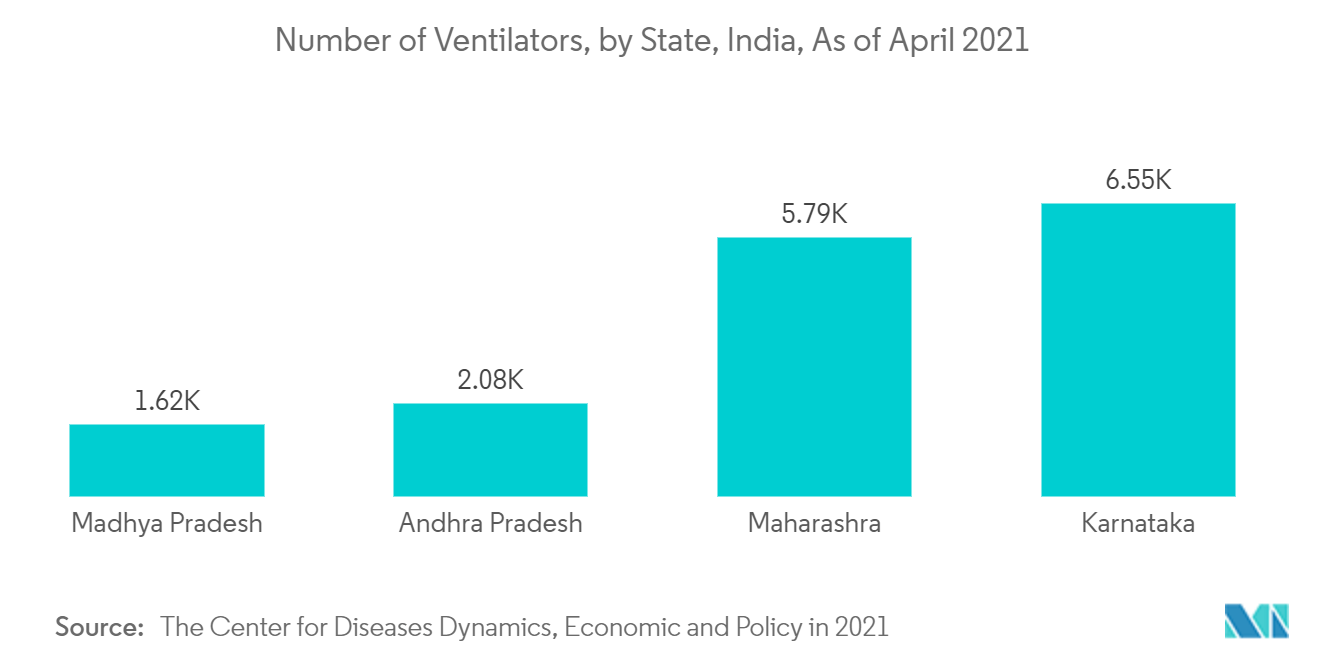
India is expected to witness significant growth in the respiratory devices market in the Asia-Pacific region over the forecast period owing to the factors such as the growing incidence of respiratory disorders, increasing government initiatives, and the presence of market players in the country.
The rising burden of respiratory diseases such as asthma and COPD is the key factor driving the market growth in the country. For instance, according to an article published in Lung India in August 2022, it has been observed that the prevalence of asthma ranged from 2% in Karnataka to 18.2% in Rajasthan. In addition, as per the same source, the prevalence of asthma among children was 7.9%. Also, as per an article published in Bulletin WHO in December 2021, it has been observed that the prevalence of COPD in India was highest in South India, followed by Northern India. Thus, the high burden of respiratory diseases raises the demand for inhalers and other respiratory devices, thereby propelling the market growth in the country.
Furthermore, the rising company activities in developing technologically advanced respiratory devices and increasing product launches are also expected to fuel the market growth in the country. For instance, in November 2021, Cipla Limited launched Spirofy, India's first pneumotach-based portable, wireless Spirometer, on World COPD Day. Also, in June 2021, DetelPro launched DetelPro Oxy10, a pulse oximeter having an LED display that helps users easily check the results. In addition, the auto-shut-off feature of the DetelPro pulse oximeter kicks in after 8 seconds of inactivity.
Therefore, owing to the aforementioned factors, such as the high burden of asthma and COPD and increasing product launches, the studied market is expected to grow over the forecast period.
Competitive Landscape
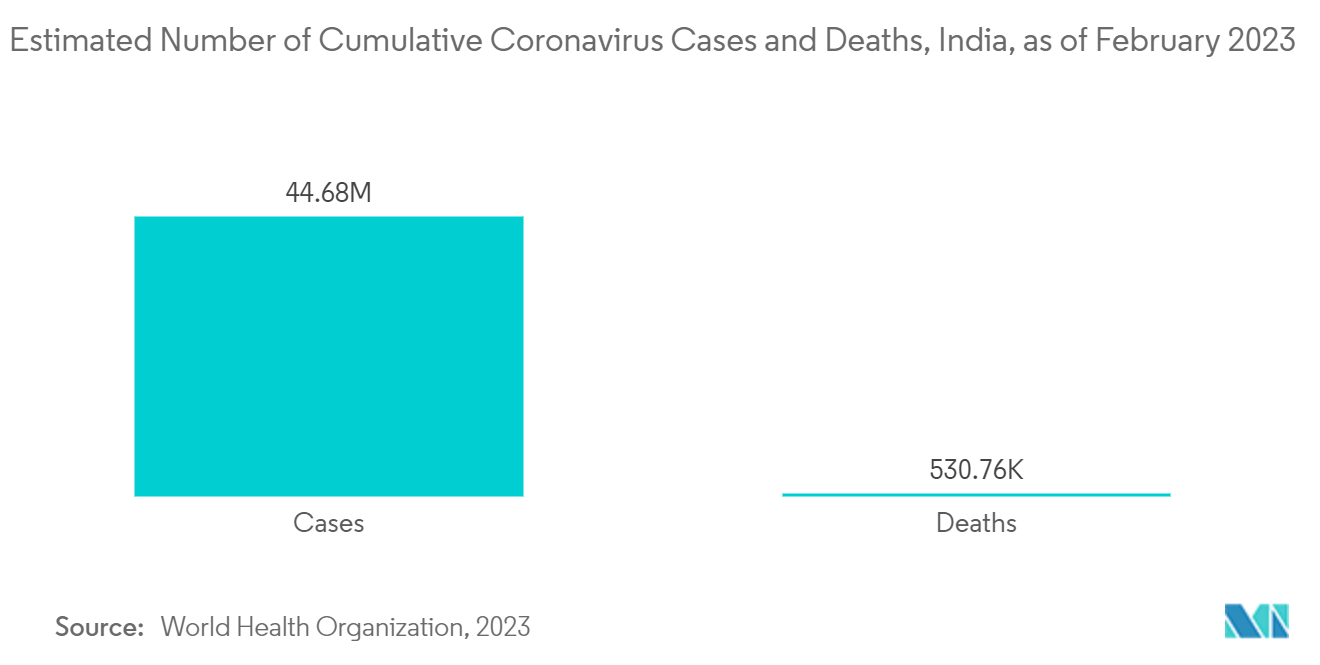
The Asia-Pacific respiratory devices market is consolidated with many players in the market. The companies are implementing certain strategic initiatives, such as a merger, new product launches, acquisitions, and partnerships that help them in strengthening their market position. Some of the companies which are currently dominating the market are GE Healthcare, Fisher & Paykel Healthcare Ltd, Koninklijke Philips NV, Smiths Medical, Dragerwerk AG, Teleflex Incorporated, 3M Company, and DeVilbiss Healthcare LLC (Drive DeVilbiss Healthcare) among others.
Asia-Pacific Respiratory Devices Industry Leaders
-
GE Healthcare (GE Company)
-
Fisher & Paykel Healthcare Ltd
-
Dragerwerk AG
-
Koninklijke Philips
-
Hamilton Medical
- *Disclaimer: Major Players sorted in no particular order
Recent Industry Developments
- July 2022: Vivos Therapeutics received multiple Class I clearances by the Therapeutic Goods Administration for multiple indications to include the treatment of snoring and obstructive sleep apnoea (mild, moderate, and severe) for both adults and children for its series of oral appliances.
- July 2022: OMRON Healthcare, Japan-based company, launched a portable oxygen concentrator that is designed to aid the home care providers who are managing the therapy and lifestyle needs of patients with COPD and respiratory problems.
Asia-Pacific Respiratory Devices Market Report Scope
As per the scope of the report, respiratory devices include respiratory diagnostic devices, therapeutic devices, and breathing devices for administering long-term artificial respiration. It may also include a breathing apparatus used for resuscitation by forcing oxygen into the lungs of a person who has undergone asphyxia. The Asia-Pacific Respiratory Devices Market is Segmented by type (diagnostic and monitoring devices (spirometers, sleep test devices, peak flow meters, pulse oximeters, capnographs, other diagnostic and monitoring devices), therapeutic devices (CPAP devices, BiPAP devices, humidifiers, nebulizers, oxygen concentrators, ventilators, inhalers, other therapeutic devices), disposables (masks, breathing circuits, other disposables)), and geography (China, Japan, India, Australia, South Korea, and Rest of Asia-Pacific). The report offers value in USD million for the above segments.
By Type
| Diagnostic and Monitoring Devices | Spirometers |
| Sleep Test Devices | |
| Peak Flow Meters | |
| Pulse Oximeters | |
| Capnographs | |
| Other Diagnostic and Monitoring Devices | |
| Therapeutic Devices | CPAP Devices |
| BiPAP Devices | |
| Humidifiers | |
| Nebulizers | |
| Oxygen Concentrators | |
| Ventilators | |
| Inhalers | |
| Other Therapeutic Devices | |
| By Disposables | Masks |
| Breathing Circuits | |
| Other Disposables |
Geography
| China |
| Japan |
| India |
| Australia |
| South Korea |
| Rest of Asia-Pacific |
| By Type | Diagnostic and Monitoring Devices | Spirometers |
| Sleep Test Devices | ||
| Peak Flow Meters | ||
| Pulse Oximeters | ||
| Capnographs | ||
| Other Diagnostic and Monitoring Devices | ||
| Therapeutic Devices | CPAP Devices | |
| BiPAP Devices | ||
| Humidifiers | ||
| Nebulizers | ||
| Oxygen Concentrators | ||
| Ventilators | ||
| Inhalers | ||
| Other Therapeutic Devices | ||
| By Disposables | Masks | |
| Breathing Circuits | ||
| Other Disposables | ||
| Geography | China | |
| Japan | ||
| India | ||
| Australia | ||
| South Korea | ||
| Rest of Asia-Pacific | ||
Key Questions Answered in the Report
What is the current Asia-Pacific Respiratory Devices Market size?
The Asia-Pacific Respiratory Devices Market is projected to register a CAGR of 5.11% during the forecast period (2027-2032)
Who are the key players in Asia-Pacific Respiratory Devices Market?
GE Healthcare (GE Company), Fisher & Paykel Healthcare Ltd, Dragerwerk AG, Koninklijke Philips and Hamilton Medical are the major companies operating in the Asia-Pacific Respiratory Devices Market.
What years does this Asia-Pacific Respiratory Devices Market cover?
The report covers the Asia-Pacific Respiratory Devices Market historical market size for years: 2021, 2022, 2023, 2024, 2025, and 2026. The report also forecasts the Asia-Pacific Respiratory Devices Market size for years: 2027, 2028, 2029, 2030, 2031, and 20302