
Market Overview
| Study Period | 2020 - 2031 |
|---|---|
| Forecast Data Period | 2026 - 2031 |
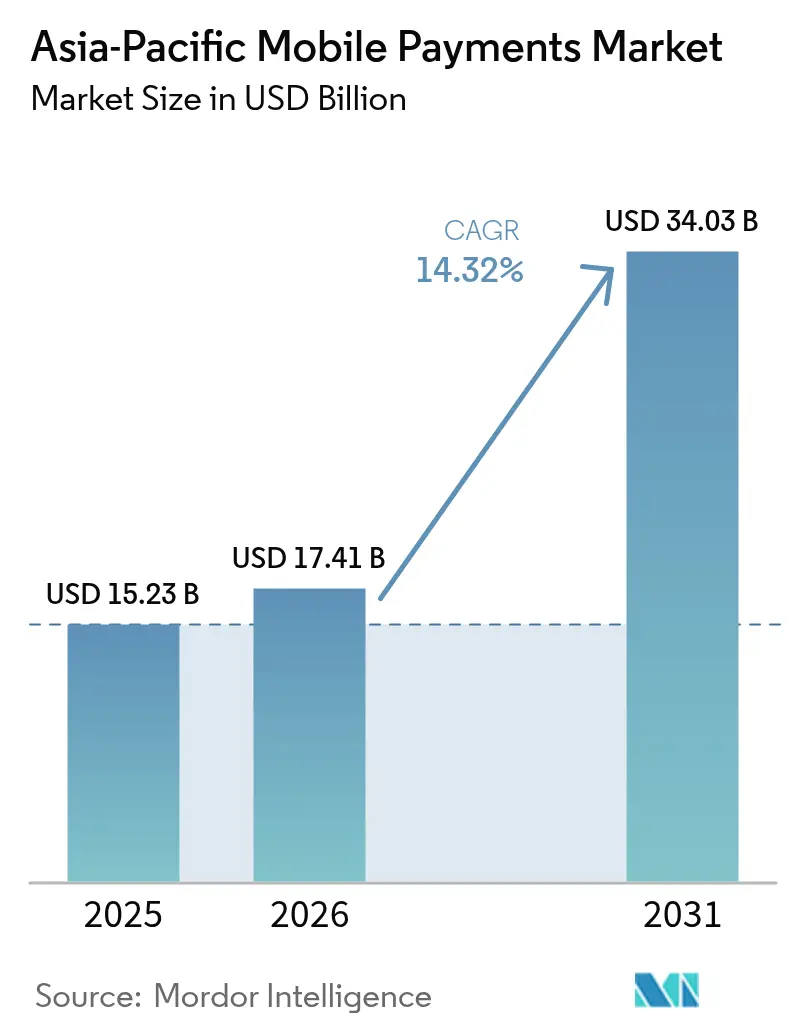
| Base Year Market Size (2025) | USD 15.23 Billion |
| Market Size (2026) | USD 17.41 Billion |
| Market Size (2031) | USD 34.03 Billion |
| Growth Rate (2026 - 2031) | 14.32 % |
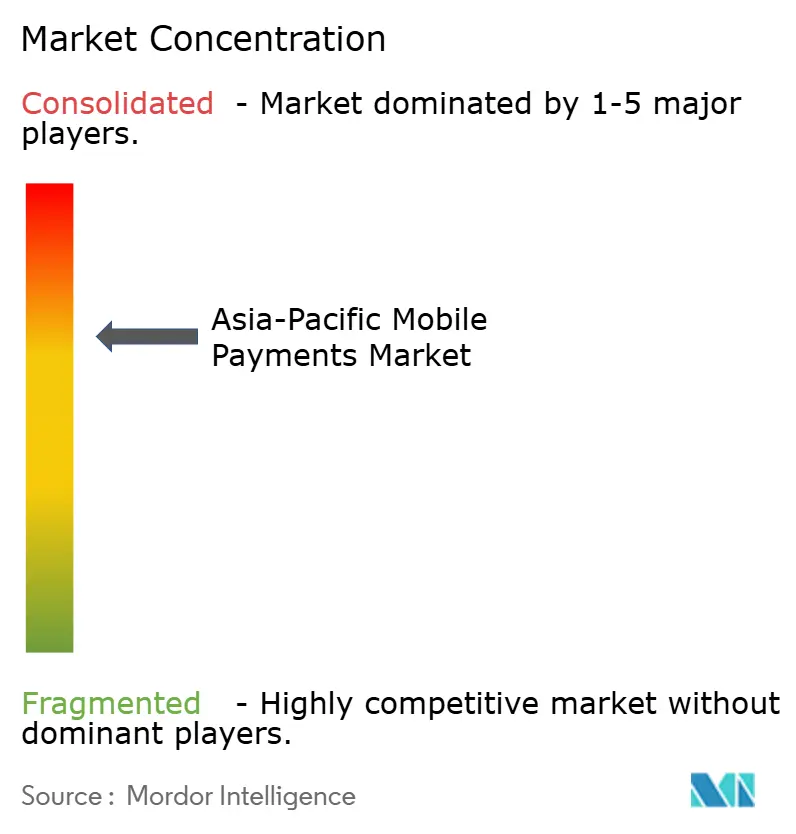
| Market Concentration | Medium |
Major Players *Disclaimer: Major Players sorted in no particular order Image © Mordor Intelligence. Reuse requires attribution under CC BY 4.0. | |
Asia-Pacific Mobile Payments Market Analysis by Mordor Intelligence
The Asia-Pacific mobile payments market size in 2026 is estimated at USD 17.41 billion, growing from 2025 value of USD 15.23 billion with 2031 projections showing USD 34.03 billion, growing at 14.32% CAGR over 2026-2031. Surging smartphone penetration, mandatory digital-payments infrastructure, and super-app ecosystems that embed commerce, logistics, and finance are amplifying wallet adoption across 2.3 billion consumers and 60 million merchants. Governments are compressing adoption cycles through zero-interchange regimes and unified QR standards, while central-bank digital-currency pilots such as the e-CNY move from sandbox to scale. Competition is intensifying as telecom-backed wallets, neobanks, and card networks race to own daily spend, prompting alliances focused on cross-border settlement, loyalty integration, and real-time risk scoring. Regulatory divergence on data localization and open-banking APIs will determine whether the region converges on seamless rails or remains a patchwork of bilateral links.
Key Report Takeaways
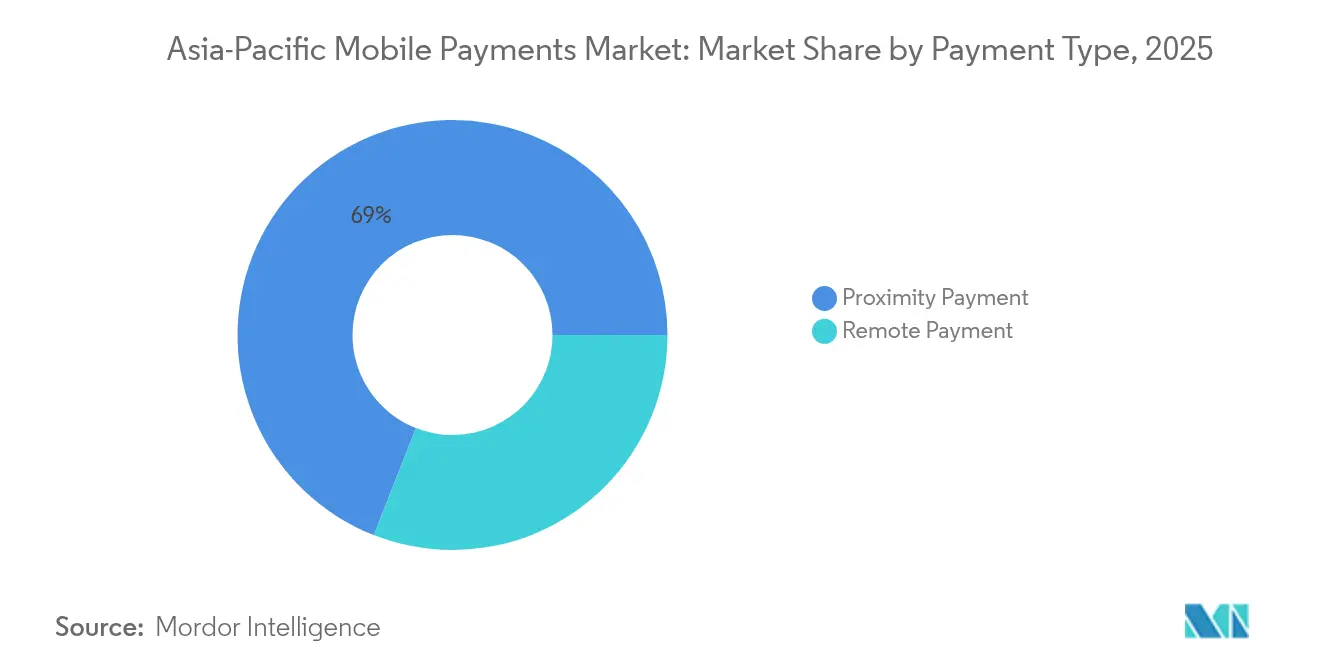
- By payment type, proximity payments led with a 69.04% Asia-Pacific mobile payments market share in 2025, whereas remote payments are on track to grow at a 15.52% CAGR through 2031.
- By payment mode, QR-code transactions commanded 44.21% of volume in 2025 and are forecast to expand at a 15.18% CAGR, easily outpacing NFC.
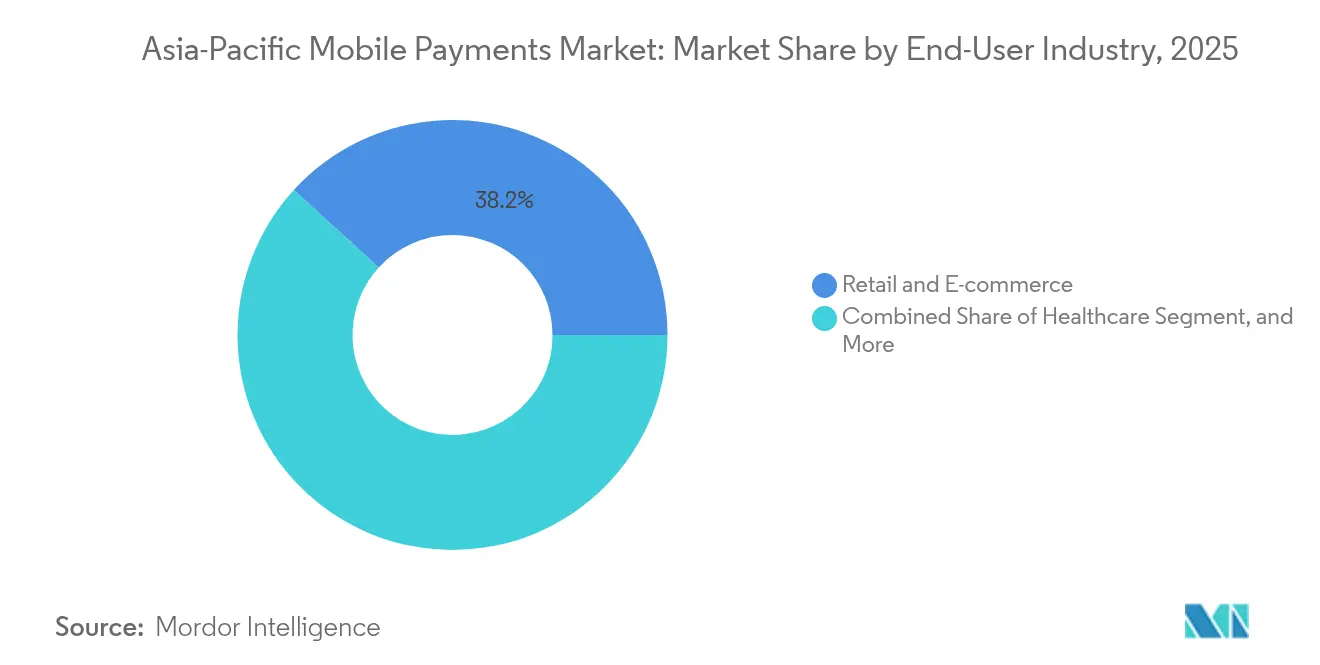
- By end-user industry, retail and e-commerce captured 38.21% of spend in 2025, while healthcare is advancing at a 15.06% CAGR and is the fastest-growing vertical.
- By transaction value, small-ticket purchases between USD 10 and USD 50 accounted for 41.27% of volume in 2025; micro-payments below USD 10 are poised for a 15.12% CAGR.
Note: Market size and forecast figures in this report are generated using Mordor Intelligence’s proprietary estimation framework, updated with the latest available data and insights as of 2026.
Market Trends and Insights
Drivers Impact Analysis of Asia-Pacific Mobile Payments Market*
| Driver | (~) % Impact on CAGR Forecast | Geographic Relevance | Impact Timeline |
|---|---|---|---|
| Surge in smartphone and internet penetration | +2.5% | Asia-Pacific-wide, with highest impact in India, Indonesia, Philippines, Vietnam, Bangladesh | Medium term (2-4 years) |
| Government-led cashless initiatives | +3.2% | India (UPI mandate), China (e-CNY rollout), Singapore (SGQR), Thailand (PromptPay), Malaysia (DuitNow) | Short term (≤ 2 years) |
| Rapid expansion of e-commerce and super-apps | +2.8% | Southeast Asia (Indonesia, Vietnam, Philippines, Thailand), India, with spillover to China's lower-tier cities | Medium term (2-4 years) |
| Favourable fintech regulations and open banking | +2.1% | Singapore (SGFIN), India (Account Aggregator), Australia (Consumer Data Right), Japan (Payment Services Act revisions) | Long term (≥ 4 years) |
| Offline QR-code standardization for micro-merchants | +1.6% | India (Bharat QR), Singapore (SGQR), Indonesia (QRIS), Thailand (Thai QR), China (Alipay/WeChat offline protocols) | Medium term (2-4 years) |
| CBDC pilots integrating with mobile wallets | +1.4% | China (e-CNY integration with Alipay/WeChat Pay), India (digital rupee pilots), Thailand (retail CBDC trials), Singapore (Project Orchid) | Long term (≥ 4 years) |
| Source: Mordor Intelligence | |||
Surge in Smartphone and Internet Penetration
It is estimated that more than 600 million smartphone shipments will occur across the region in 2024, and sub-USD 150 models will comprise a notable share of sales in India, Indonesia, and Vietnam, widening wallet access for informal-sector workers. Mobile broadband coverage reached 78%, while India’s Bharat Net linked 250,000 village councils, bringing 400 million previously unbanked citizens online.[1] Rapid 5G rollouts cut QR-scanning latency, and manufacturers such as Xiaomi, Oppo, and Samsung preload starter wallets with cash-back, converting first-time smartphone buyers to mobile payments within 90 days. As tier-2 and tier-3 cities receive affordable data plans, the addressable base for the Asia-Pacific mobile payments market widens, reinforcing network effects for super-apps.
Government-Led Cashless Initiatives
India’s Unified Payments Interface processed 100 billion transactions in 2024, a ten-fold jump from 2020, underpinned by zero merchant-discount rates and mandatory interoperability. China’s e-CNY pilot has expanded to 26 cities and incorporated offline NFC chips into SIM cards to ensure continuity during disasters.[2] Singapore’s SGQR merged 27 schemes into one code across 300,000 merchants and linked with India and Thailand for fee-free remittances.[3] Thailand required PromptPay enrollment for subsidy recipients, routing 12 billion baht digitally in 2024. These top-down mandates accelerate behavioral change and compress multi-year adoption curves into quarters.
Rapid Expansion of E-Commerce and Super-Apps
Gross merchandise value in Southeast Asia climbed to USD 186 billion in 2024, with 68% of checkouts settled inside wallets rather than through cards or cash. GrabPay processed USD 22 billion across eight countries by cross-selling micro-loans and insurance to ride-hailing and food-delivery users. Alipay+ now connects 30 wallets, enabling tourists to pay at 90 million overseas merchants without FX conversion, while local users can shop from Chinese sellers seamlessly. The super-app flywheel combines payments, commerce, and logistics into a single interface, increasing switching costs and consolidating market share on scaled platforms.
Favourable Fintech Regulations and Open Banking
India’s Account Aggregator model allows consent-driven data sharing among 150 regulated entities, unlocking nano-credit for gig workers. Singapore’s SGFIN API forces banks to expose payment-initiation rails, lowering acquisition costs for neobanks. Australia extended its Consumer Data Right to payments, permitting third-party apps to trigger instant transfers from any account. Japan raised prepaid wallet caps to JPY 500,000, letting PayPay compete with banks for salary deposits. Together these reforms erode incumbents’ moat and fuel innovation in the Asia-Pacific mobile payments market.
Restraints Impact Analysis of Asia-Pacific Mobile Payments Market*
| Restraint | (~) % Impact on CAGR Forecast | Geographic Relevance | Impact Timeline |
|---|---|---|---|
| Payment fraud and data-breach concerns | -1.8% | Asia-Pacific-wide, with highest losses in India, Philippines, Indonesia, Vietnam | Short term (≤ 2 years) |
| Interoperability across fragmented rails | -1.2% | Southeast Asia (Indonesia, Malaysia, Thailand, Vietnam, Philippines), cross-border corridors between ASEAN nations | Medium term (2-4 years) |
| Interchange fee caps squeezing PSP margins | -0.9% | India (zero-MDR on UPI), Thailand (0.5% cap), Malaysia, with spillover to other ASEAN markets | Medium term (2-4 years) |
| NFC battery-drain and latency on low-end devices | -0.6% | India, Indonesia, Vietnam, Philippines, Bangladesh, markets where sub-USD 150 smartphones dominate | Long term (≥ 4 years) |
| Source: Mordor Intelligence | |||
Payment Fraud and Data-Breach Concerns
Consumers across the region lost USD 1.8 billion to payment fraud in 2024, with authorized push-payment scams and SIM-swap attacks comprising 54% of losses. India logged 1.35 million fraud complaints in the first half of 2024, spurring the central bank to require real-time velocity checks for UPI apps. The Philippines recorded a 38% rise in phishing incidents against GCash users, prompting tighter wallet KYC thresholds. Synthetic-identity schemes are rising as criminals blend genuine and fake credentials to open wallets, straining biometric databases. Platforms have responded with behavioral biometrics, device fingerprinting, and federated threat-intelligence feeds, yet the cost of defense is rising faster than fee revenue.
Interoperability Across Fragmented Rails
Despite UPI–PayNow and UPI–PromptPay links, most payment systems remain siloed, forcing small merchants to juggle up to seven QR codes. Singapore’s SGQR harmonized domestic schemes but lacks seamless cross-border wallet-to-wallet transfers without banking intermediaries. Indonesia’s QRIS covers 22 million merchants but does not yet clear in real time with Malaysia’s DuitNow or Thailand’s PromptPay. China’s UnionPay and Japan’s J-Debit run proprietary rails outside the ISO 20022 standard, complicating ASEAN’s connectivity program. Zero-MDR policies in India and Thailand dampen revenue incentives for building shared infrastructure, slowing progress toward a unified Asia-Pacific mobile payments market.
*Our forecasts treat driver/restraint impacts as directional, not additive. The impact forecasts reflect baseline growth, mix effects, and variable interactions.
Asia-Pacific Mobile Payments Market Segment Analysis
By Payment Type:
Proximity Dominates, Remote SurgesProximity payments controlled 69.04% of the Asia-Pacific mobile payments market in 2025, reflecting entrenched habits of scanning QR stickers at grocery stores, transit gates, and quick-service outlets. Remote payments processed in-app, for bill pay and peer-to-peer transfers, are growing faster at a 15.52% CAGR, helped by deeper e-commerce penetration and mini-program checkouts that remove browser redirects. India’s UPI recorded 8.2 billion remote transactions in November 2024 alone, and WeChat Pay processes over 90% of China’s remote spend through embedded mini-programs. As merchants adopt purchase-protection policies and instant refunds, consumer trust in remote channels is rising.
Remote volume will catch up quickly as super-apps place one-tap pay buttons inside ride-hailing, food-delivery, and streaming screens. Japan’s PayPay introduced a remote-payment API in 2024 that allows marketplaces to debit wallets without redirecting users, trimming checkout time by 40%. Meanwhile, proximity adoption continues where cash-heavy micro-merchants accept static QR codes offline. The convergence of offline and online acceptance, along with tokenized card-on-file standards, positions remote flows to match proximity by value before 2031, underpinning the overall expansion of the Asia-Pacific mobile payments market.

By Payment Mode:
QR Codes Lead, Wallets DiversifyQR-code transactions contributed 44.21% to the Asia-Pacific mobile payments market size in 2025 and are expected to advance at a 15.18% CAGR through 2031, driven by the zero hardware outlay for merchants and the capability to operate offline during network outages. Singapore’s SGQR and India’s Bharat QR demonstrate how unified standards compress onboarding costs and spur acceptance. NFC remains strong in Japan and South Korea but is less attractive in price-sensitive markets where sub-USD 150 smartphones lack chips or where battery drain deters always-on radios.
In-app wallets, such as Paytm, PhonePe, GrabPay, and GoPay, now bundle credit, insurance, and investment services, leveraging transaction data to underwrite nano-loans. Carrier billing has slipped below an 8% share as smartphone use tops 80% in urban areas. The blurring of payments and credit, exemplified by Grab’s PayLater and Paytm Postpaid, creates supervisory challenges for central banks that are still finalizing buy-now-pay-later rules.
By End-User Industry:
Retail Leads, Healthcare AcceleratesRetail and e-commerce claimed 38.21% of Asia-Pacific mobile payments market share in 2025, fueled by on-invoice discounts, loyalty points, and instant refunds that make wallets stickier than cards. Grocery, fashion, and quick-commerce platforms use wallet subsidies to boost daily active users and repeat purchase rates.
Healthcare, expanding at a 15.06% CAGR, is the fastest-growing vertical as telemedicine portals integrate wallet copay, digital prescriptions, and insurance settlement. India’s Ayushman Bharat Digital Mission enrolled 400 million citizens, letting them pay clinics via UPI and receive subsidies instantly. In China, 3,000 hospitals now accept WeChat Pay for appointments and prescription refills, cutting admin overhead by 30%. Governments’ push to seed digital health-wallet IDs will keep healthcare ahead of entertainment, BFSI, and government services in incremental value added through 2031.
By Transaction Value Range:
Small Tickets Prevail, Micro SurgesTransactions between USD 10 and USD 50 represented 41.27% of 2025 volume, covering groceries, fuel, and quick-service meals. Micro-payments under USD 10 are set for a 15.12% CAGR as street vendors, transit systems, and utility micropay protocols go live on UPI Lite and WeChat dual-offline features.
UPI Lite authorizes payments up to INR 500 (USD 6) without PINs, completing in under three seconds. China’s digital yuan uses token exchanges between offline devices, essential for rural areas or during disasters. While large-ticket flows above USD 200 remain just 18% of volume, heightened fraud risk keeps additional biometric checks in place, extending checkout friction and capping growth.
Geography Analysis
China and India Mobile Payments Market
China and India generate more than 70% of regional volume yet embody contrasting governance philosophies. In China, Alipay and WeChat Pay integrate the e-CNY pilot, which processed CNY 1.8 trillion by mid-2024, while new data-localization rules restrict Ant Group’s cross-border flows. The mBridge corridor now links mainland rails with Hong Kong, Thailand, and the UAE, positioning e-CNY for trade invoicing. India’s UPI handled 16.73 billion monthly transactions by late 2024 and is exporting its stack to Singapore, Thailand, and the UAE, enabling fee-free remittances without correspondent banks. Zero-MDR pricing, however, compresses PSP margins, pushing PhonePe and Paytm toward merchant lending and data analytics.
Japan and South Korea Mobile Payments Market
Japan’s PayPay crossed 65 million users by pairing cashback with the My Number digital-ID system, attracting salary deposits and tax refunds. The Financial Services Agency lifted prepaid wallet caps to JPY 500,000, empowering wallets to rival bank accounts. South Korea’s Kakao Pay cleared KRW 120 trillion (USD 90 billion) in 2024 and has ventured into securities and crypto custody. Both markets are mature, so providers seek outbound tourism and B2B opportunities for incremental growth in the Asia-Pacific mobile payments market.
ASEAN and Australia Mobile Payments Market
Southeast Asia remains a battleground of super-apps. GrabPay, GoPay, and ShopeePay compete on cashback, gaming, and micro-insurance to lock users into closed loops. The Philippines’ GCash hit 90 million users in 2024 and now anchors government disbursements, while stricter KYC aims to curb phishing. Thailand’s PromptPay distributed 12 billion baht in state subsidies and is piloting retail CBDC fusion. Malaysia’s DuitNow and Singapore’s PayNow became interoperable in 2024, aiding the 1.5 million cross-border workers. Indonesia’s QRIS standardized 22 million merchant codes but still lacks real-time settlement with neighbors, limiting cross-border commerce BI.GO.ID. Australia’s market is shaped by buy-now-pay-later rules; fee caps on Afterpay and Zip erode margins, triggering consolidation.
Regulatory Landscape
Regulation across Asia-Pacific is moving from enabling domestic rails toward tighter interoperability requirements, recurring-payment safeguards, and added competition oversight for wallet ecosystems. In May 2026, ASEAN Senior Economic Officials concluded negotiations for the ASEAN Digital Economy Framework Agreement (DEFA), targeted for signing at the 47th ASEAN Summit in November 2026. The agreement is positioned as a regional policy blueprint covering digital payments, cross-border e-commerce, and data governance, with implications for wallet-to-merchant acceptance and cross-border settlement models.
In India, the Reserve Bank of India (RBI) issued the Digital Payments - E-mandate Framework, 2026 (April 2026), tightening rules for recurring transactions across cards, PPIs, and UPI. It also published Payments Vision 2028 (March 2026), with priorities including interoperability and new switching infrastructure concepts. Australia moved into a new policy cycle as the Reserve Bank of Australia (RBA) launched its 2026 review of payments system regulation under the Payment Systems (Regulation) Act 1998, explicitly covering mobile wallets, A2A payments, and BNPL. This framework shapes platform access, pricing, and conduct expectations for large wallet ecosystems operating in Australia.
Value Chain Analysis
The value chain begins with device OEMs and telecom operators (including SIMs, offline enablement, and connectivity) and then expands across wallet and app providers, merchant acquirers and aggregators, and domestic instant-payment rails such as UPI, PromptPay, PayNow, DuitNow, and QRIS. Card networks and tokenization providers also remain central for credentialing, while QR standards bodies and scheme operators set acceptance rules and interoperability. On the risk and trust layer, KYC utilities, fraud analytics, and behavioral biometrics providers operate alongside bank partners that sponsor regulated float accounts, settlement, and liquidity management for non-bank wallets.
Cross-border connectivity has become a distinct mid-stream layer between domestic rails and merchant acceptance. Initiatives such as the October 2025 MoU among six ASEAN payment networks to establish a global standards body for non-card instant retail payments point to an added standards-and-routing function. Bank-led and ecosystem-led connectors are also expanding, including KASIKORNBANK and Ant International signing an MoU in May 2026 to build cross-border USD payment and liquidity infrastructure using Kinexys by J.P. Morgan and the Alipay+ ecosystem. In July 2026, Hang Seng Bank integrated with Alipay+ to launch a cross-border QR capability in Hong Kong. Merchant and hardware enablement continues to be a monetization lever in QR-heavy markets, supported by device deployments such as Paytm Soundbox distribution partnerships announced for Indonesia in July 2026. Large-platform alliances also matter, including PayPay and Visa partnering in February 2026 to extend wallet capabilities for both NFC and QR acceptance.
Competitive Landscape
The Asia-Pacific mobile payments market remains concentrated in China but fragmented elsewhere. Alipay and WeChat Pay hold a combined 92% share domestically, yet Ant Group’s forced restructuring cut cross-selling synergies and opened doors for regional challengers. Tencent monetizes its 1.3 billion social-media users through mini-programs and offline QR acceptance, but faces thin margins as ASEAN jurisdictions adopt interchange caps. In India, PhonePe owns 48% of UPI transactions, Google Pay 37%, and Paytm pivots toward merchant soundboxes and credit after regulatory scrutiny.
Scale advantages favor super-apps that bundle finance, commerce, and logistics. GrabPay processed USD 22 billion in 2024 across eight markets, and its PayLater product now spans ticketing and food delivery. Mastercard and Visa focus on real-time cross-border corridors, partnering with fintechs for single-API access to local methods. Neobanks such as Wise and Revolut attract expatriate workers with low-FX wallets, while blockchain stablecoins test low-cost remittances.
Technology differentiation pivots on AI-driven fraud mitigation and offline protocols. BioCatch’s behavioral biometrics reduce false positives by 60% and are being embedded in leading wallets. Offline dual-token systems, pivotal for disaster resilience, become procurement criteria for regulators in cyclone-prone nations. Compliance with PCI-DSS, ISO 20022, and local data-sovereignty rules remains non-negotiable; non-compliant operators risk license suspension, as evidenced by India’s 2024 purge of unlicensed wallets.
Asia-Pacific Mobile Payments Industry Leaders
-
Google LLC
-
Amazon.com Inc.
-
Paypal Inc.
-
Mastercard Inc.
-
Samsung Electronics Co., Ltd.
- *Disclaimer: Major Players sorted in no particular order
Asia-Pacific Mobile Payments Market Companies Covered in this Report
- Ant Group Co., Ltd.
- Tencent Holdings Ltd.
- One97 Communications Ltd.
- Grab Holdings Ltd.
- PT Karya Anak Bangsa (Gojek)
- Kakao Corp.
- Rakuten Group, Inc.
- LINE Corporation
- Sea Limited
- NTT DOCOMO, INC.
- SoftBank Corp. (PayPay Corp.)
- Google LLC
- Samsung Electronics Co., Ltd.
- Amazon.com, Inc.
- PayPal Holdings, Inc.
- Mastercard Incorporated
- Visa Inc.
- American Express Company
- Comviva Technologies Ltd.
- BharatPe (Resilient Innovations Pvt. Ltd.)
- PhonePe Pvt. Ltd.
- Adyen N.V.
- Fiserv, Inc.
- UnionPay International Co., Ltd.
Market Opportunities and Future Outlook
Interoperability mandates and infrastructure upgrades are creating whitespace for service-layer differentiation on top of standardized acceptance. Malaysia is a clear example, as Bank Negara Malaysia (BNM) published the Interoperable Fund Transfer Framework (IFTF) in June 2026, requiring the phase-out of proprietary QR networks by 30 June 2028. This pushes e-wallets, banks, and aggregators toward unified QR acceptance and value-added services, including fraud controls, loyalty, and merchant financing, rather than closed-loop QR capture. Singapore also advanced its platform approach in June 2026, when the Monetary Authority of Singapore (MAS) and the Association of Banks in Singapore (ABS) outlined the PayNow Generation 2 roadmap, covering merchant QR interoperability and agentic commerce pilots. This broadens opportunities for PSPs, gateway providers, and merchants building automated checkout and post-payment workflows.
Cross-border retail payments and regulated tokenized settlement are shifting from early proof points toward implemented corridors. That creates opportunities for wallets and processors to package FX, compliance, and routing as a single integration for merchants and super-apps. PayNet and NPCI International signed an agreement in February 2026 to enable cross-border QR payments between Malaysia and India, while Bank Indonesia publicly targeted completion of the QRIS-UPI link by end-2026. This expands the addressable base for travelers and cross-border workers using QR at everyday merchants. On wholesale liquidity, Siam Commercial Bank and Citi announced go-live of 24/7 USD clearing using Citi Token Services in July 2026, and KBank, StraitsX, and Grab expanded Q Wallet for Thailand-Singapore cross-border payments in April 2026, indicating ongoing demand for near real-time settlement and treasury tooling that can sit behind consumer wallet experiences.
Recent Industry Developments in Asia-Pacific Mobile Payments Market
- May 2026: Tencent Financial Technology enabled US-based PayPal users to pay across China by scanning QR codes via the WeChat Pay merchant network. The update expands inbound-tourism and cross-border spend routes into a QR-dominant acceptance ecosystem, while offering global wallets a way to access China without rebuilding local merchant coverage.
- February 2026: PayPay and Visa announced a strategic partnership aimed at expanding PayPay services into the United States and strengthening collaboration in Japan, including work around a digital wallet that supports NFC and QR payments. The partnership underscores how card networks remain relevant as tokenization and acceptance enablers in markets where QR drives day-to-day transactions.
- October 2025: Six ASEAN national payment networks signed an MoU to establish a global standards body for non-card instant retail payments, targeting standardized cross-border connectivity. This adds momentum behind harmonized rulebooks and technical standards that reduce integration complexity for wallets, banks, and merchant acquirers operating across multiple ASEAN markets.
Asia-Pacific Mobile Payments Market Report Scope and Research Methodology
Market Definition and Coverage
We size the Asia-Pacific mobile payments market as the revenue generated from payment initiation and acceptance using a mobile device, including proximity and remote payments across major economies in the region.
Scope exclusions: We exclude cash, pure card swipe transactions that do not use a mobile-based workflow, and offline bank transfers that are not initiated through a mobile payment interface.
Segments Covered in This Report
- By Payment Type
- Proximity Payment
- Remote Payment
- By Payment Mode
- NFC Payments
- QR-Code Payments
- Carrier Billing / SMS
- In-App Wallets
- By End-User Industry
- BFSI
- Retail and E-commerce
- Transportation and Logistics
- Healthcare
- Government
- Media and Entertainment
- IT and Telecommunications
- Other End-User Industries
- By Transaction Value Range
- Micro (Below USD 10)
- Small (USD 10–50)
- Medium (USD 50–200)
- Large (Above USD 200)
- By Geography
- China
- India
- Japan
- South Korea
- Philippines
- Vietnam
- Malaysia
- Australia
- Indonesia
- Thailand
- Singapore
- Rest of Asia-Pacific
Data Sources, Market Sizing, and Validation
Desk Research
Desk research starts with mapping the payment ecosystem and the measurable demand signals behind it, so our model stays tied to what is actually being used in-market. We use public sources such as central bank payment statistics and annual reports, financial regulator releases, and national statistics offices for digital economy and consumer adoption indicators.
To translate activity into market value, we also review sources such as the Bank for International Settlements (payment and settlement statistics), the International Telecommunication Union (mobile and broadband penetration), World Bank datasets (macro and inclusion indicators), and UN Comtrade where cross-border trade context matters for e-commerce intensity. Company filings, investor presentations, and reputable financial press are used to confirm product rollouts and monetization logic. We use paid subscriptions selectively for company financials, patent screening, and shipment-level trade checks where public granularity is limited. These examples are not exhaustive, and we referenced other public documents and datasets to validate assumptions and clarify open questions.
Primary Interviews and Surveys
Primary work is used to pressure-test the desk model with real operating details, especially how pricing is charged (take rate versus fixed fee), how mix shifts between QR and NFC are playing out, and where regulation changes the economics. We spoke with a balanced set of payment ecosystem participants across APAC, including wallet operators, merchant acquiring and processing roles, banks, and large merchants, so assumptions on adoption, fee levels, and channel mix could be rechecked and then refined.
Distribution of primary research fieldwork respondents
| Company type | Respondent position |
|---|---|
| Top tier: 34% | CXOs: 14% |
| Mid tier: 52% | Functional/Unit leaders: 37% |
| Smaller Players: 14% | Managers: 49% |
Market-Sizing & Forecasting
The main build uses a top-down approach where payment activity and adoption signals are reconstructed into a defined revenue pool, and then allocated across APAC markets and use cases. For example, we start from mobile payment usage growth, smartphone and internet penetration, digital commerce intensity, and the mix shift between proximity and remote payments, and then apply monetization assumptions that fit the region.
To keep the totals realistic, results are corroborated with selective bottom-up approximations, such as sampling average fees and take rates by payment mode, and then combining them with plausible processed volumes for key corridors and merchant categories. Inputs that matter in this market include QR versus NFC acceptance mix, wallet versus bank app usage, merchant discount and processing fee ranges, average transaction value movement (especially for micro and small ticket payments), and regulation-led changes like interchange caps, real-time payment rails, or data localization that can change routing and cost.
Forecasts are produced using scenario analysis supported by short time-series smoothing on the most stable drivers, and then aligned to expert views on expected fee compression and adoption pace by country. Where fee disclosures are incomplete, we fill gaps with ranges validated in interviews and apply sensitivity checks so pricing logic does not overstate value when volumes rise faster than monetization.
Data Validation & Update Cycle
We run multi-step checks so the final number fits market reality from more than one angle. Model outputs are compared against independent signals such as reported digital payment growth, merchant acceptance expansion, and public commentary on take rates or fee changes, and any sharp variance is reviewed before sign-off.
Assumptions that drive value, especially average fee levels, mix between payment modes, and currency conversion timing, are rechecked with follow-up calls when the model shows unexpected jumps. Reports are refreshed annually, and interim updates are triggered when major regulatory changes, pricing resets, or large platform shifts materially change the economics. Before delivery, an analyst completes a fresh review pass so clients receive the most up-to-date view available.
Mordor Intelligence's Asia Pacific Mobile Payments Market Size Compared With Other Published Estimates
Published market sizes for mobile payments in Asia-Pacific often look far apart because firms do not always count the same revenue pools, and they also use different years, currencies, and pricing logic when converting activity into dollars. Even when the same region is being discussed, a change in what is treated as revenue (fees and service income) versus what is treated as transaction value can quickly move the headline number.
A practical driver of spread is refresh and currency timing, since FX and fee resets can change the USD figure even when local activity stays steady. For that reason, the estimate is revalidated on a consistent annual cut and rechecked for pricing mix shifts, a refresh-led choice applied by Mordor Intelligence.
Benchmark comparison
| Source | Market Size | Gaps in Research Methodology |
|---|---|---|
| Mordor Intelligence | USD 15.23 B (2025) | |
| Regional Consultancy A | USD 50.59 B (2023) | Uses an earlier base year and appears to mix in broader mobile payment system value, which can drift toward transaction-value style accounting rather than fee and service revenue tied to monetization. |
| Trade Journal B | USD 114.42 B (2030) | Reports a later-year endpoint that may reflect accelerated adoption and a different fee progression path, and the USD value can also shift based on assumed FX and whether pricing compression is modeled. |
The table shows that the biggest differences come from year selection and what is being monetized, not only from demand growth. By keeping revenue definitions tight, applying transparent fee and mix assumptions, and updating FX timing consistently, we keep the estimate traceable to repeatable steps that users can sanity-check against observable payment activity.
Key Questions Answered in the Report
What is the current size of the Asia Pacific mobile payments market?
It stood at USD 17.41 billion in 2026 and is set to reach USD 34.03 billion by 2031.
Which payment mode grows fastest in Asia Pacific wallets?
QR-code payments are expanding at a 15.18% CAGR on the back of low hardware costs and offline capability.
How big is India’s contribution to regional mobile payments?
India’s UPI handled 16.73 billion transactions monthly by late 2024, giving the country a sizable share of regional volume.
Why is healthcare seeing rapid wallet adoption?
Telemedicine, digital insurance claims, and subsidy disbursements are pushing healthcare payments up at a 15.06% CAGR.
What fuels the rise of micro-payments under USD 10?
UPI Lite and dual-offline QR protocols let street vendors and transit systems accept low-value digital payments instantly.