
Asia-Pacific Lane Departure Warning Systems Market Size and Share
Market Overview
| Study Period | 2020 - 2031 |
|---|---|
| Forecast Data Period | 2026 - 2031 |
| Historical Data Period | 2020 - 2024 |
| Growth Rate | 14.72 % |
Major Players *Disclaimer: Major Players sorted in no particular order Image © Mordor Intelligence. Reuse requires attribution under CC BY 4.0. | |
Asia-Pacific Lane Departure Warning Systems Market Analysis by Mordor Intelligence
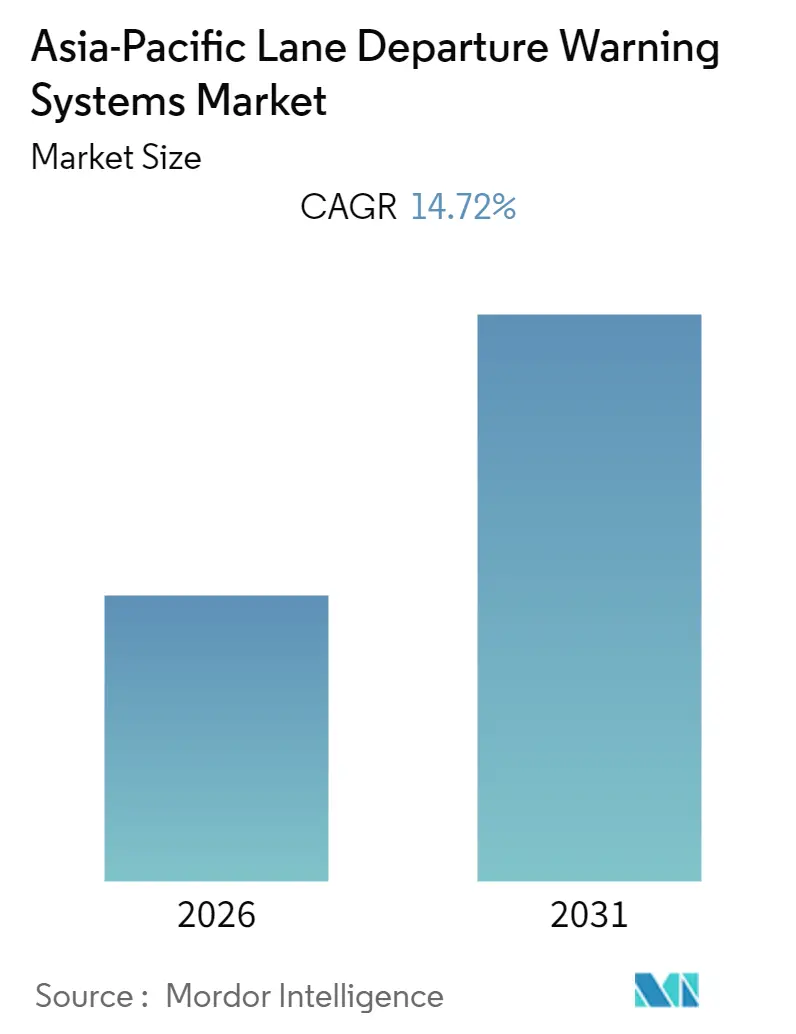
The Asia-Pacific Lane Departure Warning Systems Market size is expected to register a CAGR of 14.72% during the forecast period (2026-2031).
- The consistent increase in the number of vehicular accidents, primarily due to abrupt lane change, has led to concerns among both the consumers and governments across the world. Thus, in the automotive industry, technological advancements have been highly essential to reduce road accidents while enhancing passengers' and drivers' safety. Furthermore, rising safety concerns among the consumers have been propelling the need to implement advanced driver assistant systems (ADAS). This, in turn, has been driving the demand for lane departure warning systems (LDWS).
- The increasing adoption of advanced driver assist systems (ADAS) is expected to propel the LDWS market's growth. The income in the emerging economies, such as India and China, has been increasing, and the customers have been opting for expensive vehicles in luxury cars and SUV segments. This factor has been propelling the market growth for the automotive lane departure warning system.
- Vehicle OEMs are collaborating with technology companies to produce ADAS systems such as aane departure warning systems. For instance, in August 2020, Mitsubishi Fuso Truck and Bus Corporation (MFTBC) launched an all-electric light-duty truck eCanter with enhanced safety features. The Lane Departure Warning System (LDWS) detects lane deviation through a white line recognition camera. When the vehicle deviates from a lane without a turn signal, the system alerts the driver and displays a warning on the dashboard.
Note: Market size and forecast figures in this report are generated using Mordor Intelligence’s proprietary estimation framework, updated with the latest available data and insights as of 2026.
Asia-Pacific Lane Departure Warning Systems Market Trends and Insights
Growing Emphasis On Safety Solutions
With the growing safety concerns among both the consumers and governments across Asia-Pacific, the government and international organizations are enacting stringent safety regulations, which ensure the inclusion of ADAS in the vehicles for the passengers and driver's safety in developing countries, like India and China. As a result, many leading automakers are equipping vehicles with technologies such as the automotive lane departure warning system (ALWS).
Apart from safety concerns, a consistent rise in electric vehicles' sales is also providing significant growth opportunities to develop next-generation cars with advanced safety systems. Consequently, driving the need for lane departure warning systems. These systems work with sensors and cameras, assisting the drivers and aiding in reducing numerous unintended lane departures caused by distractions and drowsiness.
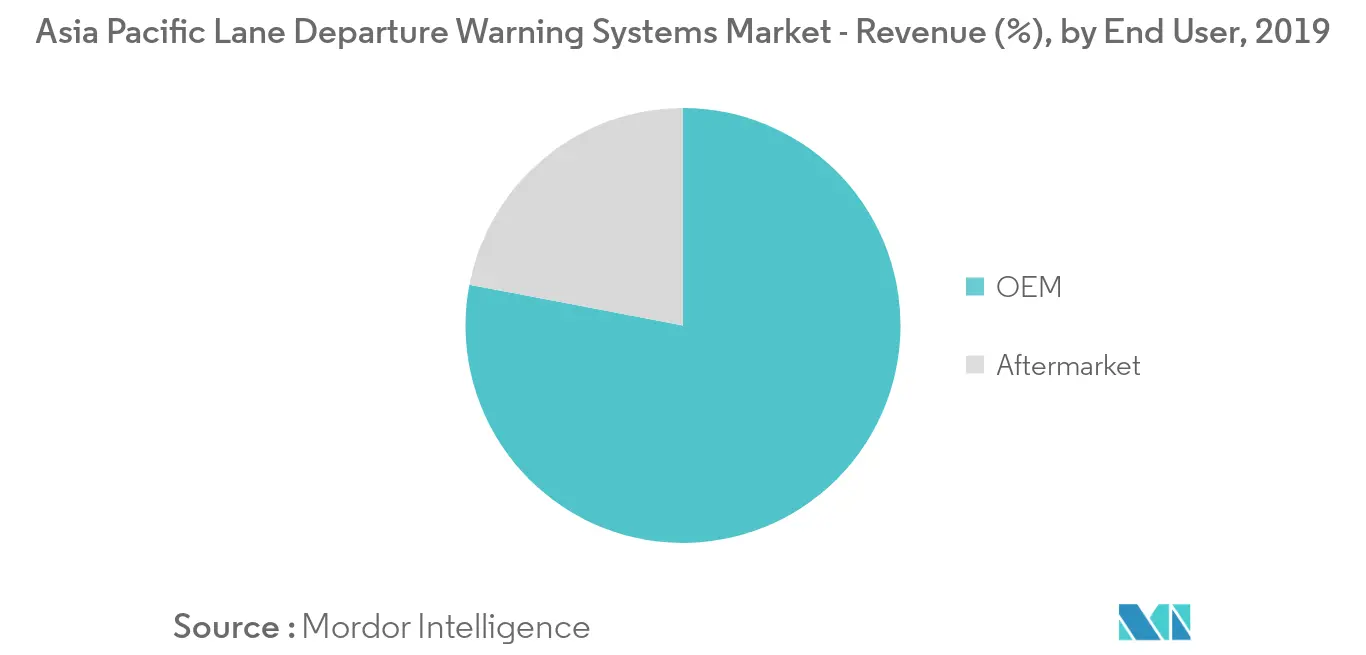
However, owing to high initial and maintenance costs, LDWS is currently available majorly for the luxury car segment. OEM's are collaborating with automotive safety system suppliers to bring down the system's value by incorporating the latest technologies. Reduction in the system's cost is expected to further drive the market in other developing countries such as Indonesia, Thailand, and other ASEAN countries.


South Korea will Witness Significant Growth in the Market
South Korea's automotive industry is one of the country's critical sectors, contributing over 10% to its GDP every year. Due to the increasing road accidents, the government implemented stringent safety regulations, which drive the LDWS market's growth.
Whereas, from January 2019, the government ordered that all new large passenger vehicles and trucks be fitted with Automated Emergency Braking (AEB) and Lane Departure Warning (LDW) systems. These factors are expected to contribute to the market's growth during the forecast period. The South Korean government's plan is to complete the communications, roads, and traffic infrastructures essential for completely autonomous driving by 2024. The government is also planning to promote hydrogen and electric vehicles so that they can account for more than 30 percent of new cars in South Korea in 2030.
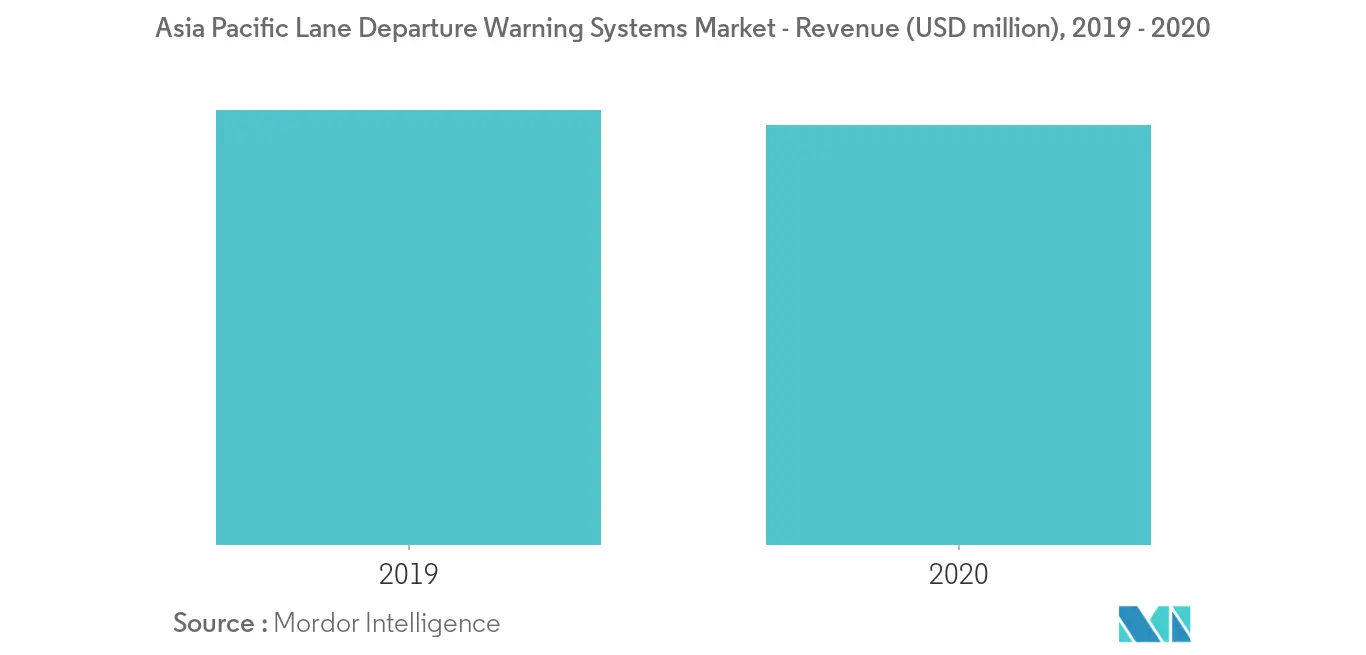
The lane departure warning systems market in South Korea has witnessed steady growth until the start of 2020. However, COVID 19 has hugely affected the market growth. Still, the restating of South Korea is expected to resume economic activities, and the country's lane departure warning market is expected to continue to pick up the pace.
Competitive Landscape
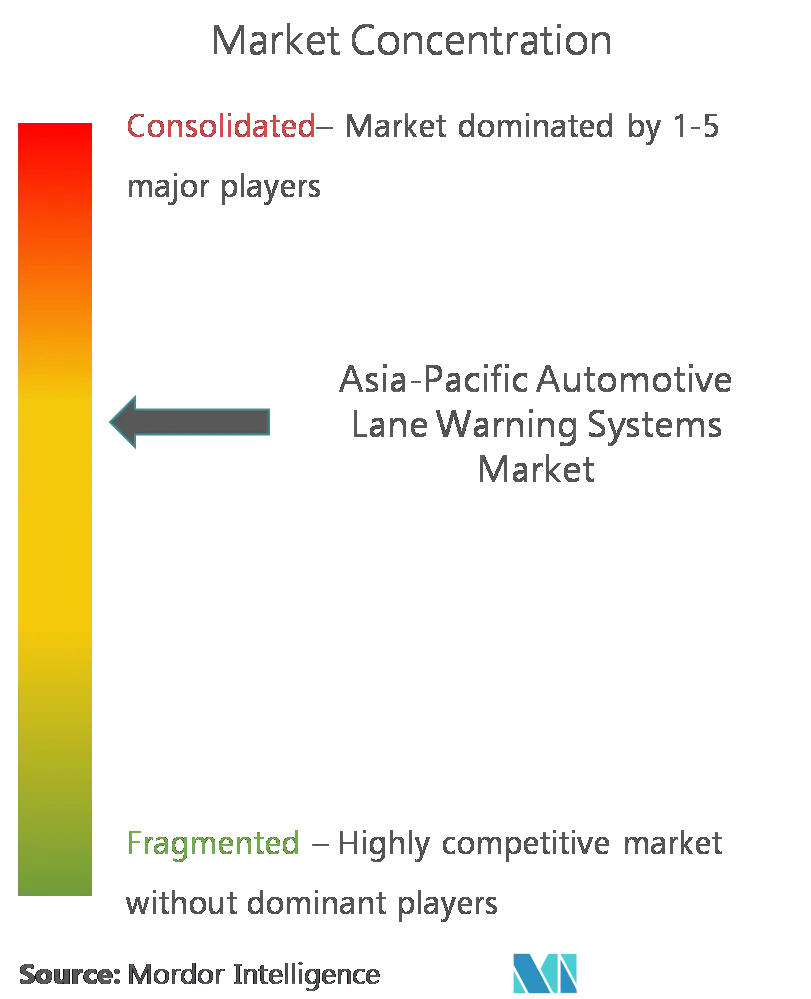
The Asia-Pacific lane departure warning systems market is dominated by various international and regional players such as Continental AG, Delphi Automotive, Robert Bosch Gmbh, and Mobileye. The APAC region has seen explosive growth in the last few decades, mostly contributed by China's huge automotive industry and, to a considerable extent, by the fast-growing Indian auto industry. Although due to US-China trade friction and COVID-19 halted the market's growth for a couple of years. The market will regain its momentum from 2021, as major players in the region are launching vehicles with lane departure warning systems, and various governing bodies are introducing various stringent regulations. For instance,
- In April 2020, SAIC-GM launched the all-new Buick GL8 Avenir in China. The Buick GL8 Avenir is a leading platform for innovation in China, with 20 advanced intelligent driving features that support the highest safety level. Aptiv's and SAIC-GM's software applications enable a full range of features such as Adaptive Cruise Control, Forward Collision Warning, Lane Change Assist, Traffic Jam Assist, and Door Open Warning.
- In June 2020, the UN announced more than 50 countries, including Japan, South Korea, and the EU member states, have agreed with standard regulations for vehicles that can take over some driving functions, including having lane-changing systems. The binding rules on Automated Lane Keeping Systems (ALKS) will come into force in January 2021. The measures were adopted by the United Nations Economic Commission for Europe (UNECE) World Forum for Harmonization of Vehicle Regulations, which brings together 53 countries, not just in Europe but also in Africa and Asia.
Asia-Pacific Lane Departure Warning Systems Industry Leaders
Denso Corporation
Delphi Automotive
Continental AG
Robert Bosch Gmbh
Mobileye
- *Disclaimer: Major Players sorted in no particular order

Market Opportunities and Future Outlook
Regulation-led fitment in commercial vehicles is creating a clearer pull-through for lane departure warning systems (LDWS) across Asia-Pacific supply chains and platforms. Australia is a concrete example, where Australian Design Rule ADR 99/01 (Lane Departure Warning Systems) took effect on 30 January 2025 for new model heavy vehicles and omnibuses above 3.5 tonnes GVM. The requirement aligns technical expectations with UN Regulation No. 130 and expands LDWS demand beyond premium passenger vehicles into higher-volume fleet procurement, benefiting suppliers that can deliver camera-based lane sensing, driver alerts, and validation or testing documentation as part of an integrated ADAS package.
On the passenger-vehicle side, OEM packaging of lane departure and road departure functions into mainstream nameplates supports higher attach rates and software-led upgrades. Honda documentation for the 2026 Civic Hatchback Hybrid describes a Road Departure Mitigation (RDM) system that monitors lane markings and pavement edges using a front wide-view camera, providing steering assistance and alerts. At the same time, technical whitespace remains in improving reliability under adverse conditions, since published research indicates LDWS performance is sensitive to weather and road-marking wear, which is pushing development toward more robust AI-assisted perception and tuning for local road environments.
Recent Industry Developments
- May 2026: Valeo announced it was selected by a leading automaker to deploy its VSS360 ADAS system in India, including lane departure warning functionality, with manufacturing referenced at its Sanand, Gujarat footprint. The award supports local sourcing and application engineering for ADAS in a cost-sensitive market, which can help shorten vehicle-program integration timelines and improve regional supply continuity.
- February 2026: Mobileye stated that Mahindra & Mahindra selected Mobileye SuperVision and Surround ADAS for at least six upcoming vehicle models, with production planned to begin in 2027. The program expands Mobileye penetration in India and links lane-related assistance functions to OEM platform roadmaps across multiple nameplates.
- October 2025: Mobileye signed an MoU with VVDN Technologies to localize production and testing of EyeQ family-based ADAS technologies in India. The agreement builds in-country capability for ADAS hardware and validation workflows, which can shorten development cycles for lane departure and related functions tailored to Indian driving conditions.


Research Methodology Framework and Report Scope
Market Definition and Coverage
This market covers the revenues generated from lane departure warning systems used in road vehicles across Asia-Pacific, including the hardware and software needed to detect lane markings and provide driver warnings or lane keeping support.
Scope exclusions: It does not count broader ADAS features that are not tied to lane departure and lane keeping functions, such as parking assist or adaptive cruise control.
Segmentation Overview
- Function Type
- Lane Departure Warning
- Lane Keeping Assist
- Sensor Type
- Video Sensors
- Laser Sensors
- Infrared Sensors
- Sales Channel Type
- OEM
- Aftermarket
- Vehicle Type
- Passenger Cars
- Commercial Vehicles
- Geography
- China
- Japan
- India
- South Korea
- Rest of Asia-Pacific
Data Sources, Market Sizing, and Validation
Desk Research
Desk research was used to set the factual base for the model, especially on vehicle production, sales, and safety regulation timelines across major APAC countries. We relied on public sources such as national transport ministries, road safety agencies, customs and trade statistics portals, and automotive industry associations, then complemented this with peer reviewed papers that track ADAS feature adoption and camera based sensing performance.
To connect market demand with supplier capacity and pricing logic, we reviewed filings and presentations from listed automotive and electronics companies, along with reputable automotive press releases and regulatory notices. Select paid subscriptions for company financials and intelligence, plus patent databases, were used to verify product roadmaps and to avoid missing relevant system variants. These sources are illustrative, and other public references were also used for cross checks, clarification, and validation during the work.
Primary Interviews and Surveys
Primary work focused on confirming adoption curves for lane warning features by vehicle class, and on validating OEM fitment patterns versus aftermarket penetration across Asia-Pacific. We spoke with a mix of component ecosystem participants, vehicle program stakeholders, and channel side experts in APAC, and this input was used to refine gaps in ASP movement, take rate assumptions, and regulation led timing shifts.
Distribution of primary research fieldwork respondents
| Company type | Respondent position |
|---|---|
| Top tier: 32% | CXOs: 14% |
| Mid tier: 48% | Functional/Unit leaders: 33% |
| Smaller Players: 20% | Managers: 53% |
Market-Sizing & Forecasting
Sizing starts from a top-down build that uses APAC vehicle production and sales by country, and then applies lane departure feature take rates by vehicle type and sales channel to reconstruct the addressable demand pool. Into this, we layer the typical bill of materials split (camera and sensing content, processing, software, and integration) and the share of lane departure warning versus lane keeping function shipped in new vehicles.
To keep the totals realistic, the numbers are cross checked using selective bottom-up approximations, such as sampled OEM fitment content per model line, channel checks on aftermarket kits, and a volume times ASP build for a subset of countries where data is clearer. Key inputs that move the model include new passenger car and commercial vehicle sales, APAC safety regulation enforcement timing, camera module and ECU ASP trends, the pace of lane keeping assist feature bundling, and the share of OEM factory fit versus retrofit demand. Where direct inputs are missing, gaps are handled by using proxy adoption from similar vehicle classes, and then corrected through expert feedback.
For forecasting, scenario analysis is used so that policy enforcement, consumer safety feature preference, and pricing erosion can be flexed without breaking the logic. Assumptions are then tuned using interview consensus on expected fitment growth, platform refresh cycles, and likely sensor mix changes over the forecast window.
Data Validation & Update Cycle
Outputs are checked against independent signals like country vehicle sales trends, ADAS penetration commentary from public sources, and the implied content per vehicle so the totals stay grounded. If the model produces jumps that cannot be explained by regulation timing, platform launches, or pricing moves, the drivers are revisited and the assumptions are re-tested with additional callbacks.
Before sign-off, the work goes through multi-step analyst reviews, including variance checks across countries and vehicle types, plus consistency checks between historical years and the start of the forecast. Reports are refreshed annually, and interim updates are made when material events occur, such as a major regulation change or a meaningful shift in vehicle production outlook. Right before delivery, a final pass is completed to ensure the latest public data and confirmed assumptions are reflected.
Mordor Intelligence's Asia Pacific Lane Departure Warning Systems Market Size Compared Against Other Published Estimates
It is normal to see different market size numbers published for lane departure warning systems, even when the region name looks the same. The differences usually come from what each study counts inside the system boundary, what year is treated as the base, and how quickly pricing and fitment rates are assumed to change.
Vehicle sales by country, observed OEM feature fitment on new model launches, and a check on camera and ECU content per vehicle are the evidence points that keep Mordor Intelligence tied to the APAC demand pool for lane departure and lane keeping functions only. Other estimates can move away from this when they bundle wider ADAS features, apply slower ASP erosion, or extend the forecast window and then report a higher year as the headline size.
Benchmark comparison
| Source | Market Size | Gaps in Research Methodology |
|---|---|---|
| Mordor Intelligence | USD 0.00 B (2024) | |
| Regional Consultancy A | USD 4.37 B (2024) | This figure is presented with a broader study frame and can reflect a wider bundle of lane safety functions across APAC, with limited visibility on OEM fitment checks by country and on how ASP erosion is applied year to year. |
| Industry Publisher B | USD 4.60 B (2024) | The estimate appears to use a longer study window and a different base year structure, and the sizing can be pushed up if lane keeping assist and adjacent ADAS content are counted more fully within the same headline market. |
Across the table, the spread is mainly explained by scope boundaries and the way adoption and pricing are projected through time. Our approach stays traceable because each country total can be reproduced from vehicle volumes, take rates, and an explicit ASP path that is reviewed through primary feedback.


Key Questions Answered in the Report
What is the current Asia-Pacific Lane Departure Warning Systems Market size?
The Asia-Pacific Lane Departure Warning Systems Market is projected to register a CAGR of 14.72% during the forecast period (2026-2031)
Who are the key players in Asia-Pacific Lane Departure Warning Systems Market?
Denso Corporation, Delphi Automotive, Continental AG, Robert Bosch Gmbh and Mobileye are the major companies operating in the Asia-Pacific Lane Departure Warning Systems Market.
What years does this Asia-Pacific Lane Departure Warning Systems Market cover?
The report covers the Asia-Pacific Lane Departure Warning Systems Market historical market size for years: 2019, 2020, 2021, 2022, 2023 and 2024. The report also forecasts the Asia-Pacific Lane Departure Warning Systems Market size for years: 2026, 2027, 2028, 2029, 2030 and 2031.
Page last updated on:





