
| Study Period | 2019 - 2030 |
| Forecast Data Period | 2025 - 2030 |
| Historical Data Period | 2019 - 2023 |
| Market Size (2025) | USD 48.36 Billion |
| Market Size (2030) | USD 118.27 Billion |
| CAGR (2025 - 2030) | 19.60% |
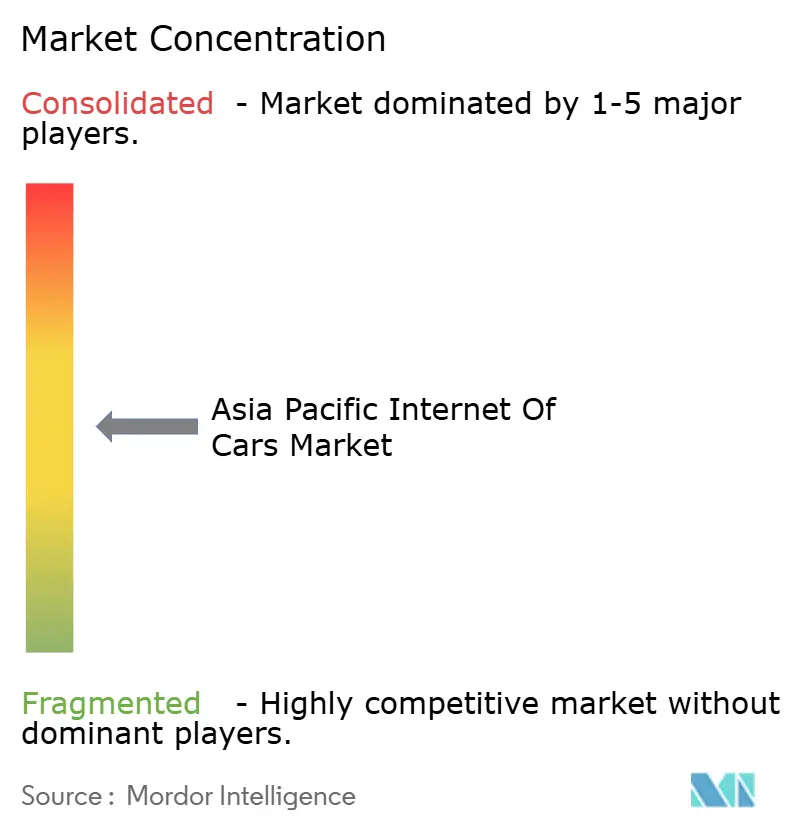
| Market Concentration | Medium |
Major Players *Disclaimer: Major Players sorted in no particular order |
Asia Pacific Internet Of Cars Market Analysis by Mordor Intelligence
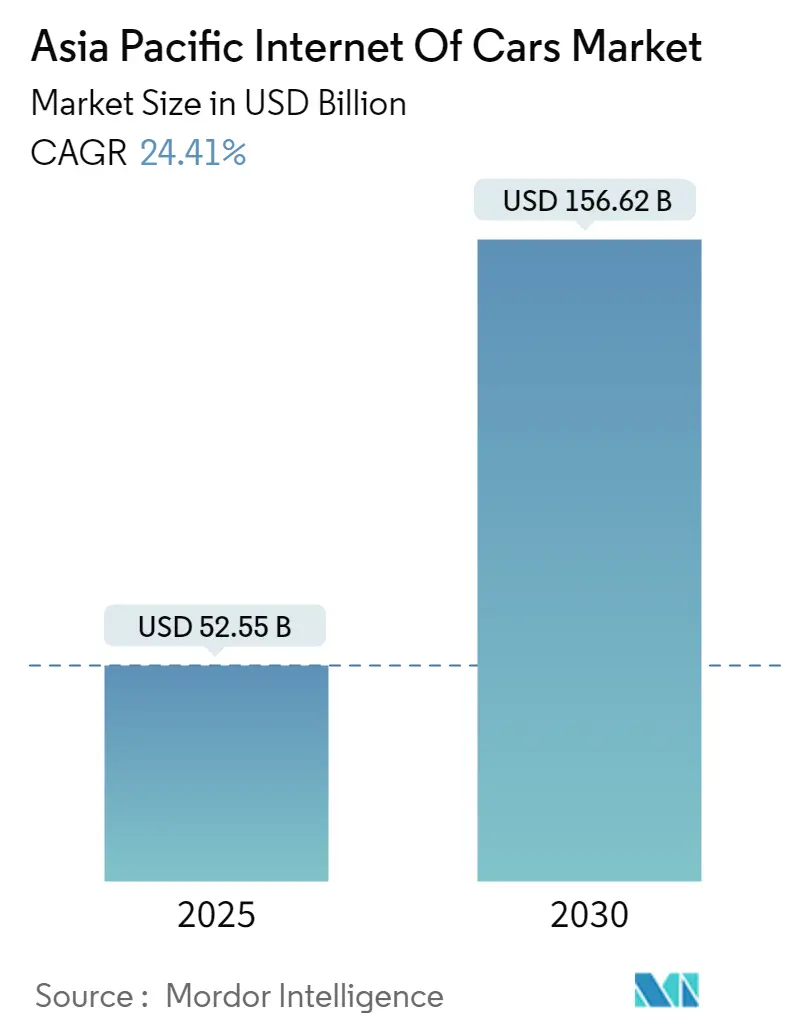
The Asia Pacific Internet Of Cars Market size is estimated at USD 52.55 billion in 2025, and is expected to reach USD 156.62 billion by 2030, at a CAGR of 24.41% during the forecast period (2025-2030).
- Internet-connected vehicles, often dubbed the "Internet of Cars," utilize internet connectivity to engage with external systems. These systems encompass applications for unlocking vehicles, GPS navigation, and vehicle-to-vehicle communication. Such vehicles can identify potential hazards and communicate this data to nearby cars, thereby diminishing accident risks. They also provide access to a plethora of online services, including live traffic updates, weather forecasts, and real-time GPS navigation. By processing data from diverse sources, these cars pave the way for autonomous driving, significantly enhancing road safety. Furthermore, they can evaluate driving habits and offer insights on fuel efficiency, leading to cost savings and a smaller ecological footprint.
- The swift uptake of 5G technology is propelling the Internet of Cars market in the Asia Pacific region. Boasting ultra-fast data speeds, minimal latency, and broad connectivity, 5G networks facilitate smooth communication between vehicles, infrastructure, and cloud services. This robust connectivity underpins real-time vehicle-to-everything (V2X) interactions, bolstering applications like autonomous driving, predictive maintenance, and advanced navigation. Nations like China, South Korea, Japan, and India are fervently bolstering their 5G infrastructure. For instance, as of March 2025, China's Ministry of Industry and Information Technology (MIIT) highlighted the establishment of over 4.39 million 5G base stations nationwide. This expansive 5G network availability is prompting automakers to embed 5 G-compatible modules in their latest vehicles, hastening the embrace of Internet of Cars technologies.
- Additionally, partnerships between automakers, telecom giants, and tech firms are propelling market expansion. In the Asia Pacific, these collaborations are pivotal in crafting cohesive connected car solutions. For instance, in September 2024, Hyundai Motor Group from South Korea joined forces with Samsung Electronics, harnessing Samsung's SmartThings IoT platform to bolster connected vehicle technology. Hyundai's premier divisions, including Hyundai Motor Co., Kia Corp., and the self-driving tech affiliate 42dot Inc., are synergizing with Samsung to elevate the automaker's software-defined vehicles (SDVs). Such collaborations meld the strengths of automakers, telecom networks, and tech software, fostering a holistic connected car ecosystem and expediting feature rollouts.
- At the heart of this transformation lie technological breakthroughs. Innovations in AI, machine learning, and the Internet of Things (IoT) are redefining vehicle functionalities. Owing to superior sensors, advanced communication frameworks, and data analytics, connected cars deliver real-time traffic insights, remote diagnostics, and autonomous driving features. This tech boom is driving manufacturers to invest heavily in these advancements.
- Yet, the adoption of these state-of-the-art technologies isn't without its challenges. The incorporation of premium hardware and software can escalate vehicle prices, potentially sidelining budget-sensitive buyers. This concern is magnified in the region's emerging markets, where consumers are particularly price-conscious.
- As vehicles become more interconnected, they inadvertently become susceptible to cyber threats. Protecting vehicle data and communication channels is paramount. However, numerous manufacturers may lack the necessary expertise or resources to navigate these complexities. Such deficiencies could hinder the widespread acceptance of Internet of Cars technologies, especially if safety apprehensions linger among consumers.
- As disposable incomes rise and the middle class expands, the Asia Pacific is solidifying its status as a pivotal center for the automotive industry. The region's economic growth is fostering increased purchasing power, enabling consumers to invest in advanced vehicle technologies. This growing demand for innovative automotive solutions is creating significant opportunities for market players to introduce cutting-edge products and expand their presence in the region.
Asia Pacific Internet Of Cars Market Trends and Insights
Hardware Component Segment is Expected to Hold a Significant Market Share
- As consumers increasingly seek features such as navigation, entertainment, and real-time updates, the region witnesses a surge in the adoption of connected vehicles. Modern consumers desire their vehicles to provide seamless connectivity, much like their smartphones. In response, manufacturers are embedding advanced hardware, encompassing infotainment systems, GPS modules, and communication devices. The burgeoning popularity of mobile applications that connect with vehicles further heightens the demand for these sophisticated hardware solutions.
- Government initiatives play a crucial role in driving this momentum. Countries across the Asia-Pacific, including India, China, South Korea, Thailand, and Singapore, are actively embracing smart transportation systems. Their goals are clear: enhance urban mobility, reduce congestion, and improve safety. A case in point is the Union Budget for FY 2024-25, where Indian officials allocated INR 1,300 crores (~USD 151.94 million) for the PM e-Bus Sewa scheme. This funding will introduce 1,000 new e-buses in FY 2024-25 across various cities, elevating the total to 1,500 since the scheme's inception. Such governmental undertakings often involve substantial infrastructure investments, emphasizing smart traffic management and vehicle-to-infrastructure communication technologies. As a result, there's a heightened demand for crucial hardware components, like sensors and communication modules, essential for achieving these smart transportation goals.
- Technological advancements are further fueling the growth of the hardware component segment. Innovations in sensors, cameras, and communication technologies not only enhance vehicle capabilities but also boost the demand for cutting-edge hardware. Take, for instance, the advancement of LiDAR and radar systems in autonomous vehicles, which rely on high-performance hardware for rapid data processing. As manufacturers aim to differentiate their offerings with leading-edge technology, the need for advanced hardware becomes even more pressing.
- The expanding electric vehicle (EV) market serves as a significant driver for this segment's growth. Countries such as China, India, South Korea, and various Southeast Asian nations are witnessing a pronounced uptick in EV adoption. With more consumers transitioning to electric vehicles, there's a heightened demand for specialized hardware. This is particularly evident for components like battery management systems, charging interfaces, and vehicle-to-everything (V2X) communications. Addressing the unique requirements of EVs—like energy efficiency and real-time performance monitoring—demands robust hardware solutions.
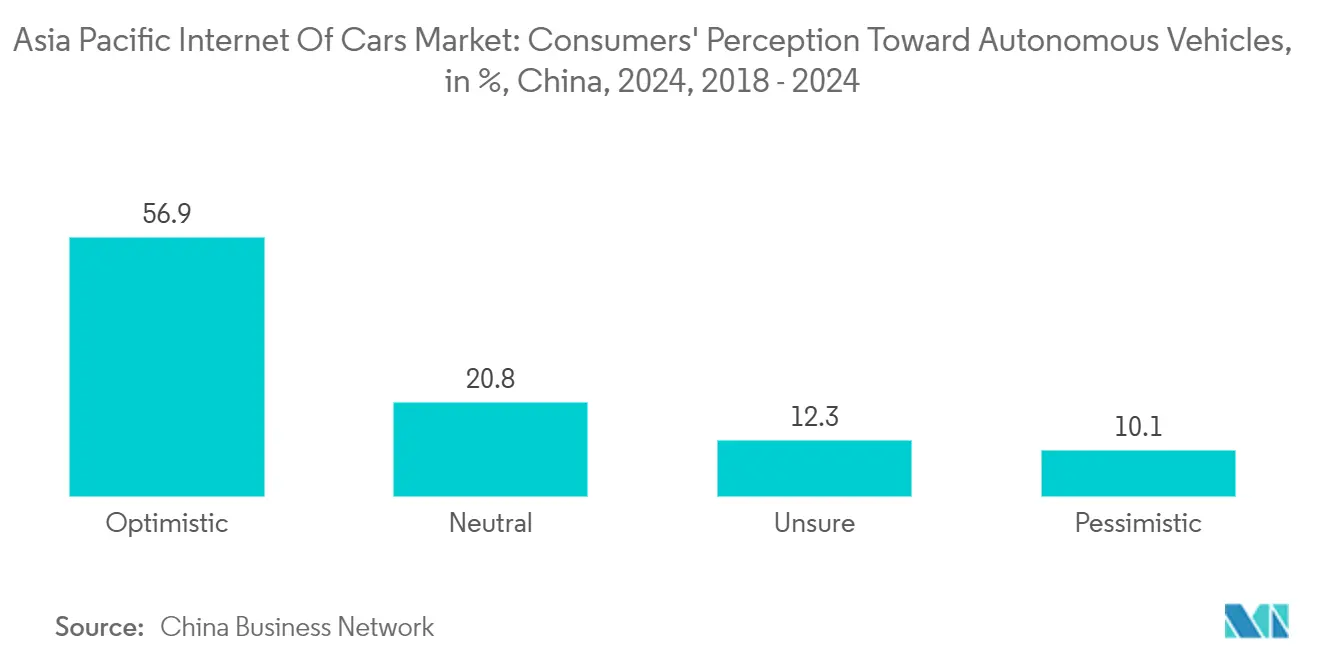
- Moreover, the growing awareness and acceptance of autonomous vehicles are fostering a conducive environment for the segment's expansion. A 2024 survey by China Business Network highlights this trend, revealing that 56.9% of Chinese respondents are in favor of autonomous vehicles.


China is Expected to Hold a Significant Market Share
- China is poised to spearhead the Asia-Pacific market, propelled by the incorporation of cutting-edge connectivity features in its latest car models. Bolstered by a dedicated Industrial Strategy, robust backing from the Central Government, and strategic investments, China's burgeoning domestic market is set to dominate the connected vehicle sector, leveraging its prowess in ICT, data processing, and platform services. The country's strategic focus on fostering innovation and technological advancements has positioned it as a global leader in the connected vehicle ecosystem, with significant contributions to the development of smart mobility solutions.
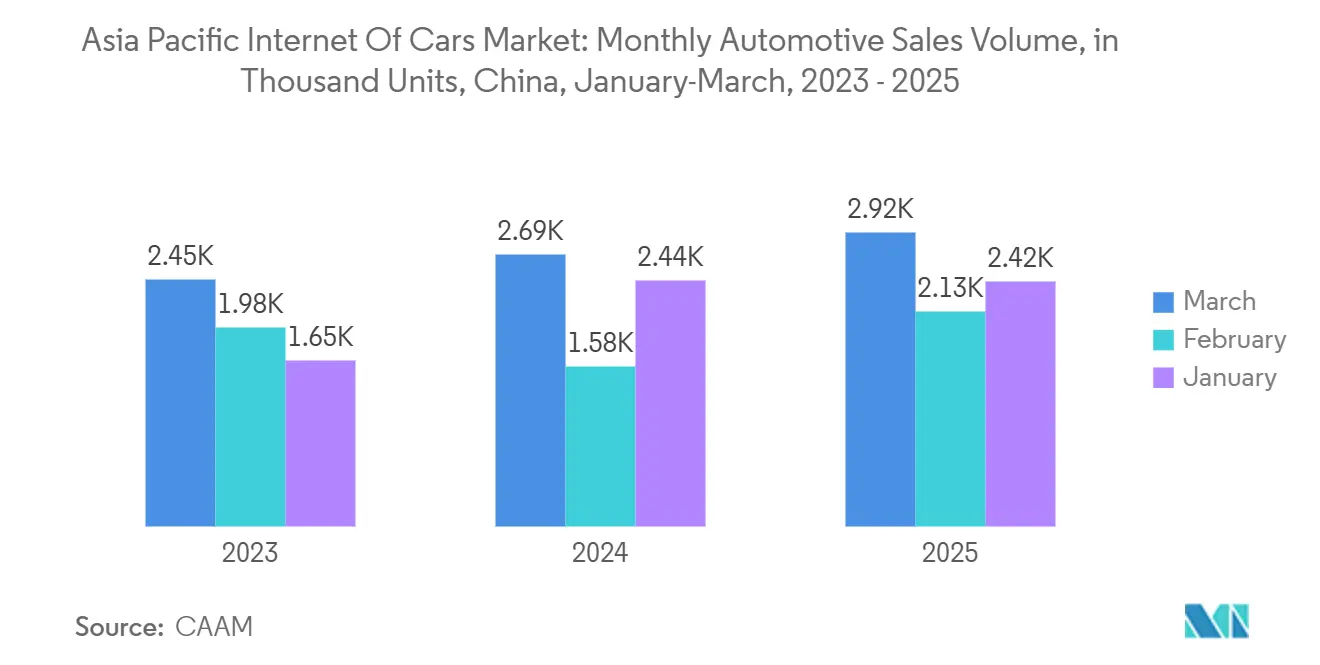
- With automotive sales on the rise, China's market is primed for growth in the coming years. Data from the China Association of Automobile Manufacturers (CAAM) reveals that in March 2025, vehicle sales in China hit 2.915 million units, reflecting an 8.2% increase from the previous year. This growth is indicative of the increasing demand for technologically advanced vehicles. As connected technologies and the Internet of Things (IoT) gain momentum, China's automotive sector is capitalizing on these advancements and seizing innovative opportunities. The integration of IoT in vehicles is enabling features such as real-time navigation, predictive maintenance, and enhanced driver assistance systems, further driving consumer interest.
- The uptick in electric and autonomous vehicle adoption in China signals a burgeoning acceptance of cutting-edge technologies among its citizens. Many contemporary electric vehicles, now equipped with cloud-driven connected technologies, underscore the public's increasing affinity for these advanced features. This trend indicates a shift in consumer preferences toward vehicles that offer enhanced connectivity, energy efficiency, and autonomous capabilities, aligning with the global push for sustainable and smart transportation solutions.
- In the developing nation of China, advancements in communication and information technology infrastructure, especially with the rollout of 5G and 4G LTE, are poised to amplify the demand for connected cars. These advancements are enabling more reliable and faster data transmission, which is critical for the seamless operation of connected vehicle technologies. This demand is further invigorated by stringent safety regulations, a heightened emphasis on security and authorization, and a suite of supportive government policies. The government's proactive measures, such as subsidies for electric vehicles and investments in smart city initiatives, foster an environment conducive to the connected car market' growth.

Competitive Landscape
In the Asia-Pacific Internet of Cars market, a semi-consolidated landscape is emerging, populated by various global players. With the region witnessing a surge in demand for connected systems and the Internet of Things, car manufacturers are forging joint ventures, entering partnerships, and rolling out technologically advanced products to outpace their rivals. This strategic maneuvering also involves laying the groundwork for anticipated features and technologies set to revolutionize the automotive sector.
Key players in the Asia-Pacific internet of cars market encompass industry giants like Cisco Systems, Inc., Google LLC (a subsidiary of Alphabet Inc.), IBM Corporation, AT&T Communications Inc., and Verizon Communications Inc. These entities boast robust brand recognition and a vast global footprint, allowing them to capture a significant slice of the market. A commitment to innovation, a diverse product lineup, and a resilient distribution network underscores their prowess. To further bolster their market position, these leaders frequently pursue strategic acquisitions and forge partnerships.
For companies eyeing success in the Asia-Pacific Internet of Cars arena, a steadfast commitment to innovation is paramount. Moreover, broadening their component offerings will be vital for nurturing enduring relationships and ensuring repeat business. Firms that channel investments into emerging markets and tailor their products to resonate with regional demands stand poised to carve out a competitive edge.
Asia Pacific Internet Of Cars Industry Leaders
Cisco Systems, Inc.
Google LLC (Alphabet Inc.)
IBM Corporation
AT&T Communications Inc.
Verizon Communications Inc.
- *Disclaimer: Major Players sorted in no particular order

Recent Industry Developments
- November 2024: At the "Integrated Development of Vehicle-Road-Cloud" forum, China Unicom unveiled its "Integrated Solution 3.0" tailored for intelligent connected vehicles. This advanced solution, a culmination of roadside sensing, edge computing, and cloud-based data fusion, champions seamless collaboration among vehicles, infrastructure, and cloud systems. Harnessing its expertise in the internet of vehicles (IoV) sector, China Unicom's solution establishes a multitiered computing system, a unified security platform, a digital twin system, and a robust testing and certification framework, propelling the industrialization of vehicle-road-cloud integration for intelligent connected vehicles (ICVs).
- October 2024: Bharti Airtel's B2B division, Airtel Business, partnered with automaker Kia India to deliver IoT connectivity solutions for Kia's next-gen platform, Kia Connect 2.0. Through this collaboration, Kia will leverage Airtel Business' IoT Hub, which provides tailored IoT solutions spanning 5G, 4G, NB-IoT, 2G, and satellite networks. Additionally, the IoT Hub boasts advanced analytics and offers real-time insights from data gathered by connected devices. Kia Connect 2.0 aims to equip Kia vehicles with features such as vehicle management, AI voice commands, remote control, safety, security, and navigation.


Asia Pacific Internet Of Cars Market Report Scope
Known as the "Internet of Cars" or the Internet of Vehicles (IoV), this network links vehicles not only to each other but also to the internet and infrastructure elements like traffic lights and roadside units. Such connectivity facilitates smooth data exchanges, enhancing safety, efficiency, and the overall driving experience. The study monitors the revenue from IoT integrations and subscription services for the Internet of Cars in the Asia-Pacific region. This spans various vehicle categories, including passenger cars, light and heavy commercial vehicles, defense units, all-terrain vehicles, and more. Additionally, the report delves into current and emerging trends, spotlighting recent technological strides in car IoT implementations.
The market is segmented by vehicle type (passenger cars, light commercial cars, heavy commercial vehicles, defense vehicles, all-terrain vehicles, and others), components (hardware, software, service), technology (Wi-Fi, Bluetooth, NFC, cellular, other technology types), communication equipment (car-to-car, car-to-infrastructure, and other communication equipment), and country. The market sizes and forecasts are provided in terms of value (USD) for all the above segments.
By Vehicle Type
| Passenger Cars |
| Light Commercial Cars |
| Heavy Commercial Vehicles |
| Defense Vehicles |
| All-Terrain Vehicles |
| Others |
By Component
| Hardware |
| Software |
| Service |
By Technology
| Wi-Fi |
| Bluetooth |
| NFC |
| Cellular |
| Other Technology Types |
By Communication Equipment
| Car-to-Car |
| Car-to-Infrastructure |
| Other Communication Equipment |
By Country***
| China |
| India |
| Japan |
| South Korea |
| By Vehicle Type | Passenger Cars |
| Light Commercial Cars | |
| Heavy Commercial Vehicles | |
| Defense Vehicles | |
| All-Terrain Vehicles | |
| Others | |
| By Component | Hardware |
| Software | |
| Service | |
| By Technology | Wi-Fi |
| Bluetooth | |
| NFC | |
| Cellular | |
| Other Technology Types | |
| By Communication Equipment | Car-to-Car |
| Car-to-Infrastructure | |
| Other Communication Equipment | |
| By Country*** | China |
| India | |
| Japan | |
| South Korea |


Key Questions Answered in the Report
How big is the Asia Pacific Internet Of Cars Market?
The Asia Pacific Internet Of Cars Market size is expected to reach USD 48.36 billion in 2025 and grow at a CAGR of 19.60% to reach USD 118.27 billion by 2030.
What is the current Asia Pacific Internet Of Cars Market size?
In 2025, the Asia Pacific Internet Of Cars Market size is expected to reach USD 48.36 billion.
Who are the key players in Asia Pacific Internet Of Cars Market?
Cisco Systems, Inc., Google LLC (Alphabet Inc.), IBM Corporation, AT&T Communications Inc. and Verizon Communications Inc. are the major companies operating in the Asia Pacific Internet Of Cars Market.
What years does this Asia Pacific Internet Of Cars Market cover, and what was the market size in 2024?
In 2024, the Asia Pacific Internet Of Cars Market size was estimated at USD 38.88 billion. The report covers the Asia Pacific Internet Of Cars Market historical market size for years: 2019, 2020, 2021, 2022, 2023 and 2024. The report also forecasts the Asia Pacific Internet Of Cars Market size for years: 2025, 2026, 2027, 2028, 2029 and 2030.
Page last updated on:
Asia Pacific Internet Of Cars Market Report
Statistics for the 2025 Asia Pacific Internet Of Cars market share, size and revenue growth rate, created by Mordor Intelligence™ Industry Reports. Asia Pacific Internet Of Cars analysis includes a market forecast outlook for 2025 to 2030 and historical overview. Get a sample of this industry analysis as a free report PDF download.


 Your data is secure and never sold or shared.


