
Market Overview
| Study Period | 2019 - 2031 |
|---|---|
| Forecast Data Period | 2026 - 2031 |
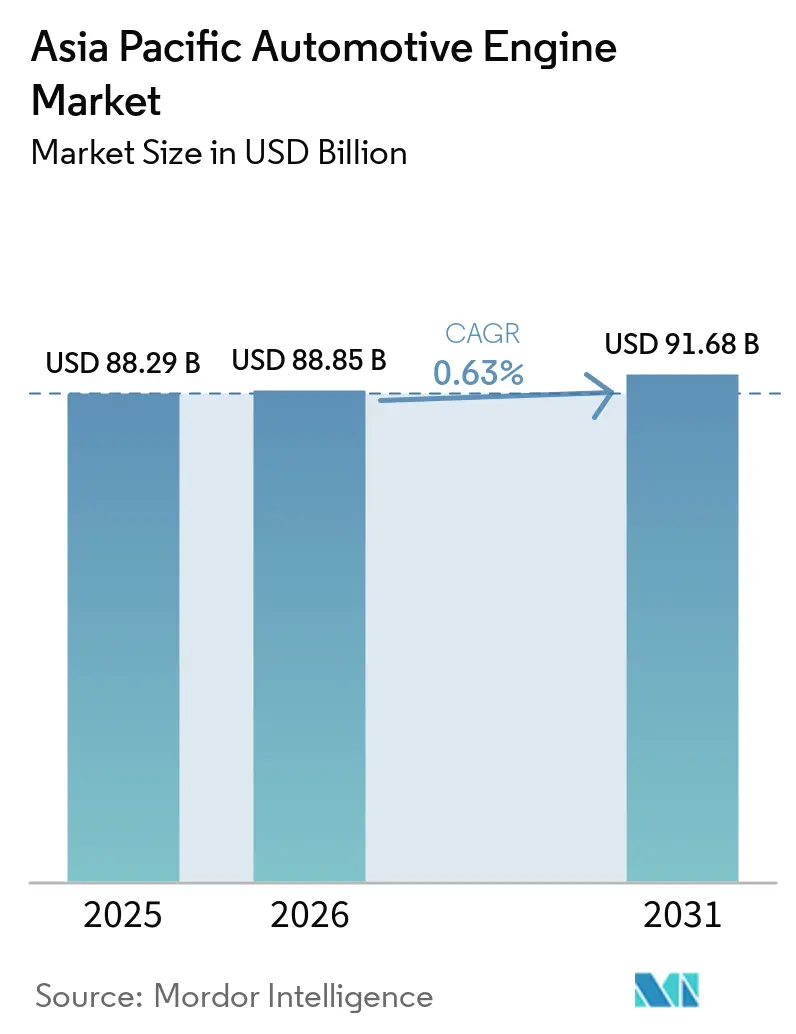
| Base Year Market Size (2025) | USD 88.29 Billion |
| Market Size (2026) | USD 88.85 Billion |
| Market Size (2031) | USD 91.68 Billion |
| Growth Rate (2026 - 2031) | 0.63 % |
| Market Concentration | Medium |
Major Players *Disclaimer: Major Players sorted in no particular order Image © Mordor Intelligence. Reuse requires attribution under CC BY 4.0. | |
Asia Pacific Automotive Engine Market Analysis by Mordor Intelligence
The Asia Pacific Automotive Engine Market size was valued at USD 88.29 billion in 2025, and is expected to reach USD 88.85 billion in 2026, and is projected to reach USD 91.68 billion by 2031, at a CAGR of 0.63% during the forecast period (2026-2031). Low single-digit growth reflects an industry juggling steady replacement demand with the rapid spread of battery-electric vehicles. Commercial-fleet expansion in China and India keeps absolute engine volumes stable, yet accelerating zero-emission adoption trims long-term upside for internal-combustion platforms. Tightening emission rules across China, India, Japan, and South Korea are reshaping product roadmaps toward smaller turbocharged units, higher-value hybrid architectures, and emerging hydrogen combustion solutions. Localization of smart machining in Thailand and Vietnam is lowering scrap rates and energy use, improving supplier profitability even as overall engine margins compress. Meanwhile, hydrogen-ICE pilots in South Korea and Chinese ports signal fresh commercial niches, while metro-level ICE bans and fuel-price swings push urban operators toward electric two-wheeler and delivery fleets.
Key Report Takeaways
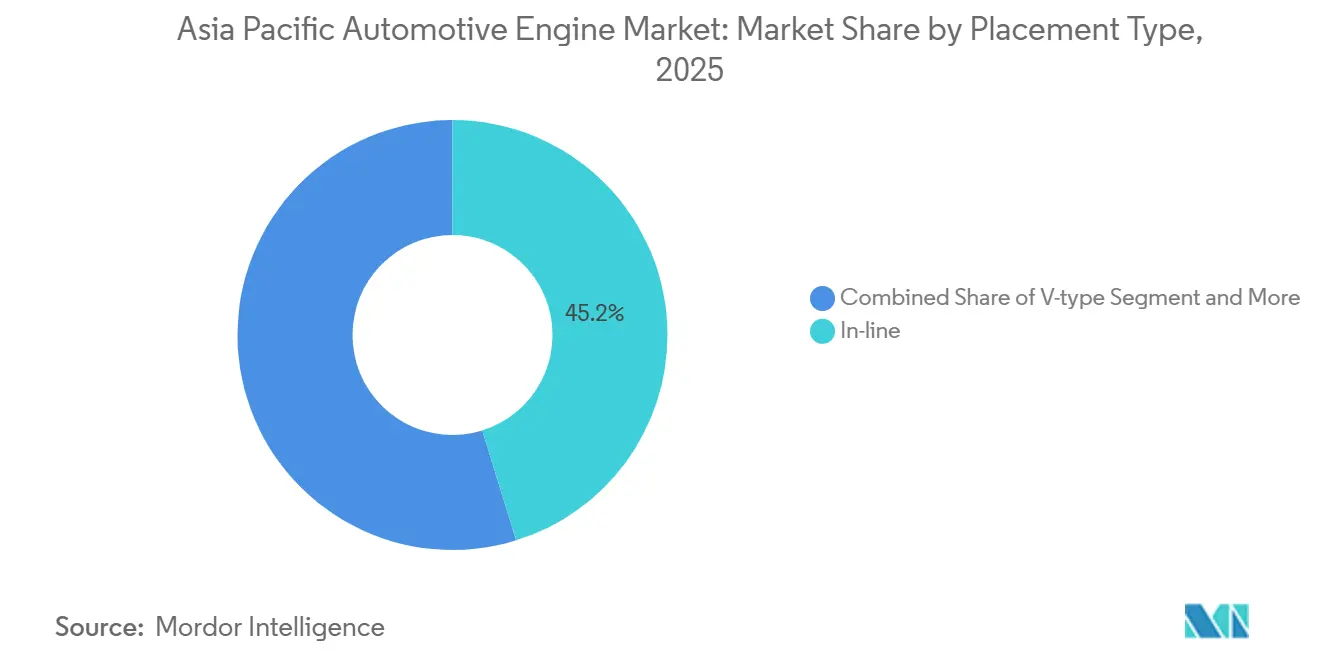
- By placement type, in-line engines led with 45.16% of the Asia Pacific automotive engine market share in 2025, while opposed-piston configurations record the highest projected CAGR at 1.67% through 2031.
- By fuel type, gasoline engines captured 46.18% revenue share in 2025; hydrogen ICE is projected to advance at a 1.75% CAGR to 2031.
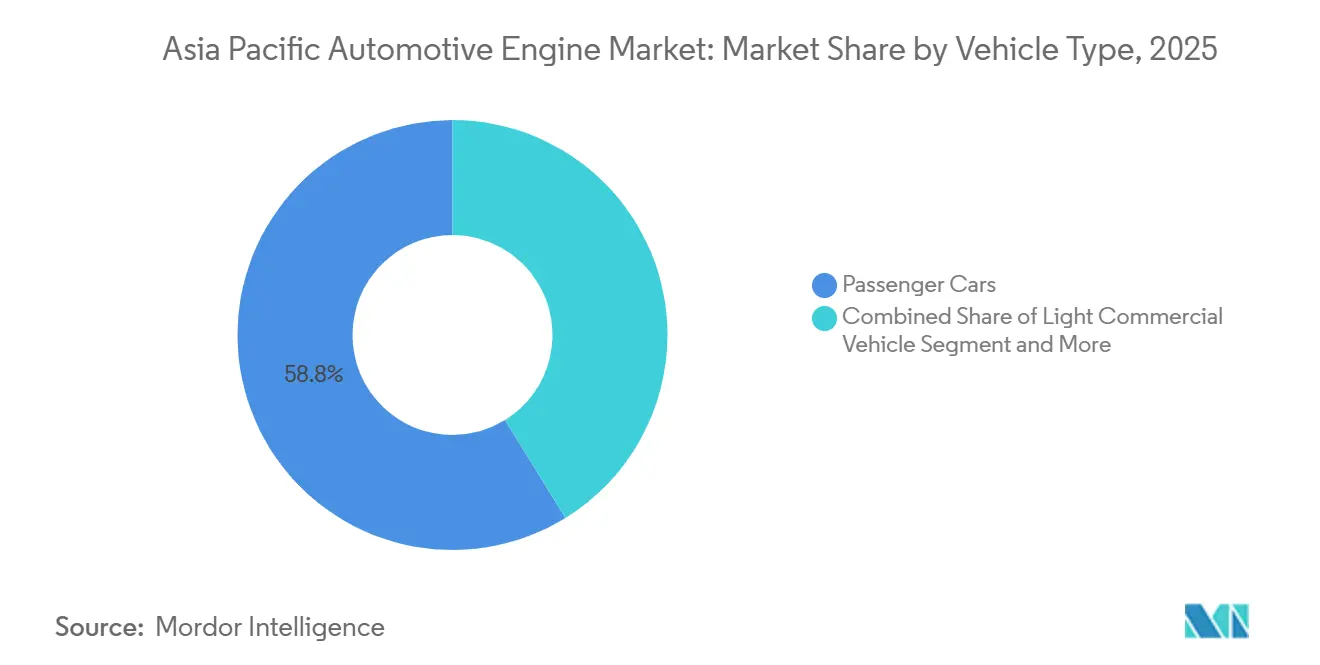
- By vehicle type, passenger cars held a 58.81% share of the Asia Pacific automotive engine market size in 2025, yet medium and heavy commercial vehicles exhibit the fastest 2.69% CAGR to 2031.
- By engine capacity, the 1.5-to-3-liter band accounted for 37.73% of the Asia Pacific automotive engine market size in 2025, while the over-3-liter segment posts the quickest 2.78% CAGR through 2031.
- By country, China commanded 34.27% revenue share of the Asia Pacific automotive engine market size in 2025 and is expanding at a 1.72% CAGR through 2031.
Note: Market size and forecast figures in this report are generated using Mordor Intelligence’s proprietary estimation framework, updated with the latest available data and insights as of 2026.
Market Trends and Insights
Drivers Impact Analysis of Asia Pacific Automotive Engine Market*
| Driver | (~) % Impact on CAGR Forecast | Geographic Relevance | Impact Timeline |
|---|---|---|---|
| Rapid Growth in OEM Production and Vehicle PARC | +0.2% | China, India, ASEAN (Indonesia, Thailand, Vietnam) | Medium term (2-4 years) |
| Stringent Regional Emission Norms | +0.1% | China, India, Japan, South Korea | Short term (≤ 2 years) |
| Localization Race for AI-Driven Smart Machining of Engine Blocks | +0.1% | ASEAN core (Thailand, Vietnam), spill-over to India | Long term (≥ 4 years) |
| Exploding Ride-Hailing/Delivery Aftermarket | +0.1% | India, Indonesia, Philippines, Vietnam | Short term (≤ 2 years) |
| Public Grants for Hydrogen-ICE R&D | +0.1% | South Korea, China (port cities: Shanghai, Shenzhen, Qingdao) | Medium term (2-4 years) |
| Government Pilots for Low-Carbon Synthetic Fuels | +0.0% | Japan, Australia, limited South Korea | Long term (≥ 4 years) |
| Source: Mordor Intelligence | |||
Rapid Growth in OEM Production and Vehicle Parc Across Emerging Asia Pacific Economies
China experienced a notable increase in passenger vehicle production, reflecting steady growth compared to the previous year. India also achieved significant production growth, supported by the reopening of rural credit lines. Indonesia and Thailand, leveraging tariff advantages, collectively expanded their vehicle assembly operations, with Japanese and Chinese brands establishing knock-down lines. By 2025, the vehicle parc in the region reached a substantial level, driving strong aftermarket demand for engines, particularly those within the mid-life age range. In response to varying fuel-quality and testing standards, automakers have introduced "India-spec" and "China-spec" engines. These engines feature locked ECU firmware, resulting in fragmented supply chains and increased engineering budgets. Such developments ensure that the Asia Pacific automotive engine market remains closely tied to replacement cycles, even as the adoption of new-vehicle electrification continues to gain momentum [1].
Stringent Regional Emission Norms Driving ICE Downsizing & Efficiency Tech
China has enforced its National VI-b rule, mandating real-driving-emissions testing and promoting the adoption of particulate filters in gasoline vehicles. In India, the Bharat Stage VI regulation significantly reduced permissible NOx emissions in light diesel vehicles. This change necessitated the use of selective catalytic reduction with urea dosing, increasing the cost per engine. Japan's 2025 update to its Post New Long-Term norms tightened limits on particle numbers, hastening the shift to dual-injection gasoline systems. Meanwhile, South Korea's LEV III standards have steered original equipment manufacturers (OEMs) towards adopting turbocharged three-cylinder engines. Collectively, these regulations are squeezing profit margins for Tier-1 suppliers in the Asia Pacific automotive engine sector. However, they simultaneously open doors for specialists in aftertreatment and lightweighting solutions.
Localization Race for AI-Driven Smart Machining of Engine Blocks in ASEAN
In the forecast period, Thailand's Eastern Economic Corridor attracted substantial investment, focusing on smart factory initiatives. Japanese Tier-1 companies integrated advanced machine vision and adaptive CNC cells, achieving high precision and significant energy savings. Meanwhile, in Vietnam, a foundry backed by Hyundai is leveraging reinforcement-learning algorithms, successfully minimizing scrap rates [2]. In Indonesia, a co-investment strategy is subsidizing robotic welding for local suppliers, with a goal to significantly increase local content in the coming years. As labor costs escalate, suppliers in the Asia Pacific automotive engine market are increasingly adopting lights-out machining to protect their operating margins.
Public Grants for Hydrogen-ICE R&D in South Korea and China’s Port Equipment
South Korea's industry ministry allocated significant funding to Hyundai Motor and Doosan Infracore, aiming to develop hydrogen engines for heavy-duty trucks. These engines are designed to achieve high thermal efficiency and significantly reduce NOx emissions [3]. Meanwhile, China has designated key cities, including Shanghai, Shenzhen, and Qingdao, as pilot zones for hydrogen internal combustion engines (hydrogen-ICE). The country is also providing subsidies for yard tractors that utilize gaseous hydrogen in modified diesel engines. In a notable achievement, Weichai Power unveiled a high-performance hydrogen prototype, which successfully passed rigorous durability tests in 2025. Such initiatives are creating new demand avenues, strengthening the Asia Pacific automotive engine market, even amidst a broader shift towards electrification.
Restraints Impact Analysis of Asia Pacific Automotive Engine Market*
| Restraint | (~) % Impact on CAGR Forecast | Geographic Relevance | Impact Timeline |
|---|---|---|---|
| Accelerating BEV / ZEV Adoption Eroding Long-Term ICE Demand | -0.2% | China, Japan, South Korea, urban India | Short term (≤ 2 years) |
| Fuel-Price Volatility & Supply-Chain Shocks | -0.1% | Global, acute in import-dependent ASEAN and South Asia | Short term (≤ 2 years) |
| Talent Flight From Traditional ICE R&D | -0.1% | Japan, South Korea, China (tier-1 cities), India (Bengaluru, Pune) | Long term (≥ 4 years) |
| Metro-Level Bans on Legacy ICE Two-Wheelers | -0.1% | Beijing, Delhi, Bangkok, Jakarta, Manila | Medium term (2-4 years) |
| Source: Mordor Intelligence | |||
Accelerating BEV / ZEV Adoption Eroding Long-Term ICE Demand
New-energy vehicles captured a significant share of passenger-car sales in China. Meanwhile, Japan and South Korea experienced moderate adoption of battery electric vehicles (BEVs), driven by substantial purchase subsidies and extensive fast-charging networks. In India, electric two-wheelers gained notable traction, supported by state incentives offering considerable financial benefits. As original equipment manufacturers (OEMs) accelerate electrification to meet fleet CAFE targets, traditional internal combustion engine (ICE) platforms are losing scale, creating challenges for the automotive engine market across the Asia Pacific region.
Fuel-Price Volatility & Supply-Chain Shocks for Refined Products
In 2025, retail gasoline prices in Asia experienced significant fluctuations. Over the course of several months, diesel prices in Thailand experienced a sharp increase. Following public protests against a substantial price hike, Indonesia reintroduced subsidies. Meanwhile, in India, the narrowing price gap between diesel and gasoline led to a decline in diesel demand for passenger cars. These unpredictable pump prices complicate total-cost-of-ownership assessments, making electric alternatives more appealing for urban delivery fleets. As a result, this trend is dampening the immediate prospects for the automotive engine market in the Asia Pacific region.
*Our forecasts treat driver/restraint impacts as directional, not additive. The impact forecasts reflect baseline growth, mix effects, and variable interactions.
Asia Pacific Automotive Engine Market Segment Analysis
By Placement Type:
Opposed-Piston Gains in Niche Heavy-DutyOpposed-piston prototypes currently hold a minute slice, yet the configuration posts a 1.67% CAGR to 2031, as Achates-licensed two-stroke designs for port equipment claim higher thermal efficiency. In-line engines maintained a 45.16% share of the Asia Pacific automotive engine market in 2025 due to packaging ease in compact cars and light trucks. V-type units still power premium SUVs and heavy haulers above 3 liters, though their relevance fades as turbo-hybrid fours replace V6s. Subaru’s boxer layout and Volkswagen Group W-types remain confined to niche sports and luxury models. Downsizing, forced induction, and combustion-hybrid synergies reinforce the in-line architecture’s dominance within the Asia Pacific automotive engine market.
Product planners now invest in flexible machining lines that switch from gasoline to hybrid block variants without lengthy changeovers. This agility protects capital returns while the opposed-piston concept eyes long-haul segments demanding lower specific fuel consumption. Continued R&D contracts from Chinese ports and Australian miners could draw more suppliers to the layout, but validation cycles and unfamiliar maintenance needs slow mass uptake.



By Fuel Type:
Hydrogen ICE Emerges Amid Gasoline DominanceGasoline led with a 46.18% share in 2025, powered by the two-wheeler boom across India, Indonesia, and Vietnam. Diesel slipped to an estimated 26% share as city bans and tighter soot limits bite. Hydrogen ICE, while embryonic, clocks the fastest 1.75% CAGR through 2031, helped by South Korean and Japanese pilots. While natural-gas engines power Indian three-wheelers and mid-weight trucks, they have yet to make significant inroads beyond metro corridors. In the Asia Pacific automotive engine industry, hybrid-ICE systems, led by Toyota and Honda, have gained notable traction in passenger-car builds, blurring the lines between traditional combustion and electrification.
Despite policymakers promoting ethanol, LPG, and synthetic-fuel blends to greenify older fleets, infrastructure limitations and certification challenges have kept their market share minimal. As a result, suppliers are pivoting: focusing on gasoline hybrid modules for volume, diesel for torque-sensitive fleets, and hydrogen ICE for specialized, high-demand hubs.
By Vehicle Type:
Commercial Fleets Anchor GrowthPassenger cars led with a 58.81% share in 2025, but will plateau as urban electrification accelerates. Medium and heavy commercial vehicles log the quickest 2.69% CAGR to 2031, underpinned by same-day delivery promises in China and Southeast Asia. Light commercial vehicles keep a fuel-economy edge yet feel pressure as diesel-gasoline price gaps narrow. Two-wheelers confront metro bans and rising e-scooter uptake, eroding demand for 110–125 cc engines. Off-road segments, from tractors to excavators, retain combustion dominance due to 12-hour duty cycles in remote zones with sparse charging.
Fleet operators now weigh hydrogen ICE and high-energy synthetic diesel for terminals where fast refueling trumps battery swap time. On the passenger side, OEMs redirect R&D dollars toward range-extending hybrids, reducing pure ICE variant counts and shrinking engine platform economies of scale across the Asia Pacific automotive engine market.

By Engine Capacity:
Over-3-Liter Segment Rides Commercial DemandEngines over 3 liters will expand at a 2.78% CAGR as e-commerce and Belt and Road projects favor torque-rich trucks. The 1.5-to-3-liter band remains the broad middle ground, covering 37.73% of the Asia Pacific automotive engine market size in 2025 for compact SUVs and pickups. Sub-1.5-liter units lose momentum as city buyers migrate to BEVs, and subsidies cloud rural purchase timing. China’s revised credit scheme no longer over-rewards ultra-small engines, curbing fresh investments in 1-liter triples.
Cummins’ X15 and Hino’s A09C illustrate the heavy-duty trend: both integrate variable-geometry turbos and cooled EGR to meet BS-VI or Japanese 2025 norms while holding 460-plus horsepower. Meanwhile, the mid-range 2-liter class is morphing into hybrid companions rather than stand-alone propulsion, signaling a portfolio bifurcation between large diesel and electrified downsized gasoline within the Asia Pacific automotive engine market.
Geography Analysis
China Automotive Engine Market
China captured 34.27% of 2025 regional revenue and is set to grow at a 1.72% CAGR to 2031. In recent years, logistics and infrastructure projects have significantly boosted commercial-vehicle output. While National VI-b regulations have increased engine costs due to the inclusion of filters and advanced catalysts, cities in tiers 3 and 4 continue to rely on gasoline hybrids. This reliance is attributed to the slower development of fast-charging infrastructure compared to coastal hubs. Weichai's hydrogen engine, having successfully completed durability testing, is poised to deliver zero-carbon combustion solutions for port fleets in the near future.
India Automotive Engine Market
India's engine market is driven by a strong production base of passenger cars and a vehicle parc seeking cost-effective replacements. The implementation of Bharat Stage VI regulations has necessitated the adoption of urea-SCR technology, adding to the cost of diesel units. With the diesel-gasoline price gap narrowing, the share of diesel cars has significantly declined compared to earlier years. Additionally, a large ride-hailing driver base has supported the growth of an aftermarket for ECU-tuning. This trend, while reducing OEM service revenues, has maintained demand for small-displacement engines.
Japan and South Korea Automotive Engine Market
Japan, South Korea, and the broader Asia Pacific region contribute significantly to the automotive landscape. Japan has experienced a slight decline in engine output as major manufacturers prioritize electrification in their capital expenditure. South Korea's substantial investment in hydrogen ICE research and development highlights its focus on innovation. At the same time, key automakers are localizing powertrain production overseas to benefit from international incentives. In the ASEAN region, vehicle production has been bolstered by thriving assembly operations in countries like Thailand and Indonesia, showcasing advancements such as AI-driven aluminum block machining. In Australia, investments in synthetic diesel pilots emphasize efforts to extend the viability of internal combustion engines for mining generators. These developments illustrate the varied pace of decarbonization across the Asia Pacific's automotive engine market, shaped by regional dynamics.
Competitive Landscape
Market Concentration
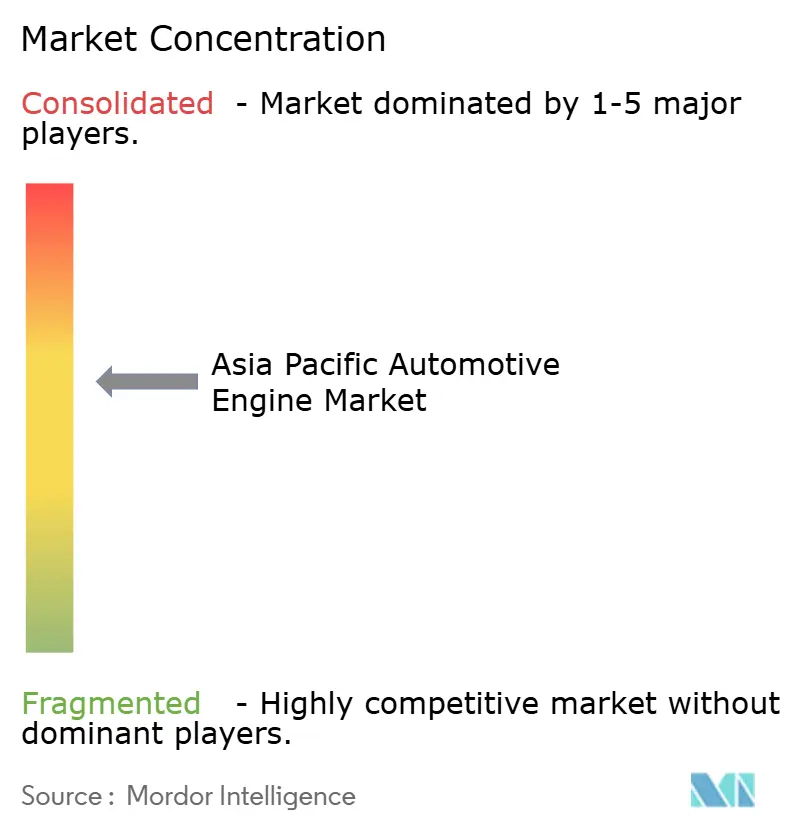
The Asia Pacific automotive engine market is moderately fragmented. The five leading companies—Toyota, Hyundai Motor Group, Honda, SAIC Motor, and Cummins—account for a significant share of revenue, although no single company dominates the market. To protect their hybrid intellectual property, Japanese automakers retain core machining operations in-house. In contrast, Chinese brands increasingly source turnkey powertrains from Guangxi Yuchai and Weichai, directing the resulting cash savings toward electric vehicle development. As wages rise, AI-driven machining lines in Thailand and Vietnam enable suppliers to maintain healthy operating margins. Meanwhile, hydrogen internal combustion engines (ICEs) for port equipment represent an emerging profit opportunity, as their faster refueling capabilities provide an advantage over fuel-cell systems in mid- to high-power applications.
Technology integration has become a critical competitive area. Cummins’ X15 uses exhaust heat to preheat intake air, improving cold-start compliance and reducing fuel consumption in BS-VI trucks. Toyota’s fourth-generation Hybrid Synergy Drive delivers strong fuel efficiency in the latest Camry model. BYD's DM-i plug-in hybrid system has captured a notable share of China's passenger car market.. Patent filings highlight this shift: Hyundai Motor Group has filed multiple patents for direct hydrogen injection as a strategic measure to mitigate battery supply risks. To remain competitive in the Asia Pacific automotive engine market, traditional engine suppliers must integrate electrified or hydrogen-based solutions.
Regulatory requirements increasingly influence operating margins. Real-driving-emissions audits enforced by China’s Ministry of Ecology and Environment and India’s Central Pollution Control Board play a pivotal role in determining hardware cost trajectories. Companies that lack the scale to amortize exhaust-aftertreatment research and development costs may face exit or merger scenarios, resulting in greater supply concentration over the forecast period.
Asia Pacific Automotive Engine Industry Leaders
-
Toyota Industries Corporation
-
AVL
-
Hyundai Motor Group
-
Fiat Chrysler Automotive Group
-
Nissan Motor Corporation
- *Disclaimer: Major Players sorted in no particular order
Asia Pacific Automotive Engine Market Companies Covered in this Report
- Toyota Motor Corporation
- Honda Motor Co., Ltd.
- Hyundai Motor Group
- Nissan Motor Corporation
- Fiat Chrysler Automotive Group
- SAIC Motor Corporation
- Cummins Inc.
- Mitsubishi Heavy Industries Engine & Turbo
- Suzuki Motor Corporation
- Yanmar Holdings
- Isuzu Motors Ltd.
- Tata Motors Ltd.
- Ashok Leyland Ltd.
- Chongqing Changan Automobile
- Weichai Power Co., Ltd.
- BYD Auto Co., Ltd.
- Kirloskar Oil Engines
- Guangxi Yuchai Machinery
- Great Wall Motor Co.
- Hino Motors Ltd.
- Dongfeng Motor Group
- FAW Jiefang Automotive
- Jiangling Motors
Recent Industry Developments in Asia Pacific Automotive Engine Market
- April 2026: At the Beijing Auto Show, Geely debuted its latest 1.5L four-cylinder Intelligent Hybrid System engine. The powertrain is expected to achieve a Guinness-certified thermal milestone, enabling select hybrid production vehicles to theoretically deliver up to 106 miles per gallon (mpg) and raising expectations for the limits of internal combustion technology.
- March 2026: At the Bangkok International Motor Show (BIMS), Toyota launched the Land Cruiser FJ, tailored specifically for Southeast Asian markets. Departing from immediate electrification trends, this rugged entry-level model will use the durable 2TR-FE 2.7L naturally aspirated gasoline engine, which produces 161 horsepower and meets regional demand for high mechanical reliability over hybridization.
- February 2025: Toyota revealed its third-generation commercial-vehicle fuel-cell stack, targeting diesel-like durability for market launch after 2026.
- January 2025: Hyundai Motor Group unveiled its next-generation hybrid line-up, comprising a 1.6-liter turbo hybrid debuting in the front-wheel-drive-based Palisade hybrid and a 2.5-liter turbo hybrid for rear-wheel-drive models — confirm the exact output figures against Hyundai's release before publishing.
Asia Pacific Automotive Engine Market Report Scope
The scope of the report includes Placement Type (In-Line, V-Type, and More), Fuel Type (Gasoline, Diesel, and More), Vehicle Type (Passenger Cars, Light Commercial Vehicles, and More), Engine Capacity (Below 1. 5 L, 1. 5–3 L, and Over 3 L), and Geography. The Market Forecasts are Provided in Terms of Value (USD) and Volume (Units).
Segmentation Overview
By Placement Type
| In-line |
| V-type |
| W-type |
| Boxer / Flat |
| Opposed-piston |
By Fuel Type
| Gasoline |
| Diesel |
| Natural Gas / CNG |
| Hybrid-ICE (Mild, Full, Plug-in) |
| Alternative Fuels (Ethanol, LPG, e-Fuels) |
| Hydrogen ICE |
By Vehicle Type
| Passenger Cars |
| Light Commercial Vehicles |
| Medium & Heavy Commercial Vehicles |
| Two-Wheelers & Powersports |
| Off-road / Agricultural / Construction |
By Engine Capacity
| Below 1.5 L |
| 1.5 to 3 L |
| Over 3 L |
By Country
| China |
| India |
| Japan |
| South Korea |
| Rest of Asia-Pacific |
| By Placement Type | In-line |
| V-type | |
| W-type | |
| Boxer / Flat | |
| Opposed-piston | |
| By Fuel Type | Gasoline |
| Diesel | |
| Natural Gas / CNG | |
| Hybrid-ICE (Mild, Full, Plug-in) | |
| Alternative Fuels (Ethanol, LPG, e-Fuels) | |
| Hydrogen ICE | |
| By Vehicle Type | Passenger Cars |
| Light Commercial Vehicles | |
| Medium & Heavy Commercial Vehicles | |
| Two-Wheelers & Powersports | |
| Off-road / Agricultural / Construction | |
| By Engine Capacity | Below 1.5 L |
| 1.5 to 3 L | |
| Over 3 L | |
| By Country | China |
| India | |
| Japan | |
| South Korea | |
| Rest of Asia-Pacific |
Key Questions Answered in the Report
How large is the Asia Pacific automotive engine market in 2026?
The market is valued at USD 88.85 billion in 2026 with a 0.63% CAGR projected to 2031.
Which engine placement dominates Asia Pacific demand?
In-line layouts dominate with 45.16% share, mainly because they package easily in compact cars and light trucks.
What fuel segment is growing fastest?
Hydrogen internal-combustion engines post the quickest 1.75% CAGR as South Korean and Japanese pilots scale up.
Why are heavy-duty engines over 3 liters still expanding?
E-commerce logistics and infrastructure projects need torque-rich trucks, driving a 2.78% CAGR for engines above 3 liters.
Which country contributes the most revenue?
China leads with 34.27% of regional revenue and maintains a 1.72% CAGR through 2031.
How fragmented is supplier competition?
The top five companies control roughly two-fifths of revenue, indicating moderate fragmentation and a concentration score of 6.