
Market Overview
| Study Period | 2021 - 2031 |
|---|---|
| Forecast Data Period | 2026 - 2031 |
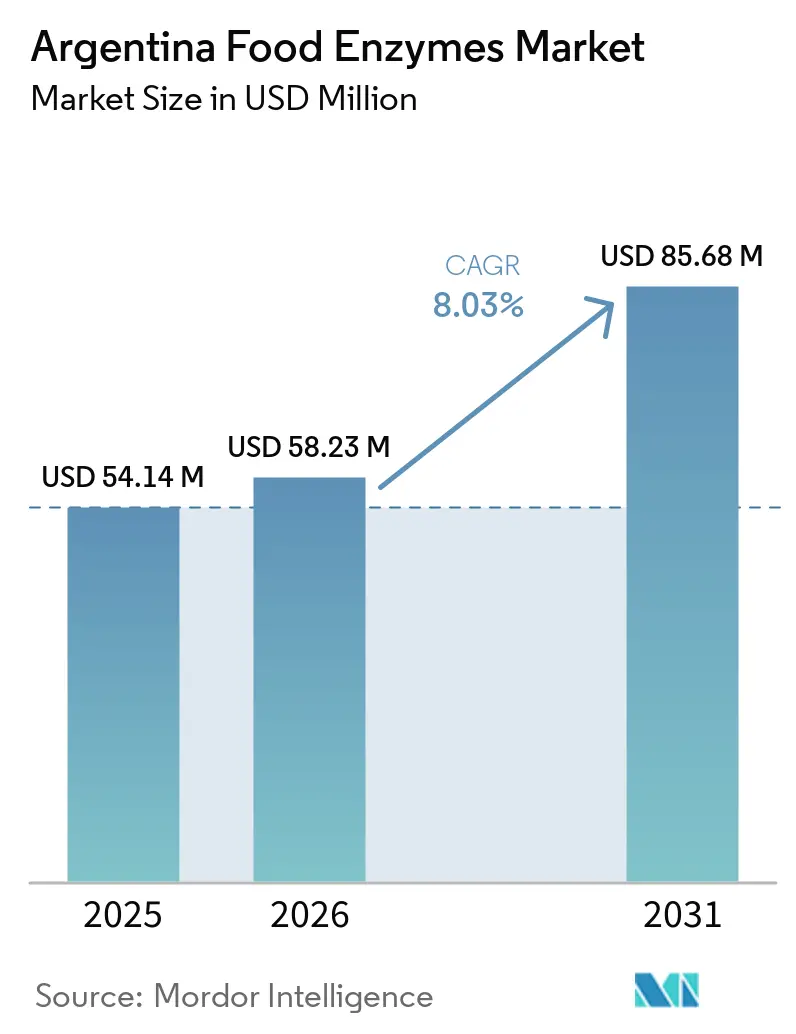
| Base Year Market Size (2025) | USD 54.14 Million |
| Market Size (2026) | USD 58.23 Million |
| Market Size (2031) | USD 85.68 Million |
| Growth Rate (2026 - 2031) | 8.03 % |
| Market Concentration | High |
Major Players *Disclaimer: Major Players sorted in no particular order Image © Mordor Intelligence. Reuse requires attribution under CC BY 4.0. | |
Argentina Food Enzymes Market Analysis by Mordor Intelligence
The Argentina food enzymes market size was valued at USD 54.14 million in 2025 and is estimated to reach USD 58.23 million in 2026 and USD 85.68 million by 2031, at a 8.03% CAGR during the forecast period (2026-2031). Argentina’s recovery in food processing investment supports wider use of enzymes in bakery, dairy, wine, and other applications. The Argentina food enzymes market benefits from processors seeking more consistent production results as wheat quality and operating conditions vary. Regulatory additions to the food code have expanded the permitted toolkit for processors, while the approval process still shapes the timing of new product launches. Suppliers are competing through local technical support, application knowledge, and formulations suited to Argentine raw materials. Import exposure and competition from conventional processing methods remain material constraints for the Argentina food enzymes market.
Key Report Takeaways
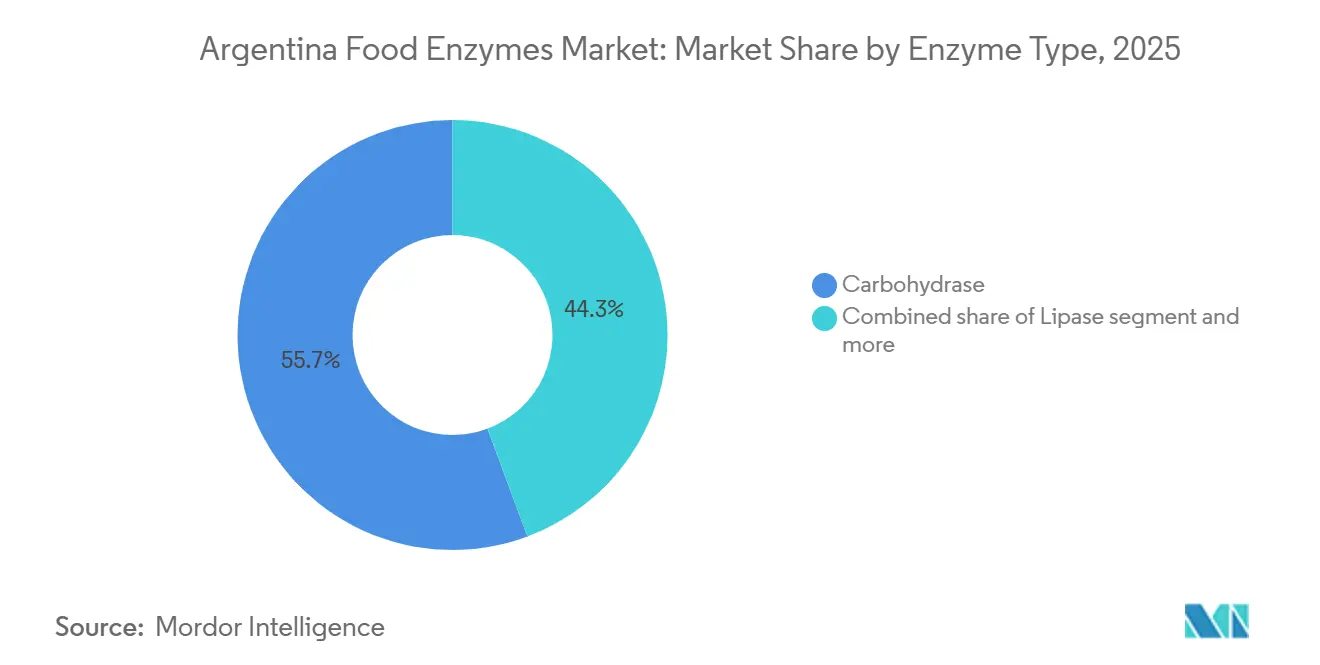
- By enzyme type, carbohydrase held 55.67% of the Argentina food enzymes market share in 2025, while lipase recorded the highest projected CAGR at 8.81% through 2031.
- By form, powder held a 66.58% share in 2025, while powder recorded the highest projected CAGR at 8.48% through 2031.
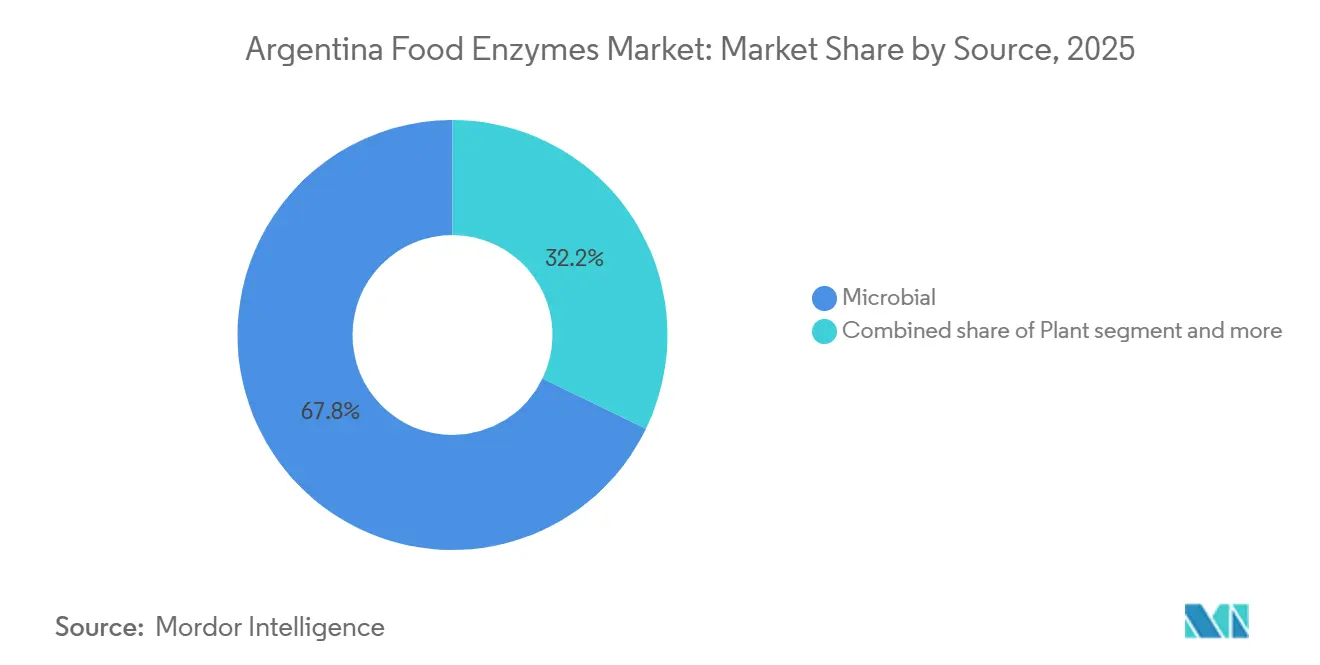
- By source, microbial enzymes held a 67.82% share in 2025, while plant-derived enzymes recorded the highest projected CAGR at 8.15% through 2031.
- By application, bakery and confectionery held a 32.41% share in 2025, while dairy and desserts recorded the highest projected CAGR at 9.23% through 2031.
Note: Market size and forecast figures in this report are generated using Mordor Intelligence’s proprietary estimation framework, updated with the latest available data and insights as of January 2026.
Argentina Food Enzymes Market Trends and Insights
Drivers Impact Analysis*
| Driver | (~) % Impact on CAGR Forecast | Geographic Relevance | Impact Timeline |
|---|---|---|---|
| Expanding Industrial Bakery Enzyme Applications | +2.0% | National, concentrated in Buenos Aires, Córdoba, and Santa Fe milling belts | Short term (≤ 2 years) |
| Increasing Adoption of Microbial Enzyme Technologies | +1.6% | National, with spillover to MERCOSUR supply chains | Medium term (2-4 years) |
| Increasing Demand for Clean-Label Food Formulations | +1.4% | National, urban centers lead adoption | Medium term (2-4 years) |
| Growing Demand for Processed Convenience Foods | +1.1% | National, strongest in Greater Buenos Aires metropolitan area | Short term (≤ 2 years) |
| Growing Utilization in Brewing and Winemaking | +0.8% | Mendoza, San Juan, Patagonian brewing clusters | Long term (≥ 4 years) |
| Rising Focus on Food Shelf-Life Extension | +0.7% | National, most relevant to export-oriented processors | Medium term (2-4 years) |
| Source: Mordor Intelligence | |||
Expanding Industrial Bakery Enzyme Applications
Industrial bakery remains the largest demand source in the Argentina food enzymes market because large-scale wheat processing requires consistent flour performance. The 2025/2026 wheat harvest produced flour with high tenacity and low extensibility, creating operational challenges that mixing changes alone could not resolve. Granotec introduced GRANOZYME Fuerza and GRANOZYME Relax for the flour profile associated with that harvest. The products show why bakeries increasingly treat enzyme selection as a response to raw-material conditions rather than a routine ingredient purchase. CAA Article 1263 permits asparaginase for bakery and cereal-based foods, which supports use in biscuits and sweet bakery products. Alfa Argentina SA’s 2025 partnership with Prozyn BioSolutions also broadened access to enzyme systems for Argentine milling and industrial bakery customers.
Increasing Adoption of Microbial Enzyme Technologies
Microbial technologies are gaining relevance because the permitted enzyme list has expanded for several food-processing uses. Joint Resolutions 7/2025, 28/2025, and 40/2025 updated Article 1263 in 2025. The changes cover microbial preparations relevant to dairy lipid modification, bakery texture, and protein hydrolysis. The positive-list model makes regulatory clearance central to commercialization in the Argentina food enzymes market. Suppliers with an approved product can move from filing to customer development with less regulatory uncertainty than suppliers of unlisted enzymes. IFF inaugurated a fermentation-based enzyme hub at Arroyito in March 2026, creating local production capability for selected enzyme applications [1].
Increasing Demand for Clean-Label Food Formulations
Clean-label positioning supports demand for processing aids that deliver functional results without adding conventional ingredient declarations. Enzymes can support dough handling, emulsification, and texture management in food formulations. In bakery, phospholipase can support emulsification through in-situ lecithin generation. This approach can reduce reliance on synthetic emulsifiers in certain applications. The Argentina food enzymes market therefore has an opening in products designed for processors pursuing simpler ingredient declarations. Plant-derived enzymes also support product development for vegan and allergen-conscious food lines.
Growing Utilization in Brewing and Winemaking
Winemaking creates a distinct enzyme demand center in Mendoza and San Juan. Argentine research has examined enzyme use for maceration, clarification, and stabilization in red wine production. Pectinases, glucanases, and cellulases are used to support extraction and process control. Research from Universidad Nacional de Cuyo reported that enzymatic maceration can reduce red-wine skin contact from 14 days to 10 days and improve fermenter yield by 25-30%. Granotec expanded its CrystalZyme line across enological and olive oil uses. In Patagonia, craft breweries in Río Negro and Neuquén provide additional demand for amylases and beta-glucanases used with adjunct-heavy beer recipes [2].
Restraints Impact Analysis*
| Restraint | (~) % Impact on CAGR Forecast | Geographic Relevance | Impact Timeline |
|---|---|---|---|
| Stringent Food Enzyme Safety Approval Requirements | -1.2% | National (ANMAT-governed under CAA Article 1263) | Long term (≥ 4 years) |
| Competition from Conventional Chemical Processing Alternatives | -0.9% | National | Medium term (2-4 years) |
| High Costs of Specialized Enzyme Formulations | -0.8% | National, most acute in SME bakery and dairy segments | Medium term (2-4 years) |
| High Dependence on Imported Enzyme Ingredients | -1.1% | National, most exposed in interior provinces with limited import logistics | Long term (≥ 4 years) |
| Source: Mordor Intelligence | |||
Stringent Food Enzyme Safety Approval Requirements
Argentina uses a positive-list system under CAA Article 1263 for food enzyme preparations. An enzyme that is not listed cannot be used as a food processing aid in Argentina. This position applies even where a preparation has recognition under regulatory frameworks in other jurisdictions. ANMAT and CONAL assess petitions through the national approval process. The 2025 amendments show active updates to the list, but they do not remove the need for a supplier to complete regulatory requirements. Documentation requirements for imported food preparations also add work before a product can move through the supply chain [3].
Competition from Conventional Chemical Processing Alternatives
Conventional chemical processing agents remain an established alternative for processors considering enzyme-based solutions. The comparison is most direct in functions such as emulsification, preservation, and dough conditioning. Existing processes may limit the willingness of some manufacturers to change formulations. This can be more relevant for high-volume products where procurement teams focus on immediate unit costs. Enzyme suppliers need to demonstrate processing value and product performance for applications where established alternatives are already accepted. The restraint does not remove demand, but it can slow conversion in price-sensitive food categories.
*Our forecasts treat driver/restraint impacts as directional, not additive. The impact forecasts reflect baseline growth, mix effects, and variable interactions.
Segment Analysis
By Enzyme Type: Carbohydrase Commands Bakery-Led Demand
Carbohydrase held 55.67% of the Argentina food enzymes market share in 2025, supported by the scale of wheat-based food manufacturing. Amylases are the highest-volume enzyme subtype within this group. Industrial bakeries use them to manage crumb structure, dough extensibility, and anti-staling behavior. These functions became more important during the 2025/2026 season, when flour characteristics required closer process control. Granotec’s 2025/2026 harvest-related products reflect this practical need for flour standardization. Pectinases form another important carbohydrate-focused group for citrus juice clarification, winemaking, and vegetable oil extraction. Cellulases support fiber-enriched food production and plant-cell-wall breakdown in juice and fermentation processes.
Lipase is projected to expand at an 8.81% CAGR through 2031, making it the fastest-growing enzyme type in the Argentina food enzymes market. Demand comes from cheese ripening, in-situ emulsification, and edible-oil degumming. Joint Resolution 40/2025 added Triacylglycerol lipase from Pichia pastoris to the permitted list. The update supports dairy and oil applications that depend on lipase functionality. Proteases retain a stable position in meat tenderization and dairy protein hydrolysis. Article 1263 provides a broad basis for protease use in bakery, brewing, cheese-making, and meat derivatives. Oxidoreductases and transglutaminase serve more specialized uses in pasta texture and functional dairy products.



By Form: Powder Formulations Set the Operational Standard
Powder accounted for a 66.58% share in 2025 and is projected to grow at an 8.48% CAGR through 2031. Its leading position reflects the operating conditions of processors across Argentina’s interior provinces. Bakery mills, grain processors, and convenience-food plants are spread across Córdoba, Santa Fe, and Entre Ríos. These locations do not always have the storage conditions available in the Buenos Aires metropolitan corridor. Powder enzymes can remain stable across a wider ambient temperature range than liquid products. This reduces handling requirements for mill operators and mid-scale industrial bakers. Powder products also fit established dry-ingredient handling practices in milling and bakery operations.
Liquid formulations hold a smaller share but remain important for dairy processing, juice clarification, and brewing. These applications often use continuous dosing systems and established temperature controls. Pectinases for wine and juice clarification are commonly supplied in liquid form for process compatibility. Certain amylase preparations used in starch liquefaction also suit liquid dosing arrangements. The two formats therefore serve different operating needs rather than identical customer requirements. Improved cold-chain infrastructure could support more liquid-enzyme use during the forecast period. Powder is still likely to remain the practical operating standard for widely distributed industrial food facilities.
By Source: Microbial Dominance with Plant Enzymes Emerging
Microbial sources accounted for a 67.82% share in 2025. Their position reflects both production efficiency and their fit with the national positive-list framework. Aspergillus oryzae, Bacillus licheniformis, Aspergillus niger, and Pichia pastoris appear in Argentina’s 2025 food-code amendments. These organisms support commercially important carbohydrases, proteases, and lipases. International producers often have established safety documentation for microbial enzyme preparations. This can make the supporting regulatory dossier more familiar for a national review. Microbial platforms also support the dairy and meat enzyme specialization described in the draft.
Plant-derived enzymes are projected to advance at an 8.15% CAGR through 2031. Bromelain and papain have historical use in meat tenderization and can also support protein hydrolysis and flavor development. Their growth is associated with demand for non-animal processing aids in vegan and flexitarian product lines. This creates a clear product-development role in premium food manufacturing. Animal-derived enzymes retain specialized relevance in traditional cheese production. However, microbial coagulation alternatives provide comparable functional outcomes for many applications. The result is a source landscape where microbial products lead volume, while plant sources gain relevance in selected clean-label and dietary-positioned foods.

By Application: Bakery Anchors Volume, Dairy Accelerates
Bakery and confectionery accounted for a 32.41% share in 2025. The segment benefits from high bread consumption and a large industrial milling base. Amylases for anti-staling and xylanases for dough extensibility are the highest-volume enzyme types in bakery. Asparaginase is also relevant for biscuits and sweet bakery products where processors manage acrylamide formation. Article 1263 permits carbohydrases for cereal-based foods and asparaginase for bakery applications. Soups, sauces, and dressings form a smaller application area for protein hydrolysis and starch modification. Other uses include functional food coatings, dietary-supplement processing, and industrial confectionery.
Dairy and desserts are projected to grow at a 9.23% CAGR through 2031, the fastest rate among applications in the Argentina food enzymes market. Lactase supports lactose-free product lines from major dairy processors and cooperatives. Lipase and protease use in cheese ripening also supports artisanal and premium aged-cheese production. Beverage applications form another important cluster covering juice clarification, wine processing, and craft brewing. These uses have potential to gain share as winemakers standardize enzyme protocols. Meat applications remain focused on tenderization and texture modification through proteases. Together, the applications show a market led by established bakery demand and supported by higher growth in dairy processing.
Competitive Landscape
Market Concentration
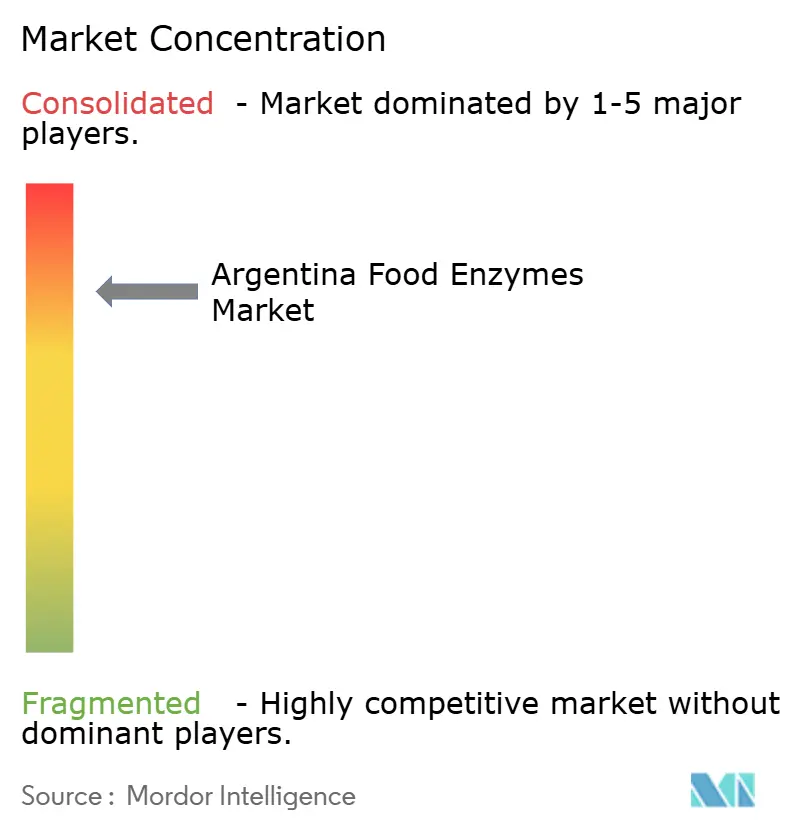
The Argentina food enzymes market is consolidated in supply and fragmented in distribution. IFF, Novonesis, dsm-firmenich, and Kerry Group form the multinational tier described in the draft. Their differentiation rests on fermentation expertise, application support, and regulatory resources. Technical service is particularly important where processors need help with dosing, raw-material variability, or process changes. IFF expanded its Arroyito operation into a fermentation-based enzyme hub in March 2026. The investment adds local production capability for brewing, food and beverage, and bioenergy applications.
Novonesis agreed in February 2025 to acquire dsm-firmenich’s share in the Feed Enzyme Alliance for EUR 1.5 billion, stated as USD 1.55 billion in the supplied draft. The transaction consolidated sales and distribution activities under Novonesis. This broader portfolio can support commercial discussions with Argentine processors operating across food, feed, and agri-industrial activities. Puratos uses its Taste Tomorrow research in commercial discussions around consumer preferences and bakery development. This approach links formulation work with consumer-facing product priorities. In the Argentina food enzymes market, such support can matter where food manufacturers need both technical and commercial guidance.
Granotec has a distinct local position through enzyme complexes calibrated to Argentine wheat harvest conditions, winemaking requirements, and olive oil processing. Its GRANOZYME products address flour characteristics from the 2025/2026 harvest. Its CrystalZyme range addresses enological quality and olive-oil processing needs. Nutring S.A., Ha-La Biotec, NOVA S.A.U., and Cergen SRL serve industrial buyers through regional ingredient and fermentation-preparation channels. Commercial openings remain in lactase for lactose-free dairy, shelf-life tools for smaller processors, and wine enzymes for mid-tier Mendoza producers. Established regulatory filings under Article 1263 remain an advantage because unlisted products require national approval before sale.
Argentina Food Enzymes Industry Leaders
-
International Flavors & Fragrances Inc.
-
dsm-firmenich
-
Kerry Group plc
-
Novonesis A/S
-
Associated British Foods plc
- *Disclaimer: Major Players sorted in no particular order
Recent Industry Developments
- March 2026: IFF inaugurated its first fermentation-based enzyme production hub in Latin America at its Arroyito, Córdoba facility, supported by a USD 8 million investment. The site now produces enzymes from the biological fermentation stage, a departure from its previous role as a downstream processing and packaging operation, enabling local supply across brewing, food and beverage, and bioenergy applications in Argentina and the wider Latin American region.
- August 2025: ANMAT and Argentina's Secretariat of Agriculture formally incorporated six new food-processing enzymes into CAA Article 1263 via Joint Resolution 40/2025, including Phospholipase C from Bacillus licheniformis, Triacylglycerol lipase from Pichia pastoris, and two variants of Prolyl oligopeptidase derived from Aspergillus niger, with direct commercial relevance for dairy lipid modification, bakery texture optimization, and gluten peptide hydrolysis.
- May 2025: Alfa Argentina SA formalized a commercial partnership with Brazilian enzyme specialist Prozyn BioSolutions to supply the POWERZYME 12331 enzyme system and related products to Argentine milling and industrial bakery clients, with pilot production conducted at Alfa's FSSC 22000-certified facility in San Francisco, Córdoba.
Argentina Food Enzymes Market Report Scope
The Argentina Food Enzymes Market is Segmented by Enzyme Type (Carbohydrase, Protease, Lipase, and Other Enzymes), by Form (Powder and Liquid), by Source (Plant, Microbial, and Animal), and by Application (Bakery and Confectionery, Dairy and Desserts, Beverages, Meat and Meat Products, Soups, Sauces, and Dressings, Other Applications). The Market Forecasts are Provided in Terms of Value (USD).
By Enzyme Type
| Carbohydrase | Amylases |
| Pectinases | |
| Cellulases | |
| Other Carbohydrases | |
| Protease | |
| Lipase | |
| Other Enzymes |
By Form
| Powder |
| Liquid |
By Source
| Plant |
| Microbial |
| Animal |
By Application
| Bakery and Confectionery |
| Dairy and Desserts |
| Beverages |
| Meat and Meat Products |
| Soups, Sauces, and Dressings |
| Other Applications |
| By Enzyme Type | Carbohydrase | Amylases |
| Pectinases | ||
| Cellulases | ||
| Other Carbohydrases | ||
| Protease | ||
| Lipase | ||
| Other Enzymes | ||
| By Form | Powder | |
| Liquid | ||
| By Source | Plant | |
| Microbial | ||
| Animal | ||
| By Application | Bakery and Confectionery | |
| Dairy and Desserts | ||
| Beverages | ||
| Meat and Meat Products | ||
| Soups, Sauces, and Dressings | ||
| Other Applications |
Key Questions Answered in the Report
What is the projected growth rate for food enzymes in Argentina?
The Argentina food enzymes market is projected to grow at an 8.03% CAGR from 2026 to 2031, reaching USD 85.7 million by 2031.
Which enzyme type leads food processing demand in Argentina?
Carbohydrase led demand with a 55.67% share in 2025, supported by industrial bakery and wheat-processing applications.
Why are powder enzymes widely used in Argentina?
Powder products held 66.58% share in 2025 because they fit dry handling practices and offer stable storage for processors across interior provinces.
Which application is growing fastest through 2031?
Dairy and desserts is projected to grow at a 9.23% CAGR through 2031, supported by lactose-free products and cheese-ripening applications.