
Market Overview
| Study Period | 2021 - 2031 |
|---|---|
| Forecast Data Period | 2026 - 2031 |
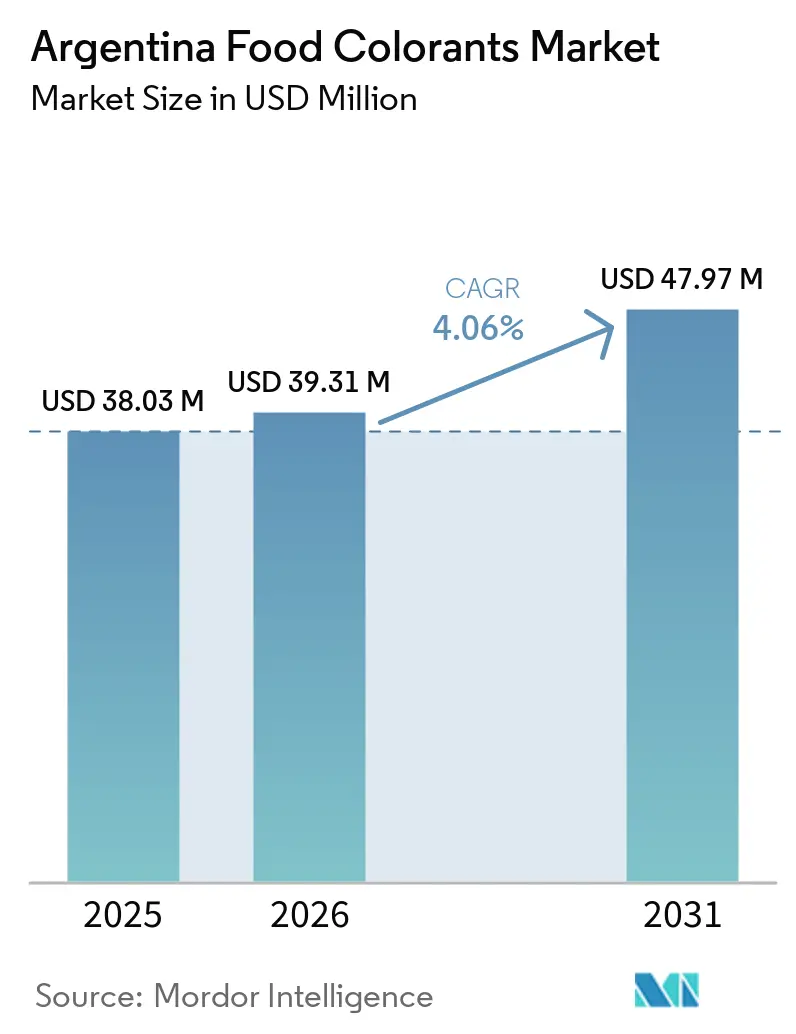
| Base Year Market Size (2025) | USD 38.03 Million |
| Market Size (2026) | USD 39.31 Million |
| Market Size (2031) | USD 47.97 Million |
| Growth Rate (2026 - 2031) | 4.06 % |
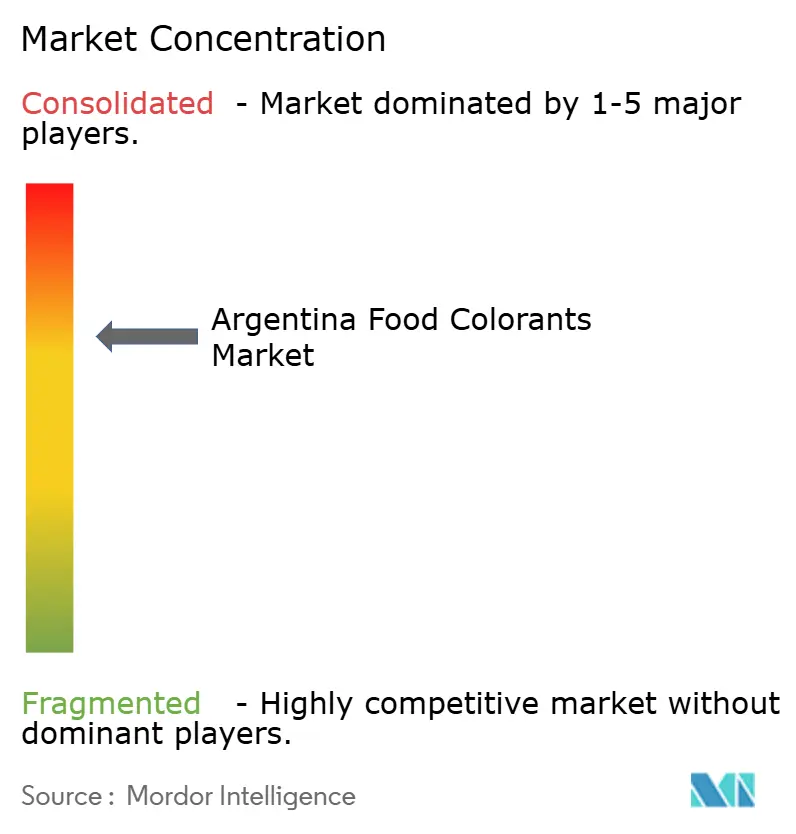
| Market Concentration | Medium |
Major Players *Disclaimer: Major Players sorted in no particular order Image © Mordor Intelligence. Reuse requires attribution under CC BY 4.0. | |
Argentina Food Colorants Market Analysis by Mordor Intelligence
The Argentina food colorants market size was USD 38.03 million in 2025 and is forecast to reach USD 39.31 million in 2026 and USD 47.97 million by 2031, growing at a CAGR of 4.06% across the 2026 to 2031 study period. Growth is expected to strengthen as natural pigments gain a larger role in formulations and raise average revenue per unit. The supplied forecast describes annual growth, reflecting the increasing role of higher-priced natural pigments as food-processing volume grows more moderately. Argentina’s food and beverage manufacturing base provides demand across bakery, dairy, meat, beverages, and confectionery, which limits dependence on any one category. The Argentina food colorants market is also shaped by a shift toward stable natural blue shades after the regional acceptance of Jagua Blue, which gives formulators an option that had long been limited.
Key Report Takeaways
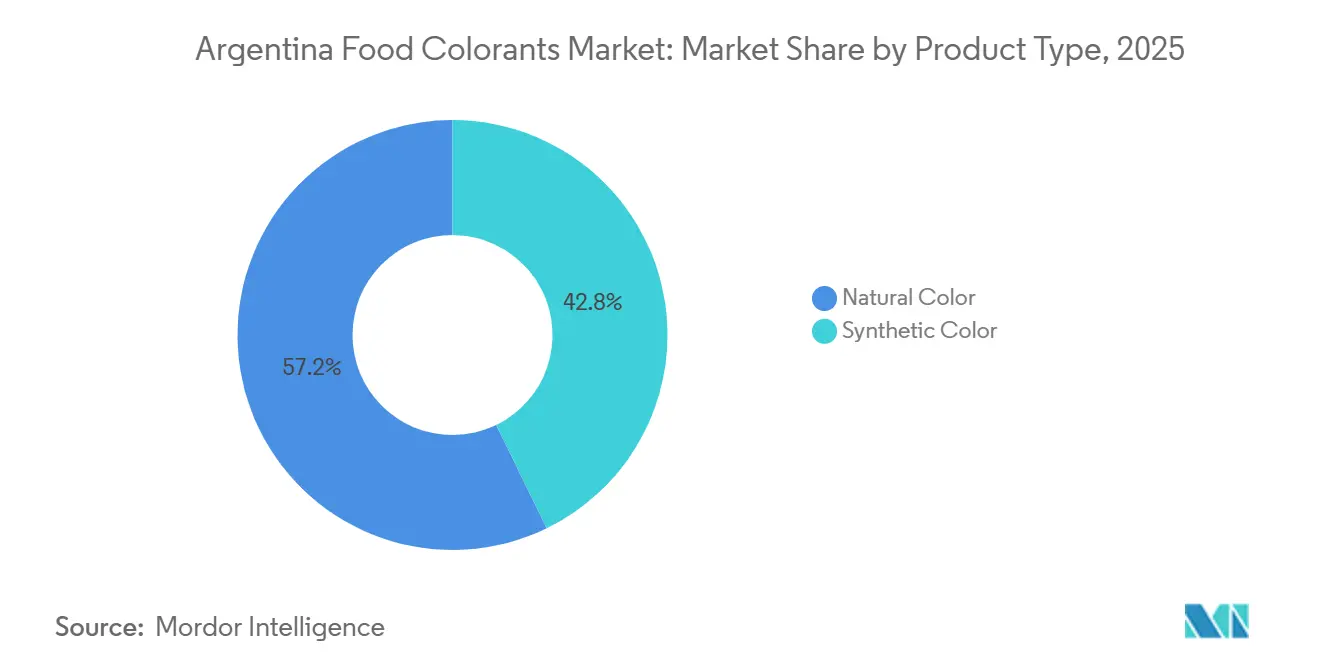
- By product type, Natural Color held 57.22% of the Argentina food colorants market share in 2025 and is forecast to grow at a 6.21% CAGR through 2031.
- By color, Red held 27.12% of revenue in 2025, while Blue is projected to grow at a 5.77% CAGR through 2031.
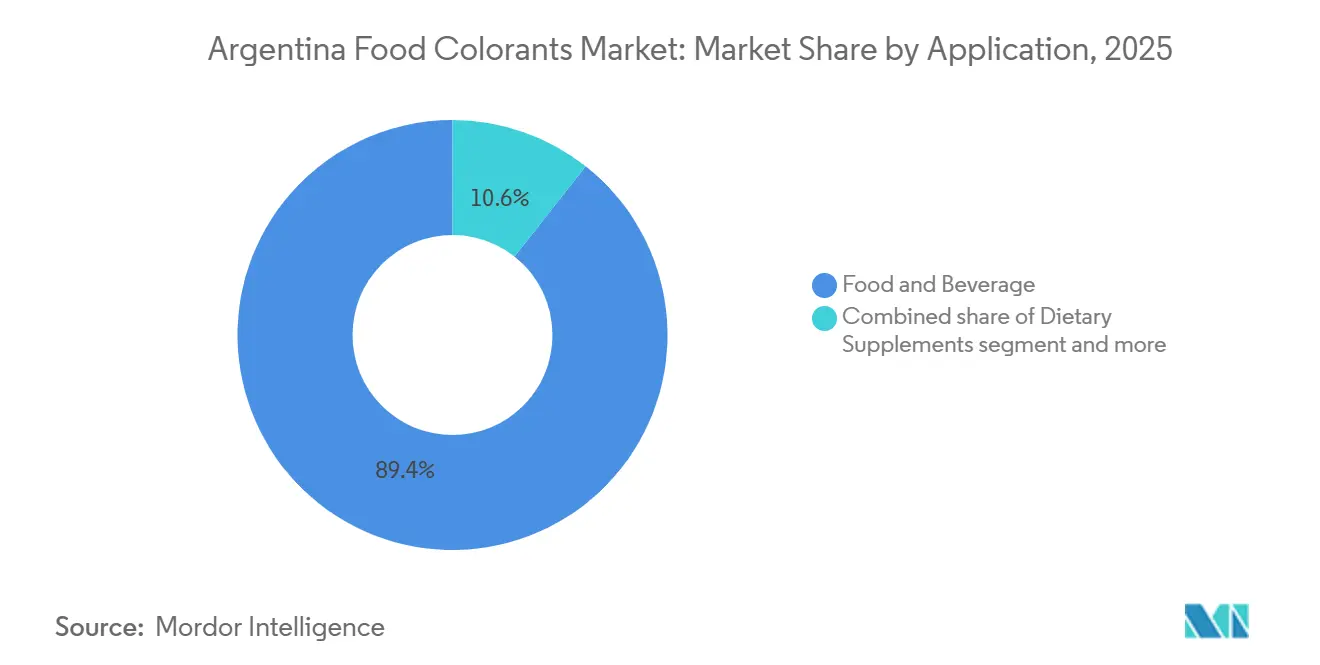
- By application, Food and Beverage accounted for 89.37% of revenue in 2025, while Dietary Supplements is forecast to grow at a 4.83% CAGR through 2031.
Note: Market size and forecast figures in this report are generated using Mordor Intelligence’s proprietary estimation framework, updated with the latest available data and insights as of January 2026.
Argentina Food Colorants Market Trends and Insights
Drivers Impact Analysis*
| Driver | (~) % Impact on CAGR Forecast | Geographic Relevance | Impact Timeline |
|---|---|---|---|
| Rising Demand for Natural and Plant-Based Colorants | +1.1% | National, early gains in Buenos Aires and Córdoba processing hubs | Short term (≤ 2 years) |
| Expanding Beverage Industry Driving Colorant Usage | +0.8% | National, strongest in Buenos Aires, Santa Fe, and Mendoza | Medium term (2-4 years) |
| Increasing Clean-Label Product Preference Among Consumers | +0.7% | National, urban centers first, spillover to secondary cities | Short term (≤ 2 years) |
| Rising Use in Cosmetics and Personal Care | +0.3% | National, concentrated in Buenos Aires Metropolitan Area | Medium term (2-4 years) |
| Technological Advances in Colorant Extraction and Stability | +0.5% | Global origin, local spillover via multinational suppliers | Long term (≥ 4 years) |
| Visual Appeal Boosting Confectionery and Bakery Sales | +0.2% | National, early gains in Buenos Aires, Rosario, and Córdoba | Short term (≤ 2 years) |
| Source: Mordor Intelligence | |||
Rising Demand for Natural and Plant-Based Colorants
The shift from petroleum-derived synthetic dyes supports the Argentina food colorants market because it reflects both consumer demand and changes in product development. It was observed that Argentine households selected food products based on specific ingredients and functional benefits in 2025. Anthocyanins, beet-derived betanin, curcumin, and carotenoids are gaining attention because they can support natural ingredient claims. As established products move to natural pigments, distributors can hold wider inventories and lower order barriers for mid-sized processors. Grupo Saporiti supplies natural colorants in formats that support this transition in local food applications. The voluntary framework launched by Argentina’s health authorities, INAL, and COPAL in August 2025 added a structured industry pathway for substitution of six synthetic colors.
Expanding Beverage Industry Driving Colorant Usage
Beverages remain a major source of colorant use because formulations require stable color through processing and shelf life. Functional beverages, flavored waters, and plant-based drinks require colorants that can withstand heat and acidic conditions. Argentina’s wine and fruit-based beverage activity creates another outlet where color consistency is important for premium positioning. Blue, purple, and green shades have been difficult to obtain in stable natural formats. Jagua Blue received regional acceptance in June 2025, expanding options for Argentine soft drink and functional beverage formulations. The Argentina food colorants market can therefore benefit as product developers test colors that were previously difficult to use in natural beverage systems.
Increasing Clean-Label Product Preference Among Consumers
Clean-label requirements are increasingly affecting products beyond premium food ranges in Argentina. A 2025 Puratos study reported that 67% of Argentine consumers wanted to know where their food came from and how it was made. This preference increases the need for clear documentation of colorant ingredients and their origin. ANMAT’s Disposición 537/2025 revised procedures for food additive authorizations and associated RNE and RNPA documentation [1]. Manufacturers and importers must respond to these documentation requirements while maintaining product consistency. The Argentina food colorants market gains support when clean-label reformulation becomes part of routine retail and compliance planning rather than a limited product claim.
Technological Advances in Colorant Extraction and Stability
Extraction and stabilization technology is improving the performance of natural pigments in demanding applications. A 2025 study reported hydrodynamic cavitation-assisted phycocyanin extraction yields of 52 mg per gram of spirulina biomass at 0.06 kWh per kilogram. Microencapsulation and calcium-alginate approaches can help protect natural colors during baking and dairy processing. Sensient began Project Prism in March 2026, a USD 250 million expansion program for its natural-color production facility. The project is intended to expand capacity, supply chain resources, and processing personnel for natural colors. These investments can improve supply reliability and color specification control for customers served through global supply chains.
Restraints Impact Analysis*
| Restraint | (~) % Impact on CAGR Forecast | Geographic Relevance | Impact Timeline |
|---|---|---|---|
| Higher Cost of Natural Colorants | -0.8% | National, most acute for SME manufacturers outside Buenos Aires | Medium term (2-4 years) |
| Stringent ANMAT and Mercosur Regulatory Requirements | -0.5% | National, compliance burden concentrated on importers | Short term (≤ 2 years) |
| Health Concerns Over Synthetic Dyes | -0.3% | National, amplified in urban consumer segments | Short term (≤ 2 years) |
| Import Restrictions and Trade Barriers | -0.2% | National, especially for specialty pigments from Asia-Pacific | Long term (≥ 4 years) |
| Source: Mordor Intelligence | |||
Higher Cost of Natural Colorants
Natural pigments carry a cost-in-use premium that many food manufacturers cannot always pass on to price-sensitive consumers. Their lower coloring power can require greater quantities than synthetic alternatives in some applications. Michroma’s fermentation-derived Red+ is designed to require less product than beetroot powder, but its cost remains above synthetic Red 40 on a per-ton basis. Small and medium-sized processors have less purchasing scale and face the cost burden most directly. New production investments and fermentation capacity can narrow cost differences over time. The Argentina food colorants market will still face a transition period before natural pigment prices become easier for all processor sizes to absorb.
Stringent ANMAT and Mercosur Regulatory Requirements
Argentina’s food colorant rules bring together ANMAT oversight, MERCOSUR requirements, and Codex references. Decree 35/2025 established the Argentine Food Code framework that applies to permitted additives and their conditions of use. Disposición 537/2025 introduced revised authorization procedures for food additives entering the country. In July 2025, ANMAT prohibited a falsely labeled food colorant product from national commerce, showing active product-authentication enforcement [2]. Novel natural colors can face sequential regional and national incorporation steps before full commercialization. This framework can delay entry for new ingredients while favoring suppliers with existing Argentine registrations.
*Our forecasts treat driver/restraint impacts as directional, not additive. The impact forecasts reflect baseline growth, mix effects, and variable interactions.
Segment Analysis
By Product Type: Natural Colors Lead in Share and Growth Simultaneously
Natural Color held 57.22% of the Argentina food colorants market share in 2025 and is forecast to grow at a 6.21% CAGR through 2031. This position reflects a wider set of uses rather than a simple replacement of synthetic dyes. Existing users are extending natural pigments into dietary supplements and functional beverages. New users are entering because retail requirements and the voluntary reformulation framework have increased attention to ingredient selection. The August 2025 framework supports a gradual move away from six synthetic colors in food and beverage products. Synthetic Color remains relevant in mass-market confectionery, processed snacks, and industrial baking mixes. Those applications still need low-cost color consistency at scale.
The Argentina food colorants industry also requires technical service that accounts for local food matrices. A colorant change in dulce de leche, facturas, or flavored yogurt requires more than replacing one ingredient with another. Grupo Saporiti offers liquid, powder, and microdispersed natural colorant formats from its Buenos Aires and Pilar operations. It also provides product support linked to Argentine Food Code compliance. This service model addresses the needs of mid-sized processors that require formulation trials in smaller volumes. Global suppliers remain important for large accounts, but local application support can be decisive for smaller conversion projects. The product split therefore reflects formulation support, procurement economics, and regulatory readiness as well as pigment performance.
By Color: Red Anchors Market Revenue While Blue Defines the Innovation Frontier
Red held 27.12% of Argentina food colorants market size in 2025. It is used across confectionery, processed meat, flavored dairy products, and carbonated beverages. Carmine from cochinilla extract and beet-derived betanin are established natural red options. Synthetic azo dyes continue to serve cost-sensitive applications even as scrutiny increases. Yellow and orange colorants are widely used in dairy coatings and snack seasonings through carotenoids and paprika oleoresin. Green, purple, and pink have smaller roles but are gaining visibility in premium bakery and functional beverage products. Their appeal is linked to product differentiation and natural ingredient positioning.
Blue is forecast to record a 5.77% CAGR through 2031. The Codex Alimentarius Commission approved Jagua Blue, INS 183, for 21 food categories in January 2025, and MERCOSUR accepted it in June 2025. Oterra’s Jungle Blue comes from unripe jagua fruit and is positioned as water-soluble, heat-stable, and pH-stable. These characteristics address limitations that kept some formulations dependent on Brilliant Blue FCF. Givaudan Sense Colour’s Everzure Galdieria received FDA authorization in 2025 and a positive EFSA scientific opinion in March 2026. The product extends natural blue options for acidic beverage applications. This wider palette allows formulators to reconsider colors that were previously difficult to deliver with natural ingredients.
By Application: Food and Beverage Dominates; Dietary Supplements Offer the Highest Growth Rate
Food and Beverage accounted for 89.37% of the Argentina food colorants market share in 2025. The segment is supported by Argentina’s broad processing base across bakery, confectionery, dairy, meat, and beverages. Bakery and confectionery consume colorants in both industrial and premium lines. Dairy applications use colorants in flavored yogurts, desserts, and cheese coatings. Argentina produced significant liters of milk in 2025, its highest volume in a decade. Beverages add volume through soft drinks and functional drink formats. Private-label programs with cleaner declarations can extend reformulation activity to regional processors.
Dietary Supplements is forecast to grow at a 4.83% CAGR through 2031. Gummy and chewable supplements require vivid, pH-stable colorants that support purchase appeal. This makes the delivery format especially relevant for natural color suppliers that can maintain shade stability. Personal Care and Cosmetics adds a separate outlet for pigments that meet cosmetic safety needs. Pharmaceuticals and other applications are subject to ANMAT registration requirements for uses such as tablet coatings and capsule identification. The Argentina food colorants industry benefits from this wider demand base, although food and beverage remains the dominant application. Each application requires a different balance of stability, safety documentation, and cost. Suppliers that can support these requirements can serve several adjacent uses with related color technologies.

Competitive Landscape
The Argentina food colorants market is moderately concentrated, with Sensient Technologies, Oterra A/S, Givaudan Sense Colour, and GNT Group identified in the supplied report as leading global participants. Their position rests on extraction capabilities, regulatory experience, broad portfolios, and established botanical supply networks. These companies pair pigment development with application support for food and beverage customers. Sensient started Project Prism in March 2026 as a USD 250 million natural-color investment program. The investment expands its production and supply chain capacity. Oterra’s regional acceptance of Jungle Blue in June 2025 provided another strategic move that improves the natural blue palette.
The Argentina food colorants market requires suppliers to handle a sequence of connected activities, from sourcing botanical raw materials to providing finished colors and technical documentation. This matters when an ingredient performs well in a laboratory trial but must remain stable in a commercial recipe, meet registration requirements, and arrive consistently at a local production plant. Harmonization is reducing some cross-border regulatory friction for food additives. GMC Resolution 22/25, adopted in 2025, aligns permitted food additive allocations more closely among Argentina, Brazil, Uruguay, and Paraguay [3]. Suppliers with Brazilian approvals may therefore face a lower incremental compliance burden when entering Argentina. This regional setting supports the Argentina food colorants market as formulations and rules become more aligned.
A service gap remains for mid-sized food processors that need trials in local recipes, Spanish-language regulatory documentation, and smaller purchase volumes. This gap is not limited to pigment supply, because customers also need guidance on dose levels, processing behavior, storage conditions, and documentation for their own product files. Local firms can be closer to a customer’s production line and can adjust color formats for applications such as dulce de leche, facturas, flavored yogurt, and regional snack products. Larger companies bring global experience and investment capacity, while smaller companies can compete through responsiveness and application familiarity. This balance explains why the Argentina food colorants market is neither fully concentrated nor highly fragmented.
Argentina Food Colorants Industry Leaders
-
Archer-Daniels-Midland Company
-
BASF SE
-
dsm-firmenich
-
Roquette Frères
-
Kerry Group plc
- *Disclaimer: Major Players sorted in no particular order
Recent Industry Developments
- March 2026: Sensient Technologies commenced Project Prism at its St. Louis natural-color plant, beginning a USD 250 million investment program to expand capacity, supply chain, and processing personnel, with direct supply implications for Latin American markets. The expansion adds 28,800 sq ft of specialized processing space to the existing 500,000-sq-ft facility.
- March 2026: Givaudan Sense Colour received a positive EFSA scientific opinion on Everzure Galdieria, its acid-stable natural blue derived from the microalga Galdieria sulphuraria via controlled fermentation. The opinion advances the product toward final European Commission authorization; FDA authorization was obtained in 2025.
- September 2025: Michroma and South Korean biotech conglomerate CJ CheilJedang (CJCJ) announced a strategic partnership to scale commercial manufacturing of Michroma's Red+ precision fermentation colorant, leveraging CJCJ's biomanufacturing facilities across the US, Brazil, China, Malaysia, and South Korea.
Argentina Food Colorants Market Report Scope
The Argentina Food Colorants Market is Segmented by Product Type (Natural Color and Synthetic Color), by Colors (Blue, Green, Red, Yellow, Purple, Orange, Pink, and Other Colors), and by Application (Food and Beverage, Personal Care and Cosmetics, Pharmaceuticals, Dietary Supplements, and Other Applications). The Market Forecasts are Provided in Terms of Value (USD).
By Product Type
| Natural Color |
| Synthetic Color |
By Color
| Blue |
| Green |
| Red |
| Yellow |
| Purple |
| Orange |
| Pink |
| Other Colors |
By Application
| Food and Beverage | Bakery and Confectionery |
| Dairy Products | |
| Snacks and Cereals | |
| Beverages | |
| Other Food and Beverages | |
| Personal Care and Cosmetics | |
| Pharmaceuticals | |
| Dietary Supplements | |
| Other Applications |
| By Product Type | Natural Color | |
| Synthetic Color | ||
| By Color | Blue | |
| Green | ||
| Red | ||
| Yellow | ||
| Purple | ||
| Orange | ||
| Pink | ||
| Other Colors | ||
| By Application | Food and Beverage | Bakery and Confectionery |
| Dairy Products | ||
| Snacks and Cereals | ||
| Beverages | ||
| Other Food and Beverages | ||
| Personal Care and Cosmetics | ||
| Pharmaceuticals | ||
| Dietary Supplements | ||
| Other Applications | ||
Key Questions Answered in the Report
What is the Argentina food colorants market size?
The supplied estimates place the Argentina food colorants market at USD 39.31 million in 2026 and USD 47.97 million by 2031, at a 4.06% CAGR.
Which product type leads food colorant demand in Argentina?
Natural Color leads with 57.22% share in 2025 and is forecast to grow at a 6.21% CAGR through 2031.
Which color is growing fastest in Argentina?
Blue is projected to grow at a 5.77% CAGR through 2031.
What is the largest use of food colorants in Argentina?
Food and Beverage accounts for 89.37% of 2025 revenue.