
Market Overview
| Study Period | 2020 - 2031 |
|---|---|
| Market Size (2026) | USD 4.52 Billion |
| Market Size (2031) | USD 5.78 Billion |
| Growth Rate (2026 - 2031) | 5.04 % |
| Fastest Growing Market | North America |
| Largest Market | Europe |
| Market Concentration | High |
Major Players *Disclaimer: Major Players sorted in no particular order Image © Mordor Intelligence. Reuse requires attribution under CC BY 4.0. | |
Aramid Fiber Market Analysis by Mordor Intelligence
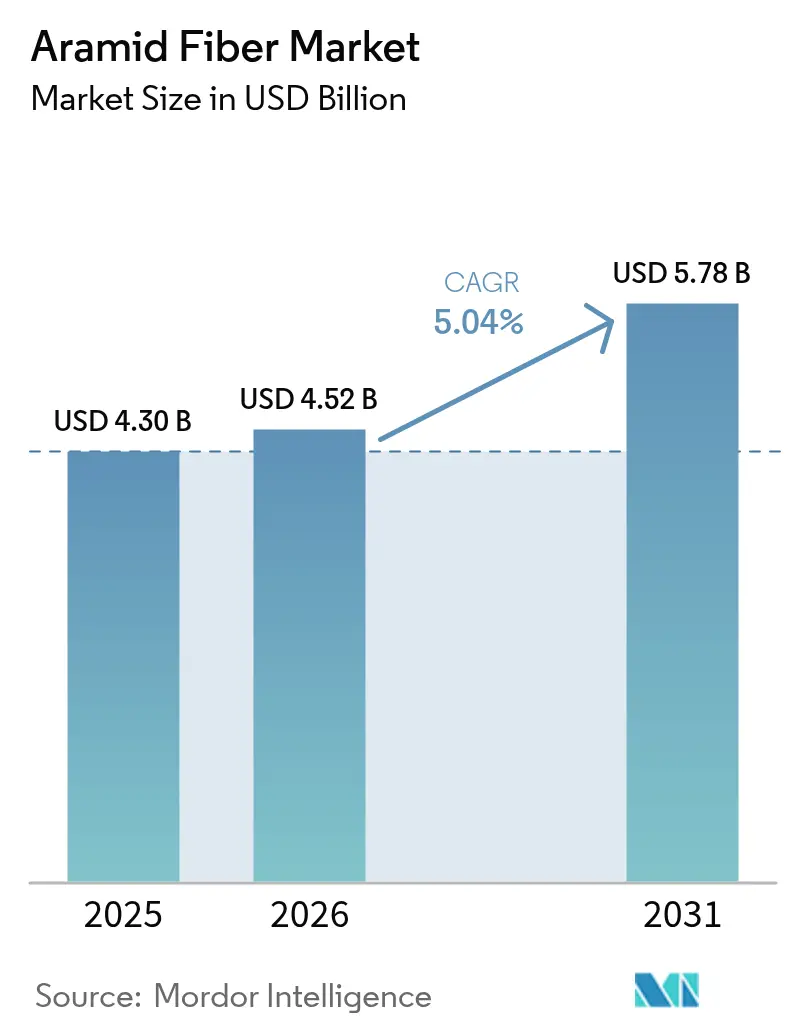
Aramid Fiber Market size in 2026 is estimated at USD 4.52 billion, growing from 2025 value of USD 4.30 billion with 2031 projections showing USD 5.78 billion, growing at 5.04% CAGR over 2026-2031. Increasing penetration in automotive, aerospace, telecom, and advanced personal protective equipment elevates demand, while the fiber’s strength-to-weight ratio and thermal stability anchor long-term relevance. Material‐lightweighting targets in electric mobility, the build-out of 5G networks, and rising investment in hypersonic and space programs continuously widen commercial opportunities. At the same time, feedstock price swings, mainly for MPD and PPD, keep margins under pressure, prompting vertical-integration moves by large producers. Intellectual-property constraints further shape competitive dynamics, cementing the position of incumbents that can finance R&D and navigate cross-licensing frameworks.
Key Report Takeaways
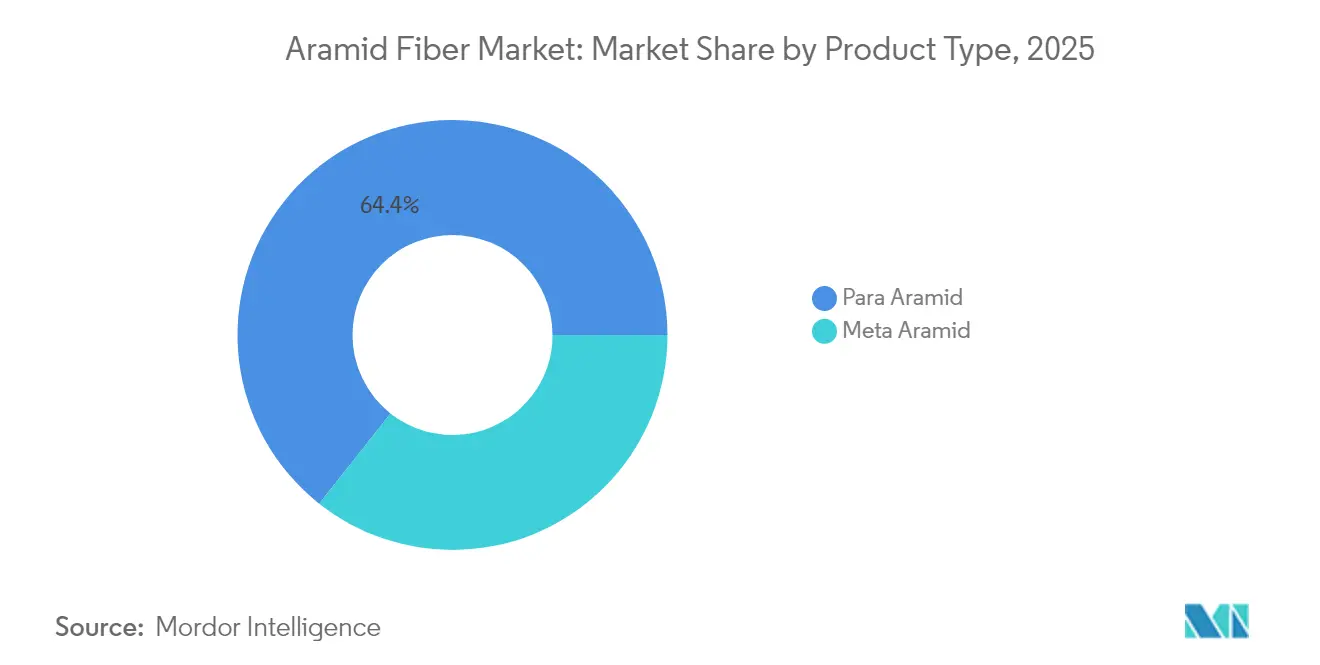
- By product type, para-aramid led with 64.35% of aramid fiber market share in 2025, while meta-aramid is set to expand at a 5.28% CAGR to 2031.
- By spinning process, wet spinning commanded 59.40% of the aramid fiber market size in 2025 and is tracking a 5.71% CAGR through 2031.
- By application, security and protection equipment captured 36.40% revenue share in 2025; optical-fiber cables are forecast to grow at a 5.35% CAGR to 2031.
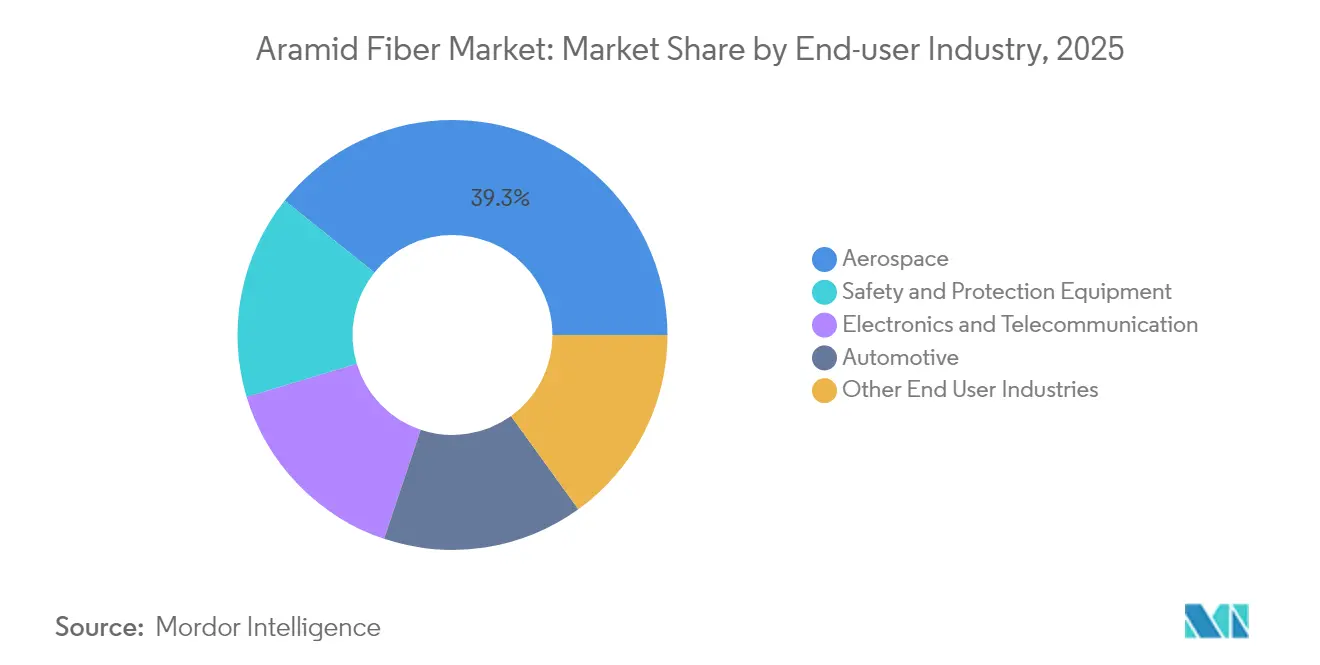
- By end-user industry, aerospace and defense held 39.25% share of the aramid fiber market size in 2025 and is advancing at a 5.86% CAGR through 2031.
- By geography, Europe accounted for 34.65% share in 2025, whereas North America records the fastest regional CAGR at 5.21% for 2026-2031.
Note: Market size and forecast figures in this report are generated using Mordor Intelligence’s proprietary estimation framework, updated with the latest available data and insights as of 2026.
Market Trends and Insights
Drivers Impact Analysis of Aramid Fiber Market*
| Driver | (~) % Impact on CAGR Forecast | Geographic Relevance | Impact Timeline |
|---|---|---|---|
| Escalating PPE safety mandates | +1.2% | Asia-Pacific with spillover global | Medium term (2-4 years) |
| EU Green-Deal push for lightweight EV tires | +0.8% | Europe, North America | Long term (≥ 4 years) |
| 5G roll-out surge for optical-fiber cables | +1.1% | Southeast Asia, Global | Short term (≤ 2 years) |
| Increase in defense spending by many countries | +1.0% | North America, Europe, Asia | Medium term (2-4 years) |
| Hypersonic & space defense investments | +0.7% | North America, Europe, China | Medium term (2-4 years) |
| Source: Mordor Intelligence | |||
Escalating PPE Safety Mandates Across Asian Manufacturing Hubs
Growing enforcement of industrial‐safety rules in China, India, and emerging Southeast Asian economies is lifting orders for aramid-reinforced gloves, helmets, and heat-resistant workwear. Industrial helmets made with aramid composites show 37% higher impact resistance than ABS counterparts, a performance gap that accelerates factory adoption. Cut-resistant gloves incorporating para-aramid deliver Level 5 protection with 30% less weight, improving comfort for continuous wear. Fire-retardant workwear formulated with meta-aramid maintains structural integrity at 425 °C, aligning with stricter foundry and petrochemical safety codes. Manufacturers supplying this region therefore raise allocation for aramid yarns and fabrics, strengthening the growth profile of the aramid fiber market.
EU Green-Deal Push for Lightweight EV Tires Reinforced with Aramid
European automakers accelerate tire redesign programs that shave vehicle mass to extend electric-car range. Aramid-reinforced tire carcasses cut weight by up to 25%, a saving directly linked to the Green Deal’s transport decarbonization targets [1]. Every kilogram trimmed offers a 0.7 km range gain, motivating OEMs to substitute polyester or steel cords with aramid. Compounders are commercializing aramid-filled rubber mixes that lower rolling resistance yet keep durability, reinforcing demand for the aramid fiber market in Europe and soon North America.
5G Roll-out Surge Elevating Demand for Aramid-Reinforced Optical-Fiber Cables
Operators racing to deploy 5G macro-cells and dense fiber backbones specify cables with higher tensile and rodent-resistance thresholds. Aramid composite rods supply three times the tensile strength of steel reinforcements at one-fifth the mass, ideal for long pulls in humid terrains [2]. Providers such as HFCL confirm rising usage of aramid elements in both underground and aerial designs. Flame-retardant, zero-halogen aramid yarns also protect data-center-to-tower links, bringing an incremental lift to the aramid fiber market.
Hypersonic & Space Defense Investments Raising Meta-Aramid Thermal-Shield Consumption
Defense agencies in the United States, Europe, and China are funding thermal-protection systems that withstand extreme aero-heating. Meta-aramid reinforced EPDM shields exhibit ablation rates as low as 0.015 mm/s, outperforming legacy ablators in solid-rocket motors. Composite studies confirm that aramid survives combined thermal and mechanical loads better than glass or carbon fibers in ultra-high-speed regimes. The specialized nature of hypersonics therefore feeds premium demand segments within the aramid fiber market.
Restraints Impact Analysis of Aramid Fiber Market*
| Restraint | (~) % Impact on CAGR Forecast | Geographic Relevance | Impact Timeline |
|---|---|---|---|
| MPD & PPD feedstock price volatility | –1.0% | Global, import-dependent regions | Short term (≤ 2 years) |
| Patent cross-licensing barriers | –0.6% | Global, emerging markets | Long term (≥ 4 years) |
| High production costs | –0.8% | Global | Medium term (2-4 years) |
| Source: Mordor Intelligence | |||
MPD & PPD Feedstock Price Volatility
Surging crude-oil swings and regional supply disruptions elevate MPD and PPD cost curves, compressing producer margins and unsettling long-term contracts. The U.S. Department of Commerce lists aromatic diamines among chemically critical inputs subject to geopolitically concentrated production, heightening supply-security risks [3]. Manufacturers counter by exploring bio-based intermediates and closed-loop recovery of aramid scrap, yet near-term volatility still shaves growth momentum within the aramid fiber market.
Patent Cross-Licensing Barriers Deterring New Para-Aramid Entrants
Extensive intellectual-property estates held by DuPont, Teijin, and a handful of peers block fast follower entry. U.S. courts upheld a 20-year ban on a challenger’s Kevlar-like product, illustrating the potency of enforcement tactics. Capital-intensive spinning assets and steep learning curves further discourage aspirants. These hurdles lock market power among incumbents, constraining broader competitive expansion and limiting the aramid fiber market’s addressable producer base.
*Our forecasts treat driver/restraint impacts as directional, not additive. The impact forecasts reflect baseline growth, mix effects, and variable interactions.
Aramid Fiber Market Segment Analysis
By Product Type:
Para-Aramid Dominance and Meta-Aramid AccelerationThe para-aramid segment held a commanding 64.35% aramid fiber market share in 2025, supported by ballistic protection, aerospace, and friction-material demand. Para-aramid yarns deliver tensile strength near 3.8 GPa, sustaining their position in body armor and aviation honeycombs. Defense-budget uplifts in the United States and renewed interest in lightweight automotive composites ensure stable volume pipelines for para-aramid within the aramid fiber market. Significant investments, such as a 3,000-ton capacity addition at Toray’s South Korea site, underscore the scale of capital allocation toward this fiber class.
Meta-aramid, while smaller in base, stages the fastest trajectory at a 5.28% CAGR through 2031. Advanced wet-spun filaments now reach 1,255 MPa tensile strength and retain over 90% strength after prolonged UV exposure, unlocking outdoor applications like transmission-line covers. Embedded in fire-retardant fabrics, insulation papers, and filtration bags, meta-aramid addresses thermal stability demands in electronics, industrial safety, and environmental protection. The aramid fiber market size for meta-aramid is forecast to expand steadily because of expanding semiconductor capacity across Asia and EU green-transition projects, setting a competitive dynamic where material attributes, not only price, decide customer conversion.

By Spinning Process:
Wet Spinning Leadership and Dry-Jet Wet Niche StrengthWet spinning captured 59.40% of aramid fiber market share in 2025 and continues to out-pace the headline market with a 5.71% CAGR. The process offers homogeneous polymer coagulation, producing uniformly dense fibers that achieve high dielectric stability, a prerequisite for electrical papers and filtration media. Upgraded solvent-recycling modules reduce emissions and cost, supporting adoption even among sustainability-minded end-users. The aramid fiber market size for wet-spun output is projected to widen in line with electrification and filter-media demand growth.
Dry-jet wet spinning remains indispensable for para-aramid where chain orientation drives extreme tensile metrics. Lab runs of polyimide analogues display tensile strength up to 2.72 GPa and modulus above 114 GPa, confirming pathway headroom for future para-aramid enhancement. Although overall share is smaller, the process anchors high-end ballistic yarn supply, aligning with the needs of defense ministries and premium sports-equipment brands. Continuous line upgrades aimed at throughput efficiency and solvent-capture technology will safeguard its niche contribution to the market.
By Application:
Security & Protection Scale and Optical-Fiber VelocitySecurity and protection equipment represented 36.40% of aramid fiber market size in 2025. Military and law-enforcement procurement of next-generation vests, helmets, and vehicle armor underpins baseline tonnage. Fire-brigade turnout gear and industrial PPE add civil demand streams, reinforcing volume stability across economic cycles. Continuous R&D produces lighter, more breathable multilayers, extending comfort and wearer compliance, which stimulates repeat purchases.
Optical-fiber cables, although smaller, post the highest growth at 5.35% CAGR. Aramid yarns and rods in cables handle tensile loading during pull-through and resist water ingress, enabling lower total-cost deployment in rural and subterranean corridors. With regulators mandating broader 5G coverage, telcos budget for extensive backbone reinforcement, accelerating the segment’s contribution to the global market. Secondary applications such as friction materials for premium brake pads and aerospace composites maintain specialized but profitable niches aware of the fiber’s superior fatigue resistance and thermal endurance.
By End-User Industry:
Aerospace & Defense Premium and Diversified Industrial UptakeAerospace and defense captured 39.25% of the aramid fiber market size in 2025, reflecting usage in aircraft panels, honeycomb cores, ballistic armor, and rocket-motor thermal shields. The sector also commands the fastest CAGR at 5.86%, supported by hypersonic weapon prototypes and commercial-space launch cadence. Aramid fiber composites translate to payload savings and extended flight ranges, hard to match with metal or lower-performance polymers.
Safety and protection equipment forms the second pillar, riding on evolving regulatory benchmarks worldwide. Electronics and telecommunications stake a rising claim, with printed-circuit reinforcement and flexible battery insulation opening incremental tonnage. Electric-vehicle platforms lean on aramid in battery pack separators and structural inserts to extend driving range. Industrial filtration, from flue-gas treatment to hot-gas filtration, leverages chemical resistance and dimensional stability. These diverse offtake routes secure demand continuity and buffer the market against single-industry shocks.
Geography Analysis
Europe Aramid Fiber Market
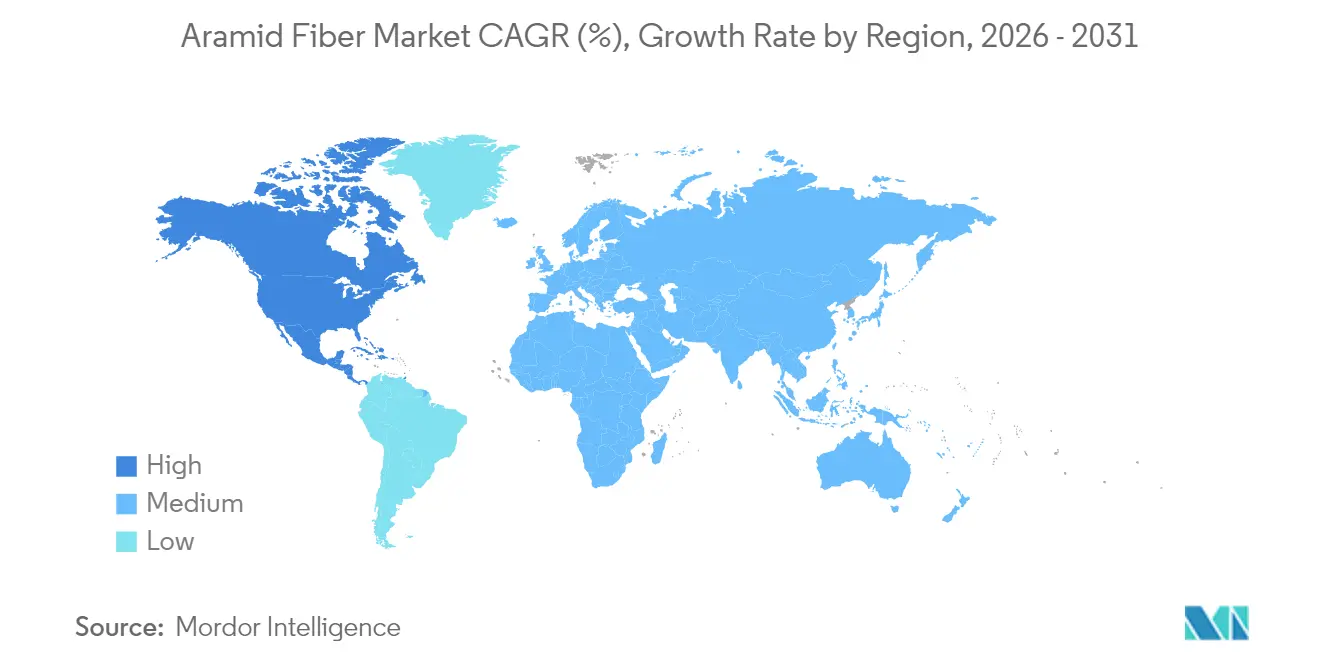
Europe anchors the global market with 34.65% revenue in 2025. Stringent worker-safety laws, ISO-aligned flame standards, and the European Union’s Green Deal propel high-value adoption in automotive and industrial settings. Germany, with its export-oriented automotive base, leads regional volume expansion, while France and the Netherlands specialize in advanced filtration and aerospace laminates. Government incentives for electric-vehicle battery plants further stimulate polymer-composite uptake.
North America Aramid Fiber Market
North America posts the fastest CAGR at 5.21% for 2026-2031. The US Aramid Fiber Market benefits from Federal defense appropriations feed continuous demand for para-aramid ballistic materials, whereas NASA and private launch providers channel investments into meta-aramid thermal shields. U.S. telecom carriers renew aerial fiber backbones across hurricane-prone corridors, specifying aramid strength members to mitigate storm damage. Canada follows similar trends with a public-safety focus, particularly in mining and energy infrastructure.
APAC Aramid Fiber Market
Asia-Pacific represents the next frontier of scale for the market. China escalates domestic output to cut reliance on imports and targets self-sufficiency in para-aramid by mid-decade. Massive construction of smart factories, EV battery plants, and renewable infrastructure multiplies demand for lightweight, heat-resistant materials. Japan and South Korea refine high-tech deployment in semiconductors and 5G hardware, requiring dielectric stability and mechanical resilience that aramid delivers. India’s Make-in-India defense program and updated occupational-safety codes build local PPE and armor consumption, adding depth to regional growth.
Value Chain Analysis
The aramid fiber value chain starts with petrochemical-derived aromatic intermediates and specialty monomers (notably MPD and PPD), which are polymerized into aramid resins and then converted into fibers via wet spinning and dry-jet wet spinning. After drawing and heat setting, fibers are processed into yarns, papers, fabrics, and composite reinforcements. Downstream demand is concentrated in performance-critical uses such as security and protection equipment, aerospace and defense composites, optical-fiber cable strength members, electrical insulation, and tire or rubber reinforcement, where qualification cycles, traceability expectations, and consistent filament properties affect supplier selection.
Consolidation is most pronounced at the fiber-production step, with a limited group of global incumbents controlling core know-how, solvent recovery, and scale assets. The same concentration is reinforced by IP and the capital intensity of spinning lines. A major upstream-to-downstream linkage shift occurred in April 2026 when Arclin completed the acquisition of DuPonts Aramids business (Kevlar and Nomex), transferring ownership of long-established brands and manufacturing operations in Europe and Asia. Sustainability requirements are also tightening into procurement and conversion workflows, including Teijin Aramids 2026 ISCC PLUS certification for its Twaron production process, which links alternative-feedstock claims to end markets such as tires and other regulated industrial applications.
Competitive Landscape
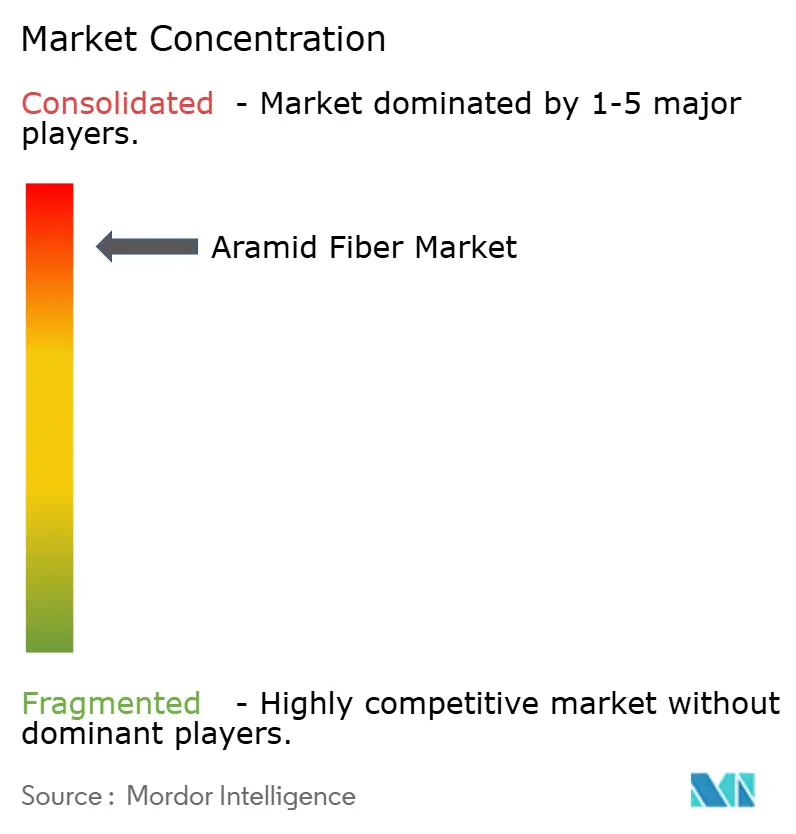
The aramid fiber market is consolidated in nature, with DuPont leading North America's para-aramid segment through patents and large-scale manufacturing, while Teijin maintains a global edge with integrated supply chains and balanced portfolios. Entry barriers include expertise in continuous polymerization, solvent-recovery systems, and high-strength spin-drawing technology. Strategic priorities focus on circularity and input diversification. Chinese players are enhancing backward integration and patent portfolios, while investments like Toray's KRW 500 billion Gumi expansion and Sinochem's capacity growth reflect confidence in demand. Future alliances target high-margin niche materials, such as nanoporous aramid aerogels for thermal management and additive manufacturing of powdered aramid composites, which could reshape competitive dynamics without disrupting traditional yarn production.
Aramid Fiber Industry Leaders
-
TEIJIN LIMITED
-
DuPont
-
Yantai Tayho Advanced Materials Co., Ltd.
-
Kolon Industries, Inc.
-
HS HYOSUNG ADVANCED MATERIALS
- *Disclaimer: Major Players sorted in no particular order
Aramid Fiber Market Companies Covered in this Report
- Aramid Hpm, LLC.
- China National Bluestar (Group) Co. Ltd.
- DuPont
- HS HYOSUNG ADVANCED MATERIALS
- Huvis Corp.
- Kolon Industries, Inc.
- Sinochem Internation Corporation
- SINOPEC YIZHENG CHEMICAL FIBRE LIMITED
- SRO Aramid
- Suzhou Zhaoda Specially Fiber Technical Co.,Ltd.
- TAEKWANG INDUSTRIAL CO., LTD.
- Teijin Limited
- Toray Industries Inc.
- TOYOBO MC Corporation
- Wuxi City Shengte Carbon Fiber Products Co.,Ltd
- X-FIPER NEW MATERIAL CO.,LTD
- Yantai Tayho Advanced Materials Co.,Ltd.
Market Opportunities and Future Outlook
Capacity additions and portfolio shifts are creating room for supply realignment and qualification-driven share changes across key end uses. In April 2026, Arclin completed its acquisition of DuPonts Aramids business (Kevlar and Nomex), establishing a new ownership structure for two benchmark brands used across protection, aerospace, and industrial segments. That change can prompt re-sourcing reviews among converters and OEMs, especially where dual sourcing and long-term supply agreements are common. On the supply side, Toray Advanced Materials Korea expanded meta-aramid output at its Gumi Plant 1 in June 2026, adding 3,000 metric tons per year and taking the site to 5,400 metric tons, which supports more localized qualification for heat-protective apparel, electrical insulation, and industrial filtration value chains.
Conversion upgrades are also opening space for lighter, higher-performance textile and composite formats, particularly where customers balance protection level, comfort, and system weight. In July 2026, Bally Ribbon Mills introduced webbing solutions using Kevlar EXO, positioned as a higher-tenacity, weight-saving next-generation aramid platform for advanced protective applications; these product moves give PPE and safety equipment makers a pathway to redesign assemblies without leaving aramid chemistry. Longer-horizon capital programs point to additional potential in ballistic and coated-composite capabilities, including Solstice Advanced Materials' plan announced in January 2026 to invest over USD 220 million to expand ballistic fiber manufacturing in Virginia, adding spinning and composite-coating capability aligned with defense and protection equipment demand for integrated, application-ready formats.
Recent Industry Developments in Aramid Fiber Market
- July 2026: Bally Ribbon Mills announced availability of advanced webbing solutions utilizing Kevlar EXO, a next-generation aramid fiber platform positioned for higher tenacity and weight savings versus legacy Kevlar. The launch supports redesign of load-bearing straps and protective assemblies where users seek lower mass without giving up durability, increasing pull-through for higher-value converted aramid products.
- April 2026: DuPont completed the divestiture of its Aramids business (including Kevlar and Nomex) to Arclin for about USD 1.8 billion, and Arclin confirmed closing of the acquisition. The transaction changes ownership of two flagship aramid brands and related manufacturing operations in Europe and Asia, reshaping competitive positioning and procurement strategies across protection, industrial, and aerospace supply chains.
- May 2024: Toray Industries announced plans to invest about USD 365 million to expand aramid production facilities at the Gumi National Industrial Complex via Toray Advanced Materials Korea, including increasing dry-spinning output at Gumi Plant 1 to 3,000 tons per year and lifting total capacity to 5,000 tons. The investment anchors additional regional supply and supports downstream conversion in cables, protection equipment, and industrial applications that require consistent long-run availability.
Aramid Fiber Market Report Scope and Research Methodology
Market Definition and Coverage
This market covers revenues generated from aramid fiber sold into end uses that need high tensile strength and heat resistance, including both para-aramid and meta-aramid. The sizing reflects demand across major regions after adjusting for trade flows and typical channel markups.
Scope exclusions: It excludes adjacent high-performance fibers that are not aramid (such as carbon fiber and UHMWPE) and excludes finished products where aramid is only a minor input cost.
Segments Covered in This Report
- By Product Type
- Para Aramid
- Meta Aramid
- By Spinning Process
- Wet Spinning
- Dry Jet Wet Spinning
- By Application
- Security and Protection Equipment
- Frictional and Brake Materials
- Optical Fiber Cables
- Aerospace Components
- Automotive Composites
- Electrical Insulation
- Others (industrial filtration, rubber and tire reinforcement)
- By End User Industry
- Safety and Protection Equipment
- Aerospace
- Automotive
- Electronics and Telecommunication
- Other End User Industries
- Geography
- Asia Pacific
- China
- India
- Japan
- South Korea
- Rest of Asia Pacific
- North America
- United States
- Canada
- Mexico
- Europe
- Germany
- United Kingdom
- France
- Italy
- Russia
- Rest of Europe
- South America
- Brazil
- Argentina
- Rest of South America
- Middle East and Africa
- Saudi Arabia
- South Africa
- Rest of Middle East and Africa
- Asia Pacific
Data Sources, Market Sizing, and Validation
Desk Research
Desk research is used to set the factual base for the model, especially on where aramid fiber is consumed and what drives volume pull from key uses like protective apparel, friction materials, and optical fiber cable reinforcement. We relied on public sources such as UN Comtrade trade statistics, USITC DataWeb tariff and import data, Eurostat industrial and trade releases, IEA and national energy agencies for power grid and infrastructure signals, and safety or industrial standards bodies that influence adoption, for example PPE and electrical insulation requirements.
Company filings, investor presentations, and reputable press were also reviewed to understand capacity additions, grade shifts between para and meta, and application mix changes over time. Select paid subscriptions were used only for company financials and intelligence, patent databases, and shipment-level import and export checks, which helped reconcile gaps that public series do not fully explain. These desk sources are illustrative only, and many other public documents were also used for cross-checking and clarification.
Primary Interviews and Surveys
Primary work focused on confirming what is actually being bought and at what price points across key applications, since aramid pricing and grade mix can move with contracts and substitution pressure. We spoke with participants across the value chain, including fiber producers, compounders and converters, distributors, and large end users in protection, automotive, aerospace, and electronics, and then rechecked assumptions by region to make sure the demand story holds together.
Distribution of primary research fieldwork respondents
| Company type | Respondent position | Region |
|---|---|---|
| Top tier: 29% | CXOs: 13% | APAC: 37% |
| Mid tier: 52% | Functional/Unit leaders: 32% | EMEA: 36% |
| Smaller Players: 19% | Managers: 55% | Americas: 27% |
Market-Sizing & Forecasting
Sizing starts with a top-down build that reconstructs demand using application-linked indicators, followed by region-level checks against production and trade movements for aramid fiber. For aramid, the model is anchored on a few practical inputs such as protective apparel and ballistic demand signals, optical fiber cable deployment trends, automotive and industrial friction material output, aerospace build rates, and typical grade splits between para-aramid and meta-aramid, which together shape the addressable consumption pool.
To keep totals realistic, results are corroborated with selective bottom-up approximations, including sampled price bands by grade, channel checks on contract versus spot behavior, and supplier side capacity and utilization discussions where data was available. When a country-level data point is missing, the gap is handled by using proxy indicators, for example industrial production and trade intensity, and then tightening the estimate through interview feedback. Forecasting uses scenario analysis supported by regression-style relationships between demand drivers and historical consumption, and the final forward view is adjusted when experts indicate a clear change in substitution, safety regulation pull, or supply additions.
Data Validation & Update Cycle
Validation is done through stepwise triangulation that compares the modeled market value with independent signals, like trade balances, capacity announcements, and application-level growth patterns, and then anomalies are reviewed before sign-off. If a large variance appears in a region or application, we re-contact sources to confirm whether it is caused by pricing, a temporary supply tightness, or a real shift in end use.
Each deliverable goes through internal analyst review so assumptions, conversions, and year-on-year movements are consistent and explainable. Reports are refreshed annually, and interim updates are made when material events happen, such as major capacity starts, policy changes impacting protective equipment, or sharp feedstock-driven price swings. Before delivery, a final pass is completed to ensure the most recent public releases and market events are reflected.
Mordor Intelligence's Aramid Fiber Market Estimate Compared With Other Published Estimates
Published market sizes for aramid fiber often do not match because the scope and the pricing logic are set up differently, and the refresh timing can also vary by publisher. Differences tend to show up most when a study mixes fiber revenue with downstream fabricated goods, or when it assumes aggressive price escalation without tying it to contracts and grade mix.
Some published figures appear to include wider downstream value for protective gear, cables, or composites, which lifts the headline number. In Mordor Intelligence, only aramid fiber revenue is counted, and applications are used to build demand volumes that are then priced using grade-specific ranges and region conversion checks, which keeps the total tied to the fiber market itself.
Benchmark comparison
| Source | Market Size | Gaps in Research Methodology |
|---|---|---|
| Mordor Intelligence | USD 4.30 B (2025) | |
| Global Consultancy A | USD 4.88 B (2025) | Uses a higher growth and pricing path that can lean on broader application baskets and less explicit separation between fiber value and downstream reinforced components, which can raise the revenue base. |
| Industry Research Group B | USD 4.71 B (2025) | Often reflects different price realization assumptions across regions and a longer historical framing that can smooth short-term contract pricing effects, thereby shifting the 2025 point estimate upward. |
The spread across the table is mainly explained by how strictly fiber-only revenue is isolated and how price progression is handled across grades and regions. By tying the estimate to observable demand indicators and then validating with trade and supply signals, the approach stays transparent enough for us to revisit quickly when new capacity, regulation, or contract pricing changes the market.
Key Questions Answered in the Report
What is the current value of the Aramid Fiber Market?
The Aramid Fiber Market stands at USD 4.52 billion in 2026 and is projected to reach USD 5.78 billion by 2031.
Which region is growing fastest in Aramid Fiber Market demand?
North America shows the highest regional growth, advancing at a 5.21% CAGR for 2026-2031, driven by defense and aerospace investment.
Why is wet spinning dominant in aramid fiber production?
Wet spinning accounts for 59.40% of the aramid fiber market share because the process yields fibers with uniform density and excellent thermal resistance, essential for electrical insulation and filtration applications.
What application segment is growing quickest?
Optical-fiber cables are the fastest-growing application, benefiting from 5G infrastructure roll-outs and posting a 5.35% CAGR through 2031.