
Market Overview
| Study Period | 2020 - 2031 |
|---|---|
| Forecast Data Period | 2026 - 2031 |
| Base Year Market Size (2025) | USD 25.12 Billion |
| Market Size (2026) | USD 26.02 Billion |
| Market Size (2031) | USD 31.02 Billion |
| Growth Rate (2026 - 2031) | 3.58 % |
| Market Concentration | Medium |
Major Players *Disclaimer: Major Players sorted in no particular order Image © Mordor Intelligence. Reuse requires attribution under CC BY 4.0. | |
Argentina Facility Management Market Analysis by Mordor Intelligence
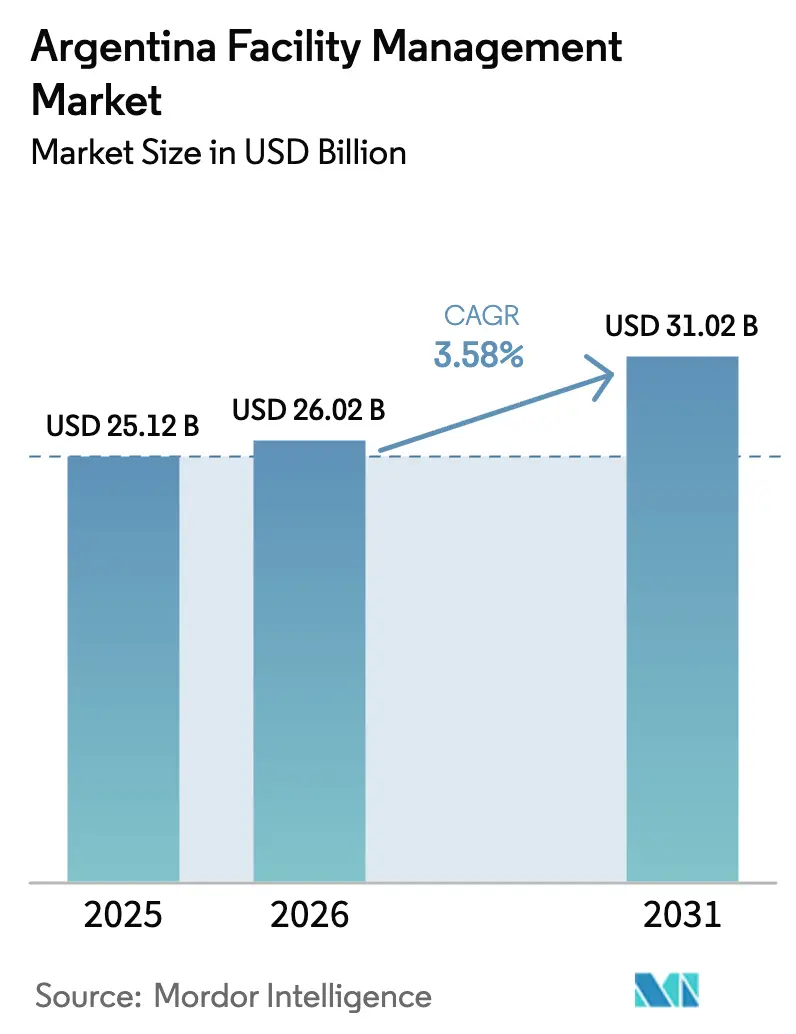
The Argentina facility management market size was valued at USD 25.12 billion in 2025 and estimated to grow from USD 26.02 billion in 2026 to reach USD 31.02 billion by 2031, at a CAGR of 3.58% during the forecast period (2026-2031). Rising outsourcing adoption, expanding critical-infrastructure investments, and stricter post-pandemic hygiene requirements collectively anchor demand, while currency volatility and skilled-labour shortages temper margins. Technology-enabled hard-service offerings—especially predictive maintenance and IoT-driven asset monitoring—are increasingly bundled with traditional soft services to deliver integrated value propositions. The Buenos Aires corporate hub supplies 60% of revenues, but secondary cities outpace the capital in growth as decentralization gains traction. International providers deepen competitive pressure by pairing global standards with local execution capabilities, prompting domestic firms to modernize service portfolios rapidly.[1]Resolución 906/2023, “Integración de Sistemas de Almacenamiento de Energía,” Ministerio de Economía, economia.gob.ar
Key Report Takeaways
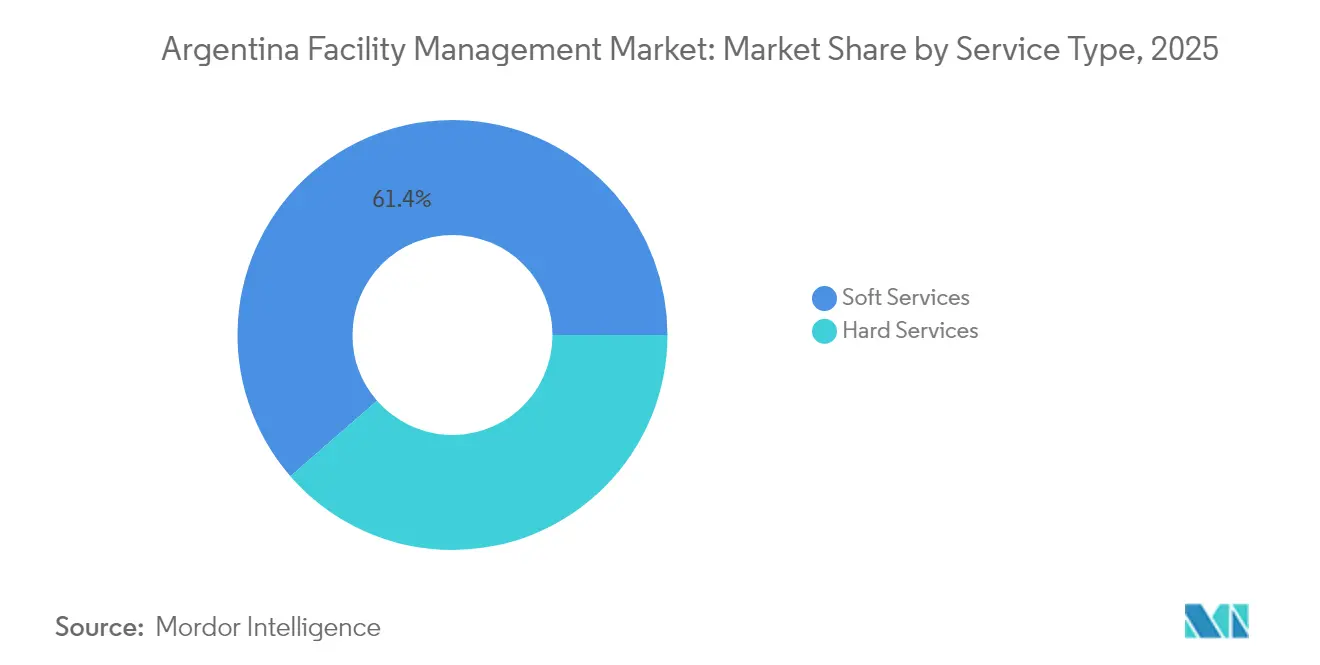
- By service type, soft services held 61.40% of the Argentina facility management market share in 2025, whereas smart-asset hard services are advancing at an 8.62% CAGR through 2031.
- By offering type, in-house delivery retained 67.35% of the Argentina facility management market size in 2025, but outsourced solutions are expanding at a 9.18% CAGR to 2031.
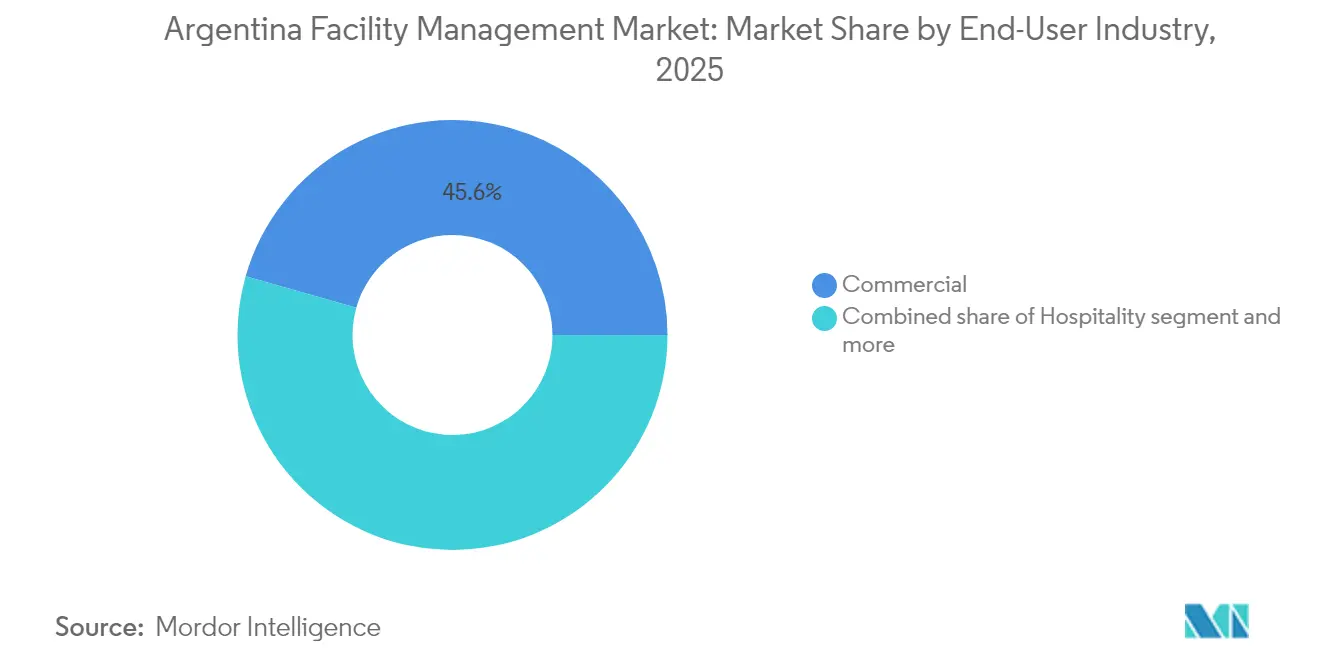
- By end-user industry, commercial facilities led with 45.60% revenue share in 2025; healthcare facilities are projected to grow at a 7.54% CAGR through 2031.
- By facility type, commercial buildings accounted for a 50.45% share of the Argentina facility management market size in 2025, while critical infrastructure facilities are growing at an 7.96% CAGR to 2031.
- CBRE, ISS, and Sodexo collectively captured the largest contractual pipeline among international providers in 2024, edging ahead of leading local firms that traditionally dominated the sector.
Note: Market size and forecast figures in this report are generated using Mordor Intelligence’s proprietary estimation framework, updated with the latest available data and insights as of 2026.
Argentina Facility Management Market Trends and Insights
Drivers Impact Analysis*
| Driver | (~) % Impact on CAGR Forecast | Geographic Relevance | Impact Timeline |
|---|---|---|---|
| Rising outsourcing penetration among corporates | 0.80% | Buenos Aires & major metros, expanding to secondary cities | Medium term (2-4 years) |
| Post-pandemic hygiene & indoor-air-quality standards enforcement | 0.60% | National, with concentration in healthcare and commercial sectors | Short term (≤ 2 years) |
| Expansion of renewable-energy and advanced industrial facilities | 0.50% | Patagonia, Mendoza, and Buenos Aires Province | Long term (≥ 4 years) |
| Government incentives for energy-efficiency retrofits in public buildings | 0.40% | National, with early adoption in CABA and provincial capitals | Medium term (2-4 years) |
| Rapid growth of data centers in Buenos Aires spurring specialized FM demand | 0.30% | Buenos Aires metropolitan area, expanding to Córdoba | Short term (≤ 2 years) |
| Adoption of BIM-IoT integrated CAFM platforms enabling predictive maintenance | 0.20% | Buenos Aires, Córdoba, Rosario, with gradual provincial expansion | Long term (≥ 4 years) |
| Source: Mordor Intelligence | |||
Rising Outsourcing Penetration Among Corporates
Argentina-based multinationals are accelerating the shift toward external service partners to convert fixed overheads into variable costs and focus internal resources on core revenue streams. Bundled and integrated contracts deliver immediate savings by folding multiple soft and hard services into outcome-oriented agreements. Technology, healthcare, and life-sciences tenants in Buenos Aires increasingly demand enterprise-grade energy management dashboards and automated SLA reporting, prompting suppliers to scale predictive-maintenance tools rapidly. Growing acceptance among domestic conglomerates in automotive and food processing extends the opportunity to secondary cities. As outsourcing volume deepens, service-level benchmarking and transparent performance metrics become critical differentiators in vendor selection.
Post-Pandemic Hygiene & Indoor-Air-Quality Standards Enforcement
Elevated cleaning frequencies and advanced filtration have evolved into baseline expectations across offices, hospitals, and retail venues. Argentine healthcare regulators now require antimicrobial surface treatments and routine indoor-air-quality audits, steering facilities toward HEPA-grade ventilation upgrades and ultraviolet disinfection options. Commercial landlords bundle hygiene analytics with tenant-experience apps that display near-real-time particulate counts, fostering occupant trust and boosting space utilization. Providers offering certified cleaning protocols gain preferred-vendor status in public tenders, especially where compliance documentation must accompany invoicing. The result is a structural uptick in contract values for soft services tied directly to measurable health and safety outcomes.[2]“Building Operations & Experience Launch,” CBRE Group Press Release, cbre.com
Expansion of Renewable-Energy and Advanced Industrial Facilities
Wind and solar projects in Patagonia, lithium-ion battery parks in Salta, and a planned LNG megaproject in Río Negro all require specialized operations-and-maintenance regimes. Asset managers must monitor turbine blade integrity, substation switchgear, and high-pressure LNG cryogenic lines under stringent safety standards. Facility management providers able to align preventive maintenance with remote-sensing data capture premium rates and long-term contracts, often indexed to energy-yield metrics. Local skill development initiatives focus on electrical, instrumentation, and control-systems certifications, expanding the technical labour pool needed for these high-complexity environments. Cross-training technicians for both renewable- and conventional-energy assets further boosts provider utilization rates.
Government Incentives for Energy-Efficiency Retrofits in Public Buildings
Federal energy-labelling mandates now cover municipal buildings, schools, and social housing, unlocking retrofit budgets for envelope insulation, LED revamping, and sensor-controlled HVAC. Performance-based public-private contracts share verified utility savings with service providers, extending predictable revenue over multi-year horizons. Facility management firms with accredited energy auditors and IRAM 11900 compliance expertise win competitive advantage, especially in Buenos Aires Province where procurement frameworks have been pre-funded through multilateral programs. Integrated retrofits often trigger follow-on maintenance scope, amplifying lifetime contract value while accelerating the adoption of building-automation systems.
Restraints Impact Analysis*
| Restraint | (~) % Impact on CAGR Forecast | Geographic Relevance | Impact Timeline |
|---|---|---|---|
| Skilled labor shortage and wage inflation pressures | -0.70% | National, with acute impact in Buenos Aires and technical specializations | Short term (≤ 2 years) |
| Currency volatility increasing costs of imported FM equipment | -0.50% | National, with higher impact on technology-intensive services | Medium term (2-4 years) |
| Fragmented provincial oversight causing compliance ambiguity | -0.30% | Provincial markets outside Buenos Aires, particularly interior regions | Long term (≥ 4 years) |
| High vacancy rates in Grade-B office stock limiting contract renewals | -0.20% | Buenos Aires commercial district, secondary office markets | Medium term (2-4 years) |
| Source: Mordor Intelligence | |||
Skilled Labor Shortage and Wage Inflation Pressures
Technical trades such as HVAC automation, high-voltage electrical maintenance, and fire-system commissioning suffer from limited apprenticeship pipelines, lifting average wages well above national inflation. Providers invest in on-site academies, pairing classroom instruction with supervised fieldwork to accelerate credential attainment. Union negotiations increasingly include technology-training clauses, reflecting employer willingness to co-fund certifications in exchange for multiyear retention. Nevertheless, bid prices factor in wage-escalation risk, pressing clients to lock contracts to consumer-price indices, thereby shifting volatility back to providers. Margins narrow most on low-complexity soft services where labour cost dominates total price.
Currency Volatility Increasing Costs of Imported FM Equipment
Sharp peso swings inflate the landed cost of chillers, BMS controllers, and IoT sensors denominated in USD or EUR, compressing capital budgets devoted to modernization. Larger suppliers maintain foreign currency hedging lines and stock strategic spares locally to mitigate lead-time and cost spikes. Smaller domestic firms face working-capital constraints that impede technology refresh cycles, widening the capability gap with multinational competitors. Clients increasingly favour multi-year fixed-rate leases on equipment bundled within FM contracts, transferring currency risk to providers with broader treasury capabilities.
*Our forecasts treat driver/restraint impacts as directional, not additive. The impact forecasts reflect baseline growth, mix effects, and variable interactions.
Segment Analysis
By Service Type: Smart Technology Elevates Hard-Service Uptake
Hard-service revenue climbed faster than any other category in 2025 as IoT-enabled asset monitoring became standard in new contract tenders. The Argentina facility management market size for smart-asset hard services is set to expand at an 8.62% CAGR, closing the gap with soft-service dominance. Integrated MEP and HVAC sensor suites feed predictive-maintenance engines that cut unplanned downtime, justifying premium fees. Simultaneously, the Argentina facility management market continues to rely on soft services—cleaning, security, catering—for steady cash flow due to their non-discretionary nature. Security assignments increasingly include video analytics and real-time access-control reporting, demonstrating how technology now permeates both service clusters.
The Argentina facility management market benefits from cross-selling opportunities when providers bundle cleaning, manned guarding, and smart-maintenance under unified account management. As building owners seek single-invoice simplicity, modular dashboards display KPI compliance across diverse workstreams, reinforcing integrated-service contract renewals. Providers investing in robotics for floor care and drones for façade inspection further differentiate on efficiency, signalling an ongoing shift toward data-rich delivery even in traditionally low-tech soft services.



By Offering Type: Outsourcing Gains Ground Without Displacing In-House Control
Corporations historically maintained direct control of janitorial, security, and minor maintenance crews, preserving a 67.35% share of in-house delivery in 2025. The Argentina facility management market share held by outsourced providers nonetheless expanded rapidly as CFOs prioritized variable-cost structures. Bundled FM contracts lower procurement overhead, while integrated FM agreements stabilize service quality across multisite portfolios. In absolute terms, the Argentina facility management market size attached to outsourced delivery is forecast to grow at 9.18% CAGR to 2031, outpacing overall industry expansion.
Single-service outsourcing remains the entry point for risk-averse clients; however, bundled and integrated formats command higher margins and longer tenures. Multinationals operating in pharmaceuticals and tech anchor flagship integrated FM agreements that include space planning and energy optimization KPIs. Domestic mid-market firms increasingly emulate these models to access expertise unavailable in house, signalling a structural shift rather than a cyclical response to cost pressures.
By End-User Industry: Healthcare Outpaces a Stable Commercial Core
Hospitals and clinics require stringent environmental controls, specialized waste disposal, and regulated cleaning protocols that push contract values above those in general office space. Consequently, healthcare exhibits the highest forecast growth, widening its footprint within the Argentina facility management market. The Argentina facility management market size captured by healthcare providers is slated to accelerate at 7.54% CAGR, underpinned by modernization of public-sector facilities and private-sector capacity expansions.
Commercial real estate nevertheless remains the revenue anchor, anchored by Grade-A office towers, shopping centers, and hybrid workplaces that collectively generate 45.60% of 2025 turnover. Ongoing refurbishment of premium offices to attract tenants supports steady spend on energy-efficient retrofits and workplace-experience enhancements. Institutional facilities—schools, museums, municipal complexes—follow closely, particularly where public-private partnerships tie performance fees to user satisfaction metrics.
By Facility Type: Critical Infrastructure Commands Premium Growth
Data centers, transport hubs, and power-generation sites constitute a niche yet highly technical slice of the Argentina facility management market. Mission-critical uptime requirements and rigorous regulatory oversight enable providers to price contracts at a meaningful premium, which explains the 7.96% CAGR outlook for critical-infrastructure facilities. Predictive analytics surrounding server-room cooling loads and substation transformer health minimize downtime risks, reinforcing client willingness to engage long-term service alliances.
Commercial buildings still dominate volumetrically, accounting for 50.45% of 2025 revenue, thanks to Buenos Aires’ dense high-rise stock and nationwide retail portfolios. The Argentina facility management market share held by commercial premises is expected to remain substantial as mixed-use developments proliferate. Residential complexes, educational campuses, and specialty venues such as wineries create incremental niches where providers tailor amenity-centric service bundles to enhance resident and visitor experiences.
Geography Analysis
Buenos Aires anchors the Argentina facility management market with 59.40% of 2025 turnover, reflecting a deep concentration of corporate headquarters, government ministries, and institutional landlords. Sophisticated tenant expectations sustain demand for integrated FM, CAFM platforms, and ESG-aligned performance metrics. While the region expands more slowly than the national average, contract renewals are sizable and typically multiyear, bolstering revenue certainty.
Rural provinces benefit indirectly from federal transport and renewable-energy programs that extend rail connectivity and install wind-farm clusters. Facility management providers with mobile, tech-enabled workforces seize early-mover advantages in these geographies but must navigate fragmented inspection regimes where provincial codes differ materially from national standards. Training local subcontractors on corporate compliance frameworks becomes a strategic imperative to sustain service-quality consistency across Argentina’s expanding economic map.
Regulatory Landscape
Facility management (FM) delivery in Argentina is shaped by a mix of national workplace and building-use standards and sector-specific technical compliance for critical infrastructure. In public buildings, the Agencia de Administracion de Bienes del Estado (AABE) sets workspace standards that guide the rational use, maintenance, and conservation of national public sector facilities. The Sustainable Public Buildings Program for the National Public Sector (Resolution 107/23) also frames requirements for sustainable management of electricity, water, gas, waste, and accessibility in government assets, which in turn informs FM tender specifications and reporting obligations.
At city level, the Buenos Aires City Building Code (2024 update) tightens requirements around maintenance activities such as cleaning ducts and maintaining fire-safety equipment, including registration obligations for service providers with the competent authority. This raises compliance expectations for both in-house teams and outsourced contractors. For FM tied to telecom and data center environments, ENACOM Resolution 57/2026 (published February 26, 2026) updates Argentina's telecom equipment approval scheme and introduces a transition toward accredited third-party certification bodies. The new framework takes effect from September 1, 2026, affecting procurement, commissioning, and lifecycle maintenance planning for connectivity, security, and monitoring hardware embedded in modern, smart-enabled FM contracts.
Value Chain Analysis
The Argentina facility management value chain includes asset owners and occupiers (commercial offices, retail, healthcare, public infrastructure, and industrial and energy sites), service integrators (international and local FM providers), and a broad subcontractor base for specialized hard services (MEP, HVAC controls, fire systems, high-voltage, and critical cooling). Upstream inputs include imported and locally distributed building systems (BMS/CAFM software, IoT sensors, access control, and power and cooling equipment) and consumables for soft services. Delivery depends heavily on local labor availability, unionized work practices, and region-specific compliance know-how, particularly outside Buenos Aires where provincial oversight can be fragmented.
Digital infrastructure players increasingly influence downstream FM requirements as more facilities demand always-on connectivity and monitored environments. Partnerships and distribution moves in the ICT ecosystem help determine the availability of critical infrastructure equipment and on-the-ground support capabilities that FM providers rely on for data centers and smart-building rollouts, for example Vertiv's October 2025 distribution alliance with Grupo Datco in Argentina and Chile for critical digital infrastructure solutions. Operator-led ecosystem initiatives also feed into FM enablement through connectivity and API platforms, such as Telecom Argentina's February 2024 collaboration with Nokia around a Network as Code platform aligned with the GSMA Open Gateway ecosystem, which supports integration of network capabilities into enterprise operations tools alongside CAFM and building-automation workflows.
Competitive Landscape
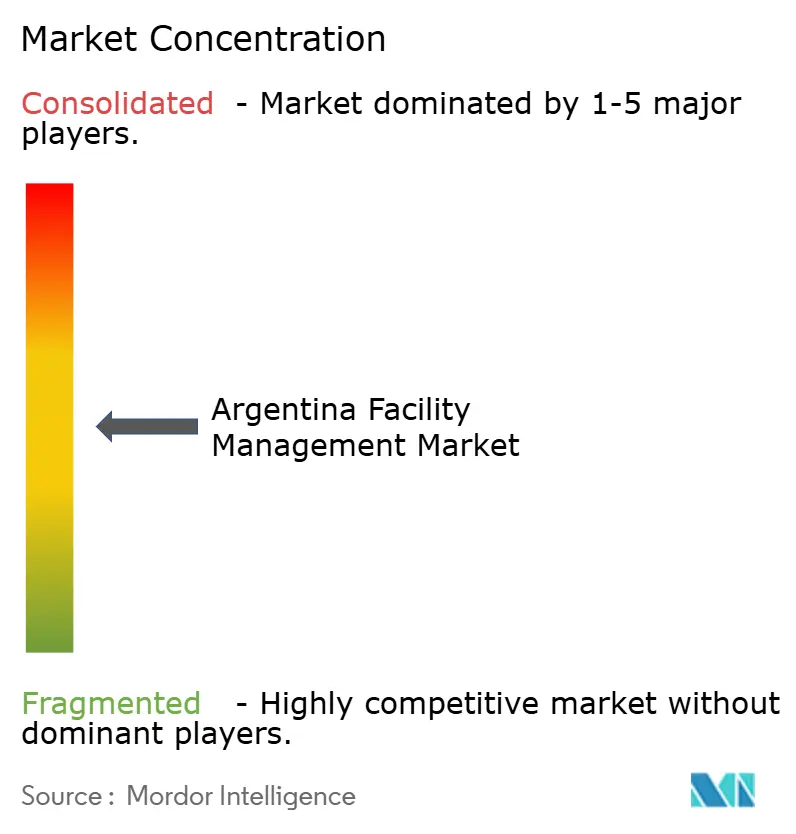
The Argentina facility management market hosts a mix of global leaders and entrenched local specialists. CBRE leverages its Building Operations & Experience platform to integrate FM with workplace-flexibility services, winning multi-site bundled contracts among technology and life-science tenants. ISS prioritizes ESG credentials, embedding carbon-reduction dashboards within service agreements to appeal to sustainability-oriented clients. Sodexo focuses on operational discipline, reducing contract-mobilization times and deploying standardized digital toolkits for real-time KPI monitoring.
Local champions such as Plural and Facility Service retain competitive footholds through deep municipal relationships and cultural familiarity, often subcontracting advanced hard-service elements to niche engineering firms. The technology race intensifies as both international and domestic players adopt BIM-IoT solutions, drone inspections, and robotics to boost productivity. Consolidation is likely: mid-sized providers lacking capital for digital upgrades may seek mergers or strategic alliances to preserve market relevance. Labor availability remains a universal challenge, prompting competitors to fund joint vocational programs to secure technician pipelines and meet rising service-level obligations.[4]“Banco Provincia Data Center Recertification,” Uptime Institute Case Study, uptimeinstitute.com
Argentina Facility Management Industry Leaders
CBRE Group Inc.
ISS Facility Services Argentina S.A.
Cushman & Wakefield S.R.L.
Sodexo Argentina S.A.
Grupo EULEN Argentina S.A.
- *Disclaimer: Major Players sorted in no particular order

Market Opportunities and Future Outlook
A white-space gap sits at the intersection of FM and Argentina's accelerating build-out and modernization of digital and critical infrastructure, especially in Buenos Aires and in expanding secondary hubs. Data centers and network facilities pull demand toward higher-spec hard services (power, cooling, fire safety, monitoring, and uptime-driven preventive maintenance) and toward integrated service models that combine technical maintenance with security, cleaning, and SLA reporting in a single operating layer. The shift is supported by operator and vendor investment activity around 5G, fiber, and data center capacity, including a reported US$30 million data center project in Buenos Aires tied to Claro, as well as public-private funding mechanisms in telecom infrastructure that expand the installed base of assets requiring audited, standards-driven maintenance.
A second opportunity area is tech-enabled productivity in labor-intensive services, where wage inflation and technician shortages push buyers toward measurable outcomes, automated reporting, and predictive maintenance. In 2026, Telecom Argentina leadership publicly emphasized autonomous-network trajectories and the use of agentic AI and process redesign, aligning with the broader enterprise push toward automation and with BIM-IoT integrated CAFM adoption in FM contracts. Parallel investments in automation within large operational facilities, such as Andreani's AI-managed automated processing systems at its Pacheco logistics plant, also point to near-term addressable scope for FM providers that can maintain sensorized assets, integrate vendor systems, and deliver compliance-ready documentation for both private clients and government-owned building portfolios governed by AABE standards and the Sustainable Public Buildings Program (Resolution 107/23).
Recent Industry Developments
- July 2026: Telecom Argentina executives outlined a roadmap toward Level 4 autonomous networks, emphasizing agentic AI, process changes, and a digital-first operating culture. This reinforces the shift toward highly instrumented, software-defined infrastructure where FM contracts increasingly require 24/7 monitoring, automated incident workflows, and tighter alignment between facilities operations and network performance.
- October 2025: Vertiv announced a distribution alliance with Grupo Datco covering Argentina and Chile for critical digital infrastructure and high-performance computing solutions. Wider availability of power and thermal infrastructure equipment, plus local channel support, strengthens the ecosystem for data center and mission-critical FM deployments that depend on consistent spares and certified service partners.
- February 2024: Telecom Argentina partnered with Nokia to advance a Network as Code platform and developer portal aligned with the GSMA Open Gateway ecosystem. By enabling enterprises to embed network intelligence into operational applications, the initiative supports deeper integration between connectivity services and smart-building or CAFM platforms used to run multi-site facility portfolios.


Research Methodology Framework and Report Scope
Market Definition and Coverage
For this report, the Argentina facility management market is defined as the value of services used to operate, maintain, and support buildings and sites across hard and soft activities, whether delivered in-house or outsourced, and counted in USD terms.
Scope exclusions: We do not count one-off construction or major capital retrofit projects as facility management revenue, even if they happen on the same site.
Segmentation Overview
- By Service Type
- Hard Services
- Asset Management
- MEP and HVAC Services
- Fire Systems and Safety
- Other Hard FM Services
- Soft Services
- Office Support and Security
- Cleaning Services
- Catering Services
- Other Soft FM Services
- Hard Services
- By Offering Type
- In-house
- Outsourced
- Single FM
- Bundled FM
- Integrated FM
- By End-user Industry
- Commercial (IT and Telecom, Retail and Warehouses, etc.)
- Hospitality (Hotels, Eateries, Large-scale Restaurants)
- Institutional and Public Infrastructure (Govt, Education, Transportation)
- Healthcare (Public and Private Facilities)
- Industrial and Process (Manufacturing, Energy, Mining)
- Other End-user Industries (Multi-housing, Entertainment, Sports and Leisure)
Data Sources, Market Sizing, and Validation
Desk Research
Desk research starts by mapping demand pools across the main facility footprints in Argentina, and then checking which service lines are typically bought as ongoing contracts versus ad hoc work. Public sources help us keep the market grounded in real building activity and operating intensity, such as INDEC construction and services indicators, Central Bank of Argentina macro and FX series, Ministry of Labor publications, and energy statistics from the national electricity and fuels authorities. We also scan tender portals and public procurement releases to understand outsourced contract patterns for institutional and public infrastructure, followed by trade association updates and reputable local business press for pricing discussions and labor availability.
On the supply side, we review company annual reports, local subsidiary disclosures when available, and investor presentations to identify service mix and exposure to sectors like commercial offices, healthcare, and industrial sites. When financial visibility is limited, we use paid subscriptions that cover company financials and intelligence, news and financials, patents where relevant, and a global contracts and tenders view to support cross-checks. This list of desk research sources is not exhaustive, and many other public documents and databases were also used to collect data, validate assumptions, and clarify open questions.
Primary Interviews and Surveys
Primary interviews and surveys are used to pressure-test what buyers actually bundle into facility management contracts in Argentina, and to confirm how pricing moves with wages, inflation, and USD-linked inputs. We speak with outsourced service providers, in-house facility heads, procurement leaders, and site managers across commercial, institutional, healthcare, hospitality, and industrial facilities, with coverage split across Buenos Aires and key secondary and provincial markets.
Distribution of primary research fieldwork respondents
Distribution of primary research fieldwork respondents
| Company type | Respondent position |
|---|---|
| Top tier: 39% | CXOs: 14% |
| Mid tier: 42% | Functional/Unit leaders: 41% |
| Smaller Players: 19% | Managers: 45% |
Market-Sizing & Forecasting
Market sizing is built using a top-down and bottom-up logic, where the top-down view starts from Argentina's serviced building and infrastructure demand pool and then reconstructs spending by applying service penetration and contract intensity to that footprint. The model is organized around hard services and soft services, and then reconciled across delivery modes (in-house versus outsourced, with outsourced split into single, bundled, and integrated styles) so overlaps are not double-counted.
Key inputs used in the model include the addressable facility base by city cluster (Buenos Aires, secondary cities, and provincial markets), typical contract frequency and staffing intensity by service line, wage and inflation movement that drives recurring cost resets, USD-linked input shares that affect pricing, and the outsourced adoption rate by end-user group (commercial, institutional and public infrastructure, healthcare, hospitality, and industrial and process). We also use practical checks like sampled annual contract values, headcount-to-area norms shared by practitioners, and channel checks on cleaning, security, and maintenance bundles, which help adjust totals when public indicators move faster than contract renewals.
For forecasting, we rely on scenario analysis with a simple multivariate layer, where revenue is linked to facility footprint growth, outsourcing mix shift, wage trends, and FX and inflation pass-through timing. When data is missing for smaller provincial markets, gaps are handled through ratio-based allocations from comparable city clusters, and then refined using interview feedback on service availability and buyer budgeting behavior.
Data Validation & Update Cycle
Validation is done by triangulating the model outputs against independent signals such as construction and services indicators, public tender activity, and staffing and wage movement that impacts recurring FM contracts. Outliers are flagged when implied spend per square meter, service penetration, or outsourcing shares fall outside what operators and buyers consider workable, and then assumptions are revisited before sign-off. A second analyst review is used to challenge currency conversion timing, inflation treatment, and year alignment so the market series stays consistent.
Reports are refreshed annually, with interim checks when material events occur (for example, sharp FX moves, wage resets, or major public infrastructure pushes that change contract volumes). Before delivery, we do a fresh review pass so clients receive the most current view, and re-contact is triggered when primary feedback conflicts with desk indicators by a meaningful margin.
Mordor Intelligence's Argentina Facility Management Market Size Measured Against Other Published Estimates
Published market sizes for facility management in Argentina can vary a lot because the service boundary is not always the same, and also because currency and inflation timing can move a USD number sharply from one cut to the next. Some sources count only outsourced FM, while others mix in broader property operations or adjacent site services that buyers do not treat as FM contracts.
A practical gap driver is how prices are carried forward in high inflation periods, since contract escalators often lag headline inflation and some cost lines are partially USD-linked, which changes the realized revenue in each calendar year. Another driver is refresh cadence, since delayed updates can hold older FX assumptions and older outsourcing penetration levels, and that can distort the current-year value. The refresh-led checks in this study prioritize current-year FX timing, wage reset behavior, and service mix verification through re-contacts, which is then applied consistently in the model by Mordor Intelligence.
Benchmark comparison
| Source | Market Size | Gaps in Research Methodology |
|---|---|---|
| Mordor Intelligence | USD 25.12 B (2025) | |
| Industry Publisher A | USD 7.00 B (2024) | This figure appears to focus on facility management plus integrated FM in a narrower, mostly outsourced lens, which can exclude in-house delivery and undercount multi-service bundles that sit outside the stated scope. |
| Market Monitor B | USD 26.02 B (2026) | This estimate is reported for a different year, and it can look larger or smaller depending on how FX conversion timing and escalation lags are treated, especially when the model rolls forward prices using simplified inflation pass-through. |
Looking across the table, most of the spread is explained by scope boundaries (outsourced-only versus total delivery) and by the year and currency timing used for conversion into USD. By keeping the inputs traceable to facility footprint, outsourcing mix, and contract price reset behavior, the final number stays easier to reproduce and re-check when conditions change quickly in Argentina.


Key Questions Answered in the Report
What is the current value of the Argentina facility management market?
The market stands at USD 26.02 billion in 2026 and is projected to reach USD 31.02 billion by 2031.
Which service type is expanding the fastest?
Smart-asset hard services deliver the highest growth at an 8.62% CAGR through 2031.
Why are outsourced facility services gaining traction?
Corporations are shifting toward variable-cost structures and tapping external expertise, pushing outsourced contracts to a 9.18% CAGR.
Which end-user segment leads growth prospects?
Healthcare facilities are expected to rise at a 7.54% CAGR owing to modernization and stringent hygiene standards.
How significant is Buenos Aires within the national market?
The capital region generates roughly 59.40% of total facility-management revenues, though secondary cities now exhibit higher growth rates.
Page last updated on:





