
Market Overview
| Study Period | 2021 - 2031 |
|---|---|
| Forecast Data Period | 2026 - 2031 |
| Base Year Market Size (2025) | USD 1.55 Billion |
| Market Size (2026) | USD 1.74 Billion |
| Market Size (2031) | USD 2.14 Billion |
| Growth Rate (2026 - 2031) | 4.23 % |
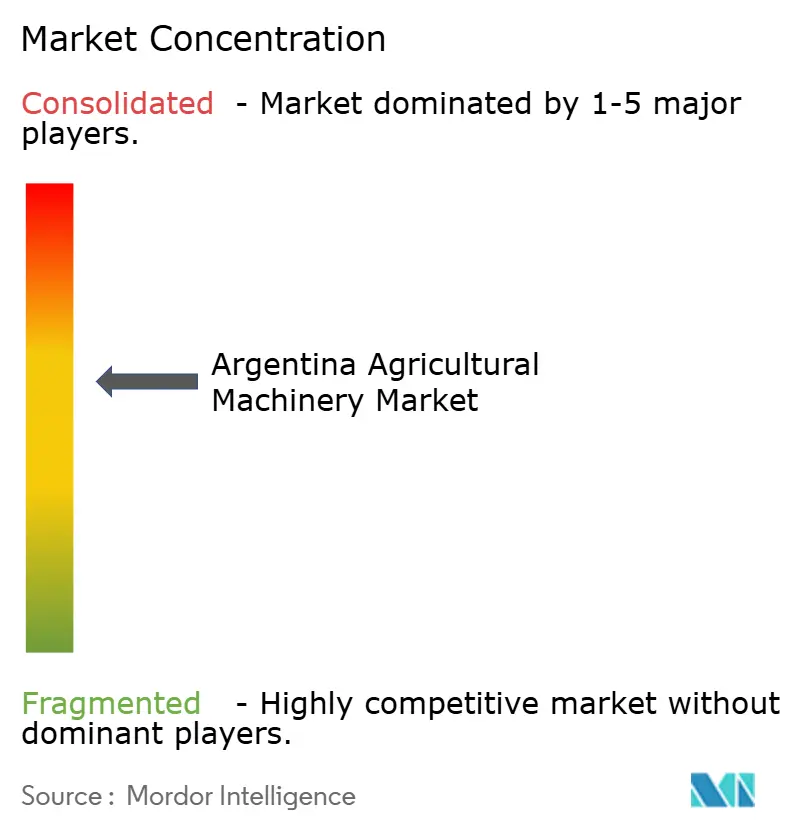
| Market Concentration | Medium |
Major Players *Disclaimer: Major Players sorted in no particular order Image © Mordor Intelligence. Reuse requires attribution under CC BY 4.0. | |
Argentina Agricultural Machinery Market Analysis by Mordor Intelligence
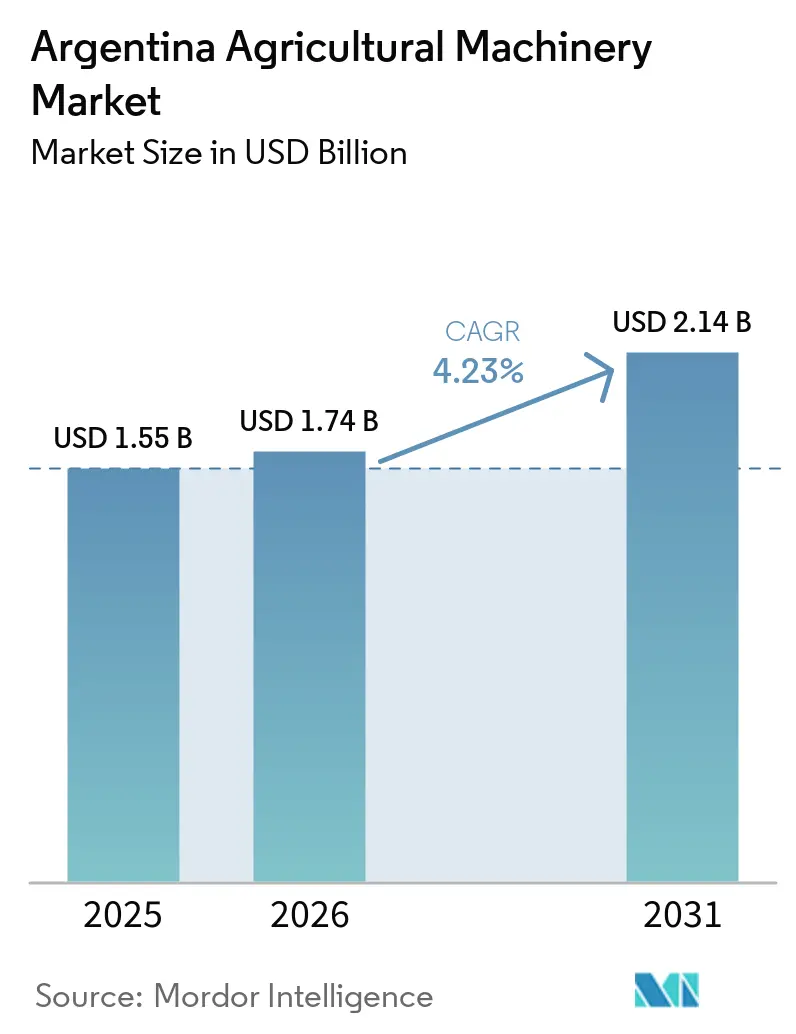
The Argentina agricultural machinery market size is projected to grow from USD 1.55 billion in 2025 to USD 1.74 billion in 2026 and is forecast to reach USD 2.14 billion by 2031 at a 4.23% CAGR over 2026-2031. The rebound follows the severe 2023-2024 drought that cut farm output and drove machinery sales into steep decline, but sweeping tariff reductions on both exports and imported capital goods are now stimulating purchasing cycles. According to the Foreign Agricultural Service (FAS) of the US Department of Agriculture, record grain and oilseed harvests in 2025, led by 27.5 million metric tons of wheat and a projected 58 million metric tons of corn, have restored producer liquidity and sparked a rush to replace aging fleets with precision-ready tractors, combines, and planters [1]. Chinese low-cost tractors have entered through non-traditional channels, pressuring prices and accelerating technology bundling by long-time leaders. Meanwhile, climate-finance inflows and carbon-credit programs are making sensor-rich implements and low-tillage equipment affordable in water-stressed regions, adding structural demand to the Argentina agricultural machinery market.
Key Report Takeaways
- By machinery type, tractors led with 44.5% of the Argentina agricultural machinery market share in 2025, and irrigation machinery is forecast to expand at a 5.4% CAGR through 2031, the fastest pace among all product segments, reflecting chronic water scarcity in Cuyo and the Northwest.
Note: Market size and forecast figures in this report are generated using Mordor Intelligence’s proprietary estimation framework, updated with the latest available data and insights as of 2026.
Market Trends and Insights
Drivers Impact Analysis of Argentina Agricultural Machinery Market*
| Driver | (~) % Impact on CAGR Forecast | Geographic Relevance | Impact Timeline |
|---|---|---|---|
| Labor-cost inflation accelerates mechanization uptake | +0.8% | National, concentrated in Pampa Húmeda grain belt | Medium term (2-4 years) |
| Access to multilateral climate-finance for ag-tech upgrades | +0.6% | National, priority in drought-prone Cuyo and Northwest | Medium term (2-4 years) |
| 5G connectivity unlocking real-time machine-to-machine farming | +0.5% | Buenos Aires, Córdoba, and Santa Fe fringe zones | Long term (≥ 4 years) |
| Carbon-credit premiums for low-tillage machinery | +0.6% | National, leveraging 90% no-till adoption | Medium term (2-4 years) |
| On-farm data monetization spurring sensor-rich implements | +0.4% | Estates above 1,000 hectares in Pampa Húmeda | Long term (≥ 4 years) |
| Electrification of specialty orchard and vineyard tractors | +0.2% | Mendoza wine region and Patagonia orchards | Long term (≥ 4 years) |
| Source: Mordor Intelligence | |||
Labor-Cost Inflation Accelerates Mechanization Uptake
Agricultural wages increased in peso terms during 2024, but the concurrent currency depreciation raised dollar-denominated labor costs, driving up daily harvest expenses. Declining rural labor availability is prompting grain producers in Buenos Aires and Córdoba to adopt autonomous sprayers and GPS-guided planters, which can achieve a return on investment within three crop cycles. These technologies not only address labor shortages but also enhance operational efficiency and precision in farming practices. The tariff reductions implemented in July 2025 lowered the landed cost of precision equipment, making replacements more accessible even for mid-sized farms. This policy change has encouraged farmers to upgrade their machinery, further boosting productivity. A single autonomous tractor can replace four to six seasonal workers on a 500-hectare farm, while variable-rate applicators help minimize fertilizer waste by applying inputs more accurately. These combined factors are driving increased demand for agricultural machinery in the Argentine market, as farmers seek to optimize costs and improve yields.
Access to Multilateral Climate-Finance for Ag-Tech Upgrades
The World Bank, the Inter-American Development Bank, and the Development Bank of Latin America and the Caribbean have collectively pledged to support climate-smart farming technologies. These funds are offered at significantly lower interest rates than local peso loan rates [2]. The financing is directed toward initiatives such as drip irrigation systems and low-tillage planters in regions like Mendoza and the semi-arid Northwest, where only a limited portion of farmland is irrigated. Producers can combine concessional loans with proceeds from carbon credits, effectively subsidizing the cost of machinery. This combination of affordable financing and additional revenue streams is driving increased adoption among cooperatives and smallholders, contributing to steady growth in the Argentina agricultural machinery market.
5G Connectivity Unlocking Real-Time Machine-to-Machine Farming
Argentina's commercial 5G deployment began in 2024, and by late 2025, operators had activated rural towers. However, coverage remains limited, falling short of the nation's cropland. Sub-50-millisecond latency enables autonomous tractors to adjust seeding or spraying rates in real time, improving yields in pilot projects. This technology has the potential to revolutionize farming practices by enabling more precise and efficient operations, reducing waste, and optimizing resource use. Satellite loans aim to extend broadband access to rural homes by 2028. Until then, many farms rely on offline precision machinery that uploads data later, limiting immediate benefits. Nevertheless, long-term advancements in connectivity are projected to drive digital integration, significantly impacting the agricultural machinery market in Argentina. These improvements are anticipated to enhance productivity, reduce operational costs, and support sustainable farming practices in the region.
Electrification of Specialty Orchard and Vineyard Tractors
Electric tractors currently account for a very small portion of Argentina's specialty-crop fleet. However, pilot programs in Mendoza and Patagonia have demonstrated significantly lower operating energy costs and the elimination of tailpipe emissions. These features are particularly valued by exporters targeting European Union retailers, which enforce strict carbon and residue standards. Despite upfront costs being considerably higher than diesel counterparts and the limited availability of rural charging infrastructure, declining battery prices and climate-focused loans are projected to enhance the economic viability of electric tractors in the long term. As vineyards and fruit orchards increasingly adopt these units, a niche yet rapidly growing segment is anticipated to develop within Argentina's agricultural machinery market.
Restraints Impact Analysis of Argentina Agricultural Machinery Market*
| Restraint | (~) % Impact on CAGR Forecast | Geographic Relevance | Impact Timeline |
|---|---|---|---|
| Currency-linked credit risk for farm equipment loans | −0.8% | National, acute in smaller-farm provinces | Short term (≤ 2 years) |
| Cyber-vulnerability in autonomous equipment controls | −0.5% | Zones more than 200 km from urban cores | Medium term (2-4 years) |
| Shortage of rural ultra-fast broadband backhaul | −0.4% | Northwest and Patagonia | Long term (≥ 4 years) |
| Scarcity of certified technicians for advanced powertrains | −0.3% | Estates deploying autonomous fleets | Medium term (2-4 years) |
| Source: Mordor Intelligence | |||
Shortage of Rural Ultra-Fast Broadband Backhaul
The limited availability of ultra-fast broadband backhaul in rural areas poses a significant challenge to the adoption of modern, data-intensive agricultural machinery. As farming increasingly relies on precision agriculture enabled by real-time data from autonomous or smart tractors, IoT sensors, and drones, the lack of high-speed, reliable, and cost-effective internet connectivity in these regions hampers modernization, productivity, and sustainability efforts. High deployment costs in low-density regions, coupled with currency fluctuations, pose significant investment barriers, limiting connectivity primarily to urban centers. Very few croplands receive 25 megabits per second service, so many growers cannot take advantage of the real-time telematics required for autonomous operation [3]. Although satellite initiatives are projected to improve coverage, the persistent issue of high latency continues to impede sub-field logistics. The fiber expansion under Santa Fe’s More Connected program holds significant promise but is not projected to be finalized for several years, leaving connectivity as an ongoing medium-term obstacle to the adoption of smart agricultural machinery in Argentina.
Cyber-Vulnerability in Autonomous Equipment Controls
GPS spoofing and ransomware incidents in other countries underscore the risks associated with Argentina's expanding fleet of smart machinery. These incidents highlight vulnerabilities in connected systems, which could lead to operational disruptions and financial losses. While standards such as ISO 15998 are available to mitigate such risks, their adoption remains voluntary, and only a limited number of dealers have implemented network segmentation or intrusion-detection protocols. The lack of widespread implementation of these measures leaves the smart machinery network exposed to potential cyber threats. Insurance products addressing cyber disruptions are still in their early stages, which is contributing to investor hesitancy about fully autonomous deployments in the Argentina agricultural machinery market. This cautious approach reflects concerns about the market's readiness to address cybersecurity challenges effectively.
*Our forecasts treat driver/restraint impacts as directional, not additive. The impact forecasts reflect baseline growth, mix effects, and variable interactions.
Argentina Agricultural Machinery Market Segment Analysis
By Machinery Type:
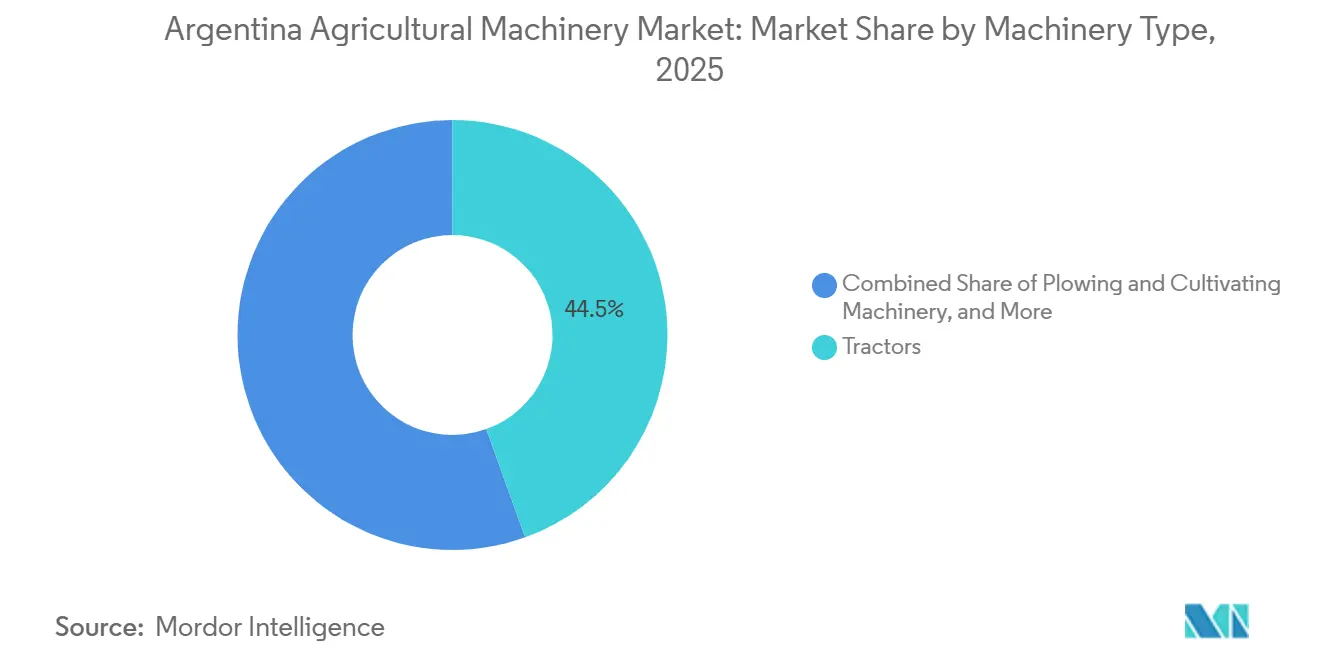
Tractors Anchor Market Value Amid Precision UpgradesTractors are the largest machinery segment and commanded 44.5% of the Argentina agricultural machinery market share in 2025, underpinned by their essential role in tillage, planting, and logistics across grain land. Units between 40 and 99 horsepower make up roughly 55% of registrations, serving the typical 500-to-2,000-hectare farm. Between January and September 2025, Deere & Company accounted for 38.5% of all tractor registrations, representing 1,561 units. This performance occurred in a market totaling 4,057 units, reflecting an 8.2% increase compared to the same period in the previous year. According to the National Institute of Statistics and Censuses (INDEC), in 2024, the total number of machines sold was 16.103, a 4% drop from the previous year and a 17% drop from the average of the last five years. Despite a dip in overall machinery, including tractor registrations, during the 2024 credit crunch, the 2025 export-tax cuts triggered a forecast 20% rebound in orders, reinforcing tractors as the linchpin of the Argentina agricultural machinery market.
Irrigation systems represent a smaller base today but are the fastest-growing segment and are forecast to expand at a 5.4% CAGR through 2031 in the Argentina agricultural machinery market. Valmont Industries, Inc. and Lindsay Corporation dominate center-pivot projects for large grain farms, while Netafim Limited excels in drip technology for vineyards and orchards. Multilateral climate funds support precision irrigation by creating blended finance packages that bring system payback periods within seven years, even at current water tariffs. Carbon-credit revenue from reduced pumping emissions further improves returns and encourages smaller growers to adopt. The Argentina agricultural machinery market size for irrigation is forecast to grow, highlighting a structural shift toward climate resilience.

Geography Analysis
The Pampa Húmeda provinces of Buenos Aires, Córdoba, Santa Fe, and Entre Ríos account for a significant share of Argentina's national grain production and agricultural equipment spending, making the region the economic center of the country's agricultural machinery market. Buenos Aires leads in tractor and combine registrations due to the prevalence of larger holdings, which justify the use of autonomous fleets. Córdoba benefits from its proximity to CNH Industrial N.V.’s manufacturing facility and its skilled dealers, which drive the adoption of advanced guidance systems. Santa Fe's "More Connected" fiber program is reducing the digital divide, enabling real-time fleet management. In contrast, Entre Ríos, characterized by smaller average farm sizes, focuses on mid-range horsepower equipment with lower levels of automation.
Outside the grain belt, the Cuyo region, comprising Mendoza, San Juan, and La Rioja, contributes significantly to Argentina's agricultural machinery market value. Persistent drought conditions and the expansion of vineyards have led to increased demand for drip irrigation systems and compact specialty tractors. In the Northwest provinces of Salta, Tucumán, and Jujuy, spending is focused on sugarcane, citrus, and tobacco harvesters, driven by rising labor costs that encourage mechanization. Although Patagonia accounts for only a small portion of national sales, it is emerging as a testing ground for electric tractors, aimed at meeting stringent European retailer standards for fruit exports.
Geographic disparities in access to credit, broadband, and technical support influence future developments. Córdoba offers equipment tax rebates linked to precision features, while Santa Fe provides subsidies for fiber backhaul supporting cloud-based platforms. Buenos Aires lags in rural broadband, limiting live data sharing beyond a 100-kilometer radius from the capital. Remote Northwest and Patagonia face 500-kilometer journeys to service centers, lengthening downtime and weakening the business case for complex electronics. These divergences suggest that the Argentina agricultural machinery market will see faster growth in water-scarce regions and technologically proactive provinces, while equipment penetration in fringe zones hinges on concurrent improvements in credit and connectivity.
Regulatory Landscape
Argentina regulates agricultural machinery through the Ministry of Economy's technical-regulation framework, with the Directorate of National Technical Regulations (DNRT) overseeing requirements applicable to machines and equipment marketed in the country. A key anchor is Resolution 17/2025 (Ministry of Economy), which approved technical regulations defining essential quality and safety requirements for machinery placed on the Argentine market and sets conformity expectations for both locally produced and imported equipment.
Trade and sector-adjacent rules also influence equipment availability and technology choices. In June 2026, Decree 483/2026 modified the regime for importing used production lines by introducing mechanisms such as automatic validation and administrative deadlines, while linking used imports to a local-purchase requirement (new domestically produced goods valued at 10% of the imported equipment's FOB value). In parallel, SENASA actions such as Resolution 458/2025 (procedures for authorization across the phytosanitary products chain, including requirements for import and labeling) and Resolution 199/2026 (framework for food safety assessment of GMOs for human and animal consumption) affect the pace of adoption for bioinputs, crop-tech packages, and the broader precision ecosystem that is increasingly bundled with modern machinery. INTI supports policy and industry monitoring via its Observatory of Agricultural Machinery, which consolidates technology trends, legislative updates, and financing-line information relevant to manufacturers and buyers.
Competitive Landscape
Argentina’s agricultural machinery arena shows moderate concentration. Deere & Company, CNH Industrial N.V., AGCO Corporation, Kubota Corporation, and Mahindra & Mahindra Limited accounted for significant market revenue in 2025. Deere & Company sustains a significant tractor and combine share by bundling its Operations Center data platform with hardware and embedding subscription revenue into every deal. CNH Industrial N.V. capitalizes on domestic assembly in Córdoba to quote in pesos and shorten delivery, an edge during currency swings. AGCO Corporation pushes its premium Fendt line for estates that already profit from carbon credits and need autonomy-ready powertrains, yet high pricing limits mid-tier uptake in the Argentina agricultural machinery market.
Disruption is brewing. About 4,000 Chinese tractors entered via informal importers in 2024, undercutting prices by as much as 40% yet offering limited precision features. Domestic implement specialists like Crucianelli and Metalfor exploit this middle space with lower-cost, locally serviced equipment tailored to 500-to-1,000-hectare farms overlooked by global giants. Precision-irrigation leaders Netafim Limited, Lindsay Corporation, and Valmont Industries, Inc. compete largely outside the tractor majors’ core skill sets, capturing a segment growing faster than tillage machinery. Technology stakes are high: AGCO Corporation’s USD 2.0 billion buyout of the PTx Trimble joint venture in April 2024 underscores the race to own data ecosystems and analytics margins that may exceed iron margins after 2028.
Policy changes influence market competition. The absence of clear cybersecurity or data-sovereignty regulations benefits established players with the resources to draft indemnities and maintain in-house legal teams. Leading companies address this by offering integrated solutions that combine machinery, software, financing, and agronomic consulting, thereby increasing customer dependency but also raising capital requirements. As a result, the agricultural machinery market in Argentina is becoming segmented. Precision-focused fleets are prevalent in the Pampa Húmeda region, while cost-sensitive buyers in peripheral areas prefer domestic equipment and gray-market imports.
Argentina Agricultural Machinery Industry Leaders
-
Deere & Company
-
CNH Industrial N.V.
-
AGCO Corporation
-
Kubota Corporation
-
Mahindra & Mahindra Limited
- *Disclaimer: Major Players sorted in no particular order
Argentina Agricultural Machinery Market Companies Covered in this Report
- Deere & Company
- CNH Industrial N.V.
- AGCO Corporation
- Kubota Corporation
- Mahindra & Mahindra Limited
- Agrale S.A.
- CLAAS KGaA mbH
- Yanmar Holdings Co., Ltd.
- Netafim Limited (Orbia Advance Corporation, S.A.B. de C.V.)
- Weichai Lovol Heavy Industry Co., Ltd.
- Lindsay Corporation
- Same Deutz-Fahr Italia S.p.A. (SDF Group S.p.A.)
- Valmont Industries, Inc.
- Carraro S.p.A.
Market Opportunities and Future Outlook
Opportunities in Argentina center on accelerating fleet renewal and increasing precision penetration across the dominant tractor and combine base, while extending modern mechanization to mid-sized and smaller farms that remain sensitive to credit conditions and service coverage. The report context points to active commercialization, including 17,049 agricultural machinery units reported for 2025 (+5.9% versus 2024) and 3,330 units sold in Q1 2026 (down year-on-year), suggesting uneven purchasing cycles that tend to favor suppliers offering stronger financing, service, and technology bundles. On the demand side, the rebound follows the 2023-2024 drought downturn and is reinforced by tariff changes that lowered the landed cost of precision equipment, lifting attention to precision-ready tractors, combines, and planters.
Near-term gaps are most visible in water-stressed regions and in digital enablement. Irrigation machinery remains a smaller base, but it is the fastest-growing product segment in the report scope, supported by multilateral climate-finance channels referenced in the study and by established suppliers such as Netafim, Lindsay, and Valmont, who can package equipment with agronomic support. A parallel adoption route runs through investment and tax/financing facilitation, including the Medium Investment Incentives Regime (RIMI) cited in July 2026 trade reporting, with accelerated depreciation and VAT recovery for SME capital-goods purchases, which can improve the economics of sensor-rich implements and low-tillage equipment when combined with the climate-finance and carbon-credit mechanisms described in the report. As connectivity improves from the 2024 commercial 5G rollout and incremental rural tower activations noted by late 2025, OEMs and local implement makers have room to broaden telematics, variable-rate application, and automated guidance offerings beyond the most connected areas of Pampa Humeda, provided they also address technician availability and cybersecurity practices for connected fleets.
Recent Industry Developments in Argentina Agricultural Machinery Market
- June 2026: The National Government issued Decree 483/2026, modifying the regime for importing used production lines with automatic validation and defined administrative deadlines. The change can widen the pool of lower-cost equipment entering Argentina while requiring a linked purchase of new domestically produced goods equal to 10% of the imported equipment's FOB value, reshaping competitive pressure on locally assembled and new imported machinery.
- November 2025: Case IH announced the expansion of its Ferreyra, Cordoba plant to boost local production of Axial-Flow harvesters. The increase in capacity improves product availability and aftersales support across the region, while raising technology benchmarking among competing OEMs.
- April 2024: John Deere inaugurated an expansion of the PLA by John Deere plant in Las Rosas, Santa Fe, targeting a 50% production-capacity increase for seeding and spraying equipment. This strengthens local supply of planters and sprayers and supports faster diffusion of precision-ready configurations through domestic manufacturing and dealer networks.
Argentina Agricultural Machinery Market Report Scope and Research Methodology
Market Definition and Coverage
This market covers the value of agricultural machinery sold and used in Argentina for core farm operations like land preparation, planting, harvesting, forage work, and irrigation, counted in USD for the study years.
Scope exclusions: This sizing does not include used-equipment resale values, routine repairs, or general-purpose industrial machines that are not intended for farm use.
Segments Covered in This Report
- By Machinery Type
- Tractors
- Less than 40 HP
- 40-99 HP
- Greater than 100 HP
- Plowing and Cultivating Machinery
- Ploughs
- Harrows
- Cultivators and Tillers
- Other Plowing and Cultivating Machinery
- Planting Machinery
- Seed Drills
- Planters
- Spreaders
- Other Planting Machinery
- Harvesting Machinery
- Combine Harvesters
- Forage Harvesters
- Other Harvesting Machinery
- Haying and Forage Machinery
- Mowers
- Balers
- Other Haying and Forage Machinery
- Irrigation Machinery
- Sprinkler Irrigation
- Drip Irrigation
- Other Irrigation Machinery
- Other Machinery Types
- Tractors
Data Sources, Market Sizing, and Validation
Desk Research
Desk research was used to build the fact base that supports demand and pricing assumptions before the model run. We relied on public statistical releases on machinery sales and turnover, plus agriculture activity indicators that help explain buying cycles after drought years and during periods of tighter credit.
Typical sources included official statistics and technical publications such as Argentina national statistics releases on agricultural machinery, customs trade data for machinery imports, FAO agriculture production and area data, central bank and government macro series for exchange rate and inflation context, and technical papers that track mechanization and irrigation adoption. We also reviewed company filings and investor decks, association websites, and agriculture press coverage to track product mix changes and channel signals. A paid subscription for company financials and a shipment-level trade view were then used to validate unit flows and price points. These examples are not exhaustive, and many other sources were consulted to collect data, validate assumptions, and clarify open questions.
Primary Interviews and Surveys
Primary work focused on validating what is actually being purchased and how pricing is formed in Argentina, particularly when currency movements change list prices quickly. We spoke with stakeholders across OEM-facing channels, dealer and distributor networks, large and mid-size farm operators, and service partners to confirm product mix, replacement timing, and the split between imported and locally assembled equipment.
Interview feedback was also used to stress-test desk assumptions on utilization, financing availability, seasonal ordering patterns around planting and harvest, and how farmers switch between equipment categories when margins tighten.
Distribution of primary research fieldwork respondents
| Company type | Respondent position |
|---|---|
| Top tier: 31% | CXOs: 18% |
| Mid tier: 47% | Functional/Unit leaders: 24% |
| Smaller Players: 22% | Managers: 58% |
Market-Sizing & Forecasting
Sizing was developed using a top-down and bottom-up approach. First, we reconstruct the demand pool from Argentina machinery sales signals and import flows, then cross-check it with selective roll-ups from supplier and channel inputs. In practice, we start from the machinery categories covered in scope, map likely unit volumes by category to the crop calendar, and apply category-level average selling prices that reflect local currency pass-through.
Key inputs used in the model include planted area and crop mix for major row crops, quarterly machinery sales trends reported by official sources, the import versus local-origin mix, farm credit availability and interest-rate direction, and exchange-rate and inflation trends that affect equipment pricing. Forecasts were built using scenario analysis because purchase timing can swing when weather recovery, credit terms, and import policy shift in the same year.
Where bottom-up inputs were incomplete, gaps were handled through conservative interpolation from comparable categories and dealer-reported mix. Adjustments were then made only when multiple primary respondents confirmed the direction and magnitude of change.
Data Validation & Update Cycle
Outputs are checked against independent signals, including whether implied unit volumes align with reported machinery sales trends and whether modeled prices stay consistent with trade unit values and announced list-price movements. When a variance looks too large, we revisit the assumption, re-check the underlying source series, and, if needed, re-contact respondents to confirm what changed, for example, a short-lived import surge or a delayed buying season.
Before sign-off, the model is reviewed in steps by an analyst and a senior reviewer, so the arithmetic, unit logic, and scope mapping remain consistent across categories. The report is refreshed annually, with interim updates triggered by material events such as major FX moves, policy changes affecting imports, or sharp shifts in farm income. A final pre-delivery pass is then completed to reflect the latest data points.
Mordor Intelligence's Argentina Agricultural Machinery Market Size Versus Other Published Estimates
Published market sizes for Argentina agricultural machinery often do not match because the included product basket, the year selected as the base, and the way prices are converted into USD can vary widely. In some cases, the same market label is used even when one estimate is closer to farm equipment only, while another also counts adjacent categories or a broader set of on-farm applications.
The table shows a wide spread that mainly comes from scope and pricing choices. This includes whether irrigation and forage equipment are counted together with tractors and harvesters, and whether values reflect local inflationary pricing translated using an annual average versus a point-in-time currency. The table also highlights how aggressive growth assumptions can lift the starting point when high mechanization adoption is assumed without matching it to observed sales cycles in Argentina.
Benchmark comparison
| Source | Market Size | Gaps in Research Methodology |
|---|---|---|
| Mordor Intelligence | USD 1.55 B (2025) | |
| Global Consultancy A | USD 3.70 B (2024) | Uses a broader product and application view and may apply higher assumed price levels across categories, which can inflate the value when converted into USD for a different base year. |
| Regional Consultancy B | USD 1.90 B (2025) | Likely applies a higher average selling price progression and assumes faster replacement buying after recovery years, with fewer checks against quarterly sales signals and import-value benchmarks. |
The table points to scope and pricing as the biggest drivers of the gap, and in Mordor Intelligence's model the total is built only from defined farm machinery categories and then stress-tested with unit and trade-value signals so the USD value stays tied to realistic purchase behavior. With this structure, the result is easier to replicate, and it remains traceable to clear inputs that can be updated when sales, FX, or credit conditions change.
Key Questions Answered in the Report
What is the projected value of the Argentina agricultural machinery market in 2031?
It is forecast to reach USD 2.14 billion by 2031, growing at 4.23% CAGR from 2026.
Which equipment category currently holds the largest share of sales?
Tractors account for 44.5% of 2025 market value, the biggest slice of spending.
Why is irrigation machinery the fastest-growing segment?
Chronic drought in Cuyo and the Northwest plus concessional climate finance push system adoption at 5.4% CAGR through 2031.
How are carbon credits influencing machinery purchases?
No-till farms can earn USD 15-USD 25 per metric ton of carbon dioxide equivalent, offsetting 30%-40% of equipment costs over five years.