
Global Antiemetic Drugs Market Size and Share
Market Overview
| Study Period | 2020 - 2031 |
|---|---|
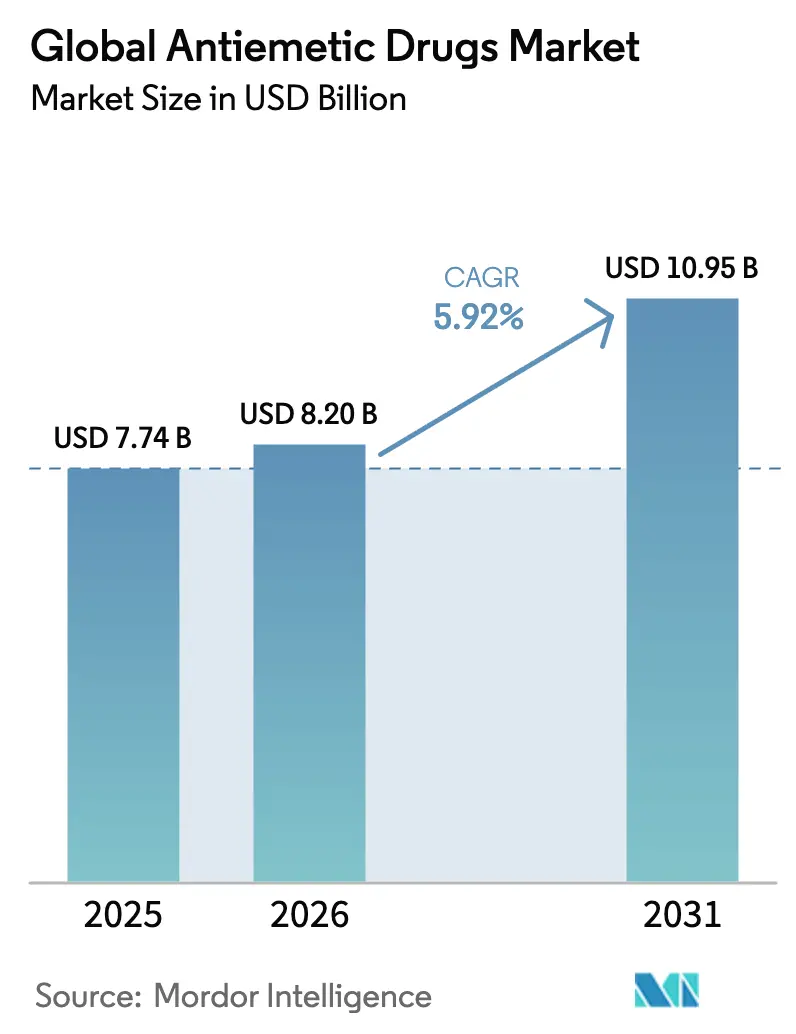
| Market Size (2026) | USD 8.2 Billion |
| Market Size (2031) | USD 10.95 Billion |
| Growth Rate (2026 - 2031) | 5.92 % |
| Fastest Growing Market | Asia-Pacific |
| Largest Market | North America |
| Market Concentration | Medium |
Major Players *Disclaimer: Major Players sorted in no particular order Image © Mordor Intelligence. Reuse requires attribution under CC BY 4.0. | |
Global Antiemetic Drugs Market Analysis by Mordor Intelligence
The Antiemetics drugs market size is expected to grow from USD 7.74 billion in 2025 to USD 8.2 billion in 2026 and is forecast to reach USD 10.95 billion by 2031 at 5.92% CAGR over 2026-2031. Demand stays firm because clinicians still struggle to control nausea and vomiting in chemotherapy, surgery and other settings. Steady global cancer incidence, wider uptake of 5-HT₃ antagonists for post-operative care, and the arrival of AI-guided dosing platforms are pushing adoption. Pricing pressure from generics keeps therapy affordable in emerging economies, which broadens patient access. Digital pharmacy channels and ambulatory infusion centers are reshaping how antiemetics reach patients and are generating new product placement opportunities.
Key Report Takeaways
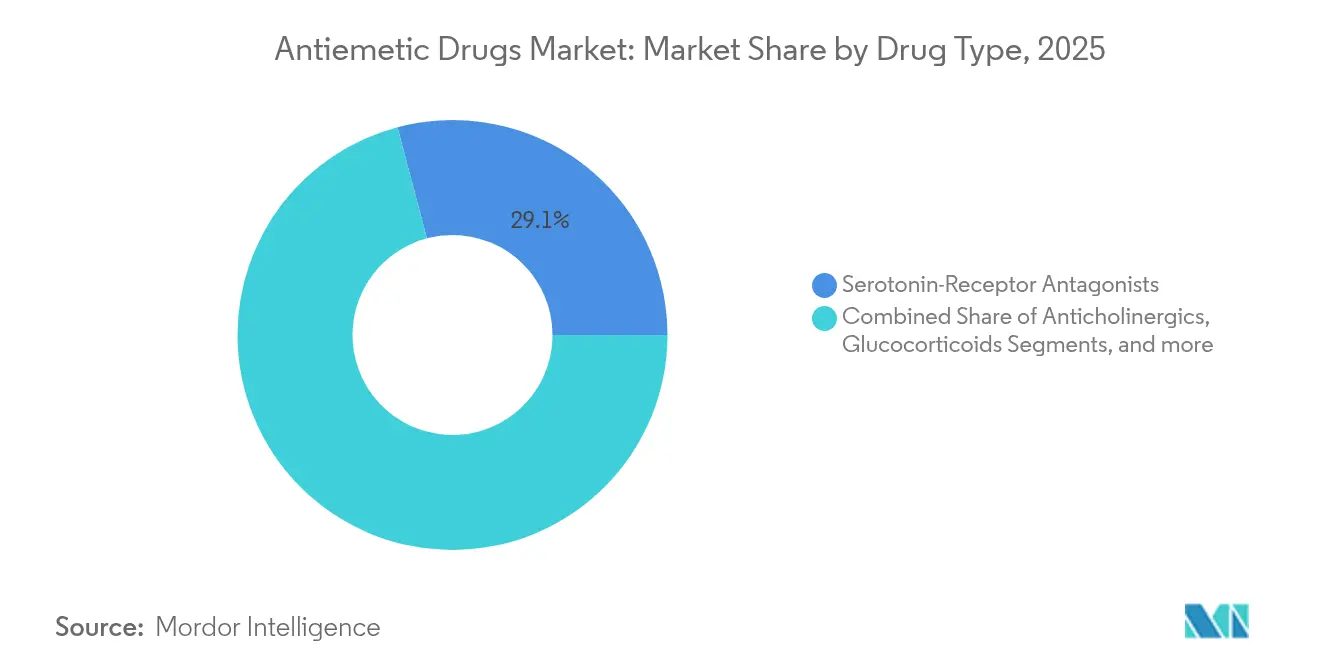
- By drug type, serotonin-receptor antagonists led with 29.12% revenue share in 2025; dopamine receptor antagonists are projected to expand at a 6.08% CAGR to 2031.
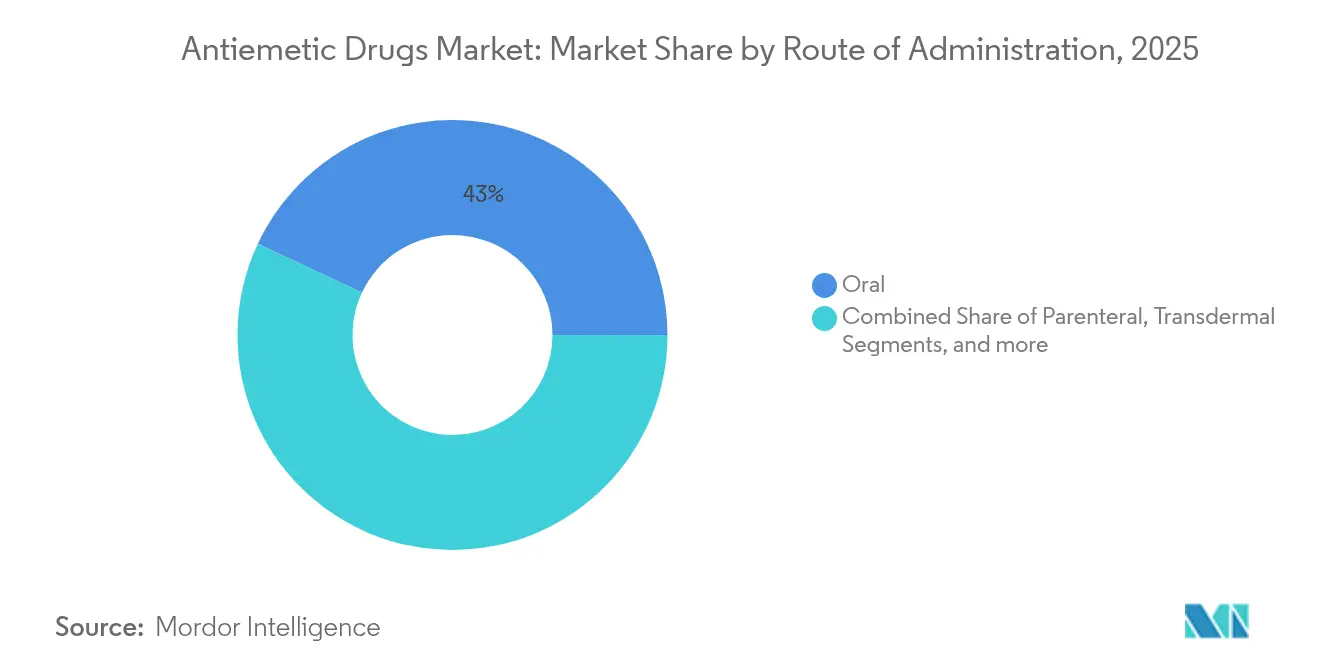
- By route of administration, oral formulations accounted for 43.02% of the Antiemetics drugs market share in 2025, while parenteral products are expected to grow at 6.01% through 2031.
- By application, chemotherapy held 32.06% share of the Antiemetics drugs market size in 2025 and post-operative use is advancing at a 6.21% CAGR through 2031.
- By distribution channel, retail pharmacies controlled 45.02% of revenue in 2025; online pharmacies carry the highest projected CAGR at 6.12% to 2031.
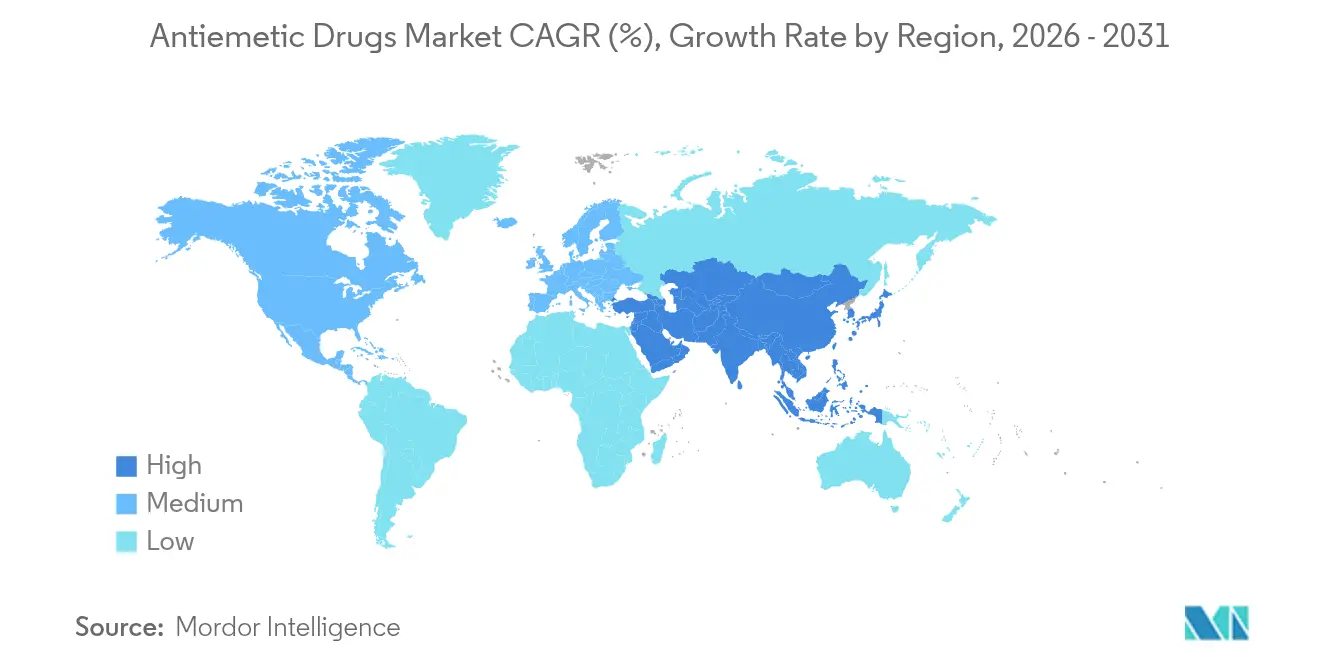
- North America captured 38.35% of regional revenue in 2025; Asia-Pacific is set to increase fastest with a 6.46% CAGR to 2031.
Note: Market size and forecast figures in this report are generated using Mordor Intelligence’s proprietary estimation framework, updated with the latest available data and insights as of 2026.
Market Trends and Insights
Drivers Impact Analysis of Global Antiemetic Drugs Market*
| Driver | % Impact on CAGR Forecast | Geographic Relevance | Impact Timeline |
|---|---|---|---|
| Rising incidence of chemotherapy-induced nausea & vomiting (CINV) | +1.2% | Global, with concentration in North America & Europe | Long term (≥ 4 years) |
| Growing clinical adoption of 5-HT₃ antagonists for post-operative nausea | +0.8% | North America & EU, expanding to APAC | Medium term (2-4 years) |
| Intensifying R&D and identification of novel antiemetic targets | +0.6% | Global, led by US and Japan | Long term (≥ 4 years) |
| Expansion of ambulatory infusion centres adopting antiemetic protocols | +0.5% | North America & EU, early adoption in urban APAC | Medium term (2-4 years) |
| Legalisation-led uptake of cannabinoid-based antiemetics | +0.4% | North America, select EU markets | Short term (≤ 2 years) |
| AI-driven predictive antiemetic dosing tools boosting adherence | +0.3% | Global, technology-forward markets first | Medium term (2-4 years) |
| Source: Mordor Intelligence | |||
Rising incidence of chemotherapy-induced nausea & vomiting
Cancer treatment volumes keep climbing, and up to 40% of patients still encounter breakthrough CINV despite triple-drug prophylaxis. Highly emetogenic regimens such as cisplatin-based protocols are most problematic. Aging populations in North America and Western Europe experience more severe symptoms because of polypharmacy and slower metabolism. China and India are scaling comprehensive cancer centres that routinely embed guideline-based antiemetic regimens, further lifting demand[1].
Growing clinical adoption of 5-HT₃ antagonists for post-operative nausea
Roughly one-third of surgical patients experience PONV, rising to 80% in high-risk laparoscopic or gynaecologic procedures. The US FDA issued draft guidance in October 2024 encouraging developers to pursue combination pharmacological approaches. European guidelines now favour long-acting 5-HT₃ agents such as palonosetron for ambulatory surgery, prompting hospitals to standardise on these newer formulations[2].
Intensifying R&D into novel antiemetic targets
Developers are exploring mechanisms beyond classic neurotransmitter blockade. GIP receptor agonists and GFRAL-RET antagonists show early activity in preclinical CINV models. Takeda advanced TAK-105 into Phase 1 studies while Japanese firms pursue next-generation NK₁ agents with superior pharmacokinetics.
Expansion of ambulatory infusion centres
Payers prefer outpatient chemotherapy because it cuts facility costs. Infusion networks now rely on electronic ordering systems that auto-recommend antiemetic prophylaxis by emetogenic risk tier. Effective CINV control reduces unscheduled emergency visits, saving thousands of dollars per episode and driving formulary adherence.
Restraints Impact Analysis of Global Antiemetic Drugs Market*
| Restraint | % Impact on CAGR Forecast | Geographic Relevance | Impact Timeline |
|---|---|---|---|
| Price erosion from generic competition | -0.9% | Global, most pronounced in developed markets | Short term (≤ 2 years) |
| Adverse drug reactions leading to discontinuation | -0.6% | Global, higher impact in elderly populations | Medium term (2-4 years) |
| API supply-chain fragility centred on limited Chinese plants | -0.4% | Global, supply chain dependent markets | Short term (≤ 2 years) |
| Oral neuro-stimulation wearables as non-pharma substitutes | -0.3% | North America & EU, tech-forward demographics | Medium term (2-4 years) |
| Source: Mordor Intelligence | |||
Price erosion from generic competition
Patent expiries on NK₁ antagonists and serotonin blockers trigger 80% price drops within two years of generic launch, squeezing branded margins and reshaping hospital formularies.
Adverse drug reactions prompting discontinuation
Sedation from olanzapine or extrapyramidal symptoms from dopamine blockers leads some patients to abandon therapy, especially seniors. QT prolongation concerns with certain 5-HT₃ agents further constrain use among cardiac-risk cohorts
*Our forecasts treat driver/restraint impacts as directional, not additive. The impact forecasts reflect baseline growth, mix effects, and variable interactions.
Global Antiemetic Drugs Market Segment Analysis
By Drug Type:
Serotonin dominance amid dopamine renaissanceSerotonin-receptor antagonists hold 29.12% of 2025 revenue, anchoring the Antiemetics drugs market through reliable efficacy and a mild safety profile. Dopamine antagonists now post the fastest 6.08% CAGR because olanzapine provides strong breakthrough-nausea relief. NK₁ agents remain the delayed-phase backbone, and glucocorticoids act as synergists. Innovation resides in GIP agonists and cannabinoid formats, which sit within the “others” category and point to future differentiation.
The serotonin class continues to enjoy wide reimbursement in hospital and retail settings, so substitution barriers are low. Dopamine antagonists gain share where payers value robust symptom control after standard prophylaxis fails. As generics proliferate, balanced multi-mechanism regimens that blend serotonin, dopamine and NK₁ blockade underpin clinical guidelines, giving entrenched brands a path to defend volume even as unit prices fall.

By Route of Administration:
Oral convenience drives leadershipOral dosing captured 43.02% of the Antiemetics drugs market in 2025 and should extend its lead due to patient preference and outpatient trends. Tablets or dissolvable films fit tele-oncology programs and keep nursing time low. Parenteral therapy remains essential during acute vomiting or when oral intake is impossible; recent lipid emulsion injectables supply fast onset with softer infusion-site profiles.
Transdermal and long-acting injectable formats are a small but fast-innovating slice. Depot products that cover multi-day chemotherapy windows cut pill burden, while on-body pumps support personalised titration. These platforms could raise both adherence and willingness to pay, helping manufacturers offset generic erosion in conventional presentations.
By Application:
Chemotherapy leadership with post-operative momentumChemotherapy held 32.06% of 2025 revenue and keeps the largest slice of the Antiemetics drugs market size because modern regimens still provoke severe nausea. Guideline-driven triple therapy underpins high per-patient spend. Post-operative use grows quickest at 6.21% CAGR as day-case surgeries rise and hospitals link PONV prevention to shorter stays.
Gastroenteritis and other everyday indications remain price-sensitive and dominated by generics. Radiation-induced nausea gains modest attention as precision radiotherapy regimens intensify. Motion sickness and pregnancy-related nausea see competition from wearable neuro-stimulation devices, nudging drug makers to invest in superior tolerability profiles.
By Distribution Channel:
Retail dominance faces digital disruptionRetail pharmacies owned 45.02% of 2025 sales, benefiting from established store networks and insurance billing. Online pharmacies, however, post a 6.12% CAGR, helped by telemedicine, e-prescribing, and home delivery convenience. Hospitals stay influential in formulary decisions for parenteral brands, but outpatient infusion centres increasingly buy direct from specialty distributors.
A unified pharmacy benefit and distribution model allows vertical integrators to negotiate sharper rebates, altering profit pools. Direct-to-patient digital portals also gather adherence data that feed AI analytics, letting manufacturers tailor support services and lift brand loyalty.
Geography Analysis
North America Antiemetic Drugs Market
North America controlled 38.35% of 2025 revenue through high cancer treatment volumes, insurance coverage for branded drugs, and early adoption of AI-supported dosing software. US FDA approvals such as APONVIE and CINVANTI often set global precedent, granting first launch advantage before generics arrive. Yet intensive price negotiation by pharmacy benefit managers forces companies to prove clinical differentiation or risk steep formulary discounts.
APAC Antiemetic Drugs Market
Asia-Pacific records the fastest 6.46% CAGR to 2031. Japan spurs innovation with next-generation NK₁ approvals like fosnetupitant, while China’s cancer centre expansion multiplies patient starts despite national pressure to procure generics. India’s biosimilar producers supply low-cost ondansetron and aprepitant, widening reach into tier-2 cities and supporting steady unit growth.
Europe Antiemetic Drugs Market
Europe offers a mature but stable outlook. EMA centralised review speeds pan-regional launches, yet country-level health technology assessments demand clear cost-effectiveness. Recent ESMO guideline updates stress patient-reported outcomes, urging makers to demonstrate better tolerability to secure premium tiers. Hospital tenders frequently bundle antiemetics with chemotherapy contracts, so suppliers position combination or long-acting products as value differentiators.
Regulatory Landscape
Regulation for antiemetic drugs is anchored by major agencies such as the US FDA and the European Medicines Agency (EMA), with global submissions commonly structured under the ICH Common Technical Document (CTD) to harmonize quality, safety, and efficacy expectations across regions. In the United States, FDA guidance continues to shape development and labeling for key use cases such as post-operative nausea and vomiting (PONV), while oncology antiemetic regimens follow recognized multi-drug standards of care that inform trial comparators and evidence thresholds.
Recent actions point to ongoing lifecycle management and cross-regional access strategies for established mechanisms. On February 12, 2026, the European Commission granted marketing authorization for Helsinn Healthcare SA's AKYNZEO (netupitant/palonosetron) oral suspension, reinforcing formulation-led efforts to widen usability in supportive care settings. EMA also maintains separate oversight for antiemetic agents in animal health, including its February 13, 2026 authorization of Emepax (maropitant), highlighting parallel regulatory pathways that can affect manufacturing, pharmacovigilance operations, and quality-system requirements for companies active in both human and veterinary portfolios.
Value Chain Analysis
The antiemetic drugs value chain spans API sourcing and finished-dose manufacturing, regulatory release, wholesale and specialty distribution, and dispensing via hospital, retail, and online pharmacies. API availability and quality control remain critical leverage points, as many mature antiemetic classes face price erosion and tender-driven purchasing, raising the importance of cost-efficient synthesis, consistent supply, and validated analytical methods across multi-country dossiers.
Partnerships and localization initiatives are also reshaping manufacturing and commercialization nodes in the value chain. In October 2025, Fosun Pharma and Helsinn Group signed a technology transfer agreement for local manufacturing of fosnetupitant and palonosetron concentrated solution for injection in Shanghai, reflecting a shift toward in-market production for resilience and faster access in high-volume countries. Commercial reach is further supported through licensing arrangements, including Hyloris Pharmaceuticals and RedHill Biopharma's February 2025 deal for a proprietary extended-release oral ondansetron tablet (excluding North America), and Lupin's December 2025 exclusive licensing agreement with Neopharmed Gentili S.p.A. for Plasil (metoclopramide) in the Philippines and Brazil, which links portfolio access to established local sales networks and regulatory know-how.
Competitive Landscape
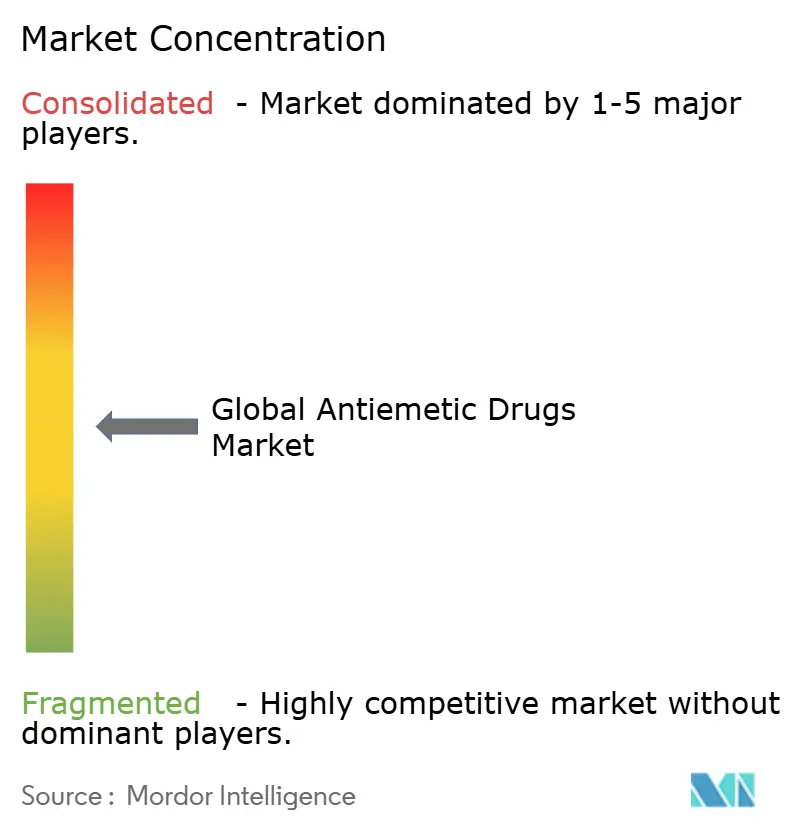
Competition is moderately concentrated. No single firm surpasses 15% share because clinical guidelines call for multi-drug regimens, spreading revenue across mechanisms and manufacturers. Global majors such as Pfizer, Merck and GlaxoSmithKline contend with focused companies like Heron Therapeutics and Acacia Pharma. Branded players defend value with fixed-dose combinations, extended-release injectables and digital adherence platforms.
Patent cliffs through 2027 erode exclusivity for NK₁ and serotonin classes, shifting revenue to volume-driven generics. In response, innovators target new biology such as GIP or GFRAL-RET modulation, aiming for orphan or breakthrough designations to secure higher reimbursement. Digital alliances supply apps that predict nausea risk and recommend tailored dosing, underpinning service-oriented differentiation.
Geographic expansion is an essential lever. Multinationals license formulations to local partners in China or Brazil to enter price-controlled markets while retaining royalty streams. Private equity-backed infusion networks in the US sign product-specific supply deals, granting preferred placement for companies offering fulfilment support and real-world evidence dashboards. Supply-chain resilience also emerges as a badge of reliability amid geopolitical scrutiny of Chinese API plants, pushing some firms to dual-source ingredients in India or Europe.
Global Antiemetic Drugs Industry Leaders
-
Pfizer Inc
-
Johnson & Johnson Services Inc
-
Merck and Co Inc.
-
GSK plc
-
Sanofi S.A.
-
Merck & Co., Inc.
- *Disclaimer: Major Players sorted in no particular order
Global Antiemetic Drugs Market Companies Covered in this Report
- GlaxoSmithKline
- Pfizer
- Merck
- Johnson & Johnson
- Sanofi
- Hikma Pharmaceuticals
- Cipla
- Novartis
- Baxter
- Torrent Pharmaceuticals
- Teva Pharmaceutical Industries
- Aurobindo Pharma Ltd.
- Abbvie
- Bausch Health
- Eisai
- Dr. Reddy’s Laboratories Ltd.
- Sun Pharmaceuticals Industries
- Takeda Pharmaceuticals
- Lupin
- Fresenius
Market Opportunities and Future Outlook
A key whitespace is nausea and vomiting associated with GLP-1 receptor agonist therapy, where dedicated, labeled options remain limited relative to the rapid expansion of metabolic-drug use in routine care. Vanda Pharmaceuticals initiated Thetis in April 2026 to evaluate tradipitant (NEREUS) for prevention of vomiting induced by GLP-1 receptor agonists, indicating ongoing clinical investment to establish fit-for-purpose antiemetic strategies beyond oncology and surgery.
Within chemotherapy-induced nausea and vomiting (CINV), opportunities are concentrating around differentiated combinations and steroid-sparing protocols that reduce corticosteroid exposure while maintaining efficacy across acute and delayed phases. In June 2026, the Journal of Clinical Oncology reported non-inferiority for NEPA plus olanzapine with reduced or no dexamethasone versus a standard 4-day dexamethasone regimen in highly emetogenic chemotherapy, supporting regimen redesign that can feed into new labeling and care-pathway adoption. Fixed-dose combination development continues as well, with ASCO 2026 presentations describing phase 3 results for fosrolapitant/palonosetron (HR20013) plus dexamethasone in moderately emetogenic chemotherapy, reinforcing product strategies that simplify prescribing and align with guideline-based multi-mechanism prophylaxis.
Recent Industry Developments in Global Antiemetic Drugs Market
- June 2026: The US FDA approved Azurity Pharmaceuticals' Aprepitant Injectable Emulsion for prevention of chemotherapy-induced nausea and vomiting (CINV). The approval adds another parenteral NK1-pathway option aimed at hospital and infusion settings where oral intake can be limited. It also increases competitive pressure on established branded and generic aprepitant/fosaprepitant presentations by expanding choice in an acute-care-friendly format.
- April 2026: Vanda Pharmaceuticals initiated Thetis, a clinical trial evaluating tradipitant (NEREUS) to prevent vomiting induced by GLP-1 receptor agonists. The program targets a rapidly expanding real-world trigger of nausea and vomiting outside traditional oncology and perioperative use. Advancing a dedicated study supports indication expansion strategies for antiemetics and can create new demand in ambulatory and telemedicine-linked prescribing flows.
- October 2024: The US FDA published draft guidance, Postoperative Nausea and Vomiting: Developing Drugs for Prevention, clarifying trial design and evidentiary expectations in adults. By tightening how efficacy and safety should be demonstrated, the guidance influences how companies plan PONV development and choose comparators, including combination approaches. It also supports more standardized labeling and may encourage sponsors to pursue formal approvals rather than rely on off-label perioperative use.
Global Antiemetic Drugs Market Report Scope and Research Methodology
Market Definition and Coverage
For this methodology, the antiemetic drugs market covers prescription and over-the-counter medicines used to prevent or treat nausea and vomiting across major triggers like chemotherapy, surgery, gastroenteritis, pregnancy, and motion sickness.
Scope exclusions: We exclude non-drug remedies and device-only approaches (such as ginger supplements and acupressure bands) when they are not sold as regulated antiemetic medicines.
Segments Covered in This Report
- By Drug Type
- Serotonin-Receptor Antagonists
- Dopamine Receptor Antagonists
- Neurokinin-1 (NK₁) Receptor Antagonists
- Glucocorticoids
- Anticholinergics
- Others
- By Application
- Chemotherapy
- Gastroenteritis
- Post-Operative
- Others
- By Route of Administration
- Oral
- Parenteral
- Transdermal & Others
- By Distribution Channel
- Hospital Pharmacies
- Retail Pharmacies
- Online Pharmacies
- Geography
- North America
- United States
- Canada
- Mexico
- Europe
- Germany
- United Kingdom
- France
- Italy
- Spain
- Rest of Europe
- Asia-Pacific
- China
- Japan
- India
- South Korea
- Australia
- Rest of Asia-Pacific
- Middle East and Africa
- GCC
- South Africa
- Rest of Middle East and Africa
- South America
- Brazil
- Argentina
- Rest of South America
- North America
Data Sources, Market Sizing, and Validation
Desk Research
Desk work starts with building the demand context for nausea and vomiting care, then mapping it to where antiemetic drug use is most consistent (especially oncology and surgical care). Public sources such as the World Health Organization, CDC, OECD health statistics, and the National Cancer Institute were used to understand disease burden, chemotherapy use direction, and procedure trends that shape utilization.
We also reviewed drug approval and safety signals from the US FDA and EMA, along with clinical guideline publications and peer reviewed articles, to understand where drug classes are preferred and how regimens are changing over time. Company filings, investor decks, and reputable healthcare press were used to cross-check product mix and geographic emphasis, and selected paid subscriptions for company financials and patent databases helped tighten revenue boundaries and innovation signals. These sources are illustrative only, and many other public and paid references were consulted for data collection, cross-checking, and clarification.
Primary Interviews and Surveys
Primary work focused on validating real-world treatment patterns and price realization, where published data can be thin or slow to update. We spoke with manufacturers, distributors, hospital pharmacy stakeholders, and clinicians across APAC, EMEA, and the Americas, which helped close gaps on channel mix, typical dosing duration for key indications, and how generic competition is affecting net prices.
Distribution of primary research fieldwork respondents
| Company type | Respondent position | Region |
|---|---|---|
| Top tier: 33% | CXOs: 12% | APAC: 39% |
| Mid tier: 52% | Functional/Unit leaders: 35% | EMEA: 34% |
| Smaller Players: 15% | Managers: 53% | Americas: 27% |
Market-Sizing & Forecasting
Sizing is built from the top down by reconstructing the demand pool tied to chemotherapy cycles, surgical volumes with prophylaxis use, and other high-frequency nausea triggers, and then translating that into treatment rates and average therapy cost. To keep the totals practical, the model uses a small set of trackable inputs such as chemotherapy utilization direction, inpatient and ambulatory procedure counts, antiemetic use per cycle or per procedure, generic penetration, and net price movement by major drug classes.
The results are then checked using selective bottom-up approximations, where available, including sampled brand and generic revenue signals, channel splits across hospital, retail, and online pharmacies, and simple volume times ASP sanity checks in key countries. When gaps appear in smaller countries, we use proxy indicators such as regional treatment intensity and healthcare spend patterns, then rebalance to avoid overstatement.
For forecasting, we rely on scenario analysis supported by expert feedback, since utilization can shift with guideline updates, new formulations, and payer pressure on pricing. Assumptions are carried forward with controlled changes in volumes and ASPs, and any step change is only applied when supported by multiple signals from interviews plus observable public indicators.
Data Validation & Update Cycle
Validation is done through repeated variance checks so the model does not drift away from real demand signals. Outputs are compared against independent indicators such as oncology treatment activity direction, procedure throughput, and channel-level availability signals, and then outliers are investigated before the figures are signed off.
A multi-step internal review is used, with follow-up calls triggered when primary feedback conflicts with the desk view or when price movement looks inconsistent with the generic mix. Reports are refreshed annually, with interim updates when there are material events such as major approvals, safety actions, or pricing shifts, and a final pre-delivery pass is completed so clients receive the latest updated view.
Mordor Intelligence's Antiemetic Drugs Market Size Measured Against Other Published Estimates
Published market sizes for antiemetic drugs often disagree because the boundary can shift in small but important ways, including which triggers are counted, how OTC sales are treated, and whether non-drug remedies get mixed into the total. Differences also come from timing, since a market with fast generic price movement can look larger or smaller depending on which year and FX rate are applied.
In our work, the biggest gap drivers are refresh cadence and how net price is modeled across branded and generic volumes, since list prices rarely match realized selling prices in hospital and retail channels. By updating currency conversion timing and rechecking ASP logic against fresh interview feedback, the estimate stays consistent with the most recent volume signals and channel mix checks applied by Mordor Intelligence.
Benchmark comparison
| Source | Market Size | Gaps in Research Methodology |
|---|---|---|
| Mordor Intelligence | USD 8.2 B (2026) | |
| Press Release Publisher A | USD 6.73 B (2023) | This figure uses an earlier base year and can understate the market if later-period oncology and surgery volumes are not rolled forward consistently. It also does not clarify whether the value reflects ex-manufacturer revenues or a different pricing point, which can shift totals when channel markups and net price erosion are present. |
| Industry Forecaster B | USD 1.63 B (2027) | This number is presented as incremental growth over a period, not the full market value, which makes it non-comparable to a point-in-time market size. It also reflects a narrower reporting style that can miss the impact of indication mix and ASP progression when the market is summarized only by net change. |
Looking at the spread together, the mismatch is mostly explained by year selection, whether the figure is a total size or an incremental change, and how net prices are translated into USD. When scope boundaries and pricing points are kept consistent, the market size becomes easier to trace back to clear variables like treated volume, use per episode, and channel mix, which are steps that can be repeated and audited over time.
Key Questions Answered in the Report
What is the current size of the Antiemetics drugs market?
The market is valued at USD 8.2 billion in 2026 and is poised to reach USD 10.95 billion by 2031.
Which drug class leads revenue in the Antiemetics drugs market?
Serotonin-receptor antagonists hold the top position with 29.12% share in 2025.
Which application segment is growing fastest?
Post-operative nausea and vomiting shows the highest CAGR at 6.21% through 2031.
Why are online pharmacies gaining ground?
Digital channels offer price transparency, home delivery and integration with telemedicine, supporting a 6.12% CAGR.
Which region will expand most quickly?
Asia-Pacific is projected to grow at 6.46% CAGR owing to large patient pools and rising healthcare spending.
How are companies defending against generic erosion?
Firms invest in long-acting formulations, combination products and digital dosing tools to sustain brand value.