
Ammonia Storage Tanks Market Size and Share
Market Overview
| Study Period | 2020 - 2031 |
|---|---|
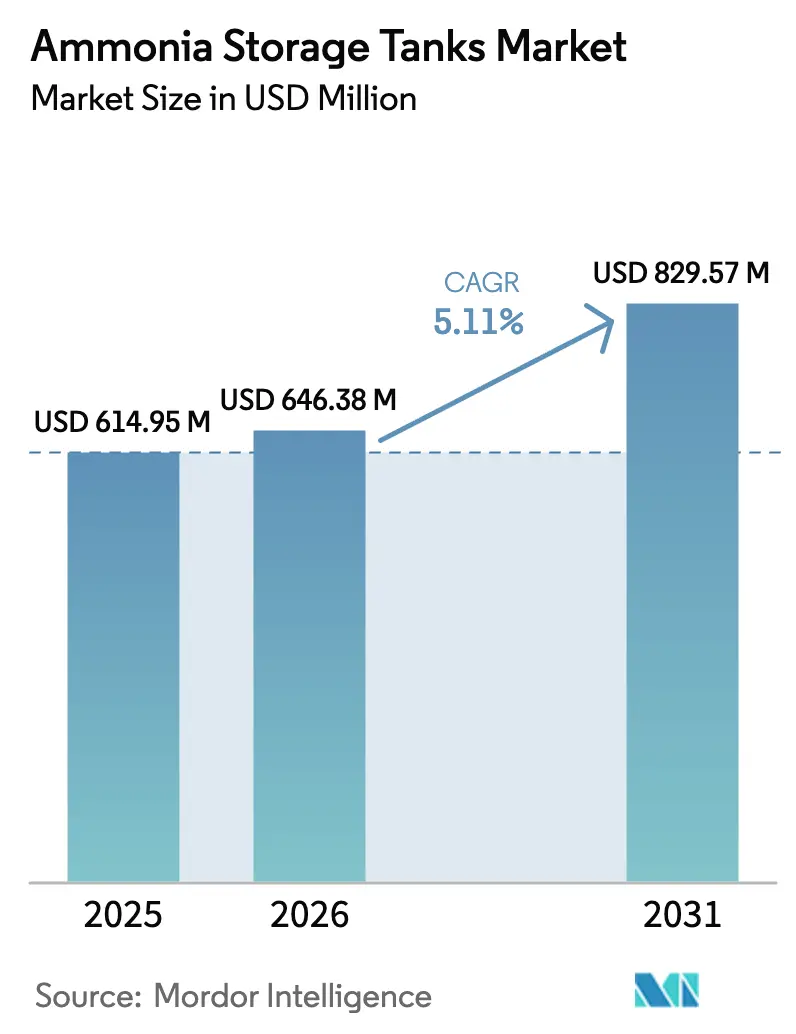
| Market Size (2026) | USD 646.38 Million |
| Market Size (2031) | USD 829.57 Million |
| Growth Rate (2026 - 2031) | 5.11 % |
| Fastest Growing Market | Middle East and Africa |
| Largest Market | Middle East and Africa |
| Market Concentration | Medium |
Major Players *Disclaimer: Major Players sorted in no particular order Image © Mordor Intelligence. Reuse requires attribution under CC BY 4.0. | |
Ammonia Storage Tanks Market Analysis by Mordor Intelligence
Ammonia Storage Tanks market size in 2026 is estimated at USD 646.38 million, growing from 2025 value of USD 614.95 million with 2031 projections showing USD 829.57 million, growing at 5.11% CAGR over 2026-2031. This growth reflects the sector’s pivot from fertilizer-centric demand toward new energy vectors such as green ammonia, long-duration energy storage, and zero-carbon maritime bunkering. Increasing government decarbonization mandates, national hydrogen strategies, and large-scale renewable projects are accelerating capital spending on purpose-built storage infrastructure. Producers are also redesigning tank farms to accommodate stricter safety standards and higher purity requirements, especially for green ammonia that demands corrosion-resistant materials. Midstream and port operators, meanwhile, view ammonia storage as a gateway asset that links renewable production clusters with global shipping lanes, drawing sizeable investment commitments from integrated energy majors and specialized terminal developers[1].
Key Report Takeaways
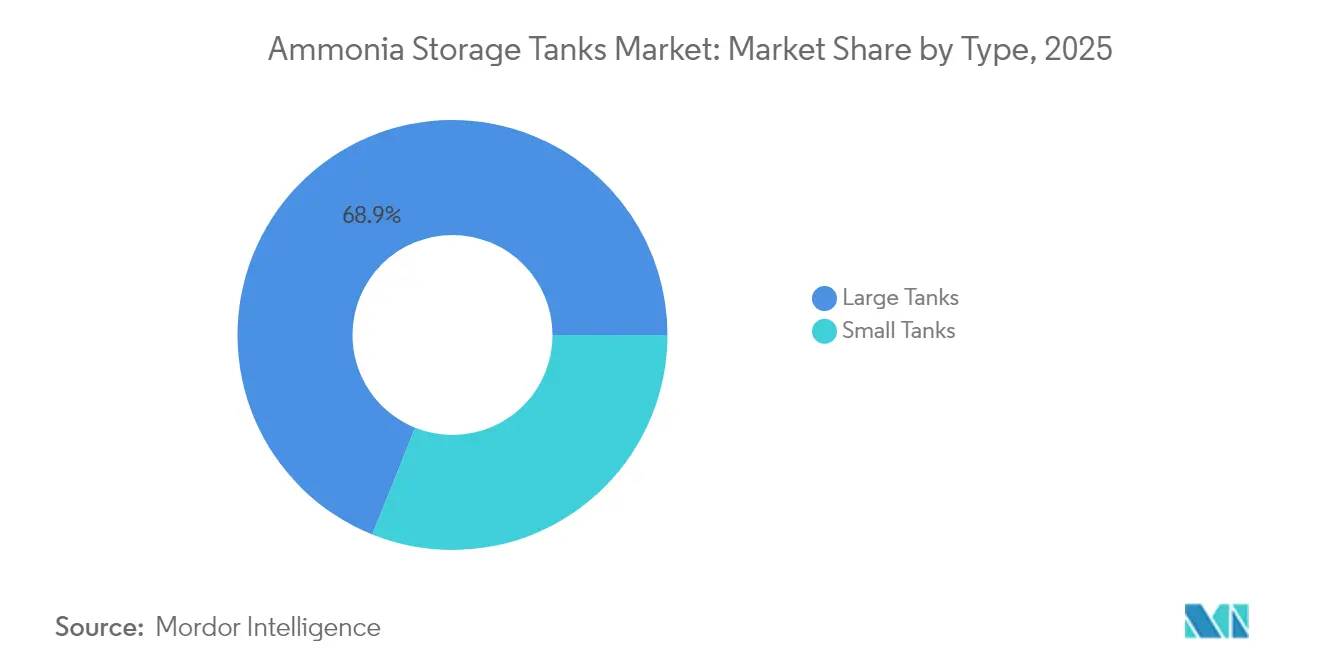
- By type, large tanks commanded 68.92% of the Ammonia Storage Tanks market share in 2025, whereas small tanks are forecast to expand at a 5.61% CAGR through 2031.
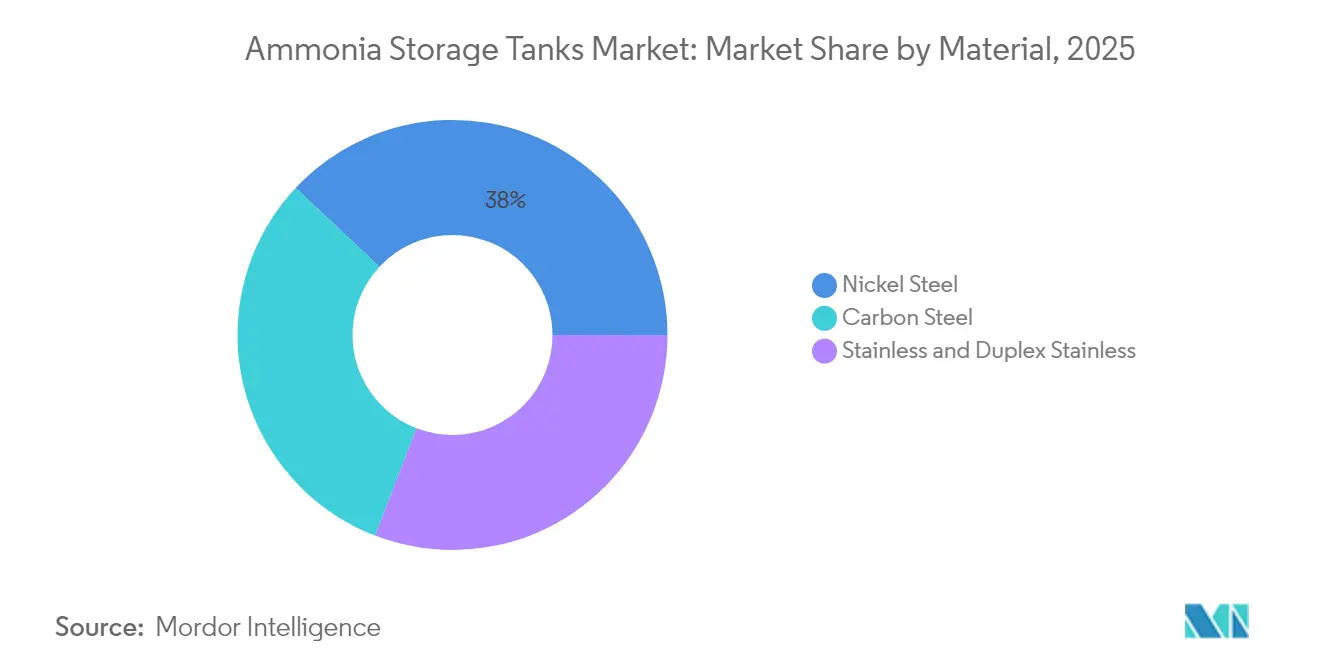
- By material, nickel steel held 38.02% of the Ammonia Storage Tanks market size in 2025, while stainless and duplex stainless steel are set to record a 5.83% CAGR between 2026 and 2031.
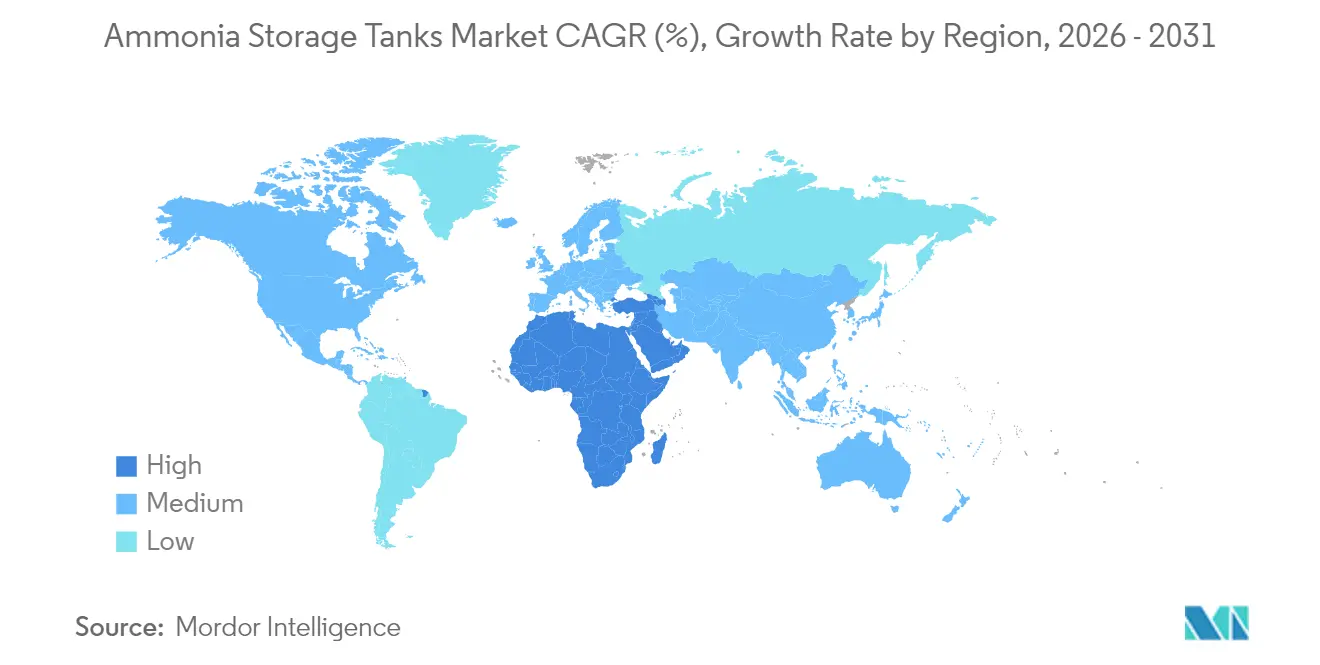
- By region, the Middle East and Africa accounted for 35.98% of global revenue in 2025 and is on track for the fastest 6.05% CAGR to 2031.
Note: Market size and forecast figures in this report are generated using Mordor Intelligence’s proprietary estimation framework, updated with the latest available data and insights as of 2026.
Market Trends and Insights
Drivers Impact Analysis of Ammonia Storage Tanks Market*
| Driver | (~) % Impact on CAGR Forecast | Geographic Relevance | Impact Timeline |
|---|---|---|---|
| Surging demand for ammonia as maritime fuel | +1.2% | Global, with early adoption in Europe and Asia-Pacific | Medium term (2-4 years) |
| Asia-Pacific expansions at global ammonia terminals | +0.9% | Asia-Pacific core, spill-over to global trade routes | Short term (≤ 2 years) |
| Increasing adoption in nitro-fertilizer supply chains | +0.7% | Global, concentrated in agricultural regions | Long term (≥ 4 years) |
| National clean-hydrogen roadmaps prioritising ammonia storage | +0.8% | Europe, North America, Australia, Japan | Medium term (2-4 years) |
| Growth of modular green-ammonia bunkering hubs | +0.6% | Coastal regions globally, port cities | Medium term (2-4 years) |
| Source: Mordor Intelligence | |||
Surging Demand for Ammonia as Maritime Fuel
The International Maritime Organization’s emission targets have prompted shipowners to trial ammonia-fueled propulsion, generating immediate demand for dedicated bunkering tanks. A Norwegian floating bunker barge cleared in 2024 can transfer 416 loads annually, illustrating how ports integrate pressurized ammonia storage with rapid turnaround logistics. Because ammonia occupies 1.6–2.3 times more volume than heavy fuel oil at equal energy content, terminals must either enlarge existing tank farms or install new cylindrical units fitted with over-pressure protection and continuous vapor return headers. The Global Maritime Forum emphasized in its 2024 infrastructure review that timely storage and handling capacity deployment is essential for meeting net-zero milestones.
Asia-Pacific Expansions at Global Ammonia Terminals
Japan, South Korea, and India are commissioning import terminals that link regional fertilizer demand with emerging power-generation and shipping uses. IHI Corporation and Royal Vopak signed a joint development agreement in July 2025 to build an advanced terminal in Japan that combines refrigerated storage with on-site cracking to supply hydrogen to heavy industry. China’s plan to add over 5 million t of new ammonia output in 2025 necessitates buffer storage that can absorb production surges and seasonal fertilizer swings. Indian operator AVTL is replicating a brownfield model at Pipavav and JNPA that couples ammonia storage with multi-product jetties, reducing berth congestion and improving vessel scheduling.
Increasing Adoption in Nitro-Fertilizer Supply Chains
Elevated urea prices—still 40% above pre-conflict five-year averages in early 2025—have persuaded producers to build extra on-site ammonia inventory. Larger storage buffers allow plants to run optimally even when natural gas feedstock or CO₂ capture units experience outages. Rabobank’s 2025 fertilizer outlook observes that the sector retains 77% of global ammonia demand and will continue to anchor baseline consumption. National food-security policies reinforce this storage-led resilience mindset, such as Australia’s push for domestic urea production.
National Clean-Hydrogen Roadmaps Prioritizing Ammonia Storage
The European Union’s hydrogen strategy targets 10 million t y of renewable hydrogen imports by 2030 and singles out ammonia as the preferred carrier because of its high energy density and established transport codes. Germany, the Netherlands, and Norway have earmarked public funding to convert existing oil and LPG terminals into refrigerated ammonia hubs. The European Hydrogen Bank awarded grants in 2025 to seven projects, including Norway’s SkiGA facility that will incorporate 100,000 t y of cushioned storage for export supply. Similar incentives appear in the United States under the Inflation Reduction Act, where production tax credits for clean hydrogen improve project economics for integrated ammonia synthesis, storage, and cracking complexes.
Restraints Impact Analysis of Ammonia Storage Tanks Market*
| Restraint | (~) % Impact on CAGR Forecast | Geographic Relevance | Impact Timeline |
|---|---|---|---|
| Ammonia toxicity and leak-management costs | -0.8% | Global, particularly stringent in developed markets | Short term (≤ 2 years) |
| High CAPEX and multi-agency regulatory approvals | -1.1% | Global, most pronounced in North America and Europe | Medium term (2-4 years) |
| Shortage of certified welders/inspectors | -0.5% | North America, Europe, select Asia-Pacific markets | Short term (≤ 2 years) |
| Source: Mordor Intelligence | |||
Ammonia Toxicity and Leak-Management Costs
Ammonia’s corrosive and toxic nature forces operators to install triple-barrier containment, rapid-acting fail-safe valves, and continuous gas detection networks. The U.S. Code of Federal Regulations under 49 CFR 173.315 restricts using copper, zinc, or silver alloys in wetted parts, increasing material costs for fittings and instrumentation. OSHA standard 1910.111 further mandates emergency ventilation and spill-containment hardware, pushing capital expenses beyond those of comparable LPG facilities[2]. Periodic acoustic-emission testing and hydrostatic revalidation add to lifecycle costs, influencing procurement decisions toward materials with proven fracture toughness.
High CAPEX and Multi-Agency Regulatory Approvals
The 2025 update to ASME BPVC Section VIII introduced a tiered approach that ties maximum allowable stress calculations to service fatigue factors, obliging design firms to recertify software and retrain engineers. API 510’s January 2025 edition extends periodic inspection to vessels below 1,000 psi if used in toxic service, which captures most ammonia storage spheres. Developers frequently navigate overlapping federal, state, and port authority reviews that can extend project lead times by 12–18 months, amplifying financing costs and deterring small investors.
*Our forecasts treat driver/restraint impacts as directional, not additive. The impact forecasts reflect baseline growth, mix effects, and variable interactions.
Ammonia Storage Tanks Market Segment Analysis
By Type:
Large Tanks Drive Industrial ApplicationsLarge tanks captured 68.92% of the ammonia storage tanks market in 2025 as vertically integrated fertilizer complexes and emerging ammonia-fueled shipping corridors required capacities above 10,000 m³ for operational efficiency. They remain favored wherever extended residence time, centralized logistics, and economies of scale outweigh site constraints. Conversely, small tanks are projected for a 5.61% CAGR during 2026-2031. Distributed green-ammonia plants that co-locate with wind or solar farms prefer smaller, modular tanks that reduce permitting complexity and shorten construction cycles. The ammonia storage tanks market size for small tanks is forecast to rise steadily as ports adopt mobile bunkering skids and rural co-ops build localized fertilizer depots to shield farmers from supply shocks. In Minnesota, the RMI roadmap showed how localized production combined with 3,000 m³ pressurized bullets minimizes long-haul trucking and aligns storage volume with agronomic demand.
The large-tank segment benefits from retrofit opportunities at brownfield petrochemical sites where foundations and containment bunds are already in place. Operators upgrading to refrigerated anhydrous service can reuse civil works and integrate modern digital twins for integrity monitoring, preserving cost advantage over greenfield construction. Furthermore, upcoming blue-ammonia projects that incorporate carbon capture units favor oversized tanks to decouple synthesis rates from ship-load scheduling, enhancing export reliability. Thus, both tank classes will coexist, with project developers choosing scale or flexibility to match evolving offtake profiles across the ammonia storage tanks market.

By Material:
Nickel Steel Dominates Amid Stainless Steel GrowthNickel steel retained 38.02% share of the ammonia storage tanks market in 2025, owing to its long-standing acceptance for -33 °C storage and favorable toughness-to-cost ratio. Fabricators are familiar with their welding procedures, and design codes supply well-established stress-relief and post-weld heat treatment protocols. That familiarity translates into lower bid pricing and shorter project timelines, maintaining its hold on bulk fertilizer projects. Yet stainless and duplex stainless steel are forecast to grow at a 5.83% CAGR through 2031 as green-ammonia producers demand ultra-low impurity thresholds and extended inspection intervals. The ammonia storage tanks market size attributed to stainless steel is set to rise where owners prioritize corrosion resistance, hydrogen embrittlement mitigation, and compatibility with potential co-storage of ammonia derivatives.
Carbon steel remains prevalent for pressurized bullets under 500 m³, albeit growth is slowing because operators increasingly specify higher chrome or duplex grades to counter stress corrosion cracking. Academic studies investigating metal-halide sorbents and composite liners signal potential material disruption in the medium term. Nonetheless, code bodies such as ASME and API are cautious in approving novel alloys, meaning nickel and stainless steels will dominate until extensive field data validate emerging contenders.
Geography Analysis
MEA Ammonia Storage Tanks Market
The Middle East and Africa secured 35.98% revenue in 2025 and is expected to post a 6.05% CAGR to 2031, the fastest worldwide. Saudi Arabia’s NEOM megaproject, now 80% complete, embeds 1.2 million t y of green ammonia output supported by a cluster of refrigerated tanks that will function both as export buffers and inland offtake nodes. Egypt’s 600,000 t y ACWA Power complex follows a similar model, signaling the region’s ambition to dominate cross-basin trade into Europe and Asia. Abundant solar and wind resources underpin low-cost renewable electricity, allowing local developers to offer competitive free-on-board pricing while absorbing the added tank infrastructure costs.
APAC Ammonia Storage Tanks Market
Asia-Pacific combines entrenched fertilizer demand with rising clean-fuel imports. Japan’s upcoming IHI-Vopak terminal aims to displace coal in co-firing projects, dictating high-purity ammonia storage with advanced boil-off gas recovery. China’s capacity buildout obliges coastal provinces to construct new spheres to balance inland production oversupply each spring. India’s National Green Hydrogen Mission is also steering port trusts to allocate land banks for the ammonia storage tanks market, anticipating export flows toward Europe by 2030.
Europe Ammonia Storage Tanks Market
Europe’s trajectory is driven by policy enforcement rather than indigenous production. Germany, the Netherlands, and Belgium are converting oil terminals into ammonia gateways to meet renewable hydrogen quotas, with Vopak’s Antwerp energy park serving as a blueprint for integrated cracking, storage, and distribution.
The Americas Ammonia Storage Tanks Market
North America exhibits steady but moderate growth as operators wrestle with complex permitting and community engagement, though US Gulf Coast refineries are upgrading existing LPG spheres to dual-service ammonia vessels. South America remains nascent; however, Brazil’s hydropower surplus offers a future green-ammonia export vector, prompting feasibility studies for dedicated storage by 2026.
Regulatory Landscape
Safety, pressure-vessel, and hazardous-material rules shape ammonia storage-tank design, construction, and operating practices across regions. In the United States, OSHA 29 CFR 1910.111 governs storage and handling of anhydrous ammonia, and it is typically applied alongside transport requirements such as DOT 49 CFR 173.315 material restrictions for wetted components, which increases specification rigor for valves, fittings, and instrumentation. Consensus standards also influence owner requirements, including CGA G-2.1-2023 for safe storage and handling, while in Europe, industry guidance such as Fertilizers Europe inspection guidance for atmospheric refrigerated ammonia tanks supports integrity management practices at terminals and industrial sites.
Permitting is increasingly linked to decarbonization policy and traceability requirements for low-carbon molecules, which raises documentation expectations for terminals serving energy imports and bunkering. EU-facing ammonia import corridors are shaped by renewable and low-carbon compliance frameworks (including RFNBO-related rules and carbon-accounting expectations), and the phase-out of free CO2 emission allowances by 2034 increases the need for industrial users to document emissions and supply-chain characteristics. National and provincial frameworks also anchor compliance, for example Canada typically requires vessel construction aligned with CSA B51 and the ASME Boiler and Pressure Vessel Code, while localized fertilizer-handling rules (such as North Dakota Administrative Code provisions) reinforce storage, siting, and operational safeguards.
Value Chain Analysis
The value chain runs from tank engineering and fabrication (including nickel steel and stainless or duplex stainless) to specialty welding and NDE and inspection services, then into foundation and containment construction. It also covers integration of vapor handling, refrigeration, and safety systems, including gas detection, emergency isolation, and spill containment. EPC and terminal developers bundle storage with jetties, loading arms, boil-off gas recovery, and, increasingly, ammonia cracking interfaces for hydrogen supply. For large terminal tanks, procurement and delivery schedules depend on plate availability, qualified welders and inspectors, and code-compliant design and documentation, which can extend lead times when owners require full-containment or refrigerated designs.
Downstream, tank assets sit within broader logistics chains that include port terminals, shipping, and inland distribution to fertilizer plants, power generation sites, or bunkering hubs. Import infrastructure buildouts in East Asia and Western Europe connect storage to corridor-specific carbon accounting and trade documentation, because corridor emissions and verification affect offtake bankability in the EU. Contractors and developers involved in terminal and cracking concepts, including McDermott in Western Europe, therefore position storage as part of an integrated ammonia handling system that has to satisfy both safety codes and evolving low-emission supply-chain requirements.
Competitive Landscape
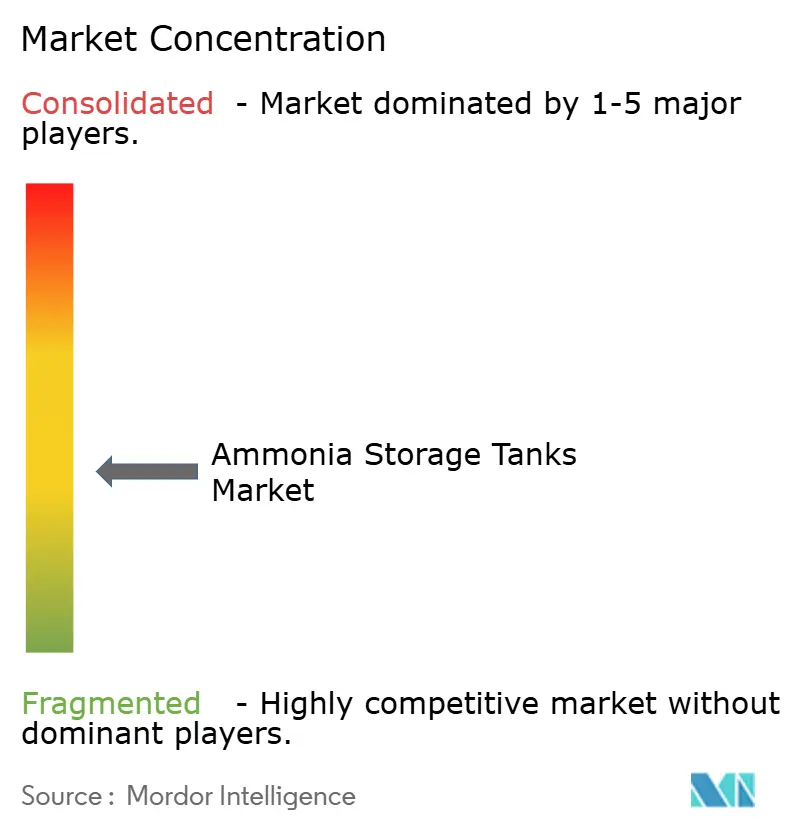
The Ammonia Storage Tanks market is moderately fragmented. Now integrated with Howden, Chart Industries leverages cryogenic expertise to supply prefabricated cold boxes and vapor handling, capturing contracts where owners favor single-vendor process guarantees. Thyssenkrupp Uhde capitalizes on its Haber-Bosch licensing footprint to bundle storage engineering with newbuild synthesis loops, a strategy reinforced by its 2024 partnership with Johnson Matthey on blue-ammonia solutions. With policy and capital converging, the ammonia storage tanks industry will likely experience selective consolidation as top players secure long-term service agreements tied to mega-projects.
Ammonia Storage Tanks Industry Leaders
-
Geldof
-
thyssenkrupp Uhde GmbH
-
McDermott
-
Royal Vopak
-
Matrix PDM Engineering
- *Disclaimer: Major Players sorted in no particular order
Ammonia Storage Tanks Market Companies Covered in this Report
- Aegis Vopak Terminals Limited
- BNH Gas Tanks
- CBandI Storage Solutions
- Chart Industries
- Engicon NV (Geldof)
- Fisher Tank Company
- IHI Corporation
- Linde PLC
- Matrix Service Company
- McDermott
- Royal Vopak
- Samarco Engineering
- SPG Steiner GmbH
- TF Warren Group
- thyssenkrupp Uhde GmbH
- ZHANJIANG MIC CHEMENERGY CO., LTD.
Market Opportunities and Future Outlook
A key white-space is import-terminal and port-side storage designed for energy use cases, including co-firing, cracking to hydrogen, and bunkering, where new refrigerated capacity is being planned alongside handling and conversion equipment. As of April 2026, the Port of Rotterdam had 18.1 million tons/year ammonia throughput capacity under development, highlighting the scale of terminal buildouts that translate into demand for large, code-intensive storage tanks and associated vapor management. Japan adds a demand anchor through policy-driven imports, with targets cited for 3 MT/year by 2030 and 30 MT/year by 2050, which increases the need for compliant coastal storage, boil-off control, and ship-loading interfaces.
Opportunity also appears in integrated ammonia-to-power and corridor-driven infrastructure, where storage becomes a gating element for project scheduling and safety-case approvals. As of April 2026, 53 ammonia-to-power projects representing 21.2 MT of ammonia demand were under development, pulling demand for both large terminal tanks and modular satellite storage near end users. On the supply side, project developers are moving from feasibility to defined engineering scopes, including thyssenkrupp Uhde pre-FEED work linked to 400,000 tpa green ammonia projects at the Port of Pecem and Port of Açu in Brazil, supporting export-oriented storage and jetty-linked tank farms in new production corridors.
Recent Industry Developments in Ammonia Storage Tanks Market
- April 2026: thyssenkrupp Uhde GmbH awarded Front-End Engineering Design FEED contract by Brunei Fertilizer Industries for a new cryogenic ammonia storage tank and export infrastructure at Sungai Liang Industrial Park. The project expands large-scale ammonia storage infrastructure in Brunei and supports export capability for downstream fertilizer operations. The engagement signals an integrated EPC FEED lead in the ammonia logistics chain.
- July 2025: Agropolychim signed a deal with Proton Ventures to design and construct a new liquid ammonia tank, 12,500 tons capacity. The tank expansion strengthens ammonia tank capacity for logistics and fertilizer operations. The arrangement reinforces downstream logistics and capacity for ammonia supply chain expansion.
- June 2025: Aegis Vopak Terminals Limited AVTL brownfield ammonia terminal development at Pipavav site to streamline ammonia imports. The development expands regional import capacity, improving supply security for ammonia. This action enhances the terminal network and supports growing trade in ammonia products.
Ammonia Storage Tanks Market Report Scope and Research Methodology
Market Definition and Coverage
For this study, the market includes the value of ammonia storage tanks used to store liquid ammonia safely at production sites, distribution terminals, and similar industrial locations. The scope covers tanks designed for low-pressure storage, typically using double-containment features and refrigeration conditions aligned to ammonia handling.
Scope exclusions: This sizing excludes ammonia transport equipment, piping systems, valves, compressors, and on-site process units that are not part of the storage tank asset.
Segments Covered in This Report
- By Type
- Small Tanks
- Large Tanks
- By Material
- Carbon Steel
- Nickel Steel
- Stainless and Duplex Stainless
- By Geography
- Asia-Pacific
- China
- India
- Japan
- South Korea
- Rest of Asia-Pacific
- North America
- United States
- Canada
- Mexico
- Europe
- Germany
- United Kingdom
- France
- Italy
- Rest of Europe
- South America
- Brazil
- Argentina
- Rest of South America
- Middle East and Africa
- Saudi Arabia
- South Africa
- Rest of Middle East and Africa
- Asia-Pacific
Data Sources, Market Sizing, and Validation
Desk Research
Desk research was used to build the starting structure for the market model and to set realistic boundaries around what counts as an ammonia storage tank. Public sources such as US EPA risk management guidance for ammonia, OSHA safety references, the European Chemicals Agency, and standards bodies such as ASME and ISO helped us interpret typical tank designs, operating conditions, and safety-driven upgrade cycles.
To anchor demand signals, we reviewed data and publications from sources such as the International Energy Agency, the UN Comtrade database for ammonia trade flows, and fertilizer and chemicals industry associations that publish capacity and logistics notes. These were supplemented with company annual reports, investor presentations, and reputable industry news to track terminal projects and capacity additions. Paid subscriptions were used selectively for company financials, tender signals, and patent activity, which helped clarify where storage projects are moving. The sources listed here are illustrative, and additional public and paid references were used for cross-checking, clarification, and validation.
Primary Interviews and Surveys
Primary work focused on interviews and short surveys with tank fabricators, engineering and project teams, terminal operators, and large end users in chemicals, fertilizers, and emerging energy uses. We used these conversations to confirm typical capacity ranges, material choices, lead times, and pricing behavior, then we re-checked assumptions across APAC, EMEA, and the Americas so regional buildout patterns did not get overstated.
Distribution of primary research fieldwork respondents
| Company type | Respondent position | Region |
|---|---|---|
| Top tier: 28% | CXOs: 14% | APAC: 45% |
| Mid tier: 56% | Functional/Unit leaders: 33% | EMEA: 35% |
| Smaller Players: 16% | Managers: 53% | Americas: 20% |
Market-Sizing & Forecasting
Sizing starts with a top-down build where ammonia production and trade patterns are used to reconstruct the likely storage footprint at plants and terminals. That footprint is then translated into tank demand using replacement and expansion rates. Once the picture is set, we corroborate it with selective bottom-up checks based on sampled tank pricing, typical capacity per site, and channel feedback from fabricators and EPC-linked respondents.
A few inputs carry most of the weight in the model, and they were kept simple so they can be repeated and audited. These include announced ammonia and green-ammonia capacity additions, port and terminal expansion timelines, typical tank capacity ranges (including large tanks used at distribution terminals), material selection shifts (carbon steel versus nickel steel and stainless variants), and the share of projects using double containment. Forecasting uses scenario analysis, since project timing can move with permitting and financing, and expert feedback was used to choose realistic start-date and ramp-up assumptions. Where bottom-up checks had gaps for smaller local projects, we used region-level averages and then pressure-tested totals against import-export flows and visible project lists.
Data Validation & Update Cycle
Outputs were validated through multiple checks, starting with whether regional totals align with observable signals such as terminal capacity additions, ammonia trade intensity, and the pace of industrial safety upgrades. Any outliers in pricing, tank count, or growth rates were reviewed, and if the reason was not clear, we reached back out to selected respondents to confirm what changed.
Before sign-off, the model is reviewed step by step by another analyst so assumptions, units, and currency handling are consistent across regions. Reports are refreshed annually, and interim updates are made when a material event changes the outlook, such as a major project delay, a safety rule change, or a large new terminal announcement. Right before delivery, we do a fresh pass to confirm the latest public project and macro signals are reflected.
Mordor Intelligence's Ammonia Storage Tanks Market Size Compared With Other Published Estimates
Published market sizes for ammonia storage tanks can look far apart, even when they all describe the same general theme. The differences usually come from what is counted as a storage tank, which year is treated as the base, and how pricing and project timing are handled when converting capacity activity into market value.
The spread also grows when some estimates mix in adjacent equipment, or when they treat only new tank shipments as the market while others include installed-base driven replacements and upgrades. Currency timing and the way inflation is applied to tank materials can further shift the number, and the refresh cadence matters because ammonia terminals and low-carbon projects are often announced with delays that span reporting cycles.
Benchmark comparison
| Source | Market Size | Gaps in Research Methodology |
|---|---|---|
| Mordor Intelligence | USD 614.95 M (2025) | |
| Trade Journal A | USD 226.00 M (2024) | Uses a shipment-style view that appears to focus on nearer-term equipment revenues, and it does not clearly state whether large, refrigerated, double-containment terminal tanks are fully included. |
| Regional Consultancy B | USD 220.00 M (2024) | Defines the space as liquid ammonia storage tanks, which can narrow scope to select tank configurations and can undercount replacement, retrofit, and site expansion work tied to safety compliance cycles. |
The table shows a clear gap between the 2025 value and the lower 2024 figures, and in Mordor Intelligence's model the scope is anchored on low-pressure liquid ammonia storage tanks used at both plant sites and distribution terminals, including double-containment designs where applicable. When definitions stay strict and the demand pool is tied back to production and trade signals, the result is easier to trace and repeat, even if project timing shifts year to year.
Key Questions Answered in the Report
What is the projected value of the ammonia storage tanks market in 2031?
The market is expected to reach USD 829.57 million by 2031, reflecting a 5.11% CAGR from 2026.
Which region is currently the largest and fastest-growing in ammonia storage tanks?
Middle East and Africa leads with 35.98% revenue in 2025 and the highest 6.05% CAGR outlook to 2031.
Which tank type is expanding the quickest?
Small tanks are forecast to grow at a 5.61% CAGR as distributed green-ammonia projects favor modular capacity.
Why is stainless steel gaining traction in new ammonia tanks?
Green-ammonia applications need higher corrosion resistance and purity, pushing stainless and duplex steels to a 5.83% CAGR.
How do safety regulations affect project costs?
Expanded requirements under OSHA, ASME, and API increase design complexity, inspection frequency, and upfront CAPEX for new installations.