
Aluminium Forging Market Size and Share
Market Overview
| Study Period | 2020 - 2031 |
|---|---|
| Market Size (2026) | USD 14.98 Billion |
| Market Size (2031) | USD 19.23 Billion |
| Growth Rate (2026 - 2031) | 5.13 % |
| Fastest Growing Market | Asia-Pacific |
| Largest Market | Asia-Pacific |
| Market Concentration | Medium |
Major Players *Disclaimer: Major Players sorted in no particular order Image © Mordor Intelligence. Reuse requires attribution under CC BY 4.0. | |
Aluminium Forging Market Analysis by Mordor Intelligence
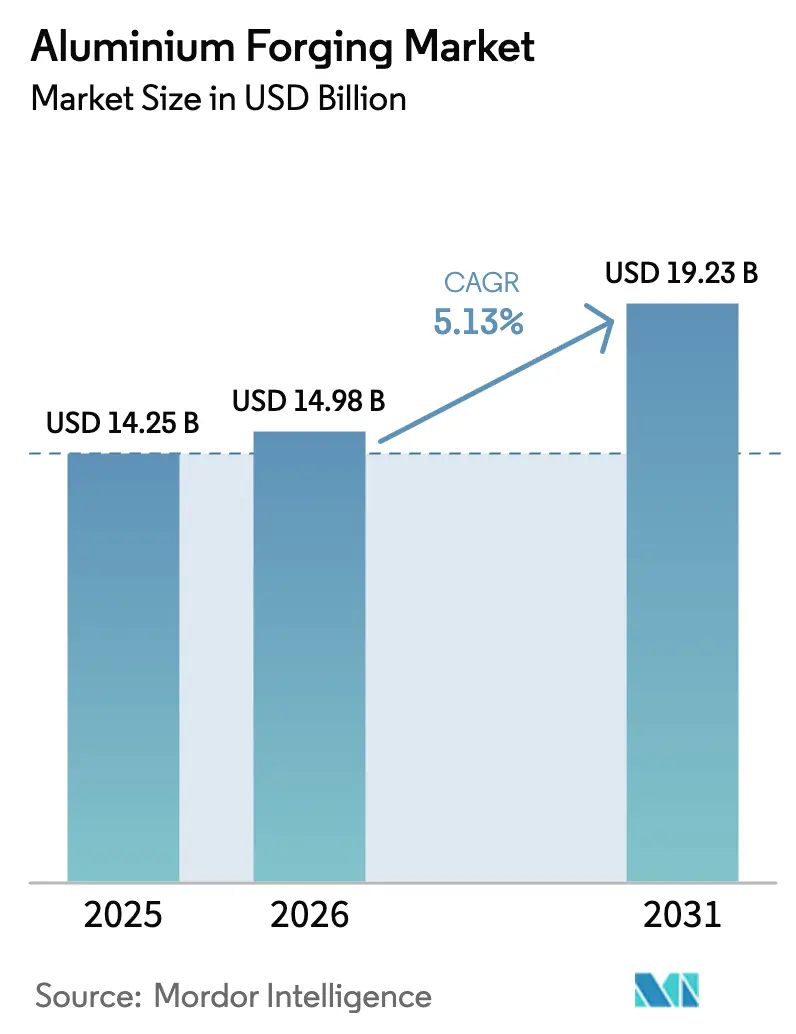
aluminium forging market size in 2026 is estimated at USD 14.98 billion, growing from 2025 value of USD 14.25 billion with 2031 projections showing USD 19.23 billion, growing at 5.13% CAGR over 2026-2031. Rising demand for lighter vehicles, stricter emission standards, and the material’s compatibility with existing press lines underpin this outlook, giving the aluminium forging market a structural edge over steel. OEMs are integrating forged aluminium suspension arms, control arms, and power-dense aerospace components to cut vehicle curb weight, extend EV range, and lower life-cycle emissions. Regional supply chains are also shifting as policymakers implement carbon taxes and local-content rules, prompting onshore capacity additions that tighten the aluminium forging market and open new revenue streams for certified suppliers. Price volatility on the London Metal Exchange and rising energy costs are compressing unhedged margins, yet forward-integration moves by top players are mitigating the impact.
Key Report Takeaways
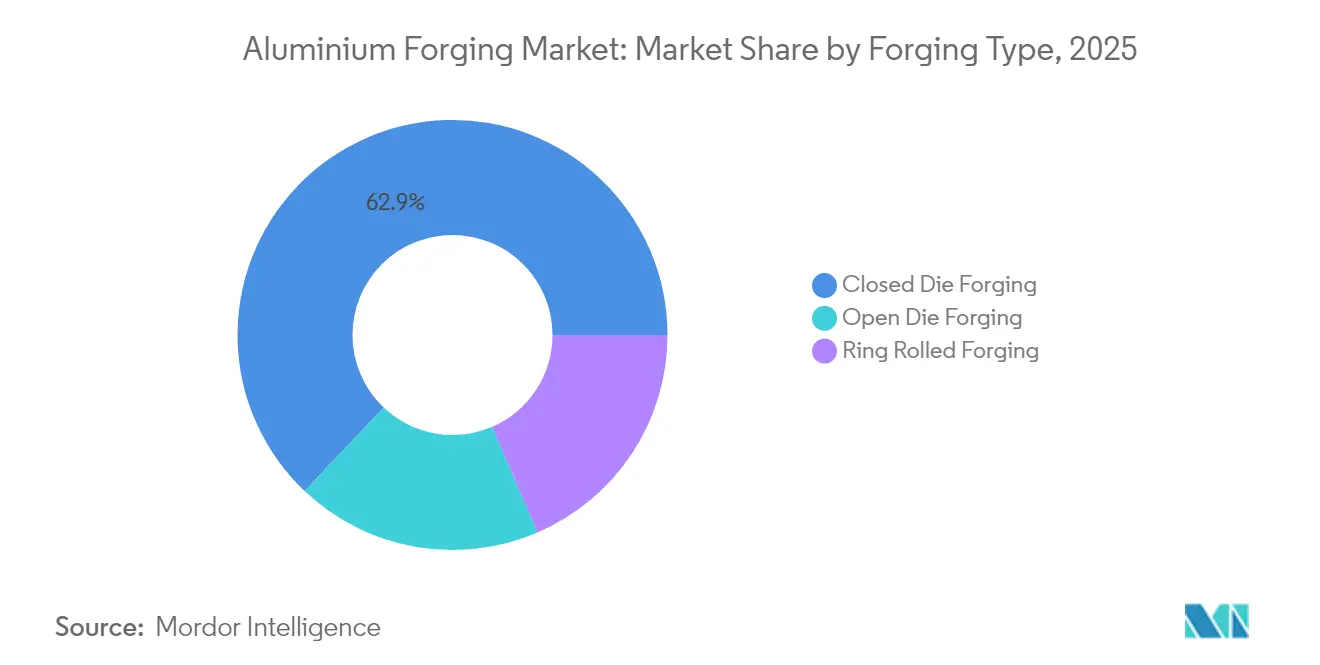
- By forging type, closed-die captured 62.93% of the aluminium forging market share in 2025, and is projected to expand at a 5.24% CAGR through 2031.
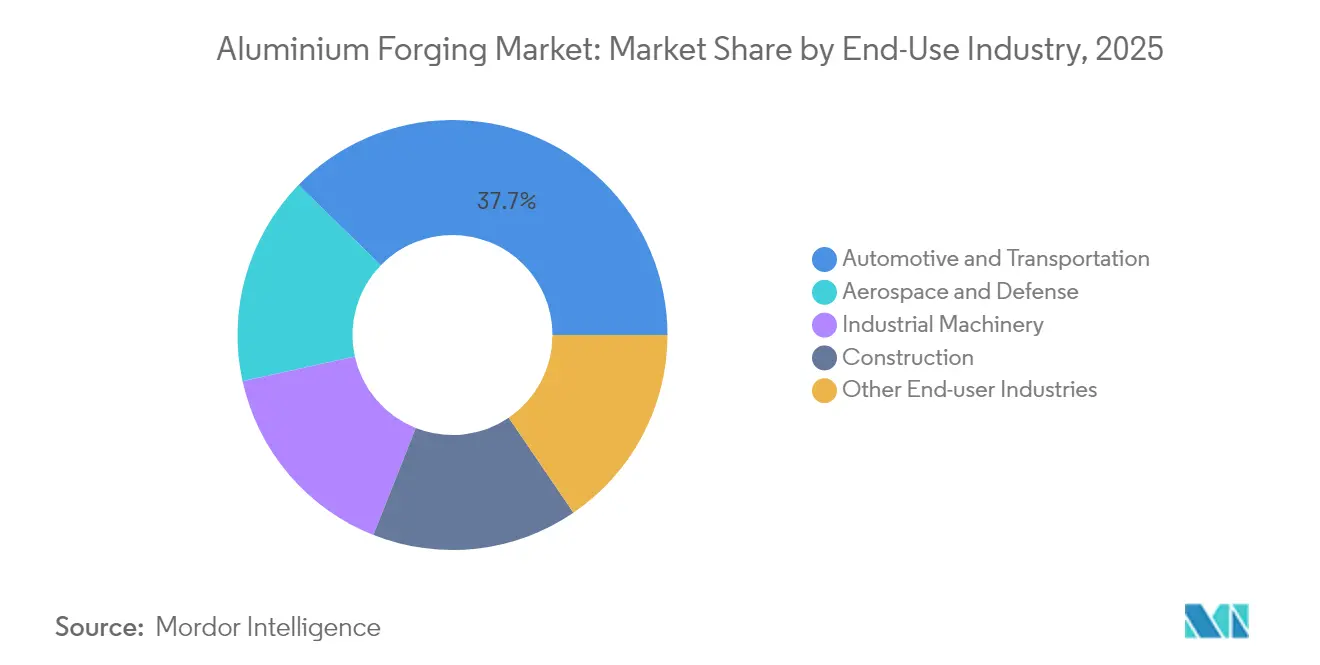
- By end-use industry, the automotive and transportation sector led with a 37.71% share of the aluminium forging market size in 2025; the aerospace and defense sector is advancing at a 5.47% CAGR to 2031.
- By geography, the Asia-Pacific region commanded 37.97% of 2025 revenue and is forecast to post a 6.35% CAGR through 2031, the fastest regional expansion in the aluminium forging market.
Note: Market size and forecast figures in this report are generated using Mordor Intelligence’s proprietary estimation framework, updated with the latest available data and insights as of 2026.
Market Trends and Insights
Drivers Impact Analysis of Aluminium Forging Market*
| Drivers | (~) % Impact on CAGR Forecast | Geographic Relevance | Impact Timeline |
|---|---|---|---|
| Growing use of lightweight materials | +1.2% | Global, concentrated in North America, Europe, and China | Medium term (2-4 years) |
| Surging EV-oriented automotive demand | +1.5% | APAC core, spill-over to North America and Europe | Short term (≤ 2 years) |
| Rising aero-engine backlog | +0.9% | North America, Europe, emerging in India and Turkey | Long term (≥ 4 years) |
| Hydrogen-ready gas-turbine build-out | +0.4% | Europe, Middle East, Japan | Long term (≥ 4 years) |
| Local-content mandates | +0.7% | India, Southeast Asia, Middle East, Brazil | Medium term (2-4 years) |
| Source: Mordor Intelligence | |||
Growing Use of Lightweight Materials Across Industrial Sectors
Automotive and aerospace OEMs report a 40-50% reduction in component weight when aluminium forgings replace steel, resulting in a 6-8% range extension on 75 kWh EV packs[1]. Even advanced high-strength steel grades remain 2.9 times denser than aluminium, forcing trade-offs between payload and fuel economy. Industrial robotics firms are adopting forged aluminum manifolds and joints to reduce arm inertia, thereby shortening pick-and-place cycles by 200 ms and increasing throughput over three shifts. Construction equipment manufacturers specify forged aluminum for booms and jibs to comply with axle-load limits, thereby unlocking higher legal payloads without incurring highway permit penalties. Aerospace remains the most weight-sensitive user; each kilogram trimmed from an airframe saves about USD 3,000 in fuel during a 20-year life, making aluminium-lithium forgings preferable to composites for cryogenic tank domes and fuselage frames.
Surging Demand from EV-Oriented Automotive and Transportation OEMs
Ramkrishna Forgings invested INR 57.5 crore (approximately USD 6.9 million) in 2024 to create a 3,000 tpa aluminium forging capacity for EV suspension arms and battery-tray brackets. ILJIN’s USD 100 million Alabama greenfield plant, announced in October 2024, will supply forged control arms to General Motors and Stellantis by Q3 2026. Mass reduction remains a key selling point; a 20 kg weight cut in unsprung parts yields an 8 km range gain on a 400-km EV, a critical margin in consumer purchase decisions. Fleet operators see analogous savings in commercial-vehicle electrification, as forged aluminium wheel hubs and steering knuckles lower rolling resistance and total cost per tonne-kilometer.
Rising Aero-Engine Backlog Driving Closed-Die Orders
Safran’s 2024 contract with Hindustan Aeronautics covers aluminium fan blades and casings for LEAP turbines, highlighting supply constraints in closed-die capacities. Turkish Aerospace reported 18-month lead times for critical aluminum forgings, compared to a historic 10-month norm, which delayed trainer-aircraft deliveries. Bharat Forge’s October 2025 Rolls-Royce deal adds Indian capacity for Pearl 10X business-jet fan blades, underscoring the OEM's willingness to qualify new AS9100D vendors. Aluminium-lithium alloys with 7-10% lower density than 2000-series alloys enable 150 kg of engine weight savings and a 2% reduction in fuel burn over 3,000 hours.
Hydrogen-Ready Gas-Turbine Build-Out
The EU-funded H2AL project is refining heat-treatment routes that maintain the stability of 6000-series aluminium above 300 °C, a requirement for hydrogen combustor liners. Siemens Energy and General Electric test hydrogen-capable turbines in Germany and the Netherlands, specifying forged aluminium casings that lower foundation costs by 10-15%. NEOM in Saudi Arabia and Japan’s ammonia co-firing push create parallel demand for corrosion-resistant valve bodies and actuator housings.
Restraints Impact Analysis of Aluminium Forging Market*
| Restraints | (~) % Impact on CAGR Forecast | Geographic Relevance | Impact Timeline |
|---|---|---|---|
| Aluminium LME price volatility | -0.8% | Global, acute in Southeast Asia and Latin America | Short term (≤ 2 years) |
| Stringent aerospace defect-detection norms | -0.5% | North America, Europe, expanding to India and Turkey | Medium term (2-4 years) |
| Energy-intensive operations facing carbon tax | -0.4% | EU, UK, future CBAM regions | Long term (≥ 4 years) |
| Source: Mordor Intelligence | |||
Aluminium LME Price Volatility and Hedging Costs
LME prices fell 20% from USD 2,600 per tonne in early 2024 to USD 2,080 in December, squeezing margins for spot-exposed forgers. Options premiums on 12-month collars widened to 4.5% of notional in 2024 versus 2.8% a year earlier, while the U.S. Midwest premium spiked to USD 1,323 per tonne in June 2025 on tariff-driven logistics snarls. Smaller Southeast Asian and Latin American suppliers lack access to sophisticated hedges and forfeit 8-12% of their margin to tolling structures. Japan’s quarterly premium jumped 30% to USD 228 per tonne in Q1 2025 on scrap scarcity and LNG-linked power costs.
Stringent Defect-Detection Standards in Aerospace Supply Chains
AS9100D compliance mandates the ultrasonic detection of subsurface voids greater than 1.5 mm, along with X-ray and full traceability, which raises capital expenditures by USD 2–5 million for mid-tier entrants. OEMs tightened sampling after Pratt & Whitney’s 2024 powder-metal recall, with some requiring 100% volumetric inspection FT.COM. Billet chemistry certificates must be archived for 20 years, which prolongs qualification to 24–36 months and delays revenue for new suppliers.
*Our forecasts treat driver/restraint impacts as directional, not additive. The impact forecasts reflect baseline growth, mix effects, and variable interactions.
Aluminium Forging Market Segment Analysis
By Forging Type:
Closed-Die Dominance Reflects Near-Net-Shape EconomicsClosed-die processes held a 62.93% share of the aluminium forging market in 2025 and are projected to expand at a 5.24% CAGR, driven by ±0.5 mm tolerances that eliminate secondary machining in high-volume automotive and aerospace parts. Investments such as Aubert & Duval’s EUR 75 million 60-MN press, due online in 2027, underline expectations of a sustained aero-engine backlog.
Ring-rolled forging retains niche status for bearings and pressure-vessel rings where weld-free geometry is indispensable. Open-die forging remains the preferred method for producing ultra-large parts exceeding 50 kg; China’s 16,500-tonne Tai’an press underscores the state's support for the nuclear and petrochemical markets. Digital simulation platforms, such as FORGE NxT 4.1, reduce prototype cycles from five to two, thereby reducing scrap and energy costs across all forging types.

By End-Use Industry:
Aerospace Grows Fastest Despite Automotive’s Volume LeadAutomotive and transportation, at 37.71% of 2025 volume, remain the largest slice of the aluminium forging market. However, the aerospace and defense sector is the fastest-growing end-use, posting a 5.47% CAGR to 2031, driven by demand for engines and airframes. Aerospace’s price premia—USD 8,000–12,000 per forged fan blade—raise the aluminium forging market size for the segment, even at modest unit counts. The aluminium forging market share for the aerospace industry is therefore projected to rise by 2.1 percentage points by 2031.
Industrial machinery users prefer forged aluminium hydraulic manifolds due to their higher thermal conductivity of 237 W/mK, compared to 50 W/mK for steel, which enables air cooling in high-duty cycles. Construction equipment builders specify forged aluminium booms to meet axle-load caps, while oil-and-gas players apply ring-rolled closures for 10,000 psi wells.
Geography Analysis
APAC Aluminium Forging Market
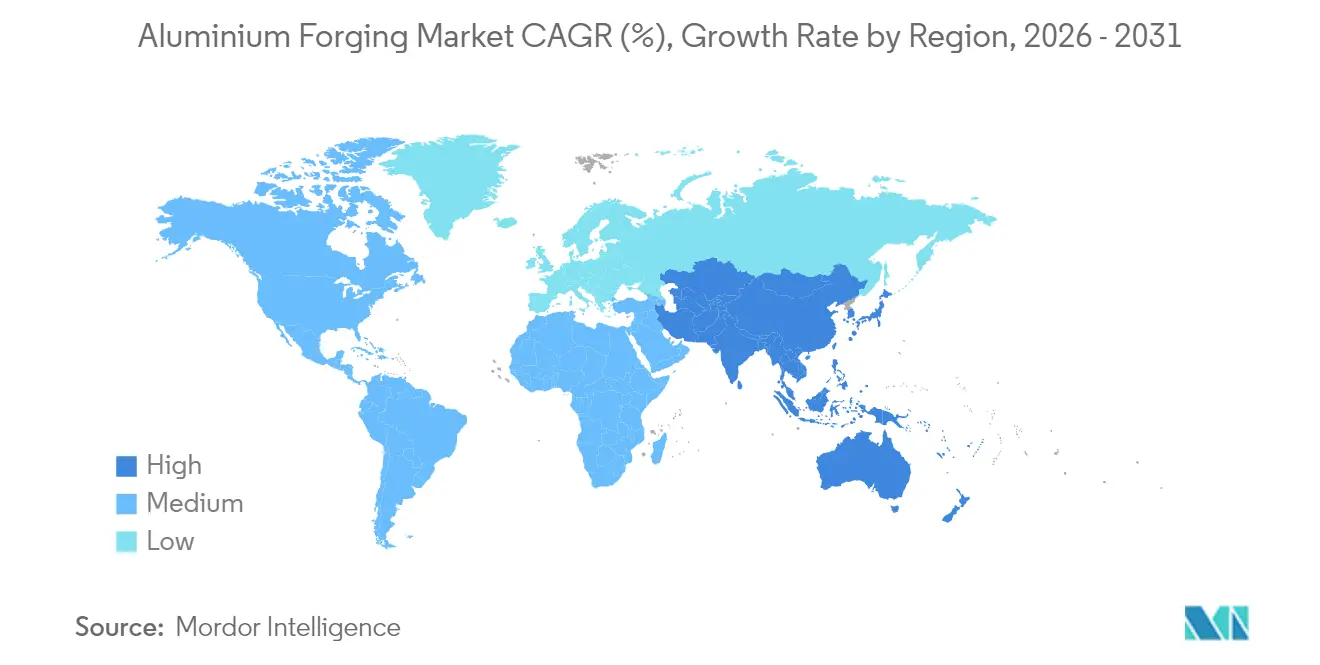
The Asia-Pacific region dominated the aluminium forging market with a 37.97% share in 2025, a position expected to widen at a 6.35% CAGR through 2031. China’s withdrawal of its 13% aluminium semi-finished products rebate in December 2024 increased landed costs for ASEAN buyers, prompting them to consider long-term tolling deals. India’s aluminium forging market is gaining momentum, driven by a per-capita consumption that lags behind the global average by a factor of four. A USD 40 billion investment in smelting expansion is needed to meet a demand of 10 million tonnes per annum by 2030.
The Americas, Europe and Middle East Aluminium Forging Market
North America’s outlook improves with ILJIN’s USD 100 million Alabama plant, which will supply EV control arms starting in Q3 2026, recapturing volume lost to Mexico. Europe consolidates around aerospace; Aubert & Duval’s new press and EGA’s 30,000 tpa recycled billet line in Germany support local circular-economy mandates. South America and the Middle East remain import-led for complex, closed-die parts, although Saudi Arabia’s NEOM and Brazil’s defense offsets are expected to foster joint ventures that will increase in-region share post-2026.
Regulatory Landscape
Trade and decarbonization measures continue to influence cross-border aluminium and forged-component flows. Tariff-linked logistics disruptions have contributed to wide regional premium swings, including the U.S. Midwest premium spiking to USD 1,323 per tonne in June 2025. In Asia, China removed its 13% rebate on aluminium semi-finished products in December 2024, which increased landed costs for downstream buyers and shaped sourcing decisions for billet and forged inputs.
Environmental compliance and carbon-related policies also affect forging economics and upstream metal availability. China maintains primary aluminium capacity caps backed by inspections and environmental assessments. Supply stabilization efforts included restarts of idled primary capacity in H1 2026, including Mount Holly in the United States, San Ciprian in Spain, and Grundartangi in Iceland. In aerospace applications, customer-driven quality requirements aligned to AS9100D, including ultrasonic detection thresholds and traceability expectations, operate as a quasi-regulatory gate, raising qualification time and compliance investment for aluminium forging suppliers.
Value Chain Analysis
The aluminium forging value chain starts with bauxite and alumina into primary aluminium, then alloying and billet production, increasingly including recycled billet routes. Forging follows heating and forming across closed-die, open-die, and ring-rolled processes, with heat treatment and downstream machining, inspection (notably ultrasonic and X-ray for aerospace), and surface finishing. On the demand side, OEMs and tier suppliers in automotive, aerospace and defense, industrial machinery, and construction use forged components. Qualification and traceability requirements, including AS9100D in aerospace, push forgers to integrate metrology, NDT, and documentation systems into the production flow.
Recent portfolio moves also point to ongoing vertical and horizontal reshaping in engineered components adjacent to, or downstream of, forging. Howmet Aerospace completed the acquisition of Consolidated Aerospace Manufacturing (CAM) on April 6, 2026 (about USD 1.8 billion), strengthening downstream fastening systems and assembly content that can be bundled with forged structures in aerospace programs. At the same time, Howmet Aerospace sold its disk forging facility in Savannah, Georgia on March 31, 2026 (about USD 230 million), reflecting continued network optimization. Separately, Bharat Forge disclosed consolidation of its European footprint and restructuring of parts of its forging operations, with completion targeted by the end of CY27 to align capacity with higher-value demand centers.
Competitive Landscape
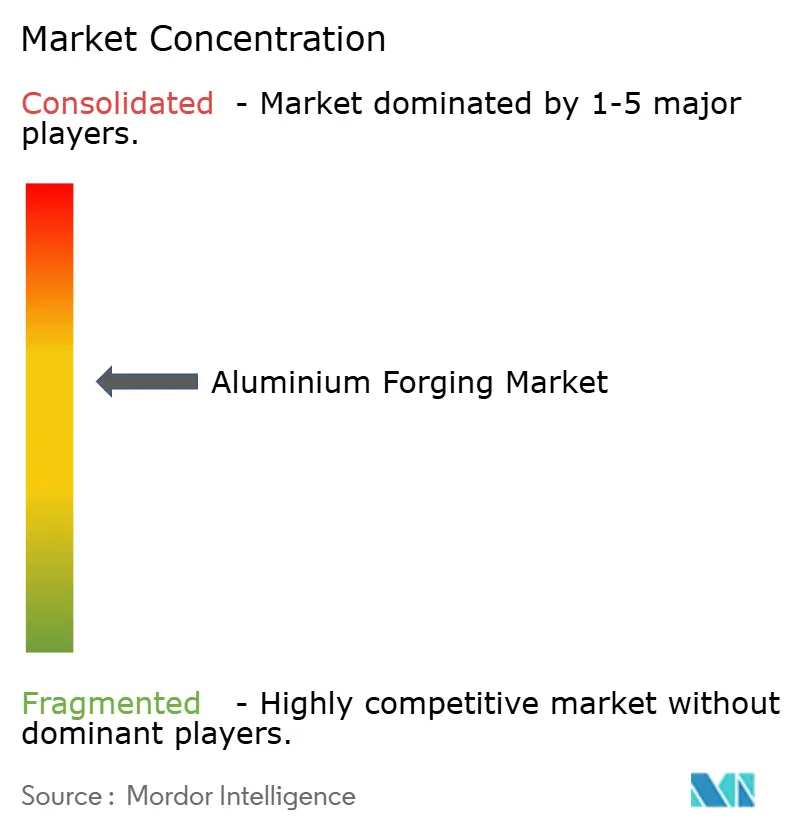
The global aluminium forging market is moderately fragmented. The top five forgers hold a significant share of the global market, while regional specialists compete through proximity and shorter lead times. Technology adoption differentiates leaders; predictive-maintenance software reduces unscheduled downtime to 3% from 8%, thereby increasing utilization. Aluminium-lithium forgings for space launchers represent white-space growth, with third-generation alloys offering 7-10% density reductions. Indian and Turkish disruptors leverage 40% lower overhead and AS9100D compliance to underbid Western incumbents by 15-20% on aero-engine parts.
Aluminium Forging Industry Leaders
-
Howmet Aerospace
-
Bharat Forge
-
Nippon Steel Corporation
-
Thyssenkrupp AG
-
Aluminum Precision Products
- *Disclaimer: Major Players sorted in no particular order
Aluminium Forging Market Companies Covered in this Report
- Accurate Steel Forgings (INDIA) Limited
- Al Forge Tech Co., Ltd
- All Metals & Forge Group
- Aluminum Precision Products
- Anchor Harvey
- Anderson Shumaker Company
- Bharat Forge
- Ellwood Group Inc.
- Howmet Aerospace
- ILJIN co., ltd.
- KOBE STEEL, LTD.
- NIPPON STEEL CORPORATION
- Norsk Hydro ASA
- Ramkrishna Forgings LTD
- Scot Forge Company
- Thyssenkrupp AG
- Wheel India Limited
Market Opportunities and Future Outlook
Aerospace and defense qualification bottlenecks and long lead times create whitespace for certified aluminium forging capacity that combines closed-die capability with advanced inspection and machining. Recent customer actions reinforce the opening. Bharat Forge signed a long-term contract with Embraer in May 2026 to manufacture critical landing gear forgings. Its October 2025 Rolls-Royce deal for Pearl 10X forged aluminium fan blades also indicates OEM willingness to qualify additional suppliers for safety-critical engine and airframe parts.
Automotive lightweighting offers further conversion headroom where forged aluminium replaces steel in suspension and chassis components. This is supported by OEM-facing investment programs and stated conversion potential. Howmet Aerospace has cited that a large portion of the commercial-transport conversion opportunity remains untapped, while North America is adding dedicated capacity through ILJIN’s USD 100 million Alabama greenfield project announced in October 2024, targeting forged control arms for General Motors and Stellantis EV platforms from Q3 2026. Supply-chain volatility tied to geopolitics and regional premiums also creates room for forgers that can secure non-disrupted billet flows and recycled input streams, as buyers prioritize steadier total delivered costs and shorter lead times.
Recent Industry Developments in Aluminium Forging Market
- May 2026: Bharat Forge signs Embraer contract to manufacture critical landing gear forgings. The agreement expands Bharat Forge's aerospace forgings footprint and integrates it into Embraer's global supply chain, creating a long-term revenue stream.
- May 2026: Howmet Aerospace reports first quarter 2026 results with forged wheel revenue of 295 million and completes CAM acquisition for 1.8 billion. The combination grows forged components revenue and expands CAM capabilities, bolstering aerospace component supply capacity.
- April 2026: Bharat Forge acquires a 30 percent stake in Fortuna Engineering Private Limited. The deal broadens machined components capabilities and strengthens onshore manufacturing footprint.
Aluminium Forging Market Report Scope and Research Methodology
Market Definition and Coverage
This market covers the value of aluminum forgings sold for use in finished components across key end-use industries. It includes revenue tied to forged parts made using common forging processes and supplied to OEMs and tiered suppliers, covering both major producing and consuming regions.
Scope exclusions: We exclude aluminum casting and machining-only parts, and we also exclude raw primary aluminum sales that are not tied to a forging output.
Segments Covered in This Report
- By Forging Type
- Open Die Forging
- Closed Die Forging
- Ring Rolled Forging
- By End-Use Industry
- Aerospace and Defense
- Automotive and Transportation
- Industrial Machinery
- Construction
- Other End-user Industries
- By Geography
- Asia-Pacific
- China
- India
- Japan
- South Korea
- Malaysia
- Thailand
- Indonesia
- Vietnam
- Rest of Asia-Pacific
- North America
- United States
- Canada
- Mexico
- Europe
- Germany
- United Kingdom
- France
- Italy
- Spain
- Nordic Countries
- Turkey
- Russia
- Rest of Europe
- South America
- Brazil
- Argentina
- Colombia
- Rest of South America
- Middle East and Africa
- Saudi Arabia
- Qatar
- United Arab Emirates
- Nigeria
- Egypt
- South Africa
- Rest of Middle East and Africa
- Asia-Pacific
Data Sources, Market Sizing, and Validation
Desk Research
Desk research was used to set the outer boundaries for demand and supply, so the model stays aligned with what the industry can realistically produce and consume. We reviewed public production and trade statistics, such as the USGS for metals context, UN Comtrade for import and export patterns in relevant product lines, and the International Aluminium Institute for upstream aluminum supply indicators that influence forging feedstock availability.
To connect end markets with forging demand, we used build indicators for automotive and aerospace from sources such as OICA for vehicle production, FAA and EASA releases for aircraft activity signals, and publications from government transport and industry agencies where lightweighting rules and fleet shifts are tracked. Company annual reports, investor presentations, and reputable press were then used to confirm capacity additions, utilization commentary, and product mix direction, with selective use of paid subscriptions for company financials, patent databases, and shipment-level trade records when needed. The sources listed here are illustrative only, and many other public and paid references were also used for data collection, validation, and clarification.
Primary Interviews and Surveys
Primary work focused on validating what portion of aluminum demand flows through forging, and how that split changes by end-use and region. We interviewed and surveyed participants across forging operations, downstream component makers, procurement teams, and industry experts, then used their input to tighten assumptions on utilization, typical pricing movement, and adoption in automotive, aerospace, and industrial equipment.
Distribution of primary research fieldwork respondents
| Company type | Respondent position | Region |
|---|---|---|
| Top tier: 34% | CXOs: 17% | APAC: 39% |
| Mid tier: 47% | Functional/Unit leaders: 32% | EMEA: 36% |
| Smaller Players: 19% | Managers: 51% | Americas: 25% |
Market-Sizing & Forecasting
Market sizing is built using top-down and bottom-up logic, where regional end-use demand signals are first used to reconstruct the addressable demand pool for forged aluminum parts, and then reconciled with what suppliers can realistically deliver. In practice, we start from end markets that pull forgings, translate those indicators into forging value using informed penetration and spend assumptions, and then apply regional splits that reflect manufacturing footprints.
Key inputs include vehicle production trends and the shift toward lightweight platforms, aircraft build and maintenance activity, industrial machinery output direction, the share of components that are forged versus substituted with cast or fabricated parts, and average selling price movement linked to alloy mix and energy cost pass-through. Forecasting relies mainly on scenario analysis, because adoption and build-rate changes can move faster in some years than long-run averages suggest, and expert inputs help choose realistic cases. Bottom-up checks are applied through sampled supplier revenue mapping, channel discussions, and ASP times volume approximations by forging type, with gaps handled using peer benchmarks when a country-level datapoint is thin.
Data Validation & Update Cycle
Validation is done through multiple checks so single-source biases do not drive the final numbers. We compare modeled totals against independent signals such as regional manufacturing output, trade direction, and visible capacity expansions, and we review variance before final sign-off.
If outliers appear, analysts revisit assumptions and, when required, re-contact interviewees to confirm whether a shift is structural or only temporary. The report is refreshed annually, and interim updates are made when material events occur (for example, major capacity changes or abrupt end-market swings). Before delivery, a final review pass is performed so clients receive the latest updated view aligned with the most recent data cuts.
Mordor Intelligence's Aluminium Forging Market Sizing Compared With Other Published Estimates
Published numbers for aluminum forging can look far apart because each publisher chooses a different scope line and a different way to translate industry activity into revenue. The most common differences come from which processes are counted, which end-use applications are treated as core, and how pricing is carried forward year to year.
The benchmark table shows a tighter 2026 value than some higher external figures. In Mordor Intelligence's model, revenue is counted only for forged aluminum products (open die, closed die, and ring rolled) sold into end uses, rather than blending in cast aluminum components or broader aluminum processing value. Differences also come from how the base year is set, whether aggressive adoption assumptions are used for automotive lightweighting, and how currency conversion timing is applied when regional prices move quickly.
Benchmark comparison
| Source | Market Size | Gaps in Research Methodology |
|---|---|---|
| Mordor Intelligence | USD 14.98 B (2026) | |
| Global Consultancy A | USD 21.08 B (2024) | This estimate appears to use a wider definition that can include conventional aluminum forging plus adjacent processing value, and it anchors on a different base year which shifts the curve when later-year adoption is applied. |
| Industry Publisher B | USD 28.00 B (2025) | The figure is likely higher because it layers in a broader component set and assumes a faster ramp in forged content per vehicle and aircraft, with fewer visible checks against capacity and trade signals that cap near-term revenue. |
Looking across the three values, the spread is mostly explained by scope boundaries and how fast adoption and pricing are allowed to rise in the forward years. Our approach stays traceable to end-market activity, forging process coverage, and practical price logic, which makes it easier for buyers to repeat the steps and stress-test the assumptions.
Key Questions Answered in the Report
What is the current value of the aluminium forging market?
The aluminium forging market size is USD 14.98 billion in 2026.
How fast will demand grow through 2031?
Market revenue is projected to rise to USD 19.23 billion, equating to a 5.13% CAGR.
Which forging type holds the largest share?
Closed-die processes commanded 62.93% of 2025 revenue, benefiting from near-net-shape economics.
Which end-use segment is expanding the quickest?
Aerospace and defense is forecast to post a 5.47% CAGR through 2031 on engine and airframe backlogs.
Which region offers the fastest growth?
Asia-Pacific is projected to advance at 6.35% annually as China and India add capacity and consumption.
What is a key risk facing forgers?
Aluminium price volatility on the LME, with a 20% drop in 2024, threatens margins for unhedged suppliers.