
Aluminum Ingots Market Size and Share
Market Overview
| Study Period | 2021 - 2031 |
|---|---|
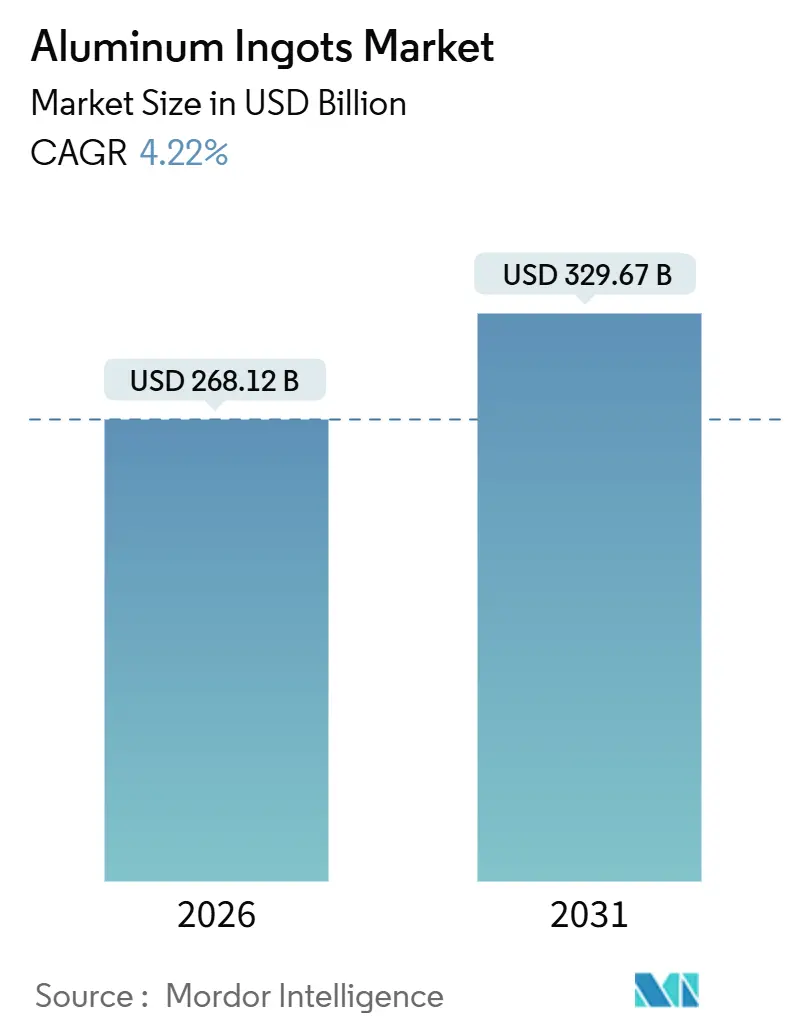
| Market Size (2026) | USD 268.12 Billion |
| Market Size (2031) | USD 329.67 Billion |
| Growth Rate (2026 - 2031) | 4.22 % |
| Fastest Growing Market | Middle East and Africa |
| Largest Market | Asia-Pacific |
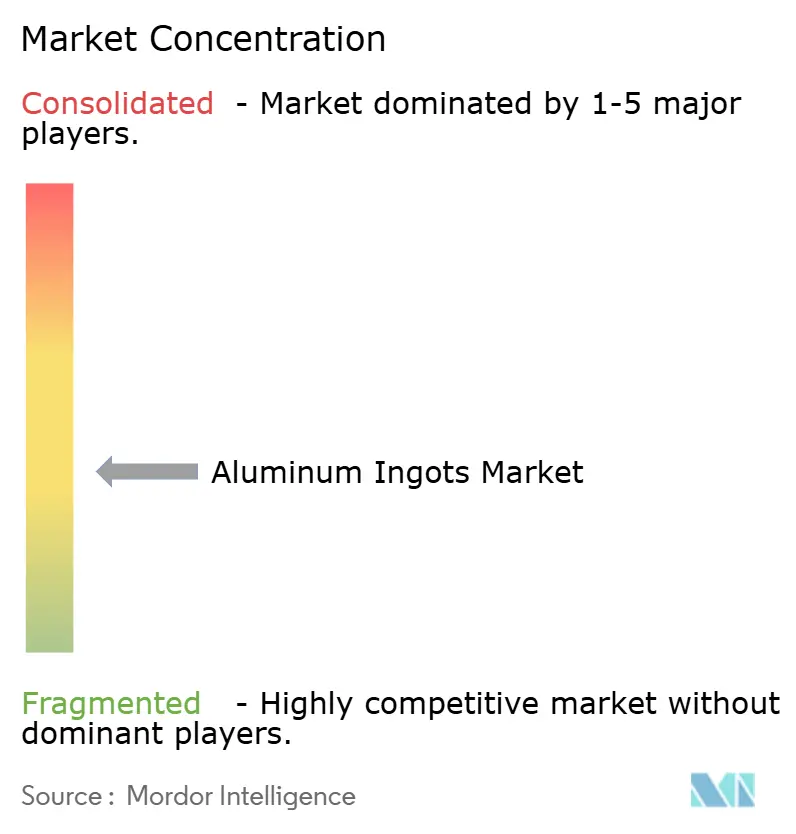
| Market Concentration | Medium |
Major Players *Disclaimer: Major Players sorted in no particular order Image © Mordor Intelligence. Reuse requires attribution under CC BY 4.0. | |
Aluminum Ingots Market Analysis by Mordor Intelligence
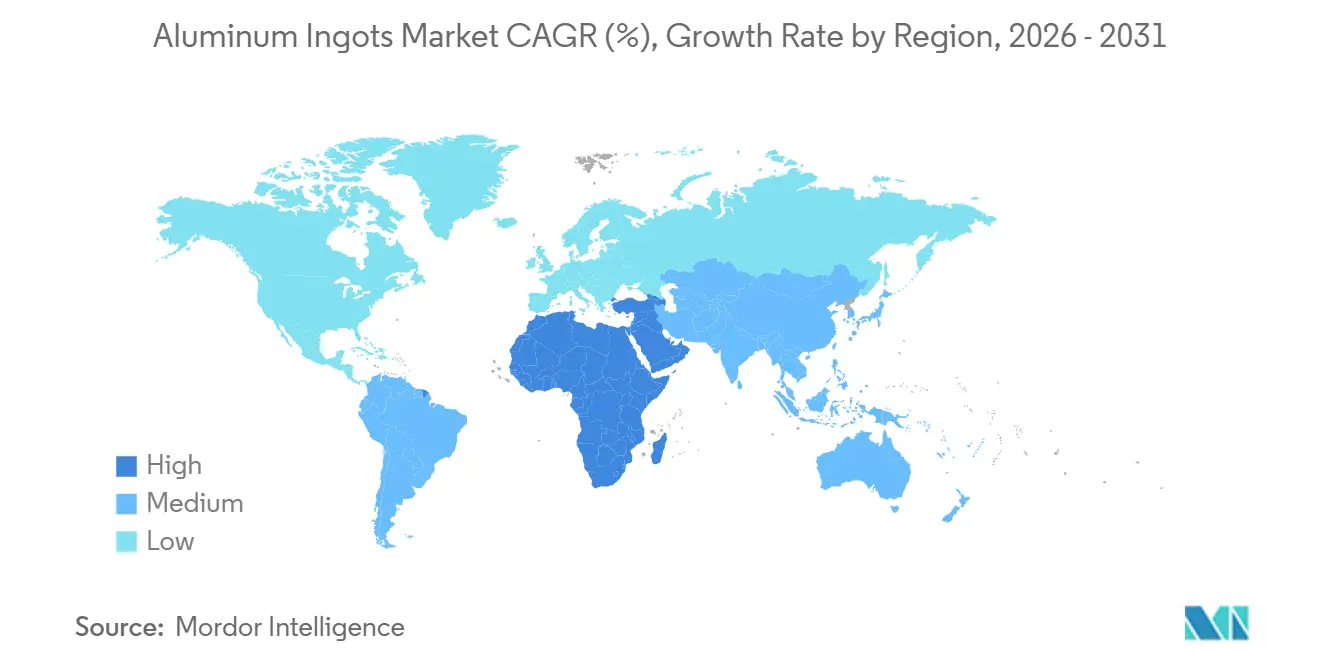
The Aluminum Ingots Market size is estimated at USD 268.12 billion in 2026, and is expected to reach USD 329.67 billion by 2031, at a CAGR of 4.22% during the forecast period (2026-2031). Capacity shifts are reshaping cost curves, because secondary ingots now grow faster than primary metal as automakers close scrap loops to meet Scope 3 goals. Border-carbon rules in the European Union, the United Kingdom, and Canada reward low-emission supply, steering premiums toward smelters that use hydropower or inert-anode cells. Asia-Pacific remains the volume anchor, but Middle East and Africa record the quickest gains on the back of subsidized gas and proximity to Indian fabricators. Over the forecast period, liquid-metal logistics in China, modular building demand in emerging economies, and steady aerospace build-rates stabilize the aluminum ingots market even when spot power prices spike.
Key Report Takeaways
- By production process, primary ingots held 62.41% of the aluminum ingots market share in 2025, while secondary ingots are expanding at a 5.32% CAGR through 2031.
- By end-user industry, building and construction led with 34.28% revenue share in 2025; automotive is forecast to advance at a 5.18% CAGR to 2031.
- By geography, Asia-Pacific commanded 53.46% of 2025 demand and Middle East and Africa are set to grow at a 4.97% CAGR to 2031.
Note: Market size and forecast figures in this report are generated using Mordor Intelligence’s proprietary estimation framework, updated with the latest available data and insights as of January 2026.
Global Aluminum Ingots Market Trends and Insights
Drivers Impact Analysis*
| Driver | (~) % Impact on CAGR Forecast | Geographic Relevance | Impact Timeline |
|---|---|---|---|
| Surging Construction Activities in Emerging Economies | +1.2% | APAC core (China, India, ASEAN), spill-over to MEA | Medium term (2-4 years) |
| Lightweighting Demand in Automotive and EVs | +1.5% | Global, with concentration in North America, EU, China | Long term (≥4 years) |
| Decarbonization Push and Recyclability Advantage | +0.9% | EU, North America, early adopters in APAC | Long term (≥4 years) |
| Shift Toward Liquid-Metal Supply Chains in China | +0.4% | China, regional spill-over to ASEAN | Short term (≤2 years) |
| Inert-Anode and Low-Carbon Smelting Premiumisation | +0.6% | Global, led by EU and North America regulatory frameworks | Long term (≥4 years) |
| Source: Mordor Intelligence | |||
Surging Construction Activities in Emerging Economies
Public infrastructure drives a large share of near-term volume in the aluminum ingots market. India’s National Infrastructure Pipeline committed USD 1.4 trillion through 2025, with roughly 30% routed to aluminum-heavy rail and power projects[1]. China’s 66% urbanization rate in 2025 keeps curtain-wall and roofing demand high, particularly in coastal provinces where corrosion resistance is critical. Vietnam and Indonesia replicate this pattern, as per-capita aluminum use in Vietnam rose to 5.1 kilograms in 2025. Growth in prefabricated modules tightens dimensional tolerances, rewarding smelters that integrate casting and extrusion at a single site. These shifts underpin sustained, mid-single-digit gains in the aluminum ingots market.
Lightweighting Demand in Automotive and EVs
Battery-electric vehicles use 20-30% more aluminum than internal-combustion cars, largely in enclosures and crash structures. Average aluminum content per North American light vehicle hit 220 kilograms in 2025 and should climb toward 250 kilograms by 2030. Closed-loop scrap systems—such as programs operated by Novelis—return stamping offcuts to the same mill within 60 days, preserving alloy chemistry and cutting virgin demand. High-silicon castings from EV battery boxes posed recycling hurdles, yet new solid-state separation solves embrittlement risks, widening secondary-ingot adoption. The result is a durable pull on the aluminum ingots market, with mobility brands seeking verified low-carbon metal to keep fleet emissions below tightening regulatory caps.
Decarbonization Push and Recyclability Advantage
Secondary aluminum consumes just 5% of the energy needed for primary metal, positioning it well as jurisdictions embed carbon costs. The EU’s Carbon Border Adjustment Mechanism assigns a default 10.6-tonne CO₂ factor to unverified ingots, adding certificate costs near EUR 954 per tonne at a EUR 90 carbon price. Canada and the United Kingdom have signaled similar frameworks for 2027-2028. Producers in Quebec, Norway, and Iceland already hedge with footprints below 4 tonnes CO₂ per tonne and earn USD 200-300 premiums from buyers needing Scope 3 relief. The aluminum ingots market therefore polarizes: low-carbon smelters thrive, while coal-based plants cede share unless they decarbonize grids or ramp recycling.
Shift Toward Liquid-Metal Supply Chains in China
China targets 90% liquid-metal transport by 2025 to avoid remelting losses of 300-400 kWh per tonne. Pilot rail links move molten aluminum in insulated ladles directly to fabricators within 48 hours, saving energy and trimming oxidation losses. Clustering smelters and casters inside 500 kilometers makes the model viable. India and Gulf producers now study similar routes for high-volume extrusions. This operational reset splits the aluminum ingots market between commodity solid ingots for export and contracted liquid flows that slash working capital for domestic users.
Restraints Impact Analysis*
| Restraint | (~) % Impact on CAGR Forecast | Geographic Relevance | Impact Timeline |
|---|---|---|---|
| Raw-Material and Power-Price Volatility | -0.8% | Global, acute in Europe and regions with deregulated energy markets | Short term (≤2 years) |
| Carbon-Border Adjustments and Stricter ESG Audits | -0.5% | EU, North America, spillover to export-oriented APAC producers | Medium term (2-4 years) |
| Hydropower-Related Water-Scarcity Curbs | -0.3% | China (Yunnan, Sichuan), Norway, Brazil, parts of Canada | Short term (≤2 years) |
| Source: Mordor Intelligence | |||
Raw-Material and Power-Price Volatility
Smelting uses 13-15 MWh of electricity per tonne, meaning power swings can wipe out margins overnight. European capacity contracted by over 1 million tonnes in 2025 as gas prices surged past EUR 100 per MWh, despite London Metal Exchange prices near USD 2,500. Alumina costs also jumped when supply disruptions in Guinea pushed FOB Australia quotes beyond USD 450 per tonne. Only vertically integrated majors with captive refineries and hydropower contracts stayed profitable. Financing new smelters grows harder when off-take lenders demand power deals longer than five years. This volatility subtracts 0.8 percentage points from the forecast CAGR for the aluminum ingots market.
Carbon-Border Adjustments and Stricter ESG Audits
Exporters to the EU must present ISO-14064 verified Scope 1 and Scope 2 data starting 2026. Default factors above 10 tonnes CO₂ per tonne of aluminum trigger certificate costs topping EUR 1,000, shutting high-carbon plants out of the market. The United Kingdom and Canada roll out parallel rules in 2027 and 2028. Chinese coal-powered smelters face a choice: decarbonize or pivot output to non-regulated markets. Auto and aerospace buyers layer on EcoVadis and Sustainalytics audits that reach beyond emissions into water and labor practices, raising compliance budgets. Smaller smelters struggle to absorb these costs, leading to gradual consolidation within the aluminum ingots market.
*Our forecasts treat driver/restraint impacts as directional, not additive. The impact forecasts reflect baseline growth, mix effects, and variable interactions.
Segment Analysis
By Production Process: Recycling Narrows the Gap
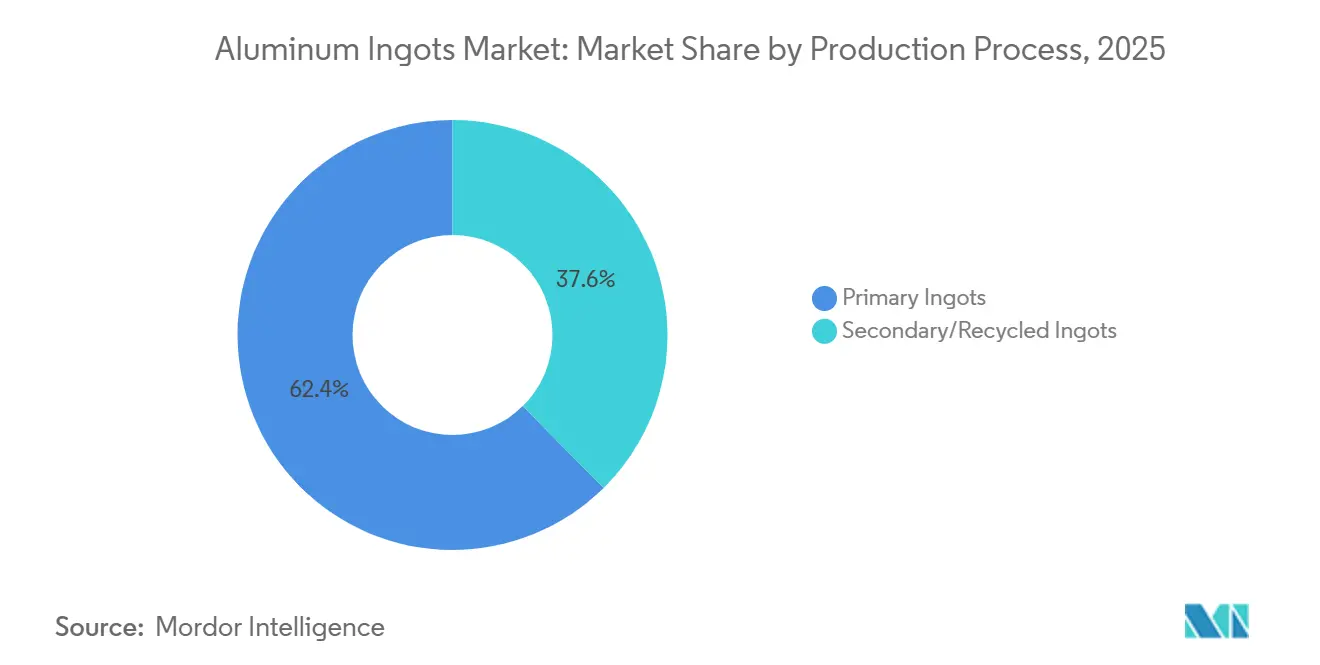
Secondary ingots expanded at a 5.32% CAGR through 2031, eroding primary dominance that stood at 62.41% in 2025. Higher end-of-life vehicle scrappage in North America returned 15 million cars in 2025, each with 180 kilograms of aluminum. Closed-loop systems let Novelis turn stamping scrap back into auto-grade sheet within 60 days, strengthening supply security. Solid-state sorting now delivers secondary ingots that meet ASTM B209 tolerances once exclusive to primary metal.
Primary smelters defend share by branding low-carbon offerings such as Norsk Hydro’s Reduxa or Rio Tinto’s RenewAl, each promising footprints below 4 tonnes CO₂ per tonne. These products earn premiums of USD 150-250 in Europe, limiting substitution where purity matters. Beverage-can makers call for 90% recycled content by 2030, yet collection plateaus at 49% in the United States. That scrap deficit lifts secondary premiums, narrowing the cost gap and keeping both routes vital within the aluminum ingots market.
By End-user Industry: Automotive Overtakes Traditional Demand
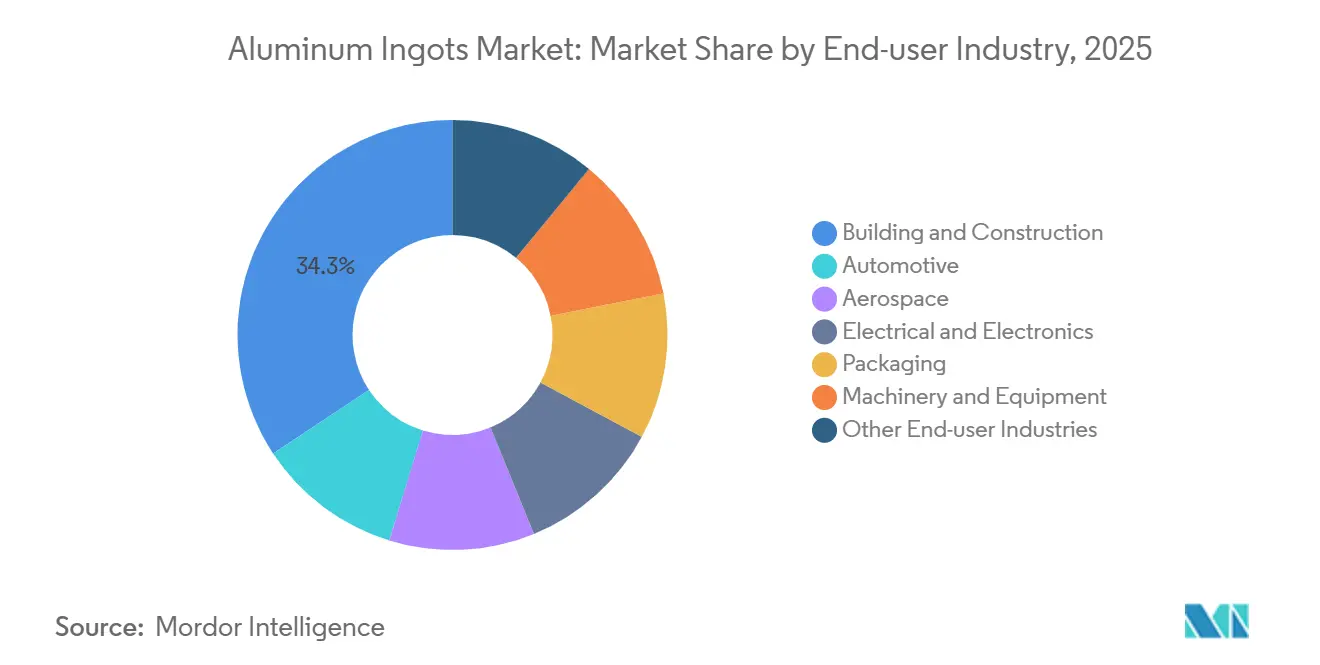
Building and construction held 34.28% of 2025 volume, but automotive volumes climb fastest at 5.18% CAGR. EU fleet compliance fines of EUR 95 per gram of excess CO₂ pressure makers to lighten vehicles. Ford’s F-150 Lightning saves 320 kilograms using an all-aluminum body, extending driving range and cutting battery size. Tesla’s single casting for the Model Y battery enclosure removes 370 fasteners, lowering assembly time by 30%. Aerospace consumes low ingot volume but remains margin-rich, as Boeing and Airbus ramp production to 480 and 735 planes in 2025 respectively.
Electrical applications benefit from India’s plan for 500 GW of renewables by 2030, requiring 2 million kilometers of aluminum conductor. Packaging gains from single-use plastic bans, as cans and foil replace polymer films. Such diverse pulls let the aluminum ingots market weather sector cycles, because weakness in construction can be offset by strength in mobility and packaging.
Geography Analysis
Asia-Pacific accounted for 53.46% of global demand in 2025, anchored by China’s 38 million-tonne appetite and India’s 4.2 million tonnes. Chinese coastal buyers increasingly import low-carbon metal from the Middle East, while inland smelters rely on domestic coal power for construction grade ingots. Japan and South Korea, lacking local smelting, excel at alloy-specific scrap segregation that feeds electronics brands[2]. ASEAN nations import ingots yet re-export finished extrusions; Vietnam doubled per-capita consumption to 5.1 kilograms by 2025 and expects double-digit growth through 2028.
Secondary ingots supplied 48% of U.S. needs in 2025 as the Inflation Reduction Act incentivizes local sourcing. Alcoa restarted its Warrick smelter and Century Aluminum reopened Hawesville, adding over 500,000 tonnes of capacity. Mexico’s consumption rose in 2025, led by auto assembly clusters in Guanajuato and Nuevo León.
Europe made up moderate demand in 2025, yet domestic smelting shrank 18% since 2022 on energy price spikes. Imports now satisfy 60% of primary needs, mostly low-carbon metal from Norway and Iceland to meet CBAM rules. Norsk Hydro’s 1.3 million-tonne hydropower capacity keeps regional supply stable. The United Kingdom consumed 800,000 tonnes, weighted toward aerospace and luxury vehicles.
South America and Middle East and Africa are the fastest growers. Brazil's consumption is supported by hydropower-backed smelters in Pará. The UAE operates 2.7 million-tonnes at Al Taweelah, while Saudi Arabia’s Ma’aden plans a 1.2 million-tonne line by 2027. Africa’s demand, concentrated in South Africa and Egypt, climbs substantially as infrastructure projects and nascent auto assembly absorb metal, yet the continent remains a net importer due to scarce refining.
Value Chain Analysis
The aluminum ingots value chain runs from bauxite mining and alumina refining to primary smelting and casting, then alloying and distribution into downstream fabricators such as extrusion, rolling, and casting. End users span building and construction, automotive, electrical, and packaging. Upstream security and logistics remain central, particularly for China, which continues to rely heavily on imported bauxite concentrated in Guinea and Australia in early 2026. Rio Tinto reported H1 2026 bauxite production of 28.5 Mt and alumina production of 4.0 Mt, underscoring the advantage of integrated majors with mine and refinery positions.
Midstream competition increasingly tracks low-carbon primary metal versus faster-growing secondary ingots. Smelters with hydropower access and process upgrades compete on verified footprint and premium products, while recyclers and scrap processors gain leverage where closed-loop automotive scrap programs and tighter alloy chemistry requirements favor high-quality sorting and remelt capability. On the distribution side, supply-chain shocks, including Middle East disruption impacts reported in 2026, have increased the value of diversified trade lanes and long-term offtake contracts, especially for European buyers managing carbon and audit requirements and for OEMs seeking traceable, low-emission ingot supply.
Competitive Landscape
The aluminum ingots market is moderately concentrated; the top ten producers control 55% of primary capacity, but none exceeds 12%. China Hongqiao, Chalco, RUSAL, Rio Tinto, Norsk Hydro dominate volume. Three strategic themes define competition. First is vertical integration: Rio Tinto’s Amrun bauxite mine and Hindalco’s Utkal alumina expansion secure feedstock. Second is low-carbon differentiation: the ELYSIS inert-anode project, Hydro’s Reduxa line, and EGA’s CelestiAL brand win premiums from OEMs that track Scope 3 emissions. Third is geographic diversification toward cheap, stable power: EGA’s Guinea bauxite export hub and Ma’aden’s Ras-Al-Khair smelter tap subsidized gas and renewable projects.
Recycling partnerships represent another moat. Novelis supplies Ford and BMW with closed-loop scrap flows, granting both alloy certainty and carbon transparency. Technology disruptors license solid-state sorting that keeps alloy chemistry intact, letting medium-sized recyclers match primary purity. Digital scrap platforms cut procurement costs, eroding the advantage of large brokers. Automation also matters: Rio Tinto patented an AI cell-control system that trims power use by 3-5%, lifting current efficiency. Smelters unable to certify ISO 14064 emissions or ISO 14067 product footprints increasingly lose bids to ESG-focused buyers, accelerating consolidation inside the aluminum ingots market.
Aluminum Ingots Industry Leaders
-
China Hongqiao Group Ltd.
-
Aluminum Corporation of China Ltd. (Chalco)
-
RusAL
-
Rio Tinto
-
Norsk Hydro ASA
- *Disclaimer: Major Players sorted in no particular order
Market Opportunities and Future Outlook
Certified low-emission metal creates a clear whitespace for ingot suppliers as border-carbon programs and buyer audits shift procurement toward certified low-emission supply and away from default-emissions assumptions. In 2026, that shift is reinforced by activity from NITI Aayog, which published a decarbonization roadmap for India focused on moving smelter power toward nuclear and renewables, alongside European industry bodies prioritizing policies and funding structures that keep low-carbon aluminum available for downstream manufacturers.
Capacity restarts and ownership moves in low-carbon regions open rooms for suppliers that can deliver stable power, verified footprints, and reliable logistics to Europe and North America. Norsk Hydro stated Slovalco will restart 75,000 tonnes of curtailed primary aluminum capacity in Q4 2026, which adds incremental supply in a market still shaped by energy constraints. Separately, Rio Tinto and Chalco announced a joint venture to acquire Votorantim's controlling stake in CBA in Brazil, indicating continued interest in expanding access to lower-carbon assets and diversified ingot supply bases. In parallel, volatility around upstream raw materials and trade routes raises the payoff for vertical integration (bauxite to alumina to ingot) and for regionalized sourcing strategies by downstream fabricators and OEMs that require continuity in alloy quality and delivery schedules.
Recent Industry Developments
- May 2026: Chalco to invest USD 1 billion in a 1.2-million-ton-per-year alumina plant in Guinea. The upstream capacity expansion in Guinea strengthens supply concentration and deepens vertical integration in the alumina and ingots chain.
- May 2026: Rio Tinto commissioned a USD 1.5 billion AP60 smelter expansion at Complexe Arvida in Quebec. The expanded low-carbon smelting capacity in North America enhances regional supply security and improves cost curves in the ingots market.
- May 2026: Government of Canada and Rio Tinto announce a USD 100 million investment in the ELYSIS aluminum electrolysis technology deployment project. The support accelerates low emission production capabilities and positions products for ESG focused markets.
Research Methodology Framework and Report Scope
Market Definition and Coverage
For this methodology, the aluminum ingots market covers the value of cast aluminum sold as ingots for further processing, including primary and secondary (recycled) metal, across major producing and consuming regions.
Scope exclusions: It excludes fabricated aluminum products (such as sheet, extrusions, and finished cast parts) and downstream processing services beyond ingot production and sale.
Segmentation Overview
- By Production Process
- Primary Ingots
- Secondary/Recycled Ingots
- By End-user Industry
- Building and Construction
- Automotive
- Aerospace
- Electrical and Electronics
- Packaging
- Machinery and Equipment
- Other End-user Industries
- By Geography
- Asia-Pacific
- China
- India
- Japan
- South Korea
- ASEAN Countries
- Rest of Asia-Pacific
- North America
- United States
- Canada
- Mexico
- Europe
- Germany
- United Kingdom
- Italy
- France
- Spain
- NORDIC Countries
- Rest of Europe
- South America
- Brazil
- Argentina
- Rest of South America
- Middle-East and Africa
- Saudi Arabia
- South Africa
- Rest of Middle-East and Africa
- Asia-Pacific
Data Sources, Market Sizing, and Validation
Desk Research
Desk research was used to map the supply and demand context around ingots, and to set practical boundaries for what should be counted as ingot value versus downstream products. We reviewed public production, trade, and consumption indicators that connect directly to ingot flows, and then used them as checkpoints during modeling.
Sources used include non-paywalled references such as the United States Geological Survey (aluminum statistics and prices), International Aluminium Institute releases and datasets, UN Comtrade trade data for aluminum forms, and the World Bank commodity price data series. We also used company annual reports and investor presentations to track capacity moves, recycling mix shifts, and regional shipment patterns, with a paid subscription focused on company financials and intelligence to cross-check reported volumes and footprint changes. This list is illustrative, and many other public and paid sources were also referenced for data collection, validation, and clarification.
Primary Interviews and Surveys
Primary work focused on validating where ingot demand is forming, how primary versus secondary ingots are being sourced, and how pricing is being passed through during energy and logistics swings. We spoke with a mix of producers, distributors, recyclers, and large industrial buyers across key regions so assumptions on utilization, import reliance, and recycled-content trends could be adjusted before final sizing.
Distribution of primary research fieldwork respondents
| Company type | Respondent position | Region |
|---|---|---|
| Top tier: 34% | CXOs: 15% | APAC: 47% |
| Mid tier: 44% | Functional/Unit leaders: 25% | EMEA: 32% |
| Smaller Players: 22% | Managers: 60% | Americas: 21% |
Market-Sizing & Forecasting
Sizing starts from a top-down build where production and trade data are used to reconstruct the addressable ingot pool by region, before value is derived through region-specific price references and mix assumptions. To keep the totals realistic, the results are then checked with selective bottom-up approximations, such as sampled producer capacity-to-output checks, distributor channel splits, and volume multiplied by average selling price for a few well-tracked routes.
Key inputs that steer the model include primary versus secondary share shifts, smelter and casthouse capacity changes, utilization and restart patterns, ingot-linked trade flows, and reference price movements for aluminum (plus typical regional premia where they are clearly observable). For forecasting, scenario analysis is used around the variables that drive the most variance, especially energy-linked cost cycles, recycling availability, and demand pull from construction, transport, and packaging. When bottom-up data is incomplete for smaller countries, gaps are filled using proxy indicators such as import dependence, apparent consumption trends, and peer-market ratios, and the estimates are rechecked with interview feedback.
Data Validation & Update Cycle
Outputs are validated through multiple passes that compare the modeled market totals against independent signals like production statistics, trade balances, and price behavior that should move in a consistent direction. If a region shows an unusual jump, the assumptions are reopened, and primary contacts are re-engaged to confirm whether the change came from a restart, a policy shift, or a temporary inventory effect.
Before sign-off, the model and write-up go through step-by-step analyst review so that definitions, units, and currency handling stay consistent across regions and years. The report is refreshed annually, and interim updates are made when major events materially change supply, demand, or pricing. Right before delivery, a final check is done so the updated view reflects the latest underlying indicators.
Mordor Intelligence's Aluminum Ingots Market Sizing Compared With Other Published Estimates
Published market values for aluminum ingots can look far apart, even when they are trying to describe the same industry. In practice, the difference usually comes from what is counted as ingot, how recycled metal is treated, what pricing reference is applied, and whether the base year aligns with the latest supply and trade data.
By tracking production plus trade reconstructed demand and refreshing recycled versus primary mix inputs, Mordor Intelligence keeps the estimate tied to ingot sales value rather than folding in downstream fabricated aluminum or broader aluminum value chains. Some sources also assume faster price or volume growth without clearly showing utilization and import balance checks, which can push totals higher over long forecasts.
Benchmark comparison
| Source | Market Size | Gaps in Research Methodology |
|---|---|---|
| Mordor Intelligence | USD 268.12 B (2026) | |
| Trade Platform A | USD 207.29 B (2026) | Uses a different boundary for what is treated as ingot value and appears to undercount the broader ingot flow tied to regional trade and secondary output, which compresses the 2026 total. |
| Industry Publisher B | USD 193.28 B (2025) | Base year is earlier and the price level looks anchored to a different timing, so the value is not directly comparable without adjusting for the year shift and mix effects between primary and recycled ingots. |
Across the table, the spread is mainly explained by scope edges around ingots versus fabricated products, and by base-year timing that changes the price deck and recycled mix. With clear inputs and repeatable checks on supply, trade, and pricing, the sizing stays transparent enough to be audited and updated when the underlying indicators move.
Key Questions Answered in the Report
What is the forecast revenue for the aluminum ingots market in 2031?
Revenue is expected to reach USD 329.67 billion by 2031, reflecting a 4.22% CAGR over 2026-2031.
Which production process leads volume in the aluminum ingots market?
Primary ingots led with 62.41% volume share in 2025, though secondary ingots are growing faster at 5.32% CAGR.
Why are automakers increasing aluminum demand?
Battery-electric vehicles need 20-30% more aluminum than conventional cars for lighter enclosures and crash structures, lifting automotive CAGR to 5.18% through 2031.
How do carbon-border rules affect aluminum trade?
The EU’s CBAM imposes certificate costs of about EUR 954 per tonne on high-carbon ingots, steering buyers toward low-emission suppliers.