
Europe Aluminium Composite Panel Market Size and Share
Market Overview
| Study Period | 2020 - 2031 |
|---|---|
| Forecast Data Period | 2026 - 2031 |
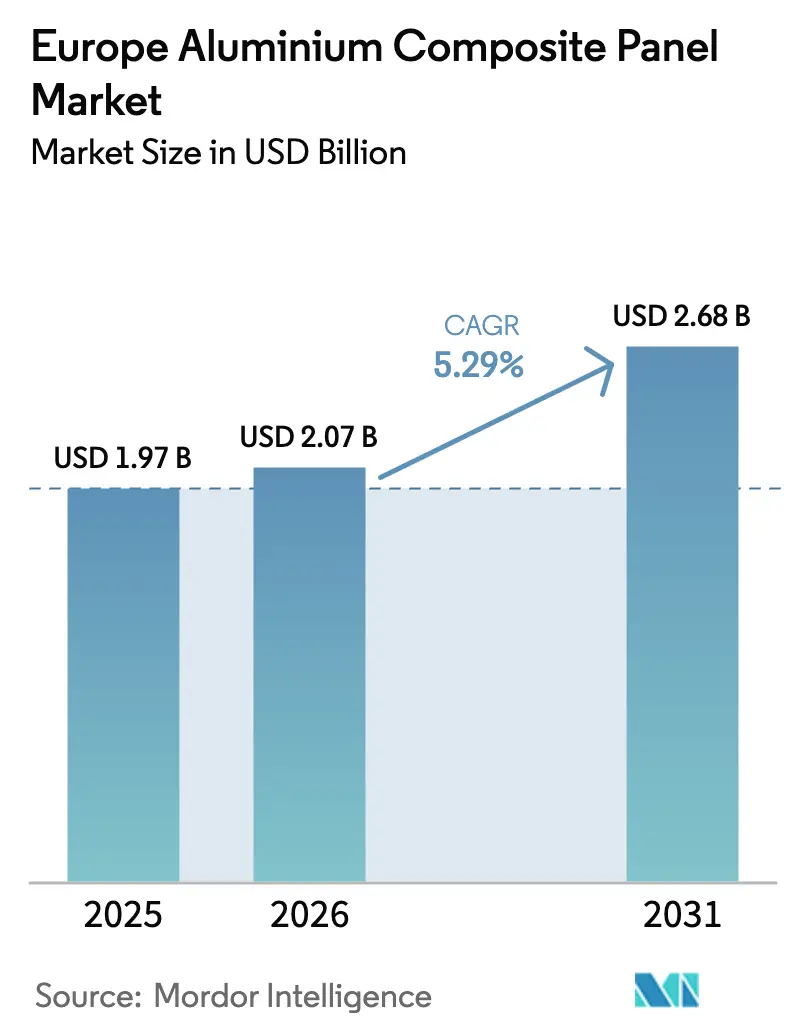
| Base Year Market Size (2025) | USD 1.97 Billion |
| Market Size (2026) | USD 2.07 Billion |
| Market Size (2031) | USD 2.68 Billion |
| Growth Rate (2026 - 2031) | 5.29 % |
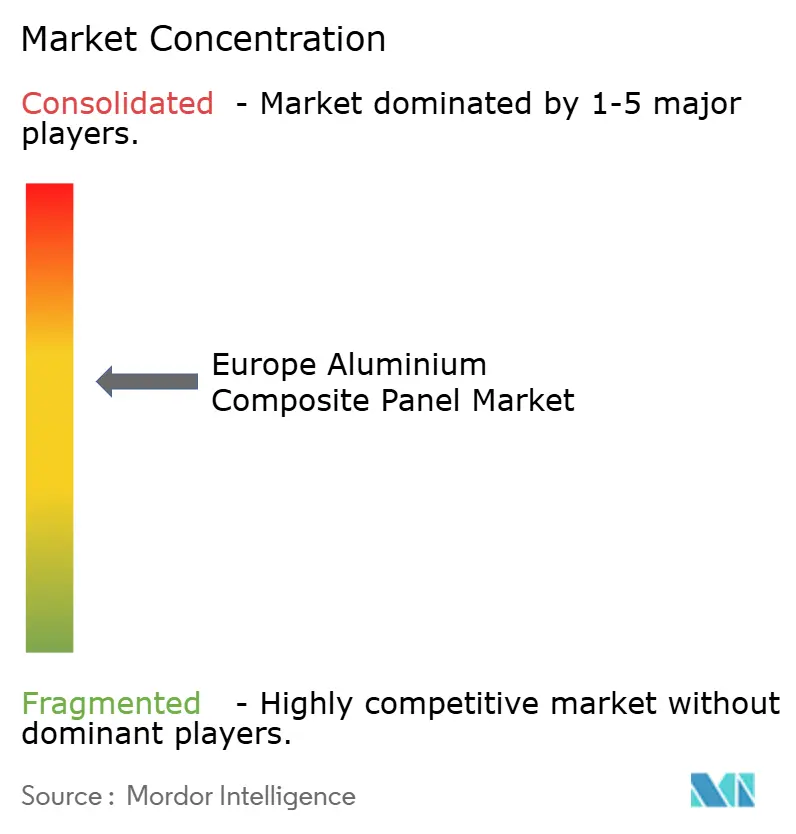
| Market Concentration | Medium |
Major Players *Disclaimer: Major Players sorted in no particular order Image © Mordor Intelligence. Reuse requires attribution under CC BY 4.0. | |
Europe Aluminium Composite Panel Market Analysis by Mordor Intelligence
The European aluminium composite panel market size is expected to grow from USD 1.97 billion in 2025 to USD 2.07 billion in 2026 and is forecast to reach USD 2.68 billion by 2031 at 5.29% CAGR over 2026-2031. This growth is based on a pivot toward façade upgrade spending, stricter fire safety rules, and premium coating demand, which offset softer residential construction. Increased public-sector civil engineering work, the adoption of long-life PVDF finishes, and the phase-out of polyethylene cores combine to keep orders steady, even as overall building activity cools. Germany dominates the European aluminium composite panel market, driven by infrastructure programs that mitigate the impact of housing market challenges on suppliers. The transportation sector, particularly rail car manufacturers, is increasingly adopting lightweight aluminium skins that comply with EN 45545 standards, thereby unlocking new growth opportunities in the market.
Key Report Takeaways
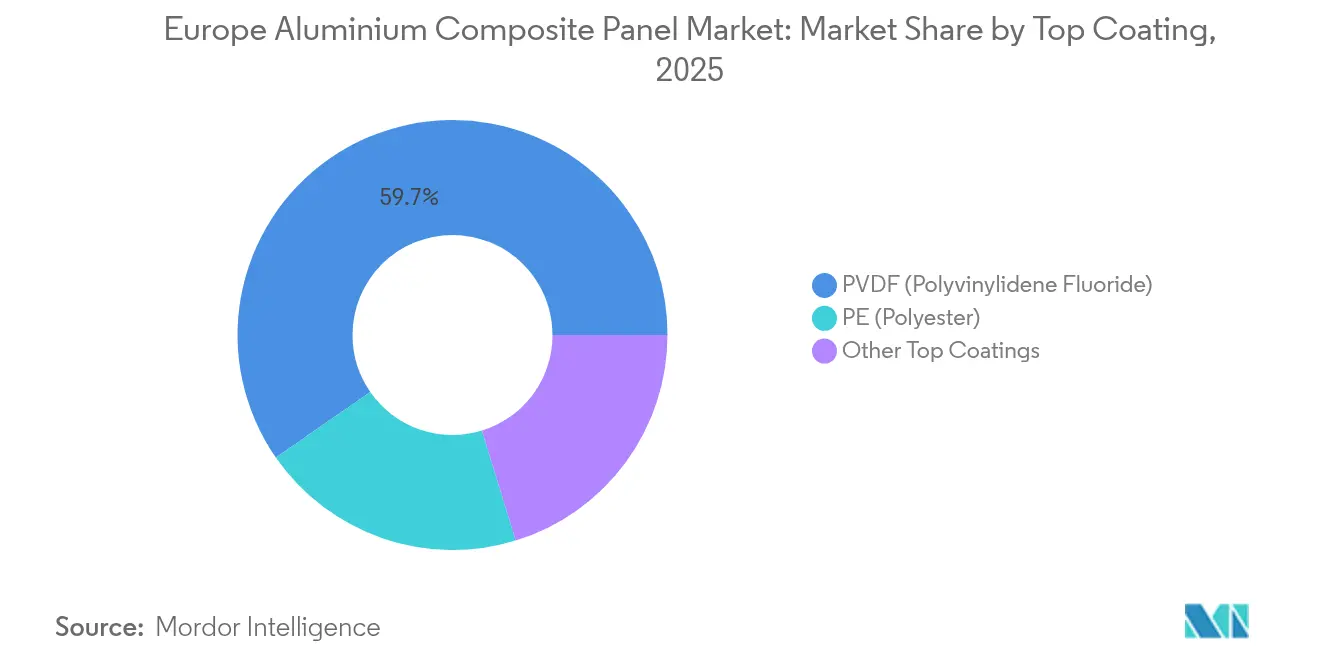
- By 2025, PVDF captured a 59.65% revenue share of the European aluminium composite panel market and is projected to accelerate at a 6.35% CAGR through 2031.
- By application, cladding held a 25.10% share of the European aluminium composite panel market in 2025 and is expected to expand at a 6.22% CAGR through 2031.
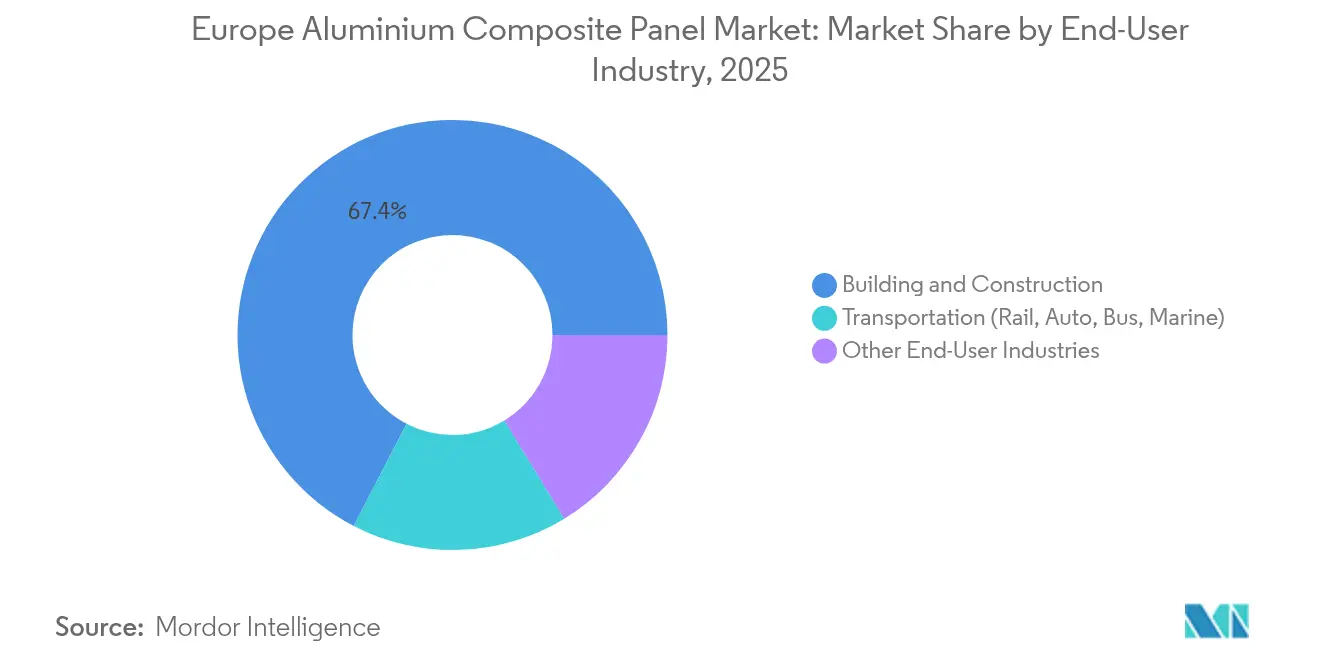
- By end-user industry, the building and construction sector accounted for 67.40% of the European aluminium composite panel market share in 2025, while the transportation sector is projected to record the highest CAGR at 6.05% through 2031.
- By geography, Germany led with 19.54% revenue share in 2025 and is growing at a 6.18% CAGR, outpacing the regional average.
Note: Market size and forecast figures in this report are generated using Mordor Intelligence’s proprietary estimation framework, updated with the latest available data and insights as of 2026.
Worldwide, activity is shaped by contributions from multiple regions, with Europe representing one of the more structurally developed among them. The global report on aluminum composite panel (acp) market by Mordor Intelligence reflects how these regional layers combine into a single system.
Europe Aluminium Composite Panel Market Trends and Insights
Drivers Impact Analysis*
| Drivers | (~) % Impact on CAGR Forecast | Geographic Relevance | Impact Timeline |
|---|---|---|---|
| Stricter EU fire-safety codes boosting A2 and FR cores | +1.2% | EU-wide, strongest in UK, Germany, France, Netherlands | Medium term (2-4 years) |
| Renovation wave under EU Green Deal needs lightweight cladding | +1.5% | EU-wide, most prominent in Germany, France, Italy, Spain | Long term (≥4 years) |
| Rapid uptake of PVDF coatings for durability and aesthetics | +0.8% | Western Europe premium projects | Medium term (2-4 years) |
| Growth of digitally printed ACPs for smart façades and DOOH ads | +0.5% | Major cities in UK, Germany, France, Spain, Italy | Long term (≥4 years) |
| Hydrogen-rail car lightweighting demand for ACP skins | +0.3% | Germany, France, UK, Netherlands | Long term (≥4 years) |
| Source: Mordor Intelligence | |||
Stricter European Union Fire-Safety Codes Boosting A2 and FR Cores
Post-Grenfell regulations eliminated polyethylene-core panels from high-rise specifications across several member states. The UK banned combustible façades above 18 m in 2018, Germany adopted similar limits for buildings above 7 m, and France applied A2-s2,d0 rules on towers over 28 m. These measures have raised demand for mineral-filled cores despite a EUR 15–20 per m² price premium. National testing differences continue, yet a 2024 working group under EUMEPS signaled progress toward harmonization. Suppliers that already hold full-scale façade certifications are poised to benefit[1].
Renovation Wave Under EU Green Deal Needs Lightweight Cladding
The Renovation Wave aims to retrofit 35 million buildings by 2030, doubling the annual energy renovation rate. Lightweight ACP over-cladding adds only 5–7 kg per m², enabling installers to place new insulation without structural reinforcement. Poland, Germany, and Spain earmark Recovery and Resilience funds for such work, and performance standards in the recast Energy Performance of Buildings Directive kick in from 2028. The project flow depends on streamlined permitting and a trained installer base; however, the long-term horizon secures a demand floor through 2050[2].
Rapid Uptake of PVDF Coatings for Durability and Aesthetics
PVDF layers maintain color and gloss for 25 years, outperforming polyester finishes that typically require repainting within 15 years. Architectural specifications in coastal and industrial zones now default to PVDF, resulting in a 20–30% cost increase. Supply tightened in 2024 when battery makers diverted fluoropolymer feedstock, doubling coil-coating lead times. While some fabricators shifted to FEVE, most premium projects still pay the surcharge to secure longer warranties and lower lifecycle maintenance costs.
Growth of Digitally Printed ACPs for Smart Façades and DOOH Ads
UV-inkjet systems print 1,200 dpi graphics onto PVDF coils, reducing turnaround to 48 hours versus the six-week wait for screen prints. Programmatic DOOH in Europe reached 27% of campaigns in 2024, and printed backlit panels offer a lower energy draw than LED displays. Architects also embed QR codes and NFC tags to link users to building data. Adoption remains below 3% of volume, yet early movers earn 15–20% margin premiums thanks to design flexibility.
Restraints Impact Analysis*
| Restraints | (~) % Impact on CAGR Forecast | Geographic Relevance | Impact Timeline |
|---|---|---|---|
| Aluminium price volatility post-Ukraine war | –0.6% | Global, acute in Europe | Short term (≤2 years) |
| Re-cladding liabilities on combustible PE cores | –0.4% | UK, Germany, France, Netherlands | Medium term (2-4 years) |
| PVDF resin shortages due to battery-sector demand | –0.3% | Western Europe premium projects | Short term (≤2 years) |
| Source: Mordor Intelligence | |||
Aluminium Price Volatility Post-Ukraine War
Sanctions on Russian metal, high European energy tariffs, and freight premiums lifted LME aluminium to USD 2,400 per tonne in early 2024. Regional smelters curtailed output by 15% compared with 2019, and import duties rose further after the 2025 U.S. tariff round. Fabricators hedge three to six months of exposure but still face margin compression. Many now source recycled coils that carry a USD 200–300 discount and 95% lower embodied carbon, though surface-quality limits keep recycled content below 30% in architectural grades.
Re-Cladding Liabilities on Combustible PE Cores
The UK Building Safety Fund covers GBP 5.1 billion of remediation costs; however, owners must still finance most upgrades, which slows new high-rise approvals. Germany and France offered parallel grants, but the fear of future liability makes developers cautious. For suppliers, the switch to A2 panels increases unit margins but reduces volume, shifting production lines toward premium cores and consolidating demand among certified brands.
*Our forecasts treat driver/restraint impacts as directional, not additive. The impact forecasts reflect baseline growth, mix effects, and variable interactions.
Segment Analysis
By Top Coating: PVDF Maintains Leadership and Growth
PVDF finishes dominated the European aluminium composite panel market, accounting for a 59.65% share in 2025, and are on track for a 6.35% CAGR to 2031. The European aluminium composite panel market size for PVDF-coated products benefits from 25-year warranty norms and a proven track record in harsh climates. Architects in coastal regions of Germany, France, and Spain are increasingly viewing polyester as a lifecycle cost risk. Supply tightness in 2024 exposed vulnerabilities, yet substitution remained limited due to warranty requirements and color-retention policies.
PVDF’s premium of EUR 5–8 per m² equates to less than 1% of installed façade cost, making the upgrade decision straightforward for Class A offices, airports, and hospitality assets. Coil coaters that control their own fluoropolymer sourcing, such as 3A Composites, preserved delivery slots even during resin shortages, reinforcing their competitive edge. Polyester retains its share in interior decoration and temporary signage, but its growth lags the headline market.

By Application: Cladding Drives Demand Under Fire-Safety Mandates
Cladding secured 25.10% of the European aluminium composite panel market share in 2025 and is projected to advance at a 6.22% CAGR through 2031. New restrictions across the UK, Germany, and France eliminate combustible cores on tall buildings, steering specifications toward mineral-filled A2 products. The European aluminium composite panel market size for cladding applications is receiving an additional push from Green Deal renovation grants that favor over-cladding solutions with integrated insulation.
Interior decoration remains second in volume. PE-core panels, 3–4 mm thick, for speed installation of partition walls and ceiling modules. Signage and hoarding rely on digital printing, while insulation boards combine ACP skins with polyisocyanurate or mineral wool to deliver 20–30% energy savings. Rail carriers, although small, are the fastest-growing niche as rolling-stock builders seek weight savings. Column covers and beam wraps round out demand, especially in atria and transport hubs.
By End-User Industry: Construction Dominates, Transportation Speeds Ahead
Building and construction accounted for 67.40% of demand in 2025, reflecting ACP’s embedded role in façades and curtain walls. Weak housing starts trimmed overall construction spending by 2% in 2024, yet civil-engineering output rose 5.8%, sustaining orders for transport hubs and public buildings. Spain delivered a double-digit output jump thanks to Recovery Plan spending, while Italy shifted toward civil engineering to compensate for the end of its tax-credit boom.
Transportation holds a modest share but posts the fastest growth rate at 6.05% CAGR. Hydrogen and battery-electric trains utilize A2 panels to comply with EN 45545 fire safety regulations and offset the weight of the tank. Electric buses and lightweight marine craft also experiment with composite skins. Suppliers that tailor fire-rated sandwich panels for rolling-stock interiors are well-positioned for multi-year rail procurement cycles.
Geography Analysis
Germany led the European aluminium composite panel market with a 19.54% share in 2025 and is projected to grow at a 6.18% CAGR through 2031. Civil engineering budgets, linked to the EUR 25.6 billion NextGenerationEU allocation and a EUR 1 billion federal fire safety fund, underpin steady panel intake despite a 17% decline in housing permits. State codes now require non-combustible façades above 7 m, maintaining demand for A2 cores.
The United Kingdom experienced a contraction in 2024 due to the Building Safety Act, which tightened liability and halted many high-rise construction starts. Even so, the GBP 5.1 billion Building Safety Fund accelerates replacement of combustible panels, anchoring a refurbishment pipeline that supports certified suppliers. France balances moderate new-build activity with grants from ANAH that cover up to half of re-cladding costs in social housing.
Nordic countries set the pace on embodied-carbon limits. Denmark already mandates declarations, and Sweden will impose thresholds from 2025, pushing manufacturers to publish EN 15804 EPDs and shorten transport distances.
Value Chain Analysis
The value chain begins with upstream aluminium inputs (primary metal and recycled scrap), plus coil-coating chemistries and resins, notably PVDF, that go into architectural-grade skins. After rolling and coil coating, converters laminate aluminium skins to mineral-filled (A2) or non-combustible (A1) cores, then fabricate sheets and value-added formats such as cassettes and system components for façade installers, along with thinner panels for interior and signage. In Europe, distribution is a mix of direct, specification-driven sales to façade contractors and OEMs, and stockist networks that help shorten lead times for refurbishment work.
Cost and availability pressures are concentrated in upstream metal and energy-linked steps. Aluminium price swings and constrained European smelter output create input risk for laminators, while PVDF feedstock tightness in 2024 reinforced dependence on a limited fluoropolymer supply base for premium coil coatings. Procurement choices also reflect decarbonization policy, with CBAM implementation and ETS benchmark updates for 2026-2030 increasing the emphasis on recycled content, EPD-backed products, and shorter supply routes, particularly for public and Nordic projects that screen embodied carbon.
Competitive Landscape
The European aluminium composite panel market is moderately consolidated, with Global firms such as 3A Composites competing with regional specialists like Euramax. 3A Composites leverages vertical integration and introduced ALUCODUAL in late 2024, a dual-sided A2 panel that streamlines glass-curtain installation. Euramax differentiates through a digital configurator that speeds design approvals, while ALUCOIL leverages recently certified EPDs to win Nordic public projects. White-space opportunities center around digital printing, off-site prefabricated cassettes, and circular economy take-back schemes. Only around 10% of end-of-life panels are recycled today. Mechanical delamination pilots in Germany and the Netherlands recover up to 90% of aluminium content, suggesting a route to new revenue streams and compliance with tightening waste directives.
Europe Aluminium Composite Panel Industry Leaders
-
3A Composites
-
Arconic Inc.
-
ALUCOIL
-
Alubond USA
-
Mitsubishi Chemical Corporation
- *Disclaimer: Major Players sorted in no particular order
Market Opportunities and Future Outlook
The main opportunity in Europe is the shift toward higher fire classifications and liability-resistant specifications, where A2-s1,d0 and A1-rated panels gain share beyond minimum code compliance for high-occupancy assets such as schools and hospitals. Product development around non-combustible cores is a visible differentiation path, including Mitsubishi Chemical Corporation's ALPOLIC portfolio positioned around non-combustible (NC/A1) and A2 grades, alongside the broader phase-out of polyethylene cores in tall-building specifications across key European markets.
A second opportunity centers on circularity and lower-carbon sourcing across the ACP value chain. The focus is moving beyond sheet sales into take-back, separation, and recycled coil qualification to meet tightening procurement criteria. While end-of-life ACP recycling remains limited in practice, mechanical delamination pilots in Germany and the Netherlands report high aluminium recovery rates. Manufacturers and fabricators that operationalize collection and separation partnerships can secure recycled metal streams and support EPD-driven bidding, while also reducing reliance on imported primary aluminium and exposure to policy-driven cost volatility tied to CBAM and ETS changes.
Recent Industry Developments
- July 2026: Arconic publishes its 2025 Sustainability Report detailing circularity and innovation goals for architectural products. The release highlights ongoing commitments to circular economy initiatives and material innovations, which support sustainability claims in ACP offerings. This reinforces Arconic's positioning with specifiers and procurement decision-makers across Europe.
- July 2026: The company published its 2025 Sustainability Report outlining circularity and innovation goals for its architectural products and other business segments. The report reiterates commitments across business units, signaling a broader sustainability strategy that can feed into project bidding and supplier selection. The disclosures may also affect competitive dynamics by making ESG commitments more explicit during procurement.
- February 2026: Arconic Architectural Products argues in UK High Court it is immune from liability under Building Safety Act 2022 regarding historical cladding supply. The company's stance highlights continued regulatory risk for legacy cladding products in Europe and could affect warranty discussions and project approvals for ACP suppliers. The case may shape how buyers assess procurement risk and market confidence in product safety claims.
Research Methodology Framework and Report Scope
Market Definition and Coverage
For this study, the Europe aluminium composite panel (ACP) market is counted as revenue from ACP sheets and panels sold into European end uses, mainly for facade and cladding, interior surfaces, and signage, across both new build and renovation activity.
Scope exclusions: The sizing excludes non-ACP metal cladding, solid aluminum sheets, insulated sandwich panels, and glass or fiber cement facade materials that can be specified for similar projects.
Segmentation Overview
- Top Coating
- PE (Polyester)
- PVDF (Polyvinylidene Fluoride)
- Other Top Coatings
- Application
- Interior Decoration
- Hoarding and Signage
- Insulation
- Cladding
- Railway Carrier
- Column Cover and Beam Wrap
- End-User Industry
- Building and Construction
- Transportation (Rail, Auto, Bus, Marine)
- Other End-User Industries
- By Geography
- Germany
- United Kingdom
- France
- Italy
- Spain
- NORDICS Countries
- Rest of Europe
Data Sources, Market Sizing, and Validation
Desk Research
Desk research helped us link ACP demand to measurable construction activity and to the rules that shape what can be specified on European facades and interiors. We used public construction and refurbishment indicators to set the direction by country, then checked the context around safety compliance, coating preferences, and trade flows that can shift volumes.
Common starting points included sources such as Eurostat construction output and building permit statistics, European Commission energy efficiency and renovation policy publications, European Committee for Standardization (EN) references for relevant product performance, national fire safety guidance and building code updates, and customs trade statistics to indicate panel import movement. We also reviewed company annual reports and investor presentations, association websites, and reputable construction press for project pipeline commentary and pricing sentiment. Where helpful, paid subscriptions were used for company financials and intelligence, import and export shipment-level checks, and patent databases to confirm innovation direction in coatings and core materials. These desk sources are not exhaustive, and many other public references were used for data collection, validation, and clarification during the work.
Primary Interviews and Surveys
Primary interviews and surveys were used to confirm how much construction and renovation activity converts into ACP demand, and to validate price steps that change by coating type, core type, and country. We spoke with manufacturers, distributors, fabricators, facade contractors, and specifiers across major European markets so the assumptions reflect local procurement practices and regulation-led material substitution.
Distribution of primary research fieldwork respondents
| Company type | Respondent position |
|---|---|
| Top tier: 33% | CXOs: 15% |
| Mid tier: 45% | Functional/Unit leaders: 25% |
| Smaller Players: 22% | Managers: 60% |
Market-Sizing & Forecasting
The market was first constructed using a top-down demand pool approach, where construction output and facade renovation activity were translated into addressable ACP usage, then filtered by adoption rates observed by application and country. To keep totals realistic, we corroborated the outcome with selective bottom-up approximations, such as sampled price per square meter by coating type multiplied by estimated installed area for major use cases, followed by channel checks on distributor throughput.
Inputs that mattered most included non-residential versus residential construction momentum, renovation intensity in older building stock, fire safety compliance trends that shift demand between core types, coating preference movement (PE versus PVDF), import reliance in smaller markets, and aluminum price direction that influences average selling prices and substitution. For forecasting, scenario analysis was used because building cycles, public infrastructure timing, and regulation-driven specification changes do not move in a straight line. When bottom-up observations were incomplete for smaller countries, gaps were handled by proxying from similar markets using per capita construction output and interview-based ACP penetration ranges, and then the results were checked again with local feedback.
Data Validation & Update Cycle
Outputs were validated in several steps so the final number stays tied to observable activity and not just assumptions. We compared implied volumes and prices against trade flow direction, construction output trends, and interview-based ranges, then investigated large variances at a country and application level before sign-off.
If mismatches appeared, we revisited the drivers, such as adoption rates, coating mix, and the renovation share, and then re-engaged key contacts to confirm what changed and why. Reports are refreshed annually, with interim updates when material events affect construction demand, regulation, or raw material pricing. Before delivery, an analyst performs a fresh pass on the latest indicators so clients receive the most current view.
Mordor Intelligence's Europe Aluminium Composite Panel Market Size Compared Against Other Published Estimates
Published market values for Europe ACPs can differ by a wide margin, even when the topic label looks identical, because the counting rules behind the number are often different. The gaps usually come from what is treated as ACP versus adjacent cladding products, whether the value chain is counted at manufacturer revenue or installed system value, and how prices are converted and refreshed.
Some published figures are built from a global total that is split into Europe, and the roll-up can include metal facade sheets or composite cladding formats that are not ACP. For Mordor Intelligence, only ACP sheet and panel revenue inside Europe is counted, and the yearly total is rechecked against construction output direction, renovation intensity, and trade signals during the annual refresh.
Benchmark comparison
| Source | Market Size | Gaps in Research Methodology |
|---|---|---|
| Mordor Intelligence | USD 1.97 B (2025) | |
| Regional Consultancy A | USD 1.78 B (2026) | Uses a later start year and leans heavily on new build demand, which can undercount refurbishment-led facade replacement where ACP usage remains steady in mature Western European markets. |
| Industry Database B | USD 2.20 B (2025) | Builds Europe from a global revenue split and may include adjacent metal facade sheets and other composite cladding formats, which inflates totals versus an ACP-only product scope. |
Overall, the spread is mainly explained by whether adjacent facade products get included, and whether Europe is modeled directly from local demand signals or allocated from a global pool, followed by pricing update timing. By keeping the counted items limited to ACP panels and by grounding adoption and price steps in repeatable checks, the final number stays transparent and practical to validate.
Key Questions Answered in the Report
What is the current value of the European aluminium composite panel market?
The market is valued at USD 2.07 billion in 2026.
How fast will demand for aluminium composite panels grow in Europe?
The market is projected to expand at a 5.29% CAGR to 2031.
Which coating type leads sales?
PVDF coatings dominated the market with a 59.65% share in 2025 and are forecasted to continue growing.
Why is Germany an attractive market for buyers?
Germany combines a large fire-safety retrofit pipeline with sustained civil-engineering outlays.
What is driving transportation demand for panels?
Hydrogen and battery-electric rail cars require lightweight, fire-rated aluminium skins to meet EN 45545.
How fragmented is supplier competition?
No firm holds more than 15%, and the top five together control roughly half of sales.