
AI In Healthcare Information Systems Market Size and Share
Market Overview
| Study Period | 2020 - 2031 |
|---|---|
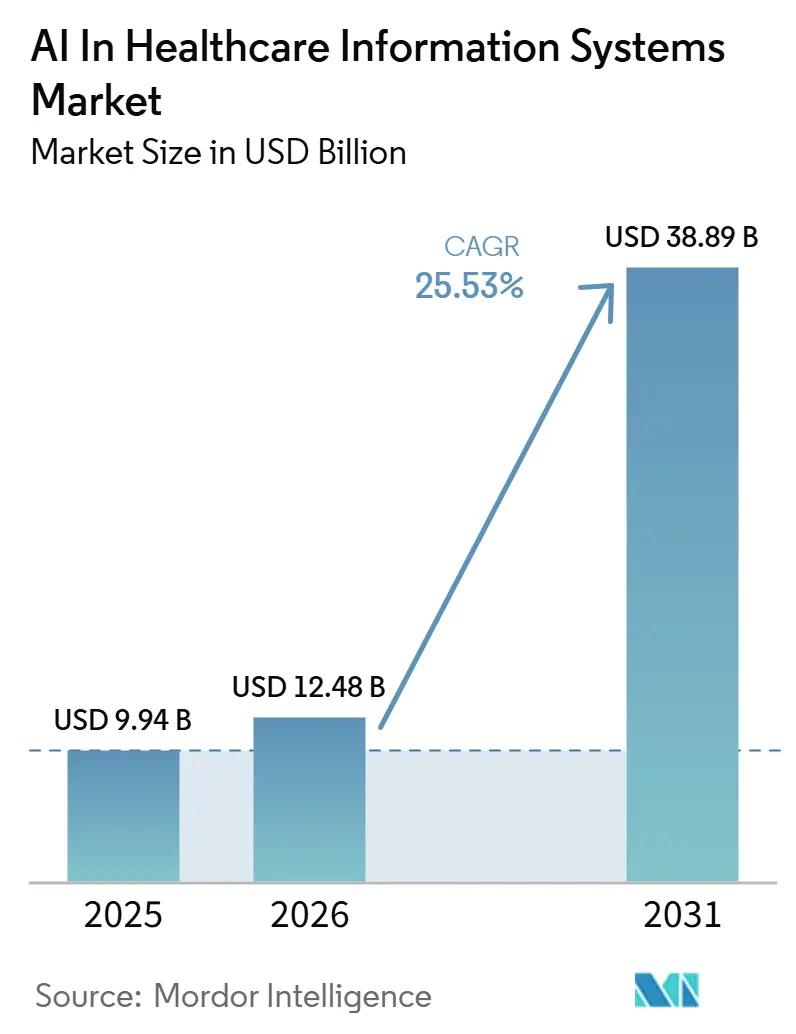
| Market Size (2026) | USD 12.48 Billion |
| Market Size (2031) | USD 38.89 Billion |
| Growth Rate (2026 - 2031) | 25.53 % |
| Fastest Growing Market | Asia-Pacific |
| Largest Market | North America |
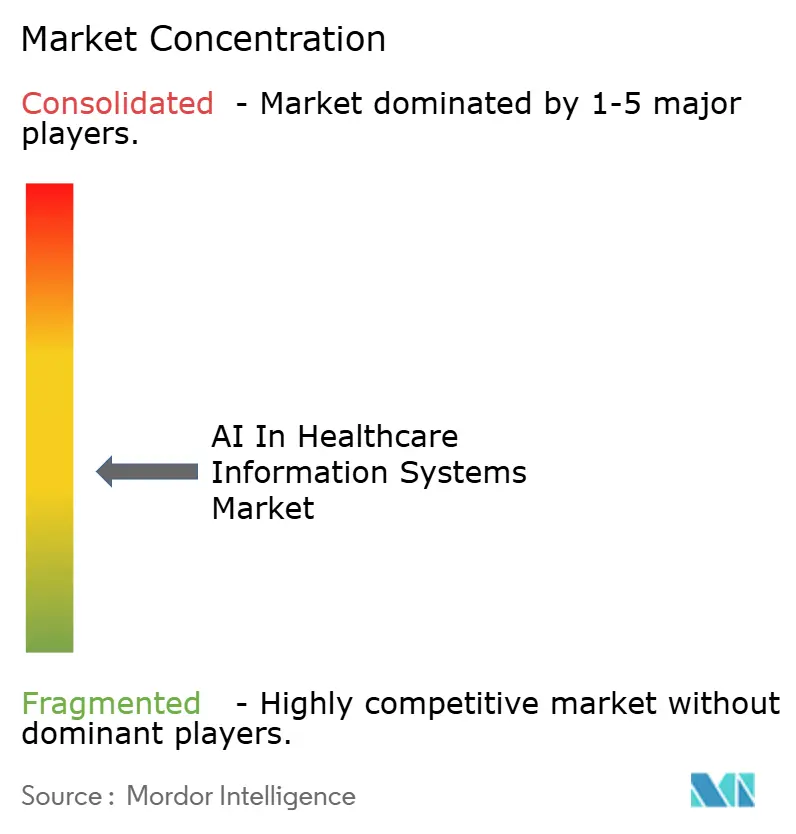
| Market Concentration | Medium |
Major Players *Disclaimer: Major Players sorted in no particular order Image © Mordor Intelligence. Reuse requires attribution under CC BY 4.0. | |
AI In Healthcare Information Systems Market Analysis by Mordor Intelligence
The AI In Healthcare Information Systems Market size is projected to be USD 9.94 billion in 2025, USD 12.48 billion in 2026, and reach USD 38.89 billion by 2031, growing at a CAGR of 25.53% from 2026 to 2031.
The AI in healthcare information systems market is moving from limited pilots to enterprise deployment as providers and payers place AI into documentation, workflow management, and data-driven clinical support. The AI in healthcare information systems market is also being lifted by the rapid expansion of multimodal medical data, because newer models can learn from imaging, pathology, voice, and longitudinal records in a single environment. Interoperability mandates and electronic prior authorization rules are creating a stronger automation base for AI in the healthcare information systems market by pushing the sector toward standardized FHIR APIs and more repeatable data exchange workflows. Ambient documentation is becoming a practical entry point because it improves clinician workflow quickly and creates structured note data that can later support broader enterprise AI use. Competition in the AI in healthcare information systems market is tightening as incumbents defend workflow access inside core health IT platforms while specialist vendors try to win on data depth, model quality, and deployment speed.
Key Report Takeaways
- By component, software led with 58.64% share in 2025, while services are forecast to expand at 26.32% CAGR through 2031.
- By deployment, cloud-based deployment held 48.29% share of the AI in healthcare information systems market size in 2025, while on-premise deployment is projected to grow at 27.51% CAGR through 2031.
- By technology, machine learning accounted for 44.56% share in 2025, while Natural Language Processing (NLP) is forecast to grow at 29.48% CAGR through 2031.
- By application, electronic health records (EHR) represented 28.62% share of the AI in healthcare information systems market size in 2025, while clinical decision Support is projected to expand at 29.42% CAGR through 2031.
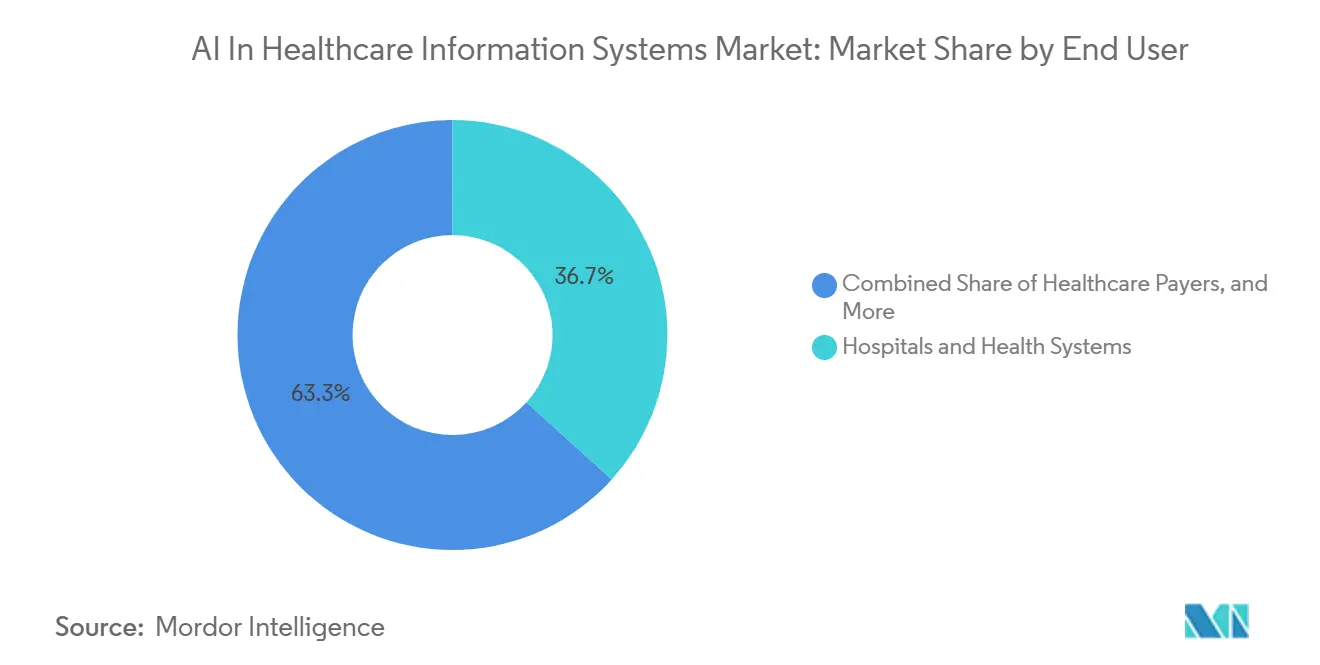
- By end user, hospitals and health systems held 36.73% share in 2025, while healthcare payers are expected to grow at 26.94% CAGR through 2031.
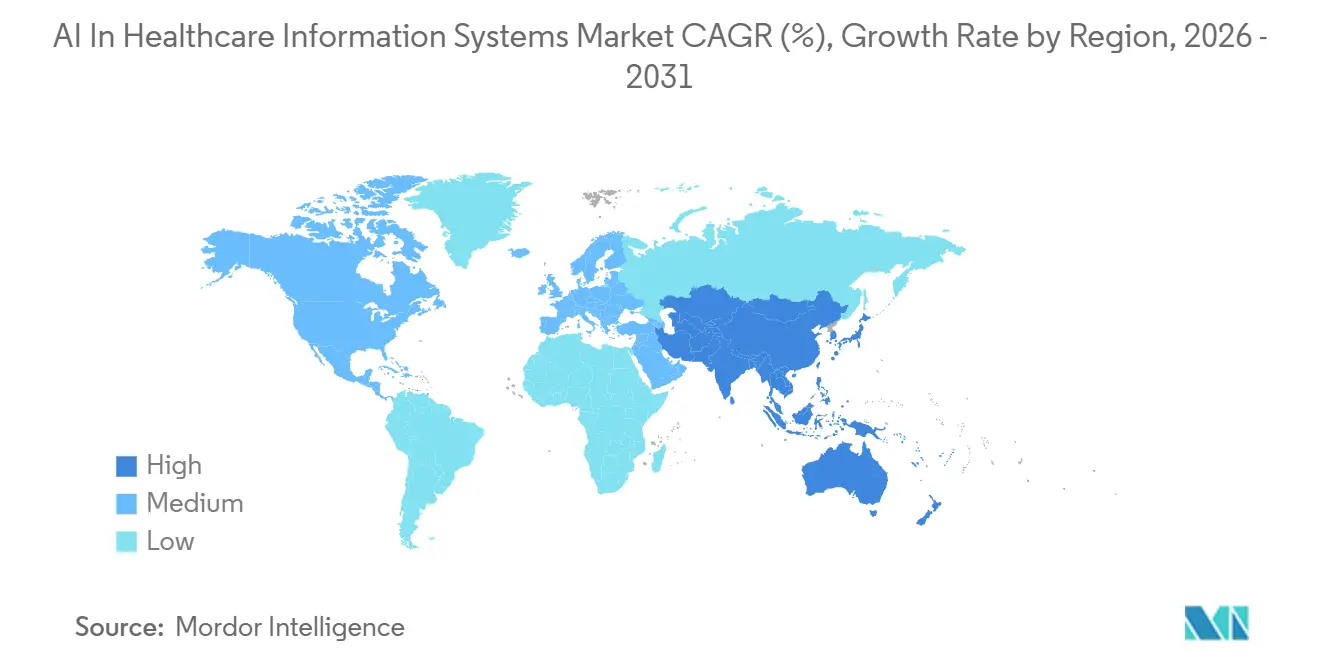
- By geography, North America captured 35.73% of the AI in healthcare information systems market share in 2025, while Asia-Pacific is projected to expand at 29.81% CAGR through 2031.
Note: Market size and forecast figures in this report are generated using Mordor Intelligence’s proprietary estimation framework, updated with the latest available data and insights as of January 2026.
Market Trends and Insights
Drivers Impact Analysis of AI In Healthcare Information Systems Market*
| Driver | (~) % Impact on CAGR Forecast | Geographic Relevance | Impact Timeline |
|---|---|---|---|
| Multimodal Clinical and Operational Data Growth | +5.5% | Global, with concentration in North America, Asia-Pacific, and Europe | Long term (≥ 4 years) |
| Clinical and Administrative Cost Compression | +4.8% | Global, strongest in North America and Australia | Medium term (2-4 years) |
| FHIR APIs and Cloud-Native Data Foundations | +4.2% | North America and Europe, with spillover into Asia-Pacific | Medium term (2-4 years) |
| Prior Authorization and Clinical Attachment Automation | +3.8% | North America, with emerging relevance in Europe | Short term (≤ 2 years) |
| Ambient Documentation as an Enterprise AI Entry Point | +4.0% | North America dominant, with rapid expansion in Asia-Pacific and Europe | Medium term (2-4 years) |
| Clinical decision support demand for real-time personalization and risk prediction | +5.0% | North America and Europe strongest, accelerating in Asia-Pacific | Long term (≥ 4 years) |
| Source: Mordor Intelligence | |||
Explosion of Multimodal Clinical and Operational Data
The AI in healthcare information systems market is being pushed by a much broader data mix that now includes imaging, genomics, pathology, wearable signals, and voice-based documentation instead of only claims and lab values. A multimodal temporal foundation model trained on 7.2 million patients across 28 medical modalities showed the ability to predict new disease onset up to 5 years in advance across 95 clinical tasks.[1] That result matters because clinical AI quality improves when platforms can connect long-time series records with several data formats inside one workflow. The CLIMB benchmark presented at ICML 2025 showed that multitask pre-training on multimodal datasets improved ultrasound AI performance by 29% and ECG analysis by 23% over single-modality training.[2] Tempus AI reported more than 450 petabytes of multimodal healthcare data and more than 45 million patient records, showing how data scale is turning into a platform advantage for companies that serve both clinical and pharmaceutical users. As a result, the AI in the healthcare information systems market increasingly rewards vendors that can aggregate, normalize, and reuse data across many care settings.
AI-Led Clinical and Administrative Cost Compression
The AI in healthcare information systems market is also gaining support from a clearer financial case for reducing documentation load and repetitive administrative work. Epic stated in February 2026 that early users of AI Charting saved up to 60 minutes per physician per day and reduced after-hours documentation by 26%.[3] Northwell Health deployed Abridge across 28 hospitals and 1,000 outpatient facilities in October 2025 and cited published data pointing to projected clinician burnout reductions of up to 67%. Abridge then extended ambient documentation into real-time order generation for labs, imaging, referrals, and medications, showing how a documentation tool can move into direct workflow execution.[4] athenahealth said in February 2026 that AI systems handling unstructured fax and scanned documents can reduce manual review time and improve claim quality at enterprise scale. This pattern is lifting the AI in healthcare information systems market because savings from documentation, coding quality, and intake workflows can be redirected into broader clinical and operational deployment.
Interoperability, FHIR APIs, and Cloud-Native Data Foundations
Interoperability rules are giving the AI in healthcare information systems market a stronger technical base by pushing payers and providers toward common data exchange standards. CMS finalized requirements for impacted payers to implement HL7 FHIR R4-based Prior Authorization, Provider Access, and Payer-to-Payer APIs, with key milestones running through January 2027. CMS also states that electronic prior authorization is intended to improve access to patient data and streamline decisions across Medicare Advantage, Medicaid, and CHIP workflows. Once these interfaces are live, AI vendors can build automation against a more repeatable schema instead of relying on a different integration method for each implementation. Cloud-native architecture becomes more important in this setting because FHIR-based exchange, real-time inference, and enterprise monitoring all require scalable compute and persistent integration layers. This infrastructure shift is expanding the addressable scope of AI in the healthcare information systems market beyond isolated pilots and into network-level automation.
Ambient Documentation Becoming the Entry Wedge for Enterprise AI
Ambient documentation is becoming the easiest first step for many providers entering the AI in healthcare information systems market because it produces visible workflow gains without major clinician retraining. Epic launched AI Charting in February 2026 as a built-in ambient documentation capability and said early adopter sites saw up to 60 minutes saved per physician per day. Northwell Health selected Abridge for deployment across 28 hospitals and 1,000 outpatient facilities, showing that ambient tools are now being evaluated as shared infrastructure rather than as narrow specialty pilots. Abridged detailed real-time order generation linked to ambient conversations for labs, imaging, referrals, and medications, which extends documentation into workflow automation. That matters because ambient systems create structured specialty-level note data that can later support coding, decision support, and downstream workflow orchestration. In practice, the AI in healthcare information systems market is using ambient documentation as a low-friction entry point that often opens the door to broader enterprise AI adoption.
Restraints Impact Analysis of AI In Healthcare Information Systems Market*
| Restraint | (~) % Impact on CAGR Forecast | Geographic Relevance | Impact Timeline |
|---|---|---|---|
| Privacy, Cybersecurity, and AI Compliance Burden | -2.8% | Global, most acute in North America and Europe | Short term (≤ 2 years) |
| Legacy Integration and Data Normalization Complexity | -2.5% | Global, with heavier friction in South and Southeast Asia and Southern Europe | Medium term (2-4 years) |
| EHR Bundling and Workflow Access Lock-In | -1.8% | North America and Europe | Medium term (2-4 years) |
| Evidence Traceability and Reimbursement Audit Risk | -1.5% | North America, with emerging relevance in Europe | Long term (≥ 4 years) |
| Source: Mordor Intelligence | |||
Privacy, Cybersecurity, and AI Compliance Burden
Privacy and security rules are slowing parts of the AI in healthcare information systems market because regulated health data requires tighter governance than many general enterprise AI deployments. The proposed HIPAA Security Rule update published on January 6, 2025, explicitly brings AI tools into the compliance scope for risk analysis, technology asset inventories, and vendor safeguard verification. Covered entities would need to identify AI software that touches ePHI and maintain written verification from vendors on technical safeguard deployment. That raises the cost of adoption for provider organizations that want rapid deployment but still need evidence, documentation, and continuous oversight. The burden falls hardest on mid-size and rural systems because they often lack dedicated AI governance teams and cybersecurity staffing. These requirements do not stop growth in the AI in healthcare information systems market, but they lengthen procurement cycles and narrow the field of vendors that can pass enterprise review.
Legacy Integration and Data Normalization Complexity
Legacy integration remains a major brake on the AI in healthcare information systems market because the most valuable clinical data often sits inside older systems that were not designed for modern AI write-back workflows. Many provider organizations still operate mixed environments where HL7 v2 feeds, proprietary formats, scanned documents, and partial FHIR layers exist at the same time. That forces vendors to spend significant effort on mapping laboratory vocabularies, medication standards, identity records, and note formatting before models can be deployed safely. Even when read access is available, multi-step workflow automation is harder because clinical teams need bidirectional data movement, audit trails, and policy controls inside the existing EHR environment. The result is longer implementation time, more dependence on service partners, and slower scaling across multi-hospital networks in the AI in healthcare information systems market. Until legacy cleanup improves, the AI in healthcare information systems market will continue to reward vendors that arrive with prebuilt connectors, governance tools, and data normalization capabilities.
*Our forecasts treat driver/restraint impacts as directional, not additive. The impact forecasts reflect baseline growth, mix effects, and variable interactions.
AI In Healthcare Information Systems Market Segment Analysis
By Component:
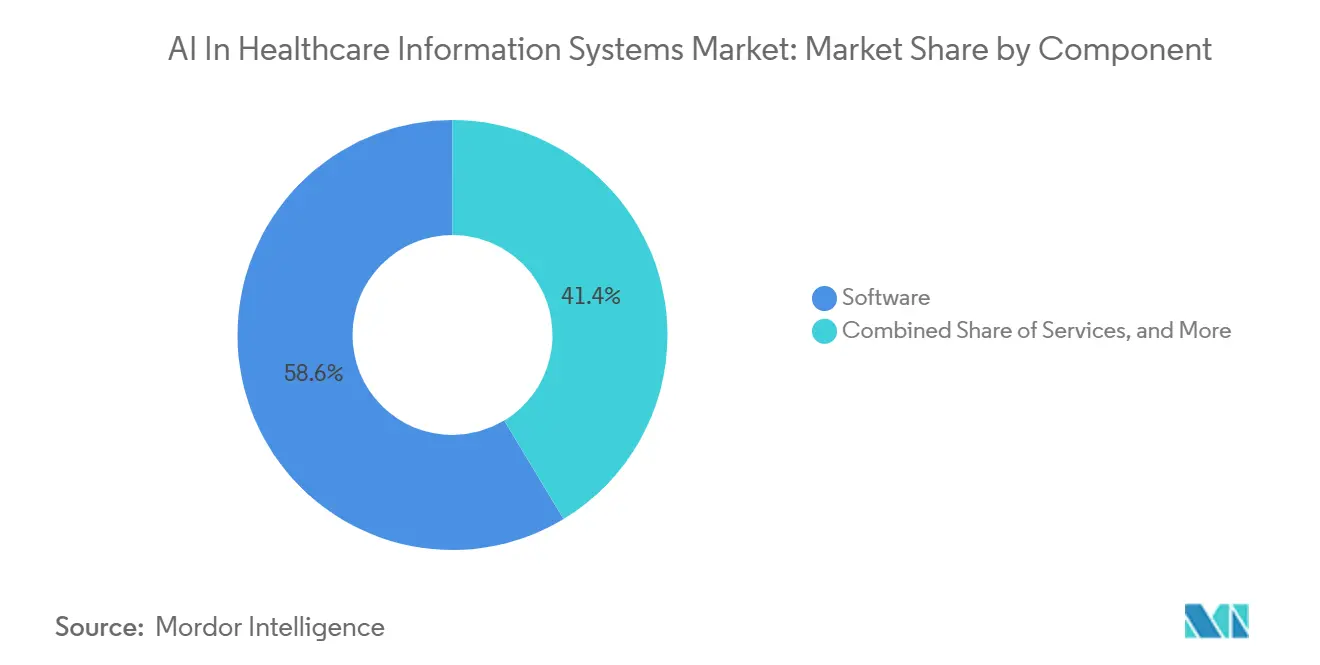
Software Leads While Service Intensity RisesSoftware held 58.64% share of the AI in healthcare information systems market size in 2025, making it the largest component segment. That lead reflects deep AI feature integration within EHRs and the rapid spread of standalone tools for documentation, clinical review, coding, and administrative workflows. Epic said in February 2026 that more than 175 generative AI use cases were either released or in active development, which shows how software vendors are embedding multiple functions into core platforms instead of selling only isolated tools. The same update said Penny, its revenue cycle AI, was being used by more than 200 organizations and had helped some users reduce coding-related claim denials by more than 20%. Software vendors also benefit from strong renewal economics because AI functions can be bundled into broader information system contracts across the AI in healthcare information systems market.
Services are projected to grow at 26.32% CAGR through 2031, the fastest pace among component segments. That trajectory reflects rising demand for implementation, integration, governance, workflow redesign, training, and post-deployment monitoring as buyers move from tool selection to enterprise execution. The service requirement becomes larger when providers need data mapping, model oversight, and user adoption support across many specialties and care sites. In the AI in healthcare information systems industry, service intensity rises further when organizations are working across several EHR instances, shared service centers, and hybrid deployment models. Over time, the gap between software and services should narrow because new rollouts increasingly require both packaged applications and hands-on operational support.

By Deployment:
Cloud Holds Scale While On-Premise Gains Strategic GroundCloud-based deployment held 48.29% share of the AI in healthcare information systems market size in 2025, giving it the largest position among deployment models. Cloud leads because ambient documentation, large-scale analytics, and payer-provider API exchange all require elastic compute and low-friction scaling. CMS interoperability requirements are reinforcing that pattern by pushing the sector toward standardized digital data exchange across impacted plans and provider workflows. The cloud model also fits the procurement logic of health systems that want faster upgrades, centralized monitoring, and multi-site rollout without large local infrastructure refreshes. For many organizations in the AI in healthcare information systems market, cloud is now the default route for new AI functions unless governance rules point in another direction.
On-premise deployment is projected to grow at 27.51% CAGR through 2031, the fastest pace among deployment options. That growth reflects rising attention to data residency, infrastructure control, and governance around sensitive clinical workloads. CMS guidance on AI use in federal infrastructure has sharpened attention on model provenance, operating environment, and oversight, which supports demand for tightly governed deployment architectures. Hybrid models remain important for academic centers and complex providers that keep sensitive clinical data local while using cloud resources for selected administrative or research workloads. Across the AI in healthcare information systems market, deployment choice is becoming a governance decision as much as a pure technology decision.
By Technology:
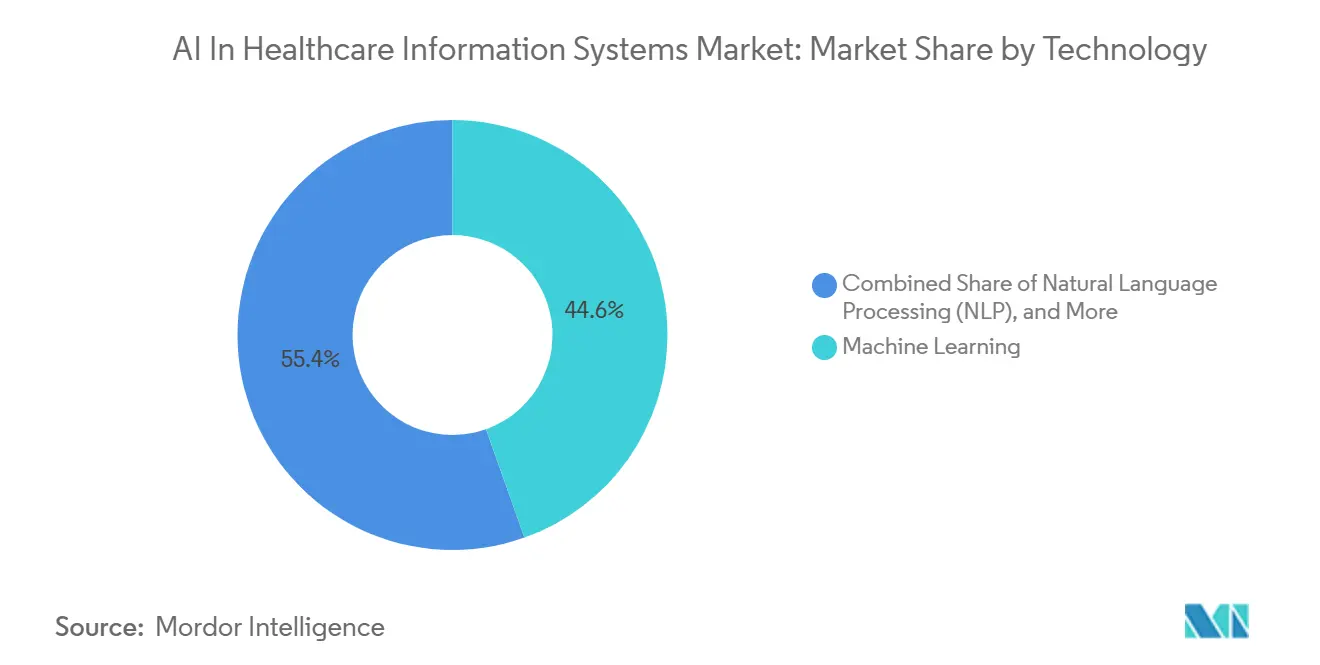
Machine Learning Remains Foundational While NLP Expands FastestMachine learning accounted for 44.56% share in 2025, giving it the largest position within the AI in healthcare information systems market. Its dominance reflects the breadth of use, because machine learning supports risk scoring, anomaly detection, triage support, scheduling optimization, claims review, and time-series prediction across many workflows. Google Research and Google DeepMind released MedGemma 1.5 in May 2026 and reported a 22% absolute improvement in EHRQA accuracy over the earlier version. That pace of improvement keeps machine learning central even as newer generative layers receive more attention in customer conversations. Machine learning, therefore, remains the main technical base for AI in the healthcare information systems market, especially where model performance must tie closely to operational data and historical records.
NLP is projected to grow at 29.48% CAGR through 2031, making it the fastest-growing technology segment. A 2026 systematic review in the Journal of Medical Internet Research found that 62.7% of relevant NLP and large language model studies on social determinants of health were published between 2023 and 2025. That pattern shows how quickly language processing is moving from academic exploration into practical healthcare workflows. In the AI in Healthcare Information Systems industry, NLP now supports ambient note capture, note structuring, extraction of clinical and social context, summarization, and conversational workflow assistance. Context-aware computing and generative tools expand on this base, but their usefulness still depends on strong language understanding inside existing clinical records.
By Application:
Clinical Intelligence Leads While Administrative Use Scales QuicklyElectronic Health Records (EHR) Analytics held the largest application share at 28.62% in 2025, reflecting the depth of AI integration within core EHR platforms for documentation, coding, patient summary generation, and operational reporting. Epic's Cosmos repository covering 300 million patient records from over 16 billion encounters across 310 health systems functions as the analytics foundation powering its family of generative medical event models developed in collaboration with Microsoft Research and Yale School of Medicine. The dominance of EHR analytics reflects a structural reality: EHR-embedded AI carries zero additional integration cost for health systems already on major platforms, making it the path of least resistance for AI adoption at scale. Aidoc, which analyzes over 60 million patient cases annually and is deployed in nearly 2,000 hospitals, secured a USD 150 million Series E in April 2026, led by Goldman Sachs Growth Equity, to scale its Clinical AI Reasoning Engine (CARE) foundation model and expand clinical analytics coverage across CT and X-ray workflows. Longitudinal Data, Interoperability Intelligence, and Research and Commercial Intelligence serve pharmaceutical pipeline acceleration and population health analytics markets that are growing but remain more concentrated among large academic and pharma-aligned systems.
Clinical Decision Support (CDS) is the fastest-growing application at 29.42% CAGR through 2031, driven by the shift from rule-based alerts to AI-powered, context-specific guidance embedded within clinical workflows. At The Christ Hospital, Epic's Art tool, integrating ambient AI with EHR analytics, identified over 100 incidental lung cancer cases by reviewing chest X-ray reports, lifting early detection rates to 69% against a national benchmark of 46%. A Nature Medicine LLM systematic review published in March 2026 covering 4,609 clinical LLM studies found that knowledge retrieval and clinical Q&A represented the second-most studied LLM task category, underscoring the research momentum behind AI-powered CDS. Abridge's March 2026 introduction of prompt-editing with embedded CDS grounding AI-generated notes in UpToDate clinical evidence with inspectable citations signals that the next phase of CDS will be contextual, auditable, and woven into documentation rather than delivered as a separate alert layer. Administrative and Financial Intelligence rounds out the application landscape, with agentic AI in revenue cycle management projected to cut the cost to collect by 30% to 60% for health systems that move from pilots to production-scale deployments.
By End User:
Providers Hold the Base While Payers Expand FastestHospitals and health systems held 36.73% share in 2025, giving providers the largest role in the AI in healthcare information systems market. Their scale makes them the largest aggregate buyers of AI software, deployment support, and workflow redesign services. Epic's February 2026 rollout of AI Charting and its broader embedded AI capabilities illustrates why hospitals remain the main launchpad for enterprise clinical AI. Large provider networks also shape product roadmaps because they can test AI across many sites, specialties, and administrative functions at the same time. This gives hospitals a central role in defining adoption standards across the AI in healthcare information systems market.
Healthcare payers are projected to grow at 26.94% CAGR through 2031, the fastest rate among end users. CMS requires expedited prior authorization decisions within 72 hours and standard decisions within 7 calendar days for impacted plans, which makes workflow automation more urgent for payer operations. Pharmaceutical and biotechnology companies remain strategically important buyers as well, especially for biomarker discovery, trial matching, and data applications tied to real-world evidence. Tempus AI reported more than 70 pharmaceutical customer data agreements in 2025, along with USD 316 million in Data and Applications revenue. That broader end-user mix gives the AI in healthcare information systems market more resilience because demand is no longer concentrated only in provider organizations.
Geography Analysis
North America AI in Healthcare Information Systems Market
North America held 35.73% of the AI in healthcare information systems market share in 2025, making it the largest regional segment. The region benefits from a dense installed base of EHR platforms, a strong concentration of established vendors, and an active policy environment around interoperability and prior authorization. CMS is pushing impacted payers toward FHIR-based APIs and electronic prior authorization workflows, with major milestones continuing through 2027. That regulatory activity creates direct demand for workflow automation, payer connectivity, and data-layer modernization across the AI in healthcare information systems market. The United States remains the regional center of adoption because many leading EHR, ambient documentation, and clinical AI vendors scale first inside provider networks that already have large digital footprints.
Europe AI in Healthcare Information Systems Market
Europe represented the second-largest regional position in 2025, supported by large public health systems and rising policy attention to responsible AI deployment. A European Commission study published in March 2026 found that 94% of EU providers were using or planning to adopt AI and projected strong uptake for clinical decision support systems by 2029. The UK 10-Year Health Plan, published in July 2025, identified a digital shift as 1 of 3 core pillars, which supports future enterprise procurement for software, interoperability, and workflow modernization. Europe also benefits from a stronger collaborative data culture in digital health, particularly where cross-system data use and standards-based modernization are already in motion. This creates a region that combines strong demand with tighter governance expectations, which can slow procurement but favor vendors that support open standards and auditable deployment.
APAC, MEA and South America AI in Healthcare Information Systems Market
Asia-Pacific is projected to grow at 29.81% CAGR through 2031, the fastest regional pace in the AI in healthcare information systems market. Growth in the region is tied to large-scale digital health buildouts, provider capacity pressure, and a shift from small pilots to operational use as national infrastructure matures. The Middle East, Africa, and South America remain early in adoption. Yet, both regions are gaining ground as public programs and private hospital groups look for automation in documentation, care coordination, and revenue workflows. This regional mix means vendors that can adapt deployment, governance, and pricing models to local infrastructure conditions should have the broadest expansion runway.
Competitive Landscape
The AI in healthcare information systems market has a two-layer structure with large EHR and health IT incumbents at the top and a wide set of specialist vendors competing underneath. Incumbents hold a meaningful advantage in workflow access because they already control clinical documentation, billing, scheduling, and patient record environments. Epic strengthened that position in February 2026 by rolling out AI Charting as a built-in capability inside its platform, which lets customers adopt ambient documentation without leaving the platform. This approach supports retention because buyers often prefer AI that works inside familiar workflows rather than requiring a separate operating layer. It also keeps switching costs high for organizations that want deep integration, auditability, and a single operating environment across the AI in healthcare information systems market.
Device and imaging players are also widening the field by linking clinical data streams to broader information system strategies instead of staying inside equipment silos. GE HealthCare introduced advanced imaging solutions powered by NVIDIA technology in December 2025 to support timely diagnoses and more streamlined clinical workflows, which shows how infrastructure and application layers are converging. Philips advanced a similar platform direction at HIMSS 2026 by connecting patient monitoring and diagnostics across EMR and third-party systems. These moves matter because hospitals increasingly want vendors that can connect bedside, imaging, and information system data inside the same operational architecture. The upper tier in the AI in healthcare information systems market therefore extends beyond classic EHR vendors and now includes companies that can bring device, imaging, and monitoring data into enterprise care workflows.
AI In Healthcare Information Systems Industry Leaders
-
Abridge AI, Inc.
-
Amazon Web Services, Inc.
-
Epic Systems Corporation
-
IBM Corporation
-
Oracle Corporation
- *Disclaimer: Major Players sorted in no particular order
AI In Healthcare Information Systems Market Companies Covered in this Report
- Abridge AI, Inc.
- Aidoc Medical Ltd.
- Amazon Web Services, Inc.
- Athenahealth
- Cognizant
- Epic Systems
- GE HealthCare Technologies Inc.
- Google LLC
- IBM
- Innovaccer
- IQVIA
- Koninklijke Philips
- Meditech
- Microsoft
- NVIDIA
- Oracle
- Qventus, Inc.
- Siemens Healthineers
- Tempus AI, Inc.
- Veradigm
- Viz.ai, Inc.
Recent Industry Developments in AI In Healthcare Information Systems Market
- April 2026: Tempus AI and USC's Keck School of Medicine announced a strategic collaboration covering clinical testing, clinical trial matching, care gap pathways, and co-development of AI tools, spanning over 1.5 million annual patient visits.
- March 2026: Tempus AI and Merck announced a multi-year strategic collaboration for AI-driven precision medicine biomarker discovery, with Merck utilizing Tempus' Lens Platform and large GPU infrastructure.
- February 2026: Epic launched AI Charting, a built-in ambient documentation tool with early adopters reporting up to 60 minutes saved per physician per day and a 26% reduction in after-hours documentation time.
Global AI In Healthcare Information Systems Market Report Scope
As per the scope of the report, AI in healthcare information systems refers to the integration of artificial intelligence technologies into hospital information systems, EHRs, and clinical decision support platforms to improve patient care and operational efficiency. It leverages tools such as machine learning, natural language processing, and predictive analytics to analyze complex medical data, automate workflows, and support clinicians in diagnosis and treatment planning. By embedding AI into healthcare IT infrastructure, these systems enable personalized care, reduce errors, and optimize resource utilization, ultimately enhancing patient outcomes and population health.
The AI in healthcare information systems is segmented by component, deployment, technology, application, end user, and geography. By component, it is further divided into software, hardware, and services. By deployment, it is segmented into cloud-based, on-premise, and hybrid. By technology, the market is segmented into machine learning, natural language processing, context-aware computing, generative AI, and others. By application, the market is segmented into clinical intelligence, administrative and financial intelligence, longitudinal data and interoperability intelligence, research and commercial intelligence, and others. By end user, the market is segmented into hospitals & health systems, pharmaceutical & biotechnology companies, healthcare payers, and others. The geography segment is further divided into North America, Europe, Asia-Pacific, the Middle East and Africa, and South America. The report also covers the estimated market sizes and trends for 17 countries across major regions globally. The report offers the market size and forecasts in value (USD) for the above segments.
Segmentation Overview
| Software |
| Hardware |
| Services |
| Cloud-Based |
| On-Premise |
| Hybrid |
| Machine Learning |
| Natural Language Processing |
| Context-Aware Computing |
| Generative AI |
| Others |
| Clinical Intelligence |
| Administrative and Financial Intelligence |
| Longitudinal Data and Interoperability Intelligence |
| Research and Commercial Intelligence |
| Others |
| Hospitals & Health Systems |
| Pharmaceutical & Biotechnology Companies |
| Healthcare Payers |
| Others |
| North America | United States |
| Canada | |
| Mexico | |
| Europe | Germany |
| United Kingdom | |
| France | |
| Italy | |
| Spain | |
| Rest of Europe | |
| Asia-Pacific | China |
| India | |
| Japan | |
| Australia | |
| South Korea | |
| Rest of Asia-Pacific | |
| Middle East and Africa | GCC |
| South Africa | |
| Rest of Middle East and Africa | |
| South America | Brazil |
| Argentina | |
| Rest of South America |
| By Component | Software | |
| Hardware | ||
| Services | ||
| By Deployment | Cloud-Based | |
| On-Premise | ||
| Hybrid | ||
| By Technology | Machine Learning | |
| Natural Language Processing | ||
| Context-Aware Computing | ||
| Generative AI | ||
| Others | ||
| By Application | Clinical Intelligence | |
| Administrative and Financial Intelligence | ||
| Longitudinal Data and Interoperability Intelligence | ||
| Research and Commercial Intelligence | ||
| Others | ||
| By End User | Hospitals & Health Systems | |
| Pharmaceutical & Biotechnology Companies | ||
| Healthcare Payers | ||
| Others | ||
| By Geography | North America | United States |
| Canada | ||
| Mexico | ||
| Europe | Germany | |
| United Kingdom | ||
| France | ||
| Italy | ||
| Spain | ||
| Rest of Europe | ||
| Asia-Pacific | China | |
| India | ||
| Japan | ||
| Australia | ||
| South Korea | ||
| Rest of Asia-Pacific | ||
| Middle East and Africa | GCC | |
| South Africa | ||
| Rest of Middle East and Africa | ||
| South America | Brazil | |
| Argentina | ||
| Rest of South America | ||
Key Questions Answered in the Report
What is the current outlook for AI in healthcare information systems?
The sector is projected to rise from USD 9.94 billion in 2025 to USD 12.48 billion in 2026 and reach USD 38.89 billion by 2031 at a 25.53% CAGR.
Why are health systems adopting these platforms more quickly now?
Adoption is accelerating because providers are using AI for documentation, workflow automation, and multimodal data analysis, while policy rules around interoperability and prior authorization are making automation more practical.
Why is ambient documentation getting so much attention?
It produces visible workflow gains early, with Epic reporting up to 60 minutes saved per physician per day and Northwell expanding deployment across 28 hospitals and 1,000 outpatient facilities.
Which part of the market is growing the fastest by application?
Clinical decision support is the fastest-growing application segment, with a projected 29.62% CAGR through 2031, supported by prior authorization automation and AI-driven document handling.
Which end users are expanding the fastest?
Healthcare payers are projected to grow at 26.94% CAGR through 2031 because CMS timelines for prior authorization decisions are increasing the need for automated workflow support.
Which region is expected to grow the fastest?
Asia-Pacific is projected to record the fastest regional growth at 29.81% CAGR through 2031, while North America remains the largest region by 2025 share.