
UAE Agriculture Market Analysis by Mordor Intelligence
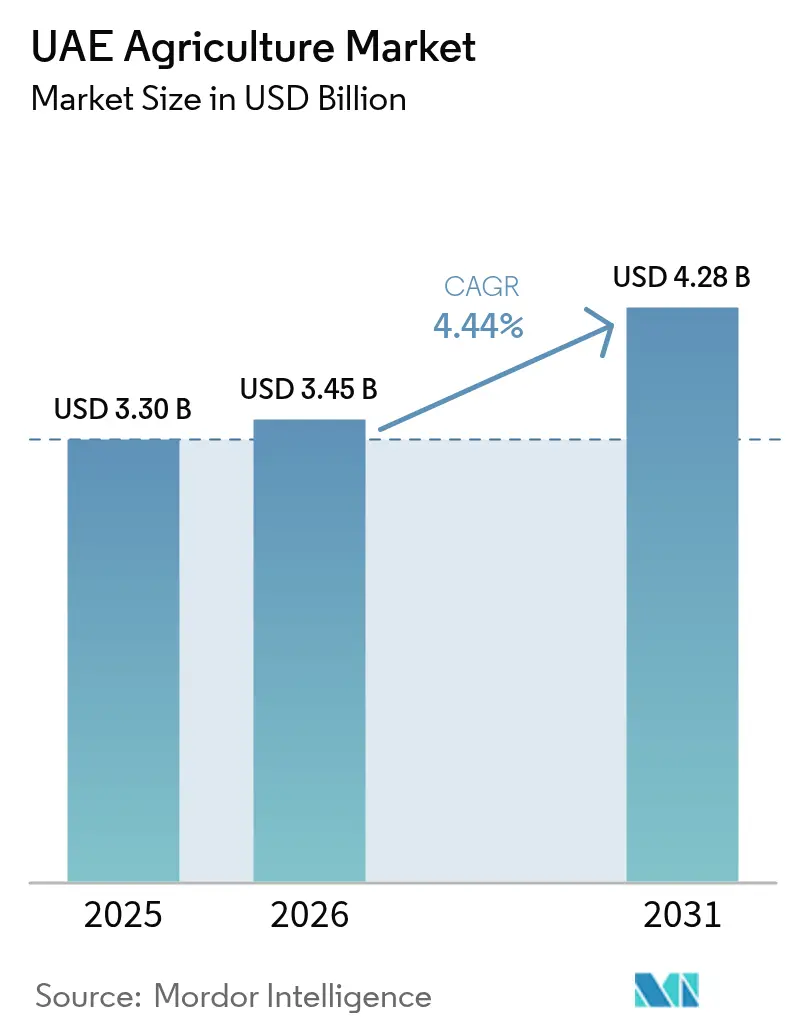
The UAE agriculture market size in 2026 is estimated at USD 3.45 billion, growing from 2025 value of USD 3.3 billion with 2031 projections showing USD 4.28 billion, growing at 4.44% CAGR over 2026-2031. The growth is driven by the federal Food Security Strategy 2051, investments in controlled-environment farming, and initiatives to reduce the country's 85-90% food import dependence[1]U.S. Department of Agriculture, “Opportunities for U.S. Agricultural Exports to the UAE,” fas.usda.gov. The market expansion is supported by vertical farming adoption, which reduces water consumption by up to 95%, along with financial support from national banks and investments from Gulf and Asian partners. The implementation of salt-tolerant forage trials, blockchain traceability systems, and desalination-powered irrigation subsidies demonstrates the shift toward efficient agricultural production. While energy cost fluctuations and strict biosecurity regulations affect growth, continued government and private sector investments maintain the United Arab Emirates' agriculture market's growth trajectory.
Key Report Takeaways
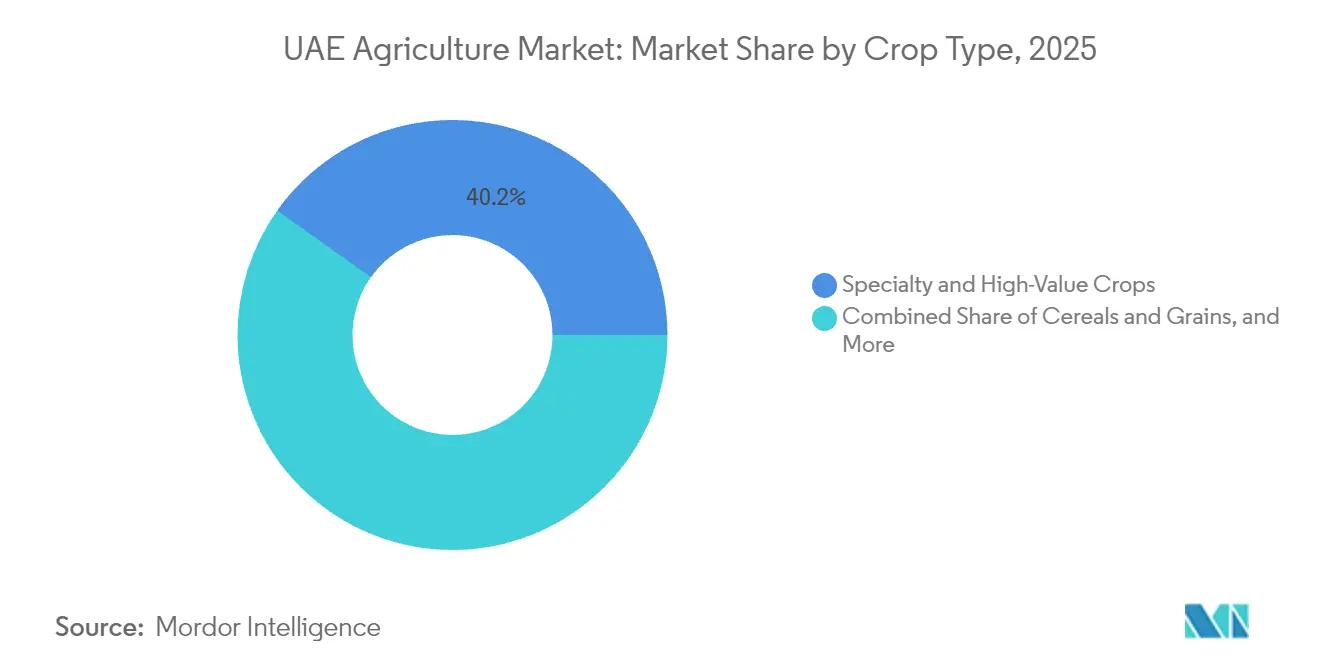
- By crop type, specialty and high-value crops dominated with a 40.18% share of the UAE agriculture market in 2025. The fruits and vegetables segment is projected to grow at a CAGR of 4.86% through 2031, representing the highest growth rate among all segments.
Note: Market size and forecast figures in this report are generated using Mordor Intelligence’s proprietary estimation framework, updated with the latest available data and insights as of 2026.
UAE Agriculture Market Trends and Insights
Drivers Impact Analysis*
| Driver | (~) % Impact on CAGR Forecast | Geographic Relevance | Impact Timeline |
|---|---|---|---|
| Government "Food Security Strategy 2051" Capital Outlay | +1.2% | Abu Dhabi and Dubai | Long term (≥ 4 years) |
| Preferential Financing for Controlled-Environment Agriculture (CEA) | +0.8% | Abu Dhabi | Medium term (2-4 years) |
| Bilateral FDI Inflows from the Gulf and Asia into Agri-Projects | +0.6% | Free zones nationwide | Medium term (2-4 years) |
| National Subsidy for Desalination-Powered Irrigation | +0.4% | Coastal emirates | Long term (≥ 4 years) |
| Blockchain-Enabled Farm-to-Fork Traceability Pilots | +0.3% | Dubai and Abu Dhabi | Short term (≤ 2 years) |
| Hydrogel-Based Soil-Moisture Retention Adoption | +0.2% | Traditional farming areas | Medium term (2-4 years) |
| Source: Mordor Intelligence | |||
Government “Food Security Strategy 2051” Capital Outlay
The UAE's Food Security Strategy 2051 directs federal funding across 38 initiatives, including the National Agriculture Centre and smart-farming grants[2]United Arab Emirates Government, “National Food Security Strategy 2051,” uae.gov.ae. The Abu Dhabi Investment Office allocated USD 100 million to agricultural technology start-ups, generating research benefits and attracting private equity investments. The matching-fund structure reduces investment risks and accelerates returns on greenhouse and robotics investments. The program implements local-content requirements in public tenders, favoring United Arab Emirates-based suppliers to increase domestic value creation. While ministries coordinate implementation to prevent overlap, the strategy's effectiveness requires standardized regulations across emirates to maintain consistent incentives and minimize bureaucracy.
Preferential Financing for Controlled-Environment Agriculture (CEA)
The Emirates Development Bank's AGRIX Accelerator program provides 20-week technical boot camps and subsidized loans for agricultural producers implementing hydroponics, automation, and AI-based crop management systems[3]Emirates Development Bank, “Emirates Development Bank Launches AGRIX Accelerator,” edb.gov.ae. Mashreq Bank offers an AED 1 billion (USD 272.3 million) credit facility through the "Make it in the Emirates" initiative to increase access to long-term capital[4] Ministry of Industry and Advanced Technology, “Mashreq Bank allocates additional AED1 billion…,” moiat.gov.ae. The program supports medium-scale growers with flexible collateral requirements and graduated repayment schedules to overcome the initial high costs of indoor farming. While loan restructuring options protect against production disruptions, the risk of excessive debt remains if technological issues or market changes affect projected yields.
Bilateral FDI Inflows from the Gulf and Asia into Agri-Projects
United Arab Emirates investors pursue a dual strategy of funding domestic greenhouses while securing international farmland through leasing agreements. Al Dahra's negotiations for 200,000 acres in Kenya, which include USD 800 million in irrigation infrastructure, demonstrate the expansion of agricultural capabilities. From 2019 to 2023, the United Arab Emirates emerged as Africa's primary investor with USD 110 billion in committed projects, including renewable energy integration for desert agriculture. These investments facilitate agricultural technology transfer, enhance supply chain stability, and create re-export opportunities through Jebel Ali Port.
National Subsidy for Desalination-Powered Irrigation
The government provides reimbursements of 30-50% on capital costs for solar-powered desalination units, reducing water costs by up to USD 1,200 per hectare for large agricultural operations. Fertiglobe's complete transition to desalinated water in 2024 demonstrates the feasibility of large-scale implementation. While subsidies reduce operating costs and enable agriculture on marginal lands, the long-term environmental sustainability depends on accelerated renewable energy adoption to offset the energy consumption of reverse-osmosis systems.
Restraints Impact Analysis*
| Restraint | (~) % Impact on CAGR Forecast | Geographic Relevance | Impact Timeline |
|---|---|---|---|
| Soil Salinization from Saline Groundwater and High Evapotranspiration | -0.9% | Coastal and central regions | Long term (≥ 4 years) |
| Stringent Biosecurity Rules Slowing Approval of Advanced Seeds and Biologics | -0.6% | Nationwide | Medium term (2-4 years) |
| Dependence on Imported Seed Genetics and Inputs | -0.4% | Specialty-crop clusters | Medium term (2-4 years) |
| Pollination Inefficiencies in Vertical Farms | -0.2% | Indoor facilities countrywide | Short term (≤ 2 years) |
| Source: Mordor Intelligence | |||
Soil Salinization from Saline Groundwater and High Evapotranspiration
Soil salinity affects 77% of United Arab Emirates agricultural land at moderate-to-high levels, while 96% of groundwater wells face severe irrigation restrictions. The increasing soil salinity compels farmers to use expensive desalinated water or adopt soilless cultivation methods. Date palm oases in Liwa and central Sharjah experience higher crop mortality rates, leading to experiments with salt-tolerant grasses for animal feed. Addressing these challenges requires extensive soil treatment through gypsum leaching, drainage system installation, and increased reverse-osmosis infrastructure, all requiring significant capital investment.
Dependence on Imported Seed Genetics and Inputs
The country imports more than 85% of its vegetable seeds and over 90% of greenhouse films from the European Union and Asia, creating vulnerability to currency fluctuations and supply chain disruptions. This dependence restricts the ability to adapt cultivars quickly to local growing conditions. While the National Agriculture Centre conducts research programs to develop domestic germplasm, these initiatives are still in preliminary testing phases.
*Our forecasts treat driver/restraint impacts as directional, not additive. The impact forecasts reflect baseline growth, mix effects, and variable interactions.
Segment Analysis
By Crop Type: Fruits and Vegetables Segment Show Varied Growth and Innovation
Specialty and high-value crops account for 40.18% of the UAE agriculture market share in 2025. Growers have increased date-palm production through precision irrigation systems and drone pollination technologies. The segment includes berry cultivation in LED-powered vertical farms, where production efficiency exceeds traditional field farming by up to 12 times per square meter. These controlled environment operations enable producers to achieve higher profit margins through export premium pricing, despite increased capital investments.
The Fruits and Vegetables segment is projected to grow at a 4.86% CAGR through 2031. Bustanica's operations exemplify this growth, with plans to produce 1 million kg of leafy greens annually while reducing water consumption by 95%. This local production supports supermarket supply chains and airline catering services, reducing delivery times and product waste. The Grains and Cereals segment maintains limited production due to high water requirements, though Sharjah's experimental wheat cultivation shows potential for local bread-flour production. In the forage sector, farmers are transitioning to salt-tolerant crops like blue panic grass, reducing dependence on desalinated water while maintaining livestock feed supply.



Geography Analysis
The UAE agriculture market operates through distinct emirate-level capabilities within a unified federal policy framework. Abu Dhabi dominates large-scale greenhouse production, supported by sovereign fund investments and access to desalination infrastructure. The emirate accounts for 60% of controlled-environment agriculture capacity, with its vertical farming facilities serving domestic markets and Gulf export channels. Dubai emphasizes agricultural technology development through free-zone policies that enable startups to develop and scale their innovations. The emirate processes USD 7.5 billion in agricultural product re-exports through the Jebel Ali logistics network. The northern emirates, particularly Ras Al Khaimah, utilize their higher rainfall for date palm cultivation and open-field vegetable production, while implementing precision irrigation systems.
The "Plant the Emirates" program targets a 25% increase in organic farming area and 20% growth in productive farms by 2030, while implementing unified agricultural extension services and certification protocols. The harmonization of water pricing across emirates reduces regional disparities and promotes hydroponic adoption in areas with reliable power infrastructure. The market's sustainable development requires alignment between desalination capacity expansion and renewable energy implementation to avoid increased carbon emissions.
Regulatory Landscape
The UAE agriculture sector is governed by a federal framework led by the Ministry of Climate Change and Environment (MOCCAE), which oversees agricultural import controls, plant and veterinary quarantine requirements, and environmental compliance. In January 2026, the UAE issued an updated package of federal laws covering agricultural and veterinary quarantine and the protection of new plant varieties, reinforcing risk-based biosecurity and stronger alignment with international plant-health norms.
Food safety and border controls directly affect agricultural commodities moving through the country. Cabinet Resolution No. (116) of 2024 set maximum residue limits for pesticides in agricultural products, raising compliance requirements for importers and distributors. Agricultural consignments (fresh produce and fodder) require phytosanitary certification and inspection at designated ports. The Federal Authority for Identity, Citizenship, Customs & Port Security (ICP) supports enforcement through the Central Customs Tariff System, which traders use to verify HS codes, duty rates, and import restrictions, complemented by emirate-level restricted and banned commodity controls (for example, via Abu Dhabi Customs).
Value Chain Analysis
The UAE agriculture value chain is shaped by a high reliance on imported inputs (seed genetics, greenhouse films, and agri-chemicals), followed by domestic production concentrated in controlled-environment agriculture (CEA) clusters, and then aggregation, cold-chain handling, processing, and distribution into retail, foodservice, and re-export channels. Government programs and semi-government operators play an outsized role in coordinating the ecosystem: the National Agriculture Centre provides farmer training and technical support, while Silal participates in farm-innovation initiatives and partnerships that connect growers with modern agronomy, inputs, and commercialization routes.
Downstream, the chain increasingly uses digital and logistics coordination to reduce fragmentation between small and mid-sized farms, packhouses, and buyers. The Mazraati platform is positioned as a connector between farmers and route-to-market logistics, while trade and re-export infrastructure, notably the Jebel Ali logistics network, anchors distribution and regional flows. Bottlenecks remain concentrated in water and energy intensity for CEA, biosecurity-driven approvals that slow access to advanced seeds and biologics, and dependence on imported inputs, which increases exposure to supply disruption and currency effects.
Market Opportunities and Future Outlook
Opportunities center on scaling domestic, water-efficient production and building supporting input and commercialization capabilities to reduce structural dependence on imports, with the report context citing 85-90% import dependence for food. Controlled-environment production is reinforced by financing and procurement pull-through. The National Food Security Strategy 2051 includes targets for government and semi-government purchases of local produce (70% by 2025 and 100% by 2030), while banks have created dedicated facilities for agri projects that improve the bankability of greenhouse and automation investments.
Technology-linked whitespace remains visible across crop genetics, energy-water integration, and supply-chain digitization. In 2025, Silal announced a Dh120 million, 100,000 m2 smart AgriTech hub in Al Ain with Shouguang Vegetable Industry Group, indicating a pathway for locally anchored production systems and know-how transfer. In 2026, Masdar partnered with Elite Agro Holding to launch an AgriPV pilot at Al Foah Farm in Al Ain, providing a route for farms to offset energy-intensive operations such as cooling and desalination-powered irrigation in CEA. On commercialization, platforms such as Mazraati and traceability pilots support higher service levels for retailers and foodservice while improving aggregation for smaller farms. Programs like Plant the Emirates, with targets to expand organic farming area and productive farms by 2030, also provide a structured base for certification, extension services, and market access.
Recent Industry Developments
- June 2026: Silal Group and Delphy launched a five-year partnership focused on capacity building and training to strengthen horticultural capabilities in the UAE. The program supports skills transfer and operational know-how for growers and agribusinesses, aligning with the shift toward higher-output, technology-enabled domestic production.
- March 2026: Silal and the National Agricultural Center commenced a collaborative initiative in Al Hamraniyah, Ras Al Khaimah, including the setup of a dedicated crop collection center. The initiative improves aggregation and route-to-market infrastructure for local farms, helping stabilize volumes and reduce supply chain fragmentation.
- October 2024: The UAE Ministry launched the Plant the Emirates national program to strengthen the agricultural sector and support sustainable food security. The program provides an institutional platform for unified extension services and certification protocols, reinforcing farm modernization priorities across emirates.


Research Methodology Framework and Report Scope
Market Definition and Coverage
This market covers the value of agricultural output within the UAE, captured across key crop groups and reflected through local production and trade flows, together with price signals that convert volumes into market value.
Scope exclusions: This scope does not include downstream food processing, retail distribution margins, foodservice sales, or non-agriculture landscaping services.
Segmentation Overview
- By Crop Type (Production Analysis (Volume), Consumption Analysis (Volume and Value), Import Analysis (Volume and Value), Export Analysis (Volume and Value), and Price Trend Analysis)
- Grains and Cereals
- Oilseeds and Pulses
- Fruits and Vegetables
- Forage and Fodder Crops
- Specialty and High-Value Crops (Dates, Berries, and Herbs)
Data Sources, Market Sizing, and Validation
Desk Research
We started by mapping the UAE agriculture value chain and aligning it to measurable statistics so the market can be sized in a repeatable way. For core anchors, we used public agriculture and trade series such as FAOSTAT, UN Comtrade, the World Bank, and UAE official releases such as the Ministry of Climate Change and Environment and the Federal Competitiveness and Statistics Centre, which help confirm crop volumes, trade direction, and broad sector signals.
Next, pricing and seasonality assumptions were built using a mix of official price references where available, customs unit values from import and export data, and documented policy and program updates from government portals and industry association websites. We also reviewed company filings, investor presentations, and reputable press to understand capacity additions (like protected cultivation) and shifts in sourcing that can change volumes and average realized prices. Where needed, a paid subscription for company financials and intelligence, and an import and export shipment-level database, were used only to cross-check select totals and timing. The desk sources listed above are illustrative, and many other public documents were also reviewed for data collection, validation, and clarification.
Primary Interviews and Surveys
To close data gaps, we spoke with a mix of growers, distributors, importers, and sector advisors, and then validated the numbers with people who track crop volumes, protected cultivation activity, and pricing shifts in the UAE. Because this is a country-level market, we checked inputs across major demand centers and farming clusters, and we re-tested assumptions when responses did not align with trade or production signals.
Distribution of primary research fieldwork respondents
| Company type | Respondent position |
|---|---|
| Top tier: 28% | CXOs: 19% |
| Mid tier: 52% | Functional/Unit leaders: 25% |
| Smaller Players: 20% | Managers: 56% |
Market-Sizing & Forecasting
Our sizing starts with a top-down reconstruction that links UAE crop supply and demand signals to value. Production, imports, and exports by crop group are aligned first, then converted using observed price trends. We also did selective bottom-up checks, including sampling crop-wise volumes through channel conversations and applying realistic average selling price ranges to see whether the implied totals fit what the market can absorb.
A few practical inputs were treated as key drivers, including crop-wise production volumes, import dependence by category, trade unit values, seasonal yield swings, the share of protected cultivation, and changes in farm input costs that can push prices. When local data was thin for a crop, we carried forward conservative volume patterns and relied more on trade and price proxies, then corrected assumptions through follow-up calls.
For forecasting, we used scenario analysis supported by trend smoothing, since policy-driven investments and water constraints can create step changes that straight-line extrapolation can miss. Growth paths were tested against expected shifts in local output, trade substitution, and price movement, then adjusted so the final curve remains consistent with what practitioners described as realistic for the next cycle.
Data Validation & Update Cycle
Triangulation was done by comparing modeled totals against independent signals such as agriculture value-added trends, trade totals, and crop-wise price movements, then reviewing any outliers that did not match the operational reality described by interviewees. We also checked for sudden jumps caused by currency timing, unusual unit values, or one-time volume spikes, and we normalized those only when supporting evidence was available.
Before sign-off, the model and assumptions go through a multi-step analyst review where calculations, source alignment, and year-over-year movements are rechecked. Reports are refreshed annually, and interim updates are triggered when material events occur, such as major policy changes, sharp input cost movements, or trade disruptions. Right before delivery, we run a final pass so clients receive the most up-to-date view available at that time.
Mordor Intelligence's the United Arab Emirates Agriculture Market Size Versus Other Published Estimates
Published numbers for UAE agriculture can look different even when they appear to cover the same scope, because each publisher makes different calls on what to count and which year to treat as the base. Differences also come up when one estimate leans more on macro value-added proxies, while another rebuilds the market from crop volumes and trade flows and then applies price logic.
The biggest gap driver is scope around what sits inside agriculture value, where Mordor Intelligence treats the market as crop output and trade-linked value signals. It avoids adding food processing, retail markups, or broader agribusiness revenue that can inflate totals.
Benchmark comparison
| Source | Market Size | Gaps in Research Methodology |
|---|---|---|
| Mordor Intelligence | USD 3.30 B (2025) | |
| Industry Publication A | USD 3.31 B (2024) | Uses a different base year and the excerpt does not clarify inclusions, so the total can shift if value-added style proxies or broader agribusiness items are blended into agriculture. |
| Trade Media B | USD 3.60 B (2024) | May reflect a wider definition that mixes crop categories with region-led aggregation and can also differ on how prices are projected forward from 2024 to later years. |
Overall, the spread is mainly explained by year selection and what is counted inside the agriculture bucket, followed by how prices are translated from volume to value. By keeping the model tied to observable production and trade indicators and then stress-testing pricing assumptions through interviews, the estimate stays transparent and easier to reconcile when clients compare sources.


Key Questions Answered in the Report
What is the current value of the UAE agriculture market?
The UAE agriculture market is valued at USD 3.45 billion in 2026.
How fast is the UAE agriculture market projected to grow?
It is projected to expand at a 4.44% CAGR, reaching USD 4.28 billion by 2031.
Which crop segment holds the largest share?
Specialty and High-Value Crops lead with 40.18% UAE agriculture market share in 2025.
Which segment is growing the quickest?
Fruits and Vegetables are forecast to grow at a 4.86% CAGR through 2031.
What is a primary risk for indoor farms in the United Arab Emirates?
Energy cost volatility can reduce profit margins for power-intensive vertical farming operations.
Page last updated on:




