
Aerospace And Defense Fiber Optic Cables Market Size and Share
| Study Period | 2020 - 2030 |
| Market Size (2025) | USD 5.15 Billion |
| Market Size (2030) | USD 7.58 Billion |
| CAGR (2025 - 2030) | 8.03% |
| Fastest Growing Market | North America |
| Largest Market | Asia Pacific |
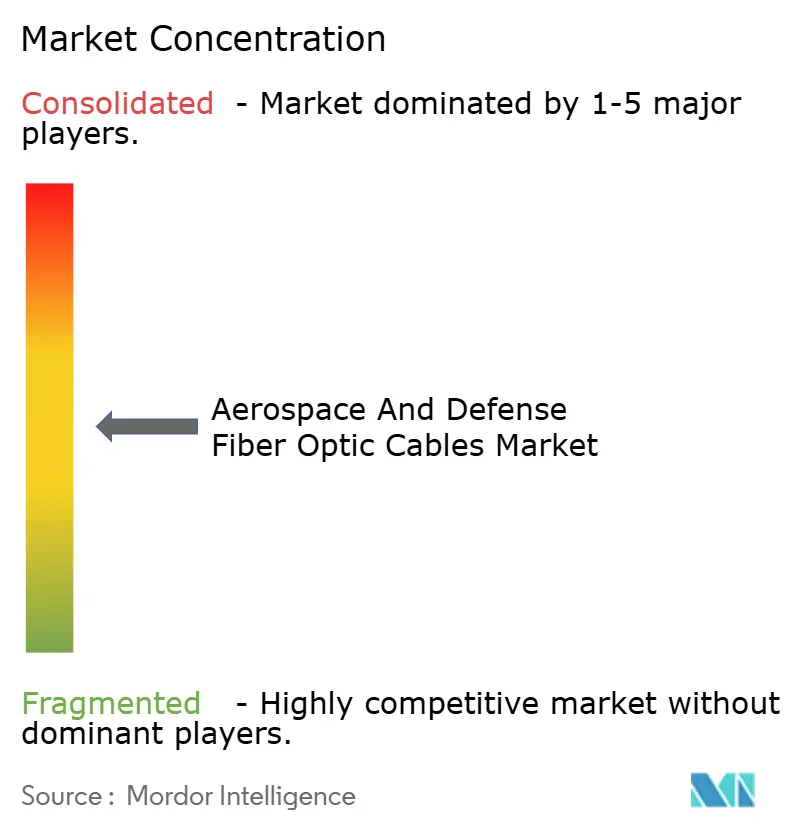
| Market Concentration | Medium |
Major Players *Disclaimer: Major Players sorted in no particular order |
Aerospace And Defense Fiber Optic Cables Market Analysis by Mordor Intelligence
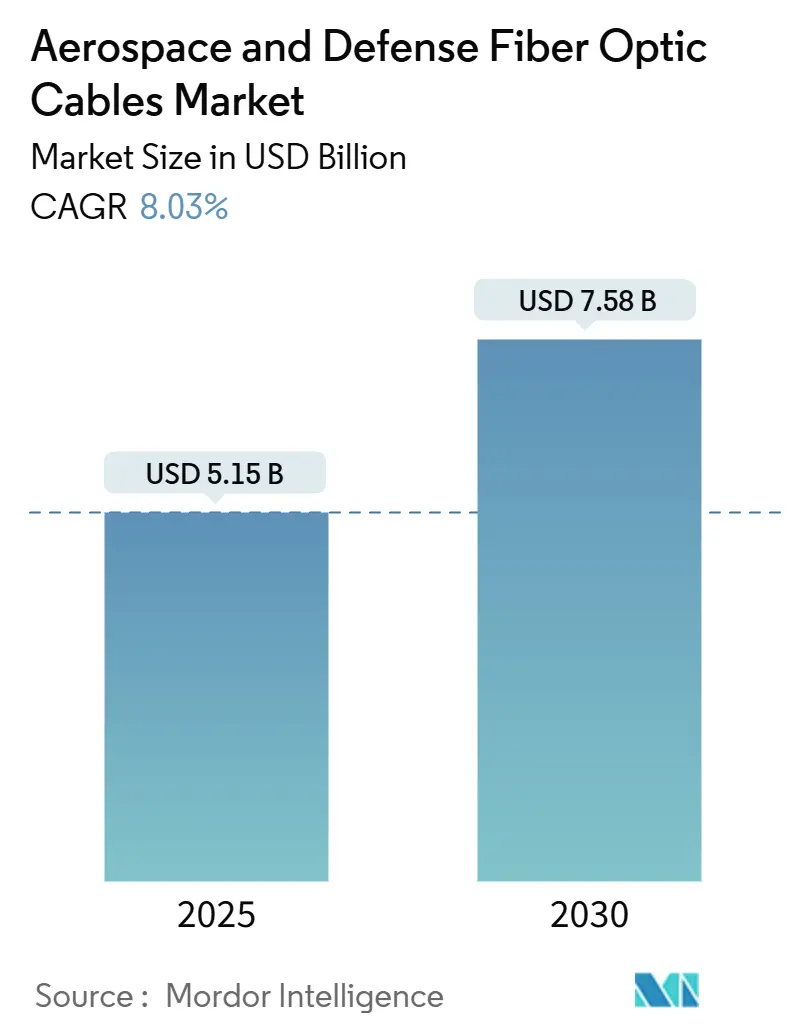
The Aerospace And Defense Fiber Optic Cables Market size is estimated at USD 5.15 billion in 2025, and is expected to reach USD 7.58 billion by 2030, at a CAGR of 8.03% during the forecast period (2025-2030).
The aerospace and defense fiber optic cables market is expected to witness significant growth. This can be attributed to the rising number of aircraft deliveries and an increasing demand for improved throughput and reliability. Authorities are now prioritizing adopting advanced solutions, replacing older cables, and further accelerating market expansion.
With their innovative offerings, noteworthy players like Carlisle Interconnect Technologies are poised to drive this growth. With the increasing demand for higher bandwidth, fiber optics have become essential in military applications to ensure reliable data and video transmission. This capability enables personnel to gather intelligence, maintain communication, and respond promptly and efficiently.
Furthermore, these cables must be compact and lightweight to accommodate the limited space available in combat aircraft, vehicles, and tanks. The Eurofighter Typhoon transmits data at 20 Mbps, while the F-35 Joint Strike Fighter achieves a rate of 2.5 Gbps. Reports indicate that the upcoming Tempest aircraft is being developed with a radar system capable of processing data 10,000 times more than earlier systems, potentially matching the internet traffic of Edinburgh, Scotland, every second. Fiber optics most effectively supports high-speed applications requiring 100 Gbps or more. Even in cases where advanced applications are not yet implemented, optical interconnects are already essential for connecting backplanes, line cards, and chip components, supporting speeds ranging from 100 Gbps to 3 Tbps.
Installing and maintaining fiber optic cables presents challenges for this market. These challenges include inflexible control models, risks to optical network systems, high costs, and susceptibility to damage, which hamper the market's growth. Balancing the need for cost-effective fiber optics with maintaining high quality presents both an opportunity and a challenge for the market.
Global Aerospace And Defense Fiber Optic Cables Market Trends and Insights
The Multi-mode Segment is Expected to Record the Highest CAGR During the Forecast Period
With their larger core diameter, multi-mode fiber optic cables can propagate multiple light modes, enabling the transmission of higher data volumes simultaneously. However, signal quality may suffer over long distances due to the high attenuation rate and data volume. Operating within the visible spectrum, these fibers have light wavelengths ranging from 850 to 1300 nm. Core-to-cladding diameter ratios typically range from 50-125 um to 62.5-125 um in multi-mode fibers.
Multi-mode fiber optics are primarily used in LANs, especially for short-distance data and audio/video applications, and they are witnessing increased adoption in the aviation industry. This adoption transforms avionics and aerospace systems, introducing new system maintenance, testing, and diagnostics challenges. Airlines are shifting from shared overhead screens to individual seatback screens, enhancing personalized services and influencing revenues. As airlines make this transition, traditional copper cabling and its associated electronics are giving way to fiber optic solutions. Multi-mode fiber optics, with data rates surpassing 10 GB/s, are the go-to choice for transmitting data across large wide-body aircraft.
In the military and defense sectors, fiber optic cables are customized for harsh environments, emphasizing application-specific designs and rigorous testing. These cables find applications across various military domains, from ground and air to sea and even space, where performance and reliability under extreme conditions are non-negotiable.


Asia-Pacific is Expected to Dominate the Market During the Forecast Period
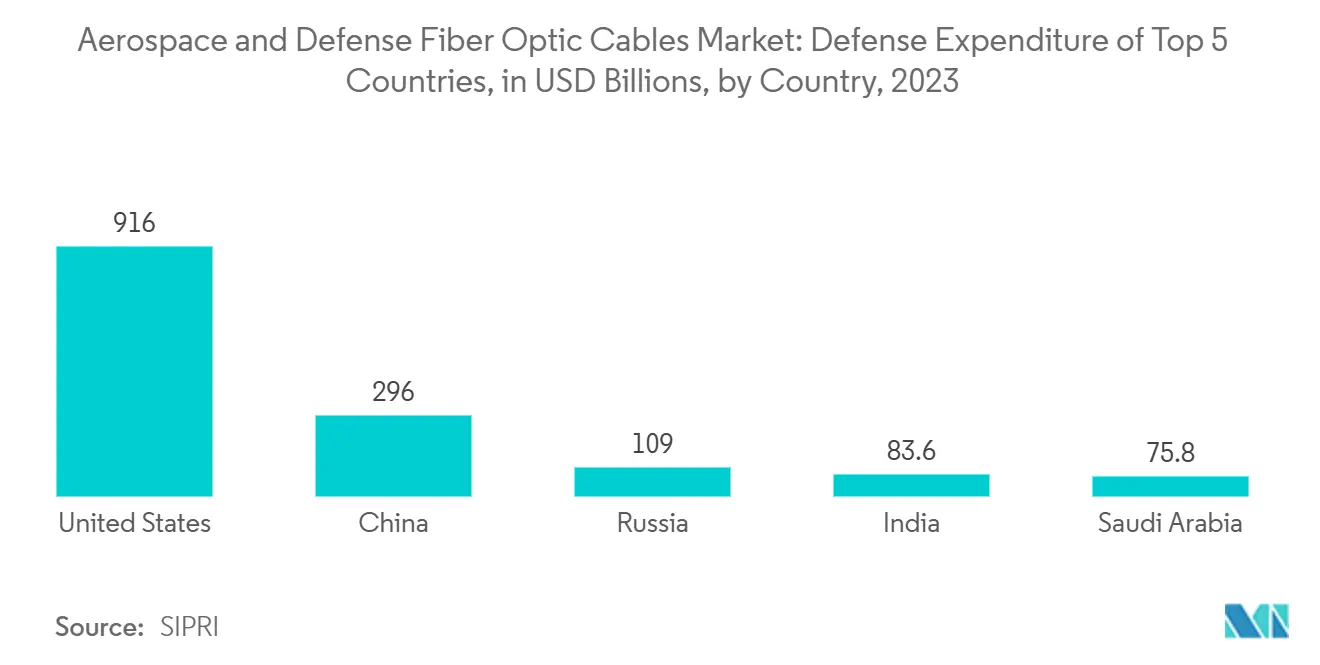
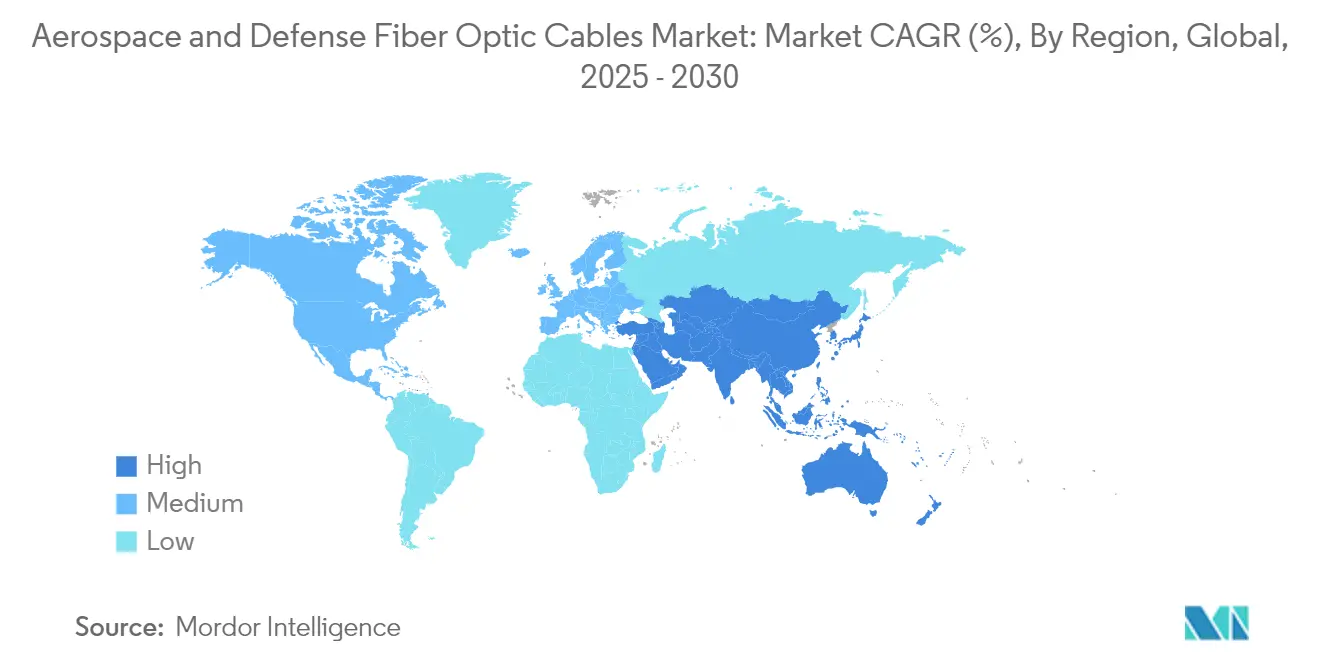
Throughout the forecast period, Asia Pacific is expected to dominate the market for aerospace and defense fiber optic cables. China and India are channeling significant investments into various programs, from aircraft and C4I systems to mission support and space-based initiatives, solidifying the region's market leadership. Major players such as Amphenol, Carlisle Interconnect Technologies, and Corning Optical Communications, all anchored in the Asia-Pacific region, further fortify the market's prowess.
Asia-Pacific is the swiftest-growing hub for military and aerospace fiber optic cables. This growth is predominantly steered by the robust economies of China and India, their escalating defense investments, heightened interest from global and local players, and a surge in R&D endeavors.
Regional challenges, such as insurgencies, territorial disputes, and political tensions, further boost the demand. When combined with favorable regulatory landscapes, these factors significantly enhance the appeal of the Asia-Pacific market for aerospace and defense fiber optic cables.

Competitive Landscape
The market for aerospace and defense fiber optic cables is semi-consolidated. The major players include Amphenol Corporation, RTX Corporation, Prysmian Group, Corning Incorporated, and OFS Fitel, LLC.
Market players are bolstering their product portfolios and striving for a lasting competitive edge through strategic moves like partnerships and acquisitions. In February 2024, RTX Corporation partnered with the US Air Force. Their goal is to pioneer high-power lasers, setting the stage for future military applications. This collaboration promises to steer advancements in fiber optic technologies, particularly in defense applications.
Aerospace And Defense Fiber Optic Cables Industry Leaders
Amphenol Corporation
RTX Corporation
Corning Incorporated
OFS Fitel, LLC.
Prysmian Group
- *Disclaimer: Major Players sorted in no particular order

Recent Industry Developments
- August 2024: Corning and Lumen finalized an agreement for next-generation fiber-optic cable supply. The agreement is expected to more than double Lumen’s intercity network miles, enabling advancements in AI capabilities for cloud data centers, enterprises, and public agencies. The deployment of this high-capacity fiber cable will significantly expand Lumen’s intercity fiber network in the US, enhancing the infrastructure of major cloud data centers. These centers are striving to accommodate increasing AI workloads and high-bandwidth applications driven by exponential data growth.
- January 2024: Amphenol Corporation unveiled a new line of high-performance fiber optic connectors tailored for demanding military and aerospace settings, underscoring their commitment to innovation.


Global Aerospace And Defense Fiber Optic Cables Market Report Scope
Fiber optic technology transmits data using highly flexible, transparent fibers of extruded glass or plastic. Fiber optic cables incorporate glass threads as thin as human hair, transmitting messages modulated into light waves. Although these cables are made of glass, they are highly durable and malleable.
The market for aerospace and defense fiber optic cables is segmented by application, type, and geography. By application, the market is segmented into communication systems, avionics, weapon systems, surveillance and reconnaissance, and electronic warfare. By type, the market is segmented into single-mode and multi-mode. The report also covers the market sizes and forecasts in major countries across different regions. For each segment, the market sizing and forecasts have been done on the basis of value (USD).
| Communication Systems |
| Avionics |
| Weapon Systems |
| Surveillance and Reconnaissance |
| Electronic Warfare |
| Single-mode |
| Multi-mode |
| North America | US |
| Canada | |
| Europe | United Kingdom |
| France | |
| Germany | |
| Russia | |
| Rest of Europe | |
| Asia-Pacific | China |
| India | |
| Japan | |
| South Korea | |
| Rest of Asia-Pacific | |
| Latin America | Brazil |
| Rest of Latin America | |
| Middle East and Africa | Saudi Arabia |
| United Arab Emirates | |
| Rest of Middle East and Africa |
| Application | Communication Systems | |
| Avionics | ||
| Weapon Systems | ||
| Surveillance and Reconnaissance | ||
| Electronic Warfare | ||
| Type | Single-mode | |
| Multi-mode | ||
| Geography | North America | US |
| Canada | ||
| Europe | United Kingdom | |
| France | ||
| Germany | ||
| Russia | ||
| Rest of Europe | ||
| Asia-Pacific | China | |
| India | ||
| Japan | ||
| South Korea | ||
| Rest of Asia-Pacific | ||
| Latin America | Brazil | |
| Rest of Latin America | ||
| Middle East and Africa | Saudi Arabia | |
| United Arab Emirates | ||
| Rest of Middle East and Africa | ||


Key Questions Answered in the Report
How big is the Aerospace And Defense Fiber Optic Cables Market?
The Aerospace And Defense Fiber Optic Cables Market size is expected to reach USD 5.15 billion in 2025 and grow at a CAGR of 8.03% to reach USD 7.58 billion by 2030.
What is the current Aerospace And Defense Fiber Optic Cables Market size?
In 2025, the Aerospace And Defense Fiber Optic Cables Market size is expected to reach USD 5.15 billion.
Who are the key players in Aerospace And Defense Fiber Optic Cables Market?
Amphenol Corporation, RTX Corporation, Corning Incorporated, OFS Fitel, LLC. and Prysmian Group are the major companies operating in the Aerospace And Defense Fiber Optic Cables Market.
Which is the fastest growing region in Aerospace And Defense Fiber Optic Cables Market?
North America is estimated to grow at the highest CAGR over the forecast period (2025-2030).
Which region has the biggest share in Aerospace And Defense Fiber Optic Cables Market?
In 2025, the Asia Pacific accounts for the largest market share in Aerospace And Defense Fiber Optic Cables Market.
What years does this Aerospace And Defense Fiber Optic Cables Market cover, and what was the market size in 2024?
In 2024, the Aerospace And Defense Fiber Optic Cables Market size was estimated at USD 4.74 billion. The report covers the Aerospace And Defense Fiber Optic Cables Market historical market size for years: 2020, 2021, 2022, 2023 and 2024. The report also forecasts the Aerospace And Defense Fiber Optic Cables Market size for years: 2025, 2026, 2027, 2028, 2029 and 2030.
Page last updated on:
Aerospace And Defense Fiber Optic Cables Market Report
Statistics for the 2025 Aerospace And Defense Fiber Optic Cables market share, size and revenue growth rate, created by Mordor Intelligence™ Industry Reports. Aerospace And Defense Fiber Optic Cables analysis includes a market forecast outlook for 2025 to 2030 and historical overview. Get a sample of this industry analysis as a free report PDF download.





