
Mergers And Acquisitions In Aerospace And Defense Market Size and Share
Market Overview
| Study Period | 2020 - 2031 |
|---|---|
| Market Size (2026) | USD 243.48 Billion |
| Market Size (2031) | USD 423.21 Billion |
| Growth Rate (2026 - 2031) | 11.69 % |
| Fastest Growing Market | Europe |
| Largest Market | North America |
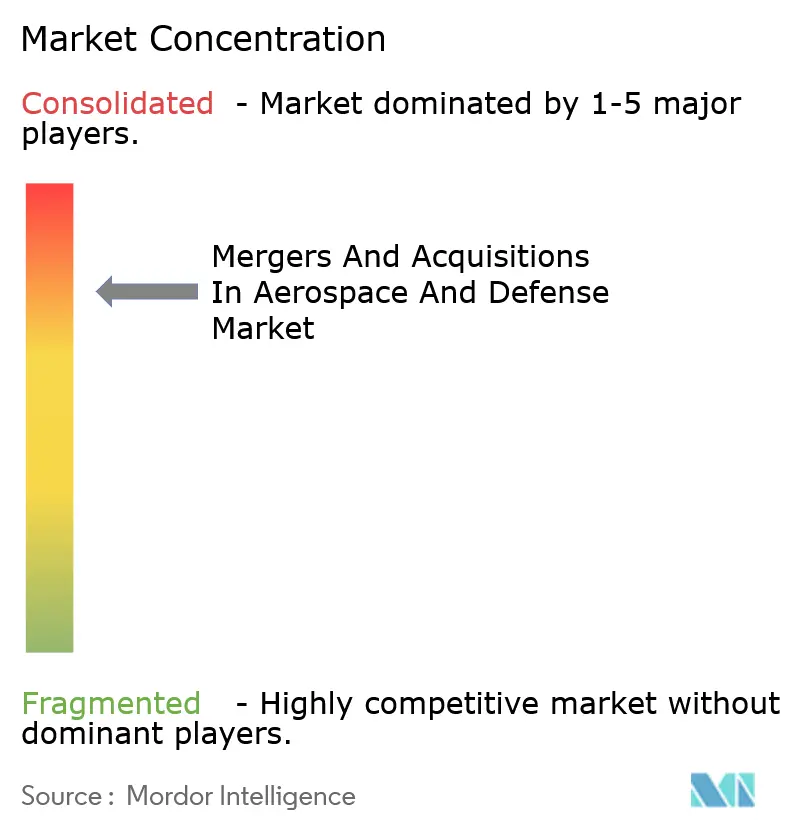
| Market Concentration | High |
Major Players *Disclaimer: Major Players sorted in no particular order Image © Mordor Intelligence. Reuse requires attribution under CC BY 4.0. | |
Mergers And Acquisitions In Aerospace And Defense Market Analysis by Mordor Intelligence
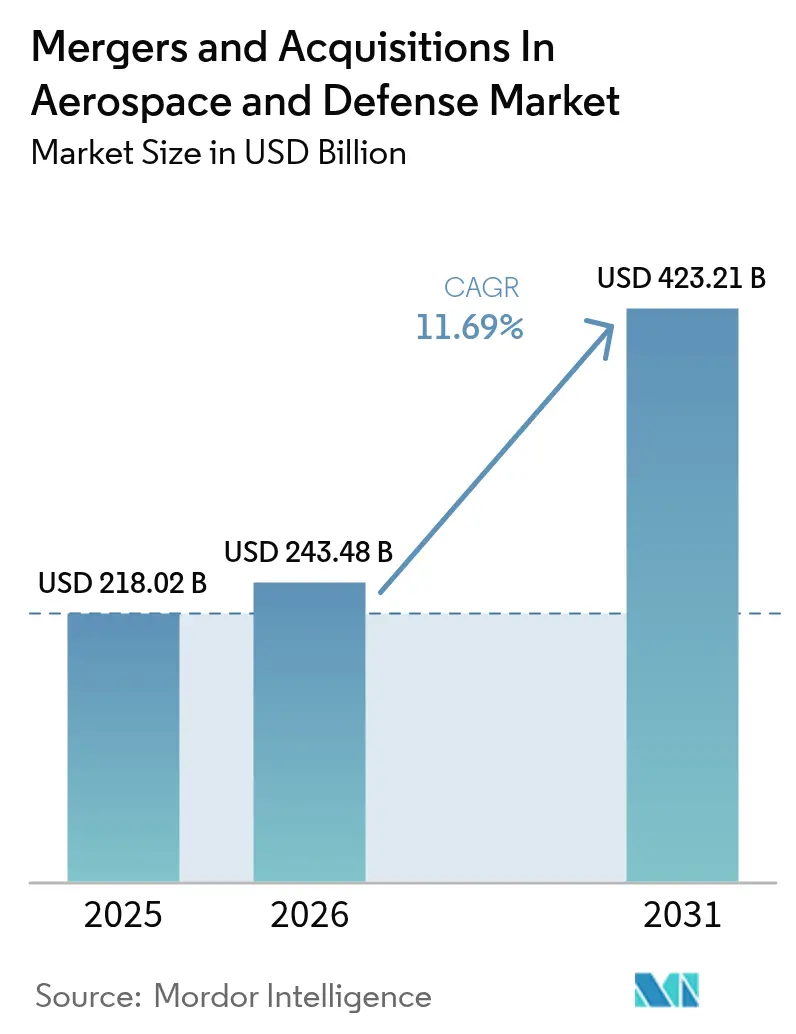
The Mergers And Acquisitions In Aerospace And Defense Market size was valued at USD 218.02 billion in 2025 and estimated to grow from USD 243.48 billion in 2026 to reach USD 423.21 billion by 2031, at a CAGR of 11.69% during the forecast period (2026-2031).
The aerospace and defense mergers and acquisitions landscape has undergone significant transformation, shifting away from traditional megamergers focused on cost savings toward strategic acquisitions aimed at product innovation and global market expansion. This evolution reflects broader industry trends, with Lazard's Aerospace and Defense Investment Banking Group reporting 148 M&A transactions announced as of May 2022. The industry's strategic focus has particularly intensified on supply chain resilience and technological advancement, with companies increasingly pursuing targeted acquisitions to secure critical capabilities and minimize disruption risks.
The market dynamics are being reshaped by the growing influence of private equity firms in aerospace M&A activities. Private equity transactions in the United States alone totaled USD 19.3 billion by the end of June 2022, demonstrating the sector's attractiveness to institutional investors. These investors are adopting more innovative approaches to capital deployment, including longer-term investment horizons, particularly in areas experiencing rapid technological advancement and market disruption. This trend is fostering a more diverse and competitive M&A environment, with private equity firms playing a crucial role in industry consolidation and technological innovation.
Cross-border transactions have emerged as a significant trend in the aerospace and defense mergers and acquisitions landscape, with US companies engaging in transactions worth USD 1.2 billion in the first half of 2022. Notable transactions include Airbus Helicopters' acquisition of German-based ZF Luftfahrttechnik in January 2023, strengthening their position in helicopter dynamic components and MRO services. These international deals reflect a broader industry strategy to enhance global market presence, access new technologies, and strengthen supply chain resilience across different geographical regions.
The industry is witnessing a strategic shift toward smaller, technology-focused acquisitions aimed at enhancing capabilities in emerging technologies and digital transformation. This trend is exemplified by recent transactions such as Abu Dhabi's ADQ combining four aviation companies to create a global firm with assets of USD 2.6 billion in October 2022, focusing on integrated maintenance, repair, and overhaul services. Companies are increasingly prioritizing acquisitions that provide access to advanced technologies in areas such as autonomous systems, artificial intelligence, and cybersecurity, reflecting the industry's evolution toward more sophisticated and digitally-enabled solutions. This strategic focus is indicative of the growing aerospace and defense market size and its potential for future growth.
Note: Market size and forecast figures in this report are generated using Mordor Intelligence’s proprietary estimation framework, updated with the latest available data and insights as of 2026.
Market Trends and Insights
Growing Focus of Aerospace and Defense OEMs on Business Expansion through Mergers and Acquisitions
The aerospace companies and defense sector has witnessed a significant transformation in its approach to aerospace acquisitions, shifting from traditional megamergers focused on cost savings to strategic acquisitions aimed at expanding product portfolios and global market presence. This evolution is evident in recent major aerospace and defense transactions, such as BAE Systems PLC's acquisition of Ball Aerospace for USD 5.5 billion in February 2024, which significantly enhanced their space and defense capabilities through the new Space and Mission Systems division. Similarly, Parker-Hannifin Corporation's acquisition of Meggitt PLC for approximately GBP 6.3 billion has enabled the expansion of their aerospace portfolio with advanced defense and aerospace technologies, demonstrating the industry's focus on technological advancement through strategic acquisitions.
The industry has also witnessed a surge in strategic mergers aimed at innovation and market expansion, as exemplified by the March 2024 merger between XTI Aircraft Company and Inpixon to form XTI Aerospace Inc., focusing on revolutionary private air transportation solutions. This trend extends to specialized technological acquisitions, as demonstrated by THALES's USD 1.1 billion acquisition of Cobham Aerospace Communications in February 2024, which aims to advance connected cockpit technologies. These strategic moves reflect the industry's shift towards acquiring smaller players with niche capabilities to enhance technological expertise and reduce supplier dependence, ultimately strengthening their competitive position in the global market.
Governmental Policies Encouraging Growth in the Market Studied
Government initiatives worldwide are actively reshaping the aerospace and defense industry landscape by implementing policies that promote domestic manufacturing capabilities and international collaboration. In response to rising global tensions and supply chain vulnerabilities, democratic governments are introducing comprehensive policies to strengthen national defense manufacturing capabilities, particularly focusing on Tier 2 and 3 suppliers rather than just OEMs. These policies have led to increased opportunities for cross-border industrial cooperation, especially in Europe, where common security concerns have fostered greater collaboration among nations in defense manufacturing and technology development.
The impact of governmental support is particularly evident in emerging markets, where policies are being formulated to encourage foreign defense manufacturers to collaborate with local companies and establish subsidiaries. For instance, the Indian government has implemented policies to promote the indigenization of defense production, resulting in the approval of 45 companies/joint ventures operating in the defense sector with foreign OEMs. These initiatives are complemented by various governments' focus on forming strategic alliances to accelerate technological advancement and economic growth, while simultaneously addressing supply chain vulnerabilities through policies that encourage shorter, more resilient supply chains and stronger national capabilities in defense manufacturing.
Mergers And Acquisitions In Aerospace And Defense Market Segment Analysis
Defense Segment in Mergers and Acquisitions (M&A) in Aerospace and Defense Market
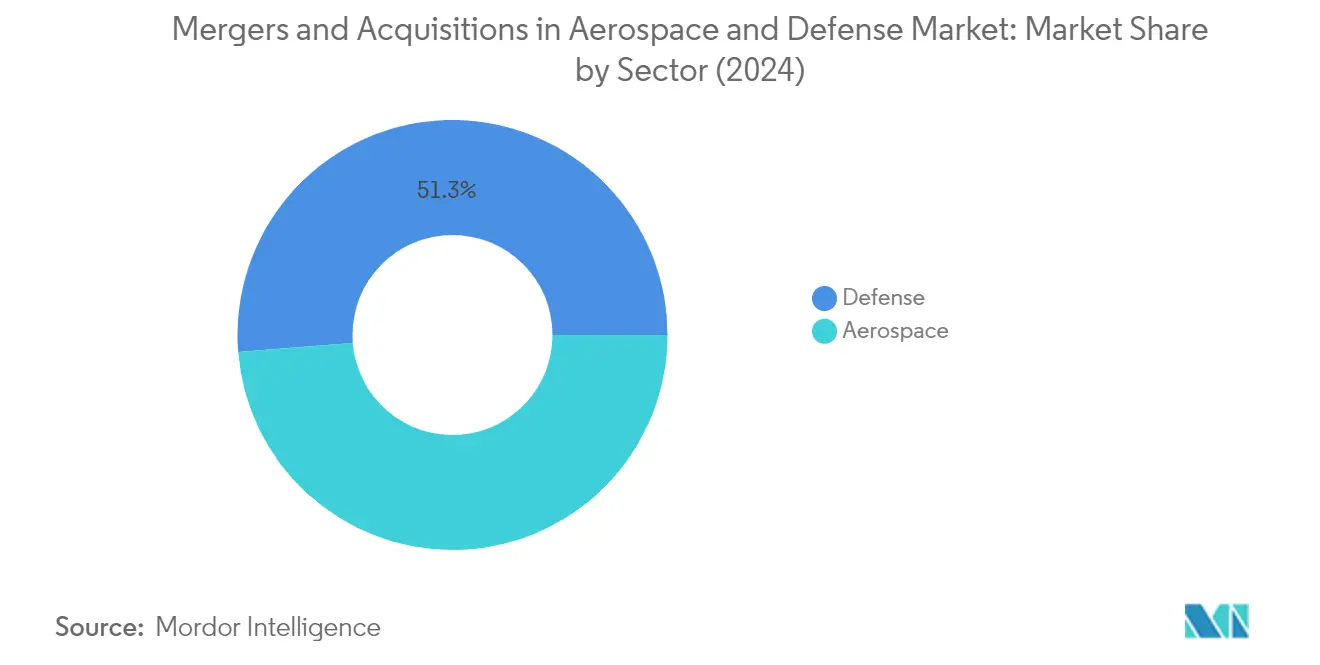
The defense segment continues to dominate the mergers and acquisitions in aerospace and defense Market, holding approximately 50.62% market share in 2025. Increasing cross-border conflicts drive this significant market position, rising concerns about terrorism, and growing political disputes among neighboring countries, which have led to an enhanced focus on strengthening defense capabilities worldwide. Substantial defense budget allocations from major powers and the strategic importance of acquisition in the defense industry further reinforce the segment's prominence. Key players in the defense sector are actively pursuing mergers and acquisitions (M&A) in defense to expand their technological capabilities, particularly in areas such as unmanned systems, cybersecurity, and advanced weapons systems. The defense segment's robust performance is also supported by governmental policies encouraging domestic defense manufacturing capabilities and the consolidation of defense industrial bases across major markets.
Aerospace Segment in Mergers and Acquisitions in Aerospace and Defense Market
The aerospace segment is demonstrating remarkable growth momentum in the M&A landscape, with an anticipated growth rate of approximately 13.62% during the forecast period 2026-2031. This accelerated growth is primarily driven by the increasing focus of aerospace companies on acquiring start-ups and innovative technology firms to enhance their product portfolios and technological capabilities. The segment's growth is further fueled by the rising demand for commercial aviation, the expansion of maintenance, repair, and overhaul (MRO) capabilities, and the growing emphasis on sustainable aviation technologies. Strategic mergers in aerospace in the aerospace sector are increasingly targeting companies specializing in electric propulsion, advanced materials, and digital technologies, reflecting the industry's shift towards more sustainable and technologically advanced solutions. The segment is also witnessing significant M&A activity in the space technology domain, as companies seek to capitalize on the growing commercial space market opportunities. This reflects the overall expansion of the aerospace and defense market size.
Geography Analysis
North America Mergers and Acquisitions in Aerospace and Defense Market
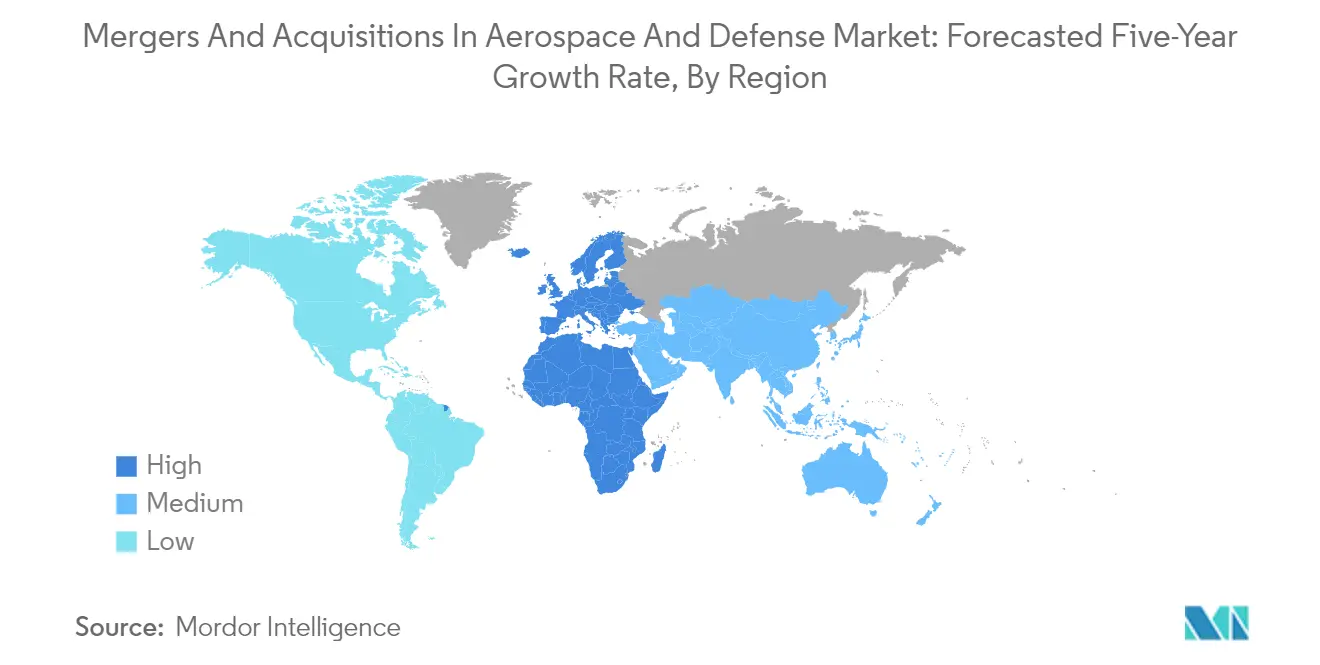
North America continues to dominate the global aerospace and defense market size, commanding approximately 62.34% of the global market share in 2025. The region's prominence is largely attributed to the presence of major aerospace OEMs and their extensive supplier networks across the United States and Canada. The mature and fragmented nature of the A&D sector in this region has created an environment where several global and regional players actively pursue aerospace mergers and acquisitions. The focus has notably shifted from megamergers towards targeted acquisitions that deliver new products and technological capabilities. The region's robust defense infrastructure and continuous technological advancement initiatives have made it particularly attractive for tier suppliers looking to penetrate the market through aerospace and defense M&A activities. The presence of stringent regulatory frameworks and sophisticated financial markets further facilitates structured deal-making processes. Additionally, the strong emphasis on supply chain sustainability and adaptation to geopolitical changes has made M&A an essential tool for industrial transformation in the region.
Europe Mergers and Acquisitions in Aerospace and Defense Market
The European mergers and acquisitions in aerospace and defense market has demonstrated remarkable resilience and growth, achieving an approximate 14.58% annual growth rate from 2026 to 2031. The region's M&A landscape is characterized by a well-established aviation and defense sector, supported by the presence of industry giants like Airbus SE, BAE Systems, and Thales. The European market has witnessed a strategic transformation in recent years, with companies increasingly focusing on consolidating supplier bases to enhance operational efficiency. The region's unique political and economic framework, particularly within the European Union, has created opportunities for cross-border collaborations and strategic partnerships. The presence of advanced research and development capabilities, coupled with strong governmental support for defense modernization initiatives, has made European companies attractive targets for strategic acquisitions. The market has also seen increased activity in emerging sectors, such as space technology, drone systems, and cybersecurity, driving further aerospace mergers and acquisitions (M&A) deals.
APAC Mergers and Acquisitions in Aerospace and Defense Market
The Asia-Pacific region is one of the most dynamic markets for mergers and acquisitions in the aerospace and defense sectors, with a projected growth rate of approximately 11.53% from 2026 to 2031. The region's M&A landscape is characterized by increasing investments in both civil aviation and defense sectors, driven by rising air passenger traffic and growing defense modernization programs. The market dynamics are shaped by the presence of emerging economic powerhouses like China and India, which are actively pursuing self-reliance in aerospace and defense capabilities. The region's strategic importance in global trade and security has attracted significant attention from international players looking to establish or expand their presence through strategic acquisitions. Local companies are increasingly seeking partnerships and acquisitions to enhance their technological capabilities and expand their market presence. The trend towards indigenous development of aerospace and defense capabilities has created numerous opportunities for technology-focused acquisitions and strategic partnerships.
LATAM Mergers and Acquisitions in Aerospace and Defense Market
The Latin American mergers and acquisitions in aerospace and defense market exhibit significant potential for growth, driven by increasing modernization efforts in both civil aviation and military sectors. The region's market dynamics are characterized by a growing focus on enhancing domestic aerospace and defense capabilities through strategic partnerships and acquisitions. Countries such as Brazil, Mexico, and Chile are leading the transformation by actively pursuing policies that encourage technology transfer and industrial cooperation through mergers and acquisitions (M&A) activities. The market has witnessed increased interest from international players looking to establish regional manufacturing and maintenance capabilities. The growing emphasis on developing indigenous aerospace and defense capabilities has created opportunities for strategic acquisitions, particularly in areas such as aircraft maintenance, repair, and overhaul (MRO) services. The region's evolving regulatory environment and increasing defense budgets have created favorable conditions for defense mergers.
MEA Mergers and Acquisitions in Aerospace and Defense Market
The Middle East and African region presents unique opportunities in mergers and acquisitions in aerospace and defense landscape, driven by ambitious modernization programs and an increasing focus on developing indigenous capabilities. The market is characterized by significant investments in aviation infrastructure and defense modernization, particularly in Gulf Cooperation Council (GCC) countries. The region's strategic position and growing emphasis on diversifying economies beyond traditional sectors have created favorable conditions for mergers and acquisitions (M&A) activities. Countries are actively pursuing partnerships and acquisitions to enhance their technological capabilities and develop local aerospace and defense industries. The market has witnessed increased interest in areas such as maintenance, repair, and overhaul (MRO) facilities, defense electronics, and unmanned systems. The growing focus on localization of manufacturing and maintenance capabilities has created opportunities for strategic acquisitions and joint ventures.
Competitive Landscape
Top Companies in Mergers and Acquisitions in Aerospace and Defense Market
The market is dominated by major players including Boeing Company, Raytheon Technologies, Airbus SE, General Electric, Safran SA, BAE Systems, Parker Hannifin, L3Harris Technologies, Leonardo SpA, and Thales. These aerospace companies are actively pursuing innovation through strategic acquisitions of smaller technology-focused firms, particularly in areas like unmanned systems, cybersecurity, and advanced materials. The industry leaders are demonstrating operational agility by streamlining their supply chains and integrating acquired capabilities into their existing portfolios. Companies are increasingly focusing on cross-border acquisitions to expand their global footprint and access new markets, particularly in the Asia-Pacific and Middle East regions. Strategic moves include vertical integration through the acquisition of key suppliers, investment in emerging technologies like autonomous systems and artificial intelligence, and expansion of MRO capabilities through targeted acquisitions of specialized service providers.
Market Consolidation Drives Industry Evolution and Growth
The aerospace and defense M&A landscape is characterized by a mix of global conglomerates and specialized players, with the major conglomerates holding significant market share through their diverse portfolios and extensive geographic presence. The market structure shows a high degree of consolidation at the top tier, with several large players dominating the global landscape, while the middle and lower tiers remain relatively fragmented with numerous specialized companies focusing on specific technologies or regional markets. The industry is witnessing a shift from megamergers focused on cost savings to strategic acquisitions aimed at acquiring new capabilities and technologies, particularly in emerging areas like unmanned systems, cybersecurity, and advanced materials.
The M&A activity in the sector is increasingly being shaped by geopolitical factors, supply chain considerations, and technological advancement needs. Companies are adopting more aggressive acquisition strategies to gain major contracts and increase their market presence, with a particular focus on acquiring smaller players with niche capabilities. Private equity firms are playing an increasingly important role in the market, bringing new perspectives and longer-term investment horizons to the industry. The market is also seeing a trend towards cross-sector collaborations, where traditional aerospace and defense companies are acquiring or partnering with technology firms to enhance their digital capabilities and innovation potential. The role of aerospace and defense M&A advisory services is becoming crucial in navigating these complex transactions.
Innovation and Agility Key to Future Success
For incumbent players to maintain and increase their market share, the focus needs to be on strategic capability acquisition and technological innovation. Companies must develop robust strategies for identifying and integrating smaller, innovative firms while maintaining operational efficiency and customer relationships. Success factors include the ability to navigate complex regulatory environments, maintain strong relationships with government customers, and effectively manage supply chain risks. Companies need to balance between organic growth and strategic acquisitions, while also investing in research and development to stay ahead of technological curves.
For contenders looking to gain ground, the key lies in developing specialized capabilities and establishing strong positions in emerging technology areas. These companies need to focus on building strong intellectual property portfolios and developing unique value propositions that address specific market needs or technological gaps. Success will depend on the ability to form strategic partnerships, maintain operational flexibility, and demonstrate clear value differentiation. Companies must also consider the increasing importance of environmental sustainability and digital transformation in their growth strategies, while being prepared to adapt to evolving regulatory requirements and changing customer preferences in both commercial and defense sectors. The presence of a defense industry M&A advisor can significantly aid in these strategic endeavors.
Mergers And Acquisitions In Aerospace And Defense Industry Leaders
-
Parker Hannifin Corporation
-
The Boeing Company
-
Airbus SE
-
RTX Corporation
-
Safran SA
- *Disclaimer: Major Players sorted in no particular order
Mergers And Acquisitions In Aerospace And Defense Market Companies Covered in this Report
- The Boeing Company
- RTX Corporation
- Airbus SE
- General Electric Company
- Safran SA
- BAE Systems PLC
- Parker Hannifin Corporation
- L3Harris Technologies Inc.
- Leonardo SpA
- THALES
- Elbit Systems Ltd
- Rolls-Royce PLC
- Honeywell International Inc.
- Rheinmetall AG
Market Opportunities and Future Outlook
Aerospace and defense dealmaking continues to drive capability rationalization across autonomous, undersea, and space-enabled systems, with secure communications and digital modernization as recurring themes. In July 2026, Lockheed Martin agreed to acquire Ultra Maritime for USD 3.45 billion, which targets deeper undersea warfare capabilities and closer integration with maritime platforms. Thales also announced an agreement to acquire a 35.5 percent stake in underwater drone maker Exail Technologies ahead of a tender offer in July 2026, reflecting consolidation momentum in marine autonomy.
More broadly, Iridium completed its acquisition of Aireon in July 2026, linking space-based surveillance with its satellite communications network and expanding data service footprints in aviation. Along the supply chain, defense industrial base expansion spending and allied rearmament programs support vertical integration and add-on acquisitions across propulsion, controls, and sustainment, while MRO and extend-life capabilities, digitization, cybersecurity, and AI-enabled operational tools are being absorbed within existing portfolios.
Recent Industry Developments in Mergers And Acquisitions In Aerospace And Defense Market
- July 2026: Lockheed Martin signed a definitive agreement to acquire Ultra Maritime for USD 3.45 billion, expanding its undersea warfare technology footprint. The deal strengthens vertical integration in maritime sensing and combat systems and increases competitive positioning in a domain where autonomy and undersea capabilities are central to modernization priorities.
- July 2026: Thales announced an agreement to acquire a 35.5% stake in underwater drone maker Exail Technologies ahead of a tender offer. The stake points to continued consolidation in European defense electronics and expands Exail's access to broader platform ecosystems.
- July 2026: Iridium completed its acquisition of Aireon, combining space-based air traffic surveillance with its satellite communications network. The integration expands global aviation connectivity and data services, enabling new service propositions and interoperability with next-generation aircraft.
Mergers And Acquisitions In Aerospace And Defense Market Report Scope and Research Methodology
Market Definition and Coverage
This market is defined as the total announced transaction value linked to mergers and acquisitions involving aerospace and defense businesses, counted for the year the deal is announced and expressed in USD.
Scope exclusions: Deals outside aerospace and defense (even if the buyer is active in the sector), minority portfolio moves that do not transfer control, and pure financing rounds are excluded from the market value.
Segments Covered in This Report
- Sector
- Aerospace
- Defense
- Geography
- North America
- Europe
- Asia-Pacific
- Latin America
- Middle East and Africa
Data Sources, Market Sizing, and Validation
Desk Research
Desk work started with building a clean list of deals, subsector tags, and country mapping, then aligning each entry to a consistent definition of transaction value. Public sources were used to anchor the model, including national securities regulators and stock exchange filings, defense procurement and budget publications, government trade and industrial output statistics, and reputable patent databases as activity signals. We also reviewed association websites and peer reviewed journals focused on the defense industrial base, and then checked company annual reports, investor presentations, and press releases for deal terms and timing.
Where values were unclear, we used paid subscriptions for company financials and intelligence, a news and financials feed, and a global contracts and tenders database selectively to cross-check ownership changes and confirm whether a target mainly serves aerospace, defense, or adjacent end markets. This reduced double counting when the same transaction appears across multiple trackers with different value fields. The desk sources listed here are illustrative only, and other public materials were also reviewed for data collection, validation, and clarification.
Primary Interviews and Surveys
Primary interviews focused on how transaction values are reported and how mixed-revenue targets should be allocated to aerospace and defense. We spoke with corporate development teams, investment bankers, sector advisors, and senior managers from supplier and services firms across APAC, EMEA, and the Americas, then used those inputs to confirm assumptions on deal timing (announced versus closed), and typical adjustments when earn-outs are disclosed after the initial announcement.
Distribution of primary research fieldwork respondents
| Company type | Respondent position | Region |
|---|---|---|
| Top tier: 39% | CXOs: 15% | APAC: 49% |
| Mid tier: 45% | Functional/Unit leaders: 34% | EMEA: 29% |
| Smaller Players: 16% | Managers: 51% | Americas: 22% |
Market-Sizing & Forecasting
Sizing used a top-down approach where deal activity was reconstructed from announced transaction values and then filtered through sector relevance rules, deal timing rules, and currency normalization to USD. For mixed targets, revenue exposure to aerospace and defense was used as an allocation key when it could be supported by filings or credible disclosures, and otherwise a conservative activity-based split was applied using interview feedback.
To keep the model grounded, we tracked inputs such as announced enterprise value versus equity value disclosure patterns, share of cross-border deals, subsector mix shifts (platforms, components, electronics, and services), defense budget direction as a demand backdrop, and interest rate and financing conditions that affect buyer appetite. Forecasts were built using scenario analysis, because A&D M&A is sensitive to a limited set of shock drivers, and each scenario was tied to how experts expect budgets, supply chain constraints, and valuation multiples to move. Results were then corroborated with selective bottom-up approximations, including sampled deal value roll-ups by region and a reasonableness check using average deal values times expected deal counts where public counts were available. When values were missing for private deals, ranges were applied and later narrowed through follow-up checks and consistency rules.
Data Validation & Update Cycle
Outputs were checked against independent signals, including year-over-year changes in total deal value, visible mega-deal concentration, and region shares that should align with where A&D production and procurement are strongest. If an outlier appeared, the deal list was re-reviewed to confirm sector tagging, eliminate duplicates, and verify the currency conversion date and value type used.
Before sign-off, a second analyst reviews assumptions and reruns key sensitivities so the model is not over-dependent on a single input. Reports are refreshed annually, and interim updates are triggered when material events occur, such as a sudden jump in mega-deals or major policy shifts that change defense spending expectations. Right before delivery, a final pass is completed so clients receive the latest updated view.
Mordor Intelligence's Aerospace and Defense Mergers and Acquisitions Market Sizing Compared With Other Published Estimates
Published estimates for A&D M&A often vary because the scope line is drawn differently, and because some sources track deal value as a flow metric while others convert it into a broader market value view. Differences also come from how mixed-business targets are allocated, whether announced or closed dates are used, and what is done when private deal values are undisclosed.
By tracking deal-level announcement timing, value type consistency, and revenue exposure splits, Mordor Intelligence keeps the 2025 total tied to transactions that are clearly in-scope, instead of letting adjacent industrial deals inflate the sum. The spread in the table below is mainly explained by geography coverage, how mega-deals are treated, and whether conservative imputation is applied to undisclosed values.
Benchmark comparison
| Source | Market Size | Gaps in Research Methodology |
|---|---|---|
| Mordor Intelligence | USD 218.02 B (2025) | |
| Industry Research Publisher A | USD 55.00 B (2024) | Uses a narrower interpretation closer to tracked deal value totals, and it appears to undercount private transactions where values are not disclosed, which keeps the headline smaller and anchored to a different year. |
| Professional Services Firm B | USD 32.00 B (2026) | US-focused deal pace estimate that reflects only one geography and a short time window, so it does not represent global activity or a full market view across regions. |
Taken together, the comparison shows that scope and counting rules move the number more than arithmetic does. When the model is built around a consistent deal list, clear allocation for mixed targets, and repeatable currency timing, the final value is easier to explain and to update as new deals are announced.
Key Questions Answered in the Report
How big is the Mergers And Acquisitions In Aerospace And Defense Market?
The Mergers And Acquisitions In Aerospace And Defense Market size is expected to reach USD 243.48 billion in 2026 and grow at a CAGR of 11.69% to reach USD 423.21 billion by 2031.
What is the current Mergers And Acquisitions In Aerospace And Defense Market size?
In 2026, the Mergers And Acquisitions In Aerospace And Defense Market size is expected to reach USD 243.48 billion.
Who are the key players in Mergers And Acquisitions In Aerospace And Defense Market?
Parker Hannifin Corporation, The Boeing Company, Airbus SE, RTX Corporation and Safran SA are the major companies operating in the Mergers And Acquisitions In Aerospace And Defense Market.
Which is the fastest growing region in Mergers And Acquisitions In Aerospace And Defense Market?
Europe is estimated to grow at the highest CAGR over the forecast period (2026-2031).
Which region has the biggest share in Mergers And Acquisitions In Aerospace And Defense Market?
In 2025, the North America accounts for the largest market share in Mergers And Acquisitions In Aerospace And Defense Market.
What years does this Mergers And Acquisitions In Aerospace And Defense Market cover, and what was the market size in 2025?
In 2025, the Mergers And Acquisitions In Aerospace And Defense Market size was estimated at USD 218.02 billion. The report covers the Mergers And Acquisitions In Aerospace And Defense Market historical market size for years: 2019, 2020, 2021, 2022, 2023, 2024 and 2025. The report also forecasts the Mergers And Acquisitions In Aerospace And Defense Market size for years: 2026, 2027, 2028, 2029, 2030 and 2031.