
5G In Defense Market Size and Share
| Study Period | 2019 - 2030 |
| Market Size (2025) | USD 1.58 Billion |
| Market Size (2030) | USD 4.24 Billion |
| CAGR (2025 - 2030) | 21.77% |
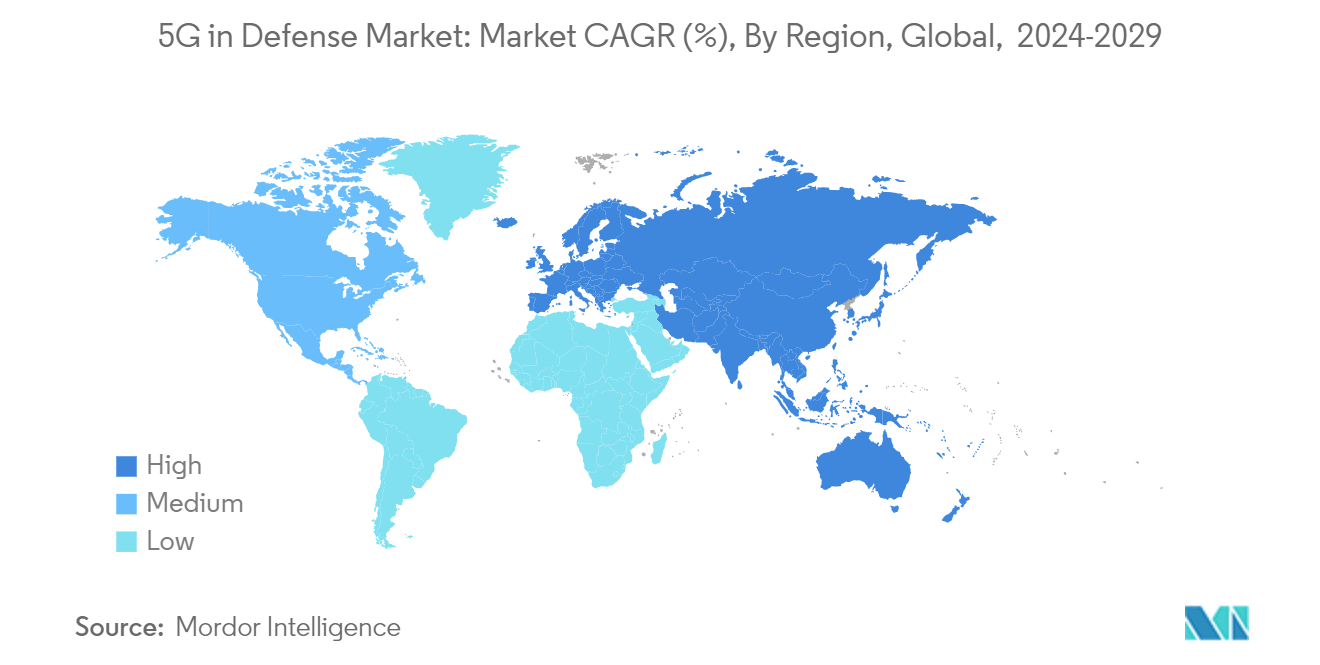
| Fastest Growing Market | Europe |
| Largest Market | North America |
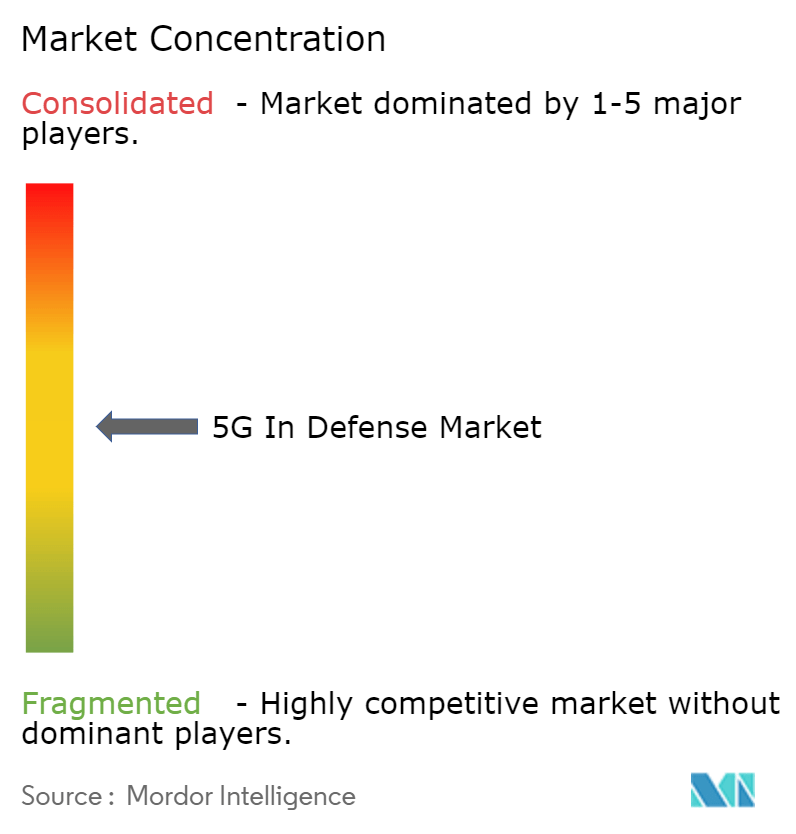
| Market Concentration | Medium |
Major Players *Disclaimer: Major Players sorted in no particular order |
5G In Defense Market Analysis by Mordor Intelligence
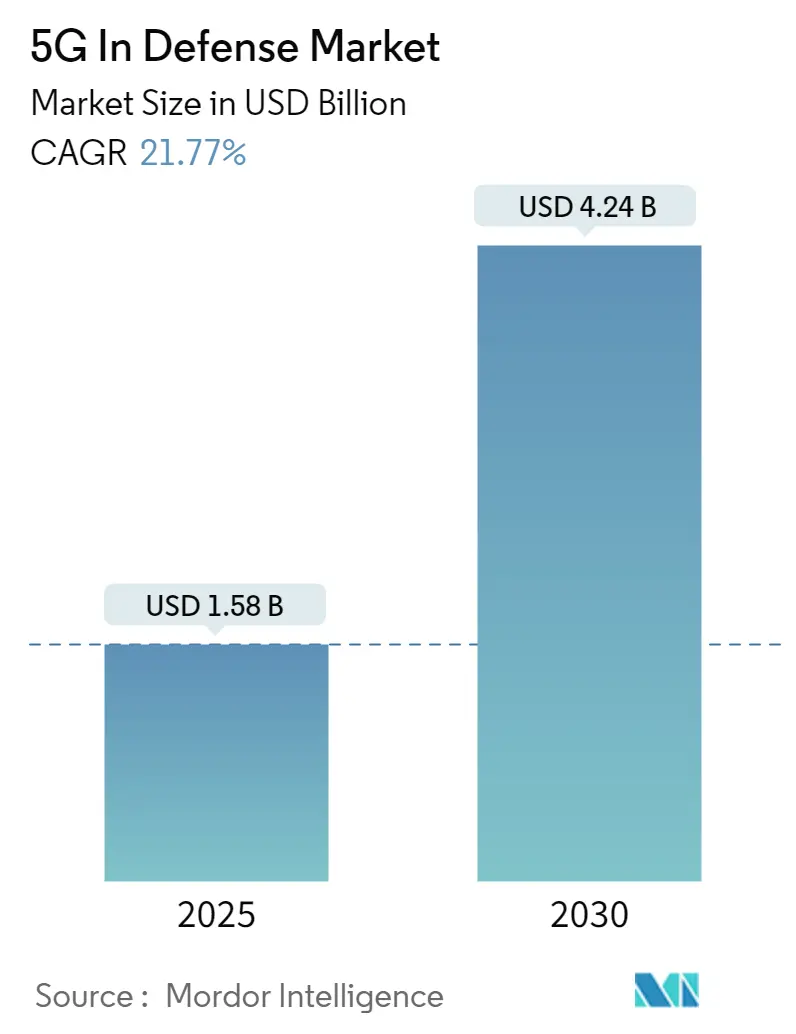
The 5G In Defense Market size is estimated at USD 1.58 billion in 2025, and is expected to reach USD 4.24 billion by 2030, at a CAGR of 21.77% during the forecast period (2025-2030).
Integrating 5G technology into defense operations marks a pivotal leap in military communications. This shift bolsters command and control enables real-time data sharing and supports the deployment of autonomous systems. The military's push for these cutting-edge communication technologies is driven by a pressing objective: to boost situational awareness and operational efficiency in today's intricate and swiftly evolving landscape.
5G technology surpasses its predecessors, offering reduced latency, increased bandwidth, and the ability to connect numerous devices simultaneously. These attributes are vital in defense contexts, where rapid decision-making and swift data exchange can be critical. As a result, defense agencies worldwide are actively pursuing 5G to enhance their operational capabilities.
However, the path to 5G adoption in defense is fraught with challenges. Agencies face hurdles such as cybersecurity threats, high infrastructure costs, spectrum allocation issues, and the need to ensure compatibility with existing legacy systems. Additionally, concerns about data privacy and potential vulnerabilities in the supply chain further complicate the deployment of this technology.
Demand for defense programs is set to drive interoperability in the defense market. 5G networks enable end-to-end slicing tailored for specific users. These slices can be customized to meet the performance requirements of programs like autonomous vehicles and automated process technologies.
Nonetheless, the substantial costs associated with establishing 5G infrastructure could hinder market growth in the coming years.
Global 5G In Defense Market Trends and Insights
Airborne Segment to Register the Highest CAGR During the Forecast Period
5G's ultra-low latency is crucial for the precise remote control of UAVs during critical moments. Furthermore, 5G ensures seamless data exchange between airborne units and ground or naval forces. This collaboration creates a unified combat perspective and enhances the efficiency of joint operations. Moreover, the technology facilitates communication among multiple drones, enabling synchronized swarm operations. These coordinated drone clusters excel in tasks, including surveillance, electronic warfare, and direct offensive maneuvers.
Contemporary defense strategies are increasingly leaning towards network-centric warfare. In this paradigm, multiple systems share data and operational information in real-time. Airborne assets, such as drones and surveillance aircraft equipped with 5G capabilities, play a pivotal role in this strategy. They seamlessly connect ground stations and command centers with live data feeds, enhancing resource deployment and situational awareness. As the military shifts towards these advanced warfare methods, the demand for 5G-enabled airborne assets surges.
5G technology is poised to elevate UAV and drone operations. With its high-speed data transmission, real-time video and sensor data streaming becomes not just possible but efficient, serving as a backbone for surveillance, reconnaissance, and combat missions. The NDAA's December 2023 announcement of a USD 886 billion defense budget underscores the significance of these advancements. Furthermore, the directive for the US Defense Department to establish 5G open RAN private wireless networks on military bases highlights the urgency and importance of this technology.
For instance, in February 2024, IG Drones from Noida, India, clinched a deal with the Indian Ministry of Defense (MoD) to supply advanced 5G-enabled Jaga UAVs. Designed for extreme temperatures and high altitudes, these UAVs bolster the surveillance prowess of the Indian Armed Forces, especially in challenging terrains.
In September 2022, Lockheed Martin Corporation teamed up with Verizon to deploy 5G-enabled drones. These drones swiftly captured and relayed real-time intelligence, surveillance, and reconnaissance (ISR) data from aircraft, streamlining the process of identifying military targets.


Europe to Witness the Highest Growth During the Forecast Period
The Europe region is experiencing significant growth in 5G technology due to countries like the UK, Germany, and France, which have advanced considerably in rolling out 5G networks, leading to a surge in demand for 5G technology solutions. Meanwhile, UK is outpacing the other countires in the wireless network arena, particularly with its advancements in 5G. The rapid establishment of 5G networks in these nations, along with others in the region, has significantly boosted the growth of the 5G testing market.
Between 2021 and 2031, the UK's Ministry of Defense, through its revamped Defense Equipment Plan, plans to allocate EUR 238 billion (equivalent to USD 270 billion) for military equipment and vital support services. This increase in military spending aims to modernize the armed forces, with a strong focus on procurement and R&D, particularly in 5G-related technologies.
Channeling investments into modernization efforts, the German government aims to bolster the nation's defense capabilities. This includes substantial funding for R&D in telecommunications and defense technologies. Innovations in military-specific 5G applications, such as tactical communications and unmanned systems operations, are being driven by joint ventures between the public and private sectors.
In November 2023, Deutsche Telekom AG established a 5G Standalone network at Helmut Schmidt University, the University of the Federal Armed Forces Hamburg (HSU/UniBw H). The university's 5G service will enable testing of digital industrial applications, including automation technology, logistics, autonomous robots, drone defense systems, and 5G-based safety and security measures.

Competitive Landscape
The 5G in Defense Market is semi-consolidated, with the market players vying for a dominant market share through attractive offerings and competitive pricing strategies. Some key market participants in the 5G defense market include Telefonaktiebolaget LM Ericsson, Huawei Technologies Co., Ltd., NEC Corporation, Samsung Electronics Co., Ltd., Nokia Corporation, L3Harris Technologies, Inc., and RTX Corporation. These major players operating in this market have adopted various strategies comprising M&A, investment in R&D, collaborations, partnerships, regional business expansion, and new product launches.
In February 2024, Zain Saudi Arabia (Zain KSA) and Huawei formalized an MoU, aiming to push the boundaries of 5.5G technology across diverse sectors. The collaboration seeks to curate a holistic range of smart solutions for individual and corporate clients, unified under the "All in 5.5G" strategy, capitalizing on Huawei's prowess in 5.5G Radio, Core, and Transmission technologies.
In June 2024, NEC Corporation pioneered a radio-over-fiber system utilizing a 1-bit fiber transmission method. This innovation promises cost-effective and stable millimeter-wave communication networks, paving the way for Beyond 5G/6G. The system employs budget-friendly electrical-to-optical converters for high-frequency analog signal transmission, enabling the rollout of compact and affordable distributed antenna units.
5G In Defense Industry Leaders
Huawei Technologies Co., Ltd.
NEC Corporation
Telefonaktiebolaget LM Ericsson
Samsung Electronics Co., Ltd.
Nokia Corporation
- *Disclaimer: Major Players sorted in no particular order

Recent Industry Developments
- July 2024: The United States Air Force (USAF) Global Strike Command plans to procure its inaugural transportable 5G network, the T Node. Designed and produced by SEMPRE, the T Node supports partner software applications, such as Instant Connect's bridging software, ensuring seamless connectivity for diverse 5G-compatible devices.
- June 2024: ANDRO Computational Solutions (Rome) clinched a competitive USD 2 million award from the Defense Advanced Research Projects Agency. Their focus is on pioneering next-gen IoT and wireless technologies. ANDRO aims to establish a scalable, open-source 5G testbed for advanced telecommunications experimentation (5GTE), broadening the spectrum of supported devices and wireless tech. Schumer highlighted the project's potential, emphasizing its realistic, open-source radio access network (ORAN) capability for rapid prototyping in cyber security, AI, and multi-access edge computing.
- January 2024: Booz Allen Hamilton, based in McLean, Virginia, secured a two-year contract worth USD 10 million from the US Navy to install a private 5G mobile network in Guam. This marks Booz Allen's inaugural full-scale 5G contract in the Indo-Pacific, and the company emphasized that the technology would enhance communication and logistics for both the Navy and the Department of Defense in the region.


Global 5G In Defense Market Report Scope
5G or 5th-generation mobile networks can considerably increase data transfer speed and improve bandwidth over 4G or 4th-generation technology, supporting new military uses.
The 5G in Defense market is segmented by communication infrastructure, core network technology, platform, and geography. By communication infrastructure, the market is segmented into small cells and macro cells. By core network technology, the market is segmented into software-defined networking (SDN), fog computing (FC), mobile edge computing (MEC), and network function virtualization (NFV). By platform, the market is segmented into land, naval, and airborne. The report also covers the market sizes and forecasts for the 5G in defense market in major countries across different regions. For each segment, the market size is provided in terms of value (USD).
| Small Cell |
| Macro Cell |
| Software-Defined Networking (SDN) |
| Fog Computing (FC) |
| Mobile Edge Computing (MEC) |
| Network Functions Virtualization (NFV) |
| Land |
| Naval |
| Airborne |
| North America | United States |
| Canada | |
| Europe | Germany |
| United Kingdom | |
| France | |
| Rest of Europe | |
| Asia-Pacific | India |
| China | |
| Japan | |
| South Korea | |
| Rest of Asia-Pacific | |
| Latin America | Brazil |
| Rest of Latin America | |
| Middle East and Africa | United Arab Emirates |
| Saudi Arabia | |
| Israel | |
| Rest of Middle East and Africa |
| By Communication Infrastructure | Small Cell | |
| Macro Cell | ||
| By Core Network Technology | Software-Defined Networking (SDN) | |
| Fog Computing (FC) | ||
| Mobile Edge Computing (MEC) | ||
| Network Functions Virtualization (NFV) | ||
| By Platform | Land | |
| Naval | ||
| Airborne | ||
| Geography | North America | United States |
| Canada | ||
| Europe | Germany | |
| United Kingdom | ||
| France | ||
| Rest of Europe | ||
| Asia-Pacific | India | |
| China | ||
| Japan | ||
| South Korea | ||
| Rest of Asia-Pacific | ||
| Latin America | Brazil | |
| Rest of Latin America | ||
| Middle East and Africa | United Arab Emirates | |
| Saudi Arabia | ||
| Israel | ||
| Rest of Middle East and Africa | ||


Key Questions Answered in the Report
How big is the 5G In Defense Market?
The 5G In Defense Market size is expected to reach USD 1.58 billion in 2025 and grow at a CAGR of 21.77% to reach USD 4.24 billion by 2030.
What is the current 5G In Defense Market size?
In 2025, the 5G In Defense Market size is expected to reach USD 1.58 billion.
Who are the key players in 5G In Defense Market?
Huawei Technologies Co., Ltd., NEC Corporation, Telefonaktiebolaget LM Ericsson, Samsung Electronics Co., Ltd. and Nokia Corporation are the major companies operating in the 5G In Defense Market.
Which is the fastest growing region in 5G In Defense Market?
Europe is estimated to grow at the highest CAGR over the forecast period (2025-2030).
Which region has the biggest share in 5G In Defense Market?
In 2025, the North America accounts for the largest market share in 5G In Defense Market.
What years does this 5G In Defense Market cover, and what was the market size in 2024?
In 2024, the 5G In Defense Market size was estimated at USD 1.24 billion. The report covers the 5G In Defense Market historical market size for years: 2019, 2020, 2021, 2022, 2023 and 2024. The report also forecasts the 5G In Defense Market size for years: 2025, 2026, 2027, 2028, 2029 and 2030.
Page last updated on:
5G In Defense Market Report
Statistics for the 2025 5G In Defense market share, size and revenue growth rate, created by Mordor Intelligence™ Industry Reports. 5G In Defense analysis includes a market forecast outlook for 2025 to 2030 and historical overview. Get a sample of this industry analysis as a free report PDF download.





