
Acrylate Monomers Market Size and Share
Market Overview
| Study Period | 2020 - 2031 |
|---|---|
| Market Size (2026) | USD 5.81 Billion |
| Market Size (2031) | USD 7.39 Billion |
| Growth Rate (2026 - 2031) | 4.95 % |
| Fastest Growing Market | Asia Pacific |
| Largest Market | Asia Pacific |
| Market Concentration | Medium |
Major Players *Disclaimer: Major Players sorted in no particular order Image © Mordor Intelligence. Reuse requires attribution under CC BY 4.0. | |
Acrylate Monomers Market Analysis by Mordor Intelligence
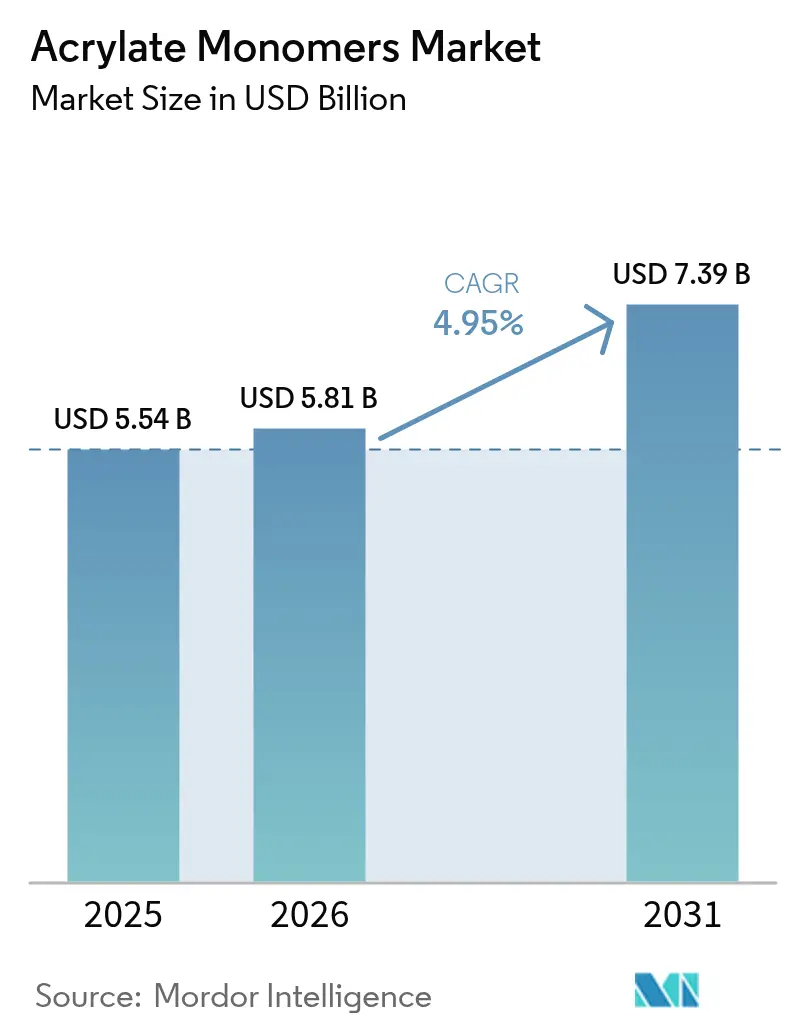
Acrylate Monomers Market size in 2026 is estimated at USD 5.81 billion, growing from 2025 value of USD 5.54 billion with 2031 projections showing USD 7.39 billion, growing at 4.95% CAGR over 2026-2031. Robust demand from low-VOC architectural paints, pressure-sensitive adhesives, and healthcare coatings is sustaining steady volume gains. Butyl acrylate remains indispensable because it strikes a balance between film hardness and flexibility, enabling formulators to meet stringent VOC limits without the use of coalescent solvents. Regulatory frameworks that cap solvent emissions, paired with tax incentives for onshoring capacity in North America, are encouraging producers to invest in continuous reactors and vacuum stripping technologies. Evolving infrastructure programs in China, India, and the ASEAN region continue to pull acrylic-acid feedstocks eastward, while capacity additions along the U.S. Gulf Coast aim to de-risk reliance on imports. Competitive priorities have shifted from headline prices to service-level agreements, technical collaboration, and residual monomer compliance, compressing margins yet stimulating innovation in UV-curable oligomers for flexible electronics.
Key Report Takeaways
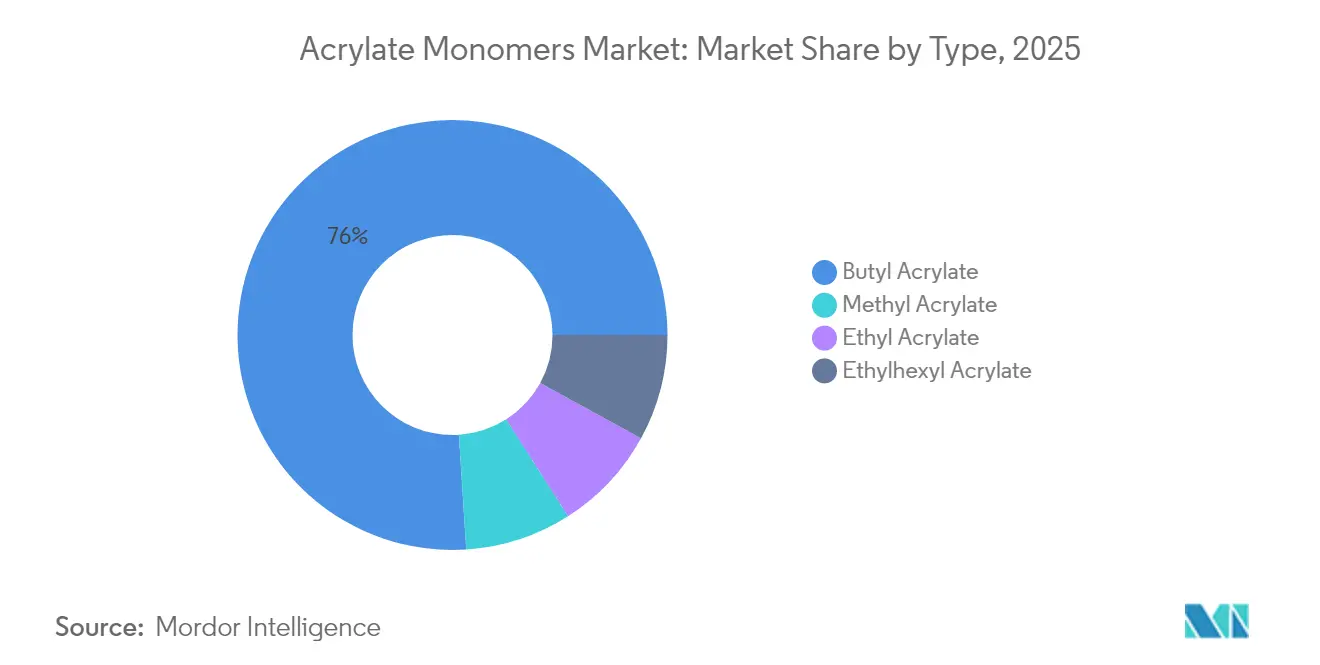
- By type, butyl acrylate captured 76.02% of the global acrylate monomers market share in 2025 and also posted the fastest 5.18% CAGR through 2031 within the acrylate monomers market.
- By application, paints and coatings held a 52.10% share of the acrylate monomers market in 2025, and are projected to advance at a 5.45% CAGR through 2031.
- By end-user sector, construction accounted for 37.05% of demand in 2025, whereas healthcare and hygiene are expanding at a 5.12% CAGR.
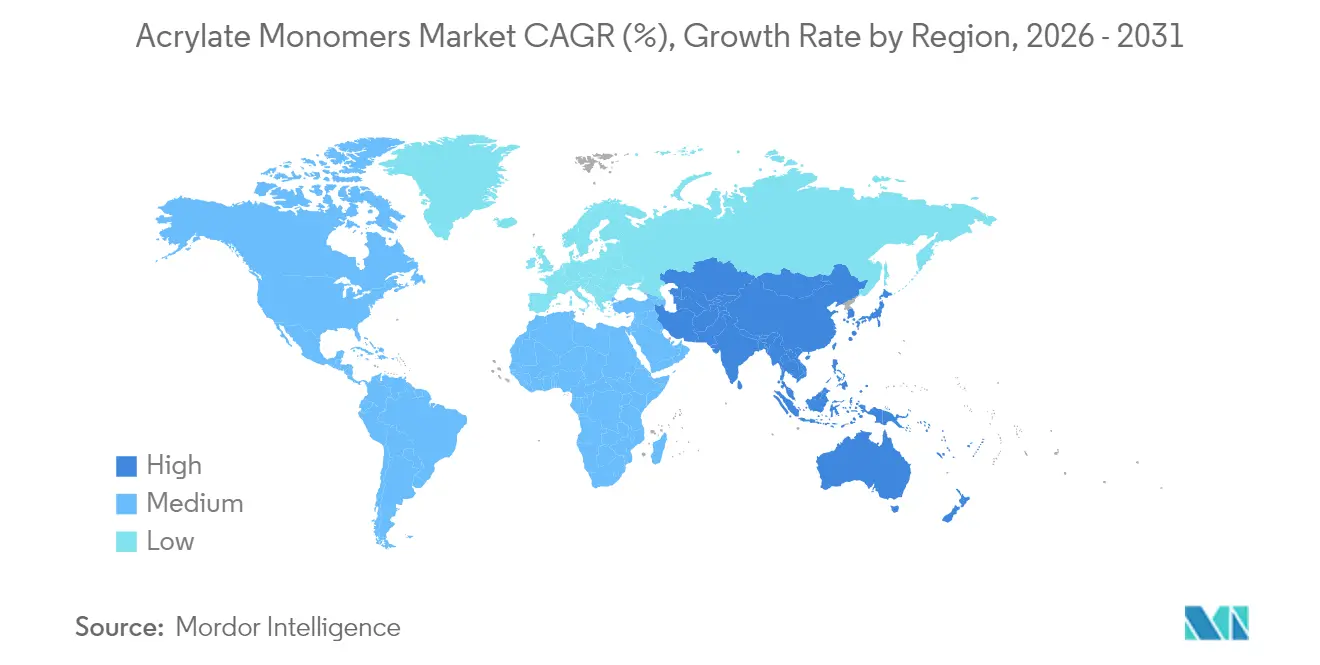
- By geography, the Asia-Pacific region commanded 44.80% of the global volume in 2025 and is forecast to grow at a 5.28% CAGR through 2031.
Note: Market size and forecast figures in this report are generated using Mordor Intelligence’s proprietary estimation framework, updated with the latest available data and insights as of 2026.
Global Acrylate Monomers Market Trends and Insights
Drivers Impact Analysis*
| Drivers | (~) % Impact on CAGR Forecast | Geographic Relevance | Impact Timeline |
|---|---|---|---|
| Low-VOC architectural coating boom | +1.8% | Global, strongest in EU and California | Medium term (2-4 years) |
| Rapid expansion of pressure-sensitive adhesive demand | +1.5% | Asia-Pacific core; spill-over to North America | Short term (≤2 years) |
| Asia-Pacific construction super-cycle | +1.3% | China, India, Vietnam, Indonesia | Long term (≥4 years) |
| Rise of UV-curable acrylate formulations for flexible electronics | +0.9% | South Korea, Taiwan, Japan, extending to China | Medium term (2-4 years) |
| On-shoring incentives and antidumping tariffs in North America | +0.7% | United States, Canada | Short term (≤2 years) |
| Source: Mordor Intelligence | |||
Low-VOC Architectural Coating Boom
Butyl-acrylate copolymers enable zero-VOC claims while preserving open time, wet-scrub durability, and alkalinity resistance, driving formulators to phase out vinyl acetate. China’s 14th Five-Year Plan mandates low-emission coatings in many of the new residential projects by 2025, accelerating local emulsion-polymer output. In India, small paint makers are adopting pre-compounded acrylic binders to bypass in-house polymerization and speed regional color launches. Third-party verification through ISO 11890 testing and LEED v4.1 credits reinforces procurement criteria that favor advanced acrylic emulsions, underscoring their suitability for use in sustainable building practices[1]International Organization for Standardization, “ISO 11890 VOC Measurement,” iso.org.
Rapid Expansion of Pressure-Sensitive Adhesive Demand
E-commerce packaging, medical tapes, and automotive trim bonding drive the use of acrylate monomer in pressure-sensitive adhesives. Ethylhexyl acrylate supplied the PSA monomer feedstock because it supports low-temperature tack in hot-melt and solvent-free formulations. Southeast Asian corrugated box production is increasing, necessitating the use of optically clear adhesive films for flexible pouches. Medical wearables rely on acrylic PSAs with residual-monomer levels under 100 ppm to meet ISO 10993 skin-sensitization thresholds. FDA guidance on extractables is pushing device makers to specify high-purity ethyl acrylate in wound-care patches.
Asia-Pacific Construction Super-Cycle
Infrastructure spending across Asia-Pacific grew in 2024, channeling acrylate monomers into waterproofing membranes, concrete sealers, and elastomeric fillers. India’s National Infrastructure Pipeline stimulates demand for butyl-acrylate emulsions in exterior insulation systems. Vietnam’s Long Son complex added acrylic-acid capacity, positioning ASEAN suppliers closer to demand centers. Prefabricated construction methods favor fast-curing acrylic sealants that tolerate shipping-induced thermal cycling. Local green-building labels such as GRIHA embed low-VOC acrylic coatings into public tenders, locking in long-term monomer offtake.
Rise of UV-Curable Acrylate Formulations for Flexible Electronics
Flexible printed circuit boards and foldable displays utilize UV-curable acrylate oligomers. Ethoxylated trimethylolpropane triacrylate and urethane-acrylate hybrids deliver high elongation and optical clarity, surpassing epoxy adhesives that yellow under blue light. Samsung Display and LG Display have qualified acrylic optically clear adhesives, securing captive demand in South Korea. Fan-out wafer-level packaging is driving the need for underfill resins that cure in under two seconds, an application well-suited to acrylate chemistry. IEC 61249 and ISO 9022 standards integrate acrylic performance metrics into supplier audits, strengthening barriers to entry.
Restraints Impact Analysis*
| Restraints | (~) % Impact on CAGR Forecast | Geographic Relevance | Impact Timeline |
|---|---|---|---|
| Volatile propylene and acrylic-acid feedstock costs | –0.6% | Global, most acute in naphtha-reliant regions | Short term (≤2 years) |
| Regulatory squeeze on residual monomer toxicity | –0.4% | EU and North America, expanding to Asia-Pacific | Medium term (2-4 years) |
| Competition from next-gen polyurethane dispersions in coatings | –0.3% | Northern Europe, North America, East Asia | Medium term (2-4 years) |
| Source: Mordor Intelligence | |||
Volatile Propylene and Acrylic-Acid Feedstock Costs
Propylene spot values fluctuated in 2024 due to refinery maintenance, PDH start-ups, and polypropylene market competition. Formulators are trialing bio-based methyl acrylate derived from glycerol or lactic acid. The EU’s Carbon Border Adjustment Mechanism embeds feedstock carbon intensity into procurement, encouraging the development of long-term propylene supply contracts[2]European Chemicals Agency, “REACH Candidate List,” echa.europa.eu.
Regulatory Squeeze on Residual Monomer Toxicity
The European Chemicals Agency added butyl acrylate to the REACH Candidate List in 2024. The EPA’s TSCA evaluation for methyl acrylate identified occupational inhalation as a priority pathway, prompting the implementation of engineering controls that add to production costs. Polymer plants are investing in vacuum stripping and steam distillation lines to achieve sub-100 ppm levels, consistent with ISO 11014 packaging guidance. Smaller players lacking retrofit capital are exiting commodity grades and turning to toll manufacturing of specialty oligomers. FDA extractables guidance is extending toxicity testing to acrylate-based drug-delivery devices, raising entry barriers for new suppliers.
*Our forecasts treat driver/restraint impacts as directional, not additive. The impact forecasts reflect baseline growth, mix effects, and variable interactions.
Segment Analysis
By Type: Butyl Acrylate Retains Structural Leadership
Butyl acrylate accounts for 76.02% of the total volume and is expected to advance at a 5.18% CAGR through 2031. Continuous-reactor upgrades shorten cycle times, reducing energy consumption and enabling responsive spot market sales. Ethyl acrylate targets high-solids industrial coatings where faster cure rates justify its premium pricing. Ethylhexyl acrylate is a key component in pressure-sensitive adhesives that require low-temperature tack in medical and automotive tapes. Methyl acrylate occupies a niche in pharmaceutical intermediates and UV-curable oligomers, benefiting from rapid radical-polymerization kinetics.
Sustained investment in ISO 9001 and ISO 14001 certification is now mandatory for suppliers serving multinational paint and adhesive firms, raising entry barriers for regional producers. The acrylate monomers market continues to favor integrated players that can offer formulation assistance and residual monomer guarantees under 100 ppm. Continuous processes also provide consistent molecular-weight distribution, a key requirement for low-temperature flexibility in architectural coatings. Producers that retrofit reactors with advanced pressure control can toggle between monomer grades, maximizing asset utilization.



By Application: Paints and Coatings Dominate as Adhesives Accelerate
Paints and coatings accounted for 52.10% of the acrylate monomers market volume in 2025 and are expected to grow at a 5.45% CAGR through 2031. Automotive refinish and industrial maintenance coatings also lean on ethyl acrylate for faster drying. Adhesives and sealants are expanding as e-commerce, wearable sensors, and flexible displays proliferate.
Plastics and polymers absorb acrylate monomers, with core-shell impact modifiers improving Izod strength in lightweight automotive parts. UV-curable printing inks are transitioning to acrylate oligomers for sub-second curing on food-contact substrates that must meet EU 10/2011 migration limits. Other outlets, including textile finishes and construction chemicals, account for a small portion. ISO 11890 VOC testing and ASTM D4060 abrasion metrics standardize performance benchmarks, accelerating solvent-borne replacement.
By End-User Sector: Construction Commands Volume, Healthcare Outpaces Growth
Construction captured 37.05% of the acrylic monomers market demand in 2025, reflecting Asia-Pacific infrastructure pipelines consuming acrylic waterproofing membranes and sealants. The growing demand from the automotive and transportation sector, with EV factories specifying acrylic battery binders and underbody coatings that meet FMVSS 302 flammability standards. Ethylhexyl-acrylate PSAs in flexible pouches and corrugated boxes drive the packaging sector. Electronics and electrical applications are primarily focused on optically clear adhesives for foldable OLED screens and UV-curable underfills in semiconductor packaging.
Healthcare and hygiene are the fastest-growing end-user segments, growing at a 5.12% CAGR, buoyed by single-use medical-device coatings and superabsorbent cores in incontinence products. Aging demographics in North America and Europe are driving the expansion of chronic-disease monitoring, prompting the use of high-purity ethyl acrylate in wound-care wraps. FDA extractables guidance reinforces the pivot to low-toxicity acrylic systems.

Geography Analysis
The Asia-Pacific region held 44.80% of the acrylate monomers market volume in 2025 and is projected to grow at a 5.28% CAGR from 2026 to 2031, at the highest regional pace. China is channeling butyl-acrylate emulsions into coatings for new housing units, while the Shenzhen and Suzhou electronics clusters utilize UV-curable oligomers for foldable screens. The National Infrastructure Pipeline spending on highways, airports, and affordable housing lifts demand in India.
North America commands a significant portion of global consumption. Canada’s share concentrates on methyl acrylate for EV battery binders, supported by Strategic Innovation Fund co-grants. Mexico contributes as near-shoring drives ethylhexyl-acrylate uptake in automotive and electronics assembly, backed by USMCA rule-of-origin incentives.
Germany, France, and the United Kingdom lead Europe's demand. REACH fees and CBAM carbon levies encourage the substitution of methyl acrylate with bio-based alternatives. The Middle East and Africa share is centered on Saudi Arabian and UAE petrochemical hubs targeting export-oriented acrylic acid. ISO 9001 and ISO 14001 compliance are now mandatory credentials for suppliers entering multinational supply chains.

Regulatory Landscape
Acrylate monomers producers operate under tightening chemical safety and labeling requirements that increasingly influence grade selection, residual-monomer controls, and documentation. In the European Union, the amended Classification, Labelling and Packaging (CLP) framework under Regulation (EU) 2024/2865 (entered into force in 2024) and subsequent updates to harmonized classifications (including Regulation (EU) 2025/1222) raise the compliance bar for hazard communication and downstream customer audits, alongside ongoing REACH obligations.
In the United States, TSCA continues to shape market access for new chemistries and new applications. In March 2026, EPA published TSCA Section 5 findings for multiple new chemical substances, and in June 2026 EPA proposed Significant New Use Rules (SNURs) for certain substances. This reinforces the need for 90-day notification lead times for defined significant new uses and heightens pre-commercial review requirements across the supply chain.
Value Chain Analysis
The acrylate monomers value chain starts with petrochemical feedstocks (notably propylene and acrylic acid), moves through esterification and purification to produce butyl acrylate, ethyl acrylate, 2-ethylhexyl acrylate, and methyl acrylate, and then feeds into polymerization and formulation for paints and coatings, pressure-sensitive adhesives, sealants, construction chemicals, hygiene, and electronics materials. Integrated producers with access to acrylic acid and utilities typically control cost and quality through continuous reactors and finishing assets, including vacuum stripping and steam distillation to support low residual-monomer requirements, while distributors and regional terminals support packaged deliveries and just-in-time supply to coatings and adhesive manufacturers.
Trade and operational constraints also influence how volumes move between regions. In March 2026, the European Commission initiated an anti-dumping investigation covering imports of butyl acrylate and 2-ethylhexyl acrylate from several origins, which adds uncertainty to import economics and pushes European converters to recalibrate sourcing and inventory strategies. On the supply side, new Asian capacity and integrated downstream moves, including acrylic ester and superabsorbent polymer projects coming onstream, are shifting more monomer availability closer to demand centers, while compliance and wastewater enforcement in major chemical clusters strengthen the advantage of large, well-capitalized sites.
Competitive Landscape
The acrylate monomers market is moderately consolidated. Competition centers on service reliability, technical co-development, and guaranteed residual monomer ceilings, rather than list price. Vertical integration strategies include adhesive formulators purchasing stakes in monomer plants to secure captive supply and tariff advantages. Continuous-reactor retrofits at leading plants reduce batch cycles, trim utility costs, and enable just-in-time delivery windows of under 48 hours. Regional Chinese players have narrowed the technology gap and now sell ethylhexyl acrylate at prices below Western benchmarks, capturing a share of the Southeast Asian adhesive compound market. Margin pressure from volatile propylene prices and tighter residual-monomer rules is prompting consolidation, with smaller producers exiting commodity grades to focus on toll manufacturing of high-purity methyl acrylate for pharma intermediates. Incumbents are channeling research and development into UV-curable oligomers for flexible circuits and optically clear adhesives, segments where differentiated performance commands premiums that offset fluctuations in feedstock costs. Compliance with REACH, TSCA, ISO 10993, and IEC 61249 embeds traceability and documentation requirements throughout the supply chain, further raising the hurdles for new entrants.
Acrylate Monomers Industry Leaders
BASF SE
Arkema
Dow
LG Chem
Nippon Shokubai Co., Ltd
- *Disclaimer: Major Players sorted in no particular order


Market Opportunities and Future Outlook
Decarbonized and mass-balance product lines are creating whitespace in monomer procurement for coatings and adhesive customers that increasingly screen suppliers on product carbon footprint and documentation. BASF introduced renewable-electricity-attributed grades (Butyl acrylate RE and 2-Ethylhexyl acrylate RE) manufactured at its Freeport, Texas site in March 2026, and Arkema commercialized bio-based ethyl acrylate at Carling, France in October 2024. These steps give formulators more defined routes to pair low-VOC performance targets with lower-carbon raw materials, and they increase the competitive emphasis on chain-of-custody schemes such as ISCC-Plus, along with consistent analytical proof of residual monomer levels for healthcare and hygiene applications.
Regional supply realignment and portfolio reshaping are also opening pockets for tolling, localization, and specialty upgrading. BASF began construction of an acrylic acid value chain complex at its Zhanjiang integrated site in March 2026, including announced capacity for butyl acrylate and 2-ethylhexyl acrylate, while Bohai Chemical brought additional acrylic acid capacity online in Tianjin in June 2026. In Europe, Synthomer announced the divestment of its Czech Republic-based Acrylate Monomers business to Mutares in June 2026, signaling repositioning toward assets and grades that can better absorb regulatory and energy-cost volatility. This environment supports demand for higher-purity monomers, UV-curable acrylate building blocks for electronics, and contract manufacturing models for customers seeking supply security without new asset investment.
Recent Industry Developments
- June 2026: Synthomer agreed to divest its Czech Republic-based Acrylate Monomers business (Synthomer a.s.) to Mutares in a carve-out transaction targeted to close by the end of Q3 2026. The deal reshapes European supply ownership and can change how customers contract for standard grades versus specialty and higher-purity monomers as the buyer focuses on operational and commercial optimization.
- March 2026: BASF launched Butyl acrylate RE and 2-Ethylhexyl acrylate RE manufactured at its Freeport, Texas site using attributed renewable electricity from wind and solar sources. The launch provides coatings and adhesive value chains with a lower-carbon input option without changing core acrylate chemistry, supporting procurement programs tied to product carbon footprint and sustainability reporting.
- October 2024: Arkema began commercial production of bio-based ethyl acrylate at its Carling, France site, reported at 40% bio-carbon content and with a reduced product carbon footprint. Commercial availability of a bio-based acrylate monomer expands formulation options for low-VOC coatings and adhesives where customers want measurable reductions in lifecycle emissions.


Research Methodology Framework and Report Scope
Market Definition and Coverage
For this study, the acrylate monomers market is defined as the sales value of industrial acrylate monomers used as building blocks in downstream formulations, counted at the first point of sale and tracked across major consuming regions.
Scope exclusions: This sizing excludes finished polymers and formulated end products (such as paints, inks, adhesives, and sealants) and counts only the monomer chemicals, not the downstream value added.
Segmentation Overview
- By Type
- Butyl Acrylate
- Ethyl Acrylate
- Ethylhexyl Acrylate
- Methyl Acrylate
- By Application
- Paints and Coatings
- Adhesives and Sealants
- Plastics and Polymers
- Printing Inks
- Other Applications
- By End-User Sector
- Construction
- Automotive and Transportation
- Packaging
- Electronics and Electrical
- Healthcare and Hygiene
- By Geography
- Asia-Pacific
- China
- India
- Japan
- South Korea
- Malaysia
- Thailand
- Indonesia
- Vietnam
- Rest of Asia-Pacific
- North America
- United States
- Canada
- Mexico
- Europe
- Germany
- United Kingdom
- France
- Italy
- Spain
- Nordic Countries
- Turkey
- Russia
- Rest of Europe
- South America
- Brazil
- Argentina
- Colombia
- Middle-East and Africa
- Saudi Arabia
- Qatar
- United Arab Emirates
- Nigeria
- Egypt
- South Africa
- Rest of Middle-East and Africa
- Asia-Pacific
Data Sources, Market Sizing, and Validation
Desk Research
Desk research was used to build the fact base on supply, trade, and end use demand signals for acrylate monomers. We referenced public sources such as UN Comtrade for trade flows, USGS and national statistics offices for industrial output indicators, the US EPA and the European Chemicals Agency for regulatory context, and customs and tariff schedules to sanity check product classification.
Along with that, we reviewed company annual reports, investor presentations, and plant and capacity announcements reported in reputable press to map where material is produced and how it moves into downstream applications. Patent databases were also reviewed to spot shifts in chemistry and process routes that can change yields and cost curves. For financial cross checks, a paid subscription for company financials and news intelligence was used when public disclosures were thin. These sources are illustrative, and we also used other public documents and datasets for data collection, validation, and clarification.
Primary Interviews and Surveys
Primary work focused on validating how monomer demand is built up from downstream usage and how pricing behaves across regions and contract types. We spoke with a mix of producers, distributors, and downstream formulators across APAC, EMEA, and the Americas, so gaps from desk research could be closed and key assumptions could be rechecked before finalizing the model.
Distribution of primary research fieldwork respondents
| Company type | Respondent position | Region |
|---|---|---|
| Top tier: 26% | CXOs: 18% | APAC: 39% |
| Mid tier: 53% | Functional/Unit leaders: 37% | EMEA: 36% |
| Smaller Players: 21% | Managers: 45% | Americas: 25% |
Market-Sizing & Forecasting
The sizing starts with a top-down build where production capacity, utilization direction, and import export balances are used to reconstruct apparent consumption by region, and then converted to value using observed pricing ranges. To keep the totals realistic, the outputs are corroborated with selective bottom-up approximations, such as sampling application level volumes and applying typical monomer loading rates, followed by supplier and channel checks on average selling prices.
Key inputs that shaped the model included new capacity additions and shutdown timing, operating rate trends, and feedstock and energy cost movement that influences monomer pricing. We used coatings and adhesives production indicators as demand anchors, and we tracked trade mix shifts that change regional availability. Where bottom-up data was incomplete for smaller countries, gaps were handled by using proxy indicators like manufacturing output and coatings consumption patterns, then normalizing back to regional totals.
For forecasting, scenario analysis was used so the base case could reflect the most common view shared by industry respondents on demand recovery, operating rates, and price progression. Assumptions were also tested year by year against observed spreads between major regions, since currency timing and contract resets can change market value even when volumes are steady.
Data Validation & Update Cycle
Model outputs were checked against independent signals like capacity utilization narratives, trade direction changes, and downstream production indices, so large variances could be questioned early. When a number looked off, the underlying drivers were revisited, and follow-up calls were triggered to confirm whether the issue came from scope, timing, or pricing assumptions.
Before sign-off, the work goes through multi step analyst reviews where calculations, unit conversions, and country roll ups are verified again. Reports are refreshed annually, and interim updates are made when material events occur, such as major plant outages, new capacity start ups, or sharp feedstock price swings. Right before delivery, a fresh review pass is completed so clients receive the latest updated view.
Mordor Intelligence's Acrylate Monomers Market Size Measured Against Other Published Estimates
Published market sizes for acrylate monomers can vary a lot because authors do not always count the same chemical scope, year basis, or pricing method, and then forecast assumptions widen the spread further. The benchmark table makes the differences easy to see, and the drivers behind them can be traced back to what is included and how value is calculated.
The table shows a much higher 2024 value in one source and a lower 2024 value in another, which mainly comes from scope and pricing choices. In Mordor Intelligence's approach, the value is built around core industrial acrylate monomers used as upstream inputs, and totals are checked using capacity, trade, and downstream production signals, rather than blending in adjacent polymer and formulation revenues. Some published figures also use a single global average price or a different currency conversion timing, which can inflate or compress the same volume picture depending on the year.
Benchmark comparison
| Source | Market Size | Gaps in Research Methodology |
|---|---|---|
| Mordor Intelligence | USD 5.81 B (2026) | |
| Industry Publisher A | USD 10.56 B (2024) | Often reflects a wider value chain treatment where polymer or formulation value can be mixed into the monomer view, and pricing is presented as a broad average without clear regional resets, which lifts the headline number. |
| Research Publisher B | USD 5.20 B (2024) | Uses a different base year and may rely more on revenue aggregation from selected company disclosures, which can undercount indirect sales channels and leads to less transparent reconciliation to capacity and trade signals. |
Taken together, the spread mostly comes from what is counted as a monomer market versus a downstream materials market, and from how prices are averaged across regions and time. By keeping the steps traceable to capacity, trade balance, and downstream output indicators, the final estimate stays practical to replicate and easier to audit when assumptions need to be updated.


Key Questions Answered in the Report
What is the current value of the acrylate monomers market?
The acrylate monomers market size is expected to reach USD 5.81 billion by 2026.
Which segment holds the largest share in acrylate monomer demand?
Butyl acrylate accounts for 76.02% of the global volume due to its versatility in coatings and adhesives.
Which region leads consumption growth for acrylate monomers?
Asia-Pacific leads with 44.80% share in 2025 and a 5.28% CAGR through 2031.
Why are UV-curable acrylate formulations gaining traction?
Flexible electronics and foldable displays require fast-curing, optically clear adhesives that acrylates provide better than epoxies.
Page last updated on:


 Your data is secure and never sold or shared.


