
Polyacrylamide Market Size and Share
Market Overview
| Study Period | 2021 - 2031 |
|---|---|
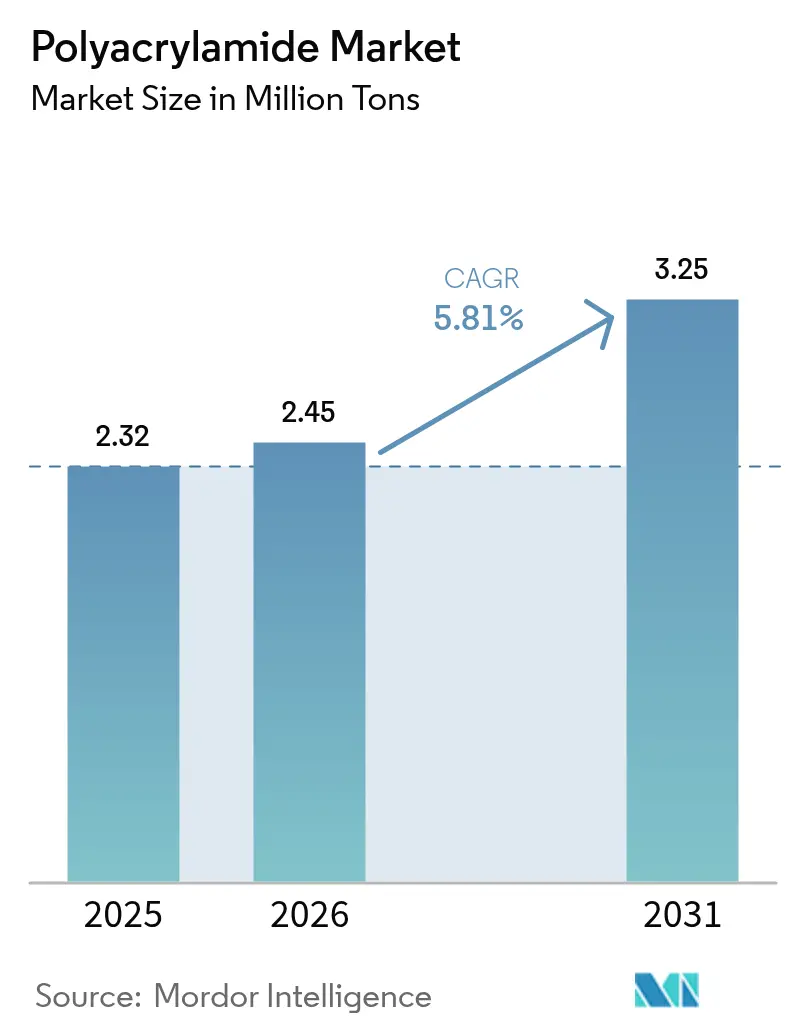
| Market Volume (2026) | 2.45 Million tons |
| Market Volume (2031) | 3.25 Million tons |
| Growth Rate (2026 - 2031) | 5.81 % |
| Fastest Growing Market | Asia Pacific |
| Largest Market | Asia Pacific |
| Market Concentration | Medium |
Major Players *Disclaimer: Major Players sorted in no particular order Image © Mordor Intelligence. Reuse requires attribution under CC BY 4.0. | |
Polyacrylamide Market Analysis by Mordor Intelligence
The Polyacrylamide Market size is expected to increase from 2.32 million tons in 2025 to 2.45 million tons in 2026 and reach 3.25 million tons by 2031, growing at a CAGR of 5.81% over 2026-2031. Demand is migrating from commodity flocculants toward higher-value specialties as enhanced oil recovery (EOR) accelerates, semiconductor wastewater tightens purity limits, and battery-metal tailings require ultra-high-molecular-weight grades. Regulatory drivers, EPA residual-monomer caps, the EU Urban Wastewater Treatment Directive 2024/3019, and Asia-Pacific sludge-handling mandates are raising quality thresholds and favoring certified producers. Asia-Pacific remains the volume anchor, yet North American shale and European nutrient-removal projects are reshaping the application mix in their regions. Intensifying innovation around salt-tolerant polymers, grafted bio-derivatives, and closed-loop dosing systems signals that intellectual property, not scale alone, will differentiate future winners.
Key Report Takeaways
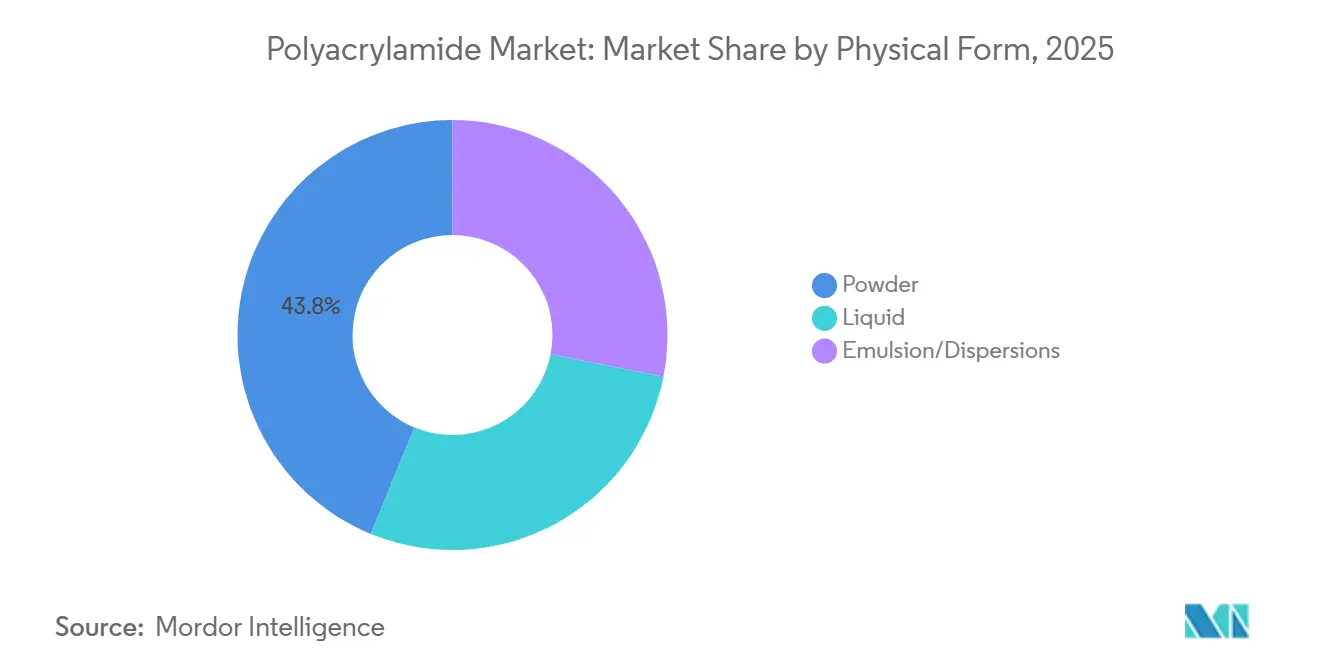
- By physical form, powder captured 43.80% of the polyacrylamide market share in 2025, whereas emulsions/dispersions are forecast to expand at a 6.12% CAGR through 2031.
- By application, flocculants for water treatment held 41.52% revenue share in 2025; enhanced oil recovery is projected to grow at a 6.24% CAGR to 2031.
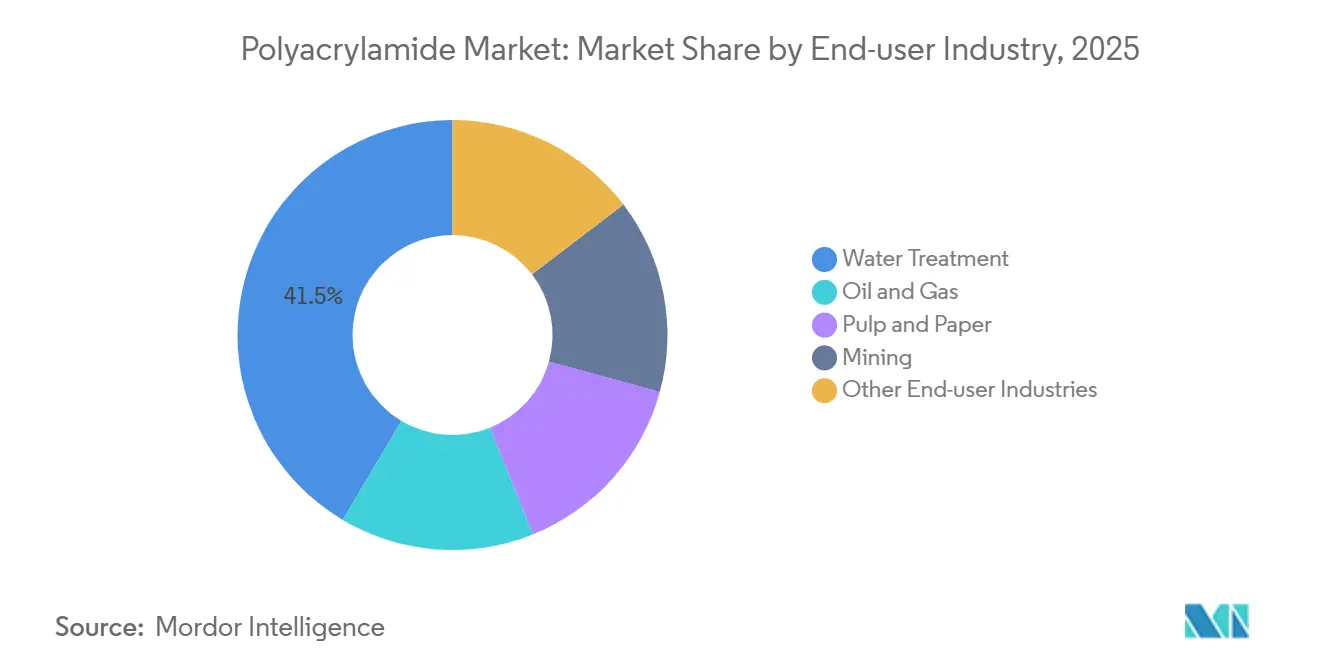
- By end-user industry, water treatment accounted for 41.48% of the polyacrylamide market size in 2025, while oil and gas is advancing at a 6.20% CAGR to 2031.
- By geography, Asia-Pacific led with 49.95% share of the polyacrylamide market in 2025 and is enlarging at a 6.25% CAGR through 2031.
Note: Market size and forecast figures in this report are generated using Mordor Intelligence’s proprietary estimation framework, updated with the latest available data and insights as of 2026.
Market Trends and Insights
Drivers Impact Analysis of Polyacrylamide Market*
| Driver | (~) % Impact on CAGR Forecast | Geographic Relevance | Impact Timeline |
|---|---|---|---|
| Growing utilization in enhanced oil recovery (EOR) | +1.2% | Middle East, North America (Permian, Bakken), Latin America (heavy oil) | Medium term (2-4 years) |
| Rising demand for flocculants in municipal & industrial wastewater treatment | +1.5% | Europe, Asia-Pacific (China, India, ASEAN), North America | Long term (≥ 4 years) |
| Expansion of mining activities driving demand for sedimentation aids | +1.3% | Asia-Pacific (Indonesia, Philippines), Latin America (Chile, Peru, Brazil), Australia | Medium term (2-4 years) |
| Shift toward ultra-high-molecular-weight friction reducers for shale completions | +0.9% | North America (US Permian, Eagle Ford, Bakken; Canada Montney) | Short term (≤ 2 years) |
| Surge in demand for biodegradable PAM grades in precision agriculture | +0.7% | Europe, North America (US Midwest, California), Asia-Pacific (China, India) | Long term (≥ 4 years) |
| Source: Mordor Intelligence | |||


Growing Utilization in Enhanced Oil Recovery
Polymer flooding now targets deeper, hotter, and saltier reservoirs, prompting a pivot from standard hydrolyzed polyacrylamide to ATBS-copolymer blends stable above 120°C and at 200,000 ppm salinity. National oil companies favor EOR because it lifts recovery factors by 5%-15% without frontier exploration. Selective gel-placement technologies that pair polyacrylamide with chromium or organic cross-linkers further reduce water cut, extend well life, and defer abandonment costs. These dual pathways are expected to raise polymer demand per barrel recovered and reinforce the value of ultra-high-molecular-weight grades. Consequently, EOR’s share of the polyacrylamide market is climbing faster than any other application, reshaping supplier portfolios toward higher-margin specialty products.
Rising Demand for Flocculants in Municipal & Industrial Wastewater Treatment
The EU Urban Wastewater Treatment Directive lowered the tertiary-treatment threshold from 10,000 to 1,000 population equivalents, compelling widespread clarifier and centrifuge upgrades[1]European Commission, “Directive 2024/3019,” eur-lex.europa.eu. Municipal biosolids typically rely on cationic polyacrylamide at 40%-60% charge density, while Asian textile effluents need 80% charge to capture anionic dyes. India’s Central Pollution Control Board requires sludge for cement-kiln co-processing to reach below 20% moisture by 2026, pushing polymer doses above 5 kg per dry tonne. China’s drive to incinerate or pyrolyze municipal sludge also hinges on achieving 40% solids, a benchmark attainable only with high-dose polyacrylamide treatment. Global procurement agencies are shifting to performance-based contracts, pressuring suppliers to deliver polymers that hit dewatering targets without overdosing penalties.
Expansion of Mining Activities Driving Demand for Sedimentation Aids
Battery-metal projects lifted global mining capex and intensified tailings-management scrutiny. Anionic polyacrylamide remains essential for thickening slurries containing fine clays and silicates that delay water recycling. Laterite nickel and high-altitude copper operations in Indonesia, the Philippines, and Chile use polymer doses 50% higher than traditional sulfide ores because of colloidal silica and iron hydroxide interference. Water-scarce jurisdictions grant permits contingent on water-recovery efficiency, so operators increasingly specify ultra-high-molecular-weight grades that deliver faster settling and clearer overflow. This demand surge, paired with stricter residue limits, is tilting the polyacrylamide market toward certified, high-purity, mining-grade offerings.
Shift Toward Ultra-High-Molecular-Weight Friction Reducers for Shale Completions
US shale basins consumed about 75,000 tons of polyacrylamide in 2025, with per-well polymer loading intensifying as lateral lengths rise. Slickwater formulas cut pumping pressure by up to 50%, saving 20%-35% on completion costs compared with guar gels. Produced-water reuse raises salinity beyond 100,000 ppm, degrading anionic polymers; cationic friction reducers, though pricier, preserve viscosity and mitigate formation damage in such brines. Thermal stability up to 240°C enables reliable performance in Haynesville and Eagle Ford wells. Residual polymer recovery is becoming routine, with aluminum-sulfate coagulation removing up to 90% of flowback PAM prior to recycling.
Restraints Impact Analysis of Polyacrylamide Market*
| Restraint | (~) % Impact on CAGR Forecast | Geographic Relevance | Impact Timeline |
|---|---|---|---|
| Health & carcinogenicity concerns over residual acrylamide monomer | -0.8% | Global, with stricter enforcement in North America, Europe, Australia | Medium term (2-4 years) |
| Rising preference for bio-based flocculants in Europe | -0.5% | Europe (Germany, France, Nordic countries), North America (green procurement mandates) | Long term (≥ 4 years) |
| Growing regulatory pressure on polymer micro-particle discharge into surface waters | -0.4% | Europe, Asia-Pacific (Japan, South Korea, Singapore) | Long term (≥ 4 years) |
| Source: Mordor Intelligence | |||
Health & Carcinogenicity Concerns Over Residual Acrylamide Monomer
WHO lists acrylamide as a probable human carcinogen, while ATSDR highlights neurotoxicity at chronic exposures above 0.5 mg/kg day[2]World Health Organization, “IARC Monographs on the Identification of Carcinogenic Hazards to Humans,” who.int. The US EPA caps residual monomer at 0.05% in polymers used for drinking-water treatment and limits the dose to 1 mg/l. Meeting these limits requires vacuum-distillation or reactive-precipitation stripping units that add USD 200-400/t to production costs. Premium grades certified under NSF/ANSI 60 now command price premiums of 10%-20%, fragmenting the polyacrylamide market between certified and non-certified tiers. Non-compliant shipments have already faced rejections in Australia and New Zealand, prompting importers to demand supplier certification.
Rising Preference for Bio-Based Flocculants in Europe
Peer-reviewed studies show chitosan, starch, and cellulose flocculants achieve up to 75% of synthetic PAM efficiency, although they require 1.5-2× the dose. Germany, France, and Nordic countries have adopted green-procurement rules that favor biopolymers despite higher prices of USD 3,000-5,000/t versus USD 1,500-2,500 for synthetic grades. Kemira’s EUR 130 million joint venture with IFF, targeting a 2027 start-up, illustrates incumbent hedging against future displacement. Cost remains the primary adoption barrier, yet EU carbon-pricing and pending microplastic discharge rules are narrowing the gap. Suppliers able to balance performance and biodegradability will gain traction as mandates tighten.
*Our forecasts treat driver/restraint impacts as directional, not additive. The impact forecasts reflect baseline growth, mix effects, and variable interactions.
Polyacrylamide Market Segment Analysis
By Physical Form:
Emulsions Gain on Handling EfficiencyPowder grades accounted for 43.80% of the polyacrylamide market share in 2025, serving price-sensitive municipal and mining customers that have existing dissolution tanks. Emulsion formats, typically 30%-40% active solids, dissolve in under five minutes and eliminate dust exposure, a decisive benefit after OSHA cut the permissible acrylamide dust limit to 0.03 mg m-3 in 2024. The segment is forecast to grow at 6.12% annually through 2031, raising its slice of the polyacrylamide market size as automation and real-time dosing spread across mining and offshore platforms.
Emulsions command 10%-20% price premiums over powders but cut labor, dissolution energy, and overdosing losses, often lowering the total cost of ownership. SNF’s 2024 expansion in Lara, Australia, added 5,000 t y-1 of emulsion capacity to meet mining demand, reflecting supplier bets on this shift. Liquid grades at 10%-15% solids address cosmetics and small wastewater plants that prioritize storage simplicity. Legacy powder users in Asia-Pacific and Latin America still favor USD <2,000/t pricing, yet as safety and productivity metrics grow stricter, powder’s dominance will erode in favor of safer, faster-diluting formats.


By Application:
EOR Outpaces Water Treatment on Technical IntensityFlocculants for water treatment represented 41.52% of volume in 2025, but EOR is the fastest-growing application, advancing at a 6.24% CAGR to 2031. Polymer flooding employs 500-2,000 ppm solutions of ultra-high-molecular-weight polyacrylamide to improve sweep efficiency, unlocking 5%-15% extra oil in mature reservoirs. This technical intensity raises per-unit value and is lifting EOR’s contribution to the polyacrylamide market size more than any other use.
Municipal dewatering and industrial clarifiers will still absorb the single-largest share because utility budgets and sludge-handling mandates guarantee baseline consumption. However, plateauing infrastructure replacement in mature economies is slowing volume growth. Mining and mineral processing, at 15%-18% of demand, continue rising as tailings reprocessing and water-scarcity compliance become standard in battery-metal projects. Soil-conditioner and cosmetic uses deliver niche but high-margin revenue that depends on specialty grades with tight impurity specifications.
By End-User Industry:
Oil and Gas Gains on Shale ResilienceMunicipal and industrial utilities accounted for 41.48% of end-user demand in 2025, yet oil and gas are projected to grow at a 6.20% CAGR between 2026 and 2031. Shale completions deploy friction reducers at 5.6-4,484 ppm, cutting pumping power and allowing produced-water reuse in high-salinity environments. The practice converts polyacrylamide from a cost item into a completion-efficiency lever, underpinning sustained volumes even in volatile rig cycles.
Mining ranks next as lithium, nickel, and copper producers scale ultra-high-molecular-weight polymers for thickener performance in water-stressed zones. Pulp and paper demand is migrating toward Asia-Pacific with new containerboard machines, while North American graphic-paper closures compress regional offtake. Textile effluent control in India and Southeast Asia is a bright spot, as high-charge cationic polymers replace commodity grades to hit stricter sludge-moisture and color-removal limits.
Geography Analysis
APAC Polyacrylamide Market
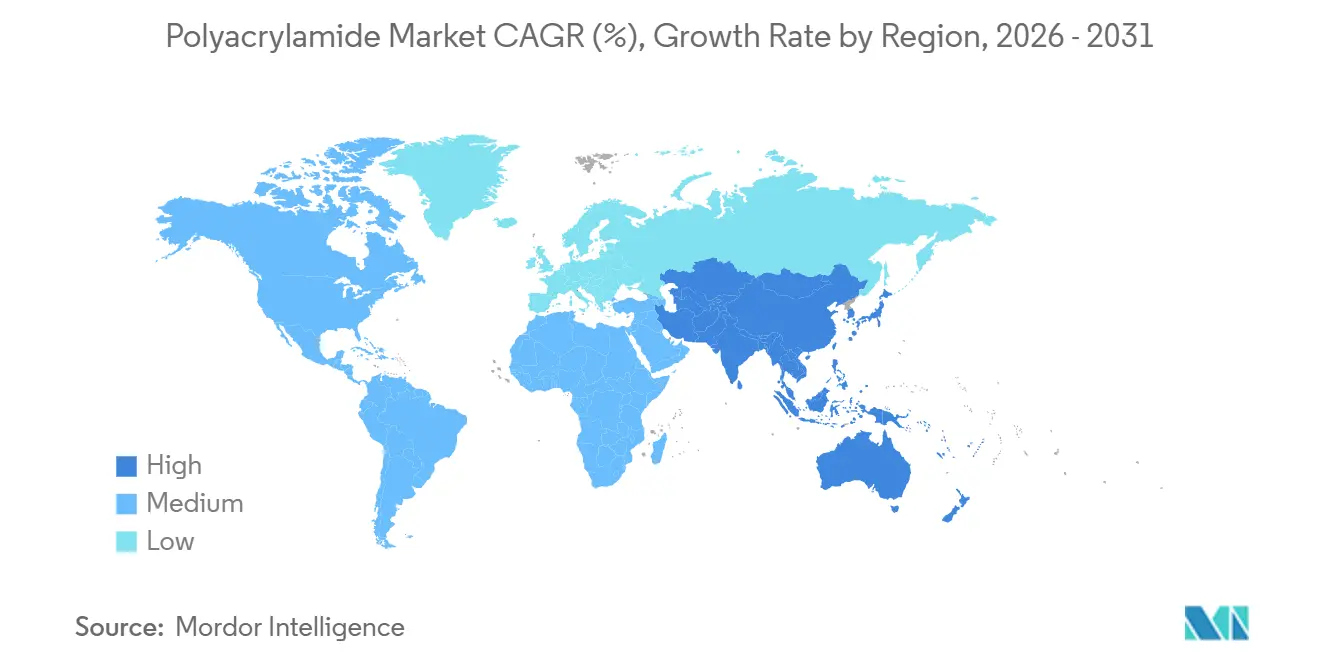
Asia-Pacific held 49.95% of the polyacrylamide market share in 2025 and will grow at 6.25% through 2031, buoyed by semiconductor expansion, 16 million t of new containerboard capacity, and battery supply-chain investments in Indonesia, Malaysia, and Thailand. China produced 55 million wet tons of municipal sludge in 2025, driving dewatering polymer demand, while India’s Swachh Bharat 2.0 targets full sludge processing by 2026, spurring cationic doses above 5 kg/t. Japan, South Korea, and Singapore are drafting polymer-particle discharge limits that could reshape product certification requirements region-wide.
North America Polyacrylamide Market
North America shows divergent patterns: hydraulic fracturing consumed 75,000 t of polyacrylamide in 2025, and suppliers such as SNF ramped up integrated monomer-polymer capacity in Louisiana to serve shale and municipal clients. Pulp-paper polymer volumes slid as graphic mills closed or shifted to packaging, but industrial wastewater upgrades and microplastic regulations in California and Canada partially offset the decline. Certified low-monomer grades command premiums, segmenting the market along NSF accreditation lines.
Europe Polyacrylamide Market
Europe’s growth is tied to Directive 2024/3019, which forces tertiary treatment and microplastic monitoring by 2029. Cationic polyacrylamide demand is climbing for sludge dewatering, yet parallel biodegradability mandates are steering procurement toward hybrid and bio-based alternatives. Kemira and Solenis are investing in renewable-polymer capacity to retain share, while regional incentives favor suppliers with demonstrable life-cycle advantages.
Mordor Intelligence provides coverage of the polyacrylamide market across other key regional markets, including Europe, each with their regulatory frameworks and demand patterns.

Regulatory Landscape
Polyacrylamide demand and product specifications are being shaped by tighter limits on residual acrylamide monomer and by application-specific compliance requirements for drinking water, industrial effluent, and mining. In the United States, the EPA sets residual-monomer and use-condition limits for polymers used in drinking-water treatment, commonly implemented through NSF/ANSI 60 certifications in procurement. In Europe, the framework is anchored in REACH registration obligations and related water-treatment standards such as EN 1407:2023.
China is updating its national standards for water-treatment polymers, raising documentation and quality-threshold expectations for domestic producers and importers. GB/T 31246-2025 (Water treatment chemicals, cationic polyacrylamides) entered implementation in May 2026, replacing the 2014 version, and GB/T 12005.3-2026 (Polyacrylamide, Part 3: General product requirements) was published in May 2026 with an effective date of December 2026, creating a transition window for reformulation, testing, and labeling alignment.
Value Chain Analysis
The polyacrylamide value chain starts with petrochemical feedstocks, where propylene-based intermediates underpin acrylonitrile production, followed by conversion to acrylamide monomer (commonly via catalytic or enzymatic hydration) and then polymerization into PAM in powder, emulsion/dispersions, or liquid formats. Feedstock exposure is a central cost driver, with acrylonitrile commonly representing the majority of operating expense. Supply reliability can also tighten when production is concentrated near refining hubs, notably the US Gulf Coast, which raises the importance of logistics resilience and inventory planning.
Downstream, producers sell neat polymers or provide solution preparation, dosing equipment, and performance-in-use services to municipal and industrial water treatment, mining and mineral processing, and oil and gas customers. Compliance and quality assurance, including residual monomer control for potable water and low-impurity grades for high-spec effluent and industrial use, increase testing and certification steps that favor integrated players and established regional blenders. Distribution is typically structured around direct key-account supply for large utilities, mines, and EOR projects, alongside local chemical distributors for smaller wastewater and industrial users where on-site technical support and rapid delivery influence supplier selection.
Competitive Landscape
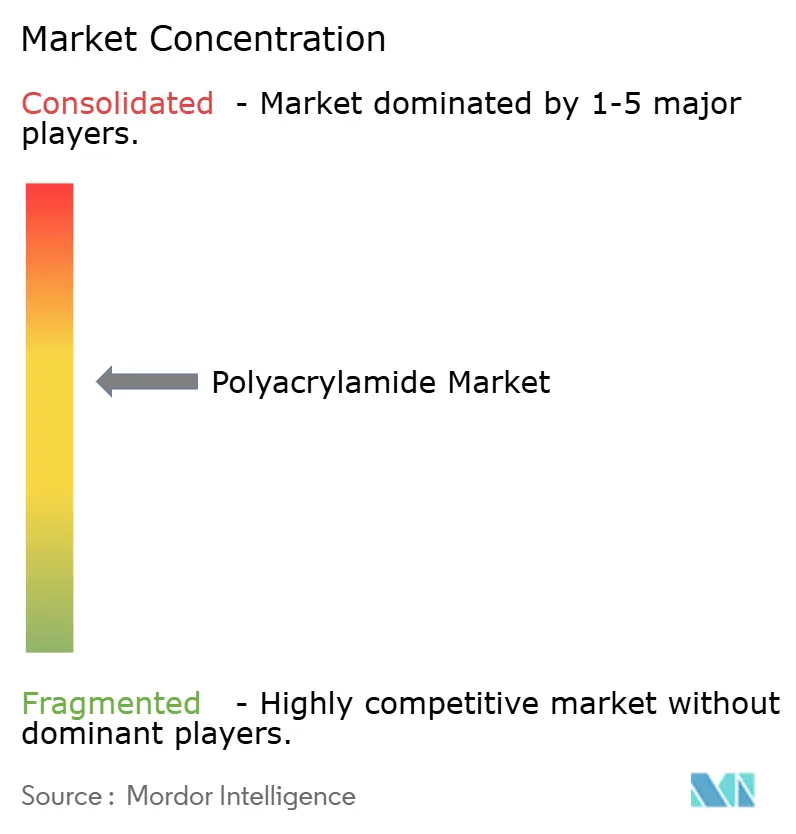
The Polyacrylamide market is moderately concentrated. Solenis vaulted into mining leadership by acquiring BASF’s Magnafloc, Rheomax, and Alclar brands in 2024, strengthening its presence in tailings management and copper flotation. SNF expanded emulsion capacity in Australia and integrated monomer capacity in the United States, prioritizing vertical integration and logistics proximity. Disruptors are emerging from bio-based niches: starch- and chitosan-derived flocculants achieve up to 75% of synthetic efficiency and already hold 15%-20% of Northern European municipal contracts.
Polyacrylamide Industry Leaders
Kemira
Solenis
BASF
SNF
Ashland
- *Disclaimer: Major Players sorted in no particular order
Polyacrylamide Market Companies Covered in this Report
- AnHui JuCheng Fine Chemicals Co. Ltd
- Anhui Tianrun Chemical Industry Co. Ltd
- Ashland
- BASF
- Beijing Hengju Chemical Group Co. Ltd
- Beijing Xitao Technology Development Co. Ltd
- CHINAFLOC
- Envitech Chemical Specialities Pvt. Ltd
- Kemira
- Liaocheng Yongxing Environmental Protection Science & Technology Co. Ltd
- Qingdao Oubo Chemical Co. Ltd
- Shandong Tongli Chemical Co. Ltd
- SNF
- Solenis
- Syensqo
- Universal Fine Chemicals SPC
- Yixing Cleanwater Chemicals Co. Ltd

Market Opportunities and Future Outlook
A clearer whitespace is emerging around regionalized supply and faster-to-qualify production near high-consumption basins, particularly where water treatment, oil and gas, and mining projects require dependable deliveries of certified grades. In North America, the announced 200,000 metric tons per year Texas New Materials polyacrylamide facility in Big Spring, Texas, targeting late-2026 startup, reflects customer pull for domestic capacity that can reduce import reliance and shorten lead times for shale friction reducers and municipal dewatering polymers.
Specialty-grade opportunities are also tied to stricter performance and safety thresholds, including low residual-monomer potable-water products and advanced polymers engineered for harsh brines and high temperatures in EOR and produced-water reuse. In the Middle East, SNF Oman reported Phase 1 operations commencing in January 2026 at Salalah with about 6,000 metric tonnes per year of polymer processing capacity, followed by a May 2026 investment announcement for a polymer manufacturing plant, indicating active capacity build-out aligned with regional oil and gas and industrial demand. On the demand side, regulatory and procurement changes such as the EU Urban Wastewater Treatment Directive 2024/3019 and tighter sludge-handling mandates in Asia are increasing adoption of performance-based purchasing, which raises the value of application engineering, closed-loop dosing, and higher-purity emulsions where safety and dissolution speed are procurement differentiators.
Recent Industry Developments in Polyacrylamide Market
- May 2026: SNF Oman announced a strategic investment for a polymer manufacturing plant in Salalah, Oman, targeting expansion into regional oil and gas and industrial markets. The investment supports local supply availability and shorter lead times for customers that depend on consistent polymer performance and on-site technical support.
- October 2025: Texas New Materials disclosed plans to build a 200,000-metric-ton-per-year polyacrylamide production facility in Big Spring, Texas, United States, targeting startup by late 2026, with NNA Polymers positioned as the channel to market. The project reflects continued regionalization of PAM supply for North American shale, mining, and municipal applications, where logistics and supply assurance influence supplier awards.
- November 2024: BASF completed the divestment of its flocculant mining business, including the Magnafloc and Rheomax trademarks, to Solenis. The transaction reshaped competitive positioning in mining water-treatment chemicals by expanding Solenis presence in tailings and thickening applications while refocusing BASF on other mining chemistries.


Polyacrylamide Market Report Scope and Research Methodology
Market Definition and Coverage
This market covers the demand for polyacrylamide (PAM) sold into end uses where it works mainly as a flocculant, thickener, or viscosity modifier, and it is counted as total consumption across major regions in the study period.
Scope exclusions: We exclude downstream service revenues (such as water treatment operations) and we also exclude equipment and non-PAM substitute chemistries that may be used in similar processes.
Segments Covered in This Report
- By Physical Form
- Powder
- Liquid
- Emulsion/Dispersion
- By Application
- Flocculants for Water Treatment
- Enhanced Oil Recovery
- Soil Conditioner
- Binders and Stabilizers in Cosmetics
- Other Applications (Mining & Mineral Processing etc.)
- By End-User Industry
- Water Treatment
- Oil and Gas
- Mining
- Pulp & Paper
- Other End-user Industries (Chemicals & Petrochemicals, etc.)
- By Geography
- Asia-Pacific
- China
- India
- Japan
- South Korea
- Malaysia
- Thailand
- Indonesia
- Vietnam
- Rest of Asia-Pacific
- North America
- United States
- Canada
- Mexico
- Europe
- Germany
- United Kingdom
- France
- Italy
- Spain
- Nordic Countries
- Turkey
- Russia
- Rest of Europe
- South America
- Brazil
- Argentina
- Colombia
- Rest of South America
- Middle East & Africa
- Saudi Arabia
- Qatar
- United Arab Emirates
- Nigeria
- Egypt
- South Africa
- Rest of Middle-East and Africa
- Asia-Pacific
Data Sources, Market Sizing, and Validation
Desk Research
Desk work started with pinning down the basic demand pool, where polyacrylamide is actually consumed, and how usage changes by industry. Public sources were used for this, such as the US Geological Survey for mining activity signals, the US Energy Information Administration for oil production trends that influence EOR demand, and the US EPA for water and wastewater regulation context that can shift polymer selection.
To keep the regional picture consistent, we also looked at sources such as UN Comtrade for trade flows of related chemical categories, and World Bank indicators for industrial output and municipal infrastructure spending patterns that tend to move treatment chemical volumes. On the company side, we reviewed annual reports, filings, and investor presentations, along with association websites and credible press to understand capacity additions and pricing commentary. Where needed, we complemented this with paid subscriptions focused on company financials and intelligence, patent databases, and shipment-level import and export tracking to cross-check directionally. These desk sources are not exhaustive, and many other public documents and datasets were also referred to for data collection, validation, and clarification.
Primary Interviews and Surveys
Primary work was used to test the sizing logic and convert volume signals into realistic value outcomes, especially where public pricing is inconsistent across grades. We spoke with participants across the value chain, including manufacturers, distributors, and large end users in water treatment, oil and gas, and pulp and paper, and then the assumptions were refined for Asia-Pacific, EMEA, and the Americas based on local market behaviors.
Distribution of primary research fieldwork respondents
| Company type | Respondent position | Region |
|---|---|---|
| Top tier: 27% | CXOs: 17% | APAC: 46% |
| Mid tier: 54% | Functional/Unit leaders: 38% | EMEA: 31% |
| Smaller Players: 19% | Managers: 45% | Americas: 23% |
Market-Sizing & Forecasting
We built the market from the demand pool first, where municipal and industrial water treatment, oilfield activity linked to polymer-based EOR, and pulp and paper output were used to reconstruct consumption by region. Once that structure was set, the totals were checked with selective bottom-up approximations, such as sampled supplier volumes in key countries and an ASP times volume sense-check by grade, and then adjusted only when the gap was explained.
Inputs used in the model included wastewater treatment throughput and sludge dewatering intensity, crude oil production and mature-field EOR activity, paper and packaging production volumes, and trade movement signals for relevant chemical flows where local production is limited. Because pricing varies sharply by ionic type, concentration, and form (powder versus emulsion), ASP paths were built as ranges and then narrowed using interview feedback on contract patterns and recent price resets. Forecasting was done using scenario analysis supported by a simple time series check, so shifts like tighter wastewater regulation or lower drilling activity could be reflected transparently. Where coverage gaps existed for smaller countries, we used proxy indicators tied to industrial output and treatment capacity, and then rechecked the implied per-unit usage before locking the estimate.
Data Validation & Update Cycle
Results were validated by comparing the final market totals against independent signals, such as regional wastewater capacity additions, oilfield chemical intensity trends, and import reliance where domestic capacity is known to be limited. Outliers were flagged, assumptions were reworked, and in some cases respondents were re-contacted when the implied consumption per facility or per barrel looked abnormal.
Before sign-off, the model goes through multi-step checks across analysts, including year-to-year variance review, unit consistency checks, and a final pass on currency conversion timing and pricing logic. Reports are refreshed annually, and interim updates are made when material events occur, such as major capacity start-ups, regulatory changes, or sharp feedstock movements. Right before delivery, an analyst runs a fresh review so clients receive the most up-to-date view possible.
Mordor Intelligence's Polyacrylamide Market Estimate Compared With Other Published Estimates
Published market values for polyacrylamide often do not match because some studies size revenue while others focus on volume, and they also differ on which end uses and grades are counted. Differences also come from how pricing is assumed across powder, liquid, and emulsion forms, and from the year chosen for currency conversion.
The main gap comes from counting value versus tons and then applying a single blended price across all grades, where Mordor Intelligence keeps the forecast anchored to the reported volume trajectory (2.45 million tons in 2026 and 3.25 million tons in 2031) and only converts to USD using application-linked ASP ranges validated with interviews.
Benchmark comparison
| Source | Market Size | Gaps in Research Methodology |
|---|---|---|
| Mordor Intelligence | USD 2.45 M (2026) | |
| Trade Journal A | USD 5.86 B (2024) | Uses a revenue-based figure that can embed broader grade coverage and blended ASP assumptions, and the 2024 base year can reflect a different price cycle than a volume-led forecast year. |
| Global Consultancy B | USD 5.60 B (2024) | Presents a single 2024 value baseline that may mix product types and average prices across regions, which can lift totals if higher-value specialty grades are assumed to dominate. |
The spread in the table is largely explained by the measurement basis and the ASP treatment, not by a single demand shock. By keeping the sizing steps tied to clear consumption drivers and then translating them into value with interview-tested price bands, the final number stays traceable and repeatable for decision-making.


Key Questions Answered in the Report
What is the projected volume of the polyacrylamide market by 2031?
It is expected to reach 3.25 million tons by 2031, reflecting a CAGR of 5.81% from 2026.
Which application is growing fastest within polyacrylamide demand?
Enhanced oil recovery is advancing at a 6.24% CAGR through 2031 due to polymer flooding in mature reservoirs
Why are emulsion formats gaining share over powder grades?
Emulsions dissolve in minutes, cut dust exposure, and integrate with automated dosing, driving a 6.12% CAGR to 2031.
How is regulation impacting polyacrylamide suppliers in Europe?
The Urban Wastewater Treatment Directive and pending biodegradability rules are boosting demand for low-residual and bio-based grades.
Which region leads global consumption?
Asia-Pacific held 49.95% of 2025 volume and is expected to grow at 6.25% to 2031 on the back of electronics, paper, and battery-metal projects.
Page last updated on:


 Your data is secure and never sold or shared.


