
Account Based Marketing Market Size and Share
Market Overview
| Study Period | 2020 - 2031 |
|---|---|
| Market Size (2026) | USD 1.15 Billion |
| Market Size (2031) | USD 2.02 Billion |
| Growth Rate (2026 - 2031) | 11.94 % |
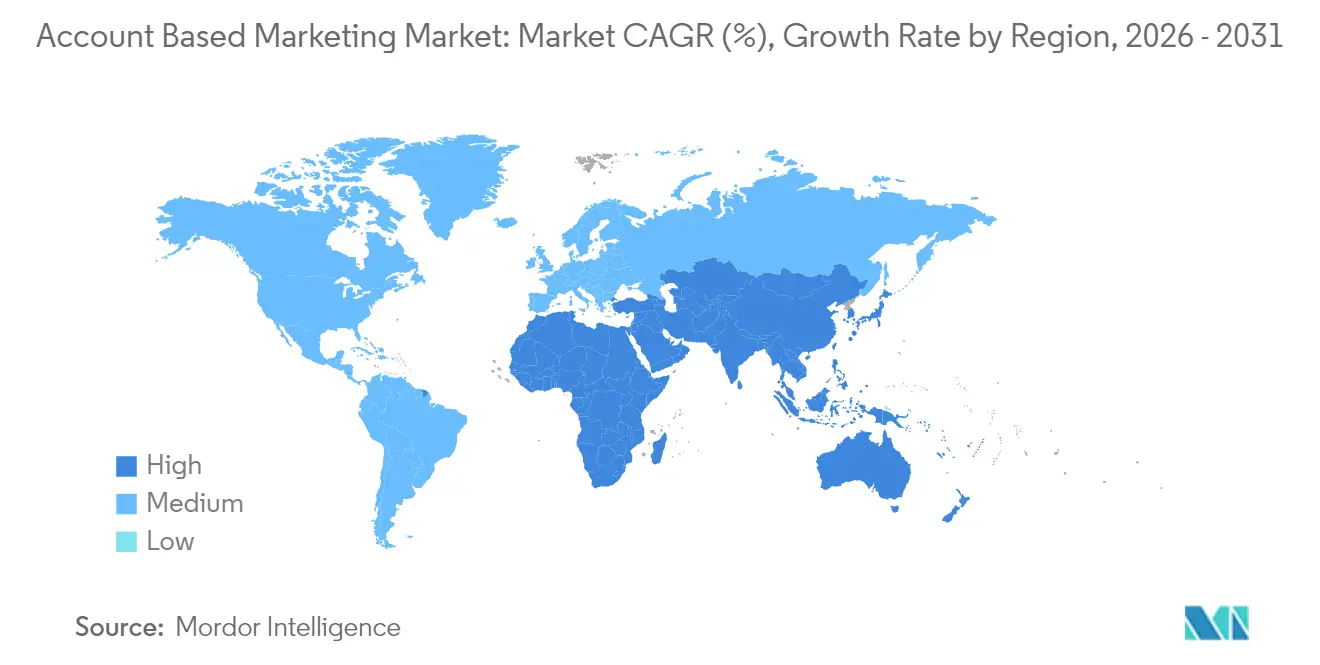
| Fastest Growing Market | Asia Pacific |
| Largest Market | North America |
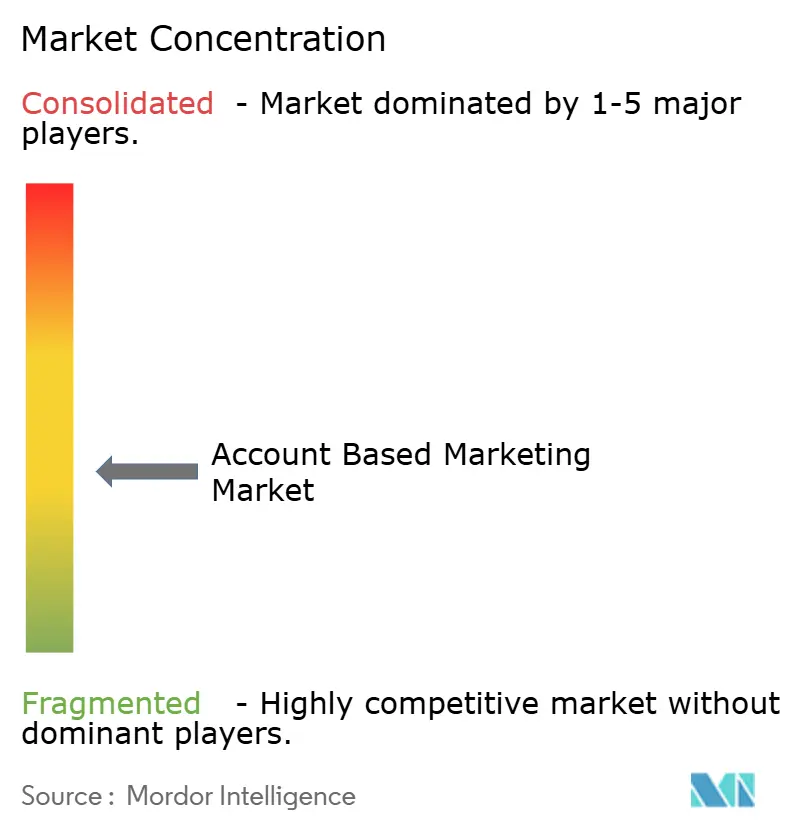
| Market Concentration | Medium |
Major Players *Disclaimer: Major Players sorted in no particular order Image © Mordor Intelligence. Reuse requires attribution under CC BY 4.0. | |
Account Based Marketing Market Analysis by Mordor Intelligence
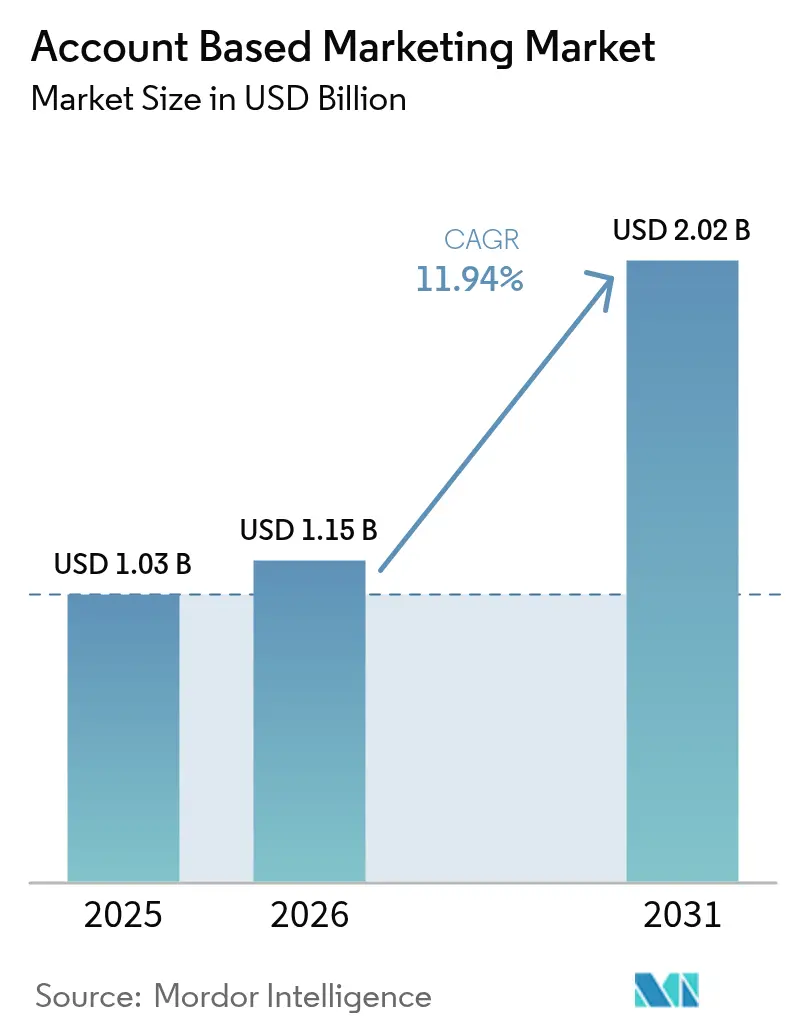
The Account-Based Marketing market size is expected to grow from USD 1.03 billion in 2025 to USD 1.15 billion in 2026 and is forecast to reach USD 2.02 billion by 2031 at 11.94% CAGR over 2026-2031. This acceleration reflects the shift from broad lead generation to highly personalized engagement, as first-party data strategies, AI-driven intent analytics, and programmatic advertising converge to improve precision targeting. Cloud-native ABM platforms now orchestrate data from customer data platforms (CDPs), CRM systems, and ad exchanges in real time, enabling marketers to identify buying-group signals, shorten sales cycles, and raise conversion rates. Google’s scheduled 2025 phase-out of third-party cookies is reinforcing these trends by making privacy-compliant, first-party data-centric approaches indispensable. Vendors are answering with cookieless ID graphs, IP-based targeting, and hashed-email matching, while CMOs simultaneously reallocate larger budget portions to measurable, revenue-linked programs. The Account-Based Marketing market therefore sits at the crossroads of data privacy regulation, AI innovation, and B2B revenue accountability.
Key Report Takeaways
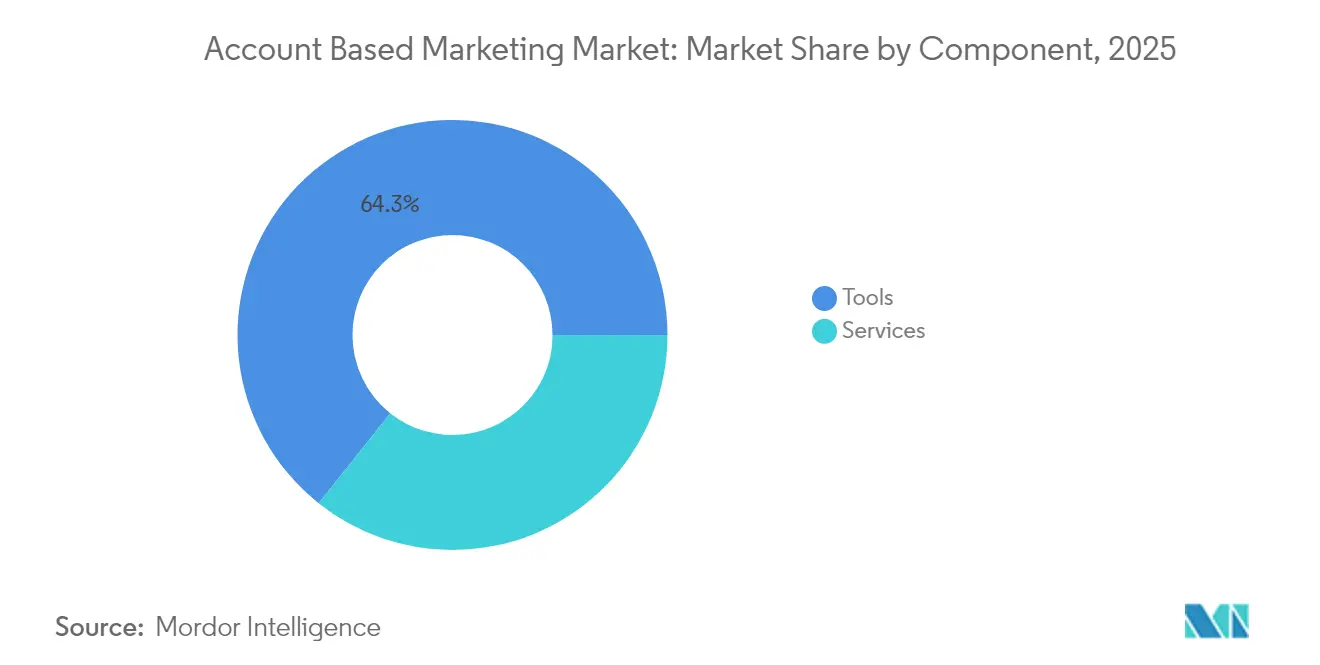
- By component, the Tools segment led with 64.30% of Account-Based Marketing market share in 2025; Services is projected to record a 14.02% CAGR through 2031.
- By deployment model, cloud solutions held 71.40% of the Account-Based Marketing market size in 2025 and are expected to expand at a 13.21% CAGR.
- By end-user industry, IT and Telecommunications accounted for a 25.60% share of the Account-Based Marketing market size in 2025, while Healthcare & Life Sciences is advancing at a 14.62% CAGR.
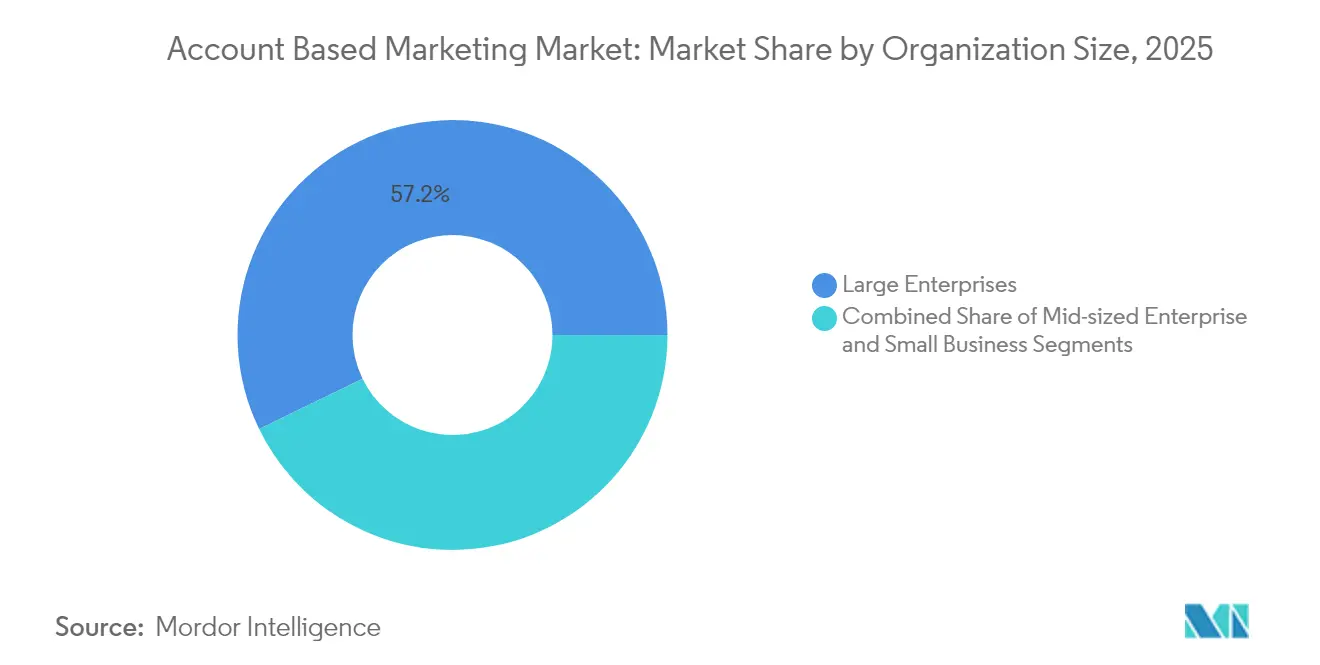
- By organization size, Large Enterprises captured 57.20% of the Account-Based Marketing market share in 2025; Mid-sized Enterprises show the fastest growth at 14.25% CAGR.
- By channel, Display Advertising commanded 29.50% of spending in 2025, whereas Social Media is rising at a 15.38% CAGR.
- By geography, North America represented 40.60% of the Account-Based Marketing market size in 2025; Asia-Pacific is poised for 14.55% CAGR through 2031.
Note: Market size and forecast figures in this report are generated using Mordor Intelligence’s proprietary estimation framework, updated with the latest available data and insights as of 2026.
Market Trends and Insights
Drivers Impact Analysis of Account Based Marketing Market*
| Driver | (~) % Impact on CAGR Forecast | Geographic Relevance | Impact Timeline |
|---|---|---|---|
| Rising Intent-Data Partnerships Accelerating ABM Platform Effectiveness | +2.5% | Global, with stronger impact in North America | Medium term (2-4 years) |
| Rapid Uptake of Programmatic ABM in Asia-Pacific Tech Start-Ups | +1.8% | Asia-Pacific, with spillover to global tech hubs | Short term (≤ 2 years) |
| Convergence of Customer Data Platforms (CDPs) with ABM Suites in North America | +1.5% | North America, with gradual adoption in Europe | Medium term (2-4 years) |
| Industry-specific Playbooks Driving ABM Adoption in BFSI & Healthcare | +1.2% | Global, with concentration in developed markets | Medium term (2-4 years) |
| Declining Third-Party Cookie Support Elevating ABM Demand for First-Party Data | +2.1% | Global, with initial impact in North America and Europe | Short term (≤ 2 years) |
| Shift Toward Revenue-Based Metrics Among CMOs Boosting ABM Budgets | +1.4% | Global, with stronger impact in enterprise segment | Short term (≤ 2 years) |
| Source: Mordor Intelligence | |||
Rising Intent-Data Partnerships Accelerating ABM Platform Effectiveness
Marketers are integrating third-party intent feeds with proprietary first-party data to rank accounts by in-market probability, resulting in sharper audience segmentation and higher win rates. More than nine in ten B2B teams embed purchase-signal data into their scoring models, and reported ROI lifts approach double traditional programs. ABM suites increasingly embed native connectors to feed intent events directly into orchestration engines, enabling same-day activation. Large software vendors are further enriching signals with conversational intelligence that captures qualitative buying context. Because these capabilities shorten sales cycles and increase average deal sizes, they are forecast to add 2.5 percentage points to overall CAGR.
Rapid Uptake of Programmatic ABM in Asia-Pacific Tech Start-Ups
Mobile-first startups across Singapore, India, and Australia are shifting ad spend into programmatic ABM that automatically matches creative, bid, and channel to each intent-rich account. Regional use cases show click-through lifts exceeding 50% and cost-per-opportunity declines of more than 30%. Localized partner ecosystems—DSPs, data providers, and ABM managed-service agencies - are lowering entry barriers, catalyzing broader adoption. The momentum is reinforced by investor pressure on startups to demonstrate efficient growth, turning programmatic ABM into a core acquisition lever. The resulting contribution to the Account-Based Marketing market growth is estimated at 1.8 percentage points over the next two years.
Convergence of Customer Data Platforms with ABM Suites in North America
Enterprises are welding CDPs to ABM engines so that behavioral, transactional, and firmographic attributes stream into unified profiles accessible to sales and marketing teams. Oracle’s CDP-driven marketing suite reports engagement lifts around 20% after enabling real-time journey triggers tailored to buying-group roles. [1]Oracle Corporation, “Oracle Marketing and Sales Unification Suite,” oracle.com Unified identity resolution allows marketers to cut waste from duplicative outreach and shift budgets to high-intent micro-segments. As integration templates from major vendors simplify deployments, North American adoption is accelerating, adding 1.5 percentage points to forecast CAGR.
Declining Third-Party Cookie Support Elevating ABM Demand for First-Party Data
Google’s looming Chrome policy change is forcing B2B advertisers to replace cookie-based retargeting with privacy-safe alternatives. ABM vendors now ship cookieless ID graphs that map hashed business emails, domain signals, and IP ranges to account profiles. Early adopters report stable match rates and impression quality despite cookie loss, while compliance teams welcome reduced regulatory exposure. This shift is driving an incremental 2.1 percentage-point lift in growth as budgets reallocate from broad display to account-centric programs.
Restraints Impact Analysis of Account Based Marketing Market*
| Restraint | (~) % Impact on CAGR Forecast | Geographic Relevance | Impact Timeline |
|---|---|---|---|
| Brand-Side Talent Gap in Multi-Touch Attribution Analytics | -0.8% | Global, with acute impact in emerging markets | Medium term (2-4 years) |
| High Subscription Costs Limiting Penetration in Emerging Markets | -0.6% | Asia-Pacific, Latin America, Middle East & Africa | Short term (≤ 2 years) |
| Data-Privacy Compliance Complexity (GDPR, LGPD, CCPA) | -0.5% | Global, with strongest impact in Europe | Medium term (2-4 years) |
| CRM–ABM Integration Challenges for Legacy On-Premise Installations | -0.4% | Global, with concentration in enterprise segment | Short term (≤ 2 years) |
| Source: Mordor Intelligence | |||
Brand-Side Talent Gap in Multi-Touch Attribution Analytics
Enterprises struggle to find analysts who can stitch online and offline touchpoints into reliable influence models, limiting confidence in ABM ROI calculations. Forty-plus percent of in-house teams admit capability gaps, which delay optimization cycles and constrain budget expansion. Outsourcing to agencies raises costs and slows insight turnaround times. Emerging markets feel the pinch most acutely, as experienced talent commands premium salaries in competitive labor pools. Until training pipelines widen, this shortfall is expected to shave 0.8 percentage points off CAGR.
High Subscription Costs Limiting Penetration in Emerging Markets
Comprehensive ABM suites often start near USD 400 per month and scale into five-figure annual contracts once advanced features and higher target-account volumes are unlocked. Such pricing challenges mid-market firms in price-sensitive economies, especially where marketing technology budgets hover at low single-digit shares of revenue. Although modular offerings and region-specific vendors are appearing, cost remains the primary obstacle to mass deployment, dampening overall growth by 0.6 percentage points in the short term.
*Our forecasts treat driver/restraint impacts as directional, not additive. The impact forecasts reflect baseline growth, mix effects, and variable interactions.
Account Based Marketing Market Segment Analysis
By Component:
Services Outpace Tools in Value CreationTools retained 64.30% of the Account-Based Marketing market share in 2025, supplying AI-powered account selection, multi-channel orchestration, and pipeline analytics. Yet the Services component is entering a higher-velocity phase, delivering a 14.02% CAGR through 2031 as companies enlist strategic advisory, content development, and managed-campaign support. The transition from technology acquisition to execution excellence fuels this surge because organizations recognize that orchestration rigor, sales alignment, and analytics maturity—not software alone—unlock revenue impact. Services providers now package vertical playbooks, attribution consulting, and first-party data architecture, positioning themselves as indispensable transformation partners.
The Account-Based Marketing market consequently relies on a symbiosis: platforms furnish scalable infrastructure, while service specialists de-risk adoption and accelerate time to value. As privacy shifts compel deeper data engineering, demand for service-led CDP integrations and compliance audits intensifies. This dual-track dynamic is set to continue, with Services capturing incremental share, particularly among industries lacking ABM expertise.



By Deployment Model:
Cloud Dominance Accelerates IntegrationCloud solutions owned 71.40% of the Account-Based Marketing market size in 2025 and advanced at 13.21% CAGR as buyers favor elastic compute, rapid feature releases, and frictionless API connections. SaaS models streamline data ingestion from CRMs, analytics suites, and ad platforms, letting marketers stand up pilots in weeks rather than quarters. Vendors such as Demandbase and 6sense now offer turnkey connectors to CDPs, marketing automation, and intent feeds, lowering integration hurdles.
On-premise deployments persist in highly regulated sectors such as financial services, where strict data-residency rules apply. Even there, hybrid architectures - local data stores paired with cloud-based orchestration layers—are gaining ground as encryption, zero-trust frameworks, and audit trails assuage security teams. Consequently, cloud’s perceived risk has fallen, and its benefits - continuous innovation, lower capex, and easier AI adoption - are widening the deployment gap.
By End-User Industry:
Healthcare Accelerates While IT LeadsIT and Telecommunications maintained a 25.60% slice of the Account-Based Marketing market in 2025 by leveraging deep technographic data and purchasing committees familiar with digital collaboration. Complex enterprise sales cycles and competitive product landscapes sustain IT’s reliance on ABM to focus resources on best-fit, high-lifetime-value accounts. Meanwhile, Healthcare & Life Sciences expands at a 14.62% CAGR as pharmaceutical, medical-device, and health-technology vendors adopt account-centric tactics to reach multidisciplinary hospital and research stakeholders. Tailored playbooks that navigate compliance and clinical governance have lowered barriers to entry for ABM in these settings.
Banking, Financial Services, and Insurance stands as the second-largest industry cohort, applying ABM to guide digital-transformation deal flow and sustainable-finance offerings. Retail and E-commerce, and Manufacturing show accelerating uptake as B2B commerce platforms demand personalized buyer journeys. Collectively, these dynamics confirm that the Account-Based Marketing market has progressed from early-stage technology niches into a cross-industry growth engine.
By Organization Size:
Mid-Market Adoption Accelerates Platform EvolutionLarge Enterprises controlled 57.20% of the Account-Based Marketing market in 2025, pairing sophisticated data estates with multi-tier ABM strategies that span one-to-one, one-to-few, and one-to-many motions. Their budgets facilitate advanced intent sources, content personalization studios, and sales-enablement integrations. Yet Mid-sized Enterprises are the fastest climbers with a 14.25% CAGR as vendors simplify onboarding, embed best-practice playbooks, and price platforms on tiered account volumes. Lightweight orchestration features, templated reporting, and self-service analytics now allow marketing teams of limited headcount to launch ABM programs within weeks.
This democratization is steering product roadmaps toward modular capabilities that scale with organizational maturity. At the same time, Enterprises press vendors for even deeper AI predictions, custom data-lake connectors, and governing-body compliance modules. The divergent needs spur specialized product editions, reinforcing the segment-specific focus throughout the Account-Based Marketing market.
By Channel:
Social Media Disrupts Display Advertising DominanceDisplay Advertising kept 29.50% of ABM channel outlays in 2025 due to its breadth and mature targeting taxonomies. However, Social Media bills are climbing fastest at 15.38% CAGR as platforms like LinkedIn refine professional identity graphs that map job titles, skills, and buying responsibilities. Sponsored InMail, matched-audience retargeting, and conversation ads now deliver direct dialogue with buying committees, generating acceptance rates that often exceed 15% for strategic connection requests.
Email remains a workhorse channel because it binds nurturing workflows to CRM opportunity stages, while personalized website experiences surface differentiated value propositions to recognized visitors. Event-driven interactions—virtual roundtables, webinars, and targeted field events—continue to close late-stage opportunities by convening cross-functional stakeholders. Effective ABM programs, therefore, orchestrate sequences across paid, owned, and earned channels, relying on AI to determine optimal touchpoints and progression triggers.
Geography Analysis
North America Account Based Marketing Market
North America held 40.60% of the Account-Based Marketing market size in 2025 on the strength of an advanced martech landscape, early adopter technology firms, and a concentration of ABM platform headquarters. United States enterprises pioneer CDP-ABM convergence, cookieless identity innovation, and AI-driven predictive scoring, establishing use-case blueprints for global peers. Data-privacy legislation such as California’s CCPA and sector-specific rules add complexity, yet they also spur investments in compliant data architectures, further entrenching ABM as the privacy-ready alternative to broad-target display.
APAC, EMEA and South America Account Based Marketing Market
Asia-Pacific is the fastest-growing territory, charting a 14.55% CAGR to 2031. Singapore, Japan, Australia, and India headline adoption, each adapting ABM to local buyer behaviors and regulatory environments. Startups capitalize on programmatic ABM to counter resource constraints and compete against multinational incumbents. Regional ad-spend reports reveal double-digit gains in mobile and social commerce, aligning perfectly with intent-driven, account-focused tactics that thrive on granular first-party engagement data. Europe ranks second by revenue share, propelled by the United Kingdom, Germany, and France, where GDPR compliance frameworks are embedded into platform feature sets. Strict lawful-basis requirements elevate the value of first-party data and authenticated audiences, positioning ABM suites that automate consent management for competitive advantage. South America and the Middle East & Africa are smaller but growing niches; Brazil and the United Arab Emirates lead regional pilots, aided by localized language support and flexible usage-based pricing. Global diffusion shows the Account-Based Marketing market transitioning from an Anglo-American paradigm to a genuinely worldwide discipline.

Regulatory Landscape
Account-based marketing (ABM) programs operate under tightening global privacy, advertising transparency, and AI-governance rules that affect identity resolution, intent-data use, and automated targeting. In the European Union, Regulation (EU) 2024/900 on the transparency and targeting of political advertising adds compliance pressure around targeting transparency and ad-disclosure practices that can influence B2B media operations and the ad-tech workflows used in ABM. In the United States, the California Privacy Protection Agency (CPPA) CCPA-related regulations became effective January 1, 2026, alongside CPPA Data Broker Registration and Accessible Deletion Mechanism (DROP) regulations, increasing operational requirements for consumer rights handling and deletion mechanisms that can affect B2B data sourcing and enrichment used for account identification.
AI enablement in ABM increasingly needs explicit governance. The amended FTC COPPA Rule has a full compliance date of April 22, 2026, which affects data collection and personalization practices when audiences can implicate minors. In Europe, the EU AI Act introduces enforceable transparency obligations for certain AI uses beginning August 2, 2026, adding compliance workload for ABM vendors and users applying generative AI for content and automated decisioning. Across Asia-Pacific and other markets, policy and standards activity such as China issuing GB/T 47294-2026 (implemented from June 1, 2026) and codes of practice in markets such as the United Kingdom (Telecommunications Security Code of Practice 2026, version 1.1) reinforce that ABM platforms operating in regulated industries, notably IT and telecommunications, must align privacy, security, and AI controls with enterprise procurement requirements.
Competitive Landscape
The Account-Based Marketing market displays moderate concentration at the enterprise tier. Demandbase, 6sense, and Terminus collectively hold meaningful shares, leveraging proprietary intent data, orchestration engines, and AI models to serve complex global accounts. Consolidation continues: DemandScience’s November 2024 merger with Terminus joined comprehensive data assets with multichannel engagement orchestration, creating a suite capable of cradle-to-grave account nurturing. [3]MarTech, “DemandScience and Terminus Merge to Build End-to-End ABM Platform,” martech.org Mid-market and SMB layers remain fragmented, with RollWorks, HubSpot, and Influ2 competing on ease of use, rapid deployment, and pricing transparency.
Competitive differentiation now centers on three axes: depth of AI-powered insights, breadth of native data partnerships, and vertical-specific playbooks. Vendors integrate intent data providers, conversational intelligence, and ad exchanges into unified dashboards, promising faster pipeline acceleration. Disruptors like Valasys Media use behavioral AI scoring to identify micro-signals and report triple-digit engagement lifts, challenging incumbents on predictive accuracy. Meanwhile, established marketing-cloud providers bundle ABM modules into larger customer-experience suites, seeking stickier platform lock-in.
Despite intensified rivalry, white-space opportunities persist in emerging-market localization, industry-specific compliance modules, and low-touch “ABM lite” products for small businesses. Suppliers that seamlessly link marketing and revenue-operations analytics, prove attribution, and respect global privacy statutes stand to consolidate leadership as budgets migrate from traditional broad-reach tactics to account-centric orchestration.
Account Based Marketing Industry Leaders
Terminus Software, Inc.
Engagio Inc.
6sense Insights, Inc.
Uberflip
Adobe Inc. (Marketo)
- *Disclaimer: Major Players sorted in no particular order
Account Based Marketing Market Companies Covered in this Report
- Terminus Software, Inc.
- Adobe Inc. (Marketo)
- Uberflip
- Triblio Inc.
- 6sense Insights, Inc.
- Engagio Inc.
- HubSpot, Inc.
- Madison Logic
- Demandbase Inc.
- Salespanel
- Drift.com, Inc.
- RollWorks (NextRoll, Inc.)
- Folloze
- MRP Prelytix (MRP)
- Kwanzoo Inc.
- Lattice Engines
- LeanData
- Bombora
- TechTarget, Inc.
- Insider Inc.

Market Opportunities and Future Outlook
ABM execution has shifted beyond pilot usage, creating whitespace in the operational layers that connect intent, identity, content, and sales workflows across increasingly complex stacks. In 2026 benchmarking, Demand Gen Report found nearly 80% of surveyed organizations actively executing an ABM strategy, with AI-powered content personalization at scale identified as a top AI use case. This supports opportunities for vendors and service providers that package repeatable orchestration playbooks, governance, and measurement across the ABM channels already central to programs (email, display, social, web personalization, and events), especially for mid-sized enterprises seeking faster time-to-value and for verticals where compliance and buying committees heighten coordination needs.
A second opportunity is agentic and ecosystem-integrated ABM, where GTM intelligence is made accessible inside broader AI-agent workflows and revenue operations toolchains. The evidence appears in platform roadmaps that emphasize AI assistance, automated triage, and security controls, and in architectures that add an AI-personalization layer over core ABM platform, intent data, enrichment, and CRM views. As third-party cookie deprecation accelerates first-party data dependence, vendors that can combine cookieless account identification methods, such as hashed-email matching plus IP and domain signals and identity graphs, with enterprise-grade controls and auditability can expand within regulated buyer segments and global enterprises running cloud-first stacks, where cloud deployments already represent the majority of ABM spending in the base year.
Recent Industry Developments in Account Based Marketing Market
- July 2026: 6sense launched its MCP (Model Context Protocol) Server to bring 6sense proprietary GTM intelligence into external AI-agent ecosystems, including Claude, ChatGPT, and Agentforce. The update extends ABM decisioning beyond a standalone UI into agent-driven workflows, raising interoperability and real-time intelligence delivery expectations for competitors.
- May 2026: 6sense opened RevvyAI more broadly for Sales Intelligence customers and expanded enterprise security capabilities such as Custom Roles, SSO role and group mapping, SCIM, and Audit Log Exports. These additions strengthen governance and deployment readiness for large enterprises adopting ABM platforms as systems of record for sensitive account and engagement data.
- November 2024: DemandScience and Terminus merged to create a combined B2B revenue marketing platform under the DemandScience brand. The consolidation broadened the suite across data and multichannel engagement, reinforcing a shift toward end-to-end platforms that connect account identification, orchestration, and measurement.


Account Based Marketing Market Report Scope and Research Methodology
Market Definition and Coverage
For this methodology, the account-based marketing market is defined as the annual revenue generated from dedicated ABM software platforms and the paid services attached to them, such as support, integration, and advisory work. These offerings are used by B2B teams to target and grow named accounts.
Scope exclusions: We exclude generic CRM suites and broad ad-tech tools when they do not provide true account-level targeting and orchestration features.
Segments Covered in This Report
- By Component
- Tools
- Services
- By Deployment Model
- On-premise
- Cloud
- By End-user Industry
- Retail and E-commerce
- BFSI
- IT and Telecommunications
- Government
- Travel and Tourism
- Healthcare and Life Sciences
- Other End-user Industries
- By Organization Size
- Large Enterprises
- Mid-sized Enterprises
- Small Businesses
- By Channel
- Display Advertising
- Social Media
- Website/Personalization
- Events and Webinars
- Others
- By Geography
- North America
- United States
- Canada
- Mexico
- South America
- Brazil
- Argentina
- Chile
- Peru
- Rest of South America
- Europe
- Germany
- United Kingdom
- France
- Italy
- Spain
- Rest of Europe
- Asia-Pacific
- China
- Japan
- South Korea
- India
- Australia
- New Zealand
- Rest of Asia-Pacific
- Middle East and Africa
- Middle East
- United Arab Emirates
- Saudi Arabia
- Turkey
- Rest of Middle East
- Africa
- South Africa
- Nigeria
- Kenya
- Rest of Africa
- Middle East
- North America
Data Sources, Market Sizing, and Validation
Desk Research
To build the base structure of the model, we start with public sources that describe how B2B marketing budgets, digital ad spend, and sales enablement adoption are changing over time. Common references include U.S. Bureau of Economic Analysis data for overall business spending context, U.S. Census Bureau indicators for business activity, and OECD digital economy publications for cross-country comparisons. We also review regulatory and privacy direction that affects targeting and measurement, using sources such as FTC communications and NIST guidance on data handling practices.
On the supply side, we review company filings, investor presentations, product documentation, and credible press coverage to understand what is actually sold as ABM versus adjacent marketing automation capabilities. When needed, a paid subscription for company financials and a patent database are used to fill gaps on revenue hints and product capability signals that are not explained clearly in public material. The desk sources listed here are not exhaustive, and additional public documents were used to collect inputs, cross-check figures, and clarify definitions.
Primary Interviews and Surveys
Primary work focuses on interviews and structured surveys with ABM platform providers, systems integrators, demand generation teams, and B2B sales operations leaders who run named-account programs. For a global view, we ensure inputs are tested across major buying regions so pricing, packaging, and adoption speed assumptions are not tied to a single geography, and we revisit outliers until the assumptions match observed purchasing behavior.
Distribution of primary research fieldwork respondents
| Company type | Respondent position | Region |
|---|---|---|
| Top tier: 36% | CXOs: 18% | APAC: 52% |
| Mid tier: 42% | Functional/Unit leaders: 40% | EMEA: 30% |
| Smaller Players: 22% | Managers: 42% | Americas: 18% |
Market-Sizing & Forecasting
Sizing is built using a top-down approach where marketing technology spend and B2B digital demand signals are reconstructed into an addressable pool for ABM platforms and attached services, then filtered by realistic adoption and packaging patterns. To keep totals anchored, we corroborate the output with selective bottom-up checks, such as sampled pricing by package tier multiplied by active customer counts from channel checks, followed by reasonableness checks on services attach rates.
A few practical inputs steer the model, and those inputs are reviewed against interview feedback before the final estimates are set. These include the share of B2B teams running named-account programs, typical contract lengths and renewal behavior, the split between platform subscription and services revenue, observed shifts toward first-party data use, and changes in privacy-related targeting limitations that can slow or redirect spend. When country-level data is missing, gaps are handled using regional benchmarks from similar digital maturity markets, and then scaling with business density indicators and interview-confirmed adoption ranges.
Forecasts are produced using scenario analysis. The base case links growth to expected budget reallocation toward measurable pipeline programs and to the pace at which ABM functionality is embedded into broader marketing stacks. The final growth path is accepted only after scenario results align with expert views on pricing pressure, replacement cycles, and the speed of new ABM seat expansion in large enterprises and mid-market firms.
Data Validation & Update Cycle
Outputs are checked through triangulation across independent signals, including observed pricing ranges, adoption discussions from interviews, and spend direction indicators from public datasets and filings. Where the model produces an outlier, it is reviewed in multiple steps, starting with range checks at the region level, then cross-validation against implied revenue per customer and services attachment logic, and finally escalation for analyst review before sign-off.
The report is refreshed annually, with interim updates made when material changes occur, such as major changes in privacy enforcement, large product updates that affect ABM capability definitions, or sudden demand shocks. Before delivery, the full model is rerun with the most recent inputs and a fresh analyst pass so clients receive an updated view.
Mordor Intelligence's Account Based Marketing Market Sizing Compared With Other Published Estimates
Published ABM market numbers can look far apart because the boundaries are drawn differently, and the same term is sometimes used for different tool sets and service bundles. Differences also come from the choice of base year, how pricing is averaged across contract types, and how quickly each publisher refreshes assumptions when buying behavior shifts.
Adoption signals from B2B program rollouts, recurring subscription pricing patterns, and services attach-rate checks are the evidence points that keep Mordor Intelligence's estimate focused on dedicated ABM platforms plus paid support, integration, and advisory services, instead of counting broad CRM or generic ad-tech spend. When other estimates expand scope into wider marketing automation stacks or apply aggressive growth paths without re-checking unit economics, the totals usually move higher and the gap becomes visible in the published figures.
Benchmark comparison
| Source | Market Size | Gaps in Research Methodology |
|---|---|---|
| Mordor Intelligence | USD 1.15 B (2026) | |
| Trade Journal A | USD 1.22 B (2024) | Uses an earlier base year and often blends ABM with a wider set of marketing tools and services, which can pull in spend that is not strictly tied to account-level orchestration and targeting. |
| Regional Consultancy B | USD 1.22 B (2024) | Defines scope through broad segment labels (account type, deployment, and verticals) but provides limited visibility on how software-only revenue is separated from adjacent martech modules, which can shift totals depending on what gets counted as ABM. |
The table shows that the spread is mainly explained by scope boundary choices and base-year timing rather than a single calculation mistake. By keeping the counted revenue tied to ABM-specific platform functionality and by stress-testing pricing and service attachment assumptions, the resulting market size stays traceable to clear variables and repeatable checks.


Key Questions Answered in the Report
How fast is the Account-Based Marketing market expected to grow?
The market is forecast to climb from USD 1.15 billion in 2026 to USD 2.02 billion by 2031, delivering a 11.94% CAGR over 2026-2031.
Which region is expanding most quickly in the Account-Based Marketing market?
Asia-Pacific leads with a projected 14.55% CAGR through 2031 as tech-savvy startups and enterprises accelerate programmatic ABM adoption.
What components of the Account-Based Marketing market are growing faster—tools or services?
Tools still dominate at 64.30% share, but Services are expanding faster at a 14.02% CAGR because companies need strategic guidance and execution support.
Why is cloud deployment preferred for ABM platforms?
Cloud solutions account for 71.40% of current spend because they enable rapid integration, continuous feature updates, and scalable processing of real-time intent data.
Which industry vertical is currently the fastest-growing ABM adopter?
Healthcare & Life Sciences is rising at a 14.62% CAGR as vendors target complex, multi-stakeholder hospital procurement processes with account-centric engagement.
Page last updated on:





