
Email Marketing Market Size and Share
Market Overview
| Study Period | 2020 - 2031 |
|---|---|
| Market Size (2026) | USD 13.72 Billion |
| Market Size (2031) | USD 22.93 Billion |
| Growth Rate (2026 - 2031) | 10.82 % |
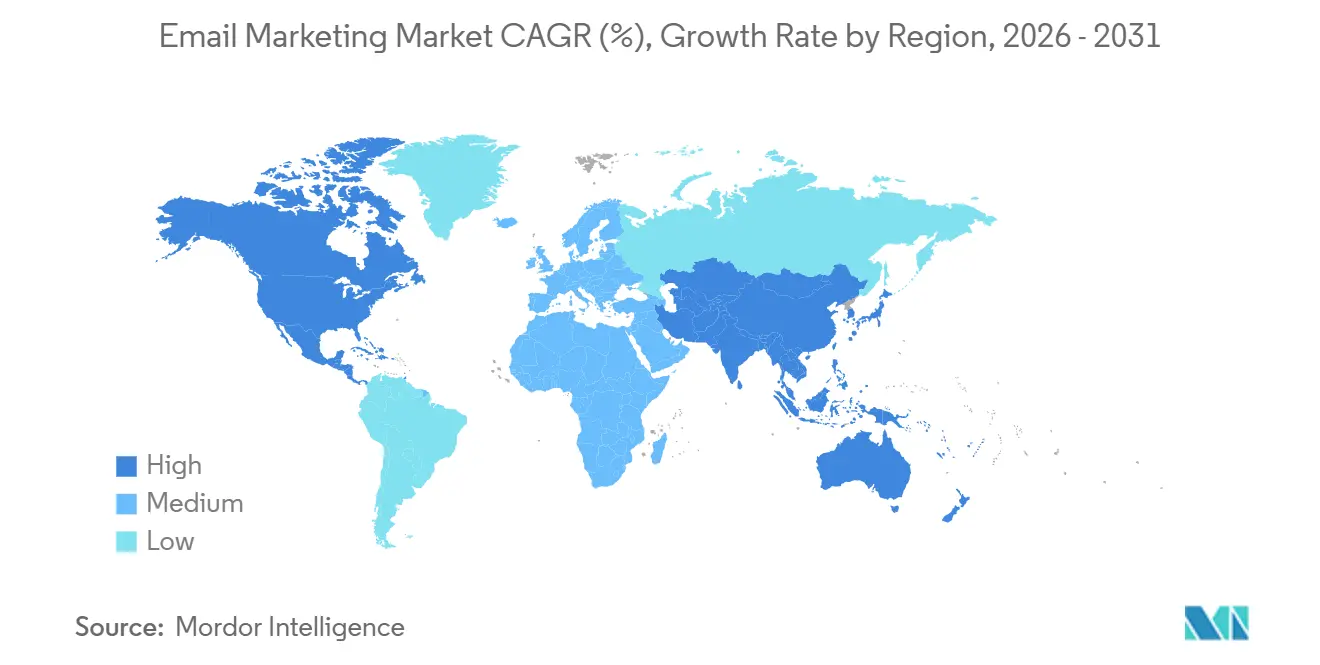
| Fastest Growing Market | Asia Pacific |
| Largest Market | North America |
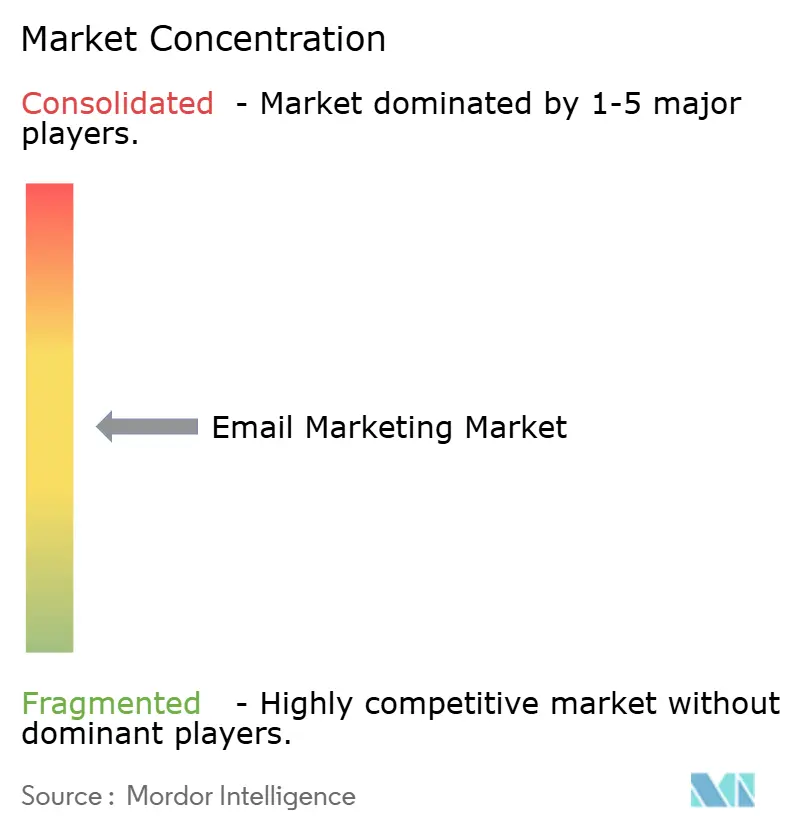
| Market Concentration | Medium |
Major Players *Disclaimer: Major Players sorted in no particular order Image © Mordor Intelligence. Reuse requires attribution under CC BY 4.0. | |
Email Marketing Market Analysis by Mordor Intelligence
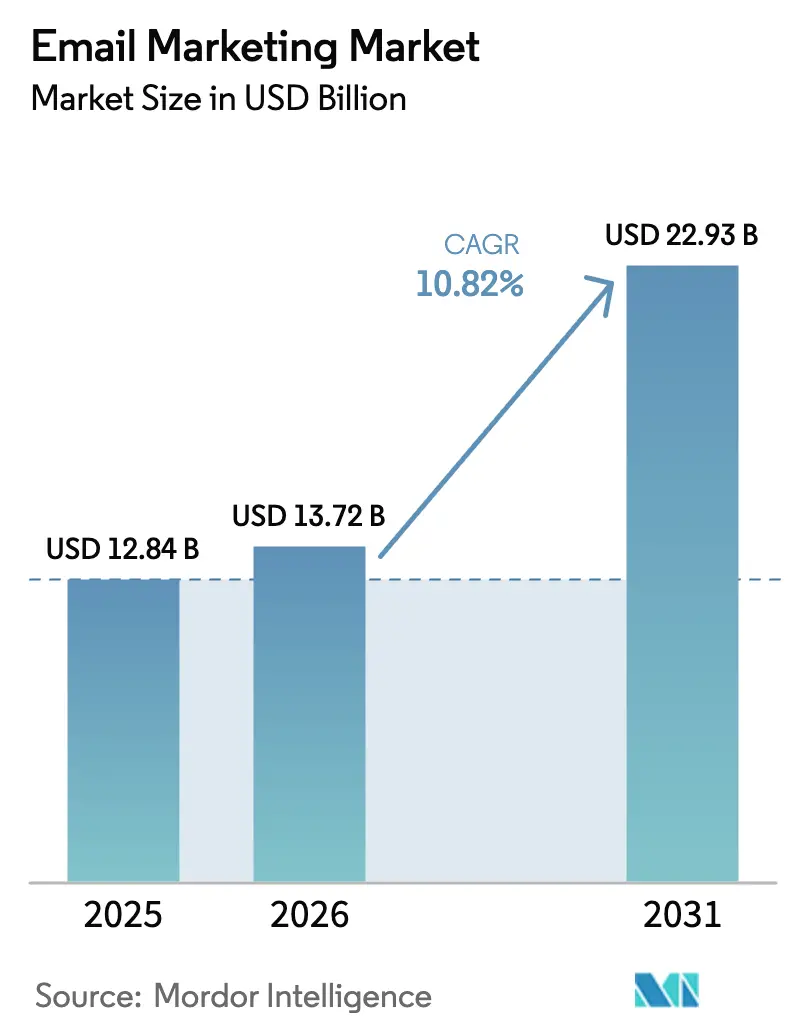
The Email marketing market size is projected to be USD 12.84 billion in 2025, USD 13.72 billion in 2026, and reach USD 22.93 billion by 2031, growing at a CAGR of 10.82% from 2026 to 203. Consistent returns- averaging USD 36 for every dollar invested- keep brands invested even as privacy rules tighten, inbox algorithms grow stricter, and users spend more time on social chat apps. Vendors are embedding automation and generative artificial intelligence to preserve deliverability and raise engagement, while small and medium-sized enterprises (SMEs) enjoy feature-rich, cloud-native suites that remove the cost and maintenance burden of on-premise software. North America’s early move to DMARC and BIMI authentication, Asia-Pacific’s rapidly scaling e-commerce base, and healthcare’s appetite for HIPAA-compliant patient journeys collectively reinforce a multiyear expansion path for the Email marketing market. Competitive intensity remains high as the leading five players invest in zero-party data capture, cross-channel orchestration, and multilingual analytics to defend share.
Key Report Takeaways
- By type, solutions led with 67.81% of the Email marketing market share in 2025, while services recorded the fastest growth at a 10.93% CAGR through 2031.
- By deployment, cloud platforms commanded 88.62% of the Email marketing market size in 2025 and are advancing at an 11.08% CAGR to 2031.
- By enterprise size, SMEs accounted for 57.94% of the Email marketing market size in 2025 and are expanding at an 11.03% CAGR between 2026 and 2031.
- By end-user vertical, retail and e-commerce held 29.17% of the Email marketing market share in 2025, whereas healthcare is projected to post the highest 10.99% CAGR through 2031.
- By geography, North America dominated with 40.93% revenue share in 2025, while Asia-Pacific is forecast to grow at an 11.18% CAGR over 2026-2031.
Note: Market size and forecast figures in this report are generated using Mordor Intelligence’s proprietary estimation framework, updated with the latest available data and insights as of January 2026.
Market Trends and Insights
Drivers Impact Analysis of Email Marketing Market*
| Driver | (~)% Impact on CAGR Forecast | Geographic Relevance | Impact Timeline |
|---|---|---|---|
| Personalization Capabilities To Enhance Engagement | +2.1% | Global, with early gains in North America and Europe | Medium term (2-4 years) |
| Automation of Campaigns And Audience Segmentation | +2.4% | Global, spill-over to Asia-Pacific and Middle East | Short term (≤ 2 years) |
| Integration of Email-Marketing Tools With CRM And E-Commerce Stacks | +1.8% | North America and Europe core, expanding to Asia-Pacific | Medium term (2-4 years) |
| Growing ROI Recognition Versus Alternative Channels | +1.6% | Global | Long term (≥ 4 years) |
| AI-Driven Predictive Send-Time Optimization | +1.9% | North America and Asia-Pacific, early adoption in Europe | Short term (≤ 2 years) |
| Privacy-Centric Authentication Adoption (DMARC, BIMI) | +1.5% | Global, regulatory push in North America and Europe | Medium term (2-4 years) |
| Source: Mordor Intelligence | |||
Automation of Campaigns And Audience Segmentation
Real-time decision engines now trigger messages off browsing histories, predictive churn scores, and lifetime-value models, driving 18-fold more revenue per recipient than one-time sends for merchants deploying Klaviyo’s automated flows.[1] HubSpot’s Breeze AI trims creation time by 40%, and Salesforce Einstein clusters micro-segments without manual lists, letting brands personalize at scale. The democratization of no-code automation empowers SMEs that lack data-science teams, supporting the broader growth of the Email marketing market. Compliance obligations such as single-click opt-outs are now native, reducing regulatory friction while preserving user experience.
Personalization Capabilities To Enhance Engagement
Dynamic product blocks and countdown timers have evolved into predictive experiences that tap zero-party data from quizzes and preference centers. Klaviyo users report 15-25% conversion lifts when recommendation engines surface items aligned to browsing patterns. Adobe Marketo Engage’s AI chooses the optimal subject line, image, and send time for each recipient, while Marriott International attributes a 12% rise in direct bookings to geo-targeted offers.[2] First-party strategies gain importance as third-party cookies and mobile identifiers disappear, sustaining engagement within the Email marketing market. Regulated industries ensure engines exclude sensitive attributes unless explicit consent exists, aligning with HIPAA and PCI DSS mandates.
Integration of Email-Marketing Tools With CRM And E-Commerce Stacks
Open APIs and prebuilt connectors synchronize segments, transactional triggers, and loyalty data across touchpoints. Sixty percent of enterprise campaigns in North America and Europe already flow through CRM-integrated pipelines, accelerating campaign speed and attribution. Shopify lists more than 200 connectors, highlighting the lower integration barrier for small retailers. Centralized consent logs satisfy GDPR and CCPA audits, a capability that underpins sustained investment in the Email marketing market.
AI-Driven Predictive Send-Time Optimization
Vendors embed machine-learning models that learn recipient-level activity windows. Salesforce, Klaviyo, and Mailchimp tout double-digit gains in click-through rates when messages land at predicted high-attention moments. The approach also mitigates inbox-provider filters that punish bulk sends clustered at the top of the hour, an advantage that shields campaign ROI. Though still early, predictive timing already resonates in Asia-Pacific where mobile-first consumers open mail in short bursts, reinforcing regional momentum in the Email marketing market.
Restraints Impact Analysis of Email Marketing Market*
| Restriant | % Impact on CAGR Forecast | Geographic Relevance | Impact Timeline |
|---|---|---|---|
| Deliverability Issues And Low Open Rates | -1.6% | Global, acute in North America and Europe | Short term (≤ 2 years) |
| Stringent Data-Privacy Regulations And Anti-Spam Acts | -1.3% | North America, Europe, APAC | Medium term (2-4 years) |
| Apple Mail Privacy Protection Eroding Open-Rate Metrics | -1.1% | Global, especially US and Western Europe | Short term (≤ 2 years) |
| Gen Z Preference For Social-Messaging Platforms | -0.9% | Global, most pronounced in APAC and Europe | Long term (≥ 4 years) |
| Source: Mordor Intelligence | |||
Deliverability Issues And Low Open Rates
Inbox algorithms reward engagement and punish spam complaints, driving average sector open rates down to 18% in 2025 and raising spam folder placement by 9%. Apple Mail Privacy Protection hides pixel opens for more than half the world’s messages, forcing marketers to shift success metrics toward clicks and conversions. Bulk-sender requirements from Gmail and Yahoo make DMARC alignment mandatory, spurring investment in list hygiene, double opt-in, and BIMI logos that add onboarding friction even as they defend brand identity.[3]
Stringent Data-Privacy Regulations And Anti-Spam Acts
GDPR fines climbed past EUR 250 million (USD 268 million) since 2024, while the FTC sharpened CAN-SPAM guidance in 2025 to penalize deceptive subject lines. Asia-Pacific regimes now demand local data residency for sensitive records, raising infrastructure costs and complicating cross-border orchestration. SMEs feel the burden most, redirecting budget toward audit logs, consent capture, and automated erasure. Still, continued compliance investment remains essential to sustaining credibility and growth within the Email marketing market.
*Our forecasts treat driver/restraint impacts as directional, not additive. The impact forecasts reflect baseline growth, mix effects, and variable interactions.
Email Marketing Market Segment Analysis
By Type:
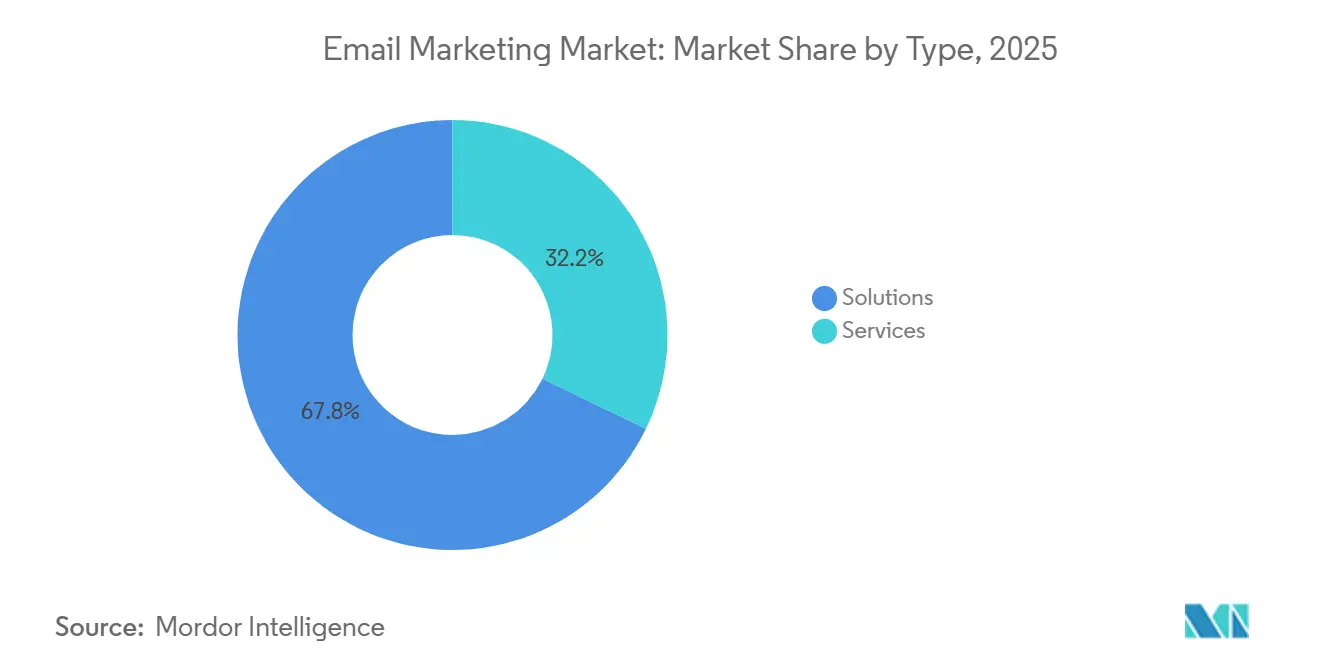
Services Outpace Solutions As Martech Stacks FragmentSolutions captured 67.81% of the Email marketing market share in 2025, reflecting entrenched spend on cloud suites and on-premise toolkits. Yet professional and managed services are forecast to grow at 10.93% CAGR, exceeding the Email marketing market size trajectory as companies seek migration help after mergers and rising compliance complexity.
Vendors such as Intuit-owned Mailchimp bundle premium migration to accelerate upsell, and consultancies leverage zero-party data strategy workshops to defend billings. The proliferation of new privacy and authentication requirements has also driven up demand for compliance consulting and deliverability audits. In verticals such as healthcare and BFSI, specialized service providers offer HIPAA- and PCI DSS-compliant campaign design, ensuring that sensitive communications adhere to both regulatory and brand guidelines.
By Deployment:
Cloud Dominates While On-Premise Persists For ComplianceCloud solutions controlled 88.62% of the Email marketing market size in 2025 and will climb at an 11.08% CAGR as brands value subscription pricing, elastic capacity, and continuous feature releases. Salesforce Marketing Cloud, HubSpot, and Klaviyo spearhead this adoption by exposing robust APIs to commerce, data-warehouse, and ad-platform partners.
However, on-premise deployments remain relevant- especially in financial services, government, and defense- where data residency, security, and regulatory requirements preclude the use of multi-tenant cloud infrastructure. Oracle Eloqua and Adobe Marketo continue to serve this niche, offering on-premise or private-cloud options for organizations with stringent compliance needs. The coexistence of both deployment models reflects the diversity of risk appetites and regulatory obligations across verticals and geographies.
By Enterprise Size:
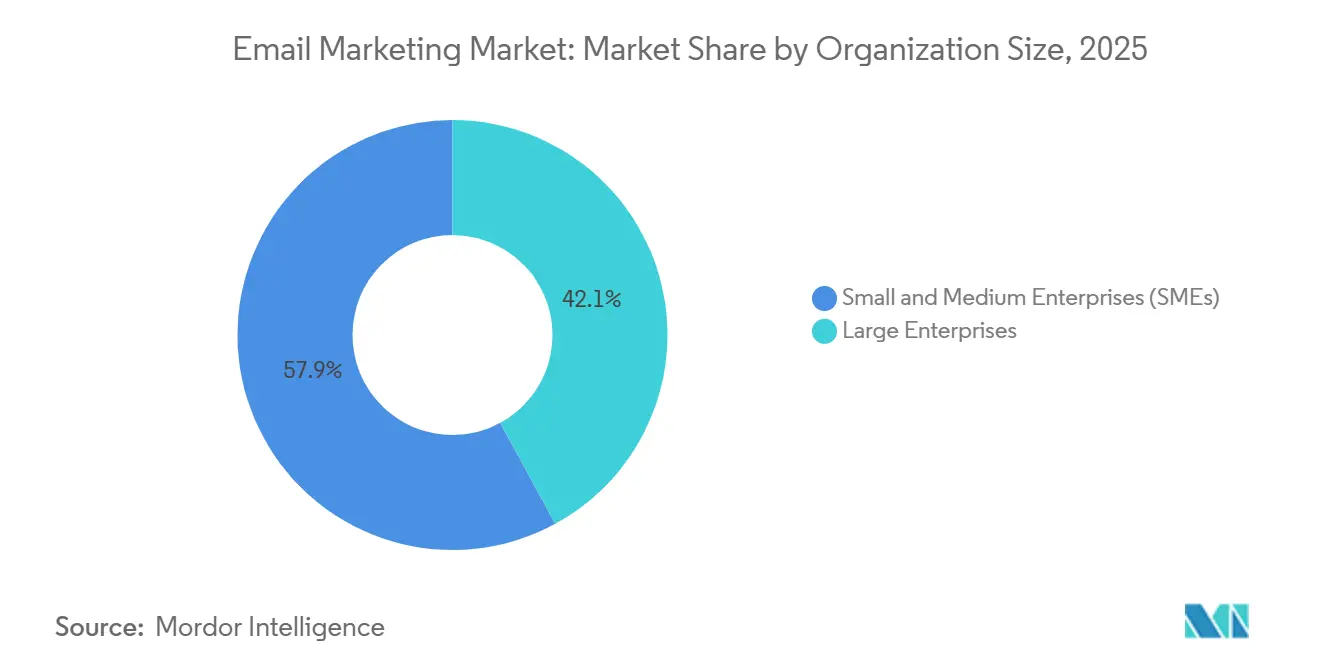
SMEs Drive Growth Through Democratized MartechSMEs represented 57.94% of the Email marketing market size in 2025, lured by low entry costs and no-code tools that let founders build abandoned-cart flows in minutes. Growth at an 11.03% CAGR through 2031 outpaces that of large enterprises, which already run mature programs.SMEs are leveraging email marketing to offset rising customer acquisition costs on social platforms, using triggered flows and A/B testing to maximize lifetime value. Large enterprises, while slower-growing, remain crucial for vendors offering advanced integrations, dedicated support, and compliance features. The proliferation of “no-code” automation tools has lowered technical barriers for SMEs, enabling them to deploy sophisticated campaigns without dedicated IT resources.
Klaviyo noted that 80% of new customers in 2025 were SMEs, many shifting budget from volatile social ad auctions to owned channels that sustain lifetime value. Conversely, multinationals lean on enterprise-grade suites for compliance automation and global language support. Hybrid email and SMS bundles attract both cohorts, reinforcing the addressable base of the Email marketing market.
By End-User Vertical:
Retail Holds The Wallet, Healthcare Gains SpeedRetail and e-commerce accounted for 29.17% of the Email marketing market share in 2025 as brands use cart recovery, limited-time offers, and loyalty updates to convert traffic and raise repeat purchases. Personalized flows lift conversion by up to 25%, supporting steady wallet share.
Healthcare grows the quickest at a 10.99% CAGR, helped by telehealth reminders, prescription refills, and patient-education journeys that comply with HIPAA. Travel and hospitality brands are leveraging email for booking confirmations, personalized offers, and loyalty program updates, with Marriott reporting a 12% increase in direct bookings attributed to advanced email workflows. BFSI firms use email for regulatory notifications, fraud alerts, and transactional confirmations, but must navigate strict data security and consent requirements. IT and telecom, government, education, and media/entertainment are also significant users, each with unique regulatory and engagement challenges.
Geography Analysis
North America Email Marketing Market
North America held a commanding 40.93% of global revenue in 2025, with the United States prioritizing DMARC adoption, predictive send-time engines, and consent-management automation. Canada and Mexico extend regional demand as SMEs adopt affordable, cloud-first suites.
Europe Email Marketing Market
Europe remains sizable but compliance-heavy. GDPR drives investment in preference centers and subject-access tooling, especially in the United Kingdom, Germany, and the Nordics. Southern Europe’s up-and-coming direct-to-consumer brands leverage multilingual templates and localized payment integrations, sustaining incremental gains in the Email marketing market.
APAC, MEA and LATAM Email Marketing Market
Asia-Pacific leads growth at an 11.18% CAGR, powered by India’s and China’s expanding e-commerce ecosystems, Southeast Asia’s fintech wave, and Japan’s switch to AI-based testing. Australia and Singapore host regional martech hubs, while Indonesia and Vietnam leapfrog legacy systems straight to API-first platforms. The Middle East and Africa and Latin America trail in absolute size but post robust mid-single-digit gains as data-protection rules mature and cloud infrastructure spreads.
Competitive Landscape
The five largest vendors- Mailchimp (Intuit), Klaviyo, Constant Contact, ActiveCampaign LLC, Salesforce Marketing Cloud, and Intuit Inc. collectively control a substantial portion of the Email marketing market, yet a long tail of regional and vertical specialists keeps the structure moderately fragmented. Intuit’s USD 12 billion Mailchimp acquisition unlocked cross-sell into TurboTax and QuickBooks customer bases, while Klaviyo’s 2024 IPO funded Flow Builder 2.0 that layers SMS orchestration atop email.
HubSpot’s July 2025 Breeze AI launch accelerates copywriting for SMEs, and Salesforce’s Einstein GPT widens predictive segmentation embedded within Marketing Cloud. Adobe Marketo Engage’s AI-driven content optimizer focuses on HIPAA and PCI DSS-regulated verticals, differentiating on compliance depth. Twilio invests USD 250 million to expand SendGrid infrastructure in Asia-Pacific, pursuing latency and inbox-placement advantages.
Mid-tier challengers such as Brevo, and Campaign Monitor exploit niches in developer-friendly APIs, modular pricing, and creative-agency tooling. Oracle Eloqua pairs with Microsoft Azure for private-cloud rollouts in banking and government, emphasizing data residency. Overall, the Email marketing market exhibits a balanced mix of heavyweight platform ecosystems and agile disruptors that keep innovation cycles brisk.
Email Marketing Industry Leaders
-
Klaviyo Group
-
Constant Contact
-
ActiveCampaign LLC
-
Salesforce Marketing Cloud
-
Intuit Inc.
- *Disclaimer: Major Players sorted in no particular order
Email Marketing Market Companies Covered in this Report
- Intuit Inc.
- Constant Contact
- Klaviyo Group
- ActiveCampaign LLC
- HubSpot Email Marketing
- Salesforce Marketing Cloud
- Adobe Marketo Engage
- Oracle Eloqua
- Sendinblue (Brevo)
- Campaign Monitor
- Drip Inc.
- AWeber Communications
- GetResponse
- VerticalResponse
- Dotdigital Group
- iContact Inc.
- Mailjet (Sinch AB)
- Moosend Ltd.
- SparkPost Ltd.
- SendGrid (Twilio)
Recent Industry Developments in Email Marketing Market
- January 2026: Salesforce launched Einstein GPT for Marketing Cloud, enabling generative AI copy and predictive segments.
- December 2025: Twilio earmarked USD 250 million to scale SendGrid deliverability infrastructure across Asia-Pacific.
- November 2025: Klaviyo released Flow Builder 2.0 for cross-channel automation.
- October 2025: Intuit’s Mailchimp integrated SMS and WhatsApp orchestration for SMEs.
Global Email Marketing Market Report Scope
Email marketing is a direct marketing channel that lets businesses share new products, sales, and updates with customers on their contact lists. It is a tool for businesses, particularly in the B2B sector, where it serves as a critical component of revenue generation strategies.
The Email Marketing Market Report is Segmented by Type (Solutions and Services), Deployment (Cloud and On-Premise), Enterprise Size (Small and Medium-sized Enterprises and Large Enterprises), End-User Vertical (Retail and E-commerce, Travel and Hospitality, IT and Telecom, BFSI, Government, Healthcare, Education, Media and Entertainment, and Other End-User Verticals), and Geography (North America, South America, Europe, Asia-Pacific, Middle East and Africa). The Market Forecasts are Provided in Terms of Value (USD).
Segmentation Overview
| Solutions |
| Services |
| Cloud |
| On-Premise |
| Small and Medium-sized Enterprises (SMEs) |
| Large Enterprises |
| Retail and E-commerce |
| Travel and Hospitality |
| IT and Telecom |
| BFSI |
| Government |
| Healthcare |
| Education |
| Media and Entertainment |
| Other End-User Verticals |
| North America | United States |
| Canada | |
| Mexico | |
| South America | Brazil |
| Argentina | |
| Rest of South America | |
| Europe | Germany |
| United Kingdom | |
| France | |
| Italy | |
| Spain | |
| Rest of Europe | |
| Asia Pacific | China |
| Japan | |
| India | |
| South Korea | |
| Rest of Asia Pacific | |
| Middle East and Africa | United Arab Emirates |
| Saudi Arabia | |
| South Africa | |
| Nigeria |
| By Type | Solutions | |
| Services | ||
| By Deployment | Cloud | |
| On-Premise | ||
| By Enterprise Size | Small and Medium-sized Enterprises (SMEs) | |
| Large Enterprises | ||
| By End-user Vertical | Retail and E-commerce | |
| Travel and Hospitality | ||
| IT and Telecom | ||
| BFSI | ||
| Government | ||
| Healthcare | ||
| Education | ||
| Media and Entertainment | ||
| Other End-User Verticals | ||
| By Geography | North America | United States |
| Canada | ||
| Mexico | ||
| South America | Brazil | |
| Argentina | ||
| Rest of South America | ||
| Europe | Germany | |
| United Kingdom | ||
| France | ||
| Italy | ||
| Spain | ||
| Rest of Europe | ||
| Asia Pacific | China | |
| Japan | ||
| India | ||
| South Korea | ||
| Rest of Asia Pacific | ||
| Middle East and Africa | United Arab Emirates | |
| Saudi Arabia | ||
| South Africa | ||
| Nigeria | ||
Key Questions Answered in the Report
How large will the Email marketing market be by 2031?
The Email marketing market is forecast to reach USD 22.93 billion by 2031.
What is the expected CAGR for Email programs between 2026 and 2031?
The market is projected to grow at a 10.82% CAGR over 2026–2031.
Which deployment model grows fastest for email platforms?
Cloud deployment leads, expanding at an 11.08% CAGR as brands favor API-first architectures.
Which end-user segment is growing the quickest?
Healthcare email programs are advancing at a 10.99% CAGR due to HIPAA-compliant patient engagement.
Which region posts the highest growth?
Asia-Pacific is projected to grow at an 11.18% CAGR, powered by e-commerce and fintech expansion.
Who are the leading vendors in this space?
Mailchimp, Klaviyo, HubSpot, Salesforce Marketing Cloud, and Adobe Marketo Engage hold the strongest positions.