
Software-Defined Radio Market Size and Share
Market Overview
| Study Period | 2019 - 2031 |
|---|---|
| Market Size (2026) | USD 18.07 Billion |
| Market Size (2031) | USD 24.76 Billion |
| Growth Rate (2026 - 2031) | 6.50 % |
| Fastest Growing Market | Asia Pacific |
| Largest Market | Europe |
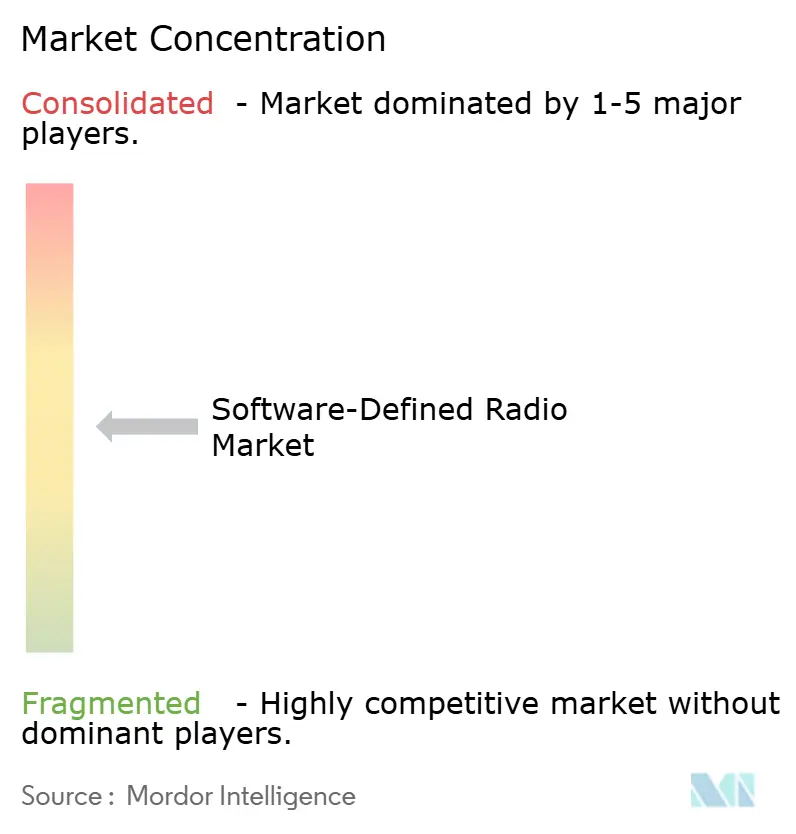
| Market Concentration | Medium |
Major Players *Disclaimer: Major Players sorted in no particular order Image © Mordor Intelligence. Reuse requires attribution under CC BY 4.0. | |
Software-Defined Radio Market Analysis by Mordor Intelligence
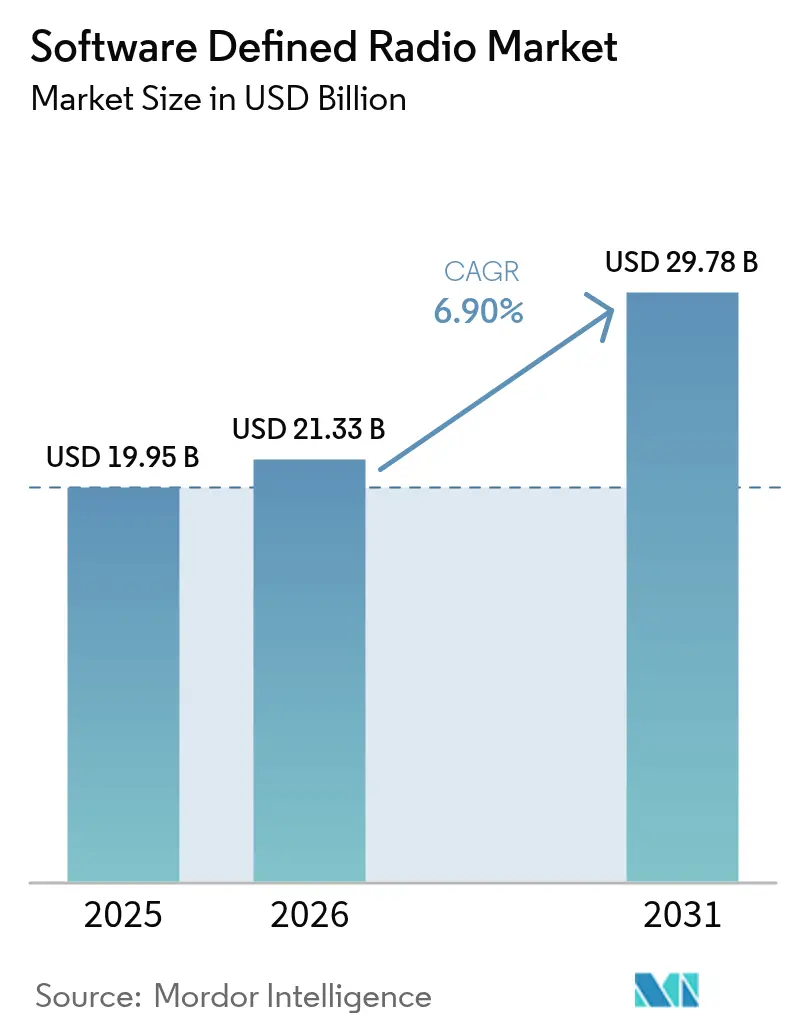
The software-defined radio market size was valued at USD 16.97 billion in 2025, and is projected to grow from USD 18.07 billion in 2026 to USD 24.76 billion by 2031, registering a CAGR of 6.50% between 2026 and 2031. Programmable waveforms and real-time spectrum awareness are changing radio deployment across defense and commercial settings. Operators can update protocols in the field rather than replace installed hardware. Defense modernization, 5G network disaggregation, and LEO ground infrastructure support demand across the software-defined radio market. Integration, waveform management, and sustainment services are becoming more important as multi-waveform systems become harder for end users to manage internally. Export controls and limited converter supply remain material constraints on deployment schedules and procurement choices.
Key Report Takeaways
- By platform, land held 58.90% of the software-defined radio market share in 2025, while space is projected to grow at an 8.49% CAGR through 2031.
- By component, hardware accounted for 60.81% of the software-defined radio market revenue in 2025 and is projected to expand at a 6.52% CAGR through 2031.
- By frequency band, VHF accounted for 38.20% of the software-defined radio market revenue in 2025, while EHF and mmWave are forecast to grow at a 9.13% CAGR through 2031.
- By end user, government and defense accounted for 81.00% of the software-defined radio market revenue in 2025, while commercial is forecast to grow at a 6.79% CAGR through 2031.
- By geography, Asia-Pacific accounted for 28.99% of the software-defined radio market revenue in 2025, while Europe is forecast to grow at a 7.44% CAGR through 2031.
Note: Market size and forecast figures in this report are generated using Mordor Intelligence’s proprietary estimation framework, updated with the latest available data and insights as of 2026.
Global Software-Defined Radio Market Trends and Insights
Drivers Impact Analysis*
| Driver | (~) % Impact on CAGR Forecast | Geographic Relevance | Impact Timeline |
|---|---|---|---|
| Transition to network-centric warfare driving next-gen SDR adoption | +1.50% | Global, led by North America and Asia-Pacific | Short term (≤ 2 years) |
| Proliferation of 5G and private wireless networks boosting radio infrastructure demand | +1.20% | Asia-Pacific, North America, and Europe | Medium term (2-4 years) |
| Virtualization of base stations through Open RAN accelerating SDR integration | +0.90% | Asia-Pacific, North America, and Europe | Medium term (2-4 years) |
| Expansion of satellite constellations increasing demand for flexible ground terminals | +0.80% | Global, with early gains in North America | Long term (≥ 4 years) |
| Secure mesh communication needs in UAV swarms elevating SDR relevance | +0.70% | Global, led by Europe and North America | Short term (≤ 2 years) |
| Regulatory push for dynamic spectrum access and sharing frameworks | +0.60% | Global, led by North America and Europe | Medium term (2-4 years) |
| Source: Mordor Intelligence | |||
Transition to Network-Centric Warfare Driving Next-Gen SDR Adoption
Military communications are moving from voice traffic toward broadband data networks that link soldiers, vehicles, aircraft, and satellites. This requirement supports demand in the software-defined radio market for radios capable of supporting multiple secure waveforms. L3Harris received USD 84.00 million in the US Army delivery orders during June 2026 for AN/PRC-158C NGC2 Gateway Manpack Falcon systems. The award followed an initial USD 24.00 million order during October 2025. These systems support high-throughput MANET, encryption, and Sensitive But Unclassified-Encrypted waveforms. Defense organizations are also pairing hardware awards with software sustainment and waveform certification work. This model can create longer-term service relationships when the armed forces lack the capacity to administer waveform updates independently.[1]L3Harris Technologies, “US Army Awards L3Harris NGC2 Manpack Radio Delivery Orders,” L3Harris, l3harris.com.
Expansion of Satellite Constellations Increasing Demand for Flexible LEO Satellite Constellation SDR Transponders
LEO constellations are creating demand for space-qualified radios that can be updated through software. Leonardo DRS completed the first on-orbit test of its XCM3-Space multi-channel SDR during December 2025. The system carried integrated advanced cryptography and demonstrated secure satellite data transport for US defense users. A further 2026 demonstration is planned to extend edge processing and waveform functions. These capabilities allow operators to adjust crypto and waveform layers without physical satellite servicing. Commercial direct-to-device projects also require receivers that manage Doppler effects and diverse spectrum bands. Amazon has described a planned 5,105-satellite Leo D2D constellation that will use L-band and S-band spectrum.
Secure Mesh Communication Needs in UAV Swarms Elevating SDR Relevance
Unmanned systems need communications that can operate across changing frequencies and connected platforms. This requirement makes waveform agility a central specification within the software-defined radio market. Bittium launched Tough SDR Unmanned during June 2026 for drones, UGVs, and autonomous sea systems. The module is designed to connect these systems to the same tactical IP network used by dismounted personnel. Its introduction reflects demand for a common communications architecture across mixed unmanned fleets. General Dynamics also described its Quiver multi-role SDR for collaborative swarm operations and remote mission support. Procurement requirements are likely to place greater value on adaptable hardware than on fixed-frequency mesh radios.
Regulatory Push for Dynamic Spectrum Access and Sharing Frameworks
Spectrum policy is increasingly favoring systems that can detect interference and change operating settings. The Federal Communications Commission proposed making up to 180 MHz in the 3.98 GHz to 4.2 GHz Upper C-band available for terrestrial flexible use during December 2025. The proposal supports a need for terminals that can adapt to shared spectrum conditions. Federal work on satellite broadband sharing also reflects pressure to revise coordination arrangements for non-geostationary systems. These developments favor cognitive radio architectures over fixed-frequency designs in bands used by commercial and defense users. The software-defined radio market can benefit from radio terminals that must avoid interference without continuous ground coordination. Regulatory progress may also shorten the time needed to demonstrate shared-spectrum technical capabilities.[2]Federal Communications Commission, “Notice of Proposed Rulemaking, 3.98-4.2 GHz Upper C-Band,” Federal Register, gpo.gov.
Restraints Impact Analysis*
| Restraint | (~) % Impact on CAGR Forecast | Geographic Relevance | Impact Timeline |
|---|---|---|---|
| Elevated capital costs associated with advanced FPGA and ADC integration | -0.80% | Global | Short term (≤ 2 years) |
| Persistent vulnerabilities to cyber threats and electronic jamming | -0.60% | Global | Short term (≤ 2 years) |
| Export regulations limiting the global deployment of reconfigurable SDR technologies | -0.50% | Global, with greatest impact outside NATO and FVEY | Long term (≥ 4 years) |
| Thermal constraints hindering high-performance Edge computing in SDR systems | -0.30% | Global | Medium term (2-4 years) |
| Source: Mordor Intelligence | |||
Elevated Capital Costs Associated with Advanced FPGA and ADC Integration
High-performance radios require expensive field-programmable gate arrays and analog-to-digital converters. This raises entry costs for regional suppliers and commercial providers without large volume commitments. The software-defined radio market also faces supply concentration in critical converter components. A design change between converter suppliers can require substantial engineering work and renewed system validation. Integrated RFSoC designs can reduce component count, power needs, and interface complexity. However, many customers still rely on established discrete configurations during current procurement cycles. Cost pressure can narrow margins for suppliers without preferred allocations or established defense supply agreements. It can also delay deployment where customers cannot absorb a higher unit cost.
Export Regulations Limiting the Global Deployment of Reconfigurable SDR Technologies
Export controls can limit the transfer of radios with protected waveforms, advanced anti-jam features, or US-originated security functions. These requirements create uncertainty for allies seeking common communications systems across national forces. The Bureau of Industry and Security amended the Export Administration Regulations in July 2026 to provide enhanced favorable treatment to the UAE. The rule permits Strategic Trade Authorization for eligible exports to the UAE government entities. The change illustrates that access still depends on country-specific regulatory treatment and program review. European agencies are responding with investments in domestic and ESSOR-compatible waveform options. This response can reduce dependence on export-controlled systems within the software-defined radio market.[3]Bureau of Industry and Security, “Providing Enhanced Favorable Treatment for the United Arab Emirates,” Federal Register, govinfo.gov.
*Our forecasts treat driver/restraint impacts as directional, not additive. The impact forecasts reflect baseline growth, mix effects, and variable interactions.
Segment Analysis
By Platform: Space Growth Changes a Land-Led Demand Base
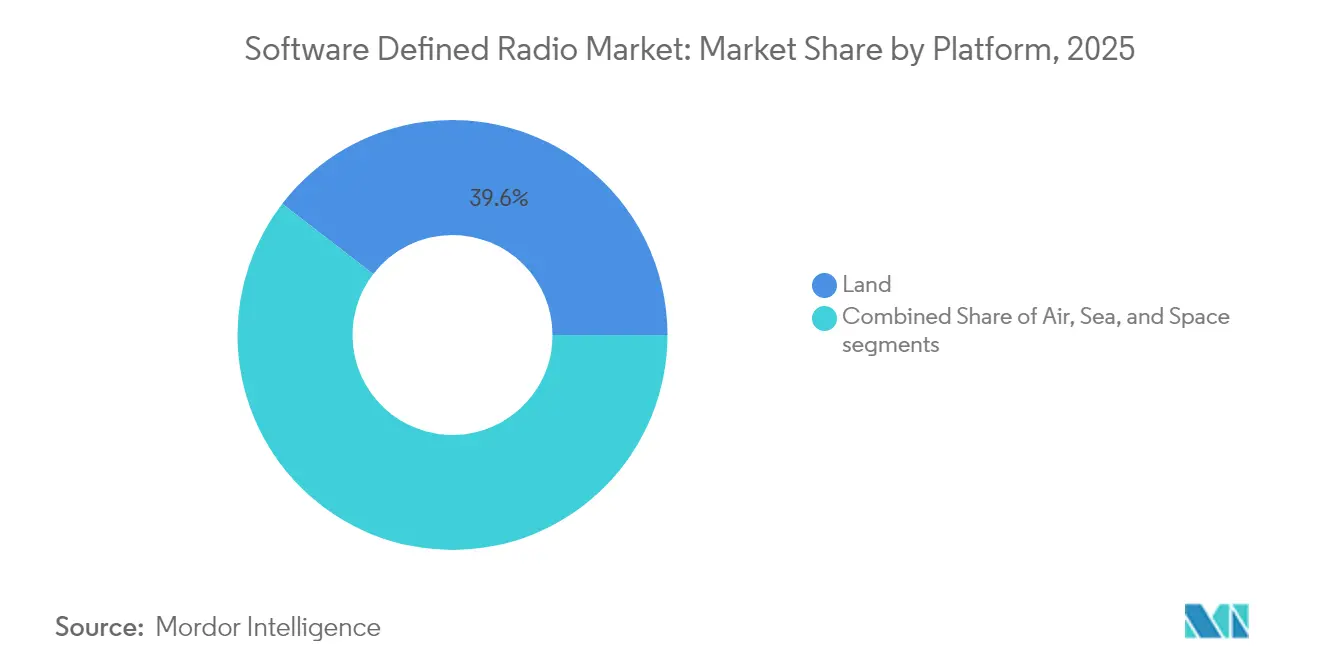
Land platforms accounted for 58.90% of revenue in 2025. Land demand rests on long-running manpack and vehicle radio programs across major defense forces. Germany’s D-LBO program supports continued demand for vehicle and field communications equipment. Rohde & Schwarz is positioned to supply 34,000 VR500 digital radios across more than 9,000 Bundeswehr vehicles. The third funding tranche was valued at EUR 300 million (USD 314.14 million) during December 2024. Land revenues should remain material even as their share declines with faster space and air procurement.
Space platforms are forecast to grow at an 8.49% CAGR through 2031. Sea platforms remain important because tactical terminals are deployed across maritime and aviation fleets. Data Link Solutions received a USD 248.00 million US Navy production contract during January 2026 for MIDS JTRS terminals. The terminals will serve maritime vessels, ground command assets, and several combat aircraft types. Air programs also require interoperable radio terminals capable of carrying shared coalition waveforms. The EuroMIDS consortium signed an OCCAR agreement in July 2026 to develop the F-EMIDS terminal across European fleets. Space demand differs because software maintenance and cryptographic rekeying can continue after launch. These services can provide recurring revenue beyond the original hardware delivery across the software-defined radio market.



By Component: Hardware Supports Revenue While Software Extends Value
Hardware accounted for 60.81% of 2025 component revenue and is forecast to grow at a 6.52% CAGR through 2031. This position reflects deployment volume across new tactical, satellite, and commercial systems. RFSoC designs integrate conversion, processing, and programmable logic into a tighter architectural framework. The approach can reduce power requirements and eliminate some discrete interface complexity. Hardware remains essential because every installed radio requires physical radio-frequency and processing capacity. SDR industry suppliers also benefit when lower hardware costs enable applications that were previously too expensive. Hardware growth, therefore, remains relevant even as software becomes more valuable across the installed base.
Software has a smaller current revenue base, but it can create recurring revenue through waveform libraries and security updates. Hardware is delivered once, whereas software can be licensed and maintained over the long life of a platform. This shift is drawing attention to integration, waveform certification, and cybersecurity services. Thales received an order for more than 5,000 LOCODA Radio Adaptable Transport platforms during June 2026. The system combines encryption, MANET waveforms, and compatibility with multiple radio providers. The contract shows how radio awards can include the value of services and software alongside hardware. This structure supports a broader value pool for the software-defined radio market.
By Frequency Band: VHF Retains Its Base While EHF and mmWave Advance
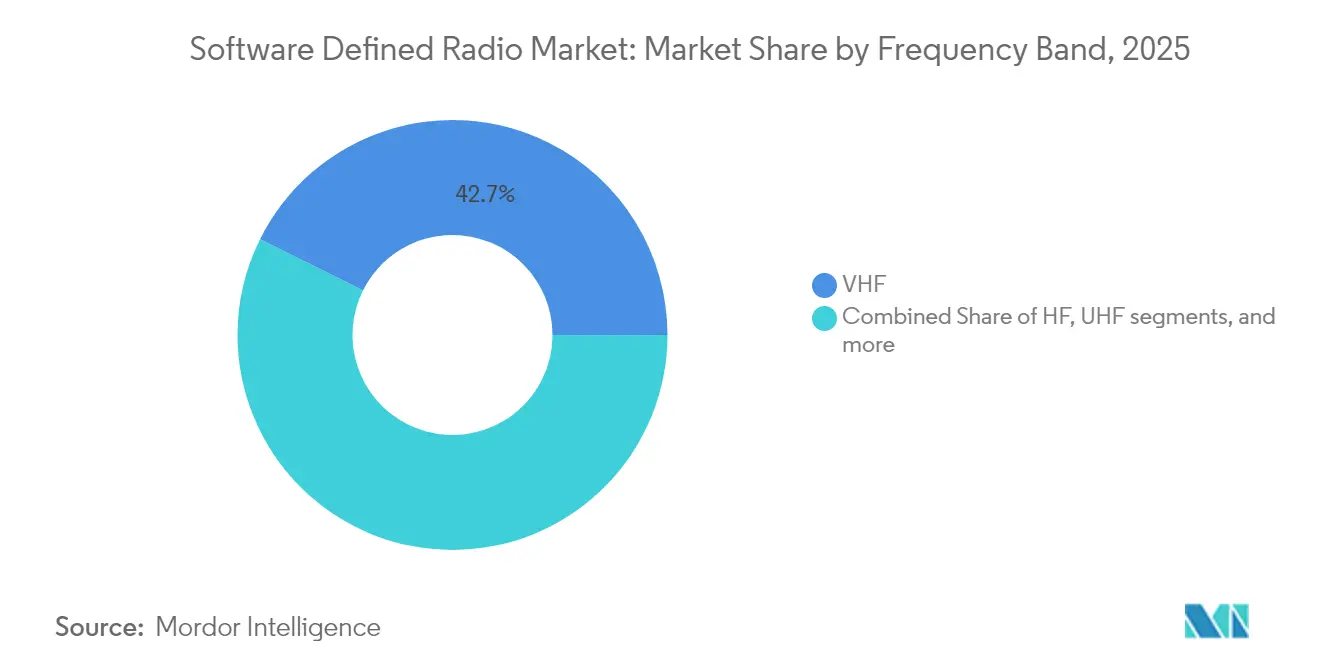
VHF held 38.20% of frequency-band revenue in 2025, supported by a large installed base of ground-force radios. Its propagation characteristics remain useful for dismounted personnel and terrain-constrained operations. The segment also benefits when forces upgrade radios without changing their established operating bands. Thales announced the deployment of more than 100 VHF 9315 radios to the Malaysian Army during April 2026. The company also established a local Synaps SDR assembly line in Segamat, Johor. These actions show continued VHF modernization in emerging defense markets. UHF and SHF systems serve additional satellite, broadband command, and data-relay requirements.
EHF and mmWave are forecast to grow at a 9.13% CAGR through 2031, the highest rate among frequency bands. The segment is supported by higher-capacity satellite downlinks, 5G backhaul, and phased-array radar integration. Higher frequencies raise thermal and processing demands for radios deployed at the edge. VPX form factors provide conduction cooling where forced-air cooling is unsuitable. This design approach can support advanced processing in demanding defense environments. HF remains relevant for long-distance command links despite its mature position in the software-defined radio market. Thales’s HF XL TRC 3900 radio was supplied with its Malaysian VHF systems for long-range force communications.
By End User: Defense Remains Central as Commercial Adoption Broadens
Government and defense held 81.00% of 2025 revenue, reflecting long procurement cycles and strict security requirements. These programs often link radio acquisition to sustainment contracts lasting 10 to 15 years. The US Army Combat Net Radio modernization program has a contract ceiling of USD 6.10 billion through March 2032. Germany’s D-LBO program also represents a large, sustained tactical communications effort. Defense demand provides a durable base for installed radios, certified waveforms, and technical support. The software-defined radio market share held by government users also reflects the high costs of military-grade security and interoperability requirements. This structure limits the ability of commercial volumes to displace defense spending in the near term.
Commercial end users are forecast to grow at a 6.79% CAGR through 2031. Telecom operators use SDR-based radio units and radio modems for 5G deployments and Open RAN architectures. Private wireless networks, including Wi-Fi and other wireless solutions, also meet the needs of users in mining, logistics, critical infrastructure, and public safety. Commercial buyers typically seek larger deployment volumes at lower unit margins than defense buyers. This preference encourages cost-optimized RFSoC hardware and more open software stacks. Integration, spectrum coordination, and radio optimization create service opportunities in the software-defined radio industry. Eridan and Software Radio Systems completed a product-grade 5G gNB integration during November 2025 using the O-RAN 7.2x interface.
Geography Analysis
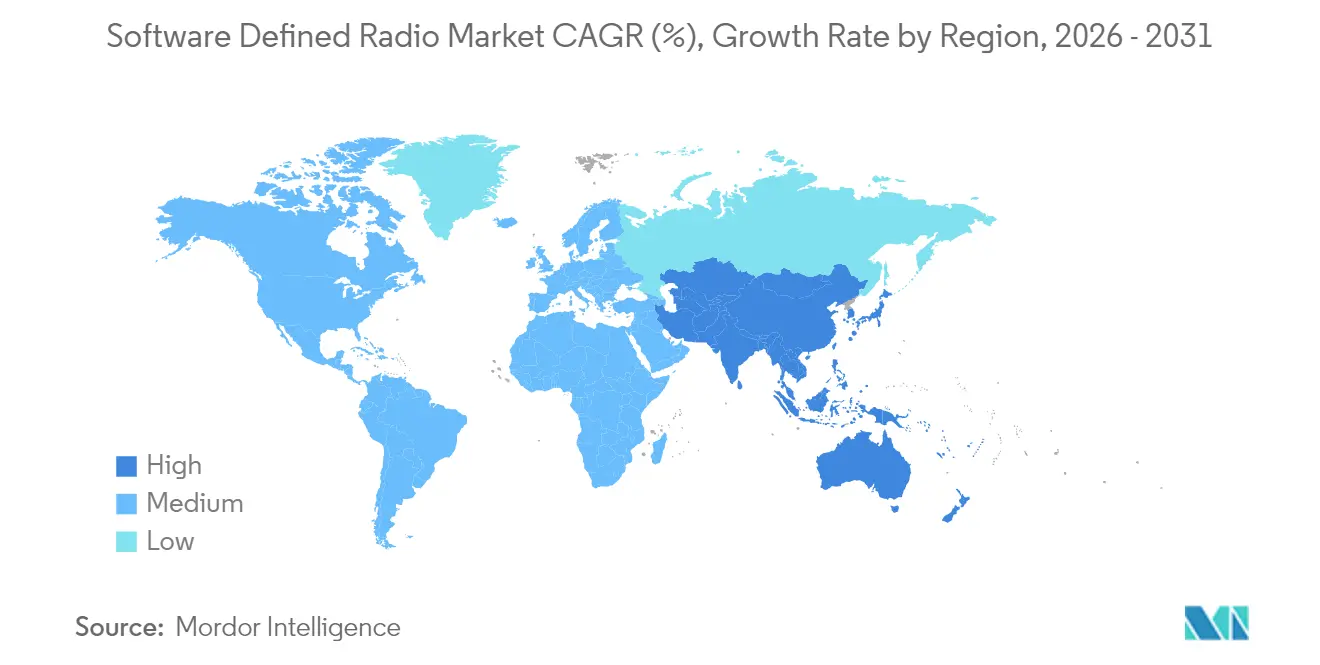
Asia-Pacific accounted for 28.99% of global revenue in 2025, the leading regional position in the software-defined radio market. Demand comes from defense modernization in China, India, Japan, South Korea, and Australia. Domestic manufacturing policies in India support a greater role for local communications suppliers. Commercial wireless infrastructure growth adds a separate demand channel across the region. Japan hosted Wireless Japan 2026, where Metanoia presented an AI-native Open SDR platform for Open RAN use. Australia’s AUKUS commitments also support communications interoperability with the US and the UK. These ties create an extended upgrade path for defense radio systems across partner forces.
North America remains the largest market by absolute spending volume during 2026, supported by US defense programs. Data Link Solutions received the USD 248.00 million MIDS JTRS contract in January 2026. More than 9,000 Link 16 systems had been delivered worldwide at that point. General Dynamics received a USD 19.00 million US Air Force contract modification during May 2026 for the Next Generation Survival Radio. The program targets qualification and pre-production readiness before planned larger-scale deployment. US spectrum rulemaking also supports the development of cognitive terminals for shared commercial and defense uses.
Europe is forecast to grow at a 7.44% CAGR through 2031, the fastest regional rate in the software-defined radio market. The region is moving from national procurement toward joint capability investment and shared waveform standards. Germany’s D-LBO effort includes a EUR 1.90 billion (USD 1.97 billion) TaWAN order released during February 2025. Deliveries are planned from late 2026 through 2029. Thales opened a communications center of excellence in Cholet in June 2025 for secure radio production. ESSOR High Data Rate compliance is becoming important for interoperability across participating countries. Smaller procurement corridors in South America, the Middle East, and Africa also support wider international demand.

Competitive Landscape
The software-defined radio market is moderately consolidated around L3Harris Technologies, Inc., BAE Systems plc, Thales Group, Northrop Grumman Corporation, and RTX Corporation. These companies benefit from established certifications, approved waveforms, and long relationships with defense customers. European specialists are gaining relevance through domestic supply positions and ESSOR-compatible product portfolios. Bittium, Rohde & Schwarz, and ASELSAN are among suppliers benefiting from this shift. The competitive field is also widening at the software and services layer. Waveform porting, Open RAN integration, and spectrum sensing do not require the same installed hardware base. These areas offer newer firms a potential route into the software-defined radio market.
Technology competition is shifting toward software integration, security functions, and lifecycle support. DeepSig demonstrated AI-native OmniPHY-5G and pre-6G learned waveforms at MWC 2026 with NVIDIA and the AI-RAN Alliance. The work addressed both commercial Open RAN and tactical radio applications. General Dynamics developed its Quiver SDR through its internal Project G13 team. The design combines reconfigurable waveforms with electronic warfare and precision timing features for collaborative operations. Such programs show that product differentiation increasingly depends on how quickly suppliers can develop and update waveform capabilities. The software-defined radio market, therefore, rewards both large primes and agile, specialized developers.
Services are becoming as important as equipment delivery in many large programs. General Dynamics Information Technology received a USD 988 million contract during January 2026 to modernize the US Navy's C5ISR systems. The work includes integration, engineering, procurement, logistics, and installation activities. Leonardo DRS developed its XCM3-Space crypto-SDR in less than 12 months before its first space test. Both examples show the value of integration capability and shorter software development cycles. This balance preserves room for regional specialists in the software-defined radio market.
Software-Defined Radio Industry Leaders
L3Harris Technologies, Inc.
RTX Corporation
Thales Group
BAE Systems plc
Northrop Grumman Corporation
- *Disclaimer: Major Players sorted in no particular order

Recent Industry Developments
- June 2026: L3Harris Technologies received USD 84 million in US Army delivery orders for AN/PRC-158C NGC2 Gateway Manpack Falcon SDR systems, its second NGC2 award, following an October 2025 initial order of USD 24 million, bringing cumulative NGC2 orders to USD 108 million and supporting multi-transport MANET gateway capabilities for Project Convergence 2026.
- December 2025: Leonardo DRS, Inc. completed the first on-orbit test of its XCM3-Space multi-channel SDR with integrated advanced cryptography. The system was launched aboard a Proteus Mercury satellite via SpaceX Transporter-15, demonstrating secure LEO satellite data transport for the US Space Force, Space Development Agency, and Missile Defense Agency. A second system is planned for 2026.
- June 2025: Terma launched Terma SPECTRA, an SDR TT&C modem. The product was developed in partnership with the European Space Agency (ESA) and incorporates expertise in Electrical Ground Support Equipment (EGSE) and Radio Frequency Special Check-Out Equipment (RF-SCOE).


Global Software-Defined Radio Market Report Scope
Software-defined radios utilize software installed on a desktop computer for signal processing. The SDRs have a receiver, a transmitter, software applications, and various auxiliary systems that serve as mixers, amplifiers, modulators/demodulators, filters, and detectors.
The software-defined radio market is segmented by platform, component, frequency band, end-user, and geography. By platform, the market is segmented into land, sea, air, and space. By component, the market is segmented into hardware and software. By frequency band, the market is segmented into High Frequency (HF), Very High Frequency (VHF), Ultra High Frequency (UHF), Super High Frequency (SHF), and Extremely High Frequency (EHF) and mmWave. By end-user, the market is segmented into government, defense, and commercial. By end-user, the market is segmented into government and defense, and commercial. The report also covers the market sizes and forecasts for the software-defined radio market in major countries across different regions. For each segment, the market size is provided in terms of value (USD).
| Land |
| Sea |
| Air |
| Space |
| Hardware |
| Software |
| High Frequency (HF) |
| Very High Frequency (VHF) |
| Ultra High Frequency (UHF) |
| Super High Frequency (SHF) |
| Extremely High Frequency (EHF) and mmWave |
| Government and Defense |
| Commercial |
| North America | United States | |
| Canada | ||
| Mexico | ||
| Europe | United Kingdom | |
| Germany | ||
| France | ||
| Italy | ||
| Rest of Europe | ||
| Asia-Pacific | China | |
| India | ||
| Japan | ||
| South Korea | ||
| Australia | ||
| Rest of Asia-Pacific | ||
| South America | Brazil | |
| Rest of South America | ||
| Middle East and Africa | Middle East | Saudi Arabia |
| Israel | ||
| Rest of Middle East | ||
| Africa | South Africa | |
| Rest of Africa | ||
| By Platform | Land | ||
| Sea | |||
| Air | |||
| Space | |||
| By Component | Hardware | ||
| Software | |||
| By Frequency Band | High Frequency (HF) | ||
| Very High Frequency (VHF) | |||
| Ultra High Frequency (UHF) | |||
| Super High Frequency (SHF) | |||
| Extremely High Frequency (EHF) and mmWave | |||
| By End-user | Government and Defense | ||
| Commercial | |||
| By Geography | North America | United States | |
| Canada | |||
| Mexico | |||
| Europe | United Kingdom | ||
| Germany | |||
| France | |||
| Italy | |||
| Rest of Europe | |||
| Asia-Pacific | China | ||
| India | |||
| Japan | |||
| South Korea | |||
| Australia | |||
| Rest of Asia-Pacific | |||
| South America | Brazil | ||
| Rest of South America | |||
| Middle East and Africa | Middle East | Saudi Arabia | |
| Israel | |||
| Rest of Middle East | |||
| Africa | South Africa | ||
| Rest of Africa | |||


Key Questions Answered in the Report
What is the forecast value of the software-defined radio market by 2031?
The software-defined radio market is forecast to reach USD 24.76 billion by 2031, expanding at a 6.50% CAGR from 2026.
Which platform is growing fastest for software-defined radios?
Space is forecast to record the fastest platform growth at an 8.49% CAGR through 2031, supported by reprogrammable satellite payloads.
Which end user accounts for the largest SDR demand?
Government and defense held 81.00% of 2025 revenue, supported by long procurement cycles and security certification requirements.
Why are EHF and mmWave radios expanding rapidly?
EHF and mmWave is forecast to grow at a 9.13% CAGR through 2031, supported by satellite downlinks, 5G backhaul, and phased-array radar.
Which region is growing fastest for SDR adoption?
Europe is forecast to grow at a 7.44% CAGR through 2031 as joint procurement and ESSOR waveform interoperability expand.
What constrains SDR deployment across countries?
High FPGA and ADC costs, limited component supply, and export controls can delay procurement and restrict access to protected waveforms.
Page last updated on:





