
Cabbages And Other Brassicas Market Size and Share
Cabbages And Other Brassicas Market Analysis by Mordor Intelligence
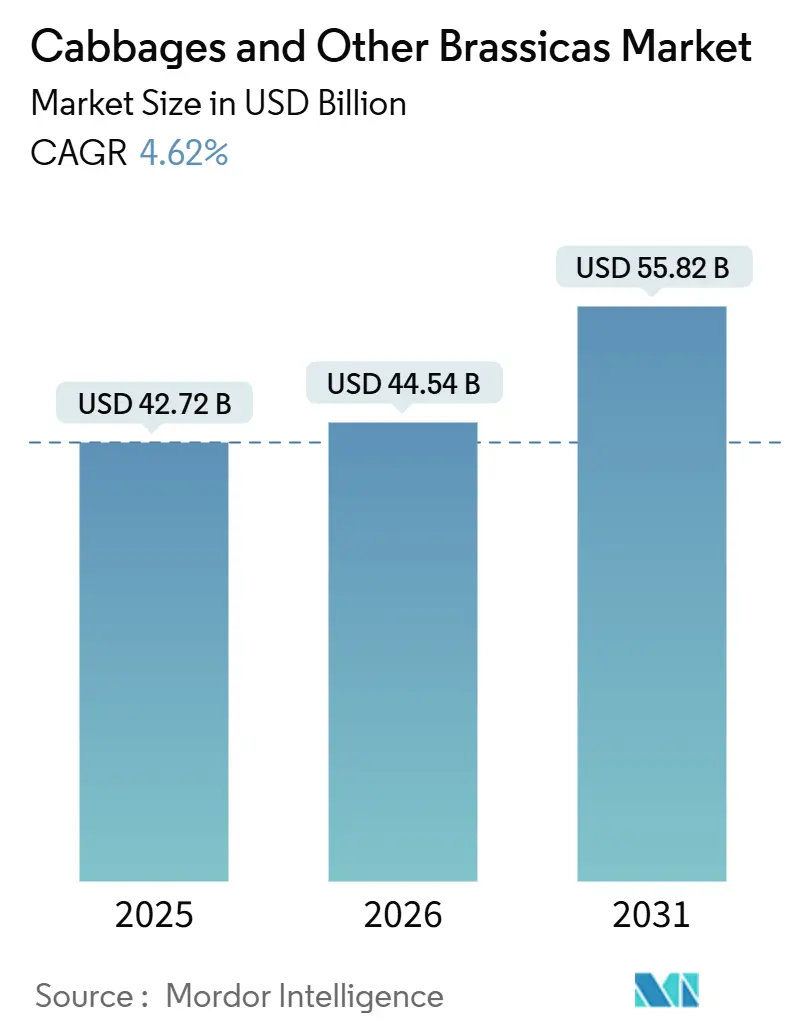
The cabbages and other brassicas market size is projected to be USD 42.72 billion in 2025, USD 44.54 billion in 2026, and reach USD 55.82 billion by 2031, growing at a CAGR of 4.62% from 2026 to 2031. This growth is driven by the expansion of cold-chain infrastructure in emerging vegetable-producing regions, the development of climate-resilient varieties to mitigate heat and pest stress, and the rising demand for nutrient-rich vegetables amid the growing popularity of fermented foods[1]Source: International Finance Corporation, “Cold Chain Infrastructure Investments in India,” ifc.org. The Asia-Pacific region accounts for more than half of the market value, supported by extensive cabbage cultivation in China and India. Protected cultivation and vertical farming are enabling premium production in urban areas with limited land availability. Africa is emerging as a key growth region, with the expansion of peri-urban greenhouse projects and food security initiatives to ensure a consistent year-round supply of brassicas. Market competition is focused on advancements such as gene-edited seed development, automated harvesting technologies, and investments in climate-controlled farming facilities. However, challenges persist, including fluctuations in fertilizer costs, post-harvest quality issues, and stricter phytosanitary regulations that impact trade.
Key Report Takeaways
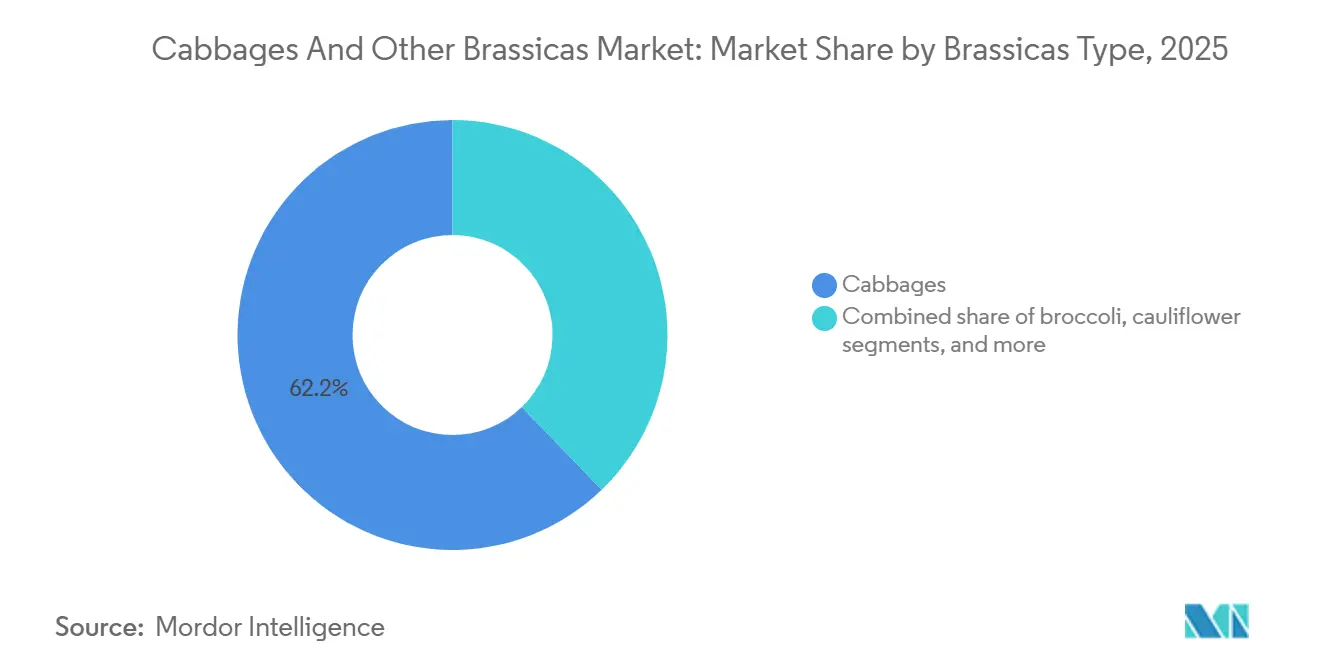
- By brassica type, cabbage led with 62.2% of the cabbages and other brassicas market share in 2025, and broccoli is projected to expand at a 3.8% CAGR through 2031.
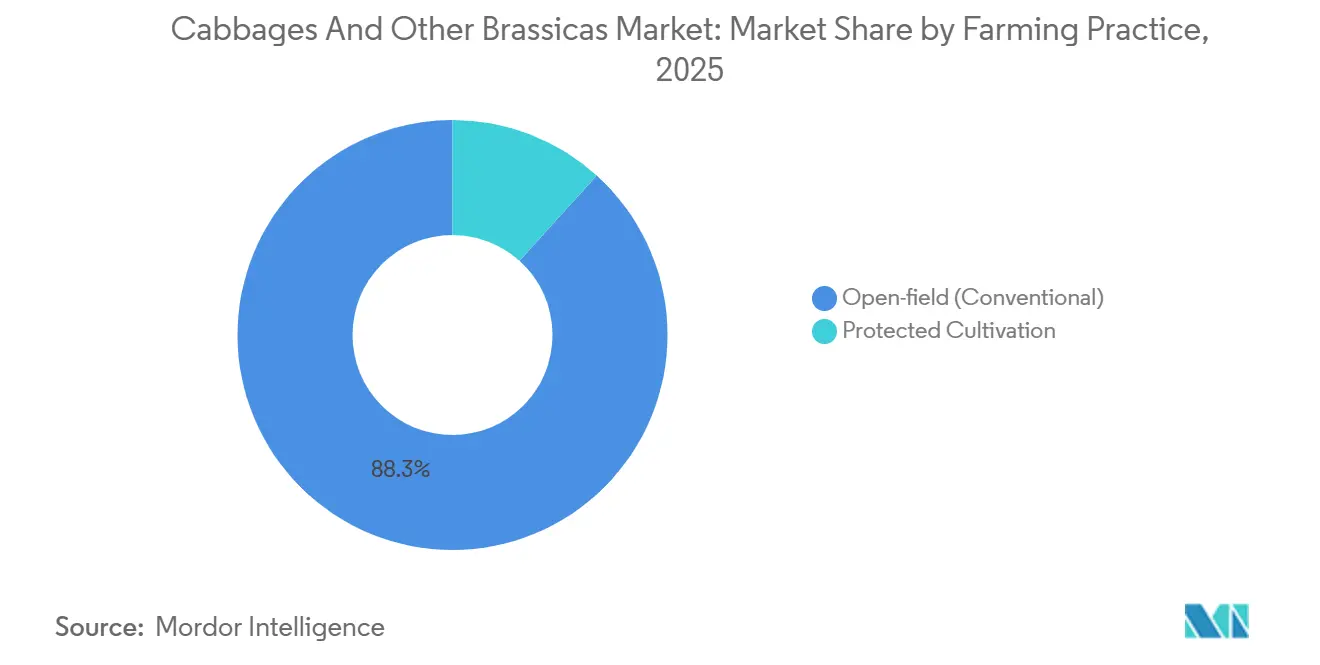
- By farming practice, open-field conventional farming held 88.3% of the cabbages and other brassicas market share in 2025, while protected cultivation is advancing at a 4.7% CAGR through 2031.
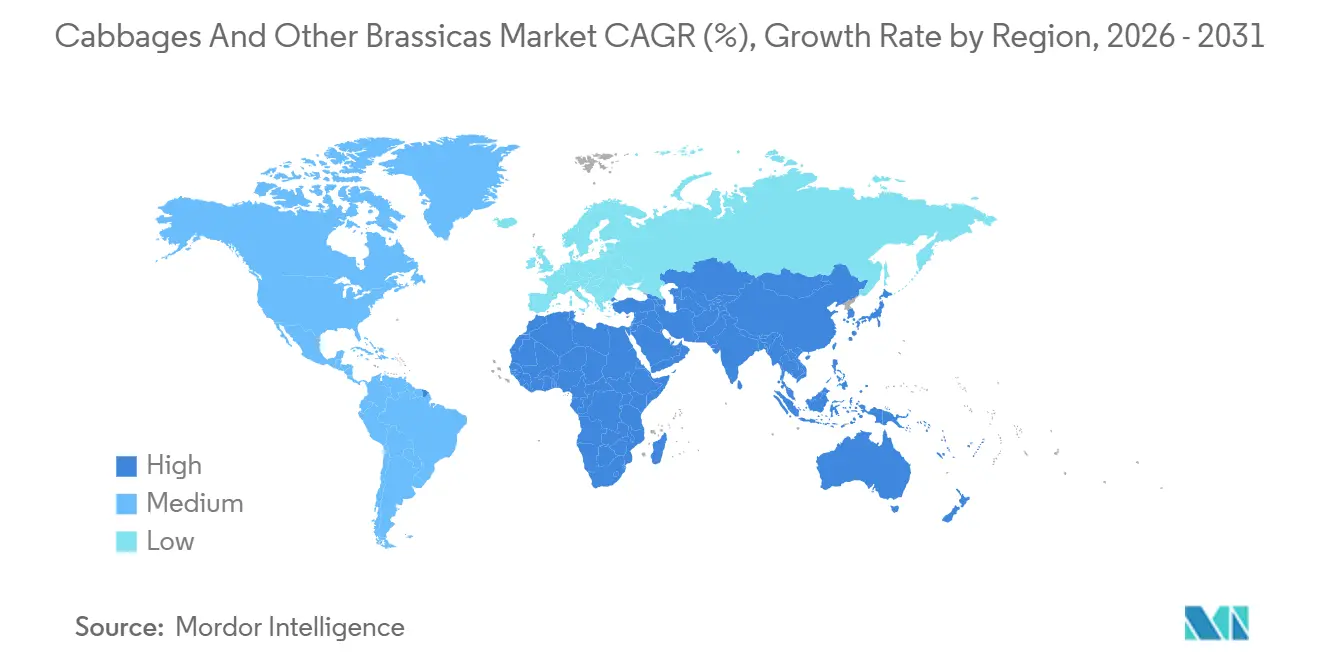
- By geography, Asia Pacific captured 54.4% share of the cabbages and other Brassicas market size in 2025, and Africa is advancing at a 3.6% CAGR through 2031.
Note: Market size and forecast figures in this report are generated using Mordor Intelligence’s proprietary estimation framework, updated with the latest available data and insights as of January 2026.
Global Cabbages And Other Brassicas Market Trends and Insights
Drivers Impact Analysis
| Driver | (~) % Impact on CAGR Forecast | Geographic Relevance | Impact Timeline |
|---|---|---|---|
| Low loss cold chain penetration in emerging vegetable belts | +0.8% | Asia Pacific, Africa, South America with early gains in India, Egypt, Brazil | Medium term (2 to 4 years) |
| Climate smart varietal breakthroughs boosting heat and pest tolerance | +0.7% | Global, with concentrated deployment in subtropical Asia and Middle East | Long term (4 years and beyond) |
| Rising demand from kimchi, sauerkraut and fermented health foods | +0.6% | Asia Pacific (South Korea, Japan), Europe (Germany, Poland), North America | Short term (2 years or less) |
| Vertical farm and protected cultivation expansion in peri urban zones | +0.5% | North America, Europe, Middle East, with pilot deployments in Asia Pacific urban centers | Medium term (2 to 4 years) |
| Gene edited glucosinolate enhanced cultivars for nutraceutical use | +0.4% | North America, Europe, with regulatory dependent adoption in Asia Pacific | Long term (4 years and beyond) |
| E commerce fresh produce fulfillment infrastructure scaling | +0.3% | North America, Europe, Asia Pacific tier 1 cities | Short term (2 years or less) |
| Source: Mordor Intelligence | |||
Low Loss Cold Chain Penetration in Emerging Vegetable Belts
Post-harvest spoilage of brassicas has historically been a significant challenge in tropical regions with limited refrigeration infrastructure. Investments under India’s Pradhan Mantri Kisan Sampada Yojana, totaling INR 150 billion (USD 1.8 billion) through 2025, catalyze pack-house and reefer-truck networks that now move cabbage and broccoli hundreds of kilometers with minimal quality loss[2]Source: Government of India, “Pradhan Mantri Kisan Sampada Yojana,” mofpi.gov.in. In developed markets, cold storage standards now allow produce to last significantly longer than under ambient conditions. These advancements have substantially reduced waste and increased processors' confidence in entering into longer-term contracts. Growers benefit from improved price stability, encouraging them to expand cultivation areas. Overall, the development of cold-chain infrastructure is reducing losses and enhancing market reliability in brassica belts.
Climate Smart Varietal Breakthroughs Boosting Heat and Pest Tolerance
New varietal developments are enabling brassicas to better withstand higher temperatures and resist pests. Breeding programs have introduced broccoli varieties that retain floret integrity under hotter conditions, minimizing yield losses during peak summer. Advances in genetic mapping have facilitated the selection of heat-tolerant cabbage and pak choi lines. Additionally, cauliflower hybrids with natural pest resistance have reduced the need for chemical inputs, decreasing reliance on insecticides. These innovations are particularly beneficial in regions affected by shifting monsoon patterns and prolonged dry spells, which disrupt planting schedules. Adoption of these varieties is growing rapidly in areas most vulnerable to climate variability, supporting more resilient production systems.
Rising Demand from Kimchi, Sauerkraut and Fermented Health Foods
The growing popularity of fermented foods is driving increased demand for brassicas across various regions. In East Asia, especially in South Korea, napa cabbage remains a staple in traditional dishes, maintaining steady consumption despite stricter import regulations. South Korea processed a substantial volume of napa cabbage into kimchi in 2025, reflecting steady domestic demand even as import checks on Chinese shipments became stricter, according to the Ministry of Agriculture, Food and Rural Affairs. In Europe, processors are offering premiums for organic brassicas as younger consumers increasingly associate fermented foods with digestive health benefits. This trend is encouraging more farms to transition to organic cultivation. In North America, natural food retailers are reporting rapid growth in kimchi sales, prompting vertical farms to experiment with compact cultivars enriched with health-promoting compounds. The global rise in fermented foods is positioning brassicas as essential ingredients in functional diets.
Vertical Farm and Protected Cultivation Expansion in Peri Urban Zones
Indoor farming initiatives are expanding rapidly in water-scarce and urban regions. Large-scale partnerships are supporting the development of vertical farms that produce pesticide-free brassicas near consumer markets. In 2023, Saudi Arabia’s Public Investment Fund (PIF) signed a joint venture agreement with AeroFarms, a US-based sustainable agriculture company, to build indoor vertical farms across the Middle Eastern region. The first farm to be built in Saudi Arabia will have an annual production capacity of up to 1.1 million kgs of crops with the country’s USD 620 billion Public Investment Fund. Research indicates that crops grown in controlled environments often have higher nutrient density and lower nitrate levels compared to open-field produce. Companies are scaling these growing centers globally, establishing vertical farms as reliable suppliers for premium retailers. These systems reduce reliance on traditional farmland and ensure consistent, year-round production. Consequently, peri-urban zones are emerging as hubs for sustainable and high-quality brassica cultivation.
Restraints Impact Analysis
| Restraint | (~) % Impact on CAGR Forecast | Geographic Relevance | Impact Timeline |
|---|---|---|---|
| Price volatility linked to synthetic fertilizer cost spikes | -0.4% | Global, with acute impact in import dependent regions of Africa and South America | Short term (2 years or less) |
| Post harvest physiological disorders shortening shelf life | -0.3% | Global, with higher incidence in tropical and subtropical zones lacking cold chain | Medium term (2 to 4 years) |
| Trade disruptive phytosanitary barrier escalation | -0.3% | Asia Pacific export corridors to North America and Europe, intra European Union trade | Medium term (2 to 4 years) |
| Labor shortages for field harvest operations | -0.2% | North America, Europe, with emerging constraints in Asia Pacific as rural to urban migration accelerates | Long term (4 years and beyond) |
| Source: Mordor Intelligence | |||
Price Volatility Linked to Synthetic Fertilizer Cost Spikes
Sharp fluctuations in fertilizer costs over the past few years have created uncertainty for brassica growers. Fertilizers account for a significant share of variable expenses, and sudden price increases compress margins, often forcing smallholders to reduce application rates. Lower input use typically results in reduced yields, prompting some farmers to shift to alternative crops that require fewer resources. While cooperative purchasing models and pilot organic systems have been introduced to mitigate these challenges, they often fail to match the productivity of conventional methods. This price volatility makes growers heavily reliant on premium markets to manage risks. The instability of fertilizer costs remains a persistent challenge for sustaining brassica production.
Labor Shortages for Field Harvest Operations
Vegetable farms in several regions are facing labor shortages, leaving portions of brassica acreage unharvested and reducing overall supply. In response, growers are investing in mechanized solutions. However, current prototypes often damage delicate florets and lack full reliability. California vegetable farms reported a 15-20% worker shortfall in 2024, leaving portions of broccoli acreage unharvested[3]Source: United States Department of Agriculture, “Farm Labor Shortage Report,” usda.gov. Demographic changes, such as the aging of rural populations, are exacerbating labor scarcity. This trend presents a long-term challenge for brassica production, as manual harvesting remains labor-intensive. Until automation technologies become more advanced and reliable, labor shortages will continue to impact productivity and profitability.
Segment Analysis
By Brassica Type: Cabbage Dominance Meets Broccoli Momentum
Cabbage dominated the cabbages and other brassicas market size, accounting for 62.2% of the total market value in 2025. This dominance is attributed to its role as a dietary staple in Asian and European cuisines, its use in fermentation industries such as kimchi and sauerkraut, and its adaptability to year-round open-field cultivation. Extensive cultivation in China and long-term contracts with European processors further solidify cabbage's position. Additionally, the transition to organic farming in Europe enhances resilience against stricter pesticide regulations. These factors ensure cabbage maintains the largest share in the cabbage and other brassicas market.
Broccoli, on the other hand, is the fastest-growing segment, with a projected CAGR of 3.8% through 2031. Rising incomes in Asia are driving a shift toward broccoli and cauliflower salads, while North American processors are innovating with chopped-kit formats to minimize waste and increase usage. Gene-edited broccoli with enhanced sulforaphane content and a sweeter flavor is projected to capture additional market share. Furthermore, premium Romanesco imports are diversifying consumer options in Europe. As consumer preferences evolve, broccoli is well positioned to expand its share of the cabbage and other brassica market, thereby contributing to overall market growth.
Note: Segment shares of all individual segments available upon report purchase
By Farming Practice: Open Field Conventional Holds Ground as Protected Cultivation Gains
Open-field conventional farming accounted for 88.3% of the supply in the cabbages and other brassicas market size in 2025, highlighting its dominance. Its low capital requirements, established infrastructure, and cost efficiency per kilogram make it the foundation of brassica production. Despite challenges such as erratic rainfall and heat waves, the use of precision tools, such as soil sensors and drone imagery, helps maintain productivity, ensuring open-field cultivation retains its largest share of the market.
Protected cultivation, however, is growing faster, with a projected CAGR of 4.7%. Decreasing LED costs, venture capital investments, and the advantages of controlled environments near urban areas drive this growth. Greenhouses, shade-net houses, and tunnel systems are expanding in regions affected by climate variability, offering higher yields per square meter and more resilient production. Vertical farms, which secure fixed-price contracts with premium retailers, provide predictable cash flows and attract institutional investors. This segment is steadily increasing its share in the cabbages and other brassicas market, positioning protected cultivation as a key driver of market growth.
Note: Segment shares of all individual segments available upon report purchase
Geography Analysis
The Asia Pacific region leads the cabbages and other brassicas market size, accounting for 54.4% of the total market value. This dominance is primarily driven by China, with over a million hectares dedicated to cabbage cultivation, according to FAOSTAT. Additionally, Japan and South Korea contribute significantly through the rapid expansion of broccoli production. In India, government initiatives, such as subsidies for semi-protected nets and cold-chain infrastructure, are reducing monsoon-related losses and increasing domestic broccoli consumption. Rising urban incomes across Southeast Asia are also influencing consumption patterns, with growing demand for fresh salads supporting niche imports of specialty cauliflower from Australia. These factors collectively establish Asia Pacific as the largest market for cabbages and other brassicas globally.
Africa is the fastest-growing region in the cabbages and other brassicas market share, with a CAGR of 3.6%. Greenhouse construction in areas like Cairo and Cape Town is enabling year-round production despite water scarcity. Egyptian growers are adopting drip irrigation and plastic tunnels, while South African cooperatives are investing in refrigerated transport, opening new export opportunities to Gulf markets. Improvements in cold-chain infrastructure, supported by development financing, have extended shelf life from five to fourteen days, enhancing the feasibility of cross-border trade within the continent. These advancements are driving steady growth in Africa’s share of the cabbages and other brassicas market.
North America and Europe are experiencing modest growth due to mature per capita consumption and labor shortages. In North America, robotics trials in California’s Salinas Valley and late-season broccoli production in Canada are helping address supply challenges. In Europe, diversification into products like colored cauliflower and Kalettes is targeting consumer interest in novelty items. South America, the Middle East, and emerging Eurasian regions are contributing incremental growth. For instance, Brazil’s southern states supply broccoli to São Paulo, Chile leverages counter-seasonal export opportunities, and Turkey is expanding cabbage cultivation to meet domestic and diaspora demand. Across these regions, advancements in infrastructure, varietal innovation, and evolving consumer preferences are supporting the gradual expansion of the cabbage and other brassica markets.
Competitive Landscape
The cabbages and other brassicas market shaped by seed companies such as Syngenta, Bayer Crop Science, and Limagrain significantly influence the seed input segment. Their efforts are centered on developing gene-edited traits that improve heat tolerance and nutrient density, setting industry standards for innovation. Emerging companies like Pairwise have demonstrated consumer acceptance of gene-edited vegetables by introducing softer mustard greens to North American retail chains. Similarly, Cibus is preparing to launch pod-shatter-resistant cabbage lines in Europe, showcasing how regulatory advancements can create new opportunities. These trends are prompting conventional breeders to accelerate marker-assisted breeding programs or enter licensing agreements to remain competitive in this rapidly evolving market.
Fresh-produce distributors, such as Dole and Bonduelle, play a critical role in scaling brassica supply chains. They are investing in automated washing and bagging systems designed for salad-kit manufacturers, enhancing efficiency and product consistency. Start-ups contribute agility by creating online-only brands that deliver ice-packed produce directly to consumers, broadening access beyond traditional retail channels. Additionally, supermarket chains are moving upstream by co-investing in dedicated greenhouses and vertical farms to secure exclusive supply. This backward integration strengthens supply chain resilience and aligns retail operations with sustainable production practices.
Agritech innovators and regional cooperatives are transforming the market's sustainability profile. Companies like Plenty are investing heavily in desert indoor farms that optimize energy and water use, while Upcycled Plant Power repurposes broccoli stalks into fiber concentrates for plant-based meat products. Cooperative groups in Poland and Germany are exploring anaerobic digestion of cabbage trimmings to generate on-farm energy and capture carbon credits. These initiatives demonstrate how stakeholders are aligning with circular economy principles and climate goals. Overall, competition across the value chain remains constructive, with a focus on process improvements, resilience, and delivering nutrient-dense brassica products rather than competing solely on price.
Recent Industry Developments
- October 2025: Syngenta showcased new brassica varieties at its Fields of Innovation 2025 event in the Netherlands, including unique colored cauliflower and specialty broccoli lines designed for resilience and consumer appeal. These varieties stand out for their adaptability to climate stress, improved disease tolerance, and distinctive visual and flavor traits that target premium retail segments.
- September 2024: Rijk Zwaan inaugurated a new vegetable breeding station in Vietnam’s Dong Nai province, enhancing seed technologies and supporting local growers with improved pest and disease tolerance and higher yields. This facility strengthens supply potential across Asia and Southeast Asia, reinforcing innovation pipelines in the cabbages and other brassicas market.
- June 2024: Woolworths South Africa has introduced an electrified refrigerated trailer system that strengthens cold‑chain sustainability for cabbage, other brassicas, and other fruits and vegetables. This innovation extends shelf life while reducing emissions, ensuring more resilient logistics for brassica distribution across regional and export supply chains.
Global Cabbages And Other Brassicas Market Report Scope
Cabbage is a leafy green, red (purple), or white (pale green) biennial plant grown as an annual vegetable crop for its dense leaved heads. It belongs to the Brassica oleracea species, a member of the Brassicaceae (mustard) family. It is characterized by its dense, round, or oval-shaped head formed by layers of overlapping leaves. Brassicas include broccoli, brussels sprouts, cabbage, cauliflower, collard greens, kale, and turnips. The Cabbages and Other Brassicas Market Report is Segmented by Brassica Type (Cabbage, Broccoli, and more), Farming Practice (Open Field Conventional, Protected Cultivation), and Geography (North America, Europe, and more). The Report Includes Production Analysis, Consumption Analysis, Import Market Analysis, Export Market Analysis, and more. The Market Forecasts are Provided in Terms of Value (USD) and Volume (Metric tons).
| Cabbage |
| Broccoli |
| Cauliflower |
| Knol Khol |
| Other Brassicas |
| Open-field (Conventional) |
| Protected Cultivation |
| North America | United States | Production Analysis (Area Harvested, Yield, and Production Volume) |
| Consumption Analysis (Consumption Value and Volume) | ||
| Import Market Analysis (Import Value, Volume, and Key Supplying Markets) | ||
| Export Market Analysis (Export Value, Volume, and Key Destination Markets) | ||
| Wholesale Price Trend Analysis and Forecast | ||
| Regulatory Framework | ||
| List of Key Players | ||
| Logistics and Infrastructure | ||
| Seasonality Analysis | ||
| Canada | Production Analysis (Area Harvested, Yield, and Production Volume) | |
| Consumption Analysis (Consumption Value and Volume) | ||
| Import Market Analysis (Import Value, Volume, and Key Supplying Markets) | ||
| Export Market Analysis (Export Value, Volume, and Key Destination Markets) | ||
| Wholesale Price Trend Analysis and Forecast | ||
| Regulatory Framework | ||
| List of Key Players | ||
| Logistics and Infrastructure | ||
| Seasonality Analysis | ||
| Mexico | Production Analysis (Area Harvested, Yield, and Production Volume) | |
| Consumption Analysis (Consumption Value and Volume) | ||
| Import Market Analysis (Import Value, Volume, and Key Supplying Markets) | ||
| Export Market Analysis (Export Value, Volume, and Key Destination Markets) | ||
| Wholesale Price Trend Analysis and Forecast | ||
| Regulatory Framework | ||
| List of Key Players | ||
| Logistics and Infrastructure | ||
| Seasonality Analysis | ||
| Europe | Germany | Production Analysis (Area Harvested, Yield, and Production Volume) |
| Consumption Analysis (Consumption Value and Volume) | ||
| Import Market Analysis (Import Value, Volume, and Key Supplying Markets) | ||
| Export Market Analysis (Export Value, Volume, and Key Destination Markets) | ||
| Wholesale Price Trend Analysis and Forecast | ||
| Regulatory Framework | ||
| List of Key Players | ||
| Logistics and Infrastructure | ||
| Seasonality Analysis | ||
| Poland | Production Analysis (Area Harvested, Yield, and Production Volume) | |
| Consumption Analysis (Consumption Value and Volume) | ||
| Import Market Analysis (Import Value, Volume, and Key Supplying Markets) | ||
| Export Market Analysis (Export Value, Volume, and Key Destination Markets) | ||
| Wholesale Price Trend Analysis and Forecast | ||
| Regulatory Framework | ||
| List of Key Players | ||
| Logistics and Infrastructure | ||
| Seasonality Analysis | ||
| United Kingdom | Production Analysis (Area Harvested, Yield, and Production Volume) | |
| Consumption Analysis (Consumption Value and Volume) | ||
| Import Market Analysis (Import Value, Volume, and Key Supplying Markets) | ||
| Export Market Analysis (Export Value, Volume, and Key Destination Markets) | ||
| Wholesale Price Trend Analysis and Forecast | ||
| Regulatory Framework | ||
| List of Key Players | ||
| Logistics and Infrastructure | ||
| Seasonality Analysis | ||
| Ukraine | Production Analysis (Area Harvested, Yield, and Production Volume) | |
| Consumption Analysis (Consumption Value and Volume) | ||
| Import Market Analysis (Import Value, Volume, and Key Supplying Markets) | ||
| Export Market Analysis (Export Value, Volume, and Key Destination Markets) | ||
| Wholesale Price Trend Analysis and Forecast | ||
| Regulatory Framework | ||
| List of Key Players | ||
| Logistics and Infrastructure | ||
| Seasonality Analysis | ||
| Asia-Pacific | China | Production Analysis (Area Harvested, Yield, and Production Volume) |
| Consumption Analysis (Consumption Value and Volume) | ||
| Import Market Analysis (Import Value, Volume, and Key Supplying Markets) | ||
| Export Market Analysis (Export Value, Volume, and Key Destination Markets) | ||
| Wholesale Price Trend Analysis and Forecast | ||
| Regulatory Framework | ||
| List of Key Players | ||
| Logistics and Infrastructure | ||
| Seasonality Analysis | ||
| India | Production Analysis (Area Harvested, Yield, and Production Volume) | |
| Consumption Analysis (Consumption Value and Volume) | ||
| Import Market Analysis (Import Value, Volume, and Key Supplying Markets) | ||
| Export Market Analysis (Export Value, Volume, and Key Destination Markets) | ||
| Wholesale Price Trend Analysis and Forecast | ||
| Regulatory Framework | ||
| List of Key Players | ||
| Logistics and Infrastructure | ||
| Seasonality Analysis | ||
| South Korea | Production Analysis (Area Harvested, Yield, and Production Volume) | |
| Consumption Analysis (Consumption Value and Volume) | ||
| Import Market Analysis (Import Value, Volume, and Key Supplying Markets) | ||
| Export Market Analysis (Export Value, Volume, and Key Destination Markets) | ||
| Wholesale Price Trend Analysis and Forecast | ||
| Regulatory Framework | ||
| List of Key Players | ||
| Logistics and Infrastructure | ||
| Seasonality Analysis | ||
| Japan | Production Analysis (Area Harvested, Yield, and Production Volume) | |
| Consumption Analysis (Consumption Value and Volume) | ||
| Import Market Analysis (Import Value, Volume, and Key Supplying Markets) | ||
| Export Market Analysis (Export Value, Volume, and Key Destination Markets) | ||
| Wholesale Price Trend Analysis and Forecast | ||
| Regulatory Framework | ||
| List of Key Players | ||
| Logistics and Infrastructure | ||
| Seasonality Analysis | ||
| Indonesia | Production Analysis (Area Harvested, Yield, and Production Volume) | |
| Consumption Analysis (Consumption Value and Volume) | ||
| Import Market Analysis (Import Value, Volume, and Key Supplying Markets) | ||
| Export Market Analysis (Export Value, Volume, and Key Destination Markets) | ||
| Wholesale Price Trend Analysis and Forecast | ||
| Regulatory Framework | ||
| List of Key Players | ||
| Logistics and Infrastructure | ||
| Seasonality Analysis | ||
| South America | Brazil | Production Analysis (Area Harvested, Yield, and Production Volume) |
| Consumption Analysis (Consumption Value and Volume) | ||
| Import Market Analysis (Import Value, Volume, and Key Supplying Markets) | ||
| Export Market Analysis (Export Value, Volume, and Key Destination Markets) | ||
| Wholesale Price Trend Analysis and Forecast | ||
| Regulatory Framework | ||
| List of Key Players | ||
| Logistics and Infrastructure | ||
| Seasonality Analysis | ||
| Chile | Production Analysis (Area Harvested, Yield, and Production Volume) | |
| Consumption Analysis (Consumption Value and Volume) | ||
| Import Market Analysis (Import Value, Volume, and Key Supplying Markets) | ||
| Export Market Analysis (Export Value, Volume, and Key Destination Markets) | ||
| Wholesale Price Trend Analysis and Forecast | ||
| Regulatory Framework | ||
| List of Key Players | ||
| Logistics and Infrastructure | ||
| Seasonality Analysis | ||
| Peru | Production Analysis (Area Harvested, Yield, and Production Volume) | |
| Consumption Analysis (Consumption Value and Volume) | ||
| Import Market Analysis (Import Value, Volume, and Key Supplying Markets) | ||
| Export Market Analysis (Export Value, Volume, and Key Destination Markets) | ||
| Wholesale Price Trend Analysis and Forecast | ||
| Regulatory Framework | ||
| List of Key Players | ||
| Logistics and Infrastructure | ||
| Seasonality Analysis | ||
| Middle East | Turkey | Production Analysis (Area Harvested, Yield, and Production Volume) |
| Consumption Analysis (Consumption Value and Volume) | ||
| Import Market Analysis (Import Value, Volume, and Key Supplying Markets) | ||
| Export Market Analysis (Export Value, Volume, and Key Destination Markets) | ||
| Wholesale Price Trend Analysis and Forecast | ||
| Regulatory Framework | ||
| List of Key Players | ||
| Logistics and Infrastructure | ||
| Seasonality Analysis | ||
| Saudi Arabia | Production Analysis (Area Harvested, Yield, and Production Volume) | |
| Consumption Analysis (Consumption Value and Volume) | ||
| Import Market Analysis (Import Value, Volume, and Key Supplying Markets) | ||
| Export Market Analysis (Export Value, Volume, and Key Destination Markets) | ||
| Wholesale Price Trend Analysis and Forecast | ||
| Regulatory Framework | ||
| List of Key Players | ||
| Logistics and Infrastructure | ||
| Seasonality Analysis | ||
| Africa | Egypt | Production Analysis (Area Harvested, Yield, and Production Volume) |
| Consumption Analysis (Consumption Value and Volume) | ||
| Import Market Analysis (Import Value, Volume, and Key Supplying Markets) | ||
| Export Market Analysis (Export Value, Volume, and Key Destination Markets) | ||
| Wholesale Price Trend Analysis and Forecast | ||
| Regulatory Framework | ||
| List of Key Players | ||
| Logistics and Infrastructure | ||
| Seasonality Analysis | ||
| South Africa | Production Analysis (Area Harvested, Yield, and Production Volume) | |
| Consumption Analysis (Consumption Value and Volume) | ||
| Import Market Analysis (Import Value, Volume, and Key Supplying Markets) | ||
| Export Market Analysis (Export Value, Volume, and Key Destination Markets) | ||
| Wholesale Price Trend Analysis and Forecast | ||
| Regulatory Framework | ||
| List of Key Players | ||
| Logistics and Infrastructure | ||
| Seasonality Analysis | ||
| By Brassica Type | Cabbage | ||
| Broccoli | |||
| Cauliflower | |||
| Knol Khol | |||
| Other Brassicas | |||
| By Farming Practice | Open-field (Conventional) | ||
| Protected Cultivation | |||
| By Geography | North America | United States | Production Analysis (Area Harvested, Yield, and Production Volume) |
| Consumption Analysis (Consumption Value and Volume) | |||
| Import Market Analysis (Import Value, Volume, and Key Supplying Markets) | |||
| Export Market Analysis (Export Value, Volume, and Key Destination Markets) | |||
| Wholesale Price Trend Analysis and Forecast | |||
| Regulatory Framework | |||
| List of Key Players | |||
| Logistics and Infrastructure | |||
| Seasonality Analysis | |||
| Canada | Production Analysis (Area Harvested, Yield, and Production Volume) | ||
| Consumption Analysis (Consumption Value and Volume) | |||
| Import Market Analysis (Import Value, Volume, and Key Supplying Markets) | |||
| Export Market Analysis (Export Value, Volume, and Key Destination Markets) | |||
| Wholesale Price Trend Analysis and Forecast | |||
| Regulatory Framework | |||
| List of Key Players | |||
| Logistics and Infrastructure | |||
| Seasonality Analysis | |||
| Mexico | Production Analysis (Area Harvested, Yield, and Production Volume) | ||
| Consumption Analysis (Consumption Value and Volume) | |||
| Import Market Analysis (Import Value, Volume, and Key Supplying Markets) | |||
| Export Market Analysis (Export Value, Volume, and Key Destination Markets) | |||
| Wholesale Price Trend Analysis and Forecast | |||
| Regulatory Framework | |||
| List of Key Players | |||
| Logistics and Infrastructure | |||
| Seasonality Analysis | |||
| Europe | Germany | Production Analysis (Area Harvested, Yield, and Production Volume) | |
| Consumption Analysis (Consumption Value and Volume) | |||
| Import Market Analysis (Import Value, Volume, and Key Supplying Markets) | |||
| Export Market Analysis (Export Value, Volume, and Key Destination Markets) | |||
| Wholesale Price Trend Analysis and Forecast | |||
| Regulatory Framework | |||
| List of Key Players | |||
| Logistics and Infrastructure | |||
| Seasonality Analysis | |||
| Poland | Production Analysis (Area Harvested, Yield, and Production Volume) | ||
| Consumption Analysis (Consumption Value and Volume) | |||
| Import Market Analysis (Import Value, Volume, and Key Supplying Markets) | |||
| Export Market Analysis (Export Value, Volume, and Key Destination Markets) | |||
| Wholesale Price Trend Analysis and Forecast | |||
| Regulatory Framework | |||
| List of Key Players | |||
| Logistics and Infrastructure | |||
| Seasonality Analysis | |||
| United Kingdom | Production Analysis (Area Harvested, Yield, and Production Volume) | ||
| Consumption Analysis (Consumption Value and Volume) | |||
| Import Market Analysis (Import Value, Volume, and Key Supplying Markets) | |||
| Export Market Analysis (Export Value, Volume, and Key Destination Markets) | |||
| Wholesale Price Trend Analysis and Forecast | |||
| Regulatory Framework | |||
| List of Key Players | |||
| Logistics and Infrastructure | |||
| Seasonality Analysis | |||
| Ukraine | Production Analysis (Area Harvested, Yield, and Production Volume) | ||
| Consumption Analysis (Consumption Value and Volume) | |||
| Import Market Analysis (Import Value, Volume, and Key Supplying Markets) | |||
| Export Market Analysis (Export Value, Volume, and Key Destination Markets) | |||
| Wholesale Price Trend Analysis and Forecast | |||
| Regulatory Framework | |||
| List of Key Players | |||
| Logistics and Infrastructure | |||
| Seasonality Analysis | |||
| Asia-Pacific | China | Production Analysis (Area Harvested, Yield, and Production Volume) | |
| Consumption Analysis (Consumption Value and Volume) | |||
| Import Market Analysis (Import Value, Volume, and Key Supplying Markets) | |||
| Export Market Analysis (Export Value, Volume, and Key Destination Markets) | |||
| Wholesale Price Trend Analysis and Forecast | |||
| Regulatory Framework | |||
| List of Key Players | |||
| Logistics and Infrastructure | |||
| Seasonality Analysis | |||
| India | Production Analysis (Area Harvested, Yield, and Production Volume) | ||
| Consumption Analysis (Consumption Value and Volume) | |||
| Import Market Analysis (Import Value, Volume, and Key Supplying Markets) | |||
| Export Market Analysis (Export Value, Volume, and Key Destination Markets) | |||
| Wholesale Price Trend Analysis and Forecast | |||
| Regulatory Framework | |||
| List of Key Players | |||
| Logistics and Infrastructure | |||
| Seasonality Analysis | |||
| South Korea | Production Analysis (Area Harvested, Yield, and Production Volume) | ||
| Consumption Analysis (Consumption Value and Volume) | |||
| Import Market Analysis (Import Value, Volume, and Key Supplying Markets) | |||
| Export Market Analysis (Export Value, Volume, and Key Destination Markets) | |||
| Wholesale Price Trend Analysis and Forecast | |||
| Regulatory Framework | |||
| List of Key Players | |||
| Logistics and Infrastructure | |||
| Seasonality Analysis | |||
| Japan | Production Analysis (Area Harvested, Yield, and Production Volume) | ||
| Consumption Analysis (Consumption Value and Volume) | |||
| Import Market Analysis (Import Value, Volume, and Key Supplying Markets) | |||
| Export Market Analysis (Export Value, Volume, and Key Destination Markets) | |||
| Wholesale Price Trend Analysis and Forecast | |||
| Regulatory Framework | |||
| List of Key Players | |||
| Logistics and Infrastructure | |||
| Seasonality Analysis | |||
| Indonesia | Production Analysis (Area Harvested, Yield, and Production Volume) | ||
| Consumption Analysis (Consumption Value and Volume) | |||
| Import Market Analysis (Import Value, Volume, and Key Supplying Markets) | |||
| Export Market Analysis (Export Value, Volume, and Key Destination Markets) | |||
| Wholesale Price Trend Analysis and Forecast | |||
| Regulatory Framework | |||
| List of Key Players | |||
| Logistics and Infrastructure | |||
| Seasonality Analysis | |||
| South America | Brazil | Production Analysis (Area Harvested, Yield, and Production Volume) | |
| Consumption Analysis (Consumption Value and Volume) | |||
| Import Market Analysis (Import Value, Volume, and Key Supplying Markets) | |||
| Export Market Analysis (Export Value, Volume, and Key Destination Markets) | |||
| Wholesale Price Trend Analysis and Forecast | |||
| Regulatory Framework | |||
| List of Key Players | |||
| Logistics and Infrastructure | |||
| Seasonality Analysis | |||
| Chile | Production Analysis (Area Harvested, Yield, and Production Volume) | ||
| Consumption Analysis (Consumption Value and Volume) | |||
| Import Market Analysis (Import Value, Volume, and Key Supplying Markets) | |||
| Export Market Analysis (Export Value, Volume, and Key Destination Markets) | |||
| Wholesale Price Trend Analysis and Forecast | |||
| Regulatory Framework | |||
| List of Key Players | |||
| Logistics and Infrastructure | |||
| Seasonality Analysis | |||
| Peru | Production Analysis (Area Harvested, Yield, and Production Volume) | ||
| Consumption Analysis (Consumption Value and Volume) | |||
| Import Market Analysis (Import Value, Volume, and Key Supplying Markets) | |||
| Export Market Analysis (Export Value, Volume, and Key Destination Markets) | |||
| Wholesale Price Trend Analysis and Forecast | |||
| Regulatory Framework | |||
| List of Key Players | |||
| Logistics and Infrastructure | |||
| Seasonality Analysis | |||
| Middle East | Turkey | Production Analysis (Area Harvested, Yield, and Production Volume) | |
| Consumption Analysis (Consumption Value and Volume) | |||
| Import Market Analysis (Import Value, Volume, and Key Supplying Markets) | |||
| Export Market Analysis (Export Value, Volume, and Key Destination Markets) | |||
| Wholesale Price Trend Analysis and Forecast | |||
| Regulatory Framework | |||
| List of Key Players | |||
| Logistics and Infrastructure | |||
| Seasonality Analysis | |||
| Saudi Arabia | Production Analysis (Area Harvested, Yield, and Production Volume) | ||
| Consumption Analysis (Consumption Value and Volume) | |||
| Import Market Analysis (Import Value, Volume, and Key Supplying Markets) | |||
| Export Market Analysis (Export Value, Volume, and Key Destination Markets) | |||
| Wholesale Price Trend Analysis and Forecast | |||
| Regulatory Framework | |||
| List of Key Players | |||
| Logistics and Infrastructure | |||
| Seasonality Analysis | |||
| Africa | Egypt | Production Analysis (Area Harvested, Yield, and Production Volume) | |
| Consumption Analysis (Consumption Value and Volume) | |||
| Import Market Analysis (Import Value, Volume, and Key Supplying Markets) | |||
| Export Market Analysis (Export Value, Volume, and Key Destination Markets) | |||
| Wholesale Price Trend Analysis and Forecast | |||
| Regulatory Framework | |||
| List of Key Players | |||
| Logistics and Infrastructure | |||
| Seasonality Analysis | |||
| South Africa | Production Analysis (Area Harvested, Yield, and Production Volume) | ||
| Consumption Analysis (Consumption Value and Volume) | |||
| Import Market Analysis (Import Value, Volume, and Key Supplying Markets) | |||
| Export Market Analysis (Export Value, Volume, and Key Destination Markets) | |||
| Wholesale Price Trend Analysis and Forecast | |||
| Regulatory Framework | |||
| List of Key Players | |||
| Logistics and Infrastructure | |||
| Seasonality Analysis | |||
Key Questions Answered in the Report
How large is the cabbages and other brassicas market?
The cabbages and other brassicas market size stands at USD 44.54 billion in 2026 and is projected to reach USD 55.82 billion by 2031, advancing at a CAGR of 4.62%.
Which brassica type holds the biggest market share?
Cabbage led with 62.2% revenue share in 2025, supported by its role as a staple in Asian and European diets and strong demand from fermenting industries.
Which brassica type is expanding fastest?
Broccoli is projected to grow at a 3.8% CAGR through 2031, driven by wellness positioning, gene‑edited innovations, and rising salad consumption in Asia and North America.
Which region dominates the cabbages and other brassicas market size?
Asia-Pacific captured 54.4% of market value in 2025, anchored by extensive cabbage acreage in China and India, and expanding broccoli demand in Japan and South Korea.
Which region is advancing at the fastest growth rate?
Africa records the highest regional momentum with a 3.6% CAGR through 2031, supported by greenhouse expansion, cold‑chain investments, and food‑security programs that prioritize year‑round brassica supply.

