
Commercial Aircraft Aftermarket Parts Market Size and Share
Market Overview
| Study Period | 2019 - 2031 |
|---|---|
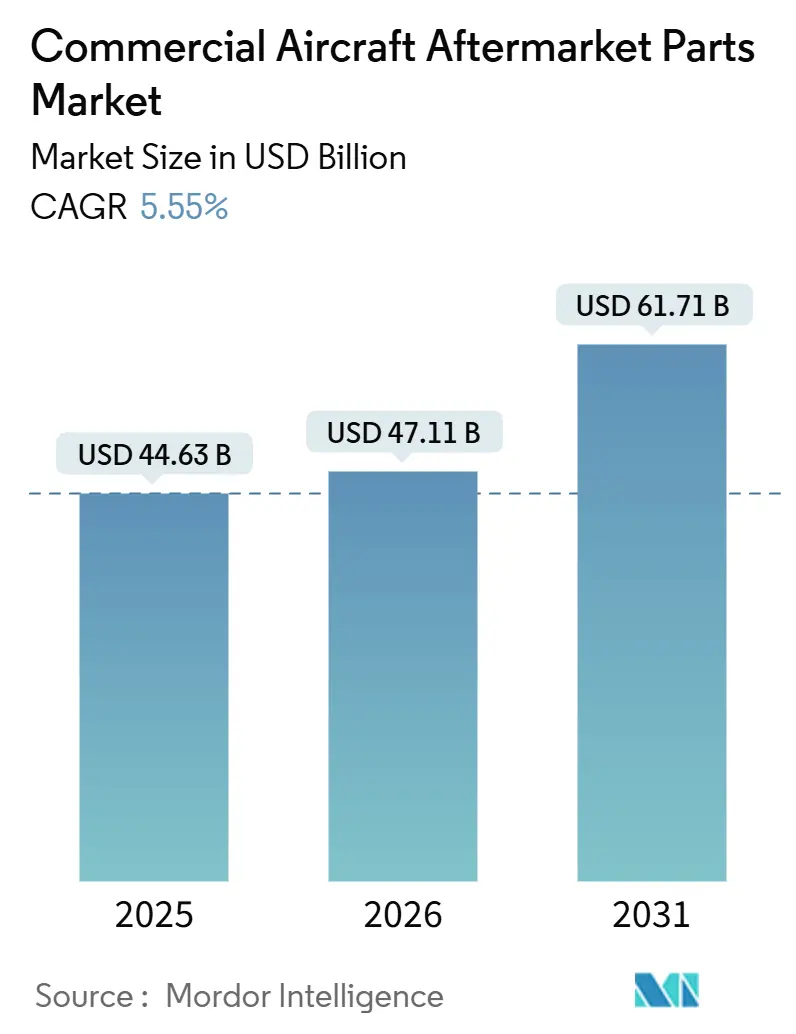
| Market Size (2026) | USD 47.11 Billion |
| Market Size (2031) | USD 61.71 Billion |
| Growth Rate (2026 - 2031) | 5.55% CAGR |
| Fastest Growing Market | Asia-Pacific |
| Largest Market | North America |
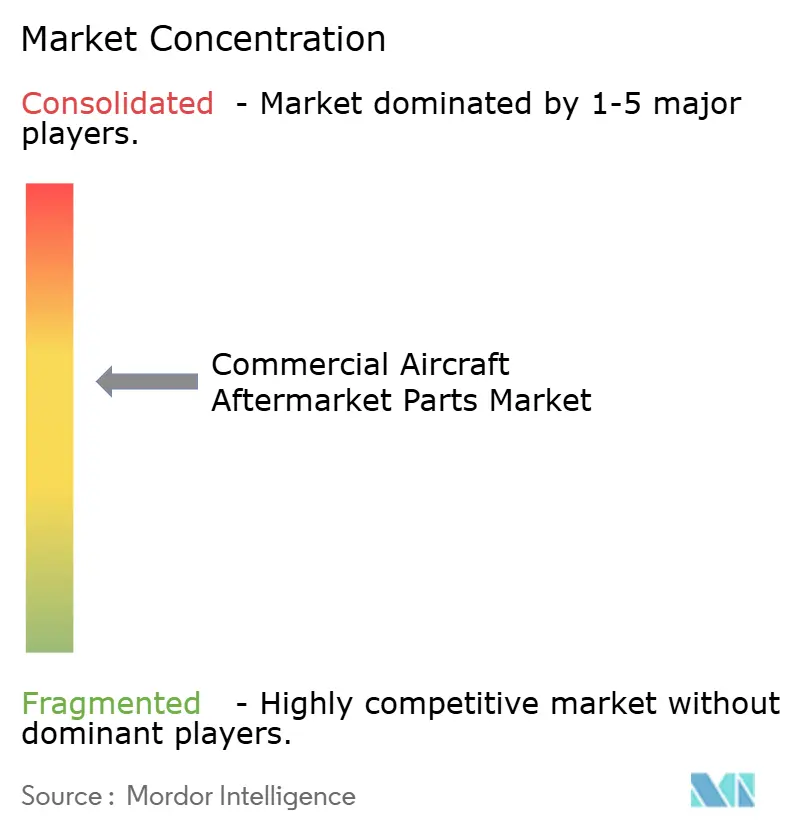
| Market Concentration | Medium |
Major Players *Disclaimer: Major Players sorted in no particular order Image © Mordor Intelligence. Reuse requires attribution under CC BY 4.0. | |
Commercial Aircraft Aftermarket Parts Market Analysis by Mordor Intelligence
The commercial aircraft aftermarket parts market size is expected to grow from USD 44.63 billion in 2025 to USD 47.11 billion in 2026 and is projected to reach USD 61.71 billion by 2031 at a 5.55% CAGR. The growth path reflects persistent OEM delivery delays, aging narrowbody fleets staying in service longer, and higher shop-visit intensity on next‑generation engines. Airlines are expanding the use of serviceable material sourcing as a hedge against long lead times and high new‑part pricing. At the same time, digitization of parts planning and predictive maintenance supports improved uptime. Additive manufacturing reduces long-tail lead times for approved interior and secondary structure components, helping airlines and MROs balance inventory and service-level goals. Supply chain friction still adds cost and complexity, keeping the commercial aircraft aftermarket parts market focused on resiliency and life‑cycle support outcomes rather than transactional spot buys.
Backlogs and certification safeguards shape near‑term dynamics. A global order backlog that exceeds 17,000 aircraft extends the in‑service life of legacy fleets and sustains parts demand despite slower new‑build ramp rates. Airlines continue to absorb extra costs linked to supplier constraints, while regulators emphasize documentation and traceability for airworthiness-critical parts. OEMs strengthen digital channels and USM programs to stabilize availability, and leading MROs scale data-driven planning to keep aircraft on wing. This favors integrated ecosystems that combine physical parts, shop capacity, and connected analytics to protect operational reliability in the commercial aircraft aftermarket parts market.[1]Source: International Air Transport Association, “Aerospace Supply Chain Bottlenecks Continue to Constrain Airlines,” IATA, iata.org
Key Report Takeaways
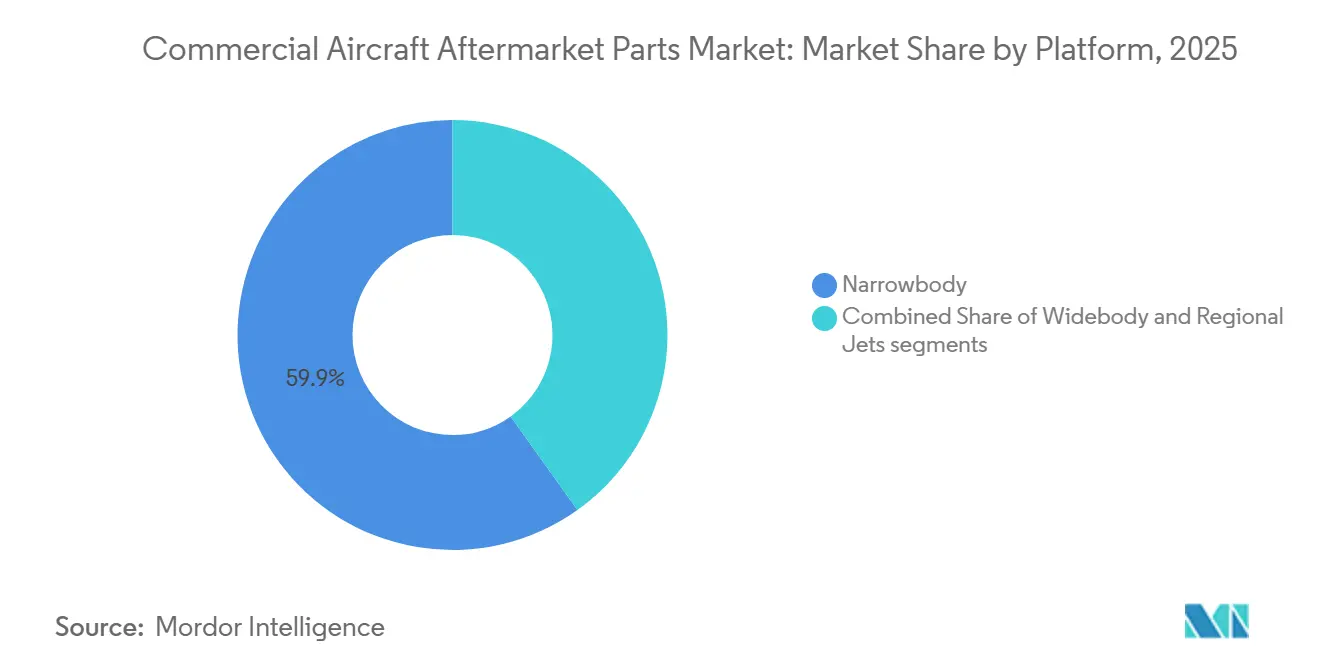
- By platform, narrowbody aircraft led the commercial aircraft aftermarket parts market with 59.87% share in 2025, while widebody platforms are projected to expand at a 6.45% CAGR through 2031.
- By component type, engine components accounted for 48.70% of the commercial aircraft aftermarket parts market size in 2025, and avionics is projected to grow at a 6.35% CAGR through 2031.
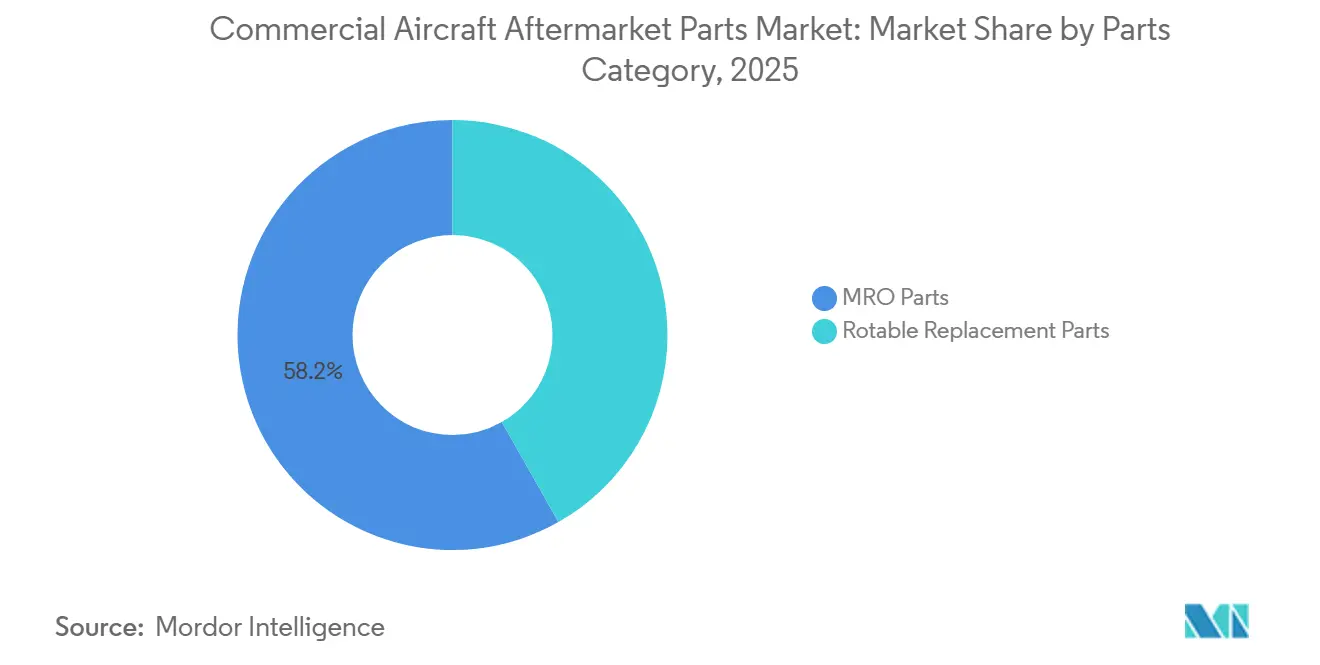
- By parts category, MRO parts accounted for 58.20% of the commercial aircraft aftermarket parts market in 2025, while rotable replacement parts are projected to grow at a 5.87% CAGR through 2031.
- By end user, airlines and cargo operators held 69.80% of spending in 2025, while independent MRO providers are projected to record a 6.24% CAGR through 2031.
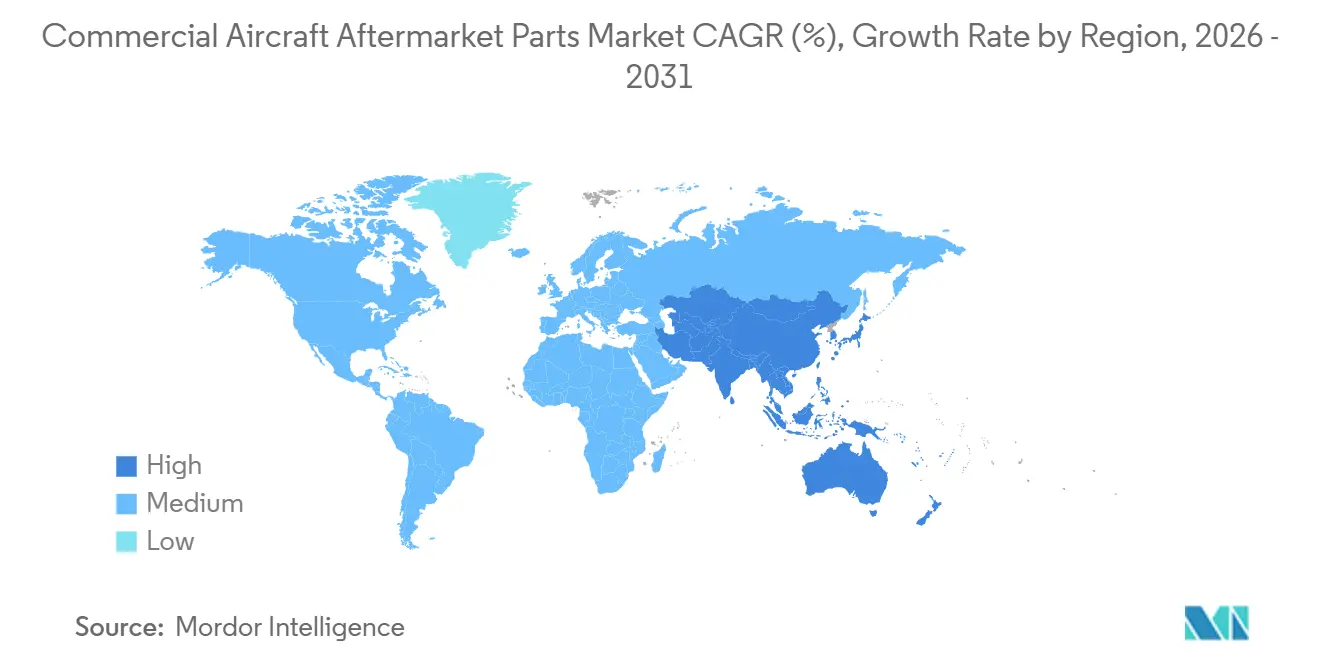
- By geography, North America accounted for 36.54% of the commercial aircraft aftermarket parts market size in 2025, and Asia-Pacific is projected to grow at a 7.10% CAGR through 2031.
Note: Market size and forecast figures in this report are generated using Mordor Intelligence’s proprietary estimation framework, updated with the latest available data and insights as of January 2026.
Global Commercial Aircraft Aftermarket Parts Market Trends and Insights
Drivers Impact Analysis
| Driver | (~) % Impact on CAGR Forecast | Geographic Relevance | Impact Timeline |
|---|---|---|---|
| Aging global single-aisle fleet amid OEM production delays | +1.8% | Global, particularly acute in North America and Europe where fleet average age exceeds 14.5 years | Long term (≥ 4 years) |
| Unscheduled shop visits from next-gen engine durability issues | +1.5% | Global, with highest concentration in Europe and Middle East operating GTF-powered fleets | Medium term (2-4 years) |
| Rapid expansion of used-serviceable-material (USM) ecosystems | +0.9% | Global, spill-over effects strongest in Asia-Pacific and South America | Medium term (2-4 years) |
| AI-enabled predictive maintenance improving parts planning | +0.7% | North America and Europe early adopters, expanding to Asia-Pacific core | Short term (≤ 2 years) |
| On-demand 3D printing shortening long-tail parts lead-times | +0.4% | Global, concentrated in North America and Europe MRO hubs with EASA/FAA AM certifications | Medium term (2-4 years) |
| Tariff-driven near-shoring of parts supply chains | +0.6% | North America primary, secondary impact in South America nearshore facilities | Short term (≤ 2 years) |
| Source: Mordor Intelligence | |||
Aging Global Single-Aisle Fleet Amid OEM Production Delays
Global order backlogs constrain replacement cycles, which pushes operators to extend legacy aircraft and sustain higher parts consumption for cycle-driven items. The backlog above 17,000 units indicates a multi‑year queue that keeps assets on wing and drives recurring demand for rotables and consumables across the commercial aircraft aftermarket parts market. The longer service lives also reinforce the need for structural inspections and directed modifications mandated by airworthiness directives for high‑cycle fleets. Regulators have issued updated guidance on continuing airworthiness and operator compliance, which supports stable demand for flight controls, landing gear, and systems parts subject to recurring checks.[2]Source: European Union Aviation Safety Agency, “Continuing Airworthiness and Airworthiness Directives,” EASA, easa.europa.eu Airlines face elevated operating costs from broader supply chain friction, which slows material availability and increases planning buffers for heavy checks. The near‑term effect is sustained aftermarket intensity for narrowbody fleets and targeted upgrades that bridge to delayed delivery slots in the commercial aircraft aftermarket parts market.
Unscheduled Shop Visits from Next-Gen Engine Durability Issues
Airlines and MROs continue to manage inspection campaigns and accelerated shop visits on select next‑generation engines, which tighten module and LRU availability. The inspection and recovery plans on geared turbofan programs remain a major capacity variable through 2026, and investments in forging and critical rotating parts aim to address structural supply needs that flow into aftermarket repair pipelines. Engine OEMs and authorized shops coordinate module flow, but elongated turnaround times can cascade across fleets and inflate spare engine and rotable pool requirements. The result is greater emphasis on predictive planning, early material positioning, and alternative sourcing to protect dispatch reliability in the commercial aircraft aftermarket parts market. Regulatory oversight of repair data and airworthiness documentation continues to influence shops and operators performing major work on critical modules, shaping the balance between OEM-captive and independent capacity in the medium term. Airlines managing mixed engine portfolios balance short-term mitigation efforts with long-term maintenance strategies, including service bulletin implementation and shop load planning.
Rapid Expansion of Used-Serviceable-Material (USM) Ecosystems
USM has become a central lever for cost control and lead‑time risk mitigation, and OEMs now integrate USM offerings and teardown programs into their service portfolios. Boeing’s services unit expanded USM channels and recycling partnerships to provide traceable materials and reduce time‑to‑service in areas where new‑part supply remains tight. Tighter documentation and back‑to‑birth traceability standards are now routine following recent global scrutiny of parts authenticity, strengthening the position of established distributors and MRO networks that can meet rigorous release requirements. The maturation of USM flows supports availability for legacy narrow‑body engines and high‑wear components as retirements and lease transitions seed parts pools. Lessors and airlines use exchange programs and pool access to keep aircraft online while protecting cash and managing exposure to supply volatility in the commercial aircraft aftermarket parts market. The net effect is a more diversified supply base that complements OEM channels without compromising airworthiness control.
AI-Enabled Predictive Maintenance Improving Parts Planning
Predictive maintenance platforms are now embedded in many airline operations and MRO shops, enabling earlier detection of anomalies and smarter allocation of rotable inventory. Lufthansa Technik’s AVIATAR platform and similar OEM and third‑party tools use flight and system data to flag potential issues before they trigger an AOG event, helping reduce unplanned removals and supporting higher fleet utilization. OEM connectivity programs and e‑enabled fleet architectures enable secure data flow from aircraft to analytics hubs, where maintenance and procurement teams can act on insights. This strengthens the link between parts forecasting, shop induction scheduling, and inventory deployment in the commercial aircraft aftermarket parts market. Predictive processes are also documented within continuing airworthiness and reliability programs, which align with FAA and EASA guidance and audit requirements. The approach reduces expedited logistics and improves on‑time performance, and it is expanding from early adopters in North America and Europe to carriers across the Asia-Pacific. Aircraft OEMs and Tier‑1s also provide service bulletins and support packages that align analytics with parts and modification kits, reinforcing closed‑loop life‑cycle management.
Restraints Impact Analysis
| Restraint | (~) % Impact on CAGR Forecast | Geographic Relevance | Impact Timeline |
|---|---|---|---|
| Global technician shortage lengthening turnaround times | -1.3% | North America, spreading to Europe and Asia-Pacific | Medium term (2-4 years) |
| OEM IP/licensing limits on independent part repairs | -0.9% | Global, most severe in North America and Europe with mature PMA ecosystems | Long term (≥ 4 years) |
| Counterfeit-part risk tightening certification compliance | -0.6% | Global, heightened scrutiny in Europe (EASA), North America (FAA), and Asia-Pacific | Medium term (2-4 years) |
| Raw-material cost and forging/casting bottlenecks | -0.8% | Global, acute pressure on titanium (Russia sanctions), aluminum, specialty alloys | Short term (≤ 2 years) |
| Source: Mordor Intelligence | |||
Global Technician Shortage Lengthening Turnaround Times
The maintenance labor pipeline remains a structural constraint, slowing throughput and raising costs across airframe, engine, and component shops. Global forecasts indicate that long-term demand for new aviation technicians significantly exceeds current training output, with the gap most pronounced in high-skill engine and avionics work scopes. MROs and airlines are addressing the issue by expanding training programs and forming partnerships with educational institutions. However, certification timelines and the need for experience continue to challenge capacity and turnaround times. The effect is longer intervals between heavy shop visits and more frequent use of exchange assets and leased modules, keeping aircraft available in the market. Regulators continue to oversee training and certification under established standards, which maintains safety and reliability but limits the rapid scaling of specialized skills. Over time, automation, digital work instructions, and AI‑based diagnostics can help amplify productivity, but the near‑term profile still points to tight labor conditions.
OEM IP/Licensing Limits on Independent Part Repairs
Regulatory frameworks and IP control shape the boundaries for independent repairs on many high‑value systems, which concentrates complex work within OEM networks. Access to type design data and engine repair procedures remains restricted, and advisory circulars outline stringent PMA and repair approval pathways for critical rotating parts and FADEC‑class components. Lease conditions and warranty terms often favor OEM components and repairs, which can limit the use of PMA or DER options for redelivery or coverage continuity. Industry associations representing PMA stakeholders advocate for greater acceptance within safety‑equivalent categories and publish guidance to standardize practices with regulators and operators. The resulting structure maintains high quality and traceability, yet it constrains pricing flexibility and capacity diversity in specific component classes within the commercial aircraft aftermarket parts market. Operators balance these constraints with stronger USM strategies and predictive material planning to reduce exposure to long lead times and constrained shop slots.
Segment Analysis
By Platform: Narrowbody Dominance Locks In Cycle-Intensive Demand
Narrowbody aircraft held 59.87% of the commercial aircraft aftermarket parts market share in 2025, reflecting higher cycle counts that accelerate wear on wheels, brakes, environmental control systems, and line‑replaceable avionics. As airlines prioritize high‑frequency short‑haul routes, utilization and turn times generate steady demand for consumables and rotables that can be exchanged on the line. Widebody platforms constitute a smaller installed base; however, they involve more complex work scopes and longer check durations. As a result, their projected growth from 2026 to 2031 is expected to surpass the fleet average. Regional jets remain essential in point‑to‑point networks and secondary airports, which sustains demand for hydraulics, pneumatics, and specialized avionics at regional MRO hubs. Regulatory directives for aging aircraft checks also favor narrowbody platforms due to higher cycles, which amplify inspection‑driven material flows.
Widebody platforms are expected to grow at a CAGR of 6.45% through 2031, driven by airlines extending the service life of long-haul aircraft and retrofitting cabins and connectivity to meet passenger expectations. Airlines balance shop workloads between structural work and systems overhauls that must meet strict continuing airworthiness standards, which drives steady parts consumption for landing gear, flight controls, and cabin systems. Service bulletins and airworthiness directives reinforce inspection routines for high‑cycle narrowbody fleets, increasing demand for certified replacement hardware and structural kits. Suppliers and MROs position rotable pools and exchange programs near operators with high aircraft utilization to reduce downtime. These patterns maintain strong parts velocity in areas where block hours and cycles are highest, which is crucial to the commercial aircraft aftermarket parts market.
Note: Segment shares of all individual segments available upon report purchase
By Component Type: Engine Parts Complexity Drives Margin Concentration
Engine components accounted for 48.70% of the commercial aircraft aftermarket parts market size in 2025, highlighting the concentration of value in turbine hardware, hot‑section materials, fuel systems, and control electronics. Next‑generation engines introduce advanced alloys, coatings, and additively manufactured features that require OEM‑authorized repairs and documented traceability. Shop capacity and module availability remain central variables for operators that must manage planned removals alongside unscheduled events. Avionics is the fastest-growing category, projected to grow at a 6.35% CAGR through 2031, driven by connectivity upgrades, IFE refresh cycles, and cockpit modernization that improve reliability and the passenger experience. Airframe components sustain steady demand as aging fleets undergo structural inspections and corrosion‑prevention treatments under FAA and EASA programs.
As digital systems proliferate, software configuration control and cybersecurity updates accompany hardware swaps, which create recurring service lines for approved avionics providers. Technical standard orders and design approvals define supplier eligibility for safety‑critical boxes, thereby limiting PMA penetration in classes such as TCAS, EGPWS, and SATCOM units. Cabin modernization remains a clear priority as airlines standardize on USB‑C power, Wi‑Fi, and slimline seating, resulting in multi‑shipset programs that roll out across fleets over several years. Composites repair capability is expanding within MRO networks to support newer airframe platforms and control surfaces, and shops add tooling and training to execute approved repairs under Part 145. These conditions keep the engine and avionics at the center of growth, while the airframe and interiors maintain a steady, programmatic cadence in the commercial aircraft aftermarket parts market.
By Parts Category: MRO Parts Lead, Rotables Accelerate
MRO parts commanded 58.20% of the commercial aircraft aftermarket parts market size in 2025, driven by recurring replacement intervals for life‑limited parts, regulatory checks, consumables, and expendables across airframe, engine, and systems. Airlines plan these material flows through maintenance programs that translate cycles and hours into predictable requirements. Rotable replacement parts are projected to grow at a 5.87% CAGR through 2031 as operators expand pool coverage and exchange options to protect dispatch performance. The spread of power‑by‑the‑hour and hourly‑based services shifts more rotable ownership to OEMs, lessors, and MROs, helping reduce capital tied up in airline stockrooms while ensuring access. Digital records and serialized tracking tools now accompany rotables across shops and operators to maintain documentation and airworthiness.
The improved data flow between predictive analytics, reliability engineering, and parts provisioning also narrows uncertainty, which reduces AOG exposure for high‑criticality items. Airlines and MROs use e‑commerce and OEM portals to source both new and USM parts under strict release controls, helping shorten service loops for the long tail of demand.[3]Source: The Boeing Company, “Services and USM Channels,” Boeing, boeing.com The regulatory stance on traceability and release notes is firm, which reinforces the role of established distributors and approved shops that can provide back‑to‑birth records. As a result, MRO parts remain the largest pool while rotable strategies expand as a structural hedge in the commercial aircraft aftermarket parts market.
By End User: Airlines Dominate, Independents Gain Share
Airlines and cargo operators accounted for 69.80% of the commercial aircraft aftermarket parts market size in 2025, reflecting the size of their active fleets and the need to maintain operating certificates through continuous compliance with airworthiness directives and maintenance programs. They coordinate parts strategies that balance OEM, USM, and pool access to control cost and protect on‑time performance. Independent MRO providers are projected to grow at a 6.24% CAGR through 2031 as carriers outsource heavy checks, component overhauls, and special process work to providers with scale, geographic proximity, and multi‑OEM capabilities. Lessors continue to influence material flows and build USM streams during transitions, which further integrates aftermarket parts planning into lease and redelivery strategies.
Regulators maintain equivalent safety and capability standards across OEM and independent shops through Part 145 approvals in both the FAA and EASA systems. This maintains quality while enabling competitive dynamics that can improve turnaround and pricing in legacy fleets. Digital service platforms also make it easier for independent MROs to integrate predictive maintenance and e‑commerce sourcing, which reduces friction for operators. As airlines focus internal resources on line maintenance and fleet reliability, they sustain a deep external network of engine and component specialists. These patterns preserve airline leadership in spending while independents expand their role within the commercial aircraft aftermarket parts market.
Geography Analysis
North America accounted for 36.54% of the commercial aircraft aftermarket parts market in 2025, supported by an extensive operator base, a strong OEM services presence, and a dense network of FAA‑approved MRO facilities. Operators in the region maintain high utilization and adopt digital and predictive processes early, thereby strengthening planning and sparing allocation across fleets. Compliance with FAA airworthiness directives drives steady demand for parts for systems, structures, and engines on high‑cycle narrow‑body aircraft. OEM distribution platforms, such as Boeing’s and Airbus’s integrated channels, improve transactional efficiency and documentation flow, supporting audit and reliability needs.
Asia Pacific is projected to grow at a 7.10% CAGR through 2031, the fastest among regions, as carriers add capacity and restore international connectivity. China’s fleet growth trajectory toward 9,570 aircraft by the next two decades underpins a large future services base and creates long‑run demand for engines, components, and cabin upgrades. India’s connectivity programs add new city pairs and stimulate narrow‑body utilization, increasing the need for rotables and consumables to support higher daily cycles. Regional MRO capability continues to expand, with established hubs and new entrants receiving approvals for line, airframe, engine, and component maintenance. Predictive platforms and OEM service packages are seeing broader adoption as operators seek to reduce unplanned events and improve reliability.
Europe remains a mature, high‑value region with robust MRO networks and strict EASA oversight that keeps inspection and documentation standards at the forefront of planning. Flag carriers and low‑cost operators extend the economic life of existing fleets through cabin modernization and connectivity retrofits to manage delivery shortfalls and match demand. The Middle East continues to scale wide‑body maintenance and component services around large hub carriers, while Africa and South America strengthen facilities and approvals to nearshore work from North American and European operators. Tariff and logistics considerations encourage nearshoring of parts flows to Caribbean and Central American sites that can offer cost and proximity advantages for US operators. Public programs that fund advanced materials and process technologies also contribute to regional supply resilience and talent development for future parts demand.
Competitive Landscape
The commercial aircraft aftermarket parts market is semi‑consolidated. OEMs lead in next‑gen engine and avionics categories where proprietary repair processes and licensing shape what independents can do. At the same time, competitive openings persist on legacy fleets and across components and interiors, where approved independents, distributors, and USM providers add supply diversity. Airlines and MROs respond by mixing OEM channels with traceable USM and exchange pools that keep aircraft online. Digital procurement and predictive maintenance narrow planning windows and reduce expediting, shifting value toward integrated material and data solutions.
Strategic investments and partnerships remain active as providers scale capacity and technology. Pratt & Whitney announced a USD 200 million expansion in Columbus, Georgia, to add forging capacity and increase throughput for critical rotating parts and MRO, helping relieve supply pressure that directly affects aftermarket turnaround. Boeing expanded its use of serviceable material capacity across its services portfolio, strengthening traceable alternatives for operators facing long lead times on select new parts. StandardAero expanded a primary MRO site to increase engine and avionics capabilities, which supports independent capacity growth in North America.
Additive manufacturing leaders continued to deliver certified interior parts that reduce lead time and weight, expanding the set of qualified components and materials within approved processes. Lufthansa Technik scaled digital platforms and component support contracts that embed predictive capabilities, pool access, and 24/7 AOG response for operators. Approvals from EASA and FAA for design and maintenance organizations are critical, as they enable engineering changes, service bulletin implementation, and large-scale component MRO activities. These factors underscore the significance of capacity, certification, and data in driving reliability and competitiveness within the commercial aircraft aftermarket parts market.
Commercial Aircraft Aftermarket Parts Industry Leaders
Honeywell International Inc.
RTX Corporation
Safran SA
Moog Inc.
General Electric Company
- *Disclaimer: Major Players sorted in no particular order
Recent Industry Developments
- February 2026: Pratt & Whitney, an RTX business, announced a USD 200 million investment to expand its Columbus, Georgia operations, including the addition of a seventh isothermal forging press. This expansion is designed to increase production of critical engine components by 30% to address the rising demand for aftermarket parts in commercial and military programs.
- November 2025: Lufthansa Technik's expanded partnership with Royal Jordanian Airlines, formalized at the Dubai Airshow, reflects the increasing demand for aftermarket parts and MRO services as airlines modernize fleets. By securing a 12-year Total Component Support (TCS) agreement for Royal Jordanian's A320neo fleet, Lufthansa Technik reinforces its role in addressing the growing need for efficient component management. This strategic move highlights the value of localized support, such as the home base pool in Amman, to ensure operational reliability and cost optimization.
Global Commercial Aircraft Aftermarket Parts Market Report Scope
The commercial aircraft aftermarket parts market encompasses the production, remanufacturing, distribution, retail, and installation of replacement parts, equipment, and accessories. While these components are not necessarily from the original equipment manufacturer (OEM), they fall into two main categories: replacement parts, which focus on performance, and accessories, which cater to customization.
The commercial aircraft aftermarket parts market is segmented by platform, component type, parts category, end user, and geography. By platform, the market is segmented into narrowbody, widebody, and regional jets. By component type, the market is segmented into airframe, engine, interior, avionics, and others. By parts category, the market is segmented into MRO parts and rotable replacement parts. By end user, the market is segmented into airlines and cargo operators, independent MRO providers, and aircraft leasing companies. The report also covers the market sizes and forecasts for the commercial aircraft aftermarket parts market in major countries across different regions. For each segment, the market size is provided in terms of value (USD).
| Narrowbody |
| Widebody |
| Regional Jets |
| Engine |
| Airframe |
| Interior |
| Avionics and Others |
| MRO Parts |
| Rotable Replacement Parts |
| Airlines and Cargo Operators |
| Independent MRO Providers |
| Aircraft Leasing Companies |
| North America | United States | |
| Canada | ||
| Mexico | ||
| Europe | United Kingdom | |
| Germany | ||
| France | ||
| Russia | ||
| Rest of Europe | ||
| Asia-Pacific | China | |
| India | ||
| Japan | ||
| South Korea | ||
| Rest of Asia-Pacific | ||
| South America | Brazil | |
| Rest of South America | ||
| Middle East and Africa | Middle East | Israel |
| Saudi Arabia | ||
| United Arab Emirates | ||
| Rest of Middle East | ||
| Africa | South Africa | |
| Rest of Africa | ||
| By Platform | Narrowbody | ||
| Widebody | |||
| Regional Jets | |||
| By Component Type | Engine | ||
| Airframe | |||
| Interior | |||
| Avionics and Others | |||
| By Parts Category | MRO Parts | ||
| Rotable Replacement Parts | |||
| By End User | Airlines and Cargo Operators | ||
| Independent MRO Providers | |||
| Aircraft Leasing Companies | |||
| By Geography | North America | United States | |
| Canada | |||
| Mexico | |||
| Europe | United Kingdom | ||
| Germany | |||
| France | |||
| Russia | |||
| Rest of Europe | |||
| Asia-Pacific | China | ||
| India | |||
| Japan | |||
| South Korea | |||
| Rest of Asia-Pacific | |||
| South America | Brazil | ||
| Rest of South America | |||
| Middle East and Africa | Middle East | Israel | |
| Saudi Arabia | |||
| United Arab Emirates | |||
| Rest of Middle East | |||
| Africa | South Africa | ||
| Rest of Africa | |||
Key Questions Answered in the Report
What is the global size and growth outlook for the commercial aircraft aftermarket parts market to 2031?
The commercial aircraft aftermarket parts market is expected to grow from USD 44.63 billion in 2025 to USD 47.11 billion in 2026 and is projected to reach USD 61.71 billion by 2031 at a 5.55% CAGR, reflecting aging fleets, OEM delivery delays, and stronger USM and predictive maintenance adoption.
Which platform contributes the most to spending in the commercial aircraft aftermarket parts market?
Narrowbody aircraft lead with 59.87% share in 2025 due to high daily cycles and short‑haul route intensity that elevate demand for wheels, brakes, ECS, and line‑replaceable avionics.
What component category accounts for the largest value in the commercial aircraft aftermarket parts market?
Engine components hold 48.70% of value in 2025, supported by complex materials, hot‑section repairs, and control systems that require OEM‑authorized processes.
Which region is the largest and which is the fastest growing in the commercial aircraft aftermarket parts market?
North America is the largest with 36.54% of value in 2025, while Asia Pacific is the fastest growing with a projected 7.10% CAGR to 2031 on rising fleet additions and restored international networks.
How are USM and predictive maintenance changing the commercial aircraft aftermarket parts market?
USM expands traceable, cost‑effective supply alternatives that reduce lead time exposure, while predictive maintenance improves early detection and inventory planning, which lowers unplanned removals and AOG exposure.
Who are the leading companies shaping strategies in the commercial aircraft aftermarket parts market?
The Boeing Company, Airbus SE, RTX Corporation, GE Aerospace, and Honeywell International Inc. lead with integrated services, IP‑controlled repairs, and digital platforms, supported by independent MROs and distributors that expand capacity and parts availability.


