

Market Overview
| Study Period | 2017 - 2028 |
|---|---|
| Base Year For Estimation | 2023 |
| Forecast Data Period | 2024 - 2028 |
| Market Size (2024) | USD 1.69 Billion |
| Market Size (2028) | USD 2.13 Billion |
| Growth Rate (2024 - 2028) | 5.96% CAGR |
| Market Concentration | Low |
Major Players
*Disclaimer: Major Players sorted in no particular order Image © Mordor Intelligence. Reuse requires attribution under CC BY 4.0. |
|

United Kingdom Adhesives Market Analysis by Mordor Intelligence
The United Kingdom Adhesives Market size is estimated at 1.69 billion USD in 2024, and is expected to reach 2.13 billion USD by 2028, growing at a CAGR of 5.96% during the forecast period (2024-2028).
The United Kingdom maintains its position as the fourth-largest adhesives market in Europe, demonstrating the industry's strategic importance in the region's manufacturing landscape. The market is experiencing a significant shift toward advanced adhesive technology, particularly in high-performance and specialty adhesive applications. This transformation is largely driven by the increasing adoption of sustainable and environmentally friendly adhesive solutions across various industries. The National Health Service (NHS), as the largest purchaser of medical products in the country, spends approximately USD 25 billion annually on medical goods and services, significantly influencing the development and adoption of specialized medical-grade adhesives.
The industry is witnessing a notable transition in manufacturing processes, with companies increasingly investing in automation and smart manufacturing technologies to enhance production efficiency and product quality. This shift is particularly evident in the development of precision application systems and quality control mechanisms. The market is characterized by a strong focus on research and development, with adhesive manufacturers in the UK continuously introducing innovative adhesive formulations to meet evolving industry requirements. The trend toward water-based and solvent-free adhesives continues to gain momentum, reflecting both regulatory pressures and changing consumer preferences.
Environmental sustainability has emerged as a central theme in the UK adhesive industry, with manufacturers increasingly focusing on developing bio-based and recyclable adhesive solutions. This trend is particularly evident in the packaging sector, where companies are actively working to develop adhesives that facilitate easier recycling and reduce environmental impact. The industry is also seeing increased collaboration between adhesive manufacturers in the UK and end-users to develop customized solutions that meet specific performance and sustainability requirements.
The market is experiencing significant technological advancement in terms of product development and application methods. Manufacturers are increasingly focusing on developing smart adhesives with properties such as self-healing capabilities and improved bond strength. The industry has also witnessed a surge in the development of adhesives specifically designed for advanced materials and composite bonding applications. This evolution is supported by substantial investments in research and development facilities across the country, enabling manufacturers to maintain their competitive edge in the global market while meeting the growing demand for specialized adhesive solutions.
United Kingdom Adhesives Market Trends and Insights
With the advancement in plastic recyclability and demand for food and beverage industry, plastic packaging to lead the packaging industry
- Due to the COVID-19 pandemic, the country-wide lockdowns and temporary shutdown of manufacturing facilities caused several issues, including supply chain and import and export trade disruptions. As a result, the country's packaging production declined by 3% in 2020 compared to the previous year, significantly affecting the market.
- However, as a result of the pandemic, consumption patterns have changed, more people started shopping online, and packaging has become much more significant. The United Kingdom has the most advanced e-commerce market and is the fourth largest in the world, which will drive the packaging production market. When it comes to internet shopping, the United Kingdom is the most popular market in Europe. The UK's e-commerce industry generated GBP 129 billion in revenue in 2021, more than triple the revenue generated by UK e-commerce in 2015, and it was around 15% higher than the GBP 112.7 billion in 2020.
- Packaging production is majorly driven by plastics in the country, accounting for around 77% of the packaging produced in 2021. Around 44.3% of plastics produced were consumed by packaging in the United Kingdom. With the advancement of plastic recyclability, the plastic production segment is likely to register the fastest growth rate of around 3.37% CAGR during the projected period.

Understand The Key Trends Shaping This Market
Download PDF
In addition to eco-friendly transportation by 2030, electric vehicle registrations growth is likely to propel the automotive production
- The UK automotive industry is a vital part of the UK economy, worth more than EUR 60.2 billion in turnover and adding EUR 11.9 billion value to the UK economy. However, in 2020, the automotive vehicle production in the country reduced by 29.5% compared to the same period in 2019, as the UK automotive sector faced some of the biggest challenges in its history while responding to the COVID-19 pandemic and repositioning for Brexit implications.
- After contracting by 29.5% in 2020, British automotive vehicle production further declined by 4.7% in 2021, as the semiconductor shortage severely affected production. New car registrations decreased 34% Y-o-Y in September 2021, which is excepted to affect the UK sealants market in the future.
- The United Kingdom is planning to phase out gasoline and diesel vehicles to promote the transition to more eco-friendly transportation by 2030. The country also planned an investment of over GBP 1.8 billion in infrastructure and grants to expand access to zero-emission vehicles and support a green economic recovery, thereby increasing the demand for the electric vehicles market in the country.
- The total number of BEV, PHEV, and HEV registrations in the United Kingdom accounted for 452,527 in 2021, registering a growth rate of 58.7% Y-o-Y, compared to 285,199 registrations in 2020. Out of total registrations in 2021 (with percentage Y-o-Y change), 190,727 (76.3%) were BEVs, 114,554 (70.6%) were PHEVs, and 147,246 (34.0%) were HEVs. In 2021, BEV, PHEV, and HEV captured around 27.5% share of total car registrations in the country.

Understand The Key Trends Shaping This Market
Download PDF
OTHER KEY INDUSTRY TRENDS COVERED IN THE REPORT
- Being the second largest aerospace sector in the world and with forecast of around 10% market share by 2030, United Kingdom aerospace sector is expected to increase
- In addition to government schemes, the usage of automation and robotics in production lines to reduce production cost, the footwear industry is likely to propel
- Rising investments in housing and infrastructure by the government to boost the construction industry
- Owing to the regulations on timber export by United Kingdom Timber Regulation (UKTR), the demand for local manufacturing of furniture is likely to boost the industry
Segment Analysis: End User Industry
Packaging Segment in UK Adhesives Market
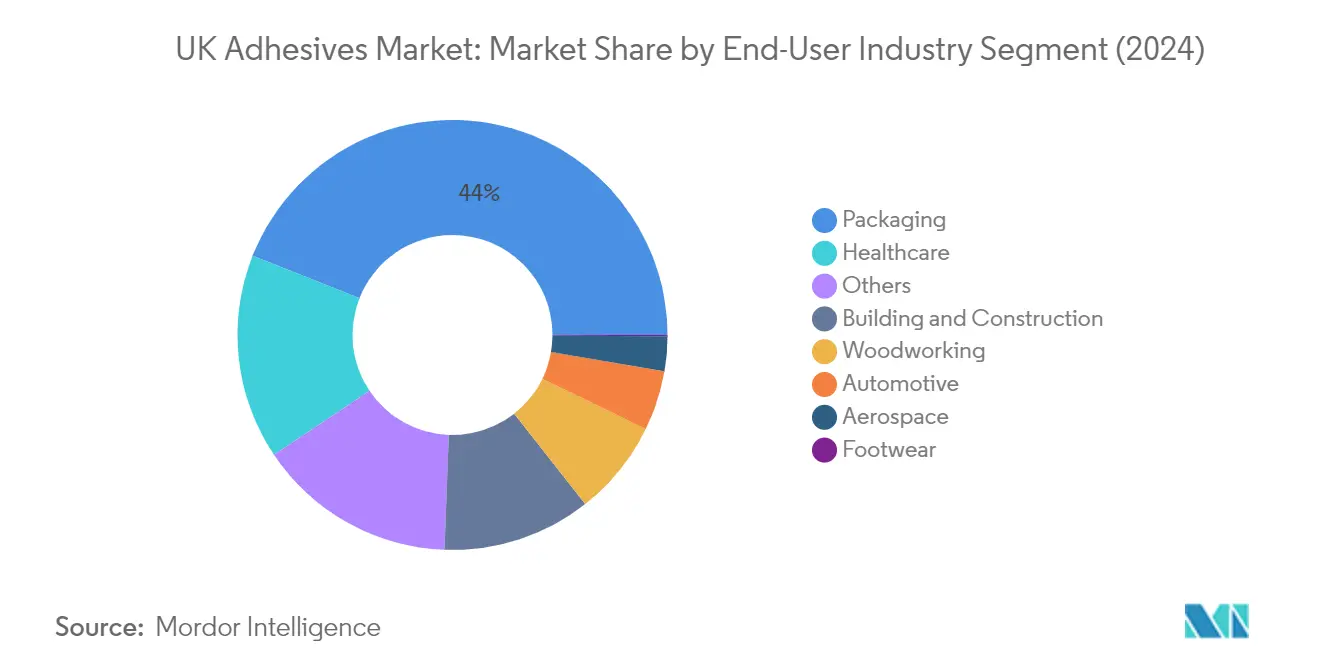
The packaging segment dominates the UK adhesives market, accounting for approximately 44% of the total market value in 2024. This significant market share is driven by the extensive use of packaging adhesive in various applications, including labels, tapes, carton sealing, joining, and laminating. The segment's dominance is further strengthened by the UK's position as one of the most advanced e-commerce markets globally, which has led to increased demand for packaging solutions. The growth in flexible packaging applications and the shift towards sustainable packaging materials have also contributed to the high consumption of adhesives in this segment. Water-based and hot melt adhesives are particularly popular in packaging applications due to their economic viability and environmental friendliness.
Footwear and Leather Segment in UK Adhesives Market
The footwear and leather segment is emerging as the fastest-growing segment in the UK adhesives market, with projections indicating robust growth through 2024-2029. This growth is primarily driven by the increasing adoption of innovative technologies in footwear manufacturing, including 3D printing and customized footwear production. The segment's expansion is further supported by the rising demand for non-leather or vegan footwear products, which require specialized adhesive solutions. Manufacturers are increasingly focusing on developing customized, health-beneficial footwear, creating new opportunities for adhesive applications. The implementation of best practices in digital supply chain management and the trend towards bringing production back to the UK are also contributing to the segment's rapid growth.
Remaining Segments in End User Industry
The other significant segments in the UK adhesives market include healthcare, building and construction, woodworking and joinery, automotive, and aerospace industries. The healthcare segment maintains a strong position due to the extensive use of medical adhesives in medical devices and equipment manufacturing. The building and construction sector demonstrates steady demand driven by infrastructure development and renovation projects. The woodworking and joinery segment benefits from the furniture manufacturing industry's growth, while the automotive sector's demand is influenced by the transition to electric vehicles and lightweight materials. The aerospace segment, though smaller, remains crucial due to the UK's position as a major aerospace manufacturing hub.
Segment Analysis: Technology
Water-borne Segment in UK Adhesives Market
Water-borne adhesives dominate the UK adhesives market, holding approximately 56% market share in 2024. These adhesives are formulated as dispersions or emulsions with polymer particles typically ranging from 50-300 nanometers in diameter. Their popularity stems from being an environmentally friendly alternative to solvent-based adhesives, offering negligible VOC emissions while maintaining strong adhesion properties. Water-borne adhesives demonstrate excellent compatibility with various substrates, including wood, paper, textiles, and leather, making them particularly valuable in woodworking, packaging, and footwear applications. The segment's dominance is further strengthened by stringent environmental regulations in the United Kingdom that favor low-VOC solutions.
Hot Melt Segment in UK Adhesives Market
The hot melt adhesive segment is experiencing the fastest growth in the UK market, with projections indicating continued expansion through 2024-2029. These thermoplastic adhesives are gaining significant traction due to their versatility and operational efficiency, particularly in automotive, packaging, and furniture applications. The segment's growth is driven by increasing demand for fast-curing adhesive solutions that offer improved productivity and reduced energy consumption. Hot melt adhesives are particularly favored in automated manufacturing processes due to their quick set times and ability to bond multiple substrate types. The segment's expansion is further supported by innovations in EVA and polyurethane-based formulations that enhance performance characteristics while maintaining cost-effectiveness.
Remaining Segments in Technology
The UK adhesives market is further segmented into reactive, solvent-borne, and UV-cured adhesives, each serving specific industrial applications. Reactive adhesives are particularly valued in automotive and construction applications for their strong structural bonding capabilities. Solvent-borne adhesives, despite environmental concerns, maintain a presence in specialized applications requiring specific performance characteristics. UV-cured adhesives have carved out a niche in electronics and medical device manufacturing due to their rapid curing properties and precision application capabilities. These segments continue to evolve with technological advancements and changing industry requirements, particularly in response to increasing demands for sustainable and efficient bonding solutions.
Segment Analysis: Resin
Acrylic Segment in UK Adhesives Market
Acrylic adhesives dominate the UK adhesives market, holding approximately 28% market share by volume in 2024, driven by their versatile applications across multiple industries. These adhesives demonstrate exceptional performance in pressure-sensitive adhesive applications for packaging, construction, footwear, leather, and healthcare end-users. The segment's strong position is supported by acrylic adhesives' ability to bond dissimilar substrates without surface preparation, making them particularly valuable in modern furniture manufacturing where polymer and wood structures need to be blended. Their resistance to excess heat and moisture has also made them a preferred choice in the construction industry, especially for energy-efficient building projects. The segment's growth is further bolstered by increasing demand from the automotive sector, where acrylic adhesives are essential for metal bonding applications in both traditional and electric vehicles.
Epoxy Segment in UK Adhesives Market
The epoxy adhesives segment is experiencing the fastest growth in the UK adhesives market, with an expected growth rate of approximately 5% during 2024-2029. This robust growth is primarily driven by increasing adoption in the automotive sector, particularly in electric vehicle manufacturing, where epoxy adhesives' superior bonding capabilities with metal, plastic, ceramic, and composite materials make them indispensable. The segment's expansion is further supported by rising demand from the furniture industry, where epoxy adhesives show excellent adhesion to wood substrates for woodworking and joinery applications. The construction industry's shift towards energy-efficient buildings and renovation projects has also contributed significantly to the segment's growth, particularly in flooring applications where epoxy adhesives' durability and strength properties are highly valued. The segment continues to benefit from ongoing technological advancements in epoxy formulations that enhance performance characteristics while meeting stringent environmental regulations.
Remaining Segments in Resin
The other significant segments in the UK adhesives market include polyurethane, VAE/EVA, silicone, and cyanoacrylate resins, each serving specific market niches with their unique properties. Polyurethane adhesives are particularly valued for their durability and flexibility in automotive and construction applications. VAE/EVA adhesives, predominantly used in hot melt adhesive technology, have established a strong presence in woodworking and packaging applications. Silicone adhesives have carved out a niche in applications requiring excellent temperature resistance and flexibility, particularly in construction and automotive sectors. Cyanoacrylate adhesives, known for their rapid curing properties, continue to be essential in electronics assembly and medical device manufacturing. Each of these segments contributes to the market's diversity by offering specialized solutions for specific application requirements while maintaining compliance with environmental regulations.
Competitive Landscape
Top Companies in UK Adhesives Market
The leading adhesive companies in the UK are actively pursuing innovation and strategic expansion to maintain their competitive positions. Product development efforts are primarily focused on sustainable and eco-friendly adhesive solutions, with companies introducing bio-based formulations and low-VOC products to meet evolving environmental regulations. Operational agility is demonstrated through investments in manufacturing facilities and R&D centers, enabling quick response to changing market demands. Strategic moves predominantly involve acquisitions of local specialists to enhance regional presence and expand product portfolios. Companies are also strengthening their distribution networks and forming partnerships with technology providers to improve market penetration. The focus on developing application-specific solutions for key end-user industries like automotive, construction, and packaging remains a crucial competitive differentiator.
Market Structure Shows Balanced Competitive Dynamics
The UK adhesives market exhibits a partially consolidated structure with a mix of global chemical conglomerates and specialized adhesive manufacturers in the UK. Global players like Henkel, Arkema, and H.B. Fuller leverage their extensive R&D capabilities and broad product portfolios to serve multiple end-user segments, while local specialists like Beardow Adams focus on specific applications and maintain strong regional relationships. The market demonstrates a healthy balance between multinational corporations and domestic players, with the latter maintaining significant market share through specialized product offerings and a deep understanding of local requirements.
The competitive landscape is characterized by ongoing consolidation activities, particularly among mid-sized players seeking to enhance their market position. Merger and acquisition strategies are primarily focused on acquiring complementary technologies and expanding geographic reach. Companies are increasingly pursuing vertical integration to secure raw material supply and strengthen their position in high-growth application segments. The presence of both diversified chemical companies and pure-play adhesive manufacturers creates a dynamic competitive environment where success depends on technological capabilities, customer relationships, and operational efficiency.
Innovation and Sustainability Drive Future Success
For incumbent companies to maintain and expand their market share, a focus on sustainable product development and digital transformation will be crucial. Market leaders are investing in bio-based raw materials and environmentally friendly formulations to address growing sustainability concerns. Building strong relationships with key end-users through customized solutions and technical support services remains essential. Companies are also expanding their presence in high-growth segments like electric vehicles and energy-efficient construction while maintaining operational excellence through automated manufacturing and supply chain optimization.
New entrants and challenger companies can gain ground by focusing on niche applications and emerging market segments. Success factors include developing specialized products for underserved markets, establishing strong distribution partnerships, and leveraging digital platforms for market access. The increasing focus on regulatory compliance, particularly regarding VOC emissions and food contact materials, creates opportunities for companies with innovative solutions. Building technical expertise in specific end-user industries and offering comprehensive application support will be critical for sustainable growth. Companies must also consider potential substitution risks from alternative bonding technologies and prepare for stricter environmental regulations. The adhesive industry is poised for growth as companies innovate in industrial adhesive and specialty adhesive solutions to meet diverse application needs.
United Kingdom Adhesives Industry Leaders
-
Arkema Group
-
Beardow Adams
-
H.B. Fuller Company
-
Henkel AG & Co. KGaA
-
Sika AG
- *Disclaimer: Major Players sorted in no particular order

Need More Details on Market Players and Competitors?
Download PDF
Recent Industry Developments
- May 2022: Henkel introduced new products, such as Loctite Liofol LA 7818 RE / 6231 RE and Loctite Liofol LA 7102 RE / 6902 RE, to promote recyclability in the packaging industry.
- March 2022: Bostik signed an agreement with DGE for distribution throughout Europe, Middle East & Africa. The agreement includes Born2BondTM engineering adhesives developed for 'by-the-dot' bonding applications in specific industries, such as automotive, electronics, luxury packaging, medical devices, and MRO.
- February 2022: H.B. Fuller announced the acquisition of Fourny NV to strengthen its Construction Adhesives business in Europe.
United Kingdom Adhesives Market Report Scope
Aerospace, Automotive, Building and Construction, Footwear and Leather, Healthcare, Packaging, Woodworking and Joinery are covered as segments by End User Industry. Hot Melt, Reactive, Solvent-borne, UV Cured Adhesives, Water-borne are covered as segments by Technology. Acrylic, Cyanoacrylate, Epoxy, Polyurethane, Silicone, VAE/EVA are covered as segments by Resin.
End User Industry
| Aerospace |
| Automotive |
| Building and Construction |
| Footwear and Leather |
| Healthcare |
| Packaging |
| Woodworking and Joinery |
| Other End-user Industries |
Technology
| Hot Melt |
| Reactive |
| Solvent-borne |
| UV Cured Adhesives |
| Water-borne |
Resin
| Acrylic |
| Cyanoacrylate |
| Epoxy |
| Polyurethane |
| Silicone |
| VAE/EVA |
| Other Resins |
| End User Industry | Aerospace |
| Automotive | |
| Building and Construction | |
| Footwear and Leather | |
| Healthcare | |
| Packaging | |
| Woodworking and Joinery | |
| Other End-user Industries | |
| Technology | Hot Melt |
| Reactive | |
| Solvent-borne | |
| UV Cured Adhesives | |
| Water-borne | |
| Resin | Acrylic |
| Cyanoacrylate | |
| Epoxy | |
| Polyurethane | |
| Silicone | |
| VAE/EVA | |
| Other Resins |
Need A Different Region or Segment?
Customize Now
Market Definition
- End-user Industry - Building & Construction, Packaging, Automotive, Aerospace, Woodworking & Joinery, Footwear & Leather, Healthcare, and Others are the end-user industries considered under the adhesives market.
- Product - All adhesive products are considered in the market studied
- Resin - Under the scope of the study, resins like Polyurethane, Epoxy, Acrylic, Cyanoacrylate, VAE/EVA, and Silicone are considered
- Technology - For the purpose of this study, Water-borne, Solvent-borne, Reactive, Hot Melt, and UV Cured adhesive technologies are taken into consideration.
| Keyword | Definition |
|---|---|
| Hot-melt Adhesive | Hot melt adhesives are generally 100% solid formulations, based on thermoplastic polymers. They are solid at room temperature and are activated upon heating above their softening point, at which stage they are liquid, and hence, can be processed. |
| Reactive Adhesive | A reactive adhesive is made up of monomers that react in the adhesive curing process and do not evaporate from the film during use. Instead, these volatile components become chemically incorporated into the adhesive. |
| Solvent-borne Adhesive | Solvent-borne adhesives are mixtures of solvents and thermoplastic, or slightly cross-linked polymers, such as polychloroprene, polyurethane, acrylic, silicone, and natural and synthetic rubbers (elastomers). |
| Water-borne Adhesive | Water-borne adhesives use water as a carrier or diluting medium to disperse a resin. They are set by allowing the water to evaporate or be absorbed by the substrate. These adhesives are compounded with water as a diluent, rather than a volatile organic solvent. |
| UV Cured Adhesive | UV curing adhesives induce curing and create a permanent bond without heating by using ultraviolet (UV) light or other radiation sources. An aggregation of monomers and oligomers is cured or polymerized by ultraviolet (UV) or visible light in a UV adhesive. Because UV is a radiating energy source, UV adhesives are often referred to as radiation curing or rad-cure adhesives. |
| Heat-resistant Adhesive | Heat-resistant Adhesives refer to those that do not break down under high temperatures. One aspect of a complicated system of circumstances is the adhesive's capacity to withstand disintegration brought on by high temperatures. As the temperature rises, adhesives may liquefy. They can withstand stresses resulting from differing coefficients of expansion and contraction, which might be an additional advantage. |
| Reshoring | Reshoring is the practice of moving commodity production and manufacturing back to the nation where the business was founded. Onshoring, inshoring, and back shoring are further terms used. Offshoring, the practice of producing items abroad to lower labor and manufacturing costs, is the opposite of this. |
| Oleochemicals | Oleochemicals are compounds produced from biological oils or fats. They resemble petrochemicals, which are substances made from petroleum. The oleochemical business is built on the hydrolysis of oils or fats. |
| Nonporous Materials | Nonporous materials are substances that do not permit the passage of liquid or air. Nonporous materials are those that are not porous, such as glass, plastic, metal, and varnished wood. Since no air can get through, less airflow is required to raise these materials, negating the requirement for high airflow. |
| EU-Vietnam Free Trade Agreement | A trade agreement and an investment protection agreement were concluded between the European Union and Vietnam on June 30, 2019. |
| VOC content | Compounds with limited solubility in water and high vapor pressure are known as Volatile Organic Compounds (VOCs). Many VOCs are human-made chemicals that are used and produced in the manufacture of paints, pharmaceuticals, and refrigerants. |
| Emulsion Polymerization | Emulsion polymerization is a method of producing polymers or connected groups of smaller chemical chains known as monomers, in a water solution. The method is often used to make water-based paints, adhesives, and varnishes, in which the water stays with the polymer and is marketed as a liquid product. |
| 2025 National Packaging Targets | In 2018, the Australian Environment Ministry set the following 2025 National Packaging Targets: 100% of the packaging must be reusable, recyclable, or compostable by 2025, 70% of plastic packaging must be recycled or composted by 2025, 50% of average recycled content must be included in packaging by 2025, and problematic and unnecessary single-use plastic packaging must be phased out by 2025. |
| Russian Government’s Import Substitution Policy | The Western sanctions suspended the distribution of several high-tech items to Russia, including those required by the raw material export sectors and the military-industrial complex. In response, the government launched an "import substitution" scheme, appointing a special commission to oversee its implementation in early 2015. |
| Paper Substrate | Paper substrates are paper sheets, reels, or boards with a base weight of up to 400 g/m2 that has not been converted, printed or otherwise altered. |
| Insulation Material | A material that inhibits or blocks heat, sound, or electrical transmission is known as Insulation Material. The variety of insulation materials includes thick fibers like fiberglass, rock and slag wool, cellulose, and natural fibers as well as stiff foam boards and sleek foils. |
| Thermal Shock | A temperature change known as thermal shock generates stress in a material. It commonly results in material breakdown and is especially prevalent in brittle materials like ceramics. When there is a quick temperature change, either from hot to cold or vice versa, this process occurs abruptly. It occurs more frequently in materials with poor heat conductivity and insufficient structural integrity. |
Need More Details on Market Definition?
Ask a Question
Research Methodology
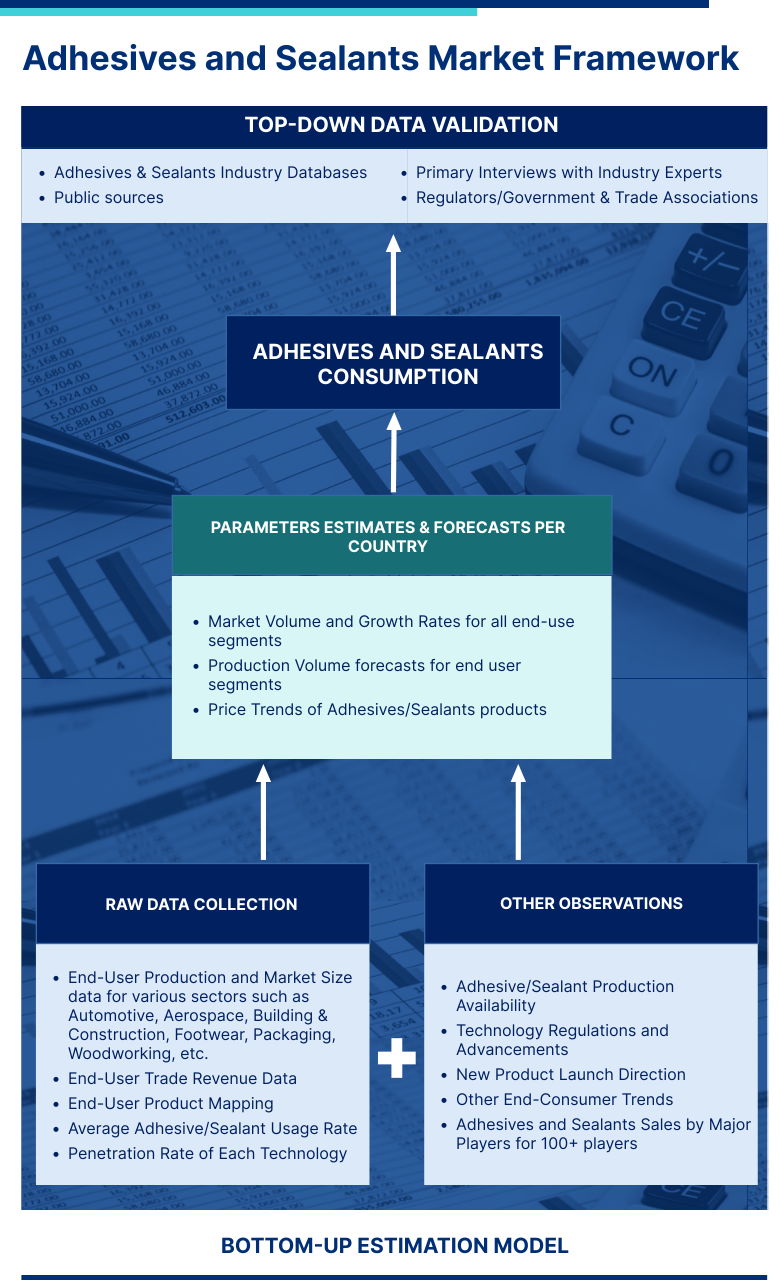
Mordor Intelligence follows a four-step methodology in all our reports.
- Step-1: Identify Key Variables: The quantifiable key variables (industry and extraneous) pertaining to the specific product segment and country are selected from a group of relevant variables & factors based on desk research & literature review; along with primary expert inputs. These variables are further confirmed through regression modeling (wherever required).
- Step-2: Build a Market Model: In order to build a robust forecasting methodology, the variables and factors identified in Step-1 are tested against available historical market numbers. Through an iterative process, the variables required for market forecast are set and the model is built on the basis of these variables.
- Step-3: Validate and Finalize: In this important step, all market numbers, variables and analyst calls are validated through an extensive network of primary research experts from the market studied. The respondents are selected across levels and functions to generate a holistic picture of the market studied.
- Step-4: Research Outputs: Syndicated Reports, Custom Consulting Assignments, Databases & Subscription Platforms
Get More Details On Research Methodology
Download PDF




