
Hygiene Adhesives Market Size and Share
Market Overview
| Study Period | 2020 - 2031 |
|---|---|
| Market Size (2026) | USD 3.51 Billion |
| Market Size (2031) | USD 4.39 Billion |
| Growth Rate (2026 - 2031) | 4.55 % |
| Fastest Growing Market | Middle East and Africa |
| Largest Market | Asia Pacific |
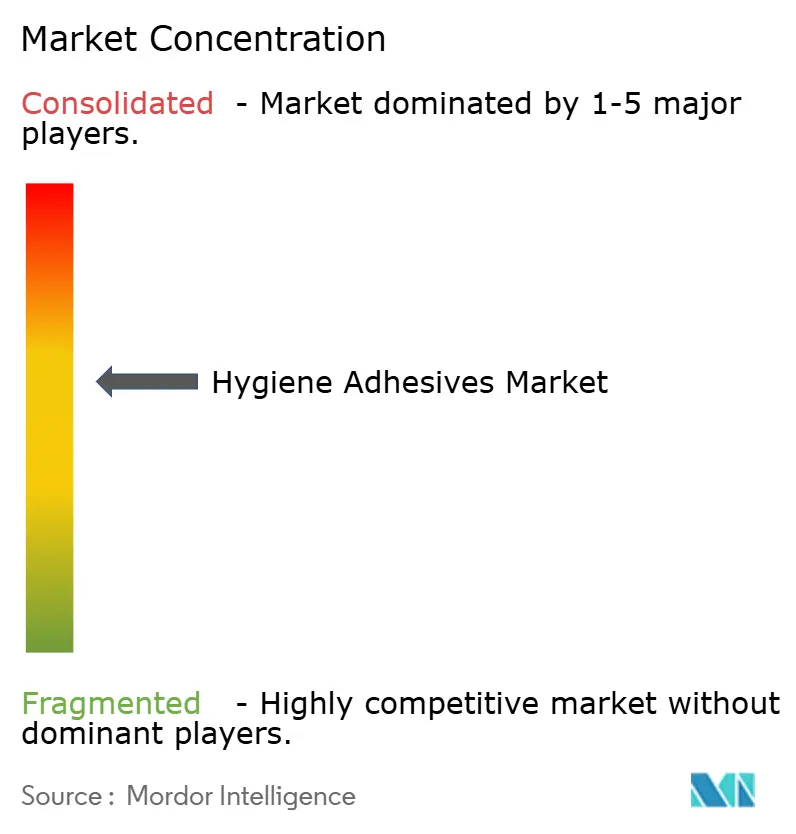
| Market Concentration | Medium |
Major Players *Disclaimer: Major Players sorted in no particular order Image © Mordor Intelligence. Reuse requires attribution under CC BY 4.0. | |
Hygiene Adhesives Market Analysis by Mordor Intelligence
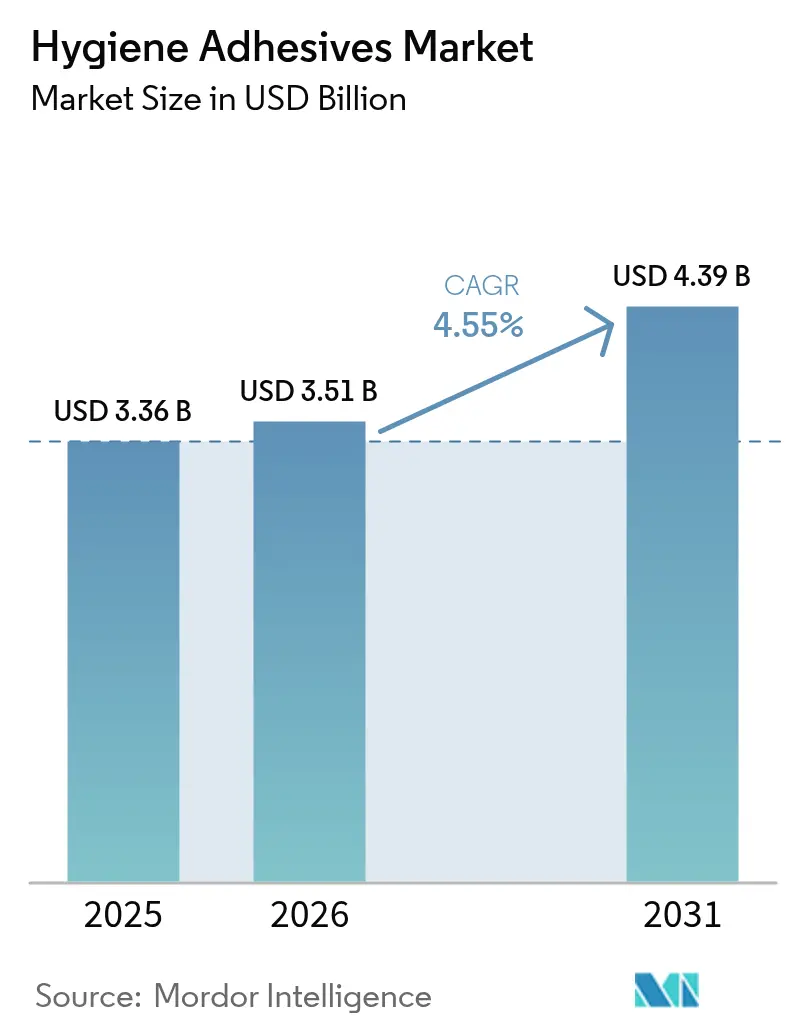
Hygiene Adhesives Market size in 2026 is estimated at USD 3.51 billion, growing from 2025 value of USD 3.36 billion with 2031 projections showing USD 4.39 billion, growing at 4.55% CAGR over 2026-2031. This expansion is driven by population aging in developed economies, rising middle-class purchasing power in Asia, and stricter regulations on volatile organic compound emissions, which encourage a shift from petroleum-based resins to bio-based chemistries. Rapid diaper line speeds exceeding 1,000 pieces per minute are driving demand towards ultra-fast-curing hot-melt technologies. Meanwhile, circular-economy regulations in Europe and Japan are creating niches for washable diaper shells and hybrid pads bonded with low-odor, reusable adhesives. Producers continue to balance feedstock cost volatility against the need for higher heat resistance, driving adoption of styrene-ethylene-butadiene-styrene (SEBS) in premium adult and baby products. Regional supply chains are also localizing as manufacturers seek tariff protection and lower freight expenses, especially across China, India, and Southeast Asia. Finally, bio-based polyurethane hot-melts that meet ISO 14855 biodegradability requirements are starting to win pilot orders from premium brands that can absorb the current 20%–30% price premium.
Key Report Takeaways
- By resin type, ethylene-vinyl acetate held 40.92% of the hygiene adhesives market share in 2025; SEBS is forecast to grow at a 6.12% CAGR through 2031.
- By product type, non-woven applications captured 66.88% of the hygiene adhesives market size in 2025, while woven substrates are projected to advance at a 5.62% CAGR through 2031.
- By end-use product, baby care led with 47.72% revenue share in 2025; feminine care is projected to expand at a 6.04% CAGR through 2031.
- By region, the Asia-Pacific commanded a 46.10% share of the hygiene adhesives market size in 2025, whereas the Middle East and Africa are growing at the fastest rate, with a 5.74% CAGR from 2025 to 2031.
Note: Market size and forecast figures in this report are generated using Mordor Intelligence’s proprietary estimation framework, updated with the latest available data and insights as of 2026.
Market Trends and Insights
Drivers Impact Analysis of Hygiene Adhesives Market*
| Driver | (~) % Impact on CAGR Forecast | Geographic Relevance | Impact Timeline |
|---|---|---|---|
| Rising consumption of disposable baby diapers worldwide | +1.2% | Global, with concentration in APAC (China, India, ASEAN) and emerging MEA markets | Medium term (2-4 years) |
| Accelerating feminine hygiene adoption in emerging Asia | +1.5% | India, Indonesia, Vietnam, Philippines; spill-over to Sub-Saharan Africa | Short term (≤ 2 years) |
| Aging populations boosting adult-incontinence demand | +1.0% | Japan, Germany, Italy, South Korea; North America (United States, Canada) | Long term (≥ 4 years) |
| Sustainability push toward low-VOC and bio-based chemistries | +0.8% | Europe (Germany, France, Nordics), North America; regulatory influence spreading to APAC | Medium term (2-4 years) |
| Automation need for ultra-fast-setting hot-melt systems | +0.6% | Global, led by high-volume manufacturers in China, United States, Germany | Short term (≤ 2 years) |
| Source: Mordor Intelligence | |||
Rising Consumption of Disposable Baby Diapers Worldwide
China’s diaper penetration climbed from 81.5% in 2021 to 89% in 2023, and parents are trading up to thinner, hypoallergenic designs that rely on advanced SEBS-based elastic adhesives[1]. Although the adhesive weight per diaper is falling by roughly 30% compared to 2020 designs, the value per unit is rising because premium elastic systems carry 15%–20% price increases. Multinationals such as Procter & Gamble and Unicharm have localized production to reduce tariffs and freight time, which allows regional formulators to co-develop tailored grades. Extended-wear and overnight products further drive demand for moisture-resistant construction adhesives that retain bond strength under sustained exposure to liquids. The baby segment, therefore, remains the single largest volume outlet for the hygiene adhesives market despite slower birth rates in East Asia.
Accelerating Feminine Hygiene Adoption in Emerging Asia
India’s sanitary-pad sales are expected to expand from USD 1.5 billion in 2024 to USD 3.0 billion by 2030, driven by the 2018 removal of a 12% goods and services tax and public-sector distribution in rural districts, where pad usage stood at only 33.5%. Rising demand translates into higher construction-adhesive volumes to bond super-absorbent cores and into pressure-sensitive grades for wings. Suppliers are prioritizing low-odor, ISO 10993-compliant chemistries to mitigate skin-irritation complaints and capture market share among first-time users. State mandates for compostable pads in parts of India, Indonesia, and the Philippines are stimulating R&D in bio-based hot-melts derived from plant oils and starches that disintegrate alongside cellulose substrates.
Aging Populations Boosting Adult-Incontinence Demand
Japan became the first country where adult diaper sales exceeded baby volumes in 2024, highlighting a demographic swing that is reshaping resin selection. Adult briefs demand higher peel strength, elevated heat resistance, and superior elastic recovery for extended wear, benefits that favor SEBS over SIS or SBS. Institutional buyers, such as hospitals, tolerate higher unit costs, enabling the inclusion of recycled or bio-based polyols that support sustainability claims. Europe and North America account for 54% of global adult-care adhesive consumption, yet rapid aging in South Korea, Taiwan, and urban China is narrowing the gap.
Sustainability Push Toward Low-VOC and Bio-Based Chemistries
REACH in Europe and China’s new T/CPA 005-2024 rule caps residual monomer and VOC limits, forcing reformulation of legacy EVA and SIS grades[2]. Pilot xylan-based polyurethane hot melts now meet ISO 14855 biodegradability standards and deliver peel adhesion within 5% of petroleum benchmarks. Evonik’s sale of its Coating & Adhesive Resins unit underlines a pivot toward specialty additives that enable waterborne and solvent-free systems. Reactive hot-melts that cure with ambient moisture cut line energy by up to 40% and eliminate high-temperature application, but still carry double-digit cost premiums.
Restraints Impact Analysis of Hygiene Adhesives Market*
| Restraint | (~) % Impact on CAGR Forecast | Geographic Relevance | Impact Timeline |
|---|---|---|---|
| Petro-resin price volatility eroding producer margins | -0.60% | Global, acute in regions dependent on imported feedstocks (Europe, Japan, India, Southeast Asia) | Short term (≤ 2 years) |
| Adhesive bleed and odour raising consumer complaints | -0.30% | Concentrated in low-cost segments across India, Southeast Asia, Sub-Saharan Africa; quality-sensitive markets in China post-T/CPA 005-2024 | Medium term (2-4 years) |
| Emerging ultrasonic bonding reducing adhesive usage | -0.40% | Premium tiers in North America, Europe, Japan; gradual spill-over to high-volume Asian converters with capital budgets | Medium term (2-4 years) |
| Source: Mordor Intelligence | |||
Petro-Resin Price Volatility Eroding Producer Margins
Ethylene and propylene costs track crude swings and refinery run rates. EVA prices softened in late 2024 amid inventory overhang in China, yet underinvestment in cracker capacity since 2020 signals a likely deficit by 2026. Hygiene adhesive formulators average 8%–12% EBITDA margins and seldom pass through feedstock spikes in full, prompting experiments with hybrid EVA-SEBS blends that temper cost risk without compromising cure speed. Larger diaper converters are studying backward integration to secure resin supply and capture added value.
Adhesive Bleed and Odor; Emerging Ultrasonic Bonding
Hot-melt migration through breathable non-wovens triggers skin-contact complaints, while tackifier volatiles create odor that hurts brand perception. China’s T/CPA 005-2024 now caps acrylic residuals at 500 mg/kg, hastening the shift to low-odor grades. Parallel growth in ultrasonic welding for leg cuffs and waistbands can eliminate the need for adhesive: suppliers such as Dukane report up to 90% material savings. However, capital outlays of USD 50,000–200,000 per line and limited suitability for multilayer laminates restrict adoption to premium converters.
*Our forecasts treat driver/restraint impacts as directional, not additive. The impact forecasts reflect baseline growth, mix effects, and variable interactions.
Hygiene Adhesives Market Segment Analysis
By Resin Type:
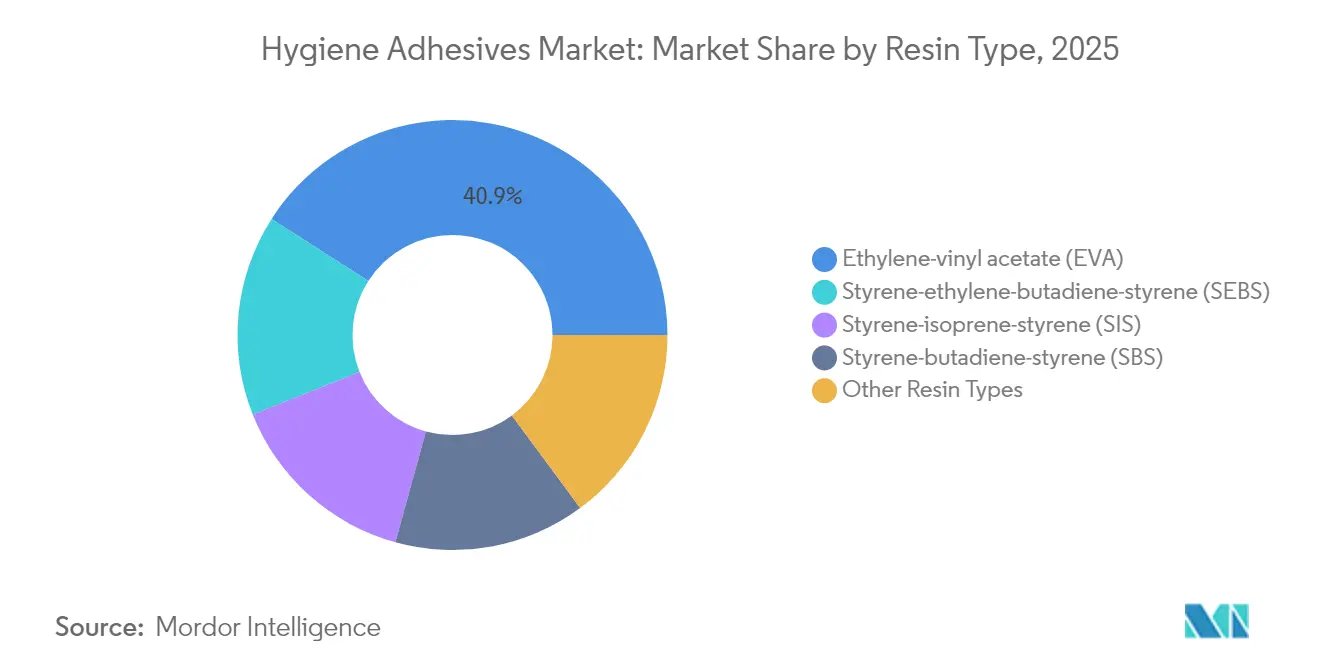
SEBS Scaling on Thermal PerformanceEthylene-vinyl acetate controlled 40.92% hygiene adhesives market share in 2025, reflecting its competitive cost and broad equipment compatibility. SEBS, however, is forecasted to grow at a 6.12% CAGR through 2031, outstripping the overall hygiene adhesives market as converters prioritize heat resistance that maintains bond integrity at body temperature over extended wear. SIS continues to lead in construction adhesives that anchor super-absorbent cores thanks to its fast-tack nature, while SBS remains a niche in pressure-sensitive tapes. Hybrid EVA-SEBS systems, commercialized in H.B. Fuller’s Full-Hook line during 2024, demonstrate how formulators balance cost with thermal durability.
Regional preferences amplify divergence. Chinese producers stay with EVA because supply chains are entrenched and formulation tweaks are minimal. In contrast, Japanese and European converters are accelerating the adoption of SEBS to meet REACH emission ceilings. Patent filings in 2024 covering modified styrene block copolymers with longer open time indicate sustained innovation aimed at line speeds above 1,000 pieces per minute.

By Product Type:
Non-Woven Dominance, Woven EmergenceNon-woven substrates accounted for 66.88% of the hygiene adhesives market size in 2025, driven by polypropylene spunbond and meltblown fabrics that accept hot-melt penetration without stiffening. High-speed automation further solidifies non-woven demand: Henkel’s Easyflow cuts waste by 81% while synchronizing bead placement with substrate feed at millisecond intervals. Woven applications, although smaller, are growing at a 5.62% CAGR as circular-economy rules in Europe and Japan spur the adoption of washable diaper shells and reusable menstrual underwear. These substrates require pressure-sensitive or silicone-based adhesives that can withstand laundering and retain repositionability.
Innovation is also addressing softness mandates. China’s T/CPA 005-2024 specifies a minimum air permeance, pushing formulators toward lower-viscosity grades that avoid fiber compression. Meanwhile, breathable back-sheet designs require adhesives that bond across layered laminates without blocking vent pores, a challenge being met by low-density, high-tack hot-melts with microcrystalline wax modifiers.
By End-Use Product:
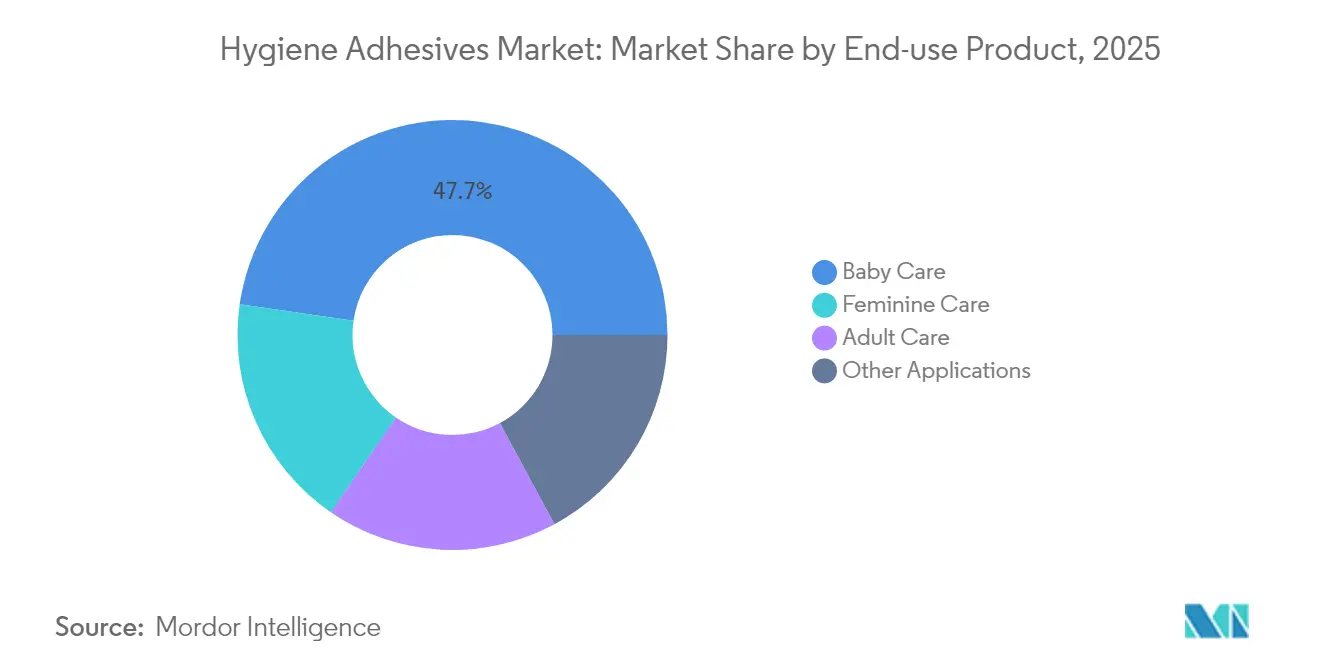
Feminine Care AscendsBaby diapers remained the volume leader, with a 47.72% share in 2025; however, growth is tapering as penetration nears saturation in East Asia and fertility declines in Europe. Parents are trading up to ultra-thin designs, utilizing SEBS elastic adhesives and moisture-resistant construction grades, which raises the value per unit even as the grams of adhesive decrease. Feminine care, in contrast, is expected to outpace all other segments at a 6.04% CAGR through 2031, driven by rural subsidy programs and tax exemptions in India, as well as rapid adoption in Indonesia and the Philippines.
Product design complexity drives adhesive differentiation. Pads require low-odor construction adhesives that preserve acquisition speed, as well as garment-safe pressure-sensitive grades for wings. Suppliers are also targeting biodegradable pads in Indian pilot schemes, utilizing bio-based hot melts that compost alongside cellulose substrates. Adult care continues to grow steadily, driven by aging demographics and increasing adhesive intensity per unit. Institutional buyers’ focus on durability and odor control favors SEBS-based systems that withstand extended use without tack loss.
Geography Analysis
APAC Hygiene Adhesives Market
The Asia-Pacific region dominated the hygiene adhesives market with a 46.10% market share in 2025, underpinned by China’s forecasted demand of 160,000 tonnes of hot-melt adhesives in 2026 and India’s rapid uptake of sanitary pads. Chinese consumers continue to shift toward premium diaper formats that require high-performance elastic adhesives, while Indian initiatives aim to increase pad penetration in rural villages. Japan exemplifies demographic inversion as adult diapers overtake baby volumes, spurring demand for high-peel SEBS adhesives that maintain bond integrity at body temperature. Quickly urbanizing ASEAN economies supply greenfield growth, although distribution fragmentation keeps service intensity high for suppliers.
North America and Europe Hygiene Adhesives Market
North America and Europe are mature but lucrative markets, driven by premiumization and stringent environmental regulations. Dow reported softer 2024 sales yet continues to invest in specialty resins, and Henkel’s US automation upgrades demonstrate a continued commitment to machine-friendly chemistries. Extended producer responsibility statutes in Europe are accelerating the switch to bio-based and waterborne adhesives, with Evonik divesting its commodity business to fund specialty additive development.
MEA and South America Hygiene Adhesives Market
The Middle East and Africa, while only a midsize base today, are expected to grow at 5.74% CAGR to 2031 on the back of Saudi Vision 2030 healthcare build-outs and a projected UAE health spend rise from USD 20.8 billion in 2023 to USD 26.7 billion by 2028. Expanding retail infrastructure and improved cold chains widen distribution for hygiene products. Brazil anchors South America yet faces currency uncertainty; however, stable inflation paths could unleash latent demand in the latter half of the decade.

Value Chain Analysis
The hygiene adhesives value chain starts with petrochemical and polymer inputs (ethylene and propylene derivatives for EVA and polyolefins, and styrenic block copolymers such as SIS and SEBS), complemented by tackifying resins, waxes, and additives (stabilizers and antioxidants) that control odor, color, and aging performance. Adhesive formulators compound these materials in melt-mixing operations and supply solid formats (pellets, pillows, or blocks) for hot-melt application on diaper and pad lines. Major formulators and solution providers active in disposable hygiene include Henkel, H.B. Fuller, Bostik (Arkema), Dow, and Savare, which provide product families tailored to construction bonding, elastic attachment, and core assembly. Downstream, hygiene product converters and brand owners purchase adhesives largely through direct B2B technical selling, where qualification and co-development are central to winning and retaining business at high line speeds. Application equipment and process integration (for example, automated adhesive delivery and precise bead placement systems used in nonwoven converting) are an important layer in the chain because uptime, waste, and temperature management directly affect total cost in production. Feedstock volatility in commodity resins and tackifiers remains a key bottleneck for formulators, while compliance and performance requirements (low odor, low VOC, skin safety, and bond reliability under moisture and heat) increase dependence on long-term supplier relationships and iterative reformulation cycles.
Competitive Landscape
The Hygiene Adhesives Market is moderately concentrated. Tier-1 vendors channel capital into automation-compatible lines and sustainability branding: Henkel’s Easyflow reduced waste by 81%, and H.B. Fuller’s Full-Hook hybrid formulation offers elastic durability with cost parity to pure SEBS. Regional suppliers compete on customized blends for biodegradable pads and reusable inserts, leveraging shorter lead times and lower overhead. M&A is reshaping portfolios. Sika’s CHF 7.5 billion acquisition of MBCC in 2024 expanded its adhesive reach, while 3M spun off its healthcare business to focus on industrial tapes, freeing up capital for high-speed manufacturing platforms. Backward integration by large diaper makers in Asia remains a strategic wildcard that could squeeze independent formulators’ volumes later in the decade.
Hygiene Adhesives Industry Leaders
-
3M
-
Dow
-
Henkel AG & Co. KGaA
-
H. B. Fuller Company
-
Arkema
- *Disclaimer: Major Players sorted in no particular order
Hygiene Adhesives Market Companies Covered in this Report
- 3M
- Abifor AG
- ADTEK Malaysia Sdn Bhd
- Arkema
- Avery Dennison Corporation
- Colquimica Adhesives
- Dow
- Evonik Industries AG
- Exxon Mobil Corporation
- Focus Hotmelt Company
- H.B. Fuller Company
- Henkel AG & Co. KGaA
- Huntsman Corporation
- ICHEMCO s.r.l.
- Jowat AG
- Lohmann GmbH & Co. KG
- NANPAO RESINS CHEMICAL GROUP
- OMNOVA Solutions Inc.
- Palmetto Adhesives
- Savare Specialty Adhesives LLC
- Sika AG
- TEX YEAR INDUSTRIES INC.
Market Opportunities and Future Outlook
Circularity-driven product design is creating whitespace for adhesives that support controlled separation of multi-layer hygiene structures at end-of-life, without sacrificing high-speed manufacturing performance. In May 2026, Bostik launched Kizen Miles 9.0 for hygiene applications with a controlled separation concept aimed at improving recyclability of absorbent hygiene product components, signaling active commercialization efforts around debonding and separability. This area also aligns with converters pushing for thinner designs with lower add-on levels, where adhesives must deliver fast set, low odor, and consistent bonding across breathable nonwovens. Regional capacity additions and localization efforts are expanding near-term tender activity for qualified hygiene adhesive grades, especially where brand owners and converters are investing in new lines and footprints. Kimberly-Clark announced a multi-year USD 2 billion North American manufacturing investment plan in May 2025, and followed with a USD 130 million expansion in Mobile, Alabama in June 2025 that includes a hygiene production line targeted to be operational in 2027, increasing the installed base of converting assets that require reliable, automation-compatible hot-melt supply. In parallel, H.B. Fuller reported manufacturing expansion actions in the IMEA region in May 2025, including opening a facility in Cairo, Egypt and expanding a site in the United Arab Emirates, reinforcing an opportunity for suppliers that can support local qualification, shorter lead times, and stable supply in fast-growing MEA demand centers.
Recent Industry Developments in Hygiene Adhesives Market
- May 2026: Henkel highlighted hygiene-focused nonwoven adhesive technologies at INDEX 26, including Technomelt DM Advance and its Easyflow automated adhesive delivery approach. The emphasis on automation, efficiency, and low-emission performance supports higher line speeds while reducing waste and downtime for converters running complex nonwoven structures.
- May 2026: A new core adhesive named Full-Care 7830 Xtra for hygiene applications was introduced by H.B. Fuller at INDEX 26, enabling the use of short fibers in absorbent hygiene products. The launch broadens material flexibility for core design while preserving bonding performance under high-speed converting conditions. This development signals ongoing tailoring of adhesive systems to support lightweight, high-throughput hygiene structures.
- July 2025: TEX YEAR INDUSTRIES INC. launched Asia's first dedicated biodegradable hot melt adhesive production line and established a new innovation building for R&D and production. The added capability broadens regional supply for bio-based hot melts used in hygiene products and accelerates localized development cycles for converters targeting lower-VOC and sustainability claims.
Hygiene Adhesives Market Report Scope and Research Methodology
Market Definition and Coverage
For this study, the hygiene adhesives market covers adhesive materials used to bond, seal, or construct disposable and related hygiene products, where the adhesive directly supports product performance, comfort, and fit across intended use conditions.
Scope exclusions: We exclude general packaging and construction adhesives that are not formulated or sold for hygiene product assembly.
Segments Covered in This Report
- By Resin Type
- Ethylene-vinyl acetate (EVA)
- Styrene-ethylene-butadiene-styrene (SEBS)
- Styrene-isoprene-styrene (SIS)
- Styrene-butadiene-styrene (SBS)
- Other Resin Types
- By Product Type
- Woven
- Non-woven
- By End-use Product
- Baby Care
- Adult Care
- Feminine Care
- Other Applications
- By Geography
- Asia-Pacific
- China
- India
- Japan
- South Korea
- ASEAN Countries
- Rest of Asia-Pacific
- North America
- United States
- Canada
- Mexico
- Europe
- Germany
- United Kingdom
- Italy
- France
- Spain
- Russia
- Rest of Europe
- South America
- Brazil
- Argentina
- Rest of South America
- Middle-East and Africa
- Saudi Arabia
- South Africa
- Rest of Middle-East and Africa
- Asia-Pacific
Data Sources, Market Sizing, and Validation
Desk Research
Desk research was used to build a clean starting point for hygiene adhesive volumes, trade flows, and raw material context before any modeling was finalized. We mainly referenced public sources such as US Census Bureau trade statistics, UN Comtrade, Eurostat, and relevant national statistics portals, and then cross-checked the market direction using association and standards bodies such as ISO and ASTM.
To keep assumptions realistic, we also reviewed company annual reports and investor presentations, product brochures, and credible industry news coverage that discusses capacity changes, feedstock cost movements, and manufacturing expansions. Where needed, we used paid subscriptions for company financials and a patent database to confirm ownership patterns and innovation focus, without relying on one-off claims. The desk sources listed here are illustrative, and we used other public and paid references for data collection, validation, and clarification.
Primary Interviews and Surveys
Primary work focused on interviews and structured surveys with raw material suppliers, adhesive formulators, converters, and procurement and product teams tied to hygiene product manufacturing. Because this is a global market, we spread conversations across major consumption and manufacturing hubs to validate application-level adhesive usage, typical pricing movement, and how shifts in resin choice are affecting demand.
Insights from these discussions were used to test desk assumptions, fill gaps where public data is thin, including application mix shifts, and then confirm the demand curve used in forecasting.
Distribution of primary research fieldwork respondents
| Company type | Respondent position | Region |
|---|---|---|
| Top tier: 32% | CXOs: 13% | APAC: 42% |
| Mid tier: 49% | Functional/Unit leaders: 42% | EMEA: 35% |
| Smaller Players: 19% | Managers: 45% | Americas: 23% |
Market-Sizing & Forecasting
Sizing started from a top-down build where hygiene product demand indicators were converted into an adhesive demand pool using application-level adhesive intensity assumptions, which were then priced using regional average selling price ranges. After forming the first totals, we corroborated them with selective bottom-up approximations, such as roll-ups of sampled supplier revenues, channel checks with converters, and sanity checks on resin-based consumption patterns.
In the model, a few inputs mattered most, and we treated them as adjustable levers rather than fixed facts. These included the mix of hygiene end products (baby care, adult care, and feminine care), resin type mix shifts such as EVA and SEBS, non-woven versus woven share in relevant constructions, average adhesive add-on rates per unit, and feedstock-driven price movement that influences realized ASPs. When gaps showed up in supplier coverage or regional splits, we handled missing pieces through proportional allocation tied to validated production and consumption signals, then re-tested those allocations during expert calls.
For forecasting, scenario analysis was used so that growth could be expressed under a base case and then stressed with realistic shifts, like faster adoption of premium performance resins or a slower recovery in discretionary hygiene categories. The final year-by-year trajectory was accepted only after primary feedback confirmed that the assumed ranges were consistent with procurement behavior and manufacturing changeover timelines.
Data Validation & Update Cycle
Validation was handled through triangulation across three layers, which were demand indicators, pricing checks, and supplier-side reality checks. Analysts compared model outputs against independent signals, including hygiene product production direction, resin availability context, and observable pricing trends, then investigated variances before sign-off.
If an outlier appeared, the triggers were to re-check units, currency timing, and implied adhesive intensity, then re-contact sources when the variance could not be explained from public information. Reports are refreshed annually, with interim updates when material events occur, such as capacity additions, regulatory changes, or sharp feedstock swings. Before delivery, a final analyst pass is completed so clients receive the most current view based on the latest inputs that we can validate.
Mordor Intelligence's Hygiene Adhesives Market Sizing Compared With Other Published Estimates
Published market sizes for hygiene adhesives often do not match because the scope lines are drawn differently, and the underlying demand signals are not always aligned. Differences in year selection, currency timing, and how product and application boundaries are treated can move the final number even when the topic name looks identical.
The table shows a spread mainly because some estimates anchor the market to technology buckets, for example hot-melt versus water-based, while others anchor it to resin families and hygiene product constructions. These approaches also apply different usage rates and ASP progressions. In Mordor Intelligence's model, the count is tied to hygiene product assembly demand by resin type and substrate construction, which tends to reduce double counting that can happen when adjacent medical and general-purpose adhesive uses are blended into the same pool.
Benchmark comparison
| Source | Market Size | Gaps in Research Methodology |
|---|---|---|
| Mordor Intelligence | USD 3.51 B (2026) | |
| Global Consultancy A | USD 2.53 B (2024) | Uses a different base year and is organized by adhesive technology types, which can shift the included volume and pricing when mapped back to hygiene end-product assembly demand. |
| Industry Publisher B | USD 2.70 B (2023) | Starts from an earlier base year and applies a higher growth curve, and the broader application framing can pull in specialty and medical uses that are not consistently separated from core disposable hygiene construction. |
Taken together, the comparison suggests that the largest differences come from base year selection and how the demand pool is built, whether it starts from hygiene product construction needs or from adhesive technology groupings. By keeping inputs traceable to a few repeatable levers, like resin mix, substrate usage, and realistic pricing ranges, the final estimate stays explainable and easier to update when market conditions change.
Key Questions Answered in the Report
How fast is demand for adhesives in feminine hygiene products growing?
Feminine products are projected to record a 6.04% CAGR between 2026 and 2031, the quickest among all end-use segments.
Which region provides the largest sales base for hygiene adhesives?
Asia-Pacific led with 46.10% share in 2025, anchored by China’s sizable diaper and pad production volumes.
What resin is gaining popularity for premium diapers and adult briefs?
SEBS is scaling the fastest because its heat resistance and elastic recovery outperform EVA and SIS in extended-wear applications.
Why are converters considering ultrasonic bonding?
Ultrasonic welding can remove elastic-attachment adhesives entirely and cut material expense by up to 90%, though high capex limits uptake.
What sustainability trends affect formulation choices?
Regulators are lowering VOC thresholds, prompting a move toward bio-based polyurethane hot-melts that meet ISO 14855 degradability criteria.
What is the current market size of hygiene adhesives market?
The Hygiene Adhesives Market size is estimated at USD 3.51 billion in 2026, and is expected to reach USD 4.39 billion by 2031, at a CAGR of 4.55% during the forecast period (2026-2031).