
Yarn Market Size and Share
Yarn Market Analysis by Mordor Intelligence
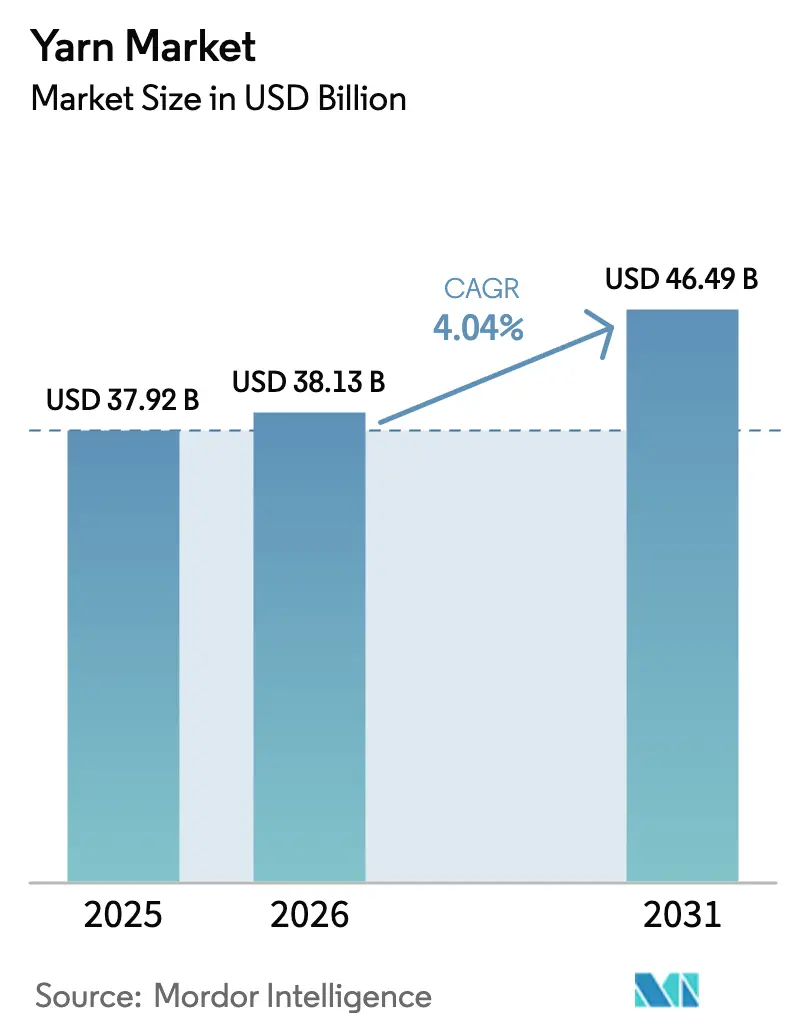
The yarn market size was valued at USD 37.92 billion in 2025 and estimated to grow from USD 38.13 billion in 2026 to reach USD 46.49 billion by 2031, at a CAGR of 4.04% during the forecast period (2026-2031). Rising demand for regenerated cellulosic fibers, fast-fashion inventory pressures that reward 72-hour delivery cycles, and government-backed farm-to-spindle parks in South and Southeast Asia are reshaping competitive cost curves. Automation that reduces processing costs enables large Chinese and Turkish mills to maintain margins even amid significant fluctuations in cotton futures prices. Europe retains a premium-priced niche in technical and luxury yarns, while Africa is drawing Chinese green-field spinning investment that bypasses legacy Western supply networks. Capacity additions in Southeast Asia have created yarn oversupply, compressing commodity spreads but accelerating a pivot toward specialty counts with added functionality.
Key Report Takeaways
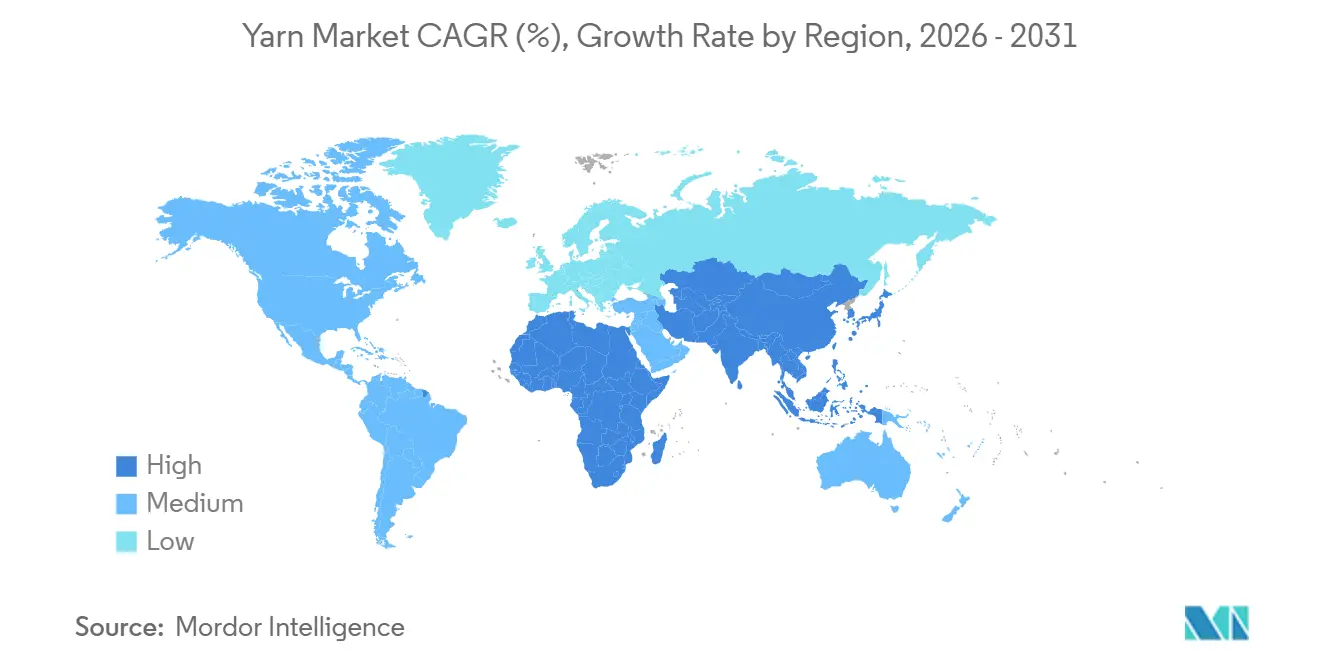
- By geography, Europe led with 32.7% of the yarn market share in 2025, while Africa is projected to post the fastest regional CAGR of 4.8% through 2031.
Note: Market size and forecast figures in this report are generated using Mordor Intelligence’s proprietary estimation framework, updated with the latest available data and insights as of January 2026.
Global Yarn Market Trends and Insights
Drivers Impact Analysis*
| Driver | (~) % Impact on CAGR Forecast | Geographic Relevance | Impact Timeline |
|---|---|---|---|
| Surging demand for regenerated cellulosic yarns | +0.8% | Europe and North America | Medium term (2-4 years) |
| Growing global fast-fashion production volumes | +0.9% | Asia-Pacific core | Short term (≤ 2 years) |
| Shift toward bio-based agro-feedstock for yarn spinning | +0.5% | North America and Europe | Long term (≥ 4 years) |
| Government incentives for integrated farm-to-spindle clusters | +0.6% | India, Bangladesh, Vietnam, and Ethiopia | Medium term (2-4 years) |
| Rapid automation of ginning and spinning at farm cooperatives | +0.5% | China and Turkey | Medium term (2-4 years) |
| Blockchain-enabled provenance premiums on sustainable yarn | +0.3% | Europe and North America | Long term (≥ 4 years) |
| Source: Mordor Intelligence | |||
Surging Demand for Regenerated Cellulosic Yarns
Regenerated cellulosic fibers such as viscose, lyocell, and modal are taking share from cotton yarn as apparel brands hunt for lower water footprints and softer hand feel. Lenzing has inaugurated the world’s largest lyocell plant in Prachinburi, Thailand, increasing its annual capacity by 100,000 metric tons. Although the plant was completed in 2022, its full-scale operations play a key role in addressing global demand for Tencel-branded fibers and align with Lenzing's 2025 strategy. China is a leading producer of viscose fiber globally. The industry is highly concentrated, with key players such as Sateri, Sanyou Chemical, and Xinjiang Zhongtai driving production. This dominance is supported by domestic fast-fashion demand, which prioritizes cost-effective drape and dye uptake. Finer-than-40s spinning know-how remains concentrated in Europe and Japan, keeping supply tight for technical textiles. Moisture-management benefits let regenerated cellulosics premiums over ring-spun cotton, offsetting higher certification costs tied to OEKO-TEX Standard 100 compliance. Specialty capacity constraints and premium pricing have positioned regenerated cellulosic yarns as the fastest-growing slice of the yarn market.
Growing Global Fast-Fashion Production Volumes
Fast-fashion models, which frequently turn inventory throughout the year, increased yarn consumption even as apparel unit sales remained stable in developed markets. Vertically integrated mills in countries such as Turkey and Bangladesh secured orders due to their ability to rapidly adjust production. Ultra-fast-fashion platforms, which focus on aggregating smaller orders, contributed to a considerable growth in yarn consumption across the Asia-Pacific region during the same period. Cotton blends continued to dominate the market, as their wrinkle resistance and price stability outweighed the challenges posed by crude oil price fluctuations, which can cause significant variations in yarn costs over short periods. The pending European Union Digital Product Passport will require disclosure of fiber origin by 2027, favoring digitally enabled mills that can tag lots at source[1]Source: European Commission, “Digital Product Passport Proposal,” ec.europa.eu.
Government Incentives for Integrated Farm-to-Spindle Clusters
Government incentives for integrated "farm-to-spindle" clusters aim to streamline the textile value chain, lowering costs and enhancing the global competitiveness of the yarn market. The Government of India has approved the establishment of seven PM Mega Integrated Textile Region and Apparel (PM MITRA) Parks on Greenfield and Brownfield sites by 2025. These parks will feature world-class infrastructure, including plug-and-play facilities, with a total outlay of USD 540 million through 2027-28. The finalized locations for these parks are Tamil Nadu (Virudhnagar), Telangana (Warangal), Gujarat (Navsari), Karnataka (Kalaburagi), Madhya Pradesh (Dhar), Uttar Pradesh (Lucknow), and Maharashtra (Amravati). The initiative aims to co-locate ginning, spinning, and weaving operations, with a target of adding two million new spindles by 2028[2]Source: India Ministry of Textiles, “Mega Integrated Textile Region and Apparel Scheme,” texmin.nic.in. Vietnam extended tax holidays for the Mekong Delta, pulling Taiwanese investment away from China. These incentives embed cost and speed advantages, expanding the yarn market's footprint in emerging hubs.
Blockchain-Enabled Provenance Premiums on Sustainable Yarn
Luxury and outdoor brands are now paying additional premiums for yarn lots that are fully traceable through blockchain platforms. These platforms ensure transparency by validating data related to farm origin, spinning processes, and shipment details. Pilot projects conducted in Europe and the United States have significantly reduced the time required to resolve quality disputes, helping buyers by easing their working capital requirements. Companies that adopted these systems early have experienced a noticeable increase in contract renewal rates, reflecting a loyalty benefit that offsets the costs of system integration. The next stage of development focuses on tokenized smart contracts that will enable automatic payment release once independent laboratories confirm the fiber content. This innovation has the potential to transform liquidity practices within the yarn market.
Restraints Impact Analysis*
| Restraint | (~) % Impact on CAGR Forecast | Geographic Relevance | Impact Timeline |
|---|---|---|---|
| Volatile natural-fiber commodity prices | -0.6% | India, United States, and Central Asia | Short term (≤ 2 years) |
| Geopolitical export bans on staple fibers | -0.4% | India and China | Short term (≤ 2 years) |
| Competition from synthetic fibers | -0.5% | Global, pronounced impact in Asia-Pacific, South America, and Africa | Long term (≥ 4 years) |
| Persistent shortage of skilled loom technicians | -0.3% | North America and Europe | Long term (≥ 4 years) |
| Source: Mordor Intelligence | |||
Competition from Synthetic Fibers
Synthetic fibers, primarily polyester and nylon, are gradually replacing cotton and other natural fibers due to their stable pricing, consistent performance, and the economies of scale offered by vertically integrated petrochemical complexes. Polyester staple fiber has been priced notably lower than equivalent cotton yarn, given the strength and elongation benefits that reduce fabric waste. This cost advantage is structural, and polyester production increases in tandem with crude oil refining, while cotton acreage remains constrained by limited land and water availability in key producing regions such as India, the United States, and Uzbekistan. Leading Chinese polyester manufacturers, including Hengli Petrochemical and Tongkun Group, operate single-site complexes that convert paraxylene into purified terephthalic acid, polymer chips, and finished yarn. Natural-fiber spinners emphasize traceability, organic certification, and biodegradability, but these features command only a modest price premium in cost-sensitive apparel markets, leaving a significant cost gap that synthetic fibers continue to leverage.
Persistent Shortage of Skilled Loom Technicians
Automation has reduced workforce requirements, but tasks involving complex counts and specialty blends still require human oversight for setup and quality assurance. The decline of textile education programs in Europe and North America has led to skill erosion driven by retirements, which automation cannot fully address[3]Source: Financial Times Reporters, “Textile Labor Gaps Threaten Output,” ft.com. Additionally, wage premiums for certified technicians have increased, adding to the cost pressures on mills already burdened by rising energy costs. In Asia, opportunities in the digital economy are drawing younger talent away from spinning operations, mirroring labor shortages seen in Western markets. This shortage of skilled labor extends commissioning timelines for new production lines and complicates the scaling of innovative yarns, thereby limiting the growth potential of the yarn market.
*Our forecasts treat driver/restraint impacts as directional, not additive. The impact forecasts reflect baseline growth, mix effects, and variable interactions.
Geography Analysis
Europe is the largest geography and accounted for 32.7% of the yarn market share in 2025, anchored by Italy's Prato district and Germany's Saxony cluster. The European textile industry benefits from higher margins in technical and luxury segments, despite elevated labor costs. The European Union Strategy for Sustainable and Circular Textiles is driving significant investments in recycled fiber production, as demonstrated by a major project in Saxony. Near-shoring trends are encouraging the expansion of production capacity in countries such as Portugal and Romania. Compliance with REACH chemical regulations leads to increased costs, a premium that many buyers are willing to pay to ensure adherence to established standards.
Africa is forecast to log the highest regional CAGR of 4.8% between 2026 and 2031. By 2025, Ethiopia's Hawassa and Bole Lemi parks were home to numerous spinning mills equipped with many spindles, collectively exporting a substantial volume of yarn. The duty-free access provided under the African Growth and Opportunity Act offers a notable cost advantage for shipments directed to North American brands. Egypt, on the other hand, capitalizes on its domestic production of long-staple cotton to manufacture a considerable quantity of blended yarn each year, benefiting from its geographical proximity to European markets. Despite infrastructure-related challenges, such as port congestion that increases logistics expenses, ongoing investments in renewable energy projects and road corridor development are gradually addressing these issues. These improvements continue to attract partnerships and investments, particularly from Chinese joint ventures.
Asia-Pacific remained the production powerhouse, accounting for the majority of global output, underpinned by China, India, Vietnam, and Bangladesh. China has emerged as a major producer, with output evenly distributed among cotton, natural yarns, and blends. The country has developed a large and integrated textile manufacturing industry, closely linked to agriculture and raw-material processing, positioning it as a key participant in the global textile, garment, and fiber markets. However, the majority of this production was consumed domestically due to the relocation of sewing operations abroad. India played a key role in exports, primarily supplying cotton yarn to China's weaving facilities. Vietnam experienced substantial growth in its spindle capacity, supported by investments from South Korean and Taiwanese companies. Bangladesh, which relies heavily on imports to meet its demand, has set ambitious goals to increase its self-sufficiency in the coming years.


Competitive Landscape
The yarn market is shaped by regional specialists, vertically integrated textile conglomerates, and commodity traders who aggregate output from hundreds of small mills. Chinese yarn exporters, such as Shandong Ruyi and Jiangsu Sunshine, are facing a reduction in their market share for commodity yarn counts to competitors in Vietnam and Bangladesh. To address this challenge, they are increasingly focusing on producing specialty yarns, including antibacterial cotton blends, which are positioned as premium products in the market. There are also significant opportunities for growth in recycled cotton yarn, where existing mechanical and chemical recycling technologies are not yet fully developed and often yield inconsistent quality.
Emerging disruptors in the yarn industry include digital marketplaces that directly connect spinners with fabric mills and apparel brands, eliminating traditional intermediaries and lowering transaction costs. Mid-sized spinners are increasingly adopting technology, such as AI-driven quality control systems, to detect defects in real time, thereby reducing waste and enhancing customer retention. Sustainability certifications, such as the Global Recycled Standard and Better Cotton Initiative, have become key competitive advantages. Patent filings in yarn technology, as tracked by the World Intellectual Property Organization, have risen, with innovations focusing on bio-based fiber spinning, zero-twist yarn structures, and embedded conductive filaments for smart textiles. Vertical integration strategies, including spinners acquiring weaving and knitting capacities or forming joint ventures with apparel brands, are reshaping the competitive landscape by capturing margins across multiple stages of the value chain and mitigating risks associated with commodity price fluctuations.
Strategic consolidation continued in Southeast Asia, where Taiwanese groups bought Vietnamese mills to lock in supply, and in Africa, where Chinese state-owned enterprises took majority stakes rather than joint ventures, signaling long-term commitment. The pending European Union Carbon Border Adjustment Mechanism will impose tariffs on embedded carbon from 2027, favoring mills that are already investing in renewable power and life-cycle accounting. Vertical integration moves, in which spinners acquire downstream knitting operations or partner with apparel brands, aim to defend margins and control quality in a yarn market increasingly sensitive to traceability and emissions disclosure.
Recent Industry Developments
- September 2025: AYM Syntex has established a wholly owned subsidiary, Innovative Yarns LLC, in Delaware, United States, to enhance its presence in the North American market. This initiative aims to expand the company's trading operations in specialty yarns, fibers, and textile products.
- February 2025: Vardhman Textiles introduced three new yarn collections at Bharat Tex 2025, emphasizing sustainability, design, and premium quality. This launch aligns with the company's GreenWeave philosophy, integrating Environmental, Social, and Governance (ESG) objectives into its manufacturing practices.
- January 2025: Ambercycle, a company specializing in circular materials, has formed a strategic partnership with Shenghong Holding Group to expand the production of regenerated filament yarns made with cycora material. This collaboration integrates cycora into the Chinese value chain to meet global demand for circular solutions in the apparel industry.


Global Yarn Market Report Scope
Yarn is a continuous length of interlocked fibers used in fabric production, knitting, crocheting, embroidery, and rope manufacturing. It is available in various forms, including balls of wool for general use and specialized threads for sewing machines and embroidery work. The Yarn Market Report is Segmented by Geography (North America, Europe, Asia-Pacific, South America, the Middle East, and Africa). The Report Includes Production Analysis (Volume), Consumption Analysis (Value and Volume), Export Analysis (Value and Volume), Import Analysis (Value and Volume), Wholesale Price Trend Analysis, Regulatory Framework, List of Key Players, Logistics and Infrastructure, and Seasonality Analysis. The Market Forecasts are Provided in Terms of Value (USD) and Volume (Metric Tons).
| North America | United States | Production Analysis (Production Volume) |
| Consumption Analysis (Consumption Value and Volume) | ||
| Import Market Analysis (Import Value, Volume, and Key Supplying Markets) | ||
| Export Market Analysis (Export Value, Volume, and Key Destination Markets) | ||
| Wholesale Price Trend Analysis and Forecast | ||
| Regulatory Framework | ||
| List of Key Players | ||
| Logistics and Infrastructure | ||
| Seasonality Analysis | ||
| Mexico | Production Analysis (Production Volume) | |
| Consumption Analysis (Consumption Value and Volume) | ||
| Import Market Analysis (Import Value, Volume, and Key Supplying Markets) | ||
| Export Market Analysis (Export Value, Volume, and Key Destination Markets) | ||
| Wholesale Price Trend Analysis and Forecast | ||
| Regulatory Framework | ||
| List of Key Players | ||
| Logistics and Infrastructure | ||
| Seasonality Analysis | ||
| Canada | Production Analysis (Production Volume) | |
| Consumption Analysis (Consumption Value and Volume) | ||
| Import Market Analysis (Import Value, Volume, and Key Supplying Markets) | ||
| Export Market Analysis (Export Value, Volume, and Key Destination Markets) | ||
| Wholesale Price Trend Analysis and Forecast | ||
| Regulatory Framework | ||
| List of Key Players | ||
| Logistics and Infrastructure | ||
| Seasonality Analysis | ||
| Europe | Germany | Production Analysis (Production Volume) |
| Consumption Analysis (Consumption Value and Volume) | ||
| Import Market Analysis (Import Value, Volume, and Key Supplying Markets) | ||
| Export Market Analysis (Export Value, Volume, and Key Destination Markets) | ||
| Wholesale Price Trend Analysis and Forecast | ||
| Regulatory Framework | ||
| List of Key Players | ||
| Logistics and Infrastructure | ||
| Seasonality Analysis | ||
| United Kingdom | Production Analysis (Production Volume) | |
| Consumption Analysis (Consumption Value and Volume) | ||
| Import Market Analysis (Import Value, Volume, and Key Supplying Markets) | ||
| Export Market Analysis (Export Value, Volume, and Key Destination Markets) | ||
| Wholesale Price Trend Analysis and Forecast | ||
| Regulatory Framework | ||
| List of Key Players | ||
| Logistics and Infrastructure | ||
| Seasonality Analysis | ||
| France | Production Analysis (Production Volume) | |
| Consumption Analysis (Consumption Value and Volume) | ||
| Import Market Analysis (Import Value, Volume, and Key Supplying Markets) | ||
| Export Market Analysis (Export Value, Volume, and Key Destination Markets) | ||
| Wholesale Price Trend Analysis and Forecast | ||
| Regulatory Framework | ||
| List of Key Players | ||
| Logistics and Infrastructure | ||
| Seasonality Analysis | ||
| Spain | Production Analysis (Production Volume) | |
| Consumption Analysis (Consumption Value and Volume) | ||
| Import Market Analysis (Import Value, Volume, and Key Supplying Markets) | ||
| Export Market Analysis (Export Value, Volume, and Key Destination Markets) | ||
| Wholesale Price Trend Analysis and Forecast | ||
| Regulatory Framework | ||
| List of Key Players | ||
| Logistics and Infrastructure | ||
| Seasonality Analysis | ||
| Italy | Production Analysis (Production Volume) | |
| Consumption Analysis (Consumption Value and Volume) | ||
| Import Market Analysis (Import Value, Volume, and Key Supplying Markets) | ||
| Export Market Analysis (Export Value, Volume, and Key Destination Markets) | ||
| Wholesale Price Trend Analysis and Forecast | ||
| Regulatory Framework | ||
| List of Key Players | ||
| Logistics and Infrastructure | ||
| Seasonality Analysis | ||
| Russia | Production Analysis (Production Volume) | |
| Consumption Analysis (Consumption Value and Volume) | ||
| Import Market Analysis (Import Value, Volume, and Key Supplying Markets) | ||
| Export Market Analysis (Export Value, Volume, and Key Destination Markets) | ||
| Wholesale Price Trend Analysis and Forecast | ||
| Regulatory Framework | ||
| List of Key Players | ||
| Logistics and Infrastructure | ||
| Seasonality Analysis | ||
| Asia-Pacific | China | Production Analysis (Production Volume) |
| Consumption Analysis (Consumption Value and Volume) | ||
| Import Market Analysis (Import Value, Volume, and Key Supplying Markets) | ||
| Export Market Analysis (Export Value, Volume, and Key Destination Markets) | ||
| Wholesale Price Trend Analysis and Forecast | ||
| Regulatory Framework | ||
| List of Key Players | ||
| Logistics and Infrastructure | ||
| Seasonality Analysis | ||
| India | Production Analysis (Production Volume) | |
| Consumption Analysis (Consumption Value and Volume) | ||
| Import Market Analysis (Import Value, Volume, and Key Supplying Markets) | ||
| Export Market Analysis (Export Value, Volume, and Key Destination Markets) | ||
| Wholesale Price Trend Analysis and Forecast | ||
| Regulatory Framework | ||
| List of Key Players | ||
| Logistics and Infrastructure | ||
| Seasonality Analysis | ||
| Japan | Production Analysis (Production Volume) | |
| Consumption Analysis (Consumption Value and Volume) | ||
| Import Market Analysis (Import Value, Volume, and Key Supplying Markets) | ||
| Export Market Analysis (Export Value, Volume, and Key Destination Markets) | ||
| Wholesale Price Trend Analysis and Forecast | ||
| Regulatory Framework | ||
| List of Key Players | ||
| Logistics and Infrastructure | ||
| Seasonality Analysis | ||
| Australia | Production Analysis (Production Volume) | |
| Consumption Analysis (Consumption Value and Volume) | ||
| Import Market Analysis (Import Value, Volume, and Key Supplying Markets) | ||
| Export Market Analysis (Export Value, Volume, and Key Destination Markets) | ||
| Wholesale Price Trend Analysis and Forecast | ||
| Regulatory Framework | ||
| List of Key Players | ||
| Logistics and Infrastructure | ||
| Seasonality Analysis | ||
| Sri Lanka | Production Analysis (Production Volume) | |
| Consumption Analysis (Consumption Value and Volume) | ||
| Import Market Analysis (Import Value, Volume, and Key Supplying Markets) | ||
| Export Market Analysis (Export Value, Volume, and Key Destination Markets) | ||
| Wholesale Price Trend Analysis and Forecast | ||
| Regulatory Framework | ||
| List of Key Players | ||
| Logistics and Infrastructure | ||
| Seasonality Analysis | ||
| South America | Brazil | Production Analysis (Production Volume) |
| Consumption Analysis (Consumption Value and Volume) | ||
| Import Market Analysis (Import Value, Volume, and Key Supplying Markets) | ||
| Export Market Analysis (Export Value, Volume, and Key Destination Markets) | ||
| Wholesale Price Trend Analysis and Forecast | ||
| Regulatory Framework | ||
| List of Key Players | ||
| Logistics and Infrastructure | ||
| Seasonality Analysis | ||
| Argentina | Production Analysis (Production Volume) | |
| Consumption Analysis (Consumption Value and Volume) | ||
| Import Market Analysis (Import Value, Volume, and Key Supplying Markets) | ||
| Export Market Analysis (Export Value, Volume, and Key Destination Markets) | ||
| Wholesale Price Trend Analysis and Forecast | ||
| Regulatory Framework | ||
| List of Key Players | ||
| Logistics and Infrastructure | ||
| Seasonality Analysis | ||
| Middle East | United Arab Emirates | Production Analysis (Production Volume) |
| Consumption Analysis (Consumption Value and Volume) | ||
| Import Market Analysis (Import Value, Volume, and Key Supplying Markets) | ||
| Export Market Analysis (Export Value, Volume, and Key Destination Markets) | ||
| Wholesale Price Trend Analysis and Forecast | ||
| Regulatory Framework | ||
| List of Key Players | ||
| Logistics and Infrastructure | ||
| Seasonality Analysis | ||
| Saudi Arabia | Production Analysis (Production Volume) | |
| Consumption Analysis (Consumption Value and Volume) | ||
| Import Market Analysis (Import Value, Volume, and Key Supplying Markets) | ||
| Export Market Analysis (Export Value, Volume, and Key Destination Markets) | ||
| Wholesale Price Trend Analysis and Forecast | ||
| Regulatory Framework | ||
| List of Key Players | ||
| Logistics and Infrastructure | ||
| Seasonality Analysis | ||
| Africa | South Africa | Production Analysis (Production Volume) |
| Consumption Analysis (Consumption Value and Volume) | ||
| Import Market Analysis (Import Value, Volume, and Key Supplying Markets) | ||
| Export Market Analysis (Export Value, Volume, and Key Destination Markets) | ||
| Wholesale Price Trend Analysis and Forecast | ||
| Regulatory Framework | ||
| List of Key Players | ||
| Logistics and Infrastructure | ||
| Seasonality Analysis | ||
| Egypt | Production Analysis (Production Volume) | |
| Consumption Analysis (Consumption Value and Volume) | ||
| Import Market Analysis (Import Value, Volume, and Key Supplying Markets) | ||
| Export Market Analysis (Export Value, Volume, and Key Destination Markets) | ||
| Wholesale Price Trend Analysis and Forecast | ||
| Regulatory Framework | ||
| List of Key Players | ||
| Logistics and Infrastructure | ||
| Seasonality Analysis | ||
| By Geography | North America | United States | Production Analysis (Production Volume) |
| Consumption Analysis (Consumption Value and Volume) | |||
| Import Market Analysis (Import Value, Volume, and Key Supplying Markets) | |||
| Export Market Analysis (Export Value, Volume, and Key Destination Markets) | |||
| Wholesale Price Trend Analysis and Forecast | |||
| Regulatory Framework | |||
| List of Key Players | |||
| Logistics and Infrastructure | |||
| Seasonality Analysis | |||
| Mexico | Production Analysis (Production Volume) | ||
| Consumption Analysis (Consumption Value and Volume) | |||
| Import Market Analysis (Import Value, Volume, and Key Supplying Markets) | |||
| Export Market Analysis (Export Value, Volume, and Key Destination Markets) | |||
| Wholesale Price Trend Analysis and Forecast | |||
| Regulatory Framework | |||
| List of Key Players | |||
| Logistics and Infrastructure | |||
| Seasonality Analysis | |||
| Canada | Production Analysis (Production Volume) | ||
| Consumption Analysis (Consumption Value and Volume) | |||
| Import Market Analysis (Import Value, Volume, and Key Supplying Markets) | |||
| Export Market Analysis (Export Value, Volume, and Key Destination Markets) | |||
| Wholesale Price Trend Analysis and Forecast | |||
| Regulatory Framework | |||
| List of Key Players | |||
| Logistics and Infrastructure | |||
| Seasonality Analysis | |||
| Europe | Germany | Production Analysis (Production Volume) | |
| Consumption Analysis (Consumption Value and Volume) | |||
| Import Market Analysis (Import Value, Volume, and Key Supplying Markets) | |||
| Export Market Analysis (Export Value, Volume, and Key Destination Markets) | |||
| Wholesale Price Trend Analysis and Forecast | |||
| Regulatory Framework | |||
| List of Key Players | |||
| Logistics and Infrastructure | |||
| Seasonality Analysis | |||
| United Kingdom | Production Analysis (Production Volume) | ||
| Consumption Analysis (Consumption Value and Volume) | |||
| Import Market Analysis (Import Value, Volume, and Key Supplying Markets) | |||
| Export Market Analysis (Export Value, Volume, and Key Destination Markets) | |||
| Wholesale Price Trend Analysis and Forecast | |||
| Regulatory Framework | |||
| List of Key Players | |||
| Logistics and Infrastructure | |||
| Seasonality Analysis | |||
| France | Production Analysis (Production Volume) | ||
| Consumption Analysis (Consumption Value and Volume) | |||
| Import Market Analysis (Import Value, Volume, and Key Supplying Markets) | |||
| Export Market Analysis (Export Value, Volume, and Key Destination Markets) | |||
| Wholesale Price Trend Analysis and Forecast | |||
| Regulatory Framework | |||
| List of Key Players | |||
| Logistics and Infrastructure | |||
| Seasonality Analysis | |||
| Spain | Production Analysis (Production Volume) | ||
| Consumption Analysis (Consumption Value and Volume) | |||
| Import Market Analysis (Import Value, Volume, and Key Supplying Markets) | |||
| Export Market Analysis (Export Value, Volume, and Key Destination Markets) | |||
| Wholesale Price Trend Analysis and Forecast | |||
| Regulatory Framework | |||
| List of Key Players | |||
| Logistics and Infrastructure | |||
| Seasonality Analysis | |||
| Italy | Production Analysis (Production Volume) | ||
| Consumption Analysis (Consumption Value and Volume) | |||
| Import Market Analysis (Import Value, Volume, and Key Supplying Markets) | |||
| Export Market Analysis (Export Value, Volume, and Key Destination Markets) | |||
| Wholesale Price Trend Analysis and Forecast | |||
| Regulatory Framework | |||
| List of Key Players | |||
| Logistics and Infrastructure | |||
| Seasonality Analysis | |||
| Russia | Production Analysis (Production Volume) | ||
| Consumption Analysis (Consumption Value and Volume) | |||
| Import Market Analysis (Import Value, Volume, and Key Supplying Markets) | |||
| Export Market Analysis (Export Value, Volume, and Key Destination Markets) | |||
| Wholesale Price Trend Analysis and Forecast | |||
| Regulatory Framework | |||
| List of Key Players | |||
| Logistics and Infrastructure | |||
| Seasonality Analysis | |||
| Asia-Pacific | China | Production Analysis (Production Volume) | |
| Consumption Analysis (Consumption Value and Volume) | |||
| Import Market Analysis (Import Value, Volume, and Key Supplying Markets) | |||
| Export Market Analysis (Export Value, Volume, and Key Destination Markets) | |||
| Wholesale Price Trend Analysis and Forecast | |||
| Regulatory Framework | |||
| List of Key Players | |||
| Logistics and Infrastructure | |||
| Seasonality Analysis | |||
| India | Production Analysis (Production Volume) | ||
| Consumption Analysis (Consumption Value and Volume) | |||
| Import Market Analysis (Import Value, Volume, and Key Supplying Markets) | |||
| Export Market Analysis (Export Value, Volume, and Key Destination Markets) | |||
| Wholesale Price Trend Analysis and Forecast | |||
| Regulatory Framework | |||
| List of Key Players | |||
| Logistics and Infrastructure | |||
| Seasonality Analysis | |||
| Japan | Production Analysis (Production Volume) | ||
| Consumption Analysis (Consumption Value and Volume) | |||
| Import Market Analysis (Import Value, Volume, and Key Supplying Markets) | |||
| Export Market Analysis (Export Value, Volume, and Key Destination Markets) | |||
| Wholesale Price Trend Analysis and Forecast | |||
| Regulatory Framework | |||
| List of Key Players | |||
| Logistics and Infrastructure | |||
| Seasonality Analysis | |||
| Australia | Production Analysis (Production Volume) | ||
| Consumption Analysis (Consumption Value and Volume) | |||
| Import Market Analysis (Import Value, Volume, and Key Supplying Markets) | |||
| Export Market Analysis (Export Value, Volume, and Key Destination Markets) | |||
| Wholesale Price Trend Analysis and Forecast | |||
| Regulatory Framework | |||
| List of Key Players | |||
| Logistics and Infrastructure | |||
| Seasonality Analysis | |||
| Sri Lanka | Production Analysis (Production Volume) | ||
| Consumption Analysis (Consumption Value and Volume) | |||
| Import Market Analysis (Import Value, Volume, and Key Supplying Markets) | |||
| Export Market Analysis (Export Value, Volume, and Key Destination Markets) | |||
| Wholesale Price Trend Analysis and Forecast | |||
| Regulatory Framework | |||
| List of Key Players | |||
| Logistics and Infrastructure | |||
| Seasonality Analysis | |||
| South America | Brazil | Production Analysis (Production Volume) | |
| Consumption Analysis (Consumption Value and Volume) | |||
| Import Market Analysis (Import Value, Volume, and Key Supplying Markets) | |||
| Export Market Analysis (Export Value, Volume, and Key Destination Markets) | |||
| Wholesale Price Trend Analysis and Forecast | |||
| Regulatory Framework | |||
| List of Key Players | |||
| Logistics and Infrastructure | |||
| Seasonality Analysis | |||
| Argentina | Production Analysis (Production Volume) | ||
| Consumption Analysis (Consumption Value and Volume) | |||
| Import Market Analysis (Import Value, Volume, and Key Supplying Markets) | |||
| Export Market Analysis (Export Value, Volume, and Key Destination Markets) | |||
| Wholesale Price Trend Analysis and Forecast | |||
| Regulatory Framework | |||
| List of Key Players | |||
| Logistics and Infrastructure | |||
| Seasonality Analysis | |||
| Middle East | United Arab Emirates | Production Analysis (Production Volume) | |
| Consumption Analysis (Consumption Value and Volume) | |||
| Import Market Analysis (Import Value, Volume, and Key Supplying Markets) | |||
| Export Market Analysis (Export Value, Volume, and Key Destination Markets) | |||
| Wholesale Price Trend Analysis and Forecast | |||
| Regulatory Framework | |||
| List of Key Players | |||
| Logistics and Infrastructure | |||
| Seasonality Analysis | |||
| Saudi Arabia | Production Analysis (Production Volume) | ||
| Consumption Analysis (Consumption Value and Volume) | |||
| Import Market Analysis (Import Value, Volume, and Key Supplying Markets) | |||
| Export Market Analysis (Export Value, Volume, and Key Destination Markets) | |||
| Wholesale Price Trend Analysis and Forecast | |||
| Regulatory Framework | |||
| List of Key Players | |||
| Logistics and Infrastructure | |||
| Seasonality Analysis | |||
| Africa | South Africa | Production Analysis (Production Volume) | |
| Consumption Analysis (Consumption Value and Volume) | |||
| Import Market Analysis (Import Value, Volume, and Key Supplying Markets) | |||
| Export Market Analysis (Export Value, Volume, and Key Destination Markets) | |||
| Wholesale Price Trend Analysis and Forecast | |||
| Regulatory Framework | |||
| List of Key Players | |||
| Logistics and Infrastructure | |||
| Seasonality Analysis | |||
| Egypt | Production Analysis (Production Volume) | ||
| Consumption Analysis (Consumption Value and Volume) | |||
| Import Market Analysis (Import Value, Volume, and Key Supplying Markets) | |||
| Export Market Analysis (Export Value, Volume, and Key Destination Markets) | |||
| Wholesale Price Trend Analysis and Forecast | |||
| Regulatory Framework | |||
| List of Key Players | |||
| Logistics and Infrastructure | |||
| Seasonality Analysis | |||


Key Questions Answered in the Report
What is the projected value of global yarn sales by 2031?
Sales are projected to reach USD 46.49 billion by 2031.
Which geographic region recorded the highest yarn revenue in 2025?
Europe contributed 32.7% of global revenue in 2025.
Where is the fastest regional growth anticipated between 2026 and 2031?
Africa is forecast to grow at a 4.8% compound annual growth rate through 2031.
Why are regenerated cellulosic fibers attracting more buyers?
They combine lower water footprints with softness and moisture management, letting brands pay premium prices while meeting sustainability goals.
How is factory automation influencing spinning costs?
Robotic doffing and artificial-intelligence inspection are reducing labor requirements by up to 40% and improving yarn consistency.
Page last updated on:




