
Wireless Display Market Size and Share
Market Overview
| Study Period | 2020 - 2031 |
|---|---|
| Market Size (2026) | USD 8.34 Billion |
| Market Size (2031) | USD 16.87 Billion |
| Growth Rate (2026 - 2031) | 15.13 % |
| Fastest Growing Market | Asia-Pacific |
| Largest Market | North America |
| Market Concentration | Medium |
Major Players *Disclaimer: Major Players sorted in no particular order Image © Mordor Intelligence. Reuse requires attribution under CC BY 4.0. | |
Wireless Display Market Analysis by Mordor Intelligence
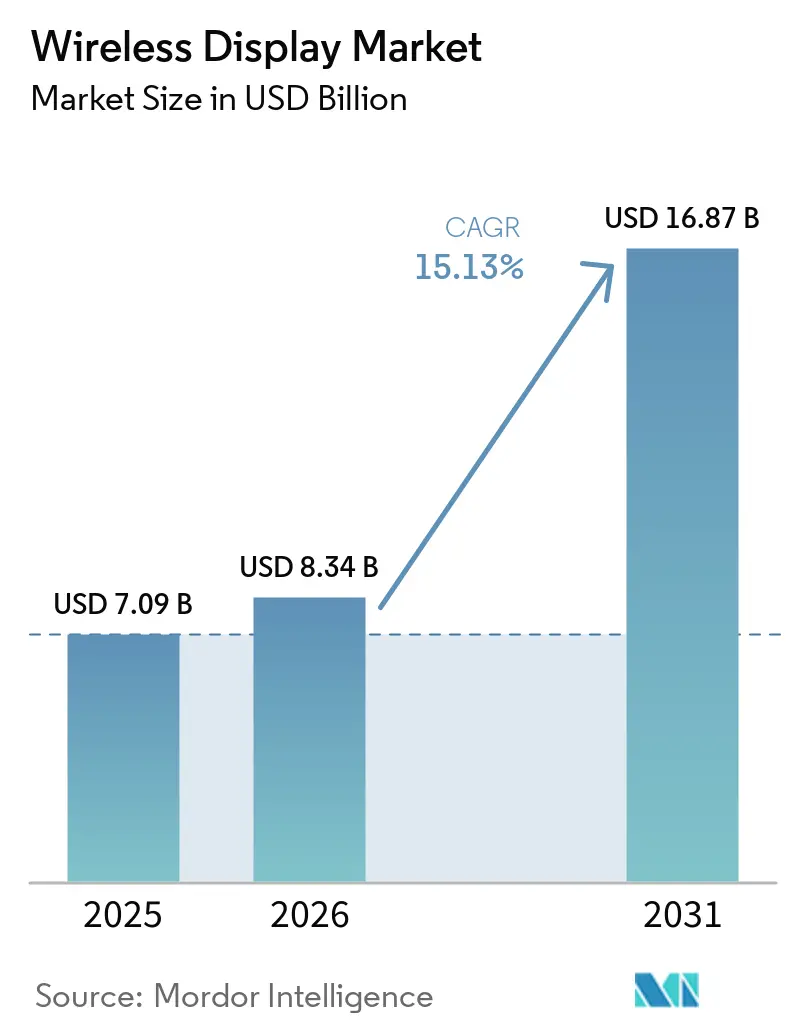
The wireless display market size was valued at USD 7.09 billion in 2025 and estimated to grow from USD 8.34 billion in 2026 to reach USD 16.87 billion by 2031, at a CAGR of 15.13% during the forecast period (2026-2031). The wireless display market is expanding across enterprise and institutional settings as hybrid work policies make BYOD workflows standard in meeting rooms, with buyers expecting reliable multi-device casting. The adoption of Wi-Fi 6E-capable devices is reducing latency and bandwidth issues, increasing the use of wireless display systems. The growing base of smart TVs, interactive flat panels, and connected projectors supports native casting in homes, classrooms, hospitals, and offices without relying solely on standalone receivers. Additionally, subscription-based screen mirroring, device management, and analytics platforms are shifting revenue from one-time hardware refresh cycles. Stricter procurement standards in healthcare and industrial settings, emphasizing encryption, policy control, and performance, are creating opportunities for vendors offering secure software management and broad protocol support.
Key Report Takeaways
- The hardware segment led the wireless display market with 54.32% in 2025, while software and services are forecast to expand at a 15.53% CAGR through 2031.
- By technology protocol, AirPlay held 32.56% share of the wireless display market in 2025, while Google Cast is projected to record the highest CAGR at 16.33% through 2031.
- By end-user, residential accounted for 56.82% of total demand in 2025, while commercial is set to grow fastest at a 15.42% CAGR through 2031.
- By application, consumer entertainment and streaming captured 45.23% of the wireless display market in 2025, while healthcare visualization and collaboration are forecast to grow at a 15.53% CAGR through 2031.
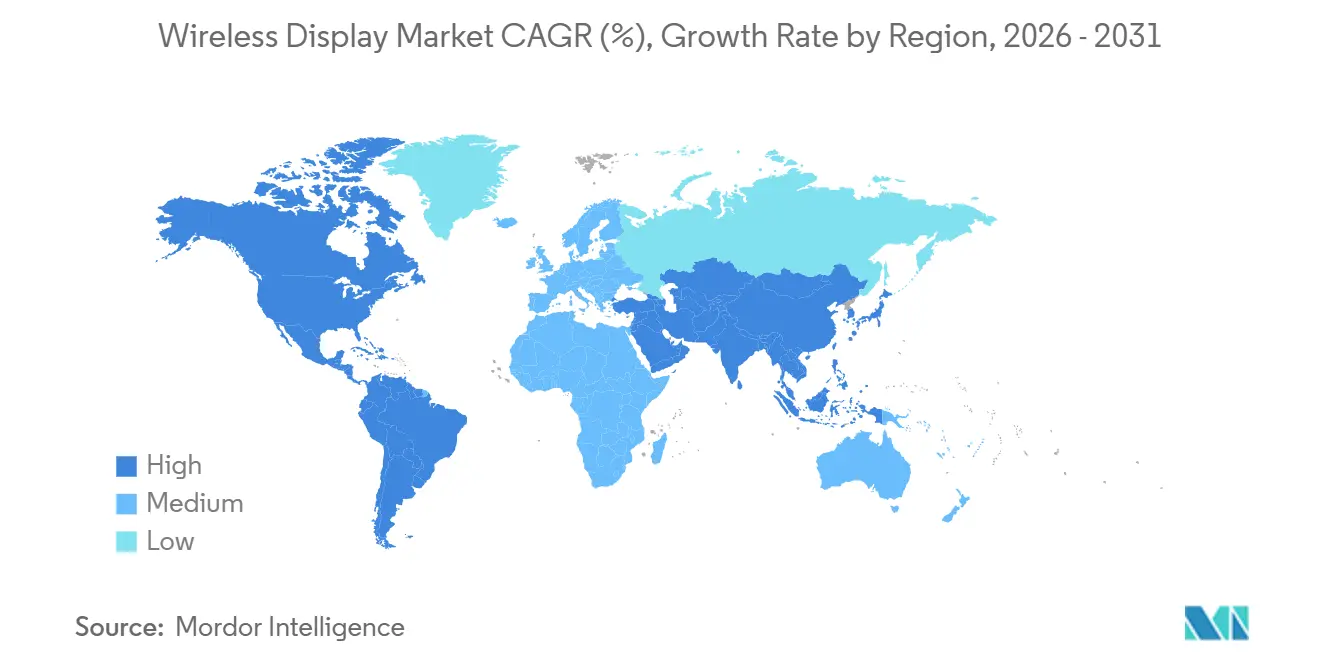
- By geography, North America held 34.58% share in 2025, while Asia-Pacific is projected to post the highest CAGR at 16.04% through 2031.
Note: Market size and forecast figures in this report are generated using Mordor Intelligence’s proprietary estimation framework, updated with the latest available data and insights as of January 2026.
Market Trends and Insights
Drivers Impact Analysis of Wireless Display Market*
| Driver | (~) % Impact on CAGR Forecast | Geographic Relevance | Impact Timeline |
|---|---|---|---|
| Hybrid Work and BYOD Collaboration Normalization | +3.2% | Global, with highest intensity in North America and Europe | Short term (≤ 2 years) |
| Wi-Fi 6, Wi-Fi 6E, and 5G Upgrades Improving Low-Latency Casting | +2.8% | Global, APAC core, spill-over to Middle East and Africa | Medium term (2-4 years) |
| Rising Installed Base of Smart TVs, Interactive Flat Panels, and Connected Projectors | +2.4% | Global, concentrated impact in APAC and North America | Medium term (2-4 years) |
| Classroom and Meeting Room Digitalization Programs | +2.1% | APAC core, North America and Europe | Medium term (2-4 years) |
| USB-C Laptop Transition Accelerating Demand for Cable-Free Room Workflows | +1.6% | North America and Europe, spill-over to APAC | Short term (≤ 2 years) |
| Security-Certified Native Casting and Guest Network Segmentation Becoming Procurement Differentiators | +1.2% | North America and Europe | Long term (≥ 4 years) |
| Source: Mordor Intelligence | |||
Hybrid Work and BYOD Adoption Reshaping Enterprise Wireless Infrastructure
Permanent hybrid work arrangements have pushed the wireless display market deeper into enterprise workflows, as meeting rooms now need to support many personal devices rather than a fixed room computer. Cisco reported that 55% of wireless leaders cited BYOD and user mobility as the main drivers of rising dependence on wireless networks in its November 2025 survey across 30 markets.[1] The same study found that 80% of organizations increased wireless infrastructure spending over the five years before the survey, indicating that this demand is tied to long-term network investment rather than short-term room upgrades. Enterprises are therefore accepting higher unit costs for systems that can support AirPlay, Miracast, and Google Cast in a single room because mixed device fleets create a real compatibility problem. This change is also shifting revenue toward software and services because device management, analytics, and subscription support are becoming part of the standard enterprise purchase.
Wi-Fi 6E And Infrastructure Upgrades Removing The Latency Ceiling
The wireless display market is benefiting from a broader access point refresh cycle, as Wi-Fi 6E provides access to 1,200 MHz of unlicensed 6 GHz spectrum in the United States and has since gained support across several major countries and regions. Cisco recorded a 23% year-over-year increase in Wi-Fi 6E and Wi-Fi 7 access point deployments across its managed networks in the second half of 2025, indicating that enterprise migration is already underway at a meaningful scale. It also reported a 60% year-over-year increase in 6 GHz clients activated across 5 million managed networks in 2025, indicating stronger endpoint readiness for advanced casting use cases. Earlier 5 GHz deployments often struggled in dense classrooms and office environments, but 6 GHz capacity improves conditions for multi-source, high-resolution sharing. Enterprises that refresh access points on three-to-four-year cycles are likely to align wireless presentation purchases with this network transition between 2026 and 2029, which supports unit demand during the forecast window.
Smart TV and Interactive Flat Panel Expansion Creating Embedded Display Demand
The wireless display market is expanding through the installed base of smart TVs, interactive flat panels, and connected projectors, as native casting becomes a default feature across more display endpoints. In commercial settings, this has become more visible in education and healthcare, where Newline Interactive 4K panels with native AirPlay, Miracast, and Google Cast support were documented in active deployments as of February 2025. Embedded casting changes the demand mix by expanding the installed base without requiring every room or home to add a separate receiver. That supports premium software platforms that manage policy, access, and fleet control across multiple displays, even while it reduces room for low-end dongle growth. Hardware-only vendors at the value tier are therefore facing tighter pricing conditions, while vendors with software layers are better placed to protect revenue quality.
Classroom and Meeting Room Digitalization Programs Sustaining Structural Demand
Government-backed room digitalization programs are providing the wireless display market with a steadier source of volume, as procurement runs across multiple years rather than a single budget cycle. ScreenBeam said in March 2025 that Ohio State University's College of Engineering had already transitioned nearly 100 rooms to ScreenBeam 1100 Plus and planned additional rollout phases, replacing incumbent solutions from Barco, Crestron, and Mersive. Institutional buyers are also treating wireless presentation as a bundled room platform instead of a simple adapter purchase. ScreenBeam's education platform combines centralized management, emergency alert integration, and digital signage, which helps justify a premium over consumer-grade casting devices. This model supports recurring management revenue over time, making it harder for pure hardware vendors to compete solely on price.
Restraints Impact Analysis of Wireless Display Market*
| Restraint | (~) % Impact on CAGR Forecast | Geographic Relevance | Impact Timeline |
|---|---|---|---|
| Protocol Fragmentation Across AirPlay, Miracast, Google Cast, and Proprietary Stacks | -1.8% | Global | Medium term (2-4 years) |
| HDMI and USB-C Cable Reliability Still Outperform Wireless in High-Bandwidth Use Cases | -1.4% | Global, with stronger impact in North America and Europe | Long term (≥ 4 years) |
| Smart TV Native Casting Reducing Incremental Demand for Standalone Receivers in Consumer Settings | -1.0% | North America, Europe, and APAC | Medium term (2-4 years) |
| Enterprise RF Congestion and Zero-Trust Network Policies Extending Deployment Cycles | -0.8% | North America and Europe | Short term (≤ 2 years) |
| Source: Mordor Intelligence | |||
Protocol Fragmentation Complicating Enterprise Procurement Decisions
The wireless display market still faces a real interoperability problem because AirPlay, Miracast, Google Cast, and proprietary stacks do not deliver a consistent experience across mixed device fleets. Buyers can either pay a higher price for multi-protocol hardware or accept compatibility gaps that frustrate users in shared rooms. This issue becomes harder in regulated environments because security design now matters as much as simple screen sharing. A March 2026 research note from the Cloud Security Alliance identified vulnerabilities in Wi-Fi client isolation that affect both WPA2 and WPA3 networks and stem from the IEEE 802.11 standard itself, meaning vendor patching alone does not fully eliminate the risk.[2] When protocol complexity and security reviews occur simultaneously, procurement approval cycles lengthen, and some organizations delay refresh decisions until better alignment emerges.
Wired Connectivity Retaining a Performance Advantage in Bandwidth-Intensive Applications
The wireless display market remains constrained in high-bandwidth use cases because wired HDMI 2.1 and USB-C DisplayPort still offer lower latency and greater reliability. Wi-Fi 6E and Wi-Fi 7 improve available throughput, but they do not fully close the gap for uncompressed 8K, real-time graphics pipelines, or other use cases that need frame delivery below 5 ms. This does not stop mainstream adoption in classrooms, offices, or training rooms where compressed video quality is acceptable. It does, however, limit addressable demand in industrial control rooms, professional broadcast, and advanced medical imaging environments where wired certainty still carries more weight. Vendors are responding with better codecs such as H.265 and AV1 rather than trying to position wireless as a full replacement for wired performance in every setting.
*Our forecasts treat driver/restraint impacts as directional, not additive. The impact forecasts reflect baseline growth, mix effects, and variable interactions.
Wireless Display Market Segment Analysis
By Offering:
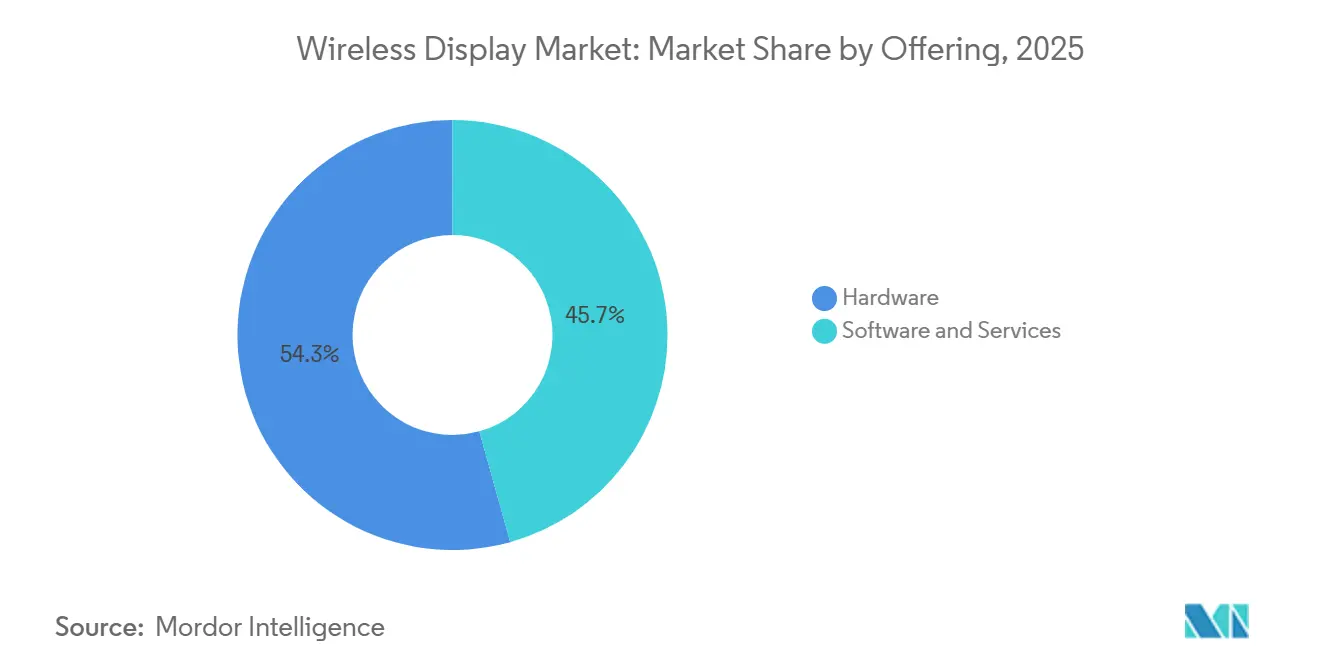
Software Platforms Gain Weight Within A Hardware-Led BaseHardware retained 54.32% of the wireless display market size in 2025, supported by the large installed base of adapters, integrated presentation systems, and embedded modules across homes and commercial venues. That lead still reflects how much prior spending in the wireless display industry went into physical room hardware and display endpoints. The segment remains important because many buyers still need dedicated receivers, smart meeting room devices, or display-integrated modules to support reliable casting across multiple users. At the same time, the composition of hardware demand is changing as enterprise buyers prefer bundled systems that combine room control, device connectivity, and cloud administration instead of single-function dongles.
Software and services are projected to grow at a 15.53% CAGR from 2026 to 2031, making it the fastest-growing segment of the wireless display market. This growth is tied to subscription-based screen-sharing, device-management, and analytics platforms that help enterprises manage usage policies and fleet performance. Airtame introduced Airtame 3 in December 2025 with a Wi-Fi 6E chipset and a licensing model priced at USD 120 per device per year for core features and USD 300 per device per year for full hybrid conferencing, demonstrating how recurring revenue is built into the product stack. Managed services also have room to expand, as IT teams handling multi-vendor deployments and zero-trust integration may prefer external support for firmware management, security policy, and ongoing administration.
By Technology Protocol:
AirPlay Leads While Google Cast Builds MomentumAirPlay held 32.56% share of the wireless display market in 2025 because Apple devices already route screen mirroring through a mature native ecosystem across iPhone, iPad, and MacBook users. That installed base gave AirPlay an advantage in both residential use and business settings where Apple endpoints are common. Miracast still keeps a place in commercial environments because Windows-based fleets remain important across enterprise, education, and public institutions. Wireless HDMI and WirelessHD continue to serve narrower needs where throughput matters more than broad protocol flexibility, while Intel WiDi keeps losing relevance as legacy endpoints cycle out of use.
Google Cast is forecast to grow at a 16.33% CAGR from 2026 to 2031, which makes it the fastest-growing protocol group in the wireless display market. Its momentum comes from deep integration across Android and Chrome OS, as well as wider availability on Google-certified TVs and meeting room hardware. These conditions are pushing buyers toward software-defined receivers that support multiple protocols from a single endpoint, rather than forcing a room to rely on a single device ecosystem. That direction matters because buyers increasingly want broad compatibility, policy control, and simpler deployment instead of protocol-specific room hardware.
By End-User:
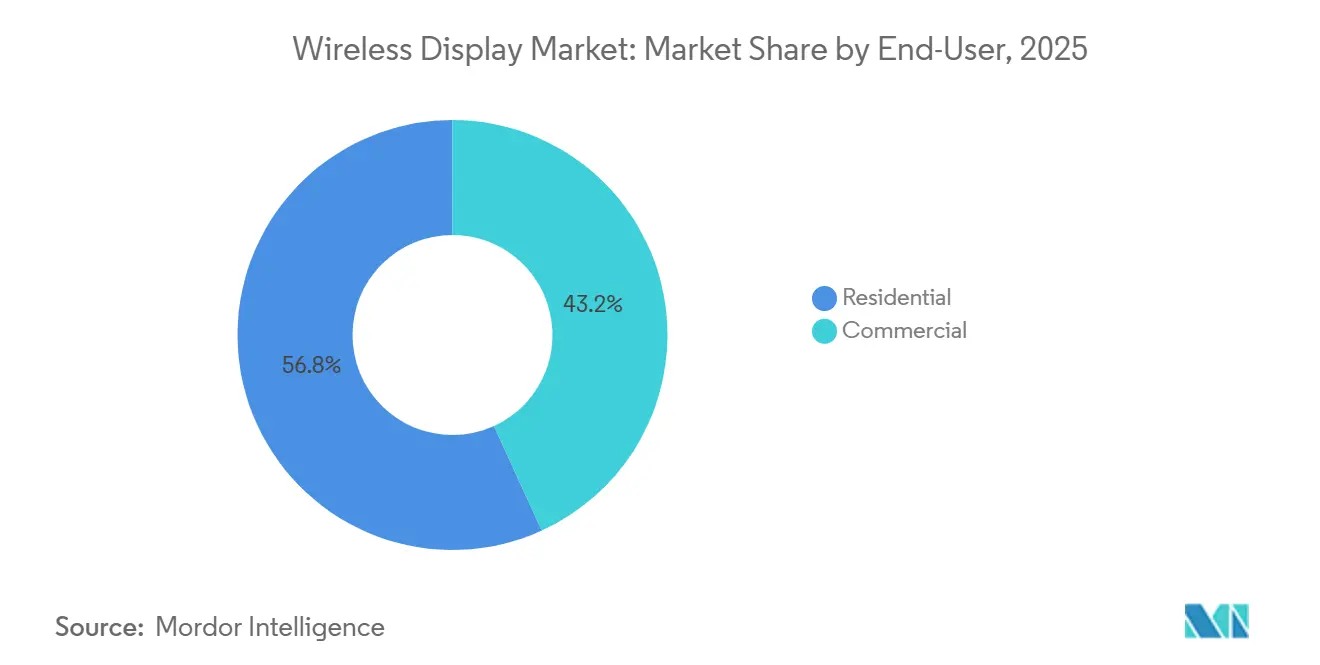
Residential Scale Persists While Commercial Spending AcceleratesResidential accounted for 56.82% of the wireless display market share in 2025, reflecting the scale of smart TV penetration and streaming device use across households in North America, Europe, and Asia-Pacific. The segment maintains a large revenue base because native casting is already embedded across many consumer display ecosystems, making wireless screen sharing a standard home feature rather than an add-on purchase. This same dynamic also limits incremental demand for separate receivers because more households can cast without buying another device. As a result, residential revenue remains large in absolute terms even while its growth rate lags the broader wireless display market.
Commercial is forecast to expand at a 15.42% CAGR from 2026 to 2031, which puts it ahead of the overall market pace. That growth is tied to hybrid work infrastructure budgets, meeting room refresh cycles, and continuing demand for BYOM and screen-sharing support in offices. Cisco said in April 2026 that 82% of organizations expected wireless budgets to increase, and 35% expected them to rise by 50% or more over the next 4 to 5 years. This spending backdrop supports multi-protocol room systems, managed software layers, and recurring support contracts that fit long-term enterprise deployment plans.
By Application:
Entertainment Drives Revenue While Healthcare Gains UrgencyConsumer entertainment and streaming accounted for 45.23% of the wireless display market in 2025, underscoring how household streaming behavior continues to shape revenue across the category. Smart TVs and media sticks with native casting support continue to anchor this application because they match day-to-day viewing habits and require little extra setup for most users. Enterprise presentation, collaboration, education, and training remain central commercial demand pools because they connect directly to BYOD workflows and room digitalization plans. Digital signage and public information, government and defense, and industrial control room visualization add smaller but distinct demand pockets, with industrial use standing out for its preference for predictable latency over flexible protocol support.
Healthcare visualization and collaboration are forecast to grow at a 15.53% CAGR from 2026 to 2031, making it the fastest-growing application in the wireless display market. Growth is supported by telehealth expansion, AI-assisted clinical visualization, and wireless PACS review workflows that are increasingly embedded in care delivery settings. In February 2026, Artisight announced integration of its smart hospital platform with Epic MyChart Bedside TV across more than 400 hospitals in 30 health systems, including a rollout of more than 1,800 devices at UChicago Medicine. Procurement in this area is shaped by HIPAA in the United States and GDPR in the European Union, so vendors need encryption and role-based access controls as standard product capabilities rather than optional features.
Geography Analysis
North America Wireless Display Market
North America held 34.58% of the wireless display market share in 2025, making it the largest regional market. The region benefited from mature enterprise wireless infrastructure, active device refresh cycles in education, and the presence of many platform vendors and solution integrators. USB-C adoption across commercial notebooks removed a practical barrier to cable-free room workflows by 2025, which made wireless presentation easier to support at scale. Compliance rules such as FERPA in education and HIPAA in healthcare also favored enterprise-grade systems over consumer-grade products, as policy control and security were key considerations in institutional buying. Crestron reinforced this direction in January 2026, when it introduced Collab Compute, a collaboration hardware core built on an Intel Core Ultra processor with an integrated NPU for AI-assisted meeting room deployments.[3]
APAC Wireless Display Market
Asia-Pacific is projected to grow at a 16.04% CAGR from 2026 to 2031, making it the fastest-growing region in the wireless display market. Demand is being supported by smart classroom rollouts in China and India, new corporate campus construction, and the rapid pace of 6 GHz authorization across major APAC markets. This regional pattern differs from North America because greenfield education and institutional projects can adopt wireless room connectivity as the default standard instead of replacing legacy wired systems. South Korea, Japan, and Australia also benefit from the wider regulatory shift toward Wi-Fi 6E, which helps align access point upgrades with wireless presentation purchases.
EMEA and South America Wireless Display Market
Europe remains a mature yet continually refreshing wireless display market, with the United Kingdom and Germany as key centers of enterprise demand. The EU's spectrum harmonization reduced the timing gap with North America for Wi-Fi 6E deployment, which improved the conditions for next-generation casting infrastructure. Barco, headquartered in Belgium, reported EUR 947 million in sales in 2024, equivalent to USD 1,024.65 million, and strengthened its regional position in June 2025 with the launch of ClickShare Hub on Microsoft's Device Ecosystem Platform. The Middle East and Africa remain the smallest contributors but are benefiting from smart building programs in the UAE and Saudi Arabia, while South America is still at an early stage, with Brazil and Argentina leading commercial adoption as real estate investment stabilizes.
Competitive Landscape
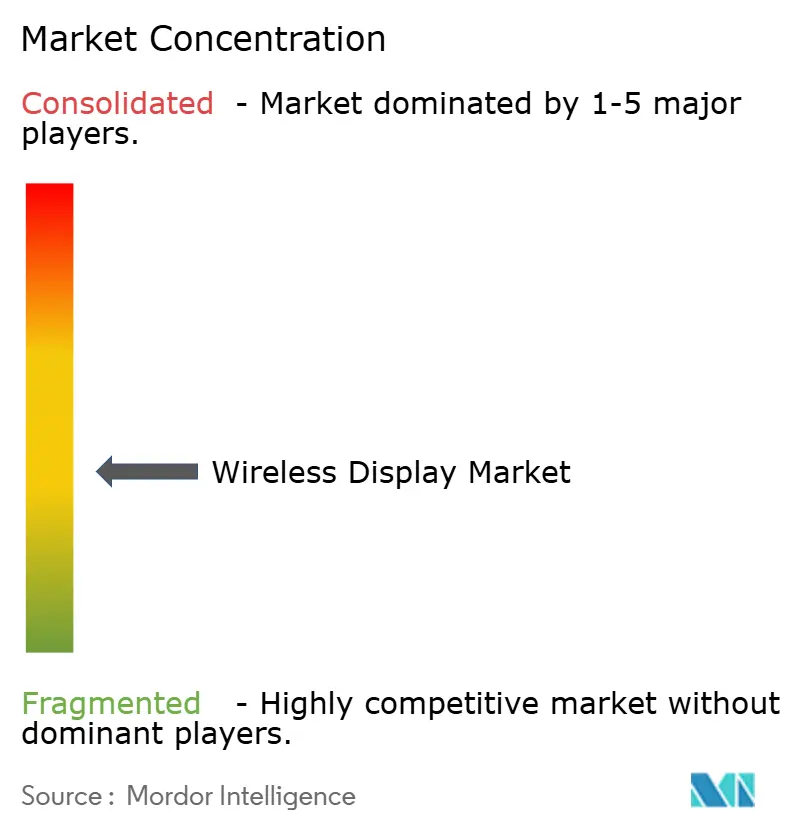
The wireless display market has a split structure, with a premium enterprise tier led by Barco, ScreenBeam, Mersive Technologies, Crestron Electronics, Kramer Electronics, and WolfVision, and a broader value tier filled by Asian OEMs serving SMB, education, and price-sensitive buyers. Competition at the higher end is no longer centered solely on protocol coverage, as simultaneous support for AirPlay, Miracast, Google Cast, and browser-based casting is increasingly expected. Buyers now put more weight on software ecosystem depth, security posture, device management, and unified communications integration. This is why the wireless display market looks fragmented in premium enterprise accounts when lower-tier commercial, education, and consumer hardware sales are included. The result is a market where a few vendors set the feature standard, while many smaller suppliers compete on price and local channel reach.
Barco demonstrated this platform-led strategy in June 2025 with ClickShare Hub, one of the first modular room systems built on Microsoft's Device Ecosystem Platform, deepening its position in Microsoft Teams Rooms environments.[4] ScreenBeam also moved beyond simple casting hardware in December 2025, launching BrowserCast across its receiver portfolio, enabling browser-based wireless display over enterprise VLANs without relying on native protocols such as mDNS. WolfVision expanded its reach into broader networked AV workflows through Cynap Pure and Cynap Bridge, which added Wi-Fi 6E, IEEE 802.1X authentication, WPA3 security, and AV-over-IP distribution support in its next-generation platform lineup. These moves show that vendors are protecting their business by combining wireless presentation with room computing, network security, and AV distribution.
There is still a need for a platform that supports healthcare-grade compliance, AI-assisted content routing, and very low latency, because no widely available product meets all 3 requirements at once. Browser-based casting is becoming one of the clearest responses to protocol fragmentation, as it reduces reliance on native-stack behavior in tightly managed enterprise networks. That matters in zero-trust environments where segmentation policies can block traditional discovery traffic and where IT teams want simpler deployment paths. The broader direction of the wireless display market is therefore toward consolidated platforms that combine sharing, signage, alerts, conferencing, and centralized device management in one cloud-managed system.
Wireless Display Industry Leaders
-
Barco NV
-
ScreenBeam Inc.
-
Airtame ApS
-
Mersive Technologies, Inc.
-
Kramer Electronics Ltd.
- *Disclaimer: Major Players sorted in no particular order
Wireless Display Market Companies Covered in this Report
- Barco NV
- Airtame ApS
- ScreenBeam Inc.
- Mersive Technologies, Inc.
- Kramer Electronics Ltd.
- WolfVision GmbH
- Kindermann GmbH
- Crestron Electronics, Inc.
- RGB Systems, Inc. dba Extron Electronics
- TEKVOX, Inc.
- SMART Technologies ULC
- Promethean Limited
- Legamaster International B.V.
- Squirrels LLC
- Splashtop Inc.
- DisplayNote Technologies Limited
- Avocor Technologies
- Yealink Network Technology Co., Ltd.
- Vivitek Corporation
- Newline Interactive Inc.
Recent Industry Developments in Wireless Display Market
- February 2026: Artisight announced the integration of its AI-native smart hospital platform with Epic MyChart Bedside TV, deploying wireless AI-powered display infrastructure, including virtual nursing, teleconsults, remote interpretation, and digital whiteboards, across over 400 hospitals in 30 health systems, with UChicago Medicine deploying over 1,800 devices across multiple inpatient care settings.
- January 2026: Crestron introduced Collab Compute, a next-generation collaboration hardware core built on an Intel Core Ultra processor with an integrated NPU, designed for AI-assisted Microsoft Teams Rooms and Zoom Rooms deployments, supporting multi-display configurations, DM Essentials endpoints, and XiO Cloud remote management. The product was showcased at ISE 2026 in Barcelona.
- December 2025: Airtame launched Airtame 3, an all-in-one platform supporting 4K wireless screen sharing, dual-screen output, Wi-Fi 6E, PoE+, and native integration with Microsoft Teams, Zoom, Google Meet, and Webex, with hardware-accelerated video conferencing processing to reduce laptop CPU load. The platform powers over 125,000 spaces globally across education and enterprise markets.
- December 2025: ScreenBeam launched BrowserCast across all ScreenBeam 1000 EDU Gen 2 and 1100x series receivers, enabling browser-based wireless display over enterprise VLANs without native protocol dependencies, directly addressing deployment friction caused by AirPlay mDNS and Google Cast DNS-SD restrictions in segmented corporate networks.
Global Wireless Display Market Report Scope
The Wireless Display Market comprises hardware, software, and related services that enable the wireless transmission, sharing, mirroring, and streaming of audio-visual content between source devices and display systems without the use of physical cables. Wireless display solutions allow users to project or cast content from smartphones, laptops, tablets, desktops, and other connected devices onto televisions, monitors, projectors, interactive flat panels, and digital signage systems using wireless communication protocols and network technologies.
The Wireless Display Market is Segmented by Offering (Hardware, and Software and Services), Technology Protocol (AirPlay, Miracast, Google Cast, Wireless HDMI and Wireless HD, Intel WiDi Legacy Installed Base, and Other Technology Base), End-User (Residential, and Commercial), Application (Consumer Entertainment and Streaming, Enterprise Presentation and Collaboration, Education and Training, Healthcare Visualization and Collaboration, Digital Signage and Public Information, Government and Defense, and Industrial and Control Room Visualization), and Geography (North America, South America, Europe, Asia-Pacific, and Middl East and Africa). The Market Forecasts are Provided in Terms of Value (USD).
Segmentation Overview
| Hardware | Wireless Display Adapters and Dongles |
| Integrated Wireless Presentation Systems | |
| Embedded Wireless Display in Smart TVs and Interactive Flat Panels | |
| Software and Services | Screen Mirroring and Casting Software |
| Device Management and Analytics Software |
| Professional and Managed Services |
| AirPlay |
| Miracast |
| Google Cast |
| Wireless HDMI and WirelessHD |
| Intel WiDi Legacy Installed Base |
| Other Technology Protocols |
| Residential |
| Commercial |
| Consumer Entertainment and Streaming |
| Enterprise Presentation and Collaboration |
| Education and Training |
| Healthcare Visualization and Collaboration |
| Digital Signage and Public Information |
| Government and Defense |
| Industrial and Control Room Visualization |
| North America | United States | |
| Canada | ||
| Mexico | ||
| South America | Brazil | |
| Argentina | ||
| Rest of South America | ||
| Europe | United Kingdom | |
| Germany | ||
| France | ||
| Italy | ||
| Rest of Europe | ||
| Asia-Pacific | China | |
| Japan | ||
| India | ||
| Spain | ||
| South Korea | ||
| Rest of Asia-Pacific | ||
| Middle East and Africa | Middle East | United Arab Emirates |
| Saudi Arabia | ||
| Rest of Middle East | ||
| Africa | South Africa | |
| Egypt | ||
| Rest of Africa | ||
| By Offering | Hardware | Wireless Display Adapters and Dongles | |
| Integrated Wireless Presentation Systems | |||
| Embedded Wireless Display in Smart TVs and Interactive Flat Panels | |||
| Software and Services | Screen Mirroring and Casting Software | ||
| Device Management and Analytics Software | |||
| By Technology Protocol | Professional and Managed Services | ||
| AirPlay | |||
| Miracast | |||
| Google Cast | |||
| Wireless HDMI and WirelessHD | |||
| Intel WiDi Legacy Installed Base | |||
| Other Technology Protocols | |||
| By End-User | Residential | ||
| Commercial | |||
| By Application | Consumer Entertainment and Streaming | ||
| Enterprise Presentation and Collaboration | |||
| Education and Training | |||
| Healthcare Visualization and Collaboration | |||
| Digital Signage and Public Information | |||
| Government and Defense | |||
| Industrial and Control Room Visualization | |||
| By Geography | North America | United States | |
| Canada | |||
| Mexico | |||
| South America | Brazil | ||
| Argentina | |||
| Rest of South America | |||
| Europe | United Kingdom | ||
| Germany | |||
| France | |||
| Italy | |||
| Rest of Europe | |||
| Asia-Pacific | China | ||
| Japan | |||
| India | |||
| Spain | |||
| South Korea | |||
| Rest of Asia-Pacific | |||
| Middle East and Africa | Middle East | United Arab Emirates | |
| Saudi Arabia | |||
| Rest of Middle East | |||
| Africa | South Africa | ||
| Egypt | |||
| Rest of Africa | |||
Key Questions Answered in the Report
What is the current and forecast value of wireless display demand?
The wireless display market size was USD 7.09 billion in 2025, is estimated at USD 8.34 billion in 2026, and is projected to reach USD 16.87 billion by 2031 at a 15.13% CAGR.
Which application generates the most revenue today?
Consumer entertainment and streaming led with 45.23% of revenue in 2025 because native casting in smart TVs and streaming ecosystems remains widely used in homes.
Which end-user group is expanding fastest through 2031?
Commercial is projected to grow at a 15.42% CAGR, supported by hybrid work budgets, meeting room upgrades, and demand for BYOM and multi-protocol collaboration.
Why is Wi-Fi 6E important for screen sharing adoption?
Wi-Fi 6E improves available spectrum and reduces contention in dense environments, which helps wireless presentation systems handle higher-resolution and multi-source sharing more reliably.
Which region offers the strongest growth outlook?
Asia-Pacific is expected to grow fastest at a 16.04% CAGR because of smart campus programs, digital classrooms, new corporate campuses, and broader 6 GHz readiness.
What is changing vendor competition the most?
Competition is shifting from simple protocol support to platform depth, where security, cloud management, browser-based casting, and unified communications integration now matter more in enterprise buying.