
Wireless Power Transmission Market Size and Share
Market Overview
| Study Period | 2020 - 2031 |
|---|---|
| Market Size (2026) | USD 18.37 Billion |
| Market Size (2031) | USD 49.32 Billion |
| Growth Rate (2026 - 2031) | 21.84 % |
| Fastest Growing Market | Asia-Pacific |
| Largest Market | Asia-Pacific |
| Market Concentration | Low |
Major Players *Disclaimer: Major Players sorted in no particular order Image © Mordor Intelligence. Reuse requires attribution under CC BY 4.0. | |
Wireless Power Transmission Market Analysis by Mordor Intelligence
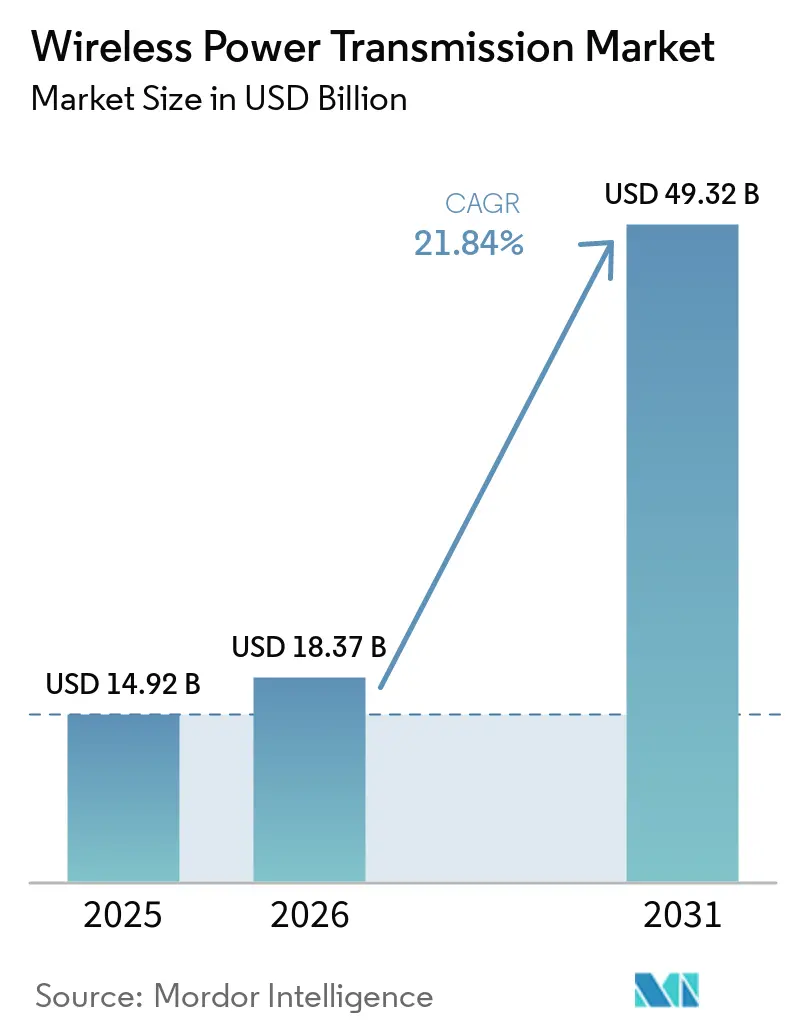
The wireless power transmission market size was valued at USD 14.92 billion in 2025 and estimated to grow from USD 18.37 billion in 2026 to reach USD 49.32 billion by 2031, at a CAGR of 21.84% during the forecast period (2026-2031). The wireless power transmission market is moving from a convenience-led category to a broader power-delivery platform as consumer devices, electric vehicles, and automated equipment increasingly require contact-free charging as part of their core design. Standardization is making adoption easier, especially after the July 2025 Qi2 25W update improved charging speed and strengthened interoperability across large device ecosystems. Competitive conditions are also shifting because automotive charging intellectual property is becoming more concentrated, while downstream deployment remains spread across companies that specialize in specific use cases and system integration. Material sourcing remains a practical constraint because ferrite cores and Litz wire are still concentrated in Asia-Pacific, which keeps procurement risk elevated for equipment makers outside the region. Regulatory differences across major regions and persistent real-world efficiency losses from misalignment and thermal load are slowing some deployments, but they are not changing the long-term direction of the wireless power transmission market.
Key Report Takeaways
- By technology, inductive coupling led the wireless power transmission market with a 42.61% revenue share in 2025, while resonant inductive coupling is projected to expand at a 22.84% CAGR through 2031.
- By transmission range, short-range held 55.39% of revenue in 2025, while long-range is expected to record the fastest growth at a 22.39% CAGR through 2031.
- By application, consumer electronics accounted for 38.49% of revenue in 2025, while automotive is projected to grow at a 23.03% CAGR through 2031.
- By component, receivers accounted for 52.26% of revenue in 2025 and are projected to grow the fastest, at a 22.78% CAGR through 2031.
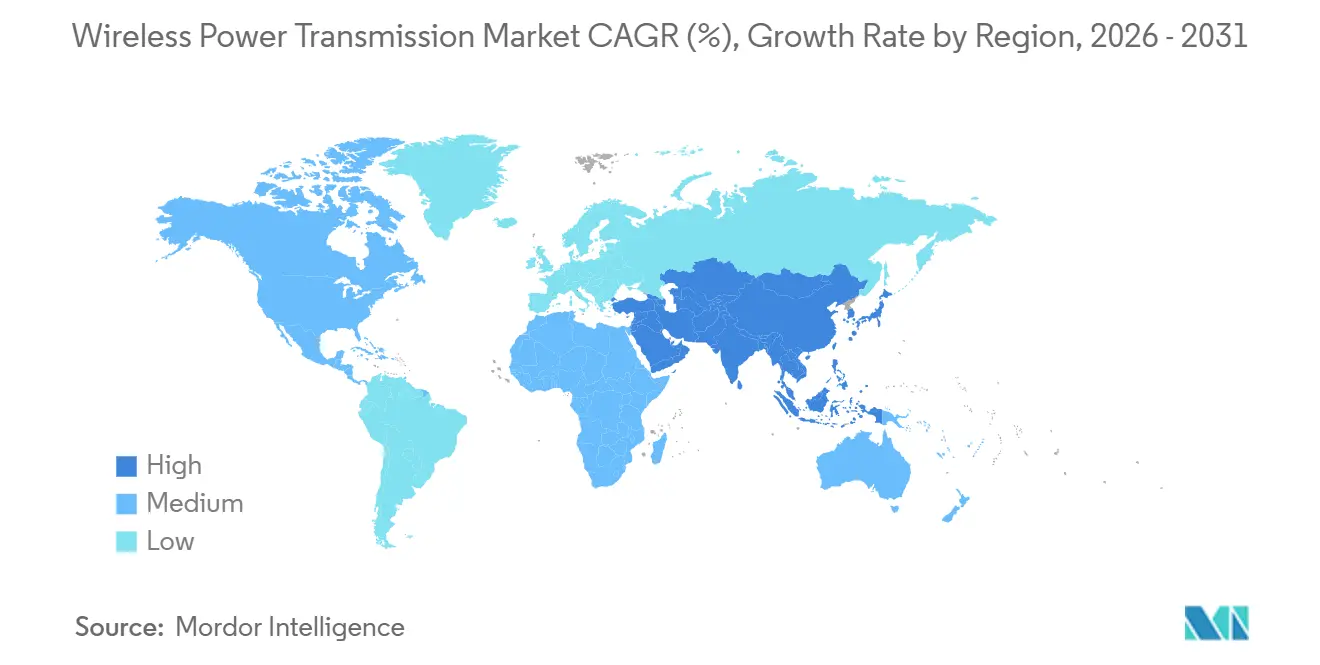
- By geography, Asia-Pacific held 36.78% of the wireless power transmission market share in 2025 and is projected to expand at a 22.81% CAGR through 2031.
Note: Market size and forecast figures in this report are generated using Mordor Intelligence’s proprietary estimation framework, updated with the latest available data and insights as of January 2026.
Market Trends and Insights
Drivers Impact Analysis of Wireless Power Transmission Market*
| Driver | (~) % Impact on CAGR Forecast | Geographic Relevance | Impact Timeline |
|---|---|---|---|
| Expanding Wireless Charging Adoption in Smartphones and Wearables | +5.2% | Global | Short term (≤ 2 years) |
| Accelerating Wireless EV Charging Deployment and Fleet Electrification | +4.8% | Europe, North America, and Asia-Pacific | Medium term (2-4 years) |
| Growing Wireless Power Use in Factory Automation and Mobile Robotics | +3.6% | Asia-Pacific core, spill-over to North America and Europe | Medium term (2-4 years) |
| Rising Qi2 Ecosystem Standardization and Magnetic Accessory Integration | +3.2% | Global | Short term (≤ 2 years) |
| Increasing Adoption of Wireless Power In Sealed and Implantable Medical Devices | +2.4% | North America and Europe | Long term (≥ 4 years) |
| Scaling Battery-Free Retail and Logistics IoT Networks | +1.8% | North America, spill-over to Europe and Asia-Pacific | Medium term (2-4 years) |
| Source: Mordor Intelligence | |||
Expanding Wireless Charging Adoption in Smartphones and Wearables
The wireless power transmission market is gaining direct support from faster wireless charging in mainstream smartphones and wearables. Qi2 v2.2.1 raised charging capability to 25 W in July 2025, narrowing the gap with wired fast charging and removing a major purchase barrier for many buyers.[1] The same update strengthened the case for magnetic alignment by improving performance while keeping interoperability at the center of the consumer charging tier. The Wireless Power Consortium also said 1.5 billion Qi2-capable devices entered circulation within the standard’s first year, which shows how quickly the installed base expanded. The wireless power transmission market also benefits from the accessory effect, because consumers who buy magnetic chargers, wallets, stands, and battery packs are more likely to stay inside the same compatibility path when replacing handsets.
Accelerating Wireless EV Charging Deployment and Fleet Electrification
The wireless power transmission market is also being boosted by the transition from EV pilots to visible commercial deployment. Electreon activated the A10 project in France in October 2025 and demonstrated 300 kW of inductive power under live traffic conditions, providing road operators and vehicle makers with a real infrastructure reference point rather than a laboratory result. In March 2026, Electreon completed its acquisition of InductEV and brought together dynamic and stationary charging intellectual property under a single company, with roughly 400 combined patents. Purdue University also demonstrated 190 kW charging of a Class 8 truck at 65 mph in December 2025 on a public U.S. test segment, which showed that heavy-duty use cases are moving into serious validation. The wireless power transmission market gains further momentum because depot operators can reduce plug handling, labor time, and connector wear in high-cycle logistics environments even before comparing energy transfer costs.
Growing Wireless Power Use In Factory Automation and Mobile Robotics
The wireless power transmission market is expanding in factories because mobile robots need charging methods that do not add cables, exposed contacts, or manual intervention to busy production floors. South Korea expanded 1 kW wireless power certification for commercial and industrial robots in March 2025, providing this use case with stronger regulatory backing and expanding the addressable market beyond low-power legacy systems. Wiferion reported in April 2025 that Hikrobot integrated its wireless charging technology into AMR fleets used in automotive assembly settings, and the deployment highlighted sub-15-minute opportunity charging rather than battery swap routines. The wireless power transmission market is benefiting from each industrial rollout, which produces more operational data on alignment behavior, charging frequency, and heat management in real facilities. That growing operating history helps equipment makers refine efficiency models and shortens future design cycles for robotics charging systems.
Rising Qi2 Ecosystem Standardization and Magnetic Accessory Integration
The wireless power transmission market is being supported by standardization that reduces friction for device makers, accessory brands, and component suppliers. Qi2 gained additional momentum in July 2025 when Korea’s Telecommunications Technology Association launched full Qi v2.2.1 product certification, reinforcing interoperability expectations across a major electronics supply chain. Once handset makers align antenna geometry and magnet placement around Qi2, the cost of supporting non-compliant alternatives becomes harder to justify. That increases switching costs at the hardware level and gives Qi2-related component vendors a more stable design roadmap. The same pattern is now appearing in industrial products, as Wiferion’s February 2026 CW Family launch translated modular, scalable charging principles into automation equipment ranging from 1.5 kW to 6 kW.
Restraints Impact Analysis of Wireless Power Transmission Market*
| Restraint | (~) % Impact on CAGR Forecast | Geographic Relevance | Impact Timeline |
|---|---|---|---|
| Efficiency Losses From Coil Misalignment and Thermal Load | -3.2% | Global | Short term (≤ 2 years) |
| High System and Infrastructure Cost Premiums Versus Wired Charging | -2.8% | Global | Medium term (2-4 years) |
| Fragmented RF Exposure and EMC Compliance Regimes | -1.6% | North America and Europe | Long term (≥ 4 years) |
| Concentrated Supply of Ferrites and Litz Wire Components | -1.2% | Global, supply concentrated in Asia-Pacific | Medium term (2-4 years) |
| Source: Mordor Intelligence | |||
Efficiency Losses from Coil Misalignment and Thermal Load
The wireless power transmission market still faces a practical efficiency problem when real-world alignment differs from ideal test conditions. IEEE ISSCC research published in February 2025 showed 60.2% end-to-end efficiency for an enhanced frequency-splitting architecture in miniaturized wireless power delivery, which is meaningful progress but still well below optimized wired charging performance at similar power levels.[2] Heat concentration at the receiver side adds another layer of difficulty, especially in consumer devices above 15 W, where thermal limits can trigger power reduction. In automotive deployments, higher-power systems also need cooling and control infrastructure that offsets part of the simplicity argument usually made for wireless charging. Electreon and Infineon highlighted this high-power challenge in December 2025 when they demonstrated 300 kW inductive charging using silicon carbide devices, because thermal management remained central to achieving that power density.
High System and Infrastructure Cost Premiums Versus Wired Charging
The wireless power transmission market also remains constrained by the higher installed cost of wireless systems compared with wired alternatives. SAE J2954 continues to shape EV wireless charging specifications, but the capital gap between wireless pads and comparably rated wired charging hardware still matters for fleet operators that buy on annual budget cycles rather than long-horizon productivity models. On industrial sites, the benefits of opportunity charging are clear, yet a large warehouse still needs many charging positions and related controls before the uptime gain becomes a strong payback case. Material costs add to that burden because ferrites and Litz wire remain difficult areas for cost compression, while the wireless power transmission market is still scaling. This cost pressure is likely to keep adoption selective in verticals where wired charging remains operationally acceptable and easier to finance.
*Our forecasts treat driver/restraint impacts as directional, not additive. The impact forecasts reflect baseline growth, mix effects, and variable interactions.
Wireless Power Transmission Market Segment Analysis
By Technology:
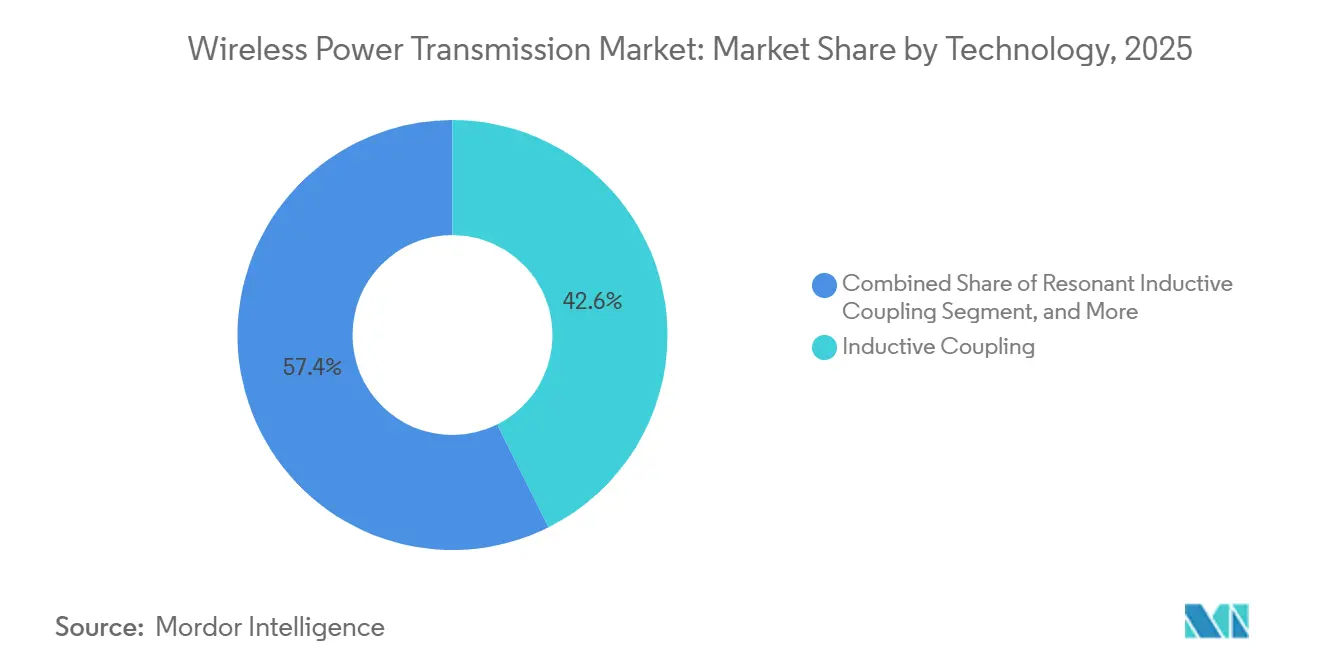
Resonant Systems Redefine Power-Distance Trade-OffsInductive coupling accounted for 42.61% of revenue in 2025, making it the largest technology block in the wireless power transmission market, as Qi-certified consumer hardware already had a deep global supply chain. That leadership came from compatibility, production scale, and a large installed base of chargers and receiving devices. The wireless power transmission industry still relies heavily on inductive coupling in phones, tablets, and many everyday accessories because it is well established and understood. Even so, the short transfer distance and tighter alignment requirements limit its suitability for applications where users cannot position equipment with high precision. The wireless power transmission market is now seeing resonant inductive coupling gain ground because it tolerates greater coil offset and supports higher power transfer across wider gaps. Resonant inductive coupling is projected to grow at a 22.84% CAGR through 2031, making it the fastest-growing technology path in the wireless power transmission market. Electreon’s October 2025 A10 motorway deployment provided a commercial proof point for this architecture at 300 kW peak power under live traffic conditions. Product qualification also continues to favor solutions with clearer compliance history under IEC 63028 and SAE J2954 frameworks.
Capacitive coupling remains a narrower option in sealed, non-ferrous, and specialized environments where magnetic field considerations matter more than raw power throughput. The wireless power transmission market includes radio frequency and microwave transmission in battery-free sensing and ambient IoT use cases, where far-field harvesting matters more than charger-pad alignment. Powercast remains a visible reference in this part of the wireless power transmission market because its patent depth and sensor deployments show that niche commercial demand already exists. Laser and infrared transmission is still the earliest commercial category, focused on long-distance or line-of-sight settings rather than broad installed-base adoption. IEEE ISSCC work on miniaturized resonant systems also matters because it gives device makers a benchmark for compact implantable and wearable designs. As a result, the technology mix in the wireless power transmission market is widening even while inductive and resonant systems remain the main revenue engines. That spread matters because it creates separate supply chains, design rules, and qualification paths inside the same wireless power transmission market. The wireless power transmission market size for inductive platforms remained the largest in 2025, but the growth curve is shifting toward resonant architectures in higher-power and less precisely aligned environments.

By Transmission Range:
Short-Range Saturation Opens Long-Range Infrastructure OpportunitiesShort-range systems accounted for 55.39% of the wireless power transmission market size in 2025, reflecting the maturity of smartphone and wearable charging ecosystems built around Qi and Qi2. This range remained dominant because millions of users already use short-distance charging pads at home, at work, and in public settings. The wireless power transmission market still depends on this installed base for volume, component scale, and supplier learning effects. Even so, short-term share concentration is expected to ease through 2031 as faster growth now comes from systems serving vehicles, factory equipment, and more distributed wireless energy use cases. Long-range is projected to expand at a 22.39% CAGR through 2031, making it the fastest-growing transmission category in the wireless power transmission market. That growth is tied to dynamic vehicle charging, ambient RF harvesting, and directed energy concepts that sit outside the traditional ferrite-pad ecosystem. Medium-range systems, usually spanning 10 cm to 1 m, are also finding space in industrial robotics and furniture charging because they offer greater tolerance without requiring fully long-range architectures. Companies such as GuRu Wireless and Ossia are pushing room-scale delivery concepts, which show how the transmission-range landscape is broadening beyond simple pad-based charging.
The supply chain picture changes meaningfully as transmission distance increases. Short-range products draw on ferrites, coils, shielding, and receiver ICs, while long-range systems require a different stack that includes antenna arrays, beam steering, and higher-value RF electronics. The wireless power transmission market, therefore, creates white space for specialists who were never strong in phone charging components. This difference means cost leadership in short-range hardware does not automatically translate into leadership in long-range wireless power. It also changes the buyer set, because infrastructure planners, logistics operators, and enterprise IoT integrators evaluate these systems with different return thresholds than consumer device makers. The wireless power transmission market will likely see clearer separation between short-range incumbents and long-range specialists as road and ambient power projects produce more field data. That separation matters because it reduces the risk that a single product architecture dominates every use case. The wireless power transmission industry is increasingly split by range logic, not just by end-use sector. Short range remains the anchor, but long-range opportunity is where much of the next competitive repositioning in the wireless power transmission market is taking shape.
By Application:
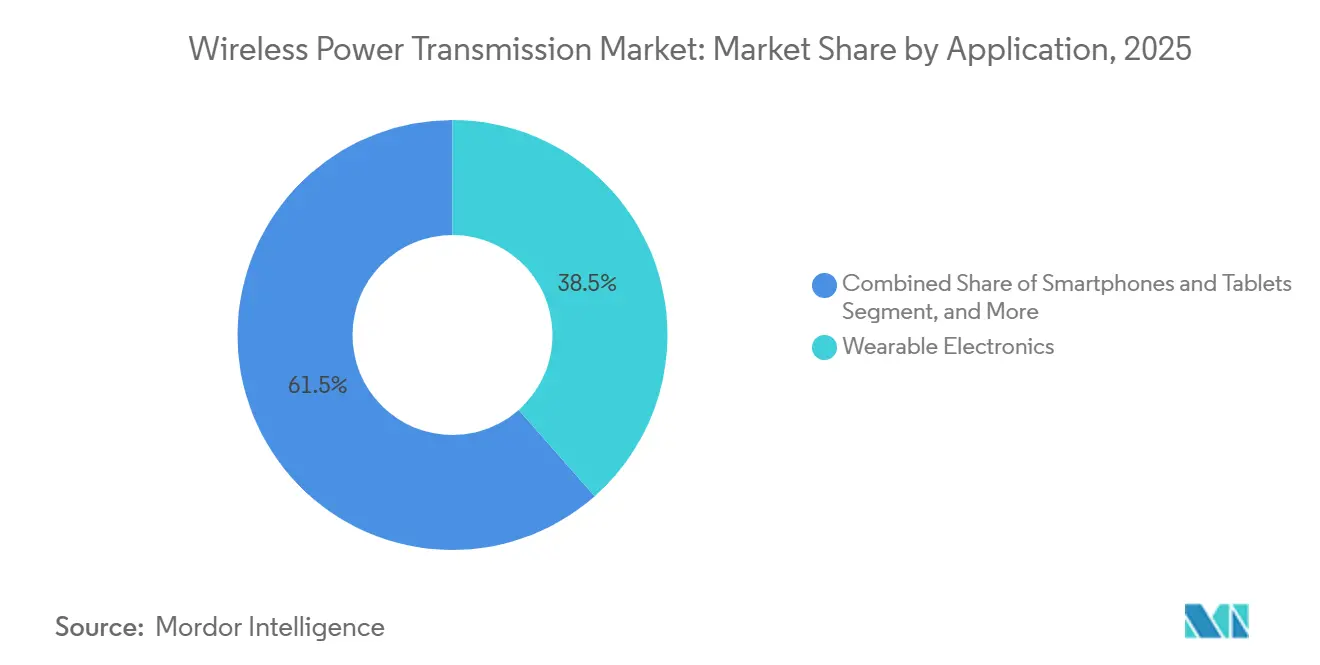
Automotive Overtakes Consumer Electronics As The Growth CatalystWearable electronics led the wireless power transmission market with 38.49% market share in 2025, reflecting the depth of the smartphone, tablet, and wearable installed base. This application remained the volume center of the wireless power transmission market because standardization, accessory ecosystems, and device refresh cycles kept adding compatible products. At the same time, the automotive market is projected to grow at a 23.03% CAGR through 2031 and has become the main driver of growth in the wireless power transmission market. That gap between current scale and future growth shows how the market is shifting from low-power device pads toward high-power vehicle and infrastructure systems. The Wireless Power Consortium’s 25 W update helped the consumer tier by improving charging speed and strengthening the value of magnetic alignment across accessories and handsets. It also reinforced the idea that wireless charging in devices is moving from a premium feature to an expected hardware layer. The wireless power transmission market benefits from this, as high-volume device categories support component scale, even as other applications are still building out. That broad device base provides suppliers with a demand cushion as automotive programs progress through longer qualification cycles. It also keeps consumer electronics important, even though the strongest forward momentum has moved elsewhere.
Automotive growth is being shaped by both static and dynamic charging development. Iveco unveiled the eDaily with an integrated dynamic wireless charging solution in March 2026, signaling its intent to produce rather than simply demonstrate a concept. Electreon’s acquisition of InductEV also tightened the competitive landscape in vehicle charging by combining dynamic and stationary charging portfolios under a single owner with significant patent depth. Industrial equipment and robotics are also gaining relevance as AMR and AGV fleets use opportunity charging to reduce downtime and remove manual intervention from busy facilities. Medical and public infrastructure applications remain smaller, yet they improve the mix quality because they often entail greater design complexity and stronger customization needs. The August 2025 Nature Biomedical Engineering publication on distributed battery-free implants also showed that wireless medical power is moving beyond single-node concepts. Across the wireless power transmission market, this means future value will not come from one application alone. Instead, consumer electronics provide scale, while automotive, industrial systems, and medical designs expand the technical and commercial boundaries of the wireless power transmission market.
By Component:
Receiver Proliferation Drives Dual-Role Market DominanceReceivers captured 52.26% share of the wireless power transmission market size in 2025 and are also projected to expand at a 22.78% CAGR through 2031. That dual role reflects a simple reality in the wireless power transmission market, every new end device needs a receiver, while a single transmitter can often serve multiple devices over time. The receiver base, therefore, scales with installed device count rather than only with charger-site count. This makes receiver demand broad, recurring, and tied to multiple end-use categories simultaneously. The wireless power transmission market includes receiver growth across phones, earbuds, wearables, robots, EV platforms, and medical devices, which gives this component class unusual breadth. Transmitters remain the second-largest component area, but buyer requirements are changing toward higher power density, stronger thermal control, and support for multiple charging modes. That is especially evident in automotive and industrial equipment programs, where a single transmitter becomes a critical system node rather than a simple consumer accessory. The wireless power transmission market also rewards transmitter suppliers that can reduce integration complexity for OEMs managing different power classes and safety requirements. As a result, component leadership is no longer defined only by hardware size or cost.
Power management and control ICs are becoming a more important margin layer because physical transmission standards are gradually becoming clearer. As the wireless power transmission market standardizes the charging interface, differentiation is shifting toward adaptive tuning, foreign-object detection, and software-driven power optimization. Magnetic materials and shielding still represent a supply risk because production remains concentrated in Asia-Pacific, and cost reductions are harder in these parts of the bill of materials. Software and controller capabilities are gaining strategic weight for the same reason, because they can improve field performance without a full hardware redesign. Energous demonstrated the commercial value of control-layer intelligence in April 2025, expanding deployment to 4,700 U.S. retail locations for a Fortune 10 retailer. Large multi-device environments require tracking, prioritization, and power management logic that cannot be solved solely by hardware. This is why the wireless power transmission market is shifting its competitive focus toward firmware and system orchestration. The wireless power transmission market share of receivers stayed highest in 2025, but the long-term value stack is becoming more balanced across hardware, control ICs, and software layers.
Geography Analysis
APAC Wireless Power Transmission Market
Asia-Pacific held 36.78% of the wireless power transmission market share in 2025 and is projected to expand at a 22.81% CAGR through 2031. The region led the wireless power transmission market because it combined dense smartphone demand, deep electronics manufacturing, and rising automation investment within the same geographic base. China remained central to the regional supply chain because it supports large-scale production of ferrites, Litz wire, receiver ICs, and device assembly for the wireless power transmission market. South Korea also strengthened its position in 2025 through expanded wireless power certification for commercial and industrial robots and through Qi v2.2.1 certification activity that reinforced its role as a compliance hub for consumer devices.
North America and Europe Wireless Power Transmission Market
North America and Europe formed the second-largest geographic cluster in the wireless power transmission market and remained the most active regions for dynamic EV charging projects. The United States was the leading North American market because it combined high smartphone wireless charging penetration with rising interest in EV fleets and visible infrastructure testing. Purdue University’s December 2025 heavy-duty truck demonstration gave the region a strong public benchmark for in-motion charging at highway speeds.[3] The FCC’s January 2026 geofenced 6 GHz variable-power device rules also helped define a more workable path for higher-power ambient wireless devices, which matters for enterprise and industrial use cases in the wireless power transmission market. Europe remained the most advanced region for road electrification in the wireless power transmission market, led by France and Italy. Electreon’s A10 motorway deployment in France validated 300 kW peak dynamic charging under real traffic conditions in October 2025. Iveco’s March 2026 announcement of the eDaily on Italy’s A35 motorway then showed that vehicle-side integration was moving closer to commercial use. Together, these developments showed that European road operators and OEMs are treating dynamic wireless charging as near-term infrastructure rather than a distant concept.
MEA and South America Wireless Power Transmission Market
South America, the Middle East, and Africa remained early-stage markets for wireless power transmission through 2026. Brazil and Argentina continued to present the clearest South American opportunities, though adoption still leaned toward consumer device charging rather than advanced EV or industrial systems. The Middle East is emerging as a selective investment destination in the wireless power transmission market, especially where mobility programs are linked to wider decarbonization and smart-city targets. Beam Global and HEVO launched an autonomous, wireless EV charging platform in February 2026 for operators in the United States and the UAE, demonstrating that the Gulf is attracting advanced mobility solutions earlier than many other emerging regions. Africa remained at an early adoption stage, with consumer electronics as the main entry point, while broader EV and industrial deployment still face infrastructure gaps and import pressures. Even so, the wireless power transmission market is likely to expand its geographic reach over 2026-2031 as lower-power consumer applications gain familiarity before higher-value automotive and automation projects follow.
Competitive Landscape
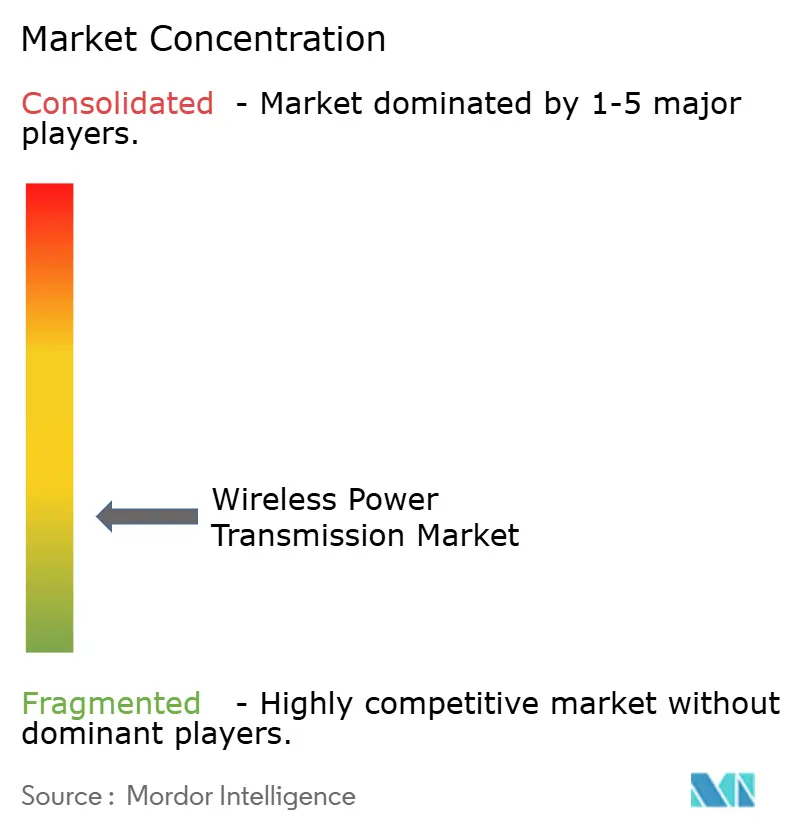
The wireless power transmission market is fragmented, with a layer of companies focused on integration and end-use specialization. This structure means a small group influences standards and architecture direction, while many others compete on deployment speed, customization, and system fit. WiTricity remains strategically important in the automotive segment of the wireless power transmission market because its resonant intellectual property aligns closely with certification pathways OEMs already recognize. Energous also showed that commercial scale can matter as much as patent depth when it expanded wireless power deployment across 4,700 U.S. retail locations in April 2025.[4]
The competitive landscape is also changing as companies try to lock in platform positions rather than sell isolated hardware. Electreon’s March 2026 acquisition of InductEV was the clearest example, as it combined dynamic and stationary EV charging portfolios and reset the balance of power in the wireless power transmission market for vehicle charging. Wiferion’s February 2026 CW Family launch pointed in a similar direction for industrial systems by offering a modular platform from 1.5 kW to 6 kW rather than a narrow point solution. That matters because factory buyers increasingly prefer charging infrastructure they can standardize across mixed fleets of AMRs, forklifts, and clean-room equipment. The wireless power transmission market is, therefore, rewarding companies that reduce integration friction and support multi-site rollouts. It is also opening room for firms that add software-defined tuning, alignment assistance, and energy management to otherwise standard hardware layers.
Smaller specialists remain important because they are pushing the edges of what the wireless power transmission market can do in long-range delivery, medical systems, and compact electronics. GuRu Wireless and Ossia continue to target room-scale RF delivery, while medical-focused firms are pursuing smaller form factors and higher efficiency for implantable use cases. The wireless power transmission market also shows growing value in hardware-software combinations, as seen in the February 2026 launch of Beam Global and HEVO, which paired wireless charging hardware with fleet energy management functions. Companies that secure design wins with OEMs, fleet operators, or medical device makers in 2026 and 2027 are likely to build durable supply relationships because specifications become harder to change once systems are validated. That gives the wireless power transmission market a mixed structure, concentrated where standards and core patents matter most, but still fragmented in day-to-day commercial execution.
Wireless Power Transmission Industry Leaders
-
WiTricity Corporation
-
Energous Corporation
-
Powercast Corporation
-
Powermat Technologies Ltd.
-
Ossia Inc.
- *Disclaimer: Major Players sorted in no particular order
Wireless Power Transmission Market Companies Covered in this Report
- WiTricity Corporation
- Energous Corporation
- Ossia Inc.
- Powercast Corporation
- Powermat Technologies Ltd.
- Wi-Charge Ltd.
- NuCurrent, Inc.
- ConvenientPower HK Limited
- Mojo Mobility, Inc.
- GuRu Wireless, Inc.
- Electreon Wireless Ltd.
- HEVO Inc.
- Evatran, LLC
- Resonant Link Medical, LLC
- PowerLight Technologies, Inc.
- Emrod Limited
- Aeterlink Corporation
- Solace Power Inc.
- Reach Power Inc.
- Etherdyne Technologies, Inc.
- Yank Technologies, Inc.
- Aira, Inc.
- Aircharge Ltd.
Recent Industry Developments in Wireless Power Transmission Market
- May 2026: Mitsubishi Fuso's eCanter completed Japan's first commercial logistics dynamic wireless EV charging trial in partnership with a domestic fleet operator, marking the transition of DWPT from R&D demonstration to revenue-generating logistics deployment in Asia-Pacific. This milestone establishes a commercial precedent that peer Japanese OEMs and logistics companies are expected to evaluate for fleet-wide rollout.
- April 2026: Qi v2.2.1 adoption expanded to flagship Android platforms, with Google's Pixel 10 Pro XL among the first Android devices to ship with native Qi v2.2.1 support and magnetic accessory compatibility, broadening the Qi2 magnetic ecosystem beyond Apple's MagSafe installed base and triggering a competitive response from other Android OEMs on accessory integration timelines.
- March 2026: Iveco unveiled the eDaily electric van with an integrated DWPT system validated on Italy's A35 motorway, making it the first production-intent commercial vehicle designed from the outset for in-motion wireless charging. The deployment positions the European commercial vehicle segment as the next frontier for EV wireless charging standardization.
- March 2026: Electreon Wireless completed the acquisition of InductEV, creating a combined entity with approximately 400 patents spanning dynamic and stationary EV wireless charging. The merged company is positioned to offer end-to-end wireless EV charging stacks to highway concessionaires and fleet operators globally, representing the largest M&A transaction in the sector to date.
Global Wireless Power Transmission Market Report Scope
The Wireless Power Transmission Market refers to the industry focused on technologies and systems that enable the transfer of electrical energy without physical wired connections through electromagnetic, capacitive, radio frequency, microwave, laser, or infrared methods. These systems are used across consumer electronics, electric vehicle charging, industrial automation, medical devices, and public infrastructure applications to improve convenience, mobility, durability, and operational efficiency. The market includes wireless power transmitters and receivers, power management and control integrated circuits, magnetic shielding materials, and software-based system controllers for short-, medium-, and long-range power transfer applications.
The Wireless Power Transmission Market Report is Segmented by Technology (Inductive Coupling, Resonant Inductive Coupling, Capacitive Coupling, Radio Frequency and Microwave Power Transmission, and Laser and Infrared Power Transmission), Transmission Range (Short Range, Medium Range, and Long Range), Application (Smartphones and Tablets, Wearable Electronics, Electric Vehicle Charging, Industrial Equipment and Robotics, Medical Devices, and Public Infrastructure and Furniture), Component (Transmitters, Receivers, Power Management and Control ICs, Magnetic Materials and Shielding, and Software and System Controllers), and Geography (North America, South America, Europe, Asia-Pacific, Middle East, and Africa). The Market Forecasts are Provided in Terms of Value (USD).
Segmentation Overview
| Inductive Coupling |
| Resonant Inductive Coupling |
| Capacitive Coupling |
| Radio Frequency and Microwave Power Transmission |
| Laser and Infrared Power Transmission |
| Short Range |
| Medium Range |
| Long Range |
| Smartphones and Tablets |
| Wearable Electronics |
| Electric Vehicle Charging |
| Industrial Equipment and Robotics |
| Medical Devices |
| Public Infrastructure and Furniture |
| Transmitters |
| Receivers |
| Power Management and Control ICs |
| Magnetic Materials and Shielding |
| Software and System Controllers |
| North America | United States |
| Canada | |
| Mexico | |
| South America | Brazil |
| Argentina | |
| Rest of South America | |
| Europe | Germany |
| United Kingdom | |
| France | |
| Italy | |
| Spain | |
| Russia | |
| Rest of Europe | |
| Asia-Pacific | China |
| Japan | |
| India | |
| South Korea | |
| Rest of Asia-Pacific | |
| Middle East | Saudi Arabia |
| United Arab Emirates | |
| Rest of Middle East | |
| Africa | South Africa |
| Nigeria | |
| Rest of Africa |
| By Technology | Inductive Coupling | |
| Resonant Inductive Coupling | ||
| Capacitive Coupling | ||
| Radio Frequency and Microwave Power Transmission | ||
| Laser and Infrared Power Transmission | ||
| By Transmission Range | Short Range | |
| Medium Range | ||
| Long Range | ||
| By Application | Smartphones and Tablets | |
| Wearable Electronics | ||
| Electric Vehicle Charging | ||
| Industrial Equipment and Robotics | ||
| Medical Devices | ||
| Public Infrastructure and Furniture | ||
| By Component | Transmitters | |
| Receivers | ||
| Power Management and Control ICs | ||
| Magnetic Materials and Shielding | ||
| Software and System Controllers | ||
| By Geography | North America | United States |
| Canada | ||
| Mexico | ||
| South America | Brazil | |
| Argentina | ||
| Rest of South America | ||
| Europe | Germany | |
| United Kingdom | ||
| France | ||
| Italy | ||
| Spain | ||
| Russia | ||
| Rest of Europe | ||
| Asia-Pacific | China | |
| Japan | ||
| India | ||
| South Korea | ||
| Rest of Asia-Pacific | ||
| Middle East | Saudi Arabia | |
| United Arab Emirates | ||
| Rest of Middle East | ||
| Africa | South Africa | |
| Nigeria | ||
| Rest of Africa | ||
Key Questions Answered in the Report
What is the current and projected size of wireless power transmission?
The wireless power transmission market was valued at USD 14.92 billion in 2025 and is estimated at USD 18.37 billion in 2026. It is projected to reach USD 49.32 billion by 2031 at a 21.84% CAGR over 2026-2031.
Which technology segment is leading wireless power transmission adoption?
Inductive coupling led the technology mix with 42.61% of revenue in 2025 because of the mature Qi-certified device and accessory ecosystem. Resonant inductive coupling is the fastest-growing technology at a 22.84% CAGR through 2031.
Why is automotive becoming more important for wireless charging systems?
Automotive is projected to grow at a 23.03% CAGR through 2031, faster than any other application. Growth is being driven by fleet electrification, dynamic road charging trials, and rising interest in vehicle platforms designed for wireless compatibility from the start.
Which region offers the strongest growth outlook through 2031?
Asia-Pacific led with 36.78% of revenue in 2025 and is forecast to grow at a 22.81% CAGR through 2031. Its position comes from strong electronics manufacturing, dense smartphone demand, and rising factory automation and EV charging activity.
What is holding back wider adoption of wireless power transmission?
The main barriers are efficiency loss from misalignment and heat, plus higher system and infrastructure cost than wired alternatives. These issues are most visible in high-power EV and industrial installations where cooling, alignment, and materials cost matter more.
Which component category is expanding the fastest?
Receivers are both the largest and fastest-growing component category, with a 52.26% share in 2025 and a projected 22.78% CAGR through 2031. This reflects the fact that every enabled device needs a receiver, while one transmitter can support multiple devices.