
Wholesale Voice Carrier Market Size and Share
Market Overview
| Study Period | 2020 - 2031 |
|---|---|
| Market Size (2026) | USD 44.53 Billion |
| Market Size (2031) | USD 73.63 Billion |
| Growth Rate (2026 - 2031) | 10.58 % |
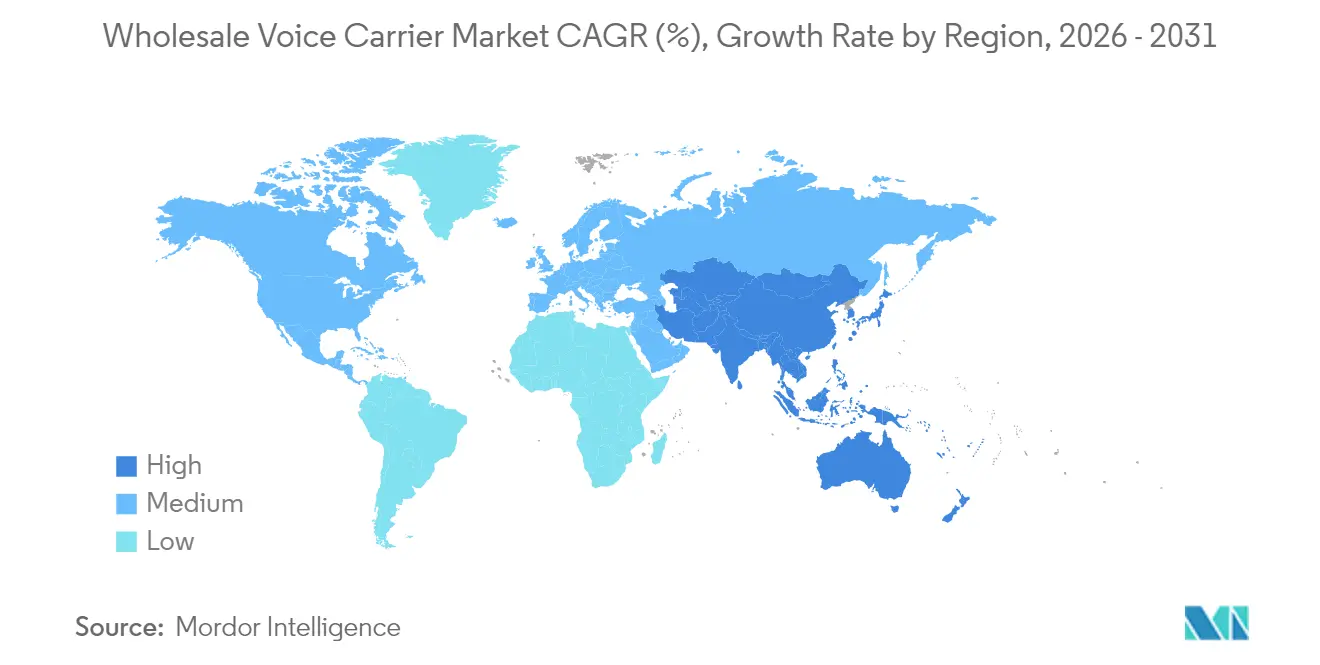
| Fastest Growing Market | Asia Pacific |
| Largest Market | North America |
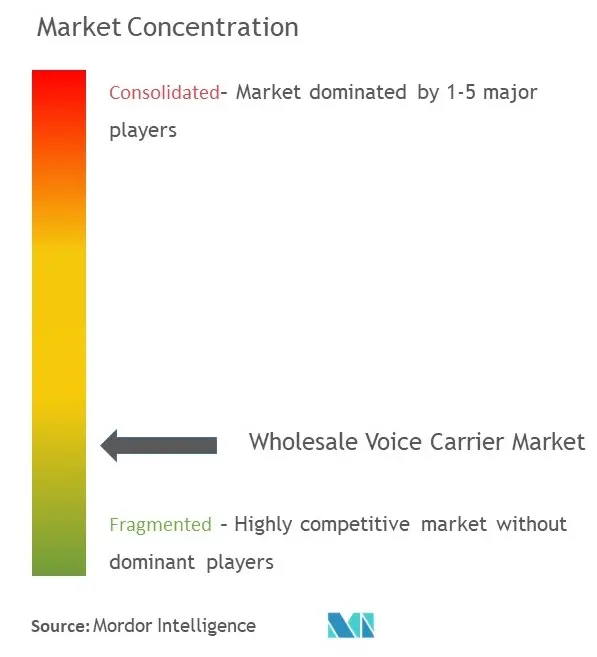
| Market Concentration | Medium |
Major Players *Disclaimer: Major Players sorted in no particular order Image © Mordor Intelligence. Reuse requires attribution under CC BY 4.0. | |
Wholesale Voice Carrier Market Analysis by Mordor Intelligence
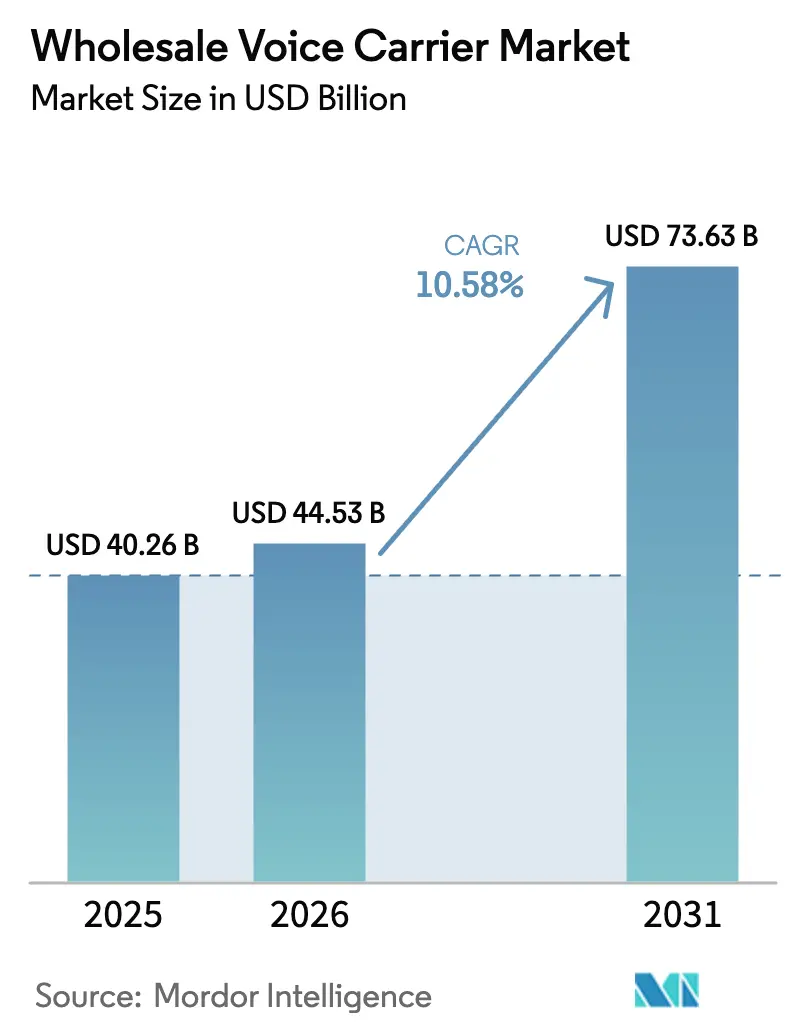
wholesale voice carrier market size in 2026 is estimated at USD 44.53 billion, growing from 2025 value of USD 40.26 billion with 2031 projections showing USD 73.63 billion, growing at 10.58% CAGR over 2026-2031. Migration from circuit-switched to IP-based architectures, rapid expansion of VoIP traffic, and growing demand for programmable voice services place the wholesale voice carrier market at the center of global connectivity. Europe keeps a commanding position thanks to harmonized interconnection rules, while Asia Pacific delivers the highest growth as 5G roll-outs accelerate voice-over-data usage. Consolidation, illustrated by large-scale acquisitions, continues to reshape competitive dynamics as operators seek scale, fiber reach, and advanced routing technologies. Fraud management, AI-driven least-cost routing, and inter-carrier blockchain pilots emerge as high-value niches within the overall wholesale voice carrier market, rewarding providers that pair infrastructure modernization with service innovation.
Key Report Takeaways
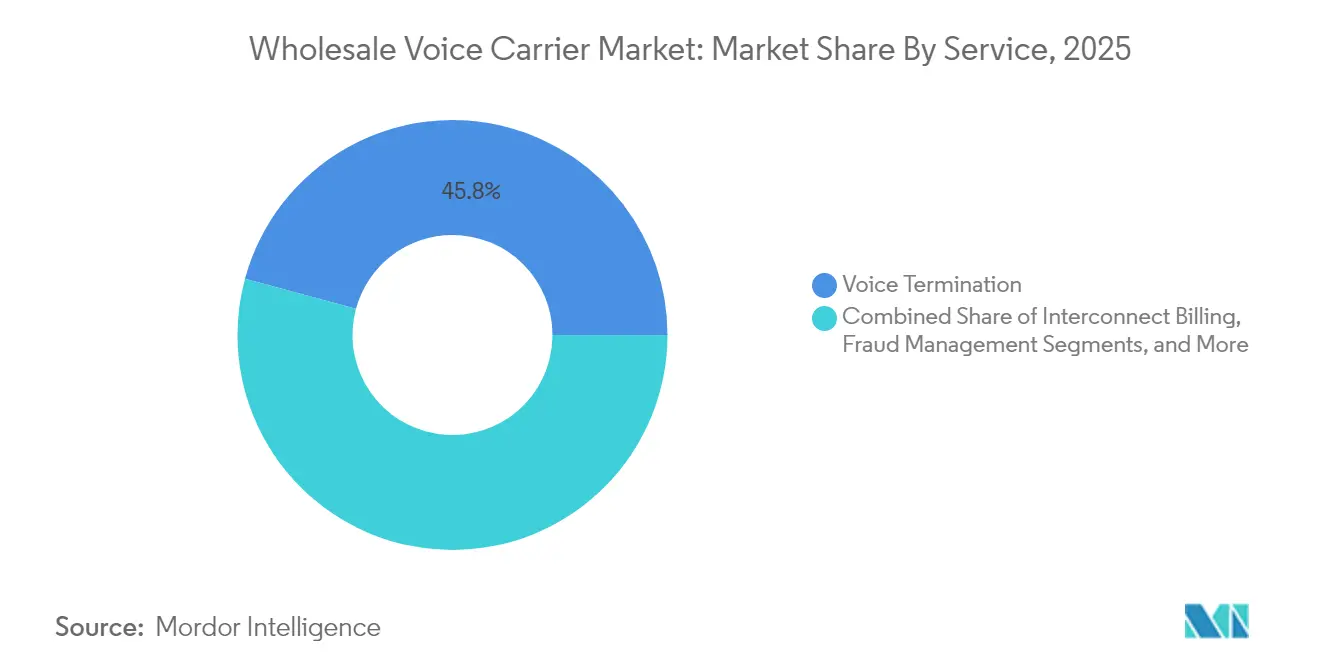
- By service, Voice Termination led with 45.78% revenue share in 2025; Fraud Management is projected to expand at a 13.55% CAGR during 2026-2031.
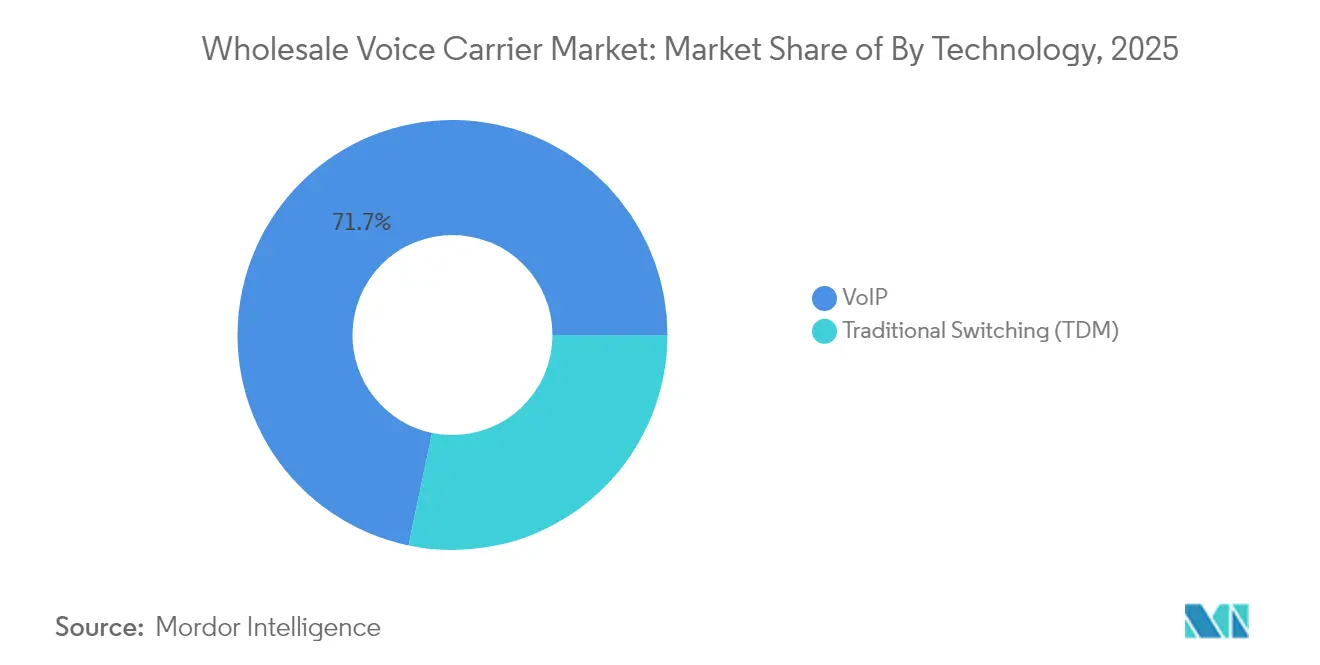
- By technology, VoIP accounted for 71.72% of the wholesale voice carrier market share in 2025, while SIP-based implementations are set to grow at 11.95% CAGR through 2031.
- By end user, Tier-1 and Tier-2 telcos captured 53.35% of demand in 2025, whereas OTT and CPaaS providers registered the fastest pace at 11.45% CAGR to 2031.
- By geography, Europe held 27.95% of 2025 revenue, yet Asia Pacific is forecast to post the highest regional CAGR of 13.72% between 2026 and 2031.
Note: Market size and forecast figures in this report are generated using Mordor Intelligence’s proprietary estimation framework, updated with the latest available data and insights as of 2026.
Market Trends and Insights
Drivers Impact Analysis of Wholesale Voice Carrier Market*
| Driver | (≈) % Impact on CAGR Forecast | Geographic Relevance | Impact Timeline |
|---|---|---|---|
| Rapid migration from TDM to SIP and VoIP trunking | +3.2% | Global, acceleration in Europe and North America | Medium term (2-4 years) |
| Cloud-based communication (UCaaS / CPaaS) uptake | +2.8% | Global, led by North America and Europe | Long term (≥ 4 years) |
| Emerging voice-over-5G roaming agreements | +1.9% | Asia Pacific core, spill-over to Europe and North America | Long term (≥ 4 years) |
| AI-enabled dynamic least-cost routing | +1.4% | Global, early adoption in developed markets | Medium term (2-4 years) |
| Source: Mordor Intelligence | |||
Rapid Migration from TDM to SIP and VoIP Trunking
Mandatory phase-outs of PSTN networks, such as the 2027 switch-off timetable set by Ofcom in the United Kingdom, compel operators to decommission legacy exchanges and invest in IP cores.[1]The transition compresses maintenance costs, enables flexible capacity scaling, and supports feature expansion even as carriers temporarily operate parallel systems that elevate opex. Early adopters leverage improved latency and advanced codec support to differentiate on call quality, while lagging providers confront regulatory penalties and higher churn risk.
Cloud-based Communication (UCaaS / CPaaS) Uptake
Enterprise preference for unified cloud platforms shifts wholesale demand from fixed trunks to API-centric voice enablement. Operators that expose programmable voice, recording, and analytics capabilities through white-label CPaaS offerings gain new revenue while safeguarding traffic volumes. Funding milestones, such as IntelePeer’s USD 110 million growth investment, signal heightened capital flow toward providers that bridge traditional termination with cloud‐native orchestration.
Emerging Voice-over-5G Roaming Agreements
Standalone 5G cores create opportunities for high-definition voice roaming and network slicing. Trials by Vodafone, A1 Group, and Ericsson deliver full-stack 5G roaming with lower latency and service-based charging, underscoring wholesale relevance in the 5G era.[2] China’s nationwide 5G roaming collaboration among its four major carriers further validates the model’s scalability for traffic exchange across heterogeneous infrastructures.
AI-enabled Dynamic Least-cost Routing Boosts Margins
AI integration replaces static routing tables with real-time quality and cost optimization. Nokia’s extension of its voice-core contract with AT&T embeds machine-learning analysis of call completion rates and customer experience metrics, redirecting traffic away from under-performing routes and lifting gross margin while sustaining service-level agreements. Capital-light carriers can now access comparable intelligence, narrowing performance gaps with incumbents.
Restraints Impact Analysis of Wholesale Voice Carrier Market*
| Restraint | (≈) % Impact on CAGR Forecast | Geographic Relevance | Impact Timeline |
|---|---|---|---|
| Heightened fraud (CLI spoofing, robocalls) | -2.1% | Global, particularly severe in North America | Short term (≤ 2 years) |
| Declining voice ARPU due to OTT substitution | -1.8% | Global, accelerated in developed markets | Medium term (2-4 years) |
| Source: Mordor Intelligence | |||
Heightened Fraud (CLI Spoofing, Robocalls)
Escalating vishing attacks that generated USD 1.2 billion in losses during 2024 undermine consumer trust and trigger stricter compliance mandates. Wholesale carriers invest heavily in analytics-driven fraud detection, yet must balance protection costs against thin per-minute margins. International fraud, estimated at USD 17 billion annually, includes False Answer Supervision and Traffic Pumping schemes that erode profitability while damaging brand reputation.
Declining Voice ARPU due to OTT Substitution
Voice minutes shrink as consumers migrate to data-rich messaging platforms. Germany’s fixed voice traffic fell 20% to 64 billion minutes in 2024, and mobile outgoing calls dipped to 153.5 billion minutes. Carriers bundle voice with data and introduce verified caller solutions to preserve value, yet wholesale rates remain under pressure as OTT offerings set new price benchmarks.
*Our forecasts treat driver/restraint impacts as directional, not additive. The impact forecasts reflect baseline growth, mix effects, and variable interactions.
Wholesale Voice Carrier Market Segment Analysis
By Service:
Fraud Management Drives InnovationVoice Termination accounted for 45.78% of revenue in 2025, maintaining its role as the cornerstone of inter-carrier exchange. However, Fraud Management delivers the swiftest expansion at 13.55% CAGR to 2031 as enterprises demand authenticated caller identities and regulators mandate robocall mitigation. Higher-margin Premium CLI products outperform commoditized Standard Best-Effort traffic thanks to guaranteed delivery and origin validation. Interconnect Billing splits between customizable on-premise modules preferred by large incumbents and SaaS suites adopted by smaller operators seeking opex flexibility. The wholesale voice carrier market benefits when revenue-assurance platforms integrate machine-learning pattern recognition, enabling predictive blocking of anomalous traffic bursts.
Fraud Management momentum stems from regulatory frameworks such as STIR/SHAKEN in North America, compelling carriers to certify calling party numbers before termination. Leading vendors package signaling firewalls with real-time analytics dashboards that flag suspicious answer-seizure ratios. As these capabilities mature, smaller solution providers encounter entry barriers while established players consolidate share through end-to-end fraud stacks. For carriers, premium anti-fraud service uptake supports average-revenue-per-minute lift that partially offsets unit price compression in the wider wholesale voice carrier market.

By Technology:
VoIP Transformation AcceleratesVoIP held 71.72% adoption in 2025 and is advancing at 11.95% CAGR, confirming its dominance over residual TDM traffic. SIP’s maturity simplifies interconnect negotiations and supports codec agility, creating a virtuous cycle of quality improvement and cost efficiency. The wholesale voice carrier market size for VoIP-based traffic is set to widen materially as operators deactivate legacy TDM switches following national PSTN retirement schedules. Demonstrations such as Nokia’s three-dimensional Immersive Voice at MWC 2025 show how spatial audio can become a premium layer atop existing VoIP frameworks.
Sustained protocol innovation benefits from AI-assisted transcoding that minimizes packet loss and latency. NTT Corporation’s real-time voice conversion prototype highlights a future where voice characteristics, accent localization, and emotion filtering personalize caller interactions without compromising network performance. These advances reinforce VoIP’s position as the foundation for next-generation services, elevating the wholesale voice carrier market as an essential backbone for immersive voice communication.
By End User:
OTT Providers Reshape DemandTier-1 and Tier-2 telcos represented 53.35% of traffic demand in 2025, relying on wholesale partners to extend geographic coverage and optimize least-cost routing. Yet the fastest growth comes from OTT and CPaaS providers at 11.45% CAGR through 2031. These application-layer firms lease wholesale voice routes and wrap them with programmable APIs that power customer engagement, two-factor authentication, and AI voice agents. KORE Wireless’s MVNE platform enabling Simpel’s rapid subscriber growth shows how virtual operators depend on wholesale infrastructure to scale cost-effectively.
The end-user mix signals a value-shift from infrastructure ownership toward service orchestration. CPaaS deployments, such as IntelePeer’s generative-AI agent for a Fortune 100 fintech client, consume substantial voice minutes while requiring integration simplicity and granular analytics. The wholesale voice carrier market adapts by offering white-label routing, real-time provisioning, and billing APIs that let digital-native brands embed voice functionality while abstracting network complexity.
Geography Analysis
Europe Wholesale Voice Carrier Market
Europe maintained a 27.95% revenue share in 2025, underpinned by robust cross-border interconnection regulations and widespread fiber backbones. Market maturity prompts a pivot toward efficiency and value-added services, illustrated by Deutsche Telekom’s EUR 115.8 billion revenue and 6.2% EBITDA uplift in 2024.Consolidation discussions between major incumbents such as Orange and Telefónica underline a strategic need to counter hyperscale cloud rivals and OTT disruptors.
APAC Wholesale Voice Carrier Market
Asia Pacific delivers the fastest regional trajectory at 13.72% CAGR through 2031, propelled by soaring 5G subscriptions, rising enterprise digitization, and inter-regional trade flows. The GSMA values the mobile economy contribution at USD 880 billion in 2024, with China alone recording RMB 1.74 trillion telecommunications revenue and double-digit growth in cloud and big-data services. Such momentum enlarges the wholesale voice carrier market size across the region as operators deploy standalone 5G cores that require new interconnect and roaming frameworks.
North America and LATAM Wholesale Voice Carrier Market
North America exhibits technological leadership but slower traffic growth. The region enforces stringent STIR/SHAKEN frameworks, compelling carriers to invest in call authentication before termination. Verizon’s USD 20 billion purchase of Frontier Communications extends fiber reach across 25 states and consolidates voice and broadband assets. Latin America presents divergent strategies: Telefónica accelerates divestments in Argentina, Chile, and Mexico to refocus capital on higher-return European markets while maintaining selective presence where regulatory conditions support profitability.
Regulatory Landscape
Regulation is tightening around call authentication, numbering governance, and the migration to all-IP interconnection, shaping wholesale termination and fraud-management economics. In the United States, the FCC opened an all-IP transition rulemaking in January 2026 (Reforming Legacy Rules for an All-IP Future), putting intercarrier compensation and legacy tariff rules on the table. A March 2026 FCC numbering proposal targeted robocalls through additional certification requirements and constraints on number resale. These moves raise compliance and operational readiness requirements for carriers handling large-scale international voice traffic.
In the United Kingdom, Ofcom concluded its 2026 Review of Call Termination Markets in March 2026 and continued regulation of wholesale call termination through 31 March 2031, keeping termination pricing and conditions within a regulated framework. Ofcom also removed the End-to-End Connectivity Condition from BT effective 1 April 2026, signaling a shift in how certain wholesale obligations are enforced as PSTN retirement progresses toward the UK switch-off timetable referenced for 2027. Taken together, these actions keep call termination and fraud mitigation central to carrier wholesale governance in key markets.
Value Chain Analysis
The wholesale voice value chain runs from infrastructure owners and interconnection providers to aggregators, service enablement platforms, and end customers that monetize minutes through retail and embedded communications. Tier-1 carriers anchor the chain with international backbone capacity, numbering assets, and direct interconnects, while Tier-2 carriers and global aggregators extend reach via transit, bilateral agreements, and least-cost routing across multiple destinations.
The chain increasingly bundles voice termination with SIP trunking, analytics, and fraud management, aligning with the shift toward IP-based architectures and programmable voice consumption by OTT and CPaaS users. Enablement and assurance layers have become more central as fraud and verification requirements intensify, pushing value upstream into real-time monitoring, signaling firewalls, and route-quality optimization. Offers such as Deutsche Telekom T Wholesale's United Voice, positioned to let retailers outsource international voice operations, show how scale players package routing, commercial settlement, and operational expertise into managed wholesale propositions. On the demand side, Tier-1 and Tier-2 telcos, MVNOs, and CPaaS providers drive volume, while interconnect billing and settlement automation influence cash flow and dispute rates across the ecosystem.
Competitive Landscape
The wholesale voice carrier market combines infrastructure-heavy incumbents with asset-light disruptors, resulting in moderate fragmentation. Strategic initiatives cluster into three categories. First, horizontal consolidation aims to aggregate scale and fiber footprints, as demonstrated by Verizon-Frontier and Sinch-Inteliquent transactions. Second, technology differentiation emphasizes AI routing, blockchain settlements, and immersive audio; Nokia’s digital operations suite for AT&T exemplifies this path. Third, vertical service expansion positions carriers in adjacent fraud management and CPaaS arenas, blurring lines between wholesale transport and application enablement.
Incumbent operators leverage extensive interconnect agreements and capital reserves, yet face margin squeeze from OTT substitution and regulatory price oversight. New entrants exploit programmable interfaces, cloud deployment, and specialized fraud solutions to win traffic from digital-native enterprises. Patent filings by Samsung, Apple, and other technology firms indicate convergence between telecom networks and machine-learning voice processing, foreshadowing competition that extends beyond traditional carriers.
White-space prospects materialize wherever quality-sensitive enterprises require guaranteed termination, verified caller identity, or low-latency 5G voice. Providers that integrate AI-driven routing, dynamic settlement ledgers, and advanced codec support strengthen bargaining power with both legacy telcos and OTT customers. Conversely, carriers that delay modernization risk traffic outflow to global aggregators that can terminate at scale with validated caller signatures.
Wholesale Voice Carrier Industry Leaders
-
Verizon
-
AT&T
-
BT
-
Deutsche Telekom AG
-
Tata Communications
- *Disclaimer: Major Players sorted in no particular order
Wholesale Voice Carrier Market Companies Covered in this Report
- Verizon
- AT&T
- BT
- Deutsche Telekom
- Tata Communications
- Telefonica
- Lumen Technologies
- Orange
- Vodafone
- IDT Corporation
- BICS
- iBASIS
- Telia Carrier (Arelion)
- PCCW Global
- Sparkle
- China Telecom Global
- NTT Communications
- PLDT Global
- Telin
- Tofane Global
Market Opportunities and Future Outlook
Whitespace is emerging in scaled international connectivity platforms that combine global voice, IPX, and enterprise-grade service management under fewer operating entities. The June 2026 announcement of a 50/50 joint venture between BT Group and Verizon to combine international enterprise operations is a concrete indicator of large carriers reorganizing assets to deliver integrated cross-border connectivity for multinational customers, rather than treating wholesale voice as a standalone commodity. This restructuring increases the premium on partners that can provide consistent termination quality, unified service management, and commercial simplicity across regions.
Another opportunity area is managed and outsourced international voice propositions, along with digital-fabric bundles that attach higher-value services to wholesale minutes. Deutsche Telekom T Wholesale markets United Voice to help retailers outsource international voice operations and optimize financial outcomes through scale. Tata Communications highlights FY26 priorities that include AI-led cloud services, SASE, and digital-fabric tools, pointing to ongoing investment emphasis on platforms that can package voice transport and termination into broader enterprise connectivity. These moves leave room for wholesale carriers to differentiate through integrated fraud mitigation, API-based provisioning and billing, and multi-service connectivity bundles that serve both traditional telco buyers and CPaaS-led demand.
Recent Industry Developments in Wholesale Voice Carrier Market
- June 2026: Verizon and BT Group announced a 50:50 joint venture combining their international enterprise operations, serving over 3,000 multinational customers with approx. $4 billion in combined annual revenue. The consolidation strengthens cross border reach and enterprise voice capabilities.
- April 2026: Tata Communications reported continued investment and operational focus on voice solutions and data services as part of its Q4 FY2026 results. This signals ongoing capital allocation toward core voice capabilities within wholesale market.
- February 2026: iBASIS completed the acquisition of Telstra International’s global voice, IPX, and messaging wholesale customer contracts. The acquisition increases scale and routing leverage in the global wholesale market.
Wholesale Voice Carrier Market Report Scope and Research Methodology
Market Definition and Coverage
For this methodology, the wholesale voice carrier market covers revenues earned from carrier-to-carrier voice services that move, terminate, and settle voice traffic across networks, including related interconnect billing and fraud management services.
Scope exclusions: Retail voice plans sold directly to end consumers, handset or PBX hardware, and non-voice messaging only services are excluded from the sizing model.
Segments Covered in This Report
- By Service
- Voice Termination
- Premium (CLI Guaranteed)
- Standard (Best-Effort)
- Interconnect Billing
- On-premise Solutions
- SaaS-based Solutions
- Fraud Management
- Revenue-Assurance and Analytics
- Signalling-Based Firewalls
- Voice Termination
- By Technology
- VoIP
- SIP (IMS)
- H.323 and Other Protocols
- Traditional Switching (TDM)
- VoIP
- By End User
- Tier-1 and Tier-2 Telcos
- Mobile Virtual Network Operators (MVNO)
- OTT and CPaaS Providers
- Enterprises and BPOs
- By Geography
- North America
- United States
- Canada
- Mexico
- South America
- Brazil
- Argentina
- Rest of South America
- Europe
- Germany
- United Kingdom
- France
- Italy
- Spain
- Russia
- Rest of Europe
- Asia Pacific
- China
- Japan
- South Korea
- India
- Australia
- Rest of Asia Pacific
- Middle East and Africa
- Saudi Arabia
- United Arab Emirates
- South Africa
- Rest of Middle East and Africa
- North America
Data Sources, Market Sizing, and Validation
Desk Research
Desk research starts by mapping how international voice minutes flow across networks, how interconnect and termination are regulated, and how operators report voice-related revenue. Public sources such as the ITU, the World Bank, OECD, and national telecom regulators (for example, FCC and BEREC publications) help anchor traffic indicators, cross-border calling patterns, and policy signals that affect pricing.
We also use operator annual reports, investor presentations, and press releases to understand how wholesale voice, interconnect, and fraud prevention are packaged and priced. Where it is useful, paid subscriptions for company financials and intelligence, news and financials, an import export shipment level database, and patent databases are used to speed up screening and cross checking, even though the market model is not built from any single paid feed. The above desk research sources are illustrative, and many other public and paid references were also used for data collection, validation, and clarification.
Primary Interviews and Surveys
Primary interviews and short surveys focus on wholesale voice carriers, interconnect and billing teams, fraud and risk specialists, and voice routing operations leaders. Their input helps translate traffic and pricing signals into practical revenue assumptions for interconnect billing, fraud management, and wholesale voice routing. Coverage is kept global, so calling corridors, termination rate behavior, and VoIP migration speed are checked across major demand and transit regions before final totals are locked.
Distribution of primary research fieldwork respondents
| Company type | Respondent position | Region |
|---|---|---|
| Top tier: 37% | CXOs: 15% | APAC: 40% |
| Mid tier: 46% | Functional/Unit leaders: 42% | EMEA: 37% |
| Smaller Players: 17% | Managers: 43% | Americas: 23% |
Market-Sizing & Forecasting
Sizing begins with a top-down reconstruction of the revenue pool by combining global voice traffic direction (on-net vs off-net and international vs domestic), interconnect and termination rate benchmarks, and the share of minutes handled through wholesale routes. To keep the model grounded, the outputs are checked with selective bottom-up approximations, such as sampled price per minute times estimated minutes by corridor, channel checks on routing mix, and a light roll up of disclosed wholesale voice and interconnect lines from a curated set of operators.
Key inputs used in the model include international call minute trends, VoIP share within wholesale routing, average termination and transit rate movement, fraud-related cost pressure that drives spend on fraud management, and the pace of traffic shifting toward IP-based switching. Forecasting is mainly done using scenario analysis, because the forward curve depends on a few step-change variables such as regulation-led rate resets, corridor mix shifts, and fraud event intensity. These scenarios are then stress tested with expert feedback. Where company disclosures are not detailed enough, gaps are handled by applying corridor and service mix ratios observed in interviews and then rebalancing back to region-level totals.
Data Validation & Update Cycle
Model results are validated through multiple checks that compare estimated revenue with independent signals such as international minutes direction, published termination rate changes, and regional telecom revenue context. Outliers are reviewed, assumptions are revisited, and follow-up questions are triggered when interview inputs diverge from desk indicators by a material margin.
Before sign-off, the work goes through a multi-step internal review so that units, currency conversions, and year alignment are consistent across geographies. Reports are refreshed annually, and interim updates are made when major regulatory actions, pricing shocks, or large traffic shifts occur. Right before delivery, we do a fresh pass on key inputs so clients receive the latest updated view.
Mordor Intelligence's Wholesale Voice Carrier Market Size Compared With Other Published Estimates
Published market size numbers for wholesale voice carrier often do not match, mainly because the service boundary is drawn differently and because traffic and pricing are projected with different assumptions. Differences also come from how firms treat interconnect billing, fraud management revenue, and whether they use a corridor-based view versus a broad telecom services proxy.
The spread in the table is mostly explained by whether legacy circuit switching revenue is carried forward at prior levels, how fast VoIP-routed minutes are assumed to replace traditional routes, and how currency timing is handled when converting multi-region revenue into USD. A second driver is refresh cadence, because termination rate changes and fraud-related re-routing can shift revenue quickly, which then changes the base year before the forecast even starts. This point is handled through annual revalidation and scope controls applied by Mordor Intelligence.
Benchmark comparison
| Source | Market Size | Gaps in Research Methodology |
|---|---|---|
| Mordor Intelligence | USD 44.53 B (2026) | |
| Trade Journal A | USD 43.00 B (2023) | Uses an earlier base year and a longer horizon, and it does not clarify whether interconnect billing and fraud management are counted as core revenue lines, which can compress the near-term value. |
| Press Release B | USD 30.70 B (2022) | Starts from a lower base year and applies a higher growth rate, and the published note is light on how termination rate resets and corridor mix changes are translated into price per minute assumptions. |
Taken together, the comparison suggests that timing, corridor-level pricing logic, and the inclusion of billing and fraud-related services are the practical levers that move the number up or down. By keeping the model tied to observable traffic signals and explicitly separating service lines before forecasting, the resulting estimate stays easier to trace and repeat across update cycles.
Key Questions Answered in the Report
What is the current size of the wholesale voice carrier market?
The wholesale voice carrier market is valued at USD 44.53 billion in 2026 and is projected to reach USD 73.63 billion by 2031.
Which region grows fastest in wholesale voice services?
Asia Pacific registers the quickest pace with a forecast 13.72% CAGR to 2031, driven by 5G adoption and expanding mobile subscriber bases.
What segment records the highest growth?
Fraud Management services are expected to grow at 13.55% CAGR between 2026 and 2031 as enterprises seek verified caller solutions.
How dominant is VoIP in wholesale traffic?
VoIP commands 71.72% of 2025 traffic and is set to strengthen further with a 11.95% CAGR as operators phase out TDM networks.
Which end-user group is expanding most rapidly?
OTT and CPaaS providers lead demand growth, advancing at 11.45% CAGR through 2031, as they embed voice APIs into digital applications.
What key risk affects wholesale voice revenues?
Heightened fraud through CLI spoofing and robocalls is projected to shave 2.1% off CAGR forecasts unless carriers deploy advanced mitigation tools.