
Market Overview
| Study Period | 2020 - 2031 |
|---|---|
| Forecast Data Period | 2026 - 2031 |
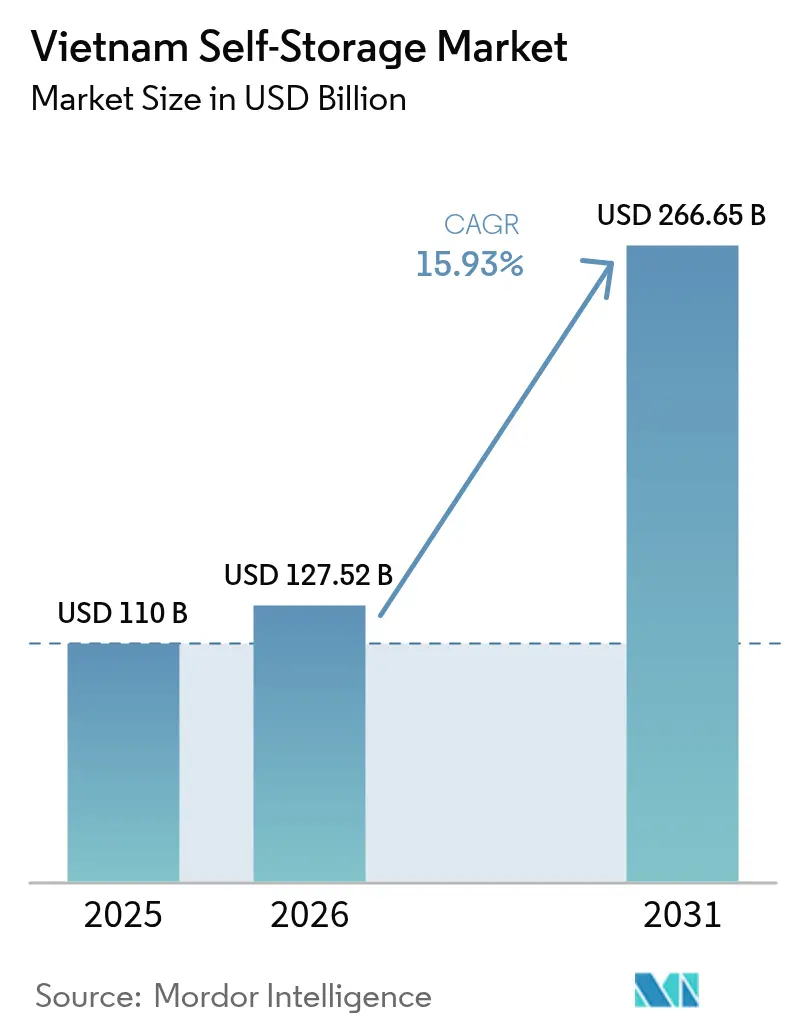
| Base Year Market Size (2025) | USD 110 Billion |
| Market Size (2026) | USD 127.52 Billion |
| Market Size (2031) | USD 266.65 Billion |
| Growth Rate (2026 - 2031) | 15.93 % |
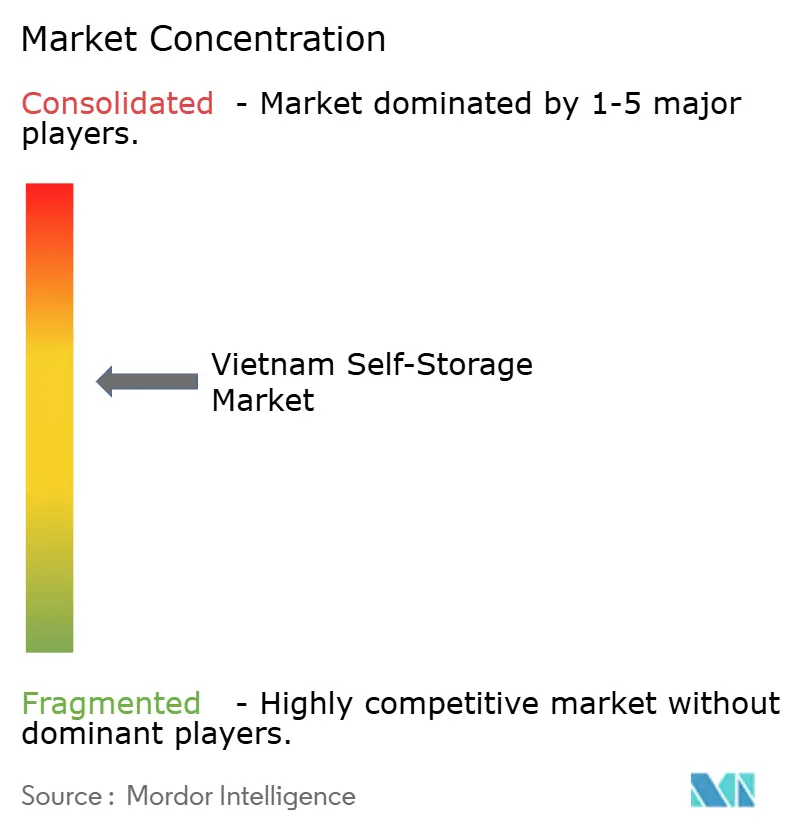
| Market Concentration | Medium |
Major Players
*Disclaimer: Major Players sorted in no particular order Image © Mordor Intelligence. Reuse requires attribution under CC BY 4.0. |
|
Vietnam Self-Storage Market Analysis by Mordor Intelligence
The Vietnam self-storage market size in 2026 is estimated at USD 127.52 million, growing from 2025 value of USD 110 million with 2031 projections showing USD 266.65 million, growing at 15.93% CAGR over 2026-2031. An urban population on track to hit 50% by the end of the decade, skyrocketing e-commerce sales, and shrinking apartment footprints in Ho Chi Minh City and Hanoi are the structural forces that keep demand for off-site space rising. Operators are layering technology into everyday operations, adding on-site inventory systems, and experimenting with valet pickup to widen appeal among city residents and micro-enterprises pressed for space. Land scarcity in downtown districts elevates development costs, yet the Vietnam self-storage market continues to grow as providers shift to multi-story formats and peripheral districts where zoning is easier and rents are lower. Foreign brands entering through joint ventures with local partners are lifting service standards, while first movers expand quickly to lock in strategic locations and high-yield customer clusters.
Key Report Takeaways
- By end-user, the consumer segment led with 67.20% of Vietnam self-storage market share in 2025; the business segment is projected to expand at an 18.58% CAGR through 2031.
- By facility type, non-climate-controlled units captured 56.40% of Vietnam self-storage market size in 2025, whereas valet/full-service sites are forecast to grow at 22.85% CAGR to 2031.
- By application use, E-commerce micro-fulfillment has emerged as the fastest-growing application segment, 42.60% of the Vietnam self-storage market size in 2025, with explosive online retail growth, which exceeded USD 20 billion in 2023, with a 29% CAGR to 2031.
- By unit size, 26–50 sq ft rooms accounted for 43.60% of Vietnam self-storage market size in 2025, yet sub-25 sq ft lockers are on track for a 19.76% CAGR to 2031.
Note: Market size and forecast figures in this report are generated using Mordor Intelligence’s proprietary estimation framework, updated with the latest available data and insights as of 2026.
Vietnam Self-Storage Market Trends and Insights
Drivers Impact Analysis*
| DRIVER | (~) % IMPACT ON CAGR FORECAST | GEOGRAPHIC RELEVANCE | IMPACT TIMELINE |
|---|---|---|---|
| Shrinking Urban Living Space in Tier-1 Cities Boosting Off-Site Storage | +4.2% | Ho Chi Minh City, Hanoi, Da Nang | Long term (≥ 4 years) |
| E-commerce SMEs' Need for Micro-Fulfillment Space | +3.8% | National, with concentration in Ho Chi Minh City and Hanoi | Medium term (2-4 years) |
| Expat and Digital-Nomad Influx Driving Short-Term Storage Demand | +2.7% | Ho Chi Minh City, Hanoi, Da Nang, Nha Trang | Short term (≤ 2 years) |
| Home-Renovation and Hybrid-Work Furniture Storage Spike | +1.9% | Urban centers nationwide | Short term (≤ 2 years) |
| Government Push to Formalize Micro-Businesses Requiring Compliant Storage | +2.3% | National | Medium term (2-4 years) |
| Rising Affluent Collectors Seeking Climate-Controlled Units | +1.6% | Ho Chi Minh City, Hanoi | Medium term (2-4 years) |
| Source: Mordor Intelligence | |||
Shrinking Urban Living Space Boosting Off-Site Storage
Vietnam’s largest cities see a steady rise in studio and one-bedroom rentals, with 40% of new leases in Ho Chi Minh City fitting that description.[1] When coupled with median home prices equal to 32.5 times median household income, residents inevitably look beyond their walls for secure storage. Operators in the Vietnam self-storage market respond by positioning multi-story sites along ring roads where land is cheaper yet still close to dense residential clusters. The long-run nature of urban land compression gives providers the confidence to invest in purpose-built facilities equipped with 24/7 access and remote monitoring. Over the forecast horizon, these sites form a distributed grid that expands in step with city sprawl and contributes materially to the long-term growth of the Vietnam self-storage market.
E-Commerce SMEs’ Need for Micro-Fulfillment Space
With national online retail surpassing USD 20 billion in 2023 and rising roughly 29% each year, small sellers require scalable inventory points near customers.[2] Flexible leases, pay-as-you-go fees, and embedded barcode tracking make self-storage an attractive middle ground between improvised spare-room stockpiles and full-scale warehousing. Leading operators now bundle cloud-based management dashboards, last-mile courier tie-ups, and secure unloading bays, effectively turning storage corridors into micro-fulfillment nodes. The Vietnam self-storage market benefits because the same square footage can earn higher turnover as goods cycle in and out more rapidly. Demand is densest in Ho Chi Minh City and Hanoi, yet secondary cities begin to emulate this pattern as regional e-commerce logistics mature.
Expat and Digital-Nomad Influx Driving Short-Term Demand
Vietnam’s visa-on-arrival ease, low cost of living, and vibrant tech scenes attract a transient population that values portability.[3] Typical rentals run from 1,000,000 VND to 5,000,000 VND per month depending on climate control and concierge services, and many opt for premium tiers offering English-language support and biometric entry. Short tenure means high churn, so occupancy analytics and automated billing become critical. Providers tap this segment by promoting flexible month-to-month contracts, app-based reservations, and free pickup within city limits. Revenues from this niche spill into larger units as nomads establish longer residencies, supporting the Vietnam self-storage market even in shoulder seasons.
Home-Renovation and Hybrid-Work Furniture Storage Spike
The shift to hybrid work has households repurposing living areas into offices, triggering short bursts of demand when furniture is stored off-site during remodels. Construction supply bottlenecks stretch project timelines, lengthening average stay per unit. Operators see weekday access peaks as contractors collect or return materials, prompting extensions of staffed hours and the rollout of secure loading docks. Though episodic, renovation-related demand lifts the Vietnam self-storage market during periods when consumer move-outs slow, smoothing revenue across the calendar.
Restraints Impact Analysis*
| RESTRAINTS | (~) % IMPACT ON CAGR FORECAST | GEOGRAPHIC RELEVANCE | IMPACT TIMELINE |
|---|---|---|---|
| Scarce Central-District Land Elevating Facility Rental Costs | -2.1% | Ho Chi Minh City, Hanoi | Long term (≥ 4 years) |
| Ambiguous Licensing Framework Causing Permitting Delays | -1.8% | National | Medium term (2-4 years) |
| Low Consumer Awareness Beyond Ho Chi Minh City | -1.6% | Secondary cities and provinces | Medium term (2-4 years) |
| FX-Driven Capex Volatility for Imported Modular Units | -0.9% | National | Short term (≤ 2 years) |
| Source: Mordor Intelligence | |||
Scarce Central-District Land Elevating Facility Costs
Prime sites inside District 1 and District 3 cost multiples of peripheral zones, squeezing feasibility for ground-up builds. Multi-story conversions of obsolete retail and commercial property partially offset land scarcity but carry higher structural retrofit expenses. Many operators pivot to ring-road parcels where entry costs are affordable, then rely on shuttle pickup to maintain customer convenience. These work-arounds keep the Vietnam self-storage market expanding yet shave a few points off potential CAGR, especially for entrants lacking patient capital.
Ambiguous Licensing Framework Causing Permitting Delays
Vietnam lacks a clearly defined self-storage category, so developers must navigate warehouse, retail, and general-service regulations simultaneously. Approval layers vary by district, leading to timeline slippage, escalating interest costs, and non-uniform fire-safety interpretations. While industry associations lobby for standardized rules, seasoned players mitigate risk by pre-consulting with local authorities and phasing projects to secure incremental permits. Regulatory opacity slows velocity but has not derailed the long-range expansion of the Vietnam self-storage market.
*Our forecasts treat driver/restraint impacts as directional, not additive. The impact forecasts reflect baseline growth, mix effects, and variable interactions.
Segment Analysis
By End-User: Business Segment Accelerates Through E-Commerce Integration
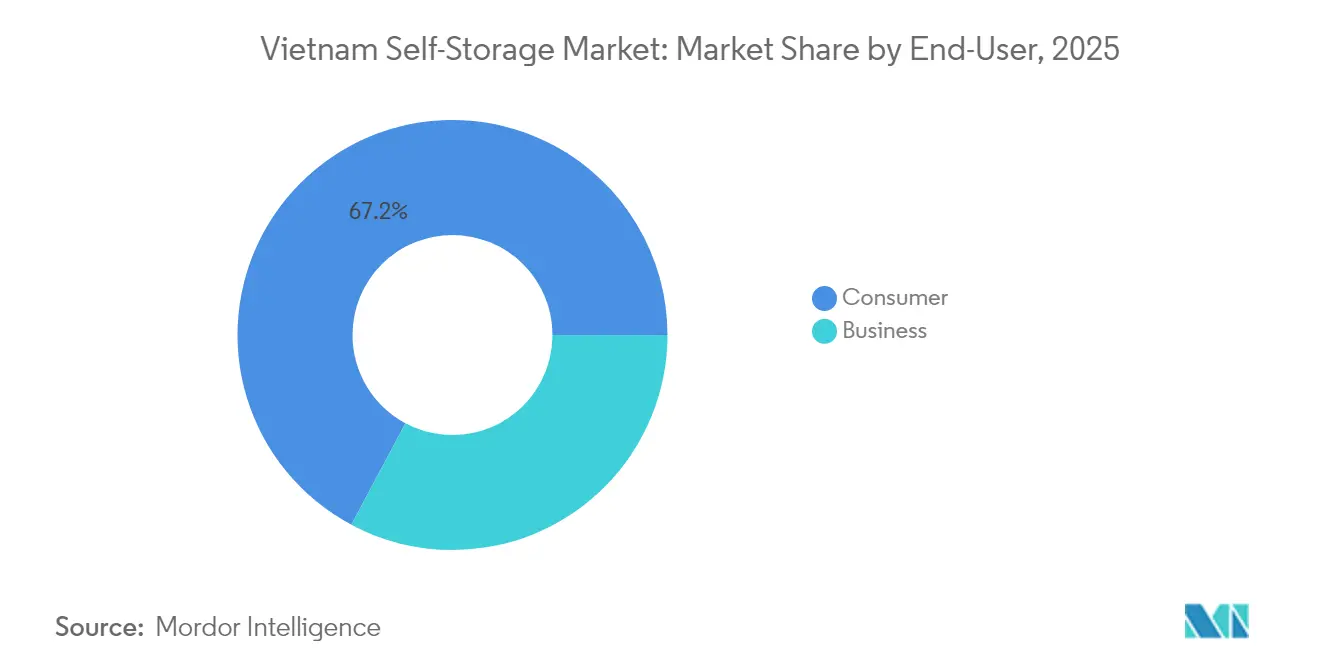
The consumer segment retained 67.20% of Vietnam self-storage market share in 2025 on the back of rising urban middle-class purchasing power. Shrinking apartments mean families send bulky furniture, seasonal décor, and recreational gear to off-site units, anchoring baseline occupancy. Vietnam self-storage market size attributable to urban residents is expected to advance steadily but at a lower clip than business demand. The business cohort, currently smaller, is expanding at an 18.58% CAGR to 2031, reflecting the surge of SMEs formalizing operations and seeking compliant storage. Operators courting this segment roll out plug-and-play inventory portals, barcode scanning, and temperature-monitored aisles that align with new packaging and EPR rules.
Momentum in the business segment feeds directly into higher revenue per square foot because turnover of parcels is faster than household belongings. Value-added logistics, such as pick-and-pack or last-mile dispatch desks, generate fee layers beyond core rent. Throughout the review period, the Vietnam self-storage industry sees cross-selling of insurance, seasonal surplus space, and late-night access packages as incremental boosters of average unit revenue. Successful facilities locate near arterial transport links to serve both city couriers and residential customers without sacrificing accessibility. This blend of demand cushions occupancy cycles and sustains the long-term trajectory of the Vietnam self-storage market.

By Facility Type: Climate-Control Premium Emerges Amid Tropical Challenges
Non-climate-controlled rooms commanded 56.40% of Vietnam self-storage market size in 2025 because they satisfy the majority of everyday needs at accessible price points. High humidity and temperature swings, however, pose risks to electronics, artwork, and wooden antiques. Wealthier collectors and corporate archives now account for a growing slice of bookings in climate-controlled aisles where humidity remains under 55% and ambient temperature stays below 25 °C. Differentiation strategies involve HEPA-filtered ventilation, remote environmental monitoring, and tiered pricing that encourages upsell. Operators forecast the premium tier to grow faster than the general pool, widening both unit spread and total revenue within the Vietnam self-storage market.
Valet and full-service concepts, on track for 22.85% CAGR, solve last-mile pain points by picking up items directly from customers and storing them in centralized depots. This format is capital-light on storefront space yet demands route-optimization software and multi-temperature vans, capabilities increasingly sourced through tech partnerships. Outdoor containerized storage targets construction firms and event contractors needing oversized or irregular-shape space, often in industrial belts outside the urban ring. Each facility archetype serves a distinct client set, underscoring how the Vietnam self-storage market diversifies to capture multiple layers of demand without diluting its core proposition.
By Unit Size: Micro-Units Capture Digital-Nomad Momentum
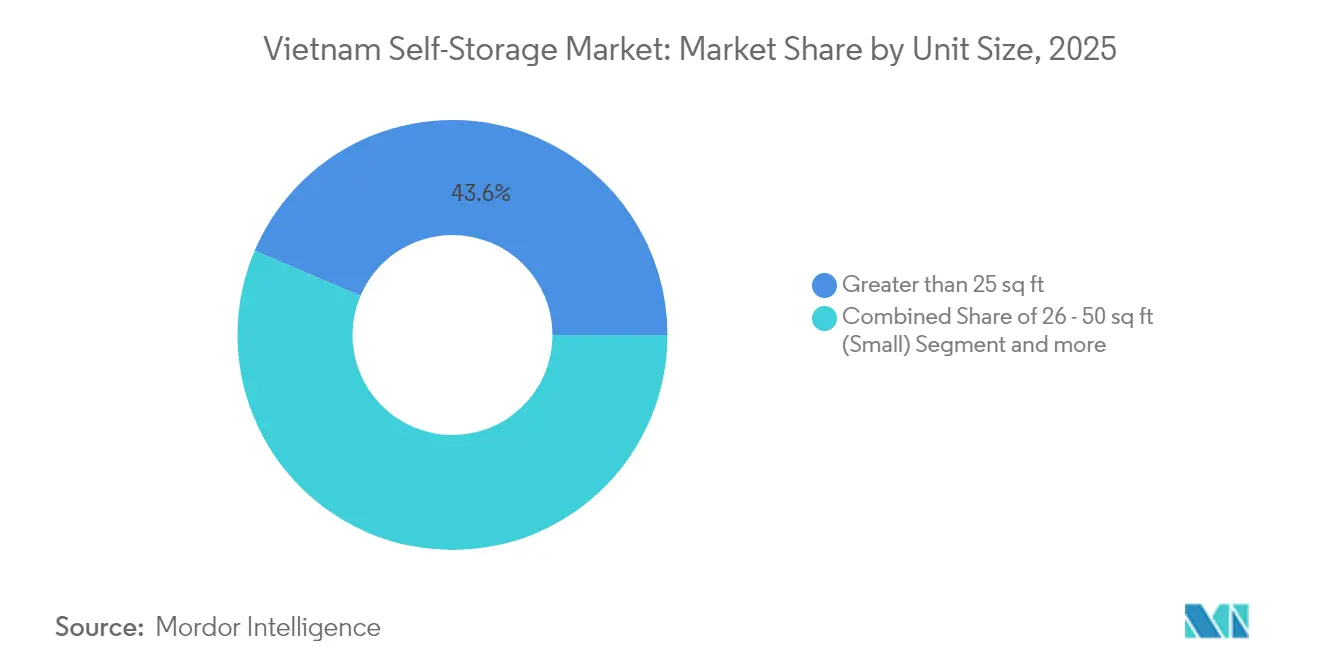
Medium-sized rooms of 26–50 sq ft held 43.60% of Vietnam self-storage market size in 2025, striking an ideal cost-to-volume balance for urban households and side-hustle entrepreneurs. Digital nomads and expatriates drive the traction of lockers under 25 sq ft, a niche forecast to grow at 19.76% CAGR through 2031. High turnover and premium service features, such as app-based biometric entry, permit operators to price these micro-units at higher yields per square foot. The Vietnam self-storage market therefore extracts more value from the same footprint by mixing small and mid-sized units inside one building.
Large rooms above 100 sq ft attract corporations storing seasonal inventory and affluent families archiving heirlooms, yet account for a smaller slice of occupancy because land costs discourage low-density layouts. Variable pricing strategies ensure every tier delivers margin, with lockers rented on daily tallies as low as USD 0.21, while larger rooms clear USD 43 each month. Across all sizes, cloud-connected sensors feed real-time occupant data to dashboards, letting managers upsell climate control or extend contracts before expiry. Such operational intelligence is rapidly becoming standard across the Vietnam self-storage market.
By Application Use-Case: E-commerce Fulfillment Transforms Traditional Storage Paradigms
E-commerce micro-fulfillment has emerged as the fastest-growing application segment, driven by Vietnam's explosive online retail growth which exceeded USD 20 billion in 2023 with a 29% annual growth rate, 2024. This application represents a fundamental shift from traditional storage concepts, as businesses transform self-storage units into operational logistics hubs equipped with inventory management systems and integrated with last-mile delivery networks. The segment's expansion is particularly pronounced among SMEs that prefer flexible mini-storage solutions over traditional warehousing, with operators like MyStorage reporting that business clients now form a significant portion of their customer base. Personal household goods currently dominates by volume, encompassing excess furniture, electronics, and personal belongings that urban residents cannot accommodate in increasingly compact living spaces where over 40% of new rentals are studios or serviced apartments.
Business inventory and documents storage is experiencing steady growth as Vietnam's formalization of micro-businesses creates compliance requirements for proper record-keeping and inventory management. The implementation of Extended Producer Responsibility (EPR) regulations effective January 2024 has intensified demand for compliant storage solutions, particularly among businesses handling packaging materials that must meet specific recycling targets Nguyen, 2025. Furniture and renovation storage represents a cyclical but lucrative segment, driven by Vietnam's expanding middle class and their increasing propensity for home improvements as disposable income rises. Seasonal items and sports gear storage, while smaller in volume, commands premium pricing due to the specialized handling requirements and the seasonal nature of demand, particularly for equipment used during Vietnam's distinct wet and dry seasons. The convergence of these application segments is creating opportunities for operators to develop specialized facilities with features tailored to specific use cases, such as climate-controlled units for sensitive business documents or accessible ground-floor units optimized for frequent e-commerce inventory turnover.
Geography Analysis
Southern Vietnam anchors demand momentum, with Ho Chi Minh City generating the highest absolute revenue and housing the densest network of multi-story sites. Peripheral districts such as Thu Duc benefit from new metro lines and ring-road extensions, allowing self-storage operators to tap cost-effective parcels while staying within a 20-minute drive of key residential towers. The Vietnam self-storage market, already clustered along East-West traffic corridors, leverages this infrastructure to roll out valet routes that cover both CBD and suburban pickup windows. Developers in the south emphasize vertical expansion, converting obsolete retail shells into six-floor facilities that extract value from tight footprints.
Northern Vietnam follows a slightly different pattern where mixed-use developments integrate storage levels beneath residential blocks in Hanoi’s emerging urban districts. Tenants appreciate on-premise access, and property developers gain a recurring income stream that stabilizes project cash flow. Vietnamese and Singaporean joint ventures are behind several of these hybrid complexes, giving foreign investors a foothold in the Vietnam self-storage market without direct land purchases. Regulatory acceptance of mixed-use designs accelerates project clears, offsetting licensing ambiguity elsewhere.
Central and coastal provinces, led by Da Nang and Nha Trang, register early-stage adoption with only a handful of modern facilities yet growing tourist and expatriate inflows. Local authorities courting digital-nomad visa programs view self-storage as an essential service amenity, easing planning approvals for small-footprint buildings near coworking hubs. Although current contribution to overall Vietnam self-storage market share remains modest, the blended growth rate outpaces that of tier-1 cities, signaling a long runway once awareness campaigns take root. Improved highway connectivity and flight links into these secondary hubs are forecast to lift unit take-up as transient populations scale.
Regulatory Landscape
Vietnam does not have a standalone licensing category for self-storage, so operators typically register under warehousing and storage (VSIC 5210). Decision 36/2025/QD-TTg (effective November 1, 2025) updates the Vietnam Economic Industry System while keeping the warehousing and storage classification used by self-storage providers. For investment structuring, foreign-invested entities often follow the standard pathway under the Law on Investment 2020 and Law on Enterprises 2020, securing an Investment Registration Certificate (IRC) via the local Department of Planning and Investment (DPI) before obtaining an Enterprise Registration Certificate (ERC), with additional sub-licenses depending on the specific services.
Facility compliance is generally driven by building and operational conditions rather than a single sector permit. Fire prevention and fighting approvals under the Ministry of Public Security often shape fit-out requirements and project opening timelines, and larger sites can also fall under environmental review thresholds, for example for facilities exceeding 5,000 sq m. On the service standardization side, TCVN 14317:2025 issued by the Ministry of Science and Technology sets technical specifications for self-storage services, including security, access control, and digital management integration. Separately, Decree 94/2024/ND-CP established a national real estate information and database system, which increases the emphasis on data reporting and system integration for real-estate-linked operations where applicable.
Value Chain Analysis
Vietnam self-storage operators typically source supply through three upstream streams: real estate (leasing or converting retail or commercial shells into multi-story storage), facility build-out and systems (racking, doors, access-control, CCTV, and fire safety systems), and software layers for bookings, billing, and inventory visibility, which support fast-turnover use cases such as e-commerce micro-fulfillment. Land scarcity and permitting variability in central districts push site selection toward ring roads and peripheral districts, which in turn increases reliance on last-mile partners, including couriers, movers, and valet pickup fleets, to keep facilities convenient for customers in Ho Chi Minh City and Hanoi.
Downstream, revenue comes from core unit rental plus add-ons such as pickup and delivery, packaging, and business services (barcode-based inventory management and dashboard access). Broader logistics ecosystem conditions influence cost and execution, including Decision 2229/QD-TTg (October 2025), which positions logistics as a national priority under the Vietnam Logistics Service Development Strategy 2025-2035, supporting investments that improve transport efficiency and digitalization. Industrial real estate conditions also shape conversion options and competition for suitable stock, with ready-built warehouse and factory occupancy reported at high levels, about 88-89% through 2025, encouraging adaptive reuse and mixed-use formats rather than greenfield development.
Competitive Landscape
Vietnam’s self-storage arena features roughly twenty active brands, with no single operator controlling a dominant majority of installed square footage. MyStorage, the local pioneer, reports 98% average occupancy and 50% annual revenue gains, illustrating the upside of first-mover proximity to high-rise condominiums. Extra Space Asia and StorHub import operational templates honed in Singapore and Hong Kong, bringing modular racking, dynamic pricing algorithms, and regional customer databases to capture early adopters looking for international-grade security. Their entry fosters healthy rivalry in the Vietnam self-storage market and sets new benchmarks for climate control and digital booking.
Partnerships and strategic capital infusions accelerate network build-out. BitcoinVN’s stake in MyStorage injects blockchain-based payment rails and real-time asset-tracking, differentiating customer experience and lowering fraud risk. Local firms such as KingKho and Saigon Storage harness home-field knowledge to secure council approvals quickly and adopt flexible lease formats prized by Vietnamese SMEs. They often beat multinational peers to land deals in district-level industrial zones, maintaining a defendable share even as foreign brands scale.
Technology constitutes the critical battleground. Operators deploy AI-driven occupancy forecasts to calibrate discount ladders and margin per square foot, while mobile dashboards alert customers to humidity shifts and overdue bills. Up-selling of insurance, padlock upgrades, and 24-hour concierge access layers revenue without additional footprint. Consolidation is expected once early growth moderates, and well-capitalized players eye bolt-on acquisitions to extend service into secondary cities. Regardless of mergers ahead, customer preferences for digital convenience and transparent pricing will dictate the winners in the Vietnam self-storage market.
Vietnam Self-Storage Industry Leaders
-
MyStorage
-
Saigon Storage
-
TITAN Containers
-
Extra Space Asia Corporate
-
KingKho Mini Storage
- *Disclaimer: Major Players sorted in no particular order
Market Opportunities and Future Outlook
White space is concentrated in modern, tech-enabled storage formats beyond the current tier-1 cluster, particularly where operators can combine small-unit density (lockers and 26-50 sq ft rooms) with pickup services and digital onboarding to address low awareness beyond Ho Chi Minh City. Within the report scope, the business segment is expanding faster as demand for compliant storage grows, and the operational playbook is already visible in market behavior. Facilities that bundle inventory portals, barcode scanning, and frequent access can target e-commerce sellers as micro-fulfillment nodes rather than passive storage.
With Vietnam online retail above USD 20 billion in 2023 and high turnover supporting stronger revenue per sq ft, operators can frame standardized SME-focused packages around receiving bays, courier handoffs, and flexible contracts that sit between traditional warehousing and informal home-based inventory. Another opportunity is compliance-led upgrades and differentiation through standards and data integration. TCVN 14317:2025 formalizes expectations around access control, security, and digital management for self-storage services, encouraging operators toward more consistent technology stacks and auditable processes. The same direction appears in adjacent real estate and industrial ecosystems, including Decree 94/2024/ND-CP for national real estate data infrastructure, and in June 2026 Siemens Limited partnering with Pacific Land JSC on a smart, tech-forward industrial park concept, reinforcing demand for digitized operations across property-linked services. For self-storage providers, this creates openings for climate-controlled offerings with humidity and temperature tracking, enterprise-grade reporting for business users, and partnerships that bring storage closer to customer traffic flows, for example through retail-footprint integrations.
Recent Industry Developments
- March 2026: MyStorage announced a strategic partnership with Ministop Vietnam to integrate mini-storage units into the convenience store chain's footprint. The model extends self-storage access points into high-traffic retail locations and supports smaller, higher-turnover unit formats suited to urban residents and micro-SMEs.
- October 2025: MyStorage secured a multi-million-dollar investment from Emerging Markets Investment Advisers (EMIA), a Singapore-based private equity fund manager. The funding strengthened expansion capacity for multi-site rollouts and supported service upgrades such as digital payments and technology-led operations.
- July 2024: SPX Express and Frasers Property Vietnam allocated USD 30 million to build an automated sorting center in Binh Duong province. Faster, more reliable last-mile throughput improves the operating environment for storage providers serving e-commerce micro-fulfillment users in the South-East industrial belt.
Research Methodology Framework and Report Scope
Market Definition and Coverage
We size the Vietnam self-storage market as revenue earned from renting dedicated storage space and related on-site services at self-storage facilities, across consumer and business customers, within Vietnam.
Scope exclusions: We exclude general warehousing and 3PL contract logistics, moving-only services, and long-term industrial storage that is not rented as self-storage space.
Segmentation Overview
-
By End-User
- Consumer
- Business
-
By Facility Type
- Climate-Controlled Facilities
- Non-Climate-Controlled Facilities
- Valet / Full-Service Storage
- Containerised Outdoor Storage
-
By Unit Size
- Greater than 25 sq ft (Locker)
- 26 – 50 sq ft (Small)
- 51 – 100 sq ft (Medium)
- Less than 100 sq ft (Large)
-
By Application Use-Case
- Personal Household Goods
- Seasonal Items and Sports Gear
- Furniture and Renovation Storage
- Business Inventory and Documents
- E-commerce Micro-Fulfillment
-
By Geography (City)
- Ho Chi Minh City
- Hanoi
- Da Nang and Central Coast
- South-East Industrial Provinces (Binh Duong, Dong Nai)
- Other Regions (Can Tho and Mekong, Northern Provinces)
Data Sources, Market Sizing, and Validation
Desk Research
Desk research helped us map the demand and supply conditions that sit behind self-storage adoption in Vietnam, especially in Hanoi and Ho Chi Minh City where space constraints show up first. We referenced public statistics on population, household formation, and internal migration, and then linked those with indicators that reflect small business formation and retail activity.
Sources used include non-paywalled publications such as Vietnam General Statistics Office releases, World Bank urban development indicators, UN population datasets, government legal and land planning portals, and customs trade series where relevant to storage-related equipment flows. We also reviewed operator websites, price cards, location lists, and reputable press articles to understand how units are sold, which services are bundled, and how pricing changes by district. In addition, a paid subscription database for company financials and another for news and corporate actions were used selectively to validate operator scale and facility timelines. This list is illustrative, and many other public and paid sources were also used for cross-checking, clarification, and validation.
Primary Interviews and Surveys
Primary work focused on confirming what is actually being sold in Vietnam and how utilization develops after a site opens, since public data is limited at city and facility level. We spoke with facility operators, property managers, and local industry participants, and we also gathered input from business users and household customers to validate typical unit mixes, occupancy paths, and discounting behavior across key metros.
Distribution of primary research fieldwork respondents
| Company type | Respondent position |
|---|---|
| Top tier: 36% | CXOs: 15% |
| Mid tier: 49% | Functional/Unit leaders: 40% |
| Smaller Players: 15% | Managers: 45% |
Market-Sizing & Forecasting
The core model starts with a top-down rebuild of Vietnam demand by tying the addressable customer pool to paid-storage penetration, and then translating this into occupied area and revenue using typical unit-size splits and price points. Where useful, the totals were corroborated through selective bottom-up checks, such as rolling up a sample of facilities by usable area, estimated occupancy, and monthly rates, which then helped adjust outliers.
Inputs that mattered in this market include facility count and opening timelines, rentable area by unit size band, occupancy ramp profiles after launch, average monthly rent per square foot (or per unit) by city, and the share of revenue coming from add-ons like packing materials and pickup or valet style service. Forecasts were built using scenario analysis with a simple demand-and-supply balance, where drivers such as urban household density, small business activity, and the new facility pipeline were stress-tested with interview feedback. When a facility or city datapoint was missing, we filled gaps using closest-city price and occupancy proxies, followed by a check against what operators described as achievable utilization and discount ranges.
Data Validation & Update Cycle
We ran multi-step checks so the final numbers stay consistent with what the Vietnam market can realistically supply and absorb. Outputs were compared against independent signals such as known facility capacity, stated unit size mixes, and observed rent ranges, and then any sharp variances were reviewed again before sign-off.
If a large mismatch showed up, analysts re-contacted sources to confirm whether it came from temporary promotions, a new site opening, or a one-off occupancy shift. The report is refreshed annually, and interim updates are made when material events occur, such as major facility launches or clear demand shocks. Before delivery, we perform a final pass to ensure assumptions and currency conversions reflect the latest available information.
Mordor Intelligence's Vietnam Self Storage Market Size Measured Against Other Published Estimates
Published market sizes for Vietnam self-storage can differ even when the topic label looks the same, because the underlying timing and pricing logic are not always aligned. Differences usually come from when rents are captured, how occupancy is treated during ramp-up, and whether adjacent services are counted as part of self-storage revenue.
A refresh-led point is that the same facility can look larger or smaller depending on the exchange rate month used, the handling of promotional discounts, and how fast average price per square foot is allowed to rise as utilization improves. By anchoring rates to recent on-the-ground price cards and then rechecking occupancy and unit mix before applying a single currency timing, the estimate stays closer to the billed revenue reality in Mordor Intelligence.
Benchmark comparison
| Source | Market Size | Gaps in Research Methodology |
|---|---|---|
| Mordor Intelligence | USD 127.52 M (2026) | |
| Trade Journal A | USD 160.00 M (2026) | Often reflects asking rents at list price with limited discount normalization, and may apply optimistic stabilized occupancy earlier than typical ramp timelines in Vietnam metros. |
| Regional Consultancy B | USD 95.00 M (2025) | May use an earlier rate snapshot and a conservative occupancy assumption, and can exclude valet or bundled service revenue that some operators realize alongside unit rent. |
The spread in the table mostly tracks timing and pricing treatment rather than a fundamentally different demand story. When rent levels, discounting, and occupancy ramp are aligned to consistent currency timing and validated with operator feedback, the resulting market size becomes easier to reproduce and track over time.
Key Questions Answered in the Report
What is the current size of the Vietnam self-storage market in 2026?
The market is valued at USD 127.52 million in 2026 and is projected to grow at a 15.93% CAGR to USD 266.65 million by 2031.
Why are small lockers growing faster than larger units?
Units below 25 sq ft cater to digital nomads and expatriates who need compact, short-term storage; this segment is posting a 19.76% CAGR, the fastest across all size tiers.
How much of the Vietnam self-storage market share does the consumer segment hold?
Consumers accounted for 67.20% of market share in 2025, reflecting widespread space constraints in urban apartments.
What makes valet or full-service storage attractive in Vietnam?
Traffic congestion and limited vehicle ownership in big cities make door-to-door pickup convenient, supporting a 22.85% CAGR for valet/full-service formats.
Are climate-controlled units necessary in a tropical climate?
Yes. High humidity threatens electronics, artwork, and wooden items, prompting affluent collectors and corporate archives to opt for climate-controlled rooms that maintain stable environmental conditions.
What regulatory hurdles do self-storage developers face in Vietnam?
The absence of a dedicated self-storage category forces projects to comply with mixed warehouse and service regulations, leading to longer permitting times and inconsistent local enforcement.