
Vietnam Metal Can Packaging Market Size and Share
Market Overview
| Study Period | 2020 - 2031 |
|---|---|
| Forecast Data Period | 2026 - 2031 |
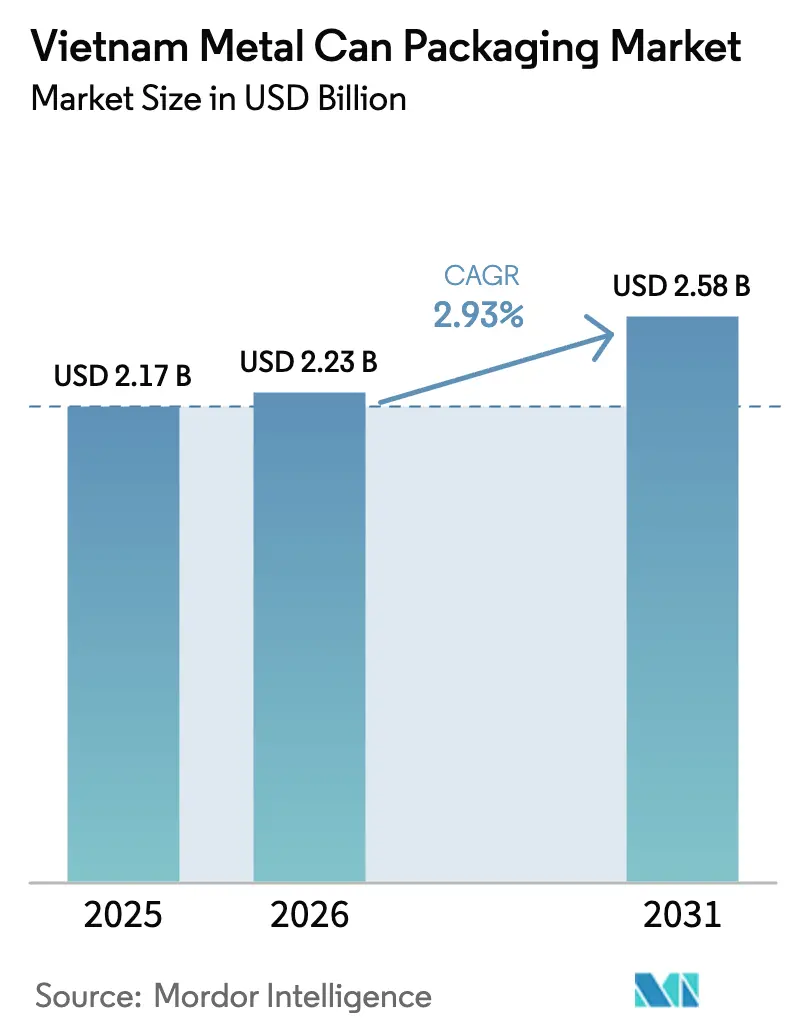
| Base Year Market Size (2025) | USD 2.17 Billion |
| Market Size (2026) | USD 2.23 Billion |
| Market Size (2031) | USD 2.58 Billion |
| Growth Rate (2026 - 2031) | 2.93 % |
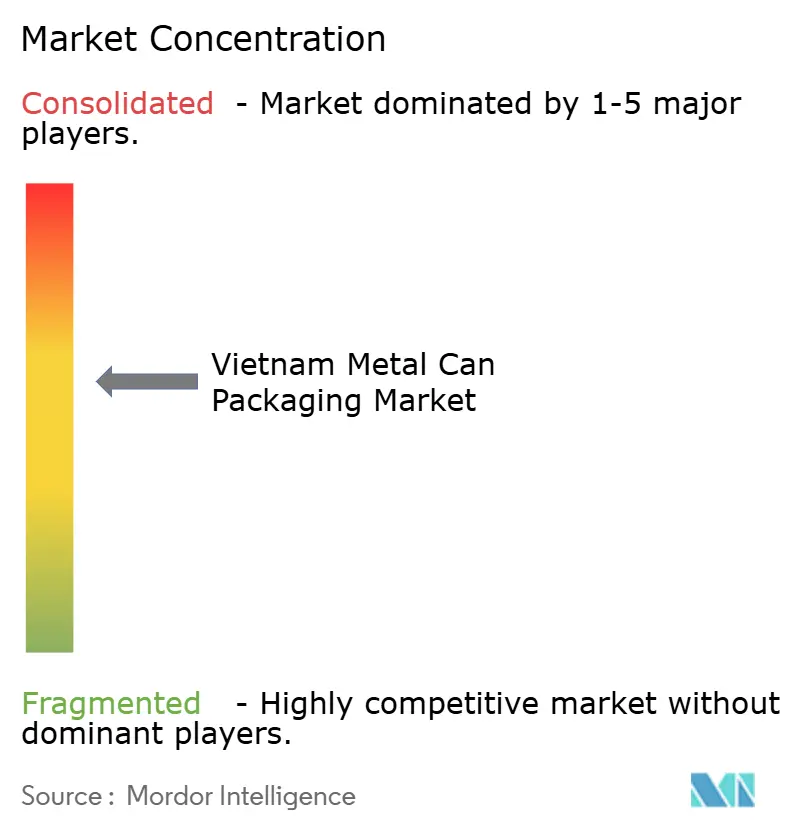
| Market Concentration | Medium |
Major Players *Disclaimer: Major Players sorted in no particular order Image © Mordor Intelligence. Reuse requires attribution under CC BY 4.0. | |
Vietnam Metal Can Packaging Market Analysis by Mordor Intelligence
The Vietnam metal can packaging market size was valued at USD 2.17 billion in 2025 and estimated to grow from USD 2.23 billion in 2026 to reach USD 2.58 billion by 2031, at a CAGR of 2.93% during the forecast period (2026-2031). This growth reflects a maturing regulatory environment that prioritizes recyclable substrates and rewards manufacturers capable of meeting mandatory collection targets. Rising urban disposable income supports steady beverage and food consumption, while government foreign-direct-investment incentives worth VND 66.38 billion (USD 2.68 million) channel capital into supporting-industry upgrades. The Vietnam metal can packaging market benefits from a new domestic hot-rolled-coil supply that reduces material lead times and insulates producers from anti-dumping duties on Chinese steel. In parallel, closed-loop pilots prove commercial feasibility for high-recycled-content cans, positioning the Vietnam metal can packaging market at the forefront of sustainability-driven innovation.
Key Report Takeaways
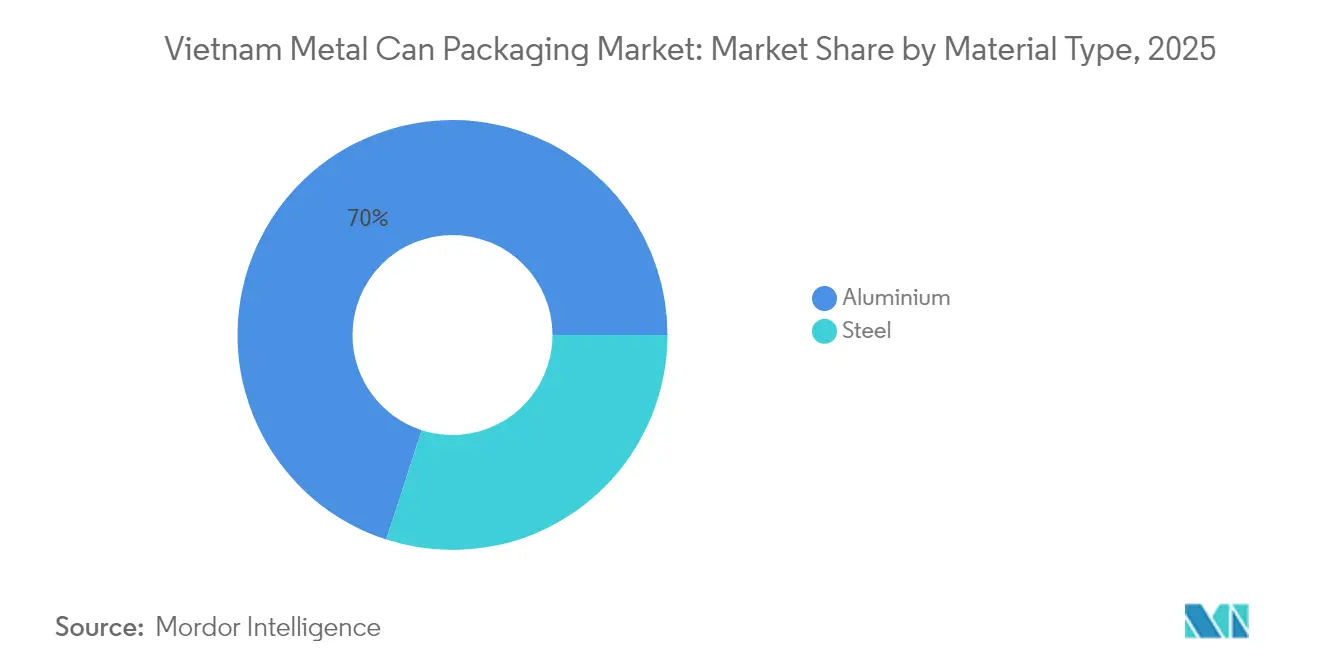
- By material type, aluminum captured 70.02% of the Vietnam metal can packaging market share in 2025 and grew at a 4.21% CAGR through 2031.
- By can structure, two-piece designs held 52.78% share of the Vietnam metal can packaging market size in 2025, Monobloc Aerosol is advancing at a 5.61% CAGR through 2031.
- By capacity, 250-500 ml formats commanded 31.05% revenue share in 2025, while ≤250 ml cans are projected to expand at a 4.73% CAGR between 2026-2031.
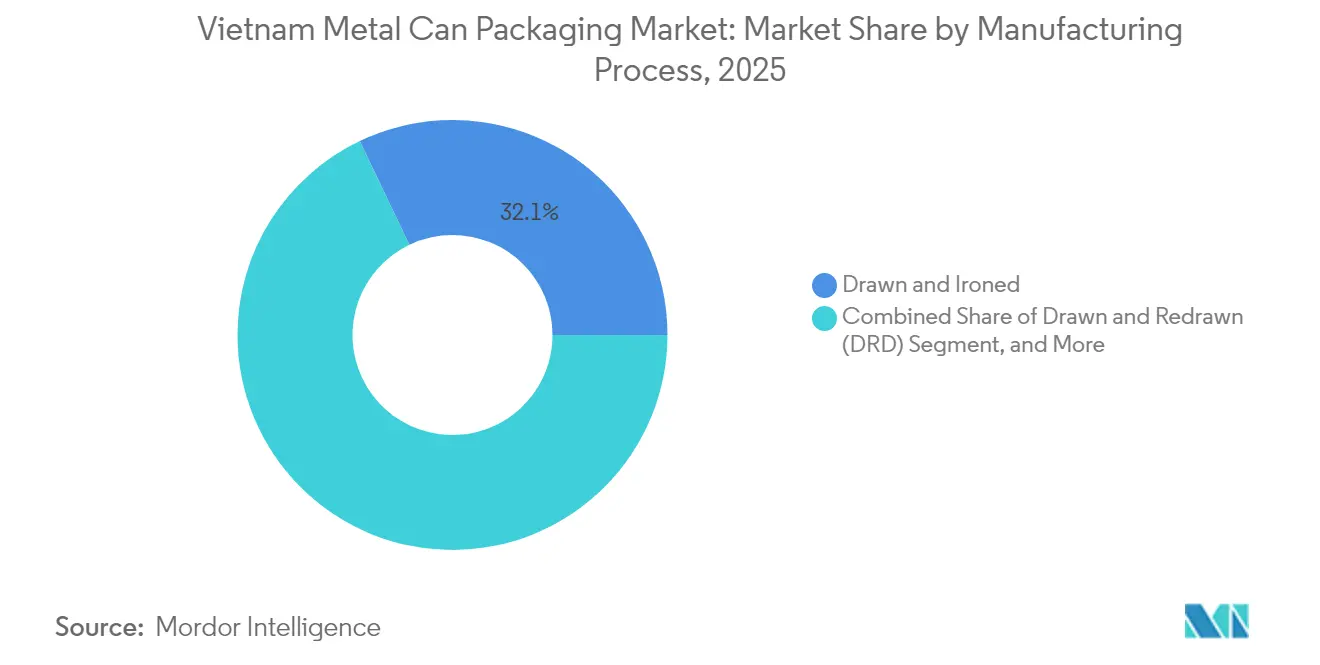
- By manufacturing process, D&I production accounted for 32.10% of the Vietnam metal can packaging market size in 2025; impact extrusion is set to grow at a 4.62% CAGR through 2031.
- By end-user, beverages led with 39.85% share of the Vietnam metal can packaging market size in 2025, whereas pharmaceuticals are advancing at a 4.96% CAGR through 2031.
Note: Market size and forecast figures in this report are generated using Mordor Intelligence’s proprietary estimation framework, updated with the latest available data and insights as of 2026.
Vietnam Metal Can Packaging Market Trends and Insights
Drivers Impact Analysis*
| Driver | (~) % Impact on CAGR Forecast | Geographic Relevance | Impact Timeline |
|---|---|---|---|
| Growing demand for convenience food and beverages | +0.8% | Ho Chi Minh City, Hanoi, Da Nang | Medium term (2-4 years) |
| High recycling rates and sustainability commitments | +0.6% | National, pilot programs in major cities | Long term (≥ 4 years) |
| Expansion of modern retail and e-commerce networks | +0.5% | Urban centers, moving to secondary cities | Medium term (2-4 years) |
| Domestic HRC capacity expansion improving input supply | +0.4% | National, Dung Quat complex focal point | Short term (≤ 2 years) |
| Closed-loop beverage-can recycling pilots | +0.3% | Ho Chi Minh City and Hanoi | Long term (≥ 4 years) |
| Government FDI incentives for supporting industries | +0.2% | National industrial zones | Medium term (2-4 years) |
| Source: Mordor Intelligence | |||
Growing Demand for Convenience Food and Beverages
Rapid urbanization is transforming grocery baskets and boosting single-serve formats. The food-processing sector expanded 7.4% in 2024 to USD 79.3 billion, and soft-drink consumption hit 4.658 billion liters, a 4.8% year-over-year increase.[1] Domestic leaders such as Vinamilk posted Q2 2024 revenue of VND 11,850 billion (USD 478 million), reaffirming demand for shelf-stable, portion-controlled packages. The 250-500 ml range already dominates, yet ≤250 ml cans record the fastest CAGR due to e-commerce and on-the-go lifestyles. Premium ready-to-drink energy beverages and alcoholic seltzers further widen the application base, sustaining volume growth for the Vietnam metal can packaging market.
High Recycling Rates and Sustainability Commitments
Vietnam’s Extended Producer Responsibility law enforces a minimum 22% aluminum recycling rate from January 2024.[2] HEINEKEN Vietnam processed 850 tonnes of used cans in its 2024 pilot, while Crown Holdings targets a 92% beverage-can collection rate by 2030. These initiatives cut raw-material costs, unlock secondary-aluminum feedstock and burnish brand credentials, giving the Vietnam metal can packaging market a clear sustainability advantage over flexible plastic competitors.
Expansion of Modern Retail and E-Commerce Networks
Logistics turnover reached USD 40-42 billion in 2024, expanding 14-16% annually despite last-mile costs at 16.5% of GDP. New highways and Long Thanh Airport improve distribution speed, enabling omnichannel strategies that favor smaller cans with vivid graphics. Retailers demand standardized footprints, pushing two-piece cans to the forefront for both shelf appeal and automated palletization. Rising e-grocery penetration further anchors growth for the Vietnam metal can packaging market.
Domestic HRC Capacity Expansion Improving Input Supply
Hòa Phát’s Dung Quat 2 complex came fully online in Q4 2025, supplying 40,000 tonnes of crude steel daily and eliminating exposure to Chinese HRC antidumping duties of 19.38-27.83%. Lead-times for can-sheet fall to 15-20 days, freeing working capital and enabling agile production schedules. As local HR coil availability improves, the Vietnam metal can packaging market gains a durable cost cushion versus import-dependent peers.
Restraints Impact Analysis*
| Restraint | (~) % Impact on CAGR Forecast | Geographic Relevance | Impact Timeline |
|---|---|---|---|
| Rising competition from flexible plastic and paper formats | -0.7% | Nationwide, food packaging segment | Medium term (2-4 years) |
| Metal price volatility and emerging trade tariffs/CBAM | -0.5% | Global but affects local plants | Short term (≤ 2 years) |
| Limited domestic rolling capacity for can-sheet quality | -0.4% | Industrial clusters | Medium term (2-4 years) |
| Urban logistics bottlenecks raising last-mile costs | -0.3% | Ho Chi Minh City, Hanoi, Da Nang | Short term (≤ 2 years) |
| Source: Mordor Intelligence | |||
Rising Competition from Flexible Plastic and Paper Formats
Paper-based Tetra Recart claims 85% lower emissions than cans and began domestic runs at Doveco Sơn La in late 2024.[3] SCG’s USD 27.3 million purchase of Starprint Vietnam accelerates lightweight paper solutions. Nearly 4,000 plastic firms allocate 39% of capacity to packaging, exerting pricing pressure. Weight savings matter for e-commerce, yet cans still excel in carbonation retention, tamper evidence and premium cues, sustaining core demand for the Vietnam metal can packaging market.
Metal Price Volatility and Emerging Trade Tariffs/CBAM
Aluminum spot prices swung sharply on the London Metal Exchange during 2024, forcing producers to hedge. The EU Carbon Border Adjustment Mechanism adds compliance costs to exporters, while U.S. tariff uncertainty keeps risk premiums elevated. Domestic manufacturers face higher power tariffs and compete for scrap as recycled-content mandates tighten. Vertical integration and long-term contracts partly offset volatility, but these external shocks trim margins and temper the CAGR for the Vietnam metal can packaging market.
*Our forecasts treat driver/restraint impacts as directional, not additive. The impact forecasts reflect baseline growth, mix effects, and variable interactions.
Segment Analysis
By Material Type: Aluminum Dominance Strengthened by EPR Mandates
Aluminum captured 70.02% of the Vietnam metal can packaging market share in 2025, a lead cemented by the 22% recycling quota that came into force the same year. The Vietnam metal can packaging market size for aluminum-based formats is projected to expand at a 4.21% CAGR through 2031 as pharmaceutical and personal-care brands prioritize high-purity barriers. Domestic plans to expand bauxite-to-aluminum refining at Lâm Đồng promise future supply security while cutting freight emissions.
Steel retains a foothold in large-volume food cans where rigidity and cost advantages prevail, especially above 1,000 ml. Hòa Phát’s in-house HRC drives down delivered prices, but the metal’s heavier weight handicaps long-distance logistics. As brand owners pledge carbon neutrality, aluminum’s proven closed-loop recyclability keeps siphoning demand from steel, reinforcing the Vietnam metal can packaging market growth trajectory.

By Can Structure: Two-Piece Technology Delivers Scale and Graphics
Two-piece cans accounted for 52.78% of the Vietnam metal can packaging market in 2025 thanks to high-speed D&I lines and photo-quality printing. Continuous lightweighting shrinks wall gauges without sacrificing strength, lowering per-unit metal use and freight costs. The Vietnam metal can packaging market size for two-piece formats will increase in tandem with beverage output and omnichannel retail growth.
Monobloc aerosol containers exhibit a 5.61% CAGR to 2031, propelled by personal-care and pharma spray products that demand seamless walls for pressure resistance. CANPACK’s Quadromix short-run technology enables seasonal promotions, improving shelf visibility. While three-piece bodies serve bulky food packs, investments tilt toward flexible two-piece lines that maximize uptime and graphics flexibility.
By Capacity/Size: Convenience Packs Outpace Family-Sized Formats
Portion control drives the 250-500 ml category to 31.05% share in 2025 as urban consumers favor on-the-go beverages. The Vietnam metal can packaging market sees ≤250 ml models rising 4.73% annually because they tuck neatly into e-commerce mailers and appeal to calorie-conscious buyers.
Family-sized 500-1,000 ml cans still populate foodservice and at-home sharing occasions, yet slower velocity limits growth. Over 1,000 ml containers address industrial lubricants and bulk foods, niches insulated from immediate substitution. As smartphone retail apps proliferate, compact cans with tamper-evident ends will gain further ground, sustaining segment mix evolution within the Vietnam metal can packaging market.
By Manufacturing Process: Impact Extrusion Gains Regulatory Tailwinds
D&I remains the production workhorse with 32.10% share, favored for long beverage runs that surpass one billion units annually. Unit costs fall as line speeds exceed 2,000 cans per minute, reinforcing dominance in carbonated drinks. The Vietnam metal can packaging market depends on these efficiencies to keep pace with price-sensitive consumers.
Impact extrusion registers a 4.62% CAGR owing to pharma-grade aerosol demand. Seamless bodies satisfy drug-stability protocols under Vietnam’s Circular 12/2025/TT-BYT. Drawn-and-redrawn processes carve out space in odd-shaped food packs, but capital budgets prioritize extrusion upgrades that meet stringent good-manufacturing-practice audits.
By End-User Industry: Pharmaceuticals Lead Growth While Beverages Anchor Volume
Beverages delivered 39.85% of the Vietnam metal can packaging market size in 2025, bolstered by energy drinks and alcoholic seltzers. Soft drinks alone topped 4.658 billion liters that year, showing a resilient thirst for canned refreshment. Brands leverage two-piece aluminum to communicate premium cues and recyclability, a message that resonates with eco-aware Gen Z shoppers.
Pharmaceuticals expand 4.96% annually, the fastest among tracked sectors. Serialization and child-resistant closures become mandatory, fueling demand for compliant metal formats with barrier integrity. Food remains a steady baseline, while personal care absorbs monobloc aerosol systems for deodorants and hair sprays. Collectively, these applications diversify revenue streams and safeguard the Vietnam metal can packaging market against single-segment shocks.
Geography Analysis
Vietnam’s industrial corridors in Ho Chi Minh City and Hanoi collectively generate the bulk of can demand, reflecting dense populations and proximity to beverage, food and pharmaceutical factories. The Vietnam metal can packaging market size in the southern cluster benefits from direct access to the new Vung Tau deep-sea port and in-house steel supply, shaving logistics costs and transit times. Improved road infrastructure adds redundancy, making trucking into the Mekong Delta smoother during flood season.
Northern production zones leverage lower electricity tariffs and government incentives inside Bac Ninh and Hai Phong industrial parks. Cross-border trade with China supplies machinery but also exposes plants to tariff swings, so local executives hedge with multi-sourcing strategies. Rapid suburbanization around Hanoi increases grocery shelf space, translating into incremental volume for regional canners.
Secondary cities such as Da Nang and Can Tho emerge as satellite hubs, drawing FDI with cheaper land leases and vocational training grants. Crown Holdings’ Da Nang plant, recognized for water-saving technology, signals confidence in central Vietnam’s growth prospects. As 3,000 km of new highways open by 2025, distributors can shuttle finished cans nationwide within 48 hours, a critical service-level improvement that benefits the Vietnam metal can packaging market.
Regulatory Landscape
Vietnam’s regulatory framework for metal can packaging is shaped by product-safety rules for direct-contact applications and environmental compliance obligations that shift end-of-life responsibility to producers. For food-contact metal packaging, the Ministry of Health’s QCVN 12-3:2011/BYT (issued under Circular 34/2011/TT-BYT) sets baseline safety requirements that can-makers and fillers reference when qualifying inks, coatings, and lacquers used on cans and ends.
On sustainability and waste management, Vietnam’s Law on Environmental Protection 2020 (notably Articles 54 and 55) establishes Extended Producer Responsibility (EPR) obligations for packaging. The Government of Vietnam’s Decree No. 110/2026/ND-CP (dated April 1, 2026) further clarifies mandatory recycling rates and waste-treatment responsibilities, effective May 25, 2026, raising compliance stakes for beverage and food brand owners as well as their can-supply partners.
Value Chain Analysis
The value chain starts with metal inputs (aluminum and steel can-sheet), followed by conversion into can bodies, ends, and closures through processes such as D&I and impact extrusion, then decoration and printing, and delivery to fillers across beverage, food, personal care, and pharmaceutical end uses. Upstream availability and lead-time reliability remain key for can makers, particularly as local coil supply dynamics affect working capital and the ability to support short promotional runs.
Downstream, compliance and circularity are increasingly embedded into procurement and operations. As EPR implementation shifts more collection and recycling burden to producers and importers, coordination matters across brand owners, can producers, scrap aggregators, and recyclers to document flows and meet recycling obligations. Industry bodies such as the Vietnam Packaging Association (VINPAS) sit across the ecosystem by linking packaging enterprises with standards discussions and trade linkages.
Competitive Landscape
The Vietnam metal can packaging market hosts a blend of global majors and agile domestic firms, yielding moderate fragmentation. Crown Holdings consolidated Ho Chi Minh City operations into its Vung Tau complex in 2024 to optimize two-piece line efficiency and lower urban rent. Ball Corporation maintains an equity investment without majority control, pursuing a capital-light posture until demand warrants greenfield expansion.
Domestic champion Hòa Phát wields upstream integration that translates into cost savings exceeding USD 60 per tonne versus import-dependent rivals. It supplies coils directly to can-making subsidiaries, insulating them from freight volatility and currency swings. Local newcomer Tan Tien Can applies impact-extrusion expertise to pharma aerosols, capturing contracts tied to Circular 12/2025 compliance.
Sustainability agendas now dictate procurement. HEINEKEN Vietnam’s successful 850-tonne closed-loop pilot persuaded retailers to prioritize cans containing verified recycled content. CANPACK’s Quadromix short-run facility supplies festival-themed editions, proving that agility can coexist with scale. Patent filings from Continental Can on double-seam monitoring systems underscore ongoing process innovation vital for quality consistency in the Vietnam metal can packaging market.
Vietnam Metal Can Packaging Industry Leaders
-
TBC-Ball Beverage Can Vietnam Ltd (Ball Corporation)
-
Hanacans Joint Stock Company
-
Crown Beverage Cans Vietnam Ltd
-
Kian Joo Can (Vietnam) Co. Ltd
-
Resonac Holdings Corporation.
- *Disclaimer: Major Players sorted in no particular order
Market Opportunities and Future Outlook
EPR operationalization creates a clearer commercial lane for closed-loop aluminum can programs and for suppliers that can document recycled content, supported by chain-of-custody across the can and end system. Decree 110/2026/ND-CP (April 1, 2026), effective May 25, 2026, sets centralized EPR mechanisms and introduces mandatory recycling-rate requirements for metal packaging, alongside itemized waste-treatment fee structures by volume (for example, per-item fees differentiated for packs below and above 500 ml). This setup raises the value of collection partnerships, traceability, and high-recycled-content offerings for beverage and food can formats that account for most unit volume.
A second opportunity sits in compliance-driven, higher-integrity metal packs for regulated applications, where tighter packaging qualification raises the bar for coatings, seam quality, and documentation. Separately, certification-led supplier differentiation is becoming more visible in Vietnam’s aluminum can ecosystem: facilities supplying beverage-can bodies and ends have pursued third-party sustainability standards (including ASI certifications and recertifications). These credentials support export-facing customers and multinational brand requirements, leaving room for local converters to compete on verified responsible sourcing as well as price.
Recent Industry Developments
- March 2026: Ball reports 2025 Combined Annual and Sustainability Report, confirming ongoing aluminum packaging investments including Vietnam footprint. The report highlights Ball's continued focus on aluminum cans in the Vietnam market and its global footprint in aluminum packaging. Affirms Ball’s Vietnam presence and potential capacity expansion plans in the can market.
- August 2025: TBC Ball Beverage Can Vietnam Limited recertified against ASI Performance Standard V3.1 and Chain of Custody Standard V2. The certification reinforces an ASI sustainability credential for its Vietnam facility. It also supports credibility and compliance across the Vietnam can supply chain.
- August 2024: Crown Beverage Cans Danang Limited achieves ASI Performance Standard V3 certification (2022) for Asia Pacific operations. The certification supports ESG alignment for Danang production and enhances export readiness. It strengthens the position of the Danang base for international customers.
Research Methodology Framework and Report Scope
Market Definition and Coverage
This market tracks the value of metal cans used to package products in Vietnam, covering cans sold into end users such as beverage, food, and other consumer and industrial uses, in nominal USD for the stated year.
Scope exclusions: This sizing excludes non-can metal formats such as caps, closures, drums, and bulk industrial containers. It also excludes non-metal packaging such as glass, paper, and plastics.
Segmentation Overview
- By Material Type
- Aluminium
- Steel
- By Can Structure
- Two-Piece
- Three-Piece
- Monobloc Aerosol
- By Capacity / Size
- ≤250 ml
- 250–500 ml
- 500–1,000 ml
- >1,000 ml
- By Manufacturing Process
- Drawn and Ironed (D&I)
- Drawn and Redrawn (DRD)
- Impact Extrusion
- By End-User Industry
- Food
- Beverage
- Personal Care and Cosmetics
- Pharmaceuticals
- Paints and Industrial Chemicals
- Automotive Fluids and Lubricants
- Other End-User Industry
Data Sources, Market Sizing, and Validation
Desk Research
Desk work started with building a clean view of Vietnam demand drivers for canned beverages and foods, along with the local manufacturing footprint. We referenced public sources such as Vietnam General Statistics Office releases, UN Comtrade trade tables for aluminum and steel products, and World Bank macro series to normalize consumption changes year to year.
To keep the model grounded, we also used sources such as Vietnam customs and tariff schedules, food and beverage industry association updates, and selected peer-reviewed packaging and materials studies that describe can formats and lightweighting trends. Company filings, investor presentations, and reputable press were used to map capacity additions and timing, while paid subscription sources for company financials and intelligence were used selectively to standardize revenue splits where public reporting was limited. These sources are illustrative, and many other references were used for data collection, validation, and clarification while building the final view.
Primary Interviews and Surveys
Primary work was used to pressure test can demand, pricing, and mix changes that are not consistently visible in public statistics. We spoke with a spread of manufacturers, material and coating participants, distributors, and large end users across Vietnam to confirm and adjust volume direction, import reliance, and utilization assumptions. Inputs were also checked across customer cohorts, since beverage seasonality and food export cycles can move can orders differently across quarters.
Distribution of primary research fieldwork respondents
| Company type | Respondent position |
|---|---|
| Top tier: 29% | CXOs: 19% |
| Mid tier: 51% | Functional/Unit leaders: 37% |
| Smaller Players: 20% | Managers: 44% |
Market-Sizing & Forecasting
Sizing is built using a top-down demand pool approach where packaged consumption and production indicators are translated into can requirements by end use, then converted into value using observed price points. To keep totals realistic, we corroborated results with selective bottom-up checks such as sampled supplier revenue ranges, channel checks on can order patterns, and volume multiplied by average selling price (ASP) sanity checks by can type.
Key inputs used in the model include the aluminum versus steel mix, two-piece versus three-piece share, typical can capacity bands used by beverage and food packers, local can-making capacity additions and utilization, and imported material availability that can tighten or loosen ASPs. Forecasts were run using scenario analysis where base demand follows macro consumption and output trends, and alternative cases reflect faster sustainability adoption, material price swings, or delayed capacity ramps. When direct datapoints were missing for smaller end uses, gaps were handled through proxy ratios anchored to comparable packaged volumes and then re-tested through interviews before totals were finalized.
Data Validation & Update Cycle
Validation is done by comparing market totals against independent signals such as related trade flows, visible capacity moves, and realistic per-unit pricing ranges, then checking whether the implied per capita can usage looks consistent with local consumption patterns. Outliers are reviewed in steps, first by the analyst building the model and then through a second review pass that focuses on assumptions and unit conversions.
If large variances appear, respondents are re-contacted to confirm whether the shift came from pricing, mix, or timing, and the model is updated accordingly. Reports are refreshed annually, with interim updates when material events occur, such as major plant start-ups or sharp raw material changes. Before delivery, a final review pass is completed so the latest data is reflected in the published numbers.
Mordor Intelligence's Vietnam Metal Can Packaging Market Size Versus Other Published Estimates
Published market values for Vietnam metal can packaging can look far apart because the scope boundary is not always drawn the same way, and because pricing and currency timing are handled differently across models. Differences also show up when one estimate leans more on production-side signals, while another leans more on consumption trends and then applies broad packaging ratios.
In a refresh-led approach, the timing of FX conversion, the month or quarter used for aluminum and steel pass-through, and the way ASPs are stepped up by can structure can move the current-year value even when unit volumes are similar. This is why the checks and annual refresh cycle applied in Mordor Intelligence keep the estimate aligned to recent can price realization and validated mix shifts.
Benchmark comparison
| Source | Market Size | Gaps in Research Methodology |
|---|---|---|
| Mordor Intelligence | USD 2.17 B (2025) | |
| Trade Journal A | USD 2.11 B (2024) | Uses a broader metal packaging narrative and a different base year, so the figure is sensitive to FX timing and may blend adjacent metal formats beyond cans, which shifts the value downward versus a can-only scope. |
| Industry Publisher B | USD 0.41 B (2025) | Appears to apply a narrower definition that can resemble only select can end uses or a subset of can types, and the ASP basis is not transparent, which can understate the total when beverage and food can volumes are both included. |
The comparison mostly points to boundary choices and pricing mechanics rather than a disagreement on demand direction. When scope is kept strictly to cans and ASPs are updated using recent material pass-through and mix, the resulting value becomes easier to reconcile with capacity signals and end use demand patterns. It is also more repeatable when the model is refreshed.
Key Questions Answered in the Report
What is the current value of the Vietnam metal can packaging market?
The Vietnam metal can packaging market size stood at USD 2.23 billion in 2026 and is on track to hit USD 2.58 billion by 2031.
Which material leads metal can demand in Vietnam?
Aluminum holds 70.02% share because the EPR law favors its 22% mandated recycling rate and robust closed-loop performance.
Which end-user sector is growing fastest for cans?
Pharmaceuticals post a 4.96% CAGR through 2031 as new regulations enforce serialization and higher packaging integrity.
How do domestic steel developments influence can production costs?
Hòa Phát’s fully integrated HRC facility cuts lead times to 15-20 days and avoids Chinese anti-dumping duties, giving local canners a cost edge.
What role does e-commerce play in driving can sizes?
Online retail fuels demand for ≤250 ml cans that fit shipping constraints and appeal to portion-control preferences among urban consumers.
How is Vietnam addressing sustainability in metal packaging?
A 22% aluminum recycling mandate backed by corporate pilots such as HEINEKEN’s 850-tonne closed-loop test is accelerating collection and recycled-content adoption.