
Vietnam Electric Vehicle Market Size and Share
Market Overview
| Study Period | 2019 - 2031 |
|---|---|
| Forecast Data Period | 2026 - 2031 |
| Base Year Market Size (2025) | USD 3.12 Billion |
| Market Size (2026) | USD 3.71 Billion |
| Market Size (2031) | USD 8.84 Billion |
| Growth Rate (2026 - 2031) | 18.95 % |
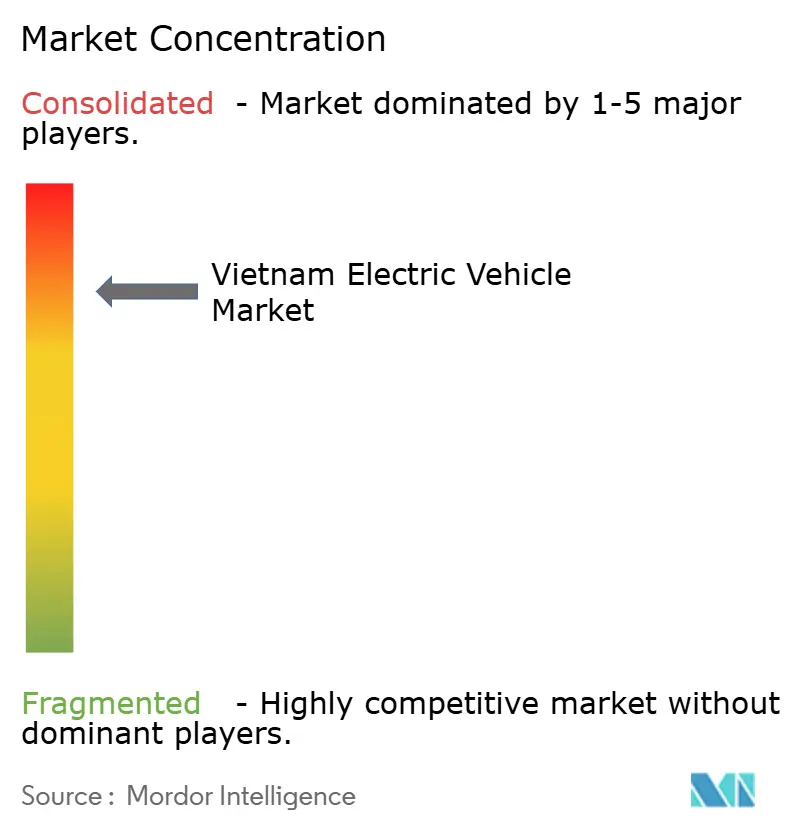
| Market Concentration | High |
Major Players
*Disclaimer: Major Players sorted in no particular order Image © Mordor Intelligence. Reuse requires attribution under CC BY 4.0. |
|
Vietnam Electric Vehicle Market Analysis by Mordor Intelligence
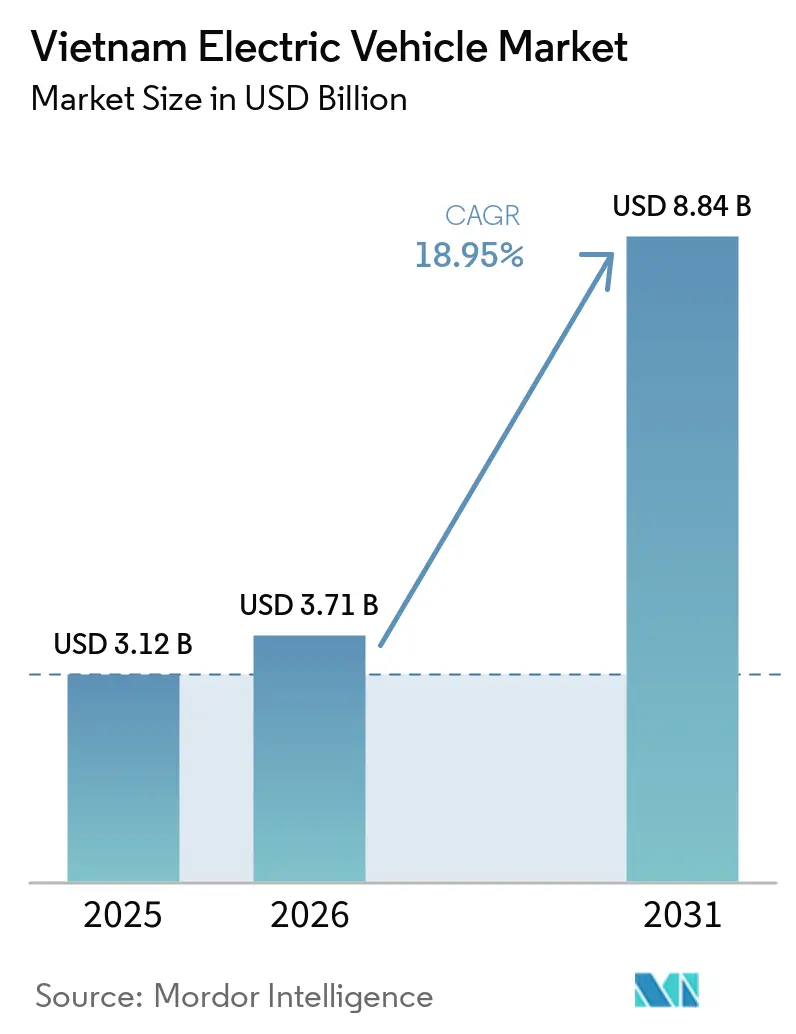
The Vietnam electric vehicle market size in 2026 is estimated at USD 3.71 billion, growing from the 2025 value of USD 3.12 billion, with 2031 projections showing USD 8.84 billion, growing at 18.95% CAGR over 2026-2031. Demand is propelled by firm government targets that mandate 50% EV penetration in urban areas by 2030 and net-zero emissions by 2050[1]Hang Nguyen Thanh, "Viet Nam Accelerates Plans to Phase Out Fossil Fuel Vehicles by 2050", Changing Transport, changing-transport.org. VinFast’s localization drive, foreign OEM factory commitments, and preferential electricity tariffs collectively reduce the total cost of ownership, amplifying adoption. Rapid two-wheeler electrification creates consumer familiarity and shared charging infrastructure that spills over to four-wheelers, while falling battery pack prices allow LFP technology to dominate value-conscious segments. Competition remains high because VinFast’s dominance deters price wars, yet Chinese brands and global mass-market OEMs are entering with cost-competitive models, nudging the ecosystem toward wider model variety and lower pricing.
Key Report Takeaways
- By vehicle type, passenger cars led with 67.65% revenue share in 2025, whereas buses are forecast to expand at a 33.11% CAGR through 2031.
- By propulsion, battery electric vehicles held 70.82% of the Vietnam electric vehicle market share in 2025 and are projected to grow at a 27.85% CAGR to 2031.
- By driving range, below-200 km models accounted for 53.72% share of the Vietnam electric vehicle market size in 2025; above-400 km models show the highest 29.10% CAGR to 2031.
- By battery type, LFP technology captured a 64.55% share in 2025, while solid-state batteries posted the fastest 36.50% CAGR through 2031.
- By end user, private ownership commanded 77.55% revenue in 2025; commercial fleet and ride-hailing is the quickest-expanding group at 31.10% CAGR to 2031.
- By region, Southern Vietnam retained 45.21% revenue share in 2025; Northern Vietnam is advancing at a 28.40% CAGR, the swiftest nationwide.
Note: Market size and forecast figures in this report are generated using Mordor Intelligence’s proprietary estimation framework, updated with the latest available data and insights as of 2026.
Vietnam Electric Vehicle Market Trends and Insights
Drivers Impact Analysis*
| Driver | (~) % Impact on CAGR Forecast | Geographic Relevance | Impact Timeline |
|---|---|---|---|
| Domestic Manufacturing Scale-up | +4.8% | Southern Vietnam, Northern Vietnam industrial zones | Medium term (2-4 years) |
| Government Incentives and Tax Rebates | +4.2% | All provinces with registration fee exemptions | Short term (≤ 2 years) |
| Rising Environmental Awareness and Net-Zero Targets | +3.3% | Urban centers in Ho Chi Minh City, Hanoi, Da Nang | Long term (≥ 4 years) |
| Electric Two-Wheeler Ecosystem Spill-Over | +2.9% | Ho Chi Minh City, Hanoi metropolitan areas | Medium term (2-4 years) |
| Falling Battery Pack Prices | +2.1% | Manufacturing hubs in Northern Vietnam, Central Vietnam | Medium term (2-4 years) |
| Preferential EV-Charging Tariff Structure | +1.3% | All provinces with established charging infrastructure | Short term (≤ 2 years) |
| Source: Mordor Intelligence | |||
Domestic Manufacturing Scale-up
VinFast targets roughly 80% domestic content by 2026 while expanding installed capacity to about 500,000 vehicles by 2027 and up to 1 million units annually by 2030. This scale-up is designed to compress per-unit component costs, deepen supplier localization, and reduce exposure to exchange-rate volatility tied to imported parts. Parallel investment plans from Chery and Geely further strengthen Vietnam’s position as an emerging regional assembly and export hub. However, high-value components such as advanced semiconductors, power electronics, and battery management systems continue to rely significantly on imports due to limited domestic fabrication capability. Long-term procurement and offtake agreements led by VinFast provide local suppliers with stronger demand visibility, supporting fresh capital expenditure, technology transfer, and faster ecosystem localization.
Government Incentives and Tax Rebates
The national incentive framework extends full registration-fee exemptions for battery electric vehicles through February 2027, materially lowering upfront acquisition costs for consumers and fleet operators. In parallel, import duties remain at 0% for vehicles sourced from ASEAN member states under prevailing regional trade agreements, reducing retail prices by more than VND 100 million per unit for qualifying models. Preferential EV charging tariffs set at approximately 2,204 VND/kWh further improve lifetime operating economics, narrowing payback periods versus internal combustion alternatives and strengthening the total cost of ownership proposition, underscoring multi-tier policy coordination[2]"HCMC wants only electric motorbikes for ride-hailing by 2030", VnExpress, e.vnexpress.net. Continuity beyond 2027 depends on reaching cost parity, exposing the market to fiscal-policy rollover risk.
Rising Environmental Awareness and Net-Zero Targets
Vietnam’s commitment to achieving net-zero emissions by 2050 establishes phased and enforceable transport-sector milestones that structurally anchor electric mobility demand. Regulatory directives mandate that all newly procured urban buses transition to green powertrains by 2025, while targeting 50% electrification of urban vehicle fleets by 2030. These binding timelines shift adoption dynamics from discretionary consumer choice to compliance-driven procurement, particularly across municipal and public transport operators. Intensifying air-quality deterioration in major cities such as Ho Chi Minh City and Hanoi has further elevated policy urgency around transport decarbonization. Rising pollution exposure has galvanized public sentiment, especially among the 25–44 age cohort that demonstrates comparatively stronger EV purchase intent. Urban policymakers are increasingly linking mobility reform with public health cost mitigation and productivity preservation.
Electric Two-wheeler Ecosystem Spill-over
Rapid growth in electric motorcycle sales has expanded national charging-port density to more than 150,000 connection points, many compatible with both two-wheelers and passenger EVs. This broader infrastructure footprint reduces range anxiety and normalizes public charging behavior in urban areas. Familiarity with battery-swapping and daily charging routines shortens the learning curve for four-wheeler adoption. Large-scale fleet electrification initiatives in Ho Chi Minh City, including plans to convert roughly 400,000 ride-hailing motorcycles by 2026, serve as visible proof points for electric mobility viability. High-utilization commercial fleets reinforce perceptions of durability and cost efficiency. Continuous exposure to electric ride-hailing services accelerates consumer trust and cross-segment adoption. Overall, two-wheeler electrification is acting as a catalyst for broader passenger EV market expansion.
Restraints Impact Analysis*
| Restraint | (~) % Impact on CAGR Forecast | Geographic Relevance | Impact Timeline |
|---|---|---|---|
| Sparse Public Charging Infrastructure | -4.2% | Rural provinces, Central Vietnam coastal areas | Medium term (2-4 years) |
| High Up-Front Vehicle Cost Vs Average Income | -3.1% | Lower-income provinces, rural Northern Vietnam | Short term (≤ 2 years) |
| Limited Mid-Range Model Availability | -2.4% | All provinces with limited dealer networks | Short term (≤ 2 years) |
| Grid Capacity Constraints at Peak Hours | -1.8% | Northern Vietnam industrial zones, Southern Vietnam urban centers | Long term (≥ 4 years) |
| Source: Mordor Intelligence | |||
Sparse Public Charging Infrastructure
While charging infrastructure remains relatively dense across tier-one urban clusters, coverage declines sharply along rural and inter-city corridors, constraining long-distance travel viability and limiting demand for models exceeding sub-200 km range brackets. This uneven distribution restricts broader geographic market expansion beyond metropolitan centers. V-Green has committed approximately USD 404 million to accelerate nationwide station deployment[3]"VinFast Founder launches Global EV Charging Stations Company V-Green," malaymail, malaymail.com., yet permitting cycles, grid integration timelines, and construction lead times suggest near-term bottlenecks will persist. Seasonal electricity demand spikes further expose grid stress risks, prompting government directives focused on strengthening transmission capacity and ensuring power-supply resilience to support sustained EV penetration.
High Up-front Vehicle Cost vs Average Income
VinFast’s VF3, priced at USD 9,200, remains aspirational for large swathes of the population despite fee waivers and battery-subscription schemes. The affordability gap concentrates adoption among upper-middle-income urbanites, limiting economies of scale. Wider domestic parts localization and LFP battery dominance are expected to narrow the gap, but meaningful mass-market access still hinges on sustained subsidy frameworks or breakthrough cost declines.
*Our forecasts treat driver/restraint impacts as directional, not additive. The impact forecasts reflect baseline growth, mix effects, and variable interactions.
Segment Analysis
By Vehicle Type: Commercial Fleets Drive Electrification
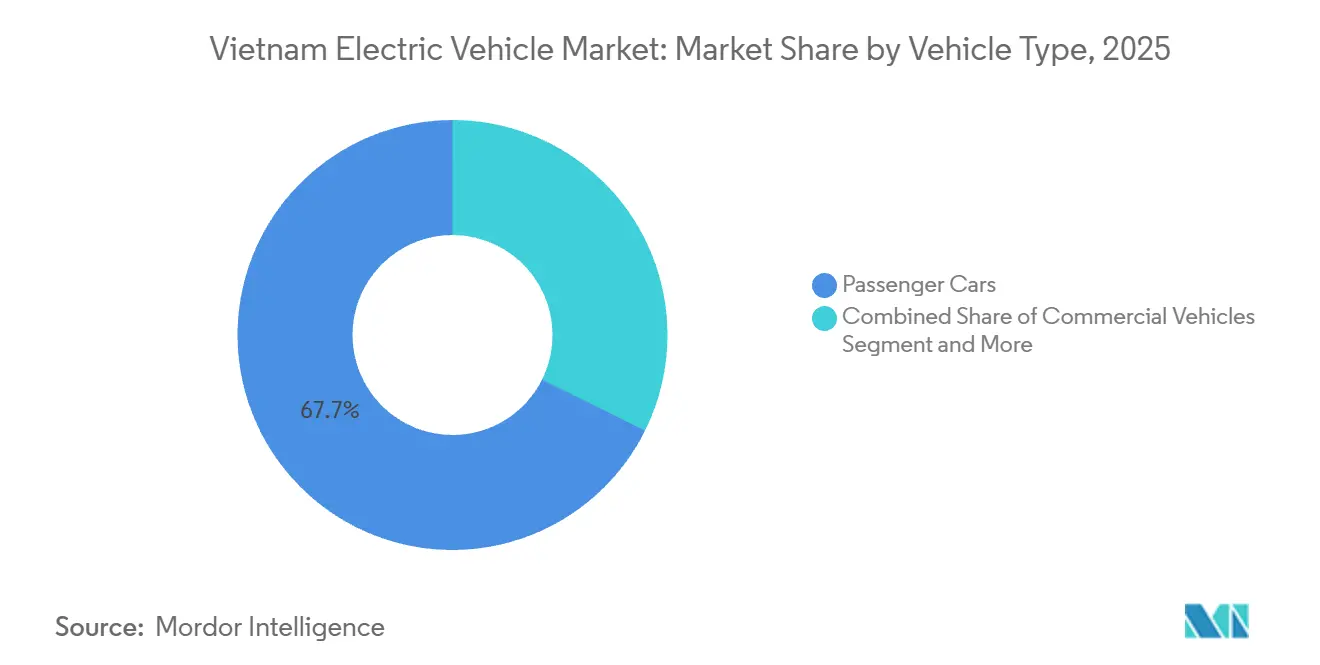
Passenger cars accounted for 67.65% of total revenue in 2025, maintaining leadership in overall market contribution, while buses recorded the fastest expansion trajectory at a 33.11% CAGR. The bus segment is expected to scale rapidly through 2028 as provincial electrification mandates unlock sizeable public tenders and structured procurement cycles. Although private ownership dominates the current vehicle base, commercial operators are increasingly shaping incremental demand. Large-scale deployments in Ho Chi Minh City and the central-district electrification roadmap in Hanoi are creating predictable bulk orders that strengthen supplier visibility and manufacturing planning.
High daily utilization rates in fleet operations amplify total-cost-of-ownership advantages, positioning commercial buyers as early adopters of advanced battery chemistries and high-capacity fast-charging solutions. Meanwhile, two-wheelers continue serving commuter flows across peri-urban and rural corridors, indirectly improving charging-station utilization economics that also support four-wheeler penetration. Over the forecast horizon, passenger-car revenue share is likely to moderate slightly despite rising absolute volumes, as buses and electric vans gain policy-driven traction in public transport modernization and last-mile logistics networks.



By Propulsion: Battery Electric Dominance
Battery electric vehicles (BEVs) accounted for 70.82% of the total market share in 2025, clearly outperforming hybrid and plug-in hybrid alternatives. This lead is expected to widen as BEV volumes expand at a projected 27.85% CAGR, supported by a national policy framework that prioritizes full electrification over transitional drivetrain technologies. Hybrids retain selective demand among peri-urban users seeking extended range flexibility, yet comparatively limited fiscal incentives constrain broader uptake. Fuel-cell vehicles remain largely at a pilot stage due to minimal hydrogen infrastructure and high deployment costs.
VinFast’s concentrated BEV-focused product strategy reinforces the pure-electric positioning in consumer perception, while nationwide charging incentives further strengthen adoption momentum. International automakers may introduce plug-in hybrid variants as a hedge against residual range anxiety, but regulatory direction continues to favor fully electric platforms. Continuous battery improvements are reducing charging times and improving energy density, narrowing the functional gap that once justified hybrid premiums. Consequently, the Vietnam electric vehicle market is progressing along a direct-to-BEV trajectory rather than following the phased hybrid transition observed in several mature economies.
By Driving Range: Urban-Optimized Solutions Lead
Sub-200 km models represented 53.72% of 2025 shipments, reflecting the dominance of short-distance urban commuting and intra-city mobility patterns. Compact range vehicles remain cost-efficient and well aligned with metropolitan driving cycles, supporting their volume leadership. However, the over-400 km segment is projected to expand at a 29.10% CAGR, contingent on accelerated highway-corridor charging deployment and improved inter-city infrastructure reliability. As fast-charging networks extend beyond city centers, consumer confidence in long-distance electric travel is expected to strengthen.
Technological advances from companies such as CATL, including next-generation high-density battery packs with ultra-fast charging potential, highlight significant performance headroom, though affordability remains critical for mass adoption. Most mainstream buyers are likely to continue prioritizing practical urban driving ranges while relying on public transport or shared mobility solutions for occasional long-haul trips. Over time, rising household incomes and increasing inter-city business travel should stimulate demand for mid- and long-range variants. This gradual shift will encourage OEMs to broaden portfolio offerings across multiple range tiers.
By Battery Type: LFP Technology Leads Cost Optimization
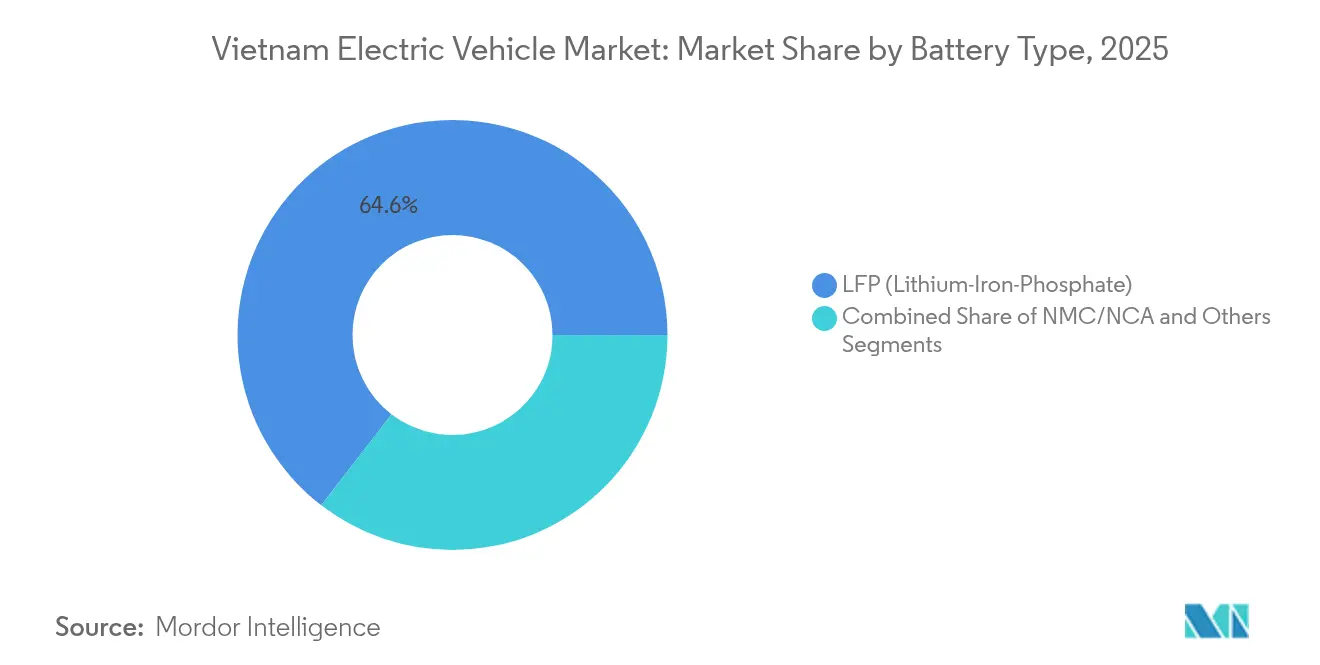
LFP chemistry accounted for 64.55% of total battery sales in 2025 and is expected to maintain a majority share due to lower raw-material costs and inherently stable thermal characteristics. In mass-market vehicle segments, safety performance, durability, and longer cycle life outweigh modest compromises in energy density. Solid-state batteries currently represent a minimal base but are projected to expand at a 36.50% CAGR as VinFast collaborates with ProLogium to advance pilot-scale production. Successful commercialization could gradually enhance energy density benchmarks and charging efficiency.
NMC and NCA chemistries continue serving premium, performance-oriented, and export-focused variants, yet elevated input costs reduce their competitiveness in price-sensitive domestic segments. Emerging government recycling and battery end-of-life management frameworks are also expected to shape chemistry preferences by tightening compliance obligations and lifecycle accountability. Solutions with established reuse and second-life ecosystems may gain regulatory favor. Overall, battery technology diversification in Vietnam reflects a cost-to-performance continuum, with LFP positioned as the foundational volume chemistry while next-generation technologies scale selectively.
By End User: Private Ownership Drives Market Growth
Private ownership accounted for 77.55% of the total 2025 volume, reflecting Vietnam’s strong preference for personal mobility and household vehicle acquisition. Individual buyers continue to drive baseline demand, supported by improving model availability and expanding dealership networks. However, the commercial fleet segment is projected to grow at a robust 31.10% CAGR as logistics firms, ride-hailing platforms, and corporate transport providers prioritize fuel savings and lower maintenance outlays. Public-sector procurement also contributes to steady momentum through mandated electric bus transitions across provincial transit systems.
Household adoption benefits from prior exposure to electric motorcycles, where familiarity with home charging routines and battery-leasing concepts reduces behavioral resistance. Although government fleet volumes are comparatively smaller, bulk tenders exert significant signaling influence by ensuring supplier scale and portfolio diversification. Over the forecast horizon, incremental cost reductions and broader consumer financing solutions are expected to sustain private buyers as the largest segment. At the same time, accelerating fleet electrification will gradually rebalance the demand mix toward higher-utilization commercial applications.
Geography Analysis
Southern Vietnam retains roughly 45.21% market share, supported by strong economic output and proactive metropolitan policy frameworks. A July 2025 rollout of 37 electric bus routes, adding more than 250 zero-emission units, underscores sustained multimodal electrification momentum. Dense urban travel patterns enhance fleet utilization rates and shorten payback cycles under prevailing tariff structures. Seasonal power-demand spikes still create reliability risks, requiring coordinated generation planning and structured demand-response mechanisms.
Northern Vietnam is projected to expand at close to 28% CAGR through 2031, driven by proximity to component supply ecosystems and targeted industrial-cluster development. Manufacturing investments led by VinFast alongside foreign OEM participation are deepening localized tier-two supplier capabilities. Hanoi aims for full electrification of central-district bus fleets by 2030, creating visible procurement pipelines. However, winter temperature variability and grid-load constraints necessitate battery optimization and distribution upgrades.
Central Vietnam leverages its tourism-focused economy to pilot selective deployments, including coastal shuttle services and airport transfer fleets. Regional authorities have introduced concessional financing schemes to support operators procuring electric coaches serving heritage and resort corridors. Although aggregate volumes remain comparatively limited, the region functions as a testing platform for renewable-linked charging hubs integrating solar and wind generation. Successful models could later be replicated across larger urban markets nationwide.
Competitive Landscape
VinFast operates a vertically integrated structure spanning vehicle manufacturing, charging infrastructure through V-Green, and mobility services under Xanh SM, reinforcing scale advantages and brand visibility nationwide. Its domestic manufacturing focus enables faster product localization, including compact urban-oriented models designed for entry-level buyers. In contrast, Hyundai and Toyota emphasize hybrid lineups to navigate regulatory uncertainty but lack comparable proprietary charging ecosystems. This structural difference strengthens VinFast’s ecosystem control and customer retention dynamics.
Competitive strategy increasingly centers on capacity expansion and infrastructure alliances. VinFast’s April 2025 battery supplier summit secured multi-year procurement commitments, reducing exposure to input-cost volatility and enhancing supply-chain predictability. Foreign OEMs continue balancing local-content compliance with shared global platforms to protect profitability. Charging deployment has become a strategic differentiator, highlighted by V-Green’s large-scale fast-charging hub in Hanoi, encouraging broader interoperability partnerships. While connected-car features, telematics, and over-the-air updates are expanding, purchasing decisions remain more strongly influenced by pricing and charging accessibility.
Entry barriers remain moderate but increasingly capital intensive. Regulatory licensing processes are relatively transparent; however, establishing a competitive charging footprint and underwriting consumer financing programs require substantial upfront investment. Local-content incentive frameworks favor incumbents with embedded supplier ecosystems and established distribution reach. Over the medium term, additional manufacturing capacity from global entrants is expected to intensify pricing competition. This capacity influx may compress margins while accelerating technology diffusion and product-cycle upgrades across the market.
Vietnam Electric Vehicle Industry Leaders
-
Hyundai Motor Company
-
SAIC–GM–Wuling Automobile Co., Ltd.
-
Toyota Motor Corporation
-
BYD Auto Co. Ltd
-
VinFast Auto Ltd.
- *Disclaimer: Major Players sorted in no particular order

Recent Industry Developments
- June 2025: V-Green inaugurated Hanoi’s largest fast-charging station with 42 points, capable of serving 84 vehicles concurrently, reinforcing capital-city network density.
- March 2025: VinFast introduced the VF3 mini-EV at USD 9,200, targeting annual domestic sales of 20,000 units and expansion toward regional export markets.
- March 2025: Start-up Move committed USD 13 million to build 120,000 affordable EVs per year, targeting underserved budgets with 150-200 km-range models.


Vietnam Electric Vehicle Market Report Scope
An electric vehicle is powered by one or more electric motors that use energy stored in batteries. It doesn't rely on any liquid fuel components or have a tailpipe.
The Vietnamese electric vehicle market is segmented by vehicle type, propulsion, driving range, battery type, end user, and region. By vehicle type, the market is segmented into passenger cars, commercial vehicles, two-wheelers, and buses. By propulsion, the market is segmented into battery electric vehicles (BEVs), plug-in hybrid electric vehicles (PHEVs), hybrid electric vehicles (HEVs), and fuel-cell electric vehicles (FCEVs). By driving range, the market is segmented into below 200 km, 200 to 400 km, and above 400 km. By battery type, the market is segmented into LFP, NMC/NCA, and others. By end user, the market is segmented into private ownership, commercial fleet/ride-hailing, and government and public transport. By region, the market is segmented into Northern Vietnam, Central Vietnam, and Southern Vietnam. For each segment, the market sizing and forecast have been provided based on value (USD) and volume (Units).
| Passenger Cars |
| Commercial Vehicles |
| Two-Wheelers |
| Buses |
| Battery Electric Vehicles (BEV) |
| Plug-in Hybrid Electric Vehicles (PHEV) |
| Hybrid Electric Vehicles (HEV) |
| Fuel-Cell Electric Vehicles (FCEV) |
| Below 200 km |
| 200 to 400 km |
| Above 400 km |
| LFP |
| NMC/NCA |
| Others |
| Private Ownership |
| Commercial Fleet/Ride-Hailing |
| Government and Public Transport |
| Northern Vietnam |
| Central Vietnam |
| Southern Vietnam |
| By Vehicle Type | Passenger Cars |
| Commercial Vehicles | |
| Two-Wheelers | |
| Buses | |
| By Propulsion | Battery Electric Vehicles (BEV) |
| Plug-in Hybrid Electric Vehicles (PHEV) | |
| Hybrid Electric Vehicles (HEV) | |
| Fuel-Cell Electric Vehicles (FCEV) | |
| By Driving Range | Below 200 km |
| 200 to 400 km | |
| Above 400 km | |
| By Battery Type | LFP |
| NMC/NCA | |
| Others | |
| By End User | Private Ownership |
| Commercial Fleet/Ride-Hailing | |
| Government and Public Transport | |
| By Region | Northern Vietnam |
| Central Vietnam | |
| Southern Vietnam |


Key Questions Answered in the Report
What is the current size of the Vietnam electric vehicle market?
The market stands at USD 3.71 billion in 2026 and is forecast to reach USD 8.84 billion by 2031.
Which segment is growing the fastest?
Buses exhibit the highest growth, advancing at a 33.11% CAGR as provincial mandates drive public-transport electrification.
Why do battery electric vehicles dominate Vietnam’s propulsion mix?
Government incentives focus on pure electric models, and VinFast’s BEV-only line-up makes them readily available and cost-competitive versus hybrids.
How is charging infrastructure keeping pace with demand?
Urban fast-charging hubs are expanding quickly—Hanoi’s new 42-point station exemplifies high-capacity roll-outs—yet rural corridors still face coverage gaps.
What is the biggest barrier to wider EV adoption?
High upfront purchase costs relative to average income remain a chief obstacle despite fee waivers and battery-lease programs.
Which regions lead EV adoption?
Southern Vietnam holds the largest share in 2025 at 45.21% owing to Ho Chi Minh City’s initiatives, while Northern Vietnam is growing fastest at a 28.40% CAGR through 2031 thanks to industrial investment and supportive local policies.
Page last updated on:


 Your data is secure and never sold or shared.


