
Market Overview
| Study Period | 2020 - 2031 |
|---|---|
| Forecast Data Period | 2026 - 2031 |
| Base Year Market Size (2025) | USD 13.74 Billion |
| Market Size (2026) | USD 14.41 Billion |
| Market Size (2031) | USD 18.31 Billion |
| Growth Rate (2026 - 2031) | 4.90 % |
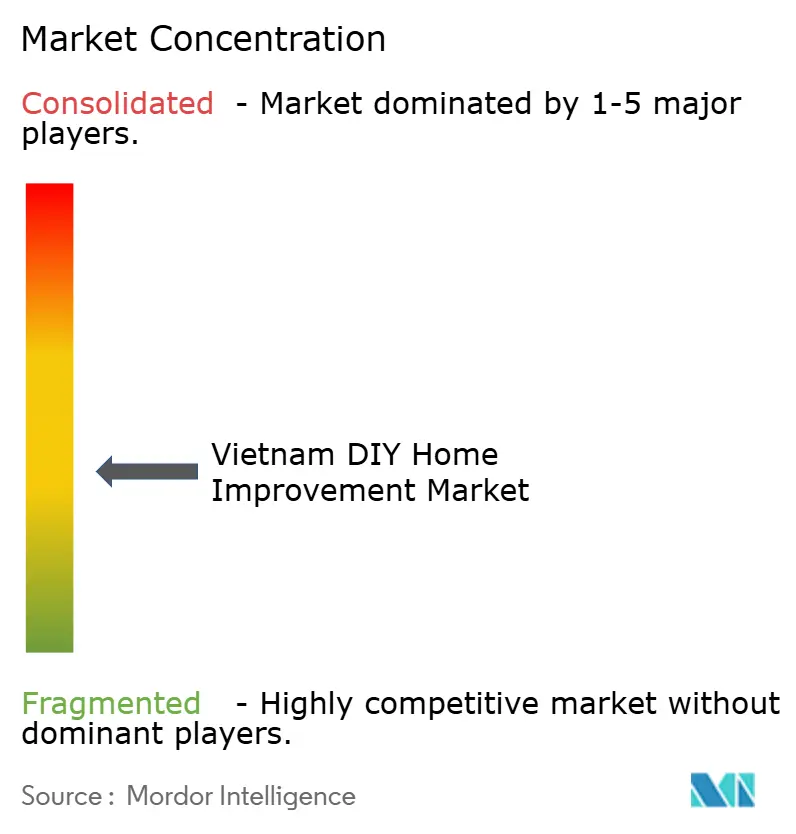
| Market Concentration | Medium |
Major Players *Disclaimer: Major Players sorted in no particular order Image © Mordor Intelligence. Reuse requires attribution under CC BY 4.0. | |
Vietnam DIY Home Improvement Market Analysis by Mordor Intelligence
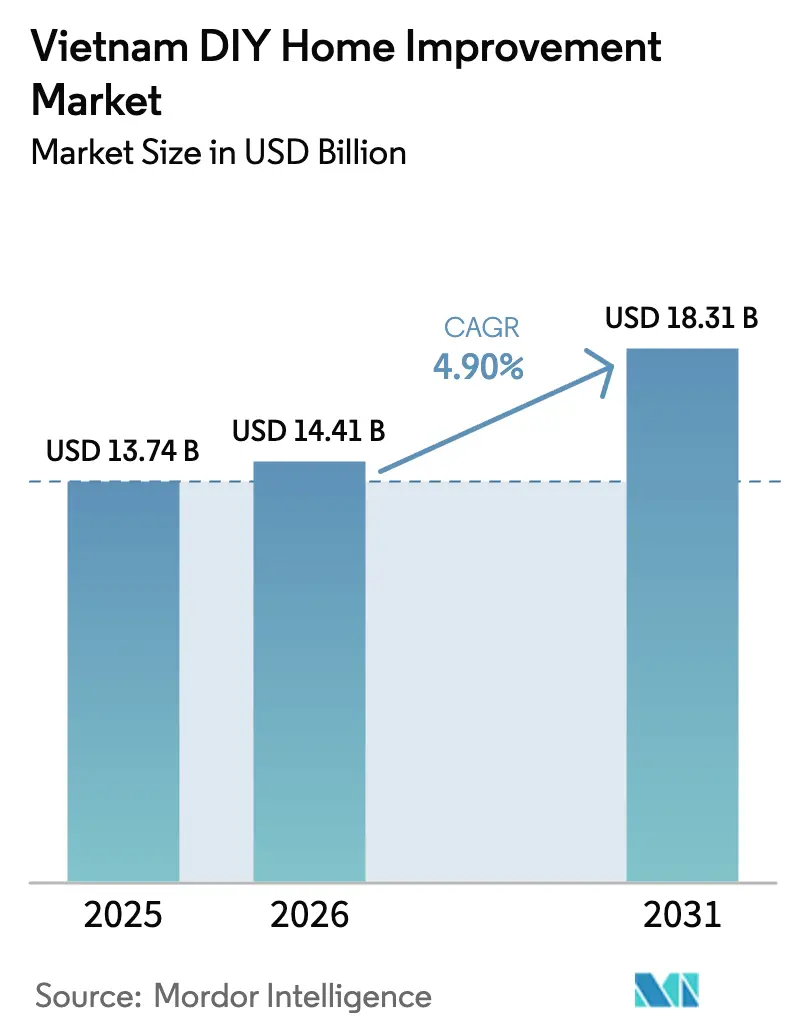
Vietnam DIY home improvement market size in 2026 is estimated at USD 14.41 billion, growing from 2025 value of USD 13.74 billion with 2031 projections showing USD 18.31 billion, growing at 4.90% CAGR over 2026-2031. Solid GDP momentum, 6.93% year-on-year in Q1 2025, along with a 7.99% expansion in construction activities, underscores a resilient demand base[1]General Statistics Office, “Gross Domestic Product in the First Quarter of 2025,” gso.gov.vn. Rising per-capita income that approached USD 4,347 in 2023, continued urban condominium handovers, and an ongoing 2% VAT reduction on building materials have together created attractive conditions for the Vietnam DIY home improvement market. Local manufacturers are leveraging a 9.4% average MFN tariff wall to displace some imports, while foreign brands eye premium segments through strategic partnerships and direct e-commerce outreach. Increased household disposable incomes, rapid digital adoption, and government-backed infrastructure projects are together propelling new opportunities across both budget and premium price bands in the Vietnam DIY home improvement market.
Key Report Takeaways
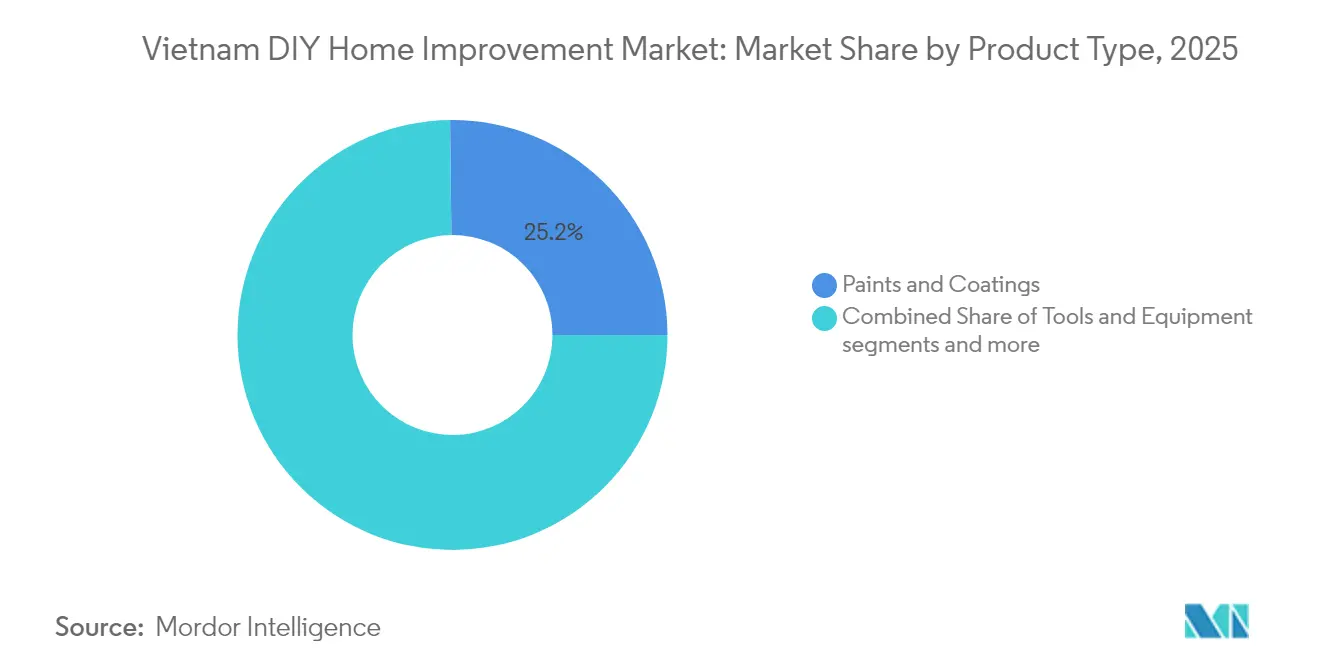
- By product type, Paints and Coatings led with 25.18% revenue share in 2025; Smart-home DIY Kits are projected to advance at a 6.07% CAGR to 2031.
- By distribution channel, Home-Improvement Superstores accounted for 32.94% of the Vietnam DIY home improvement market share in 2025, while Online Retail and E-commerce post the fastest CAGR at 7.21% through 2031.
- By end-user, Individual Home-Owners held 54.58% of the Vietnam DIY home improvement market size in 2025; Tenants/Renters are expanding at 5.34% CAGR.
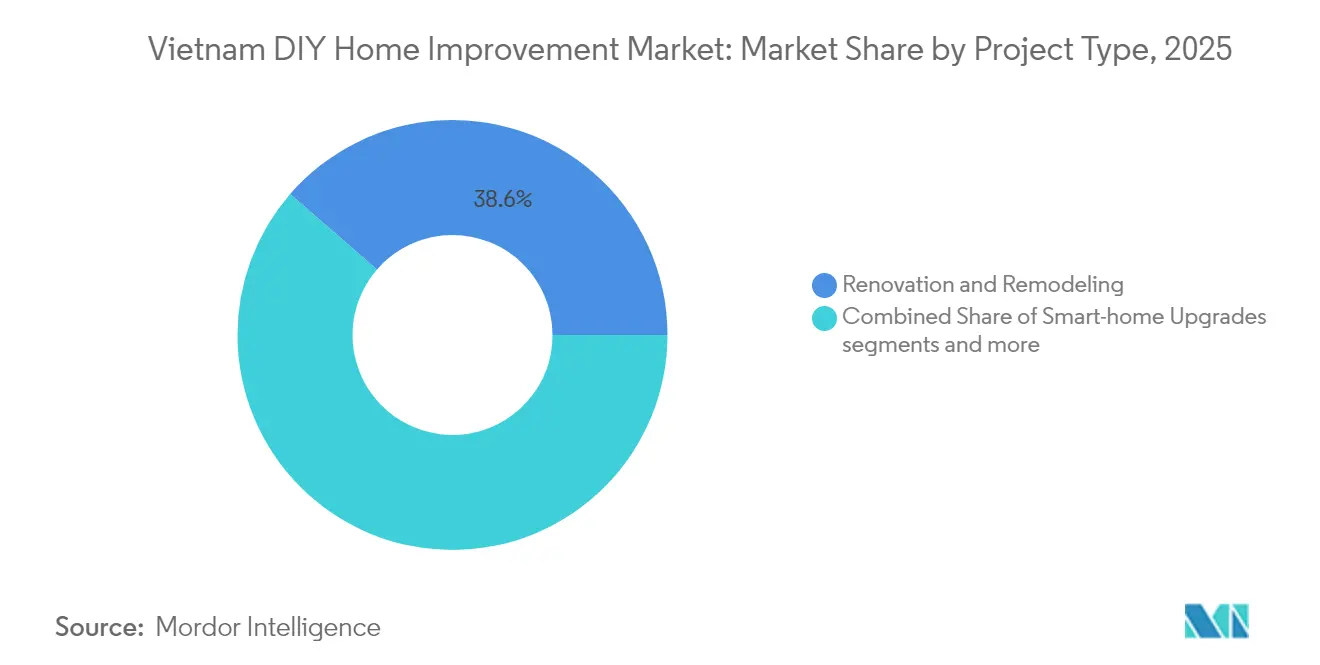
- By project type, Renovation and Remodeling captured 38.62% share of the Vietnam DIY home improvement market size in 2025, whereas Smart-home Upgrades grew at 7.33% CAGR.
- By geography, Southern Vietnam commanded 45.08% revenue share in 2025 and is progressing at 5.74% CAGR to 2031.
- The Vietnam DIY home improvement market remains moderately fragmented. Companies like ACE Home Center Vietnam, HomePro Vietnam, LIXIL (INAX), Jotun Paints Vietnam, and Nippon Paint Vietnam hold significant market share in 2025.
Note: Market size and forecast figures in this report are generated using Mordor Intelligence’s proprietary estimation framework, updated with the latest available data and insights as of 2026.
Vietnam DIY Home Improvement Market Trends and Insights
Drivers Impact Analysis*
| Driver | (~) % Impact on CAGR Forecast | Geographic Relevance | Impact Timeline |
|---|---|---|---|
| Rising middle-class disposable income | +1.2% | National, with concentration in urban centers | Medium term (2-4 years) |
| Rapid urban condominium hand-over volumes | +0.8% | Northern and Southern Vietnam, particularly Hanoi and HCMC | Short term (≤ 2 years) |
| Government VAT-reduction on building materials (2024-25) | +0.6% | National | Short term (≤ 2 years) |
| Omni-channel expansion by big-box retailers | +0.4% | Urban areas across all regions | Medium term (2-4 years) |
| Community makerspaces and DIY workshops bloom in Hanoi/HCMC | +0.3% | Northern and Southern Vietnam urban centers | Long term (≥ 4 years) |
| Social-commerce influencers promoting small-space makeovers | +0.2% | National, with higher penetration in urban areas | Medium term (2-4 years) |
| Source: Mordor Intelligence | |||
Rising Middle-Class Disposable Income
Vietnam’s burgeoning middle class is reshaping the Vietnam DIY home improvement market. Roughly 60% of households are expected to cross the USD 5,000 annual‐income mark by 2027, lifting demand for premium paint, lighting, and smart-home devices. A workforce that represents 67% of the population is benefiting from higher wage growth, while the 2025 GDP is targeted to expand 8%. Consumers who recently shifted from essential to experiential spending now allocate larger budgets to modernize their living spaces. International brands are enlarging store portfolios to match these lifestyle aspirations.
Rapid Urban Condominium Hand-Over Volumes
More than 30,000 new apartments were delivered in 2024, spurring immediate purchases of fixtures, paint, and modular storage. Hanoi’s secondary‐market apartment prices climbed 26% in 2024, while primary listings rose 36%, signaling wealth effects that boost renovation budgets[2]CBRE Vietnam, “Vietnam Residential Market Q4 2024,” cbrevietnam.com . Developers such as Vinhomes plan eight large projects in 2025, backed by revenue targets of VND 180 trillion (USD 6.9 billion). Housing Law 2023 has eased foreign ownership caps, encouraging faster transaction cycles and quicker occupancy. An expanding pipeline of mid-tier condominiums ensures a steady stream of first-time buyers and tenants eager to personalize interiors, reinforcing forward momentum in the Vietnam DIY home improvement market.
Government VAT Reduction on Building Materials (2024-26)
A 2-percentage-point VAT cut from 10% to 8%, extended until at least June 2025 with proposals through 2026, is saving buyers an estimated VND 121 trillion (USD 4.6 billion) during implementation. The policy excludes telecom and banking, yet directly benefits core DIY inputs—cement, tiles, and plumbing fittings—making home projects more affordable. The government concurrently halved several administrative fees and expedited mining permits to contain material inflation. Lower transaction frictions translate into quicker project starts and reduced price volatility, thereby improving visibility for retailers and contractors planning inventory.
Omni-Channel Expansion by Big-Box Retailers
National chains invest heavily in synchronized store-and-online ecosystems to secure mind-share. Hoa Sen Group expects to scale its Hoa Sen Home network from 120 outlets to 140 in 2025 and 300 by 2030, underpinned by VND 6 trillion (USD 0.23 billion) in logistics and IT funding. AEON intends to multiply its Vietnam presence eightfold by 2030, complementing seven operational malls with aggressive e-commerce rollouts. Home-and-living merchandise sold online hit USD 358 million in Q2 2024, a 79% leap from a year earlier.
Restraints Impact Analysis*
| Restraint | (~) % Impact on CAGR Forecast | Geographic Relevance | Impact Timeline |
|---|---|---|---|
| High import tariff on power tools (15%) | -0.7% | Nationwide, stronger pinch in industrial hubs | Medium term (2-4 years) |
| Fragmented after-sales service for complex installations | -0.5% | National, acute in secondary cities | Long term (≥ 4 years) |
| Apartment bylaws limiting structural alterations | -0.4% | High-rise projects in Hanoi & Ho Chi Minh City | Medium term (2-4 years) |
| Skilled-labour shortage inflating tool-rental rates | -0.3% | National, most severe in fast-growing suburbs | Short term (≤ 2 years) |
| Source: Mordor Intelligence | |||
High Import Tariff on Power Tools (15%)
The average 9.4% MFN duty and a specific 15% rate on many power tools elevate shelf prices and narrow model choices[3]U.S. International Trade Administration, “Vietnam Tariff Schedule Overview,” trade.gov . The United States’ April 2025 46% reciprocal tariff on Vietnamese exports has heightened talk of countermeasures, adding uncertainty to cross-border supply chains. Although wood product duties fell to 0% in March 2025, tariffs on drills, routers, and battery packs remain intact. Inflationary pressure particularly discourages hobbyists and small contractors who anchor much of the Vietnam DIY home improvement market’s entry-level demand.
Fragmented After-Sales Service for Complex Installations
Premium smart-home systems and integrated bathroom suites require skilled installers; however, only 30% of local support-industry firms meet global supply-chain standards. Cost overruns affect 60-70% of FDI construction projects due to limited project-management expertise, undermining confidence in advanced offerings. Daikin’s expansion of service centers from three to twenty illustrates the resources needed to assure owners of reliable maintenance. Secondary cities see the widest gap, slowing the diffusion of higher-end fixtures outside core metros.
*Our forecasts treat driver/restraint impacts as directional, not additive. The impact forecasts reflect baseline growth, mix effects, and variable interactions.
Segment Analysis
By Product Type: Smart-Home Integration Drives Premium Shift
Paints and Coatings retained the largest 25.18% slice of the Vietnam DIY home improvement market in 2025, buoyed by repaint cycles and local weather conditions. Smart-home DIY Kits, though smaller, are projected at a 6.07% CAGR, supported by domestic innovators such as Lumi that address language and wiring norms specific to Vietnam. Tools, lumber, and fasteners enjoy steady demand from the booming renovation trade, while lighting and electrical lines migrate toward energy-efficient LEDs. The Vietnamese high-end appliance market, now roughly USD 13 billion, is also steering residences toward modern kitchens and connected climate systems. Partnerships between international plumbing brands and leading developers ensure contemporary bathrooms become standard in new builds. Growing lifestyle emphasis on aesthetic cohesion is stimulating décor, sealants, and premium flooring, reshaping expectations across the Vietnam DIY home improvement market.
The premium paint tier has expanded markedly through sustainability branding, VOC compliance, and digital color matching. Meanwhile, hardware stores report brisk turnover in compact cordless tools ideal for apartment settings. Smart locks, voice-activated switches, and energy dashboards anchor bundled upgrade packages that cut utility costs while differentiating properties. Industrial parks in the north and south demand standardized building-material specifications, encouraging consistent quality levels nation-wide. With climate resilience climbing the policy agenda, waterproofing membranes and anti-corrosion coatings broaden revenue bases for finish product suppliers.



By Distribution Channel: Digital Transformation Accelerates Retail Evolution
Home-Improvement Superstores claimed 32.94% of sales in 2025, yet online storefronts are on course to eclipse traditional outlets thanks to a 7.21% CAGR. High mobile-data penetration and free-shipping deals entice younger consumers, while livestream demonstrations convert social engagement into immediate purchases. Hardware stores remain anchors for professional contractors needing immediate stock, but they, too, incorporate click-and-collect counters. Supermarkets and hypermarkets are carving out mini-DIY aisles to capture top-up trips, notably for fast-moving items like sealant, small tools, and décor accents.
Platform giants harness data analytics to suggest project bundles, embedding upsell prompts during product search. Conversely, pure-play e-tailers are leasing dark stores closer to high-density districts to compress delivery times. Specialty paint or lighting boutiques leverage consultative expertise to defend pricing power against broad-assortment rivals. The pandemic-era comfort with digital payment routines appears irreversible, ensuring omnichannel convenience remains core to future go-to-market blueprints in the Vietnam DIY home improvement market.
By End-User: Tenant Market Emerges as Growth Driver
Individual Home-Owners contributed 54.58% of the 2025 turnover, yet Tenants/Renters generate the fastest 5.34% CAGR as younger professionals prioritise flexibility over ownership. Hanoi apartment rents of VND 8.5-10 million for a two-bedroom have nudged landlords to approve tenant-friendly upgrades such as peel-and-stick backsplashes and movable storage. Professional Contractors keep a solid niche by overseeing large remodeling contracts and adhering to stricter safety codes introduced in 2024. Property developers increasingly promote move-in-ready finishes, elevating baseline interior standards.
A pipeline of serviced apartments, 6,246 units in Hanoi, with 4,077 more planned, boosts demand for standardized fixtures that ease facility management. Expatriate workers from expanding semiconductor and electronics plants look for dwellings that meet global safety and connectivity norms, further raising product expectations. Instituted warranty protocols and QR-code maintenance logs by suppliers such as Tân Á Đại Thành help landlords monitor lifecycle costs, widening acceptance of premium offerings across Vietnam DIY home improvement market sub-segments.
By Project Type: Smart-Home Upgrades Lead Innovation Wave
Renovation and Remodeling performed 38.62% of activities in 2025, but Smart-home Upgrades surge at a 7.33% CAGR as owners chase energy savings and security benefits. Lumi’s 6,000 m² plant and 150-plus distributors demonstrate local capability in sensors, hubs, and apps that talk to Vietnam’s 220 V electrical standard. Maintenance and repair still drive recurring revenue, given the country’s humid climate that accelerates wear on walls and plumbing.
Outdoor and garden projects expand as residents in dense cities repurpose balconies with modular decking and vertical planters. AI-driven dashboards that optimize lighting and HVAC settings gradually migrate from premium to mid-range dwellings. Building managers increasingly specify integrated packages that couple basic renovation with IoT layers, helping the Vietnam DIY home improvement market blend traditional craftsmanship with digital convenience.
By Price-Point: Premium Segment Gains Momentum
Mid-range lines held 46.62% in 2025, and premium SKUs delivered at 6.92% CAGR, mirroring broader income gains and aspirational lifestyles. Luxury imports rose sharply in 2024 as recovering tourism rekindled the appetite for global brands. Premium paint labels emphasize anti-mold formulations suited to monsoon climates, winning share among coastal homeowners. Smart appliances featuring voice control and remote diagnostics command higher margins while promising lower lifetime costs.
Economy offerings still anchor first-time DIY users and rural consumers, but even budget ranges incorporate incremental improvements such as higher LED lumen output or rust-resistant hinges. Brands differentiate through service: longer warranties, installation support, and financing options. Sustainability messaging influences purchasing decisions, motivating suppliers to certify low-VOC content or recycled material composition. Such credentials strengthen premium positioning and widen the reach of the Vietnam DIY home improvement market.
Geography Analysis
Southern Vietnam retained 45.08% of the Vietnam DIY home improvement market in 2025 and advances at a 5.74% CAGR toward 2031. Ho Chi Minh City anchors demand through robust industrial expansion and foreign direct investment that funnels expatriate housing projects, office renovations, and infrastructure buildouts. Public spending on highways and metro lines supports satellite suburban growth, stimulating purchases of flooring, doors, and climate systems. Vinhomes and similar developers are prioritizing mixed-use mega-sites in the south, anticipating strong uptake from manufacturing executives and a growing middle class.
Northern Vietnam, led by Hanoi, benefits from sizeable public-sector budgets and numerous diplomatic missions that insist on premium finishes. Secondary-market apartment prices climbed 26% in 2024, translating into capital gains reinvested in remodels. Infrastructure upgrades along the Hanoi-Haiphong corridor attract supporting industries that require staff housing and fit-out services, boosting northern market momentum within the Vietnam DIY home improvement market. Continued investment pledges—USD 4.5 billion registered in Hung Yen by May 2025—raise demand for contractor tools and building materials.
Central Vietnam is relatively smaller yet poised for step-up growth as tourism rebounds in Huế, Da Nang, and Nha Trang. Coastal resorts seek corrosion-resistant fixtures, advanced HVAC, and smart lighting to meet international guest expectations. Government incentives for social housing in flood-prone provinces drive interest in resilient roofing, waterproof coatings, and elevated flooring systems. Provincial authorities promote green building codes, nurturing demand for energy-rated windows and solar-ready wiring, thereby embedding sustainability norms early in the region’s build cycle.
Regulatory Landscape
Vietnam’s DIY home improvement ecosystem is shaped by construction management rules and building-material standards overseen by the Ministry of Construction (MOC). Decree 175/2024/ND-CP elaborates management of construction activities, reinforcing permitting, compliance, and documentation requirements that affect the timing of renovation-related categories such as paints, flooring, plumbing, and electrical goods. Construction Law No. 135/2025/QH15 takes effect July 1, 2026, replacing the prior law and adjusting compliance mechanics for enterprises serving the DIY channel. It shifts enterprise capacity certificates toward public disclosure on the Ministry of Construction website and supports more integrated design review and permit issuance, raising the value of documented capability, traceability, and standardized installation practices for retailers and brands selling complex systems.
Value Chain Analysis
Upstream, domestic and imported feeds for steel, chemicals, ceramics, and engineered wood influence the cost and assortment of tool-heavy categories, with import duties affecting pricing dynamics. Midstream, producers such as LIXIL (INAX), Jotun Paints Vietnam, and Nippon Paint Vietnam localize product mixes and shorten lead times as part of a broader push toward deeper processing and higher-tech applications that support domestic substitution where standards can be demonstrated. Downstream, ACE Home Center Vietnam and HomePro Vietnam act as retail anchors that convert supply into consumer demand, while government-led data initiatives and digital documentation help improve product traceability across the chain.
Competitive Landscape
The Vietnam DIY home improvement market remains moderately fragmented. Top players combine international know-how and local reach. ACE Home Center Vietnam and HomePro Vietnam strengthen brand equity through store expansions and targeted promotions. LIXIL, Jotun, and Nippon Paint leverage in-country plants to shorten lead times and localize product mixes. Hoa Sen Group’s plan to triple its retail count and invest VND 6 trillion (USD 0.23 trillion) illustrates the scale of capital flowing into omnichannel infrastructure.
Digital-first disruptors intensify competition. TikTok Shop’s ascent to 35% online share pressures incumbents to refine short-video selling tactics. Local smart-home champion Lumi, rooted in Vietnamese R&D, differentiates via firmware tuned to local language and wiring norms. Strategic alliances such as Nippon Paint’s April 2025 pact with Nam Long aim to tie exclusive supply contracts to residential pipelines, locking in paint volumes and specifying environmental performance benchmarks.
Supply chains pivot toward transparency. Tân Á Đại Thành’s QR-code warranty platform demonstrates after-sales digitalization can remove friction. Producers of steel, tiles, and hardware increasingly automate quality checks to align with new government guidelines on traceability. The competitive field thus rewards firms that combine reliable logistics, consultative selling, and after-market care, all backed by data. As premium segments widen, the ability to guarantee performance and continuous upgrades will separate winners from commodity suppliers across the Vietnam DIY home improvement market.
Vietnam DIY Home Improvement Industry Leaders
ACE Home Center Vietnam
HomePro Vietnam
LIXIL (INAX)
Jotun Paints Vietnam
Nippon Paint Vietnam
- *Disclaimer: Major Players sorted in no particular order

Market Opportunities and Future Outlook
Vietnam’s three-tier development model for building materials, formalized by Decision No. 527/QD-TTg (March 31, 2026), emphasizes foundational, strategic, and future materials with focus on green materials, recycled content, and low-emission production. A national database on building materials and minerals supports traceability and reduces information friction for buyers and retailers, which improves the credibility of performance claims across brands. Distribution and service quality remain practical levers for commercial growth. Hoa Sen Group’s omni-channel investments through Hoa Sen Home and AEON’s store expansion strengthen access and logistics, with Hoa Sen Home increasing from about 120 to 140 outlets in 2025 and moving toward 300 stores by 2030, while AEON pursues an eightfold retail expansion by 2030. These moves also enable more standardized installation packages for bathrooms and smart-home upgrades, supported by warranty-led programs that reduce perceived risk in premium offerings.
Recent Industry Developments
- April 2026: ACE (Vietnam) opened a steel processing, cutting, and bending factory in Phu My, Ho Chi Minh City. The expansion of local fabrication capacity for DIY/building materials strengthens supply chain resilience and capacity for Vietnam DIY hardware and components.
- June 2025: Hoa Sen Group plans to lease 300 - 500 sites nationwide, scaling Hoa Sen Home chain to 300 stores by 2030 with a USD 1.3 billion revenue target. The retail footprint expansion in Vietnam home improvement expands omnichannel and brick-and-mortar presence, pressuring peers on store-network scale.
- May 2025: AEON Eightfold retail expansion in Vietnam by 2030. The major retail expansion strengthens market access and distribution for home improvement products across Vietnam.


Research Methodology Framework and Report Scope
Market Definition and Coverage
For this report, the Vietnam DIY home improvement market is counted as consumer spending on do it yourself repair, maintenance, and upgrade products for homes, across offline and online retail, measured at retail value in USD.
Scope exclusions: We exclude contractor service labor, large new-build construction materials sold for project contracts, and purely commercial or industrial facility spending.
Segmentation Overview
- By Product Type
- Tools and Equipment
- Paints and Coatings
- Lumber and Building Materials
- Hardware and Fasteners
- Lighting and Electrical
- Flooring
- Plumbing and Bathroom Fixtures
- Adhesives and Sealants
- Decor and Home Accessories
- Garden and Outdoor
- By Distribution Channel
- Home-Improvement Superstores
- Hardware Stores
- Specialty Retailers (paint, lighting, etc.)
- Online Retail and E-commerce
- Supermarkets and Hypermarkets
- Direct Sales / Trade Counters
- By End-User
- Individual Home-Owners
- Tenants / Renters
- Professional Contractors
- Property Developers (small projects)
- By Project Type
- Renovation and Remodeling
- Maintenance and Repair
- New-build DIY
- Outdoor & Garden Projects
- Smart-home Upgrades
- By Price-Point
- Economy
- Mid-range
- Premium
- By Region (Vietnam)
- Northern Vietnam
- Central Vietnam
- Southern Vietnam
Data Sources, Market Sizing, and Validation
Desk Research
Desk research was used to set the demand context and to tighten the pricing boundaries before the model was built. We reviewed Vietnam public statistics and common macro indicators that typically move renovation and repair spending, such as construction activity, housing completions, and household income direction.
Key public sources included Vietnam General Statistics Office releases, Vietnam Customs trade data for selected DIY-linked categories, State Bank of Vietnam publications for consumer credit signals, and Ministry of Construction updates and related circulars (for housing and building-material direction). We also used company filings, investor presentations, and reputable press coverage to understand retail channel expansion and shifts in product mix. For cross-checks on patents, shipment flows, and corporate financial patterns, a few paid databases were used where they offered structured, comparable time series. The desk sources listed here are illustrative only, and many other references were used for collection, validation, and research clarification.
Primary Interviews and Surveys
Primary work focused on validating what households buy for small projects, how price points are moving, and which channels are gaining share in Vietnam. We spoke with a mix of retailers, distributors, product managers, and field operators, and the feedback was used to refine assumptions on retail markups, category mix, and the split between modern trade and traditional outlets.
Coverage was balanced across major cities and fast-growing provinces so the model did not overfit to one retail format, and we re-contacted respondents when desk signals and on-ground views did not line up.
Distribution of primary research fieldwork respondents
| Company type | Respondent position |
|---|---|
| Top tier: 25% | CXOs: 15% |
| Mid tier: 60% | Functional/Unit leaders: 31% |
| Smaller Players: 15% | Managers: 54% |
Market-Sizing & Forecasting
Sizing starts from a top-down build that reconstructs Vietnam DIY retail spending using a basket approach, where category demand is tied back to housing stock dynamics, renovation activity, and observed retail availability. Once that demand pool is formed, selective bottom-up checks are used to keep totals realistic, such as sampled price mapping for common DIY items and roll-ups from a set of visible retail formats.
Inputs that mattered most for this market included residential construction activity, apartment handovers and housing transactions, import patterns for selected home improvement product groups, shifts in consumer credit availability for home-related purchases, and channel change indicators such as e-commerce contribution and store network expansion. When a gap appeared in the bottom-up checks for fragmented traditional outlets, the missing portion was estimated through calibrated expansion factors that were validated in interviews.
For forecasting, scenario analysis was applied around a base case that reflects expected construction and household income direction, followed by category-level adjustments for price progression and mix changes. Where the model implied an unrealistic jump in spend per household, assumptions were reviewed and then re-checked with field feedback before finalizing the time series.
Data Validation & Update Cycle
Outputs are validated through multiple passes, starting with consistency checks, followed by variance reviews at category and channel level. We compare the model to independent signals like trade flows for relevant product groups, construction activity direction, and retail expansion patterns, and then investigate any outliers before totals are approved.
A second analyst reviews the assumptions and calculations, and questions are pushed back to the research owner if the logic is not traceable to a clear input. Reports are refreshed annually, and interim updates are done when material events occur, such as policy changes that affect construction, taxes, or consumer demand. Before delivery, an analyst performs a final update pass so clients receive the latest view available at that time.
Mordor Intelligence's Vietnam Diy Home Improvement Market Size Versus Other Published Estimates
Published numbers for Vietnam DIY home improvement can look far apart because the market boundary is not always handled the same way, and because different studies depend on different demand signals. In practice, the biggest splits tend to come from what is counted as DIY retail value versus broader home-related spending, and how informal and traditional outlets are treated.
Import flows for DIY-linked product groups, construction activity direction, and retailer footprint checks are the evidence that keep Mordor Intelligence's USD 13.74 B (2025) estimate anchored to consumer retail spending on DIY goods, rather than being expanded by large renovation budgets and home furnishing categories.
Benchmark comparison
| Source | Market Size | Gaps in Research Methodology |
|---|---|---|
| Mordor Intelligence | USD 13.74 B (2025) | |
| Trade Publication A | USD 23.24 B (2025) | Uses a broader definition that can bundle furniture retail and large renovation tickets into DIY, which lifts value beyond a retail DIY basket focused on repair and upgrade goods. |
| Industry Digest B | USD 9.60 B (2024) | Leans on limited modern retail tracking and applies conservative price assumptions, which can undercount traditional channel sales and small-ticket repeat purchases. |
Taken together, the spread is mainly explained by scope and how prices and channels are treated, rather than a single disagreement on growth. Our method stays traceable because each category total can be walked back to a small set of demand indicators, pricing checks, and channel adjustments that can be reviewed and updated in a repeatable way.


Key Questions Answered in the Report
What is the current value of the Vietnam home improvement and DIY market?
It stands at USD 14.41 billion in 2026 and is forecast to grow to USD 18.31 billion by 2031 at a 4.90% CAGR.
Which product segment leads sales?
Paints and Coatings hold the largest 25.18% share, although Smart-home DIY Kits are the fastest-growing category.
How important is e-commerce to industry growth?
Online Retail and E-commerce posts the highest 7.21% CAGR, driven by mobile shopping, livestream marketing, and quick delivery capabilities.
Which region dominates Vietnamese DIY spending?
Southern Vietnam captures 45.08% of national revenue owing to Ho Chi Minh City’s industrialization and foreign investment pull.
What government policies support market expansion?
A 2% VAT reduction on building materials, extended through mid-2025 with plans through 2026, lowers renovation costs and stimulates demand.
Page last updated on:





