
Market Overview
| Study Period | 2021 - 2031 |
|---|---|
| Forecast Data Period | 2026 - 2031 |
| Base Year Market Size (2025) | USD 2.70 Billion |
| Market Size (2026) | USD 2.92 Billion |
| Market Size (2031) | USD 4.36 Billion |
| Growth Rate (2026 - 2031) | 8.30 % |
| Market Concentration | Medium |
Major Players *Disclaimer: Major Players sorted in no particular order Image © Mordor Intelligence. Reuse requires attribution under CC BY 4.0. | |
Vietnam Aquaculture Feed Market Analysis by Mordor Intelligence
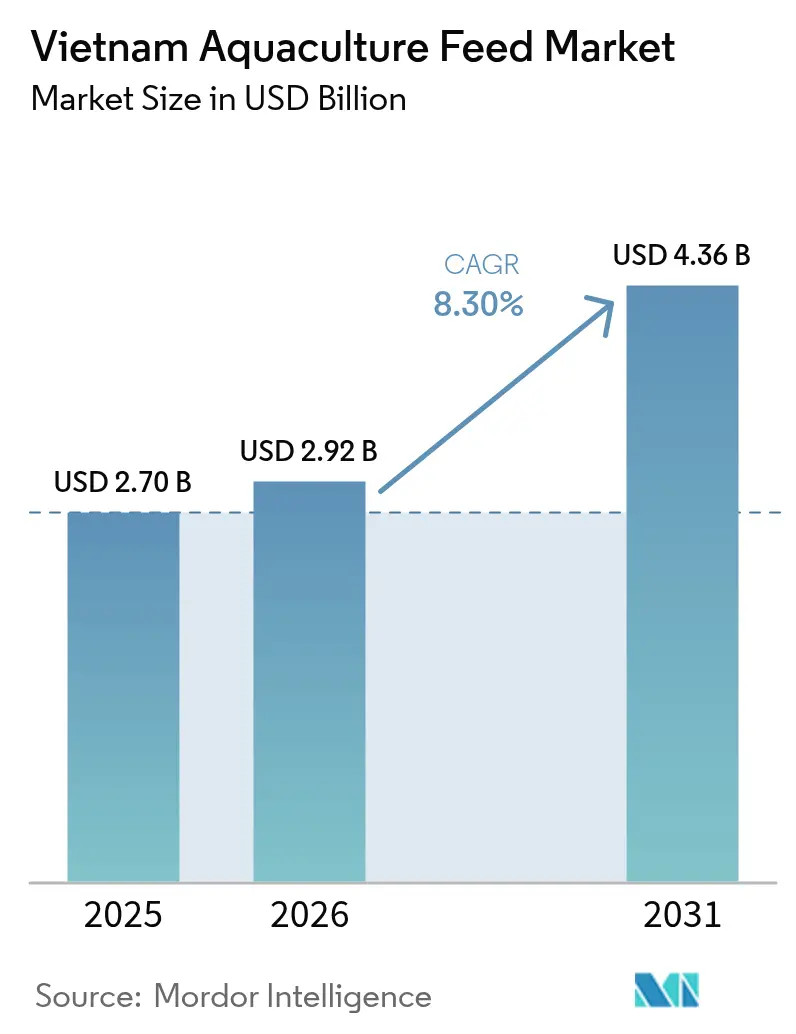
The Vietnam aquaculture feed market size was valued at USD 2.70 billion in 2025 and estimated to grow from USD 2.92 billion in 2026 to reach USD 4.36 billion by 2031, at a CAGR of 8.30% during the forecast period (2026-2031). Strong export demand for shrimp and pangasius, increased uptake of functional formulations, and rising investments in Recirculating Aquaculture Systems (RAS) are driving the Vietnam aquaculture feed market on an expansive trajectory. Extruded diets retain dominance because their buoyancy and water stability curb feed waste, while micro feeds are rapidly scaling across hatcheries. Algal and insect proteins are gaining traction as feed producers seek to insulate margins from volatile fish-meal prices. Regional tax incentives in the Shrimp-specific feed subsidies in the Mekong Delta and Central Coast are accelerating premium-feed adoption, and AI-enabled precision-feeding platforms are beginning to compress feed conversion ratios, lifting farm profitability.
Key Report Takeaways
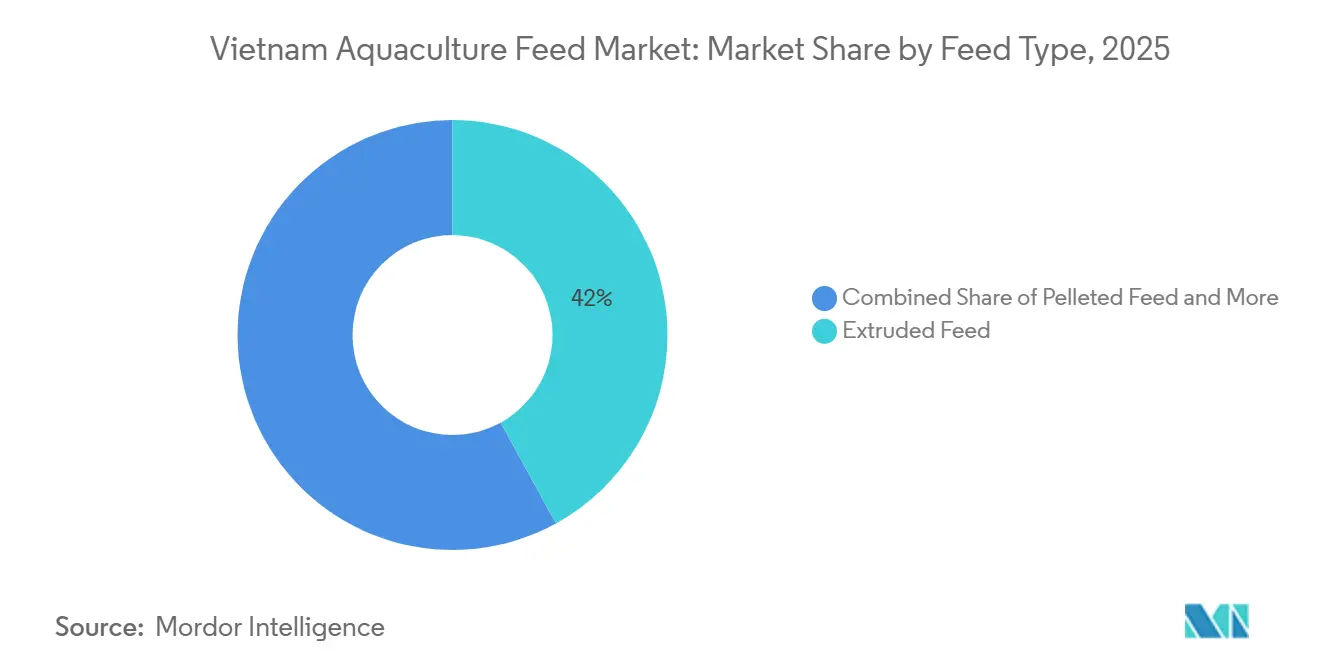
- By feed type, extruded diets were the largest segment, accounting for 42.0% of the Vietnam aquaculture feed market share in 2025, whereas micro feeds are the fastest-growing segment, advancing at an 11.5% CAGR through 2031.
- By ingredient source, fish meal and fish oil were the largest segment, commanding 38.0% of the Vietnam aquaculture feed market in 2025, while algal and alternative proteins are the fastest-growing segment, projected to grow at a 14.2% CAGR to 2031.
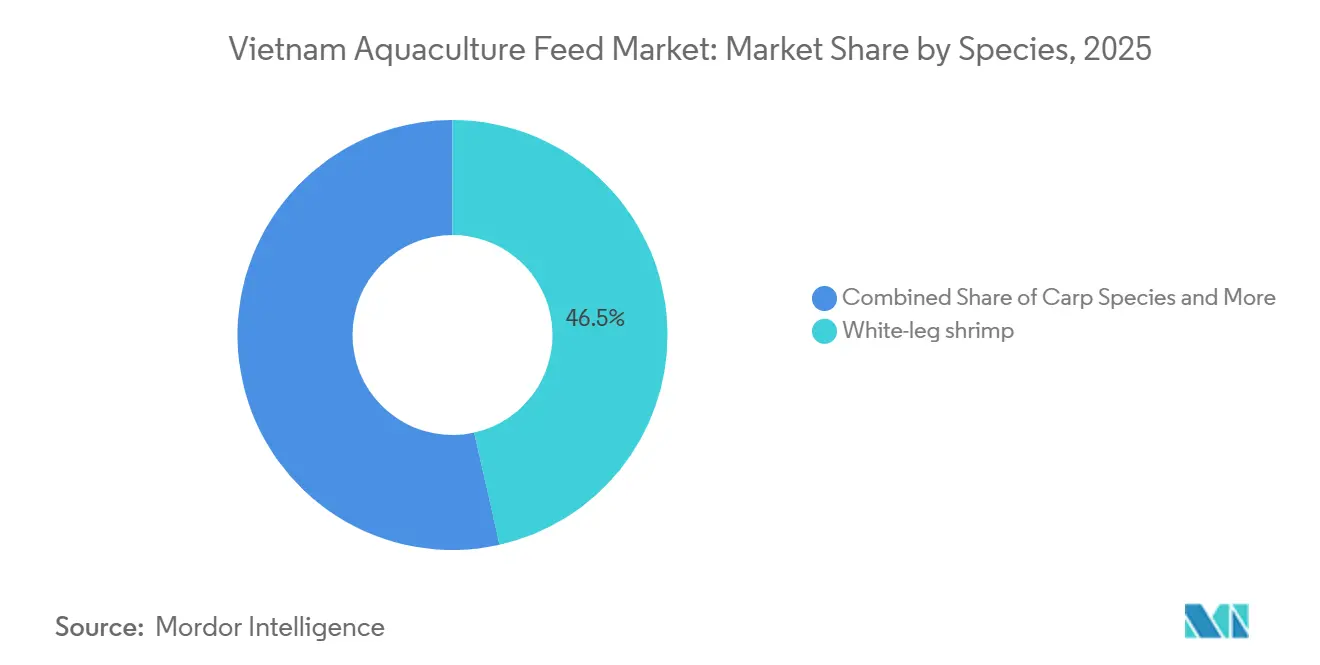
- By species, white-leg shrimp were the largest segment, holding 46.5% of the Vietnam aquaculture feed market size in 2025. Tilapia is the fastest-growing segment, forecast to expand at a 10.9% CAGR through 2031.
Note: Market size and forecast figures in this report are generated using Mordor Intelligence’s proprietary estimation framework, updated with the latest available data and insights as of 2026.
Market Trends and Insights
Drivers Impact Analysis of Vietnam Aquaculture Feed Market*
| Driver | (~) % Impact on CAGR Forecast | Geographic Relevance | Impact Timeline |
|---|---|---|---|
| Robust expansion of domestic Recirculating Aquaculture Systems facilities | +1.8% | National, with a concentration in the Mekong Delta, Southeast Region, and Red River Delta | Medium term (2-4 years) |
| Mainstream growth of functional feeds | +1.5% | National, the strongest uptake in the Mekong Delta and the Southeast Region for shrimp applications | Short term (≤ 2 years) |
| Rising consumer demand for antibiotic-free seafood | +1.3% | Global export markets (European Union, North America, and Japan), driving Vietnam-wide compliance | Medium term (2-4 years) |
| Integration of AI-driven precision-feeding platforms | +1.2% | Early adoption in the Mekong Delta and the Southeast Region, and expanding to the Red River Delta | Medium term (2-4 years) |
| Scale-up of single-cell protein production from biogas effluent | +0.9% | Pilot projects in the Mekong Delta and the Southeast Region, with limited national rollout | Long term (≥ 4 years) |
| Shrimp-specific feed subsidies in the Mekong Delta | +0.7% | Mekong Delta provinces (Ben Tre, Tra Vinh, Soc Trang, and Ca Mau) | Short term (≤ 2 years) |
| Source: Mordor Intelligence | |||
Robust Expansion of Domestic Recirculating Aquaculture Systems Facilities
The rapid expansion of Recirculating Aquaculture Systems (RAS) in Vietnam is significantly improving production efficiency and biosecurity in high-value species farming. RAS facilitates controlled water quality, reduces disease outbreaks, and enhances stocking density, particularly in shrimp and pangasius farming. For instance, intensive shrimp farms in the Mekong Delta are increasingly adopting RAS technology to minimize water exchange and mitigate disease risks such as Early Mortality Syndrome (EMS). This technology-driven approach supports higher output per hectare and stabilizes year-round production, directly contributing to overall aquaculture growth.
Mainstream Growth of Functional Feeds
The growing adoption of functional feeds fortified with probiotics, enzymes, and immunostimulants is improving feed conversion ratios and survival rates in shrimp and fish farming. As disease management becomes increasingly critical, farmers are transitioning from traditional feed to specialized formulations that enhance gut health and immunity. For instance, shrimp farms in Soc Trang and Bac Lieu provinces are using probiotic-enhanced feeds to reduce reliance on antibiotics while maintaining export-grade quality. This shift increases feed value per metric ton and enhances farm productivity, thereby driving sectoral growth. GreenFeed secured Aquaculture Stewardship Council certification in October 2025 for its probiotic shrimp diet, delivering improved feed conversion and cost savings for farmers[1].
Rising Consumer Demand for Antibiotic-Free Seafood
Rising demand from export markets such as the European Union, North America, and Japan for antibiotic-free and traceable seafood is prompting Vietnamese producers to upgrade farming practices. Compliance with international standards, such as Best Aquacultural Practices (BAP) certifications, is encouraging investments in improved water management, feed quality, and traceability systems. For instance, pangasius exporters in the Mekong Delta are increasingly adopting antibiotic-free production protocols to maintain access to premium markets. This export-driven compliance enhances Vietnam’s global competitiveness and fosters value-added growth in aquaculture.
Integration of AI-Driven Precision-Feeding Platforms
The adoption of AI-based feeding systems and smart monitoring platforms is optimizing feed utilization and reducing waste. These technologies leverage sensors and real-time data analytics to adjust feed distribution based on shrimp or fish behavior and environmental conditions. For instance, large-scale shrimp farms are implementing automated feeders that monitor consumption patterns, reducing feed wastage, improving feed conversion ratios, and lowering production costs. This technological integration boosts operational efficiency and profitability, supporting sustainable market growth. These digital tools cut input costs, elevate water quality, and will increasingly differentiate suppliers in the Vietnam aquaculture feed market.
Restraints Impact Analysis of Vietnam Aquaculture Feed Market*
| Restraint | (~) % Impact on CAGR Forecast | Geographic Relevance | Impact Timeline |
|---|---|---|---|
| Volatile fishmeal and fish oil prices | -1.4% | Global, with an acute impact on Vietnam due to high import dependence | Short term (≤ 2 years) |
| Stringent effluent-discharge rules from the Ministry of Natural Resources and Environment | -0.9% | National, with stricter enforcement in the Mekong Delta and the Southeast Region | Medium term (2-4 years) |
| Supply-chain bottlenecks for specialty additives | -0.6% | National, affecting imports of probiotics, enzymes, and immunostimulants | Short term (≤ 2 years) |
| Farmer hesitancy toward genetically engineered protein inputs | -0.5% | National, particularly among smallholder farms in the Mekong Delta and the Red River Delta | Long term (≥ 4 years) |
| Source: Mordor Intelligence | |||
Volatile Fish-Meal and Fish-Oil Prices
Vietnam relies heavily on imported fishmeal and fish oil for aquafeed production, making the industry susceptible to global price fluctuations. Increases in global fishmeal prices, often driven by supply constraints in Peru, directly raise feed production costs. This impacts shrimp farmers, leading to margin compression. As a result, some small-scale operators are compelled to reduce stocking densities or delay production cycles. The export price of fish oil from Vietnam has fluctuated significantly over the past two years. In 2024, prices ranged from 0.83 USD per kg to 2.96 USD per kg. In 2025, prices continued to vary, ranging from 0.97 USD per kg to 2.48 USD per kg[2].
Stringent Effluent-Discharge Rules
In February 2026, stricter environmental regulations introduced by the Ministry of Natural Resources and Environment have increased compliance costs for aquaculture farms. Farmers are required to invest in wastewater treatment systems and sedimentation ponds to meet discharge standards, particularly in the Mekong Delta. For instance, shrimp farms adopting high-density production must allocate additional capital to effluent management infrastructure, resulting in higher upfront investment costs. While these regulations are environmentally beneficial, they have slowed expansion among small and medium-scale farmers.
*Our forecasts treat driver/restraint impacts as directional, not additive. The impact forecasts reflect baseline growth, mix effects, and variable interactions.
Vietnam Aquaculture Feed Market Segment Analysis
By Feed Type:
Extruded Diets Dominate as Micro Feeds SurgeExtruded diets were the largest segment, accounting for 42.0% of the Vietnam aquaculture feed market share in 2025, reflecting their buoyancy advantage, which reduces waste and improves feed conversion. Pelleted diets held a significant share yet are losing ground to extruded formats as intensive shrimp farmers shift toward higher efficiency. Pelleted manufacturers are retrofitting steam conditioners to raise pellet durability, but their inherent density mismatch with shrimp feeding habits restricts uptake.
Micro feeds are the fastest-growing segment, advancing at a 11.5% CAGR through 2031, as hatcheries invest in controlled-release technology to drive gains in larval survival. Moist feeds remain a niche for eel and ornamental species because their short shelf life increases labor costs and limits their commercial potential in the Vietnamese aquaculture feed market. Thang Long Group inaugurated a new feed mill in Hai Duong province in May 2024, increasing its annual capacity to 700,000 metric tons. The facility focuses on producing extruded shrimp diets to target the premium segment and enhance profit margins[3].

By Ingredient Source:
Marine Proteins Face Substitution PressureFish meal and fish oil were the largest segment, commanding 38.0% of the Vietnam aquaculture feed market in 2025, owing to stable local supply and cost parity, though anti-nutritional factors cap inclusion rates in high-value shrimp diets. Fish oil continues to be a critical source of highly unsaturated fatty acids in marine finfish diets, although enzyme supplementation allows for partial replacement. Animal by-products, such as poultry meal, are commonly used in cost-effective pangasius feed formulations but are subject to increasing traceability requirements from export buyers. Government incentives are driving the domestic production of alternative proteins, enabling feed mills to mitigate risks associated with global commodity price fluctuations.
Algal and alternative proteins are the fastest-growing segment, projected to grow at a 14.2% CAGR to 2031. Plant proteins, primarily soy and wheat gluten, were the second-largest segment, driven by stable local supply and cost parity, though anti-nutritional factors cap inclusion rates in high-value shrimp diets. Algal proteins, sourced from Spirulina and Chlorella, provide omega-3 fatty acids without the risk of heavy-metal contamination associated with fish oil, making them a reliable alternative to mitigate marine-ingredient volatility. Regulatory uncertainties and limited farmer confidence continue to pose challenges.
By Species:
Shrimp Feeds Lead While Tilapia AcceleratesWhite-leg shrimp were the largest segment, holding 46.5% of the Vietnam aquaculture feed market size in 2025, mirroring Vietnam’s third-place global rank in shrimp exports. White-leg shrimp production is growing, driven by the adoption of intensive farming practices, premium export pricing, and technological advancements, such as Recirculating Aquaculture Systems (RAS) and precision feeding, which require specialized, high-performance feeds.
Tilapia is the fastest-growing segment, forecast to expand at a 10.9% CAGR through 2031, as cage systems expand across Northern reservoirs. Giant tiger prawn diets grow slowly because of longer culture cycles and higher disease risk. The rapid growth of tilapia production is drawing investment from multinational feed suppliers. For instance, in 2023, Aller Aqua Vietnam has developed a floating extruded feed specifically designed for cage systems, which minimizes feed waste compared to sinking pellets. Carp and catfish, traditional freshwater species, constitute a substantial portion of feed consumption. This is primarily concentrated in the Northern Midlands and Mountains region, where smallholder polyculture systems are prevalent. Other species, such as eel, grouper, and ornamental fish, occupy niche segments characterized by specialized nutritional needs and premium pricing.
Geography Analysis
Mekong Delta provinces, including Can Tho, Soc Trang, and Ca Mau, contribute over half of Vietnam's aquaculture production, driving regional feed consumption and manufacturing. Companies such as De Heus, Skretting, and CP Foods strategically position their mills near these areas to reduce freight costs and ensure timely deliveries. Additionally, Southeast coastal provinces support marine-cage culture, which increases demand for oil-rich extruded pellets, further boosting growth in feed consumption.
The geographic distribution of aquaculture activities results in varied patterns of feed demand. The Mekong Delta requires significant quantities of cost-effective pelleted feeds for pangasius and extensive shrimp farming systems. In contrast, coastal regions demand high-quality extruded feeds for intensive marine aquaculture. Central provinces, such as Nghe An and Dong Nai, have implemented updated aquaculture regulations that influence feed usage and traceability. These regulations include specific procedures for disease reporting and environmental compliance, which impact feed distribution and emergency response strategies.
While regional concentration offers economies of scale, it also increases vulnerability to flooding and disease outbreaks. As a result, manufacturers prioritize contingency stockpiles and diversified transport routes to mitigate risks. This geographic concentration provides competitive advantages for integrated operations that combine feed production, farming, and processing within regional clusters. However, it also exposes supply chains to disruptions caused by extreme weather events or disease outbreaks affecting multiple provinces simultaneously.
Regulatory Landscape
Vietnam's aquaculture feed regulation is anchored in Law No. 32/2018/QH14 on Animal Husbandry, with implementation via decrees, circulars, and national technical regulations that cover production, quality, labeling, and import controls. In November 2025, QCVN 93:2025/BNNMT (Part 1: compound aquaculture feed) updated safety indicator limits (including aflatoxin B1, heavy metals, and microbiological parameters), increasing the testing and documentation burden for compound-feed manufacturers and importers supplying shrimp and pangasius hubs.
In January 2026, Decree No. 32/2026/ND-CP took effect, amending conditions for the production and import of animal feeds and veterinary drugs and tightening compliance checkpoints for market entry. Oversight also strengthened around feed-related pharmaceutical use through Circular No. 15/2026/TT-BNNMT (March 2026), alongside continued requirements for conformity assessment and batch testing under Decree 39/2017/ND-CP and related guidance. The net effect is a higher premium placed on traceable raw materials, validated QC systems, and audit-ready product dossiers across domestic mills and imported specialty inputs.
Competitive Landscape
The Vietnam aquaculture feed market demonstrates moderate concentration with players including Skretting Vietnam (Nutreco N.V.), Cargill Inc., De Heus Animal Nutrition B.V., Charoen Pokphand Group, and Archer-Daniels-Midland Company accounting for significant revenue in 2025. The market features a mix of multinational corporations and agile domestic firms. Companies such as Cargill Inc., De Heus Animal Nutrition B.V., Charoen Pokphand Group, leverage global research and development capabilities and financial resources to secure a substantial share of premium feed sales. Meanwhile, domestic players like GreenFeed, Tongwei, and Olam Agri focus on localized formulations and farmer financing.
Domestic companies, including GreenFeed, Tongwei, and newer entrants such as Olam Agri Vietnam, adopt differentiation strategies through regional specialization, species-specific formulations, and integrated value-chain approaches that combine feed production with farming and processing. The competitive landscape fosters continuous innovation, with firms investing in alternative protein sources, precision feeding technologies, and sustainability certifications. These efforts aim to capture premium market segments and meet the demands of export-oriented customers requiring traceability and environmental compliance.
Alternative-protein alliances are budding, Entobel’s insect-meal project and methanotroph trials by Hanoi’s Institute of Biotechnology seek to dilute fish-meal exposure. Yet regulatory lag and farmer skepticism prolong marine-ingredient dominance. Competition will intensify as buyers demand empirical on-farm trial data before switching suppliers, likely squeezing manufacturers that cannot prove measurable performance gains.
Vietnam Aquaculture Feed Industry Leaders
-
Skretting Vietnam (Nutreco N.V.)
-
Cargill Inc.
-
De Heus Animal Nutrition B.V.
-
Charoen Pokphand Group
-
Archer-Daniels-Midland Company
- *Disclaimer: Major Players sorted in no particular order

Vietnam Aquaculture Feed Market Companies Covered in this Report
- Cargill Inc.
- De Heus Animal Nutrition B.V.
- Skretting (Nutreco NV)
- Archer-Daniels-Midland Company
- Charoen Pokphand Group
- Skretting Vietnam (Nutreco N.V.)
- Grobest Industrial Co. Ltd. (Grobest Group)
- Tongwei Co. Ltd.
- Alltech Inc.
- Lallemand Inc.
- INVE Aquaculture Inc. (Benchmark Holdings Plc)
- Aller Aqua Vietnam (Aller Aqua A/S)
- GreenFeed Vietnam Corp.
- Uni-President Vietnam Co. Ltd.
Market Opportunities and Future Outlook
Opportunities are concentrated in compliance-led premiumization and service bundling as Vietnam tightens technical and digital controls over aquafeed. Circular No. 16/2026/TT-BNNMT (March 2026) updates management of aquatic breeds and aquafeed, including mandatory producer and importer accounts in the national database, which raises the value of standardized product documentation, batch traceability, and digitally enabled customer support. This shift creates room for suppliers that can package feed with data capture, farm-level advisory, and verified safety performance aligned with QCVN 93:2025/BNNMT requirements.
Commercial activity in 2026 also points to demand for integrated solutions and sustainability-aligned formulations. Skretting Vietnam launched the Jade+ shrimp nutrition solution in Ben Tre in April 2026, reflecting a move from standalone diets to packages that connect nutrition with performance monitoring and farm management. In January 2026, De Heus and Minh Phu Seafood Corporation agreed to cooperate on a sustainable shrimp value chain, including technology transfer and scaling super-intensive systems (RAS-IMTA) in Ca Mau, supporting demand for functional feeds, micro feeds for hatchery stages, and alternative proteins that reduce exposure to volatile marine-ingredient pricing.
Recent Industry Developments in Vietnam Aquaculture Feed Market
- April 2026: Skretting Vietnam launched the Jade+ shrimp nutrition solution in Ben Tre, combining feed with tools that link nutrition to performance monitoring and farm conditions. The rollout reinforces a shift toward bundled, outcome-based offerings rather than commodity feed sales. It also raises competitive pressure on suppliers to provide technical services and measurable on-farm results for intensive shrimp systems.
- November 2025: Skretting Vietnam partnered with Entobel to commercialize shrimp feed containing insect meal (H-Meal), positioned as the first such product launched in Vietnam. The move supports diversification away from fishmeal and fish oil and strengthens sustainability credentials for export-aligned shrimp value chains. It also accelerates local validation and adoption pathways for novel protein inputs in compound feeds.
- April 2024: De Heus opened a new shrimp feed mill in the Co Chien Industrial Zone, Vinh Long province, with annual capacity of 50,000 metric tons. The investment expanded dedicated shrimp-feed output closer to the Mekong Delta demand center, improving service levels and logistics efficiency for large farming clusters. It also signals continued capital commitment by multinational producers to premium extruded and functional shrimp diets in Vietnam.
Vietnam Aquaculture Feed Market Report Scope and Research Methodology
Market Definition and Coverage
This market covers the value of formulated aquaculture feed sold in Vietnam for farmed aquatic species, where feed is manufactured and marketed as complete or complementary diets for on-farm use.
Scope exclusions: This sizing excludes on-farm mixed feed and raw, unformulated inputs that are not sold as finished aquaculture feed products.
Segments Covered in This Report
- By Feed Type
- Extruded Feed
- Pelleted Feed
- Moist Feed
- Micro Feed
- By Ingredient Source
- Fish Meal and Fish Oil
- Plant Protein
- Animal By-products
- Algal and Alternative Proteins
- By Species
- White-leg Shrimp (Litopenaeus vannamei)
- Giant Tiger Prawn (Penaeus monodon)
- Pangasius
- Carp
- Catfish
- Tilapia
- Other Species
Data Sources, Market Sizing, and Validation
Desk Research
Desk work started by mapping Vietnam aquaculture production and the feed demand logic behind it, so the later model stays tied to on-the-ground farming activity. We relied on public sources such as Vietnam General Statistics Office releases, FAO fishery and aquaculture datasets, and Ministry of Agriculture and Rural Development publications to anchor species mix and volume direction.
To shape pricing and product structure, we also used references like customs and trade statistics, peer-reviewed nutrition and aquaculture journals, and association or extension material that discusses feeding rates and feed conversion patterns. In addition, company filings and investor presentations were scanned for capacity expansions, margin movement, and product mix clues. We used a paid subscription database selectively for company financials, shipment-level trade checks, and patent lookups. The sources mentioned above are illustrative and not exhaustive, and other references were added as collection, validation, and clarification progressed.
Primary Interviews and Surveys
Primary work was used to pressure-test desk assumptions on feed types, farm-level consumption patterns, and how pricing changes flow into contract and spot sales. We spoke with a mix of feed producers, distributors, and aquaculture operators across key farming belts in the country, so demand signals from shrimp and freshwater species could be compared and adjusted into one consistent view.
Distribution of primary research fieldwork respondents
| Company type | Respondent position |
|---|---|
| Top tier: 38% | CXOs: 19% |
| Mid tier: 40% | Functional/Unit leaders: 36% |
| Smaller Players: 22% | Managers: 45% |
Market-Sizing & Forecasting
Sizing was built using a top-down approach where aquaculture output in Vietnam is translated into feed demand through species-wise feeding intensity and typical feed conversion behavior, and then priced using observed market price bands by feed form. The model stayed practical by working with a small set of repeatable inputs, including shrimp and key freshwater production trends, changes in farmed area and stocking density, shifts in feed mix between extruded and pelleted products, ingredient cost direction that influences realized prices, and observed movement in feed conversion ratios during disease or weather stress years.
To keep totals realistic, we used selective bottom-up approximations as checks, including supplier revenue ranges, reported capacity expansions, and channel feedback on monthly offtake and discounting. When bottom-up signals were incomplete, gaps were handled through share-based interpolation using nearby peer groups, followed by a re-check against implied feed demand per ton of harvest. For forecasting, we applied scenario analysis around export demand, disease risk, and input cost swings, and then aligned the forward path to expert consensus on how quickly farms adopt improved feed and feeding practices.
Data Validation & Update Cycle
Validation was done by comparing outputs against independent signals such as aquaculture production direction, trade activity for key ingredients, and visible capacity utilization shifts shared in interviews. If a year showed an unusual jump in implied feed use per ton of harvest, the assumptions were revisited and relevant respondents were contacted again for clarification.
Before sign-off, the model and key assumptions go through a multi-step analyst review so arithmetic, units, and conversions remain consistent across years. The report is refreshed annually, and interim updates are triggered when material events occur, including policy changes, sharp input cost swings, or major capacity additions. Right before delivery, an analyst performs a final pass so clients receive the most current view available at that time.
Mordor Intelligence's Vietnam Aquaculture Feed Market Estimate Compared With Other Published Estimates
Published market numbers for Vietnam aquaculture feed can look different because the included feed basket, the price points used, and the timing of currency and inflation updates are not always aligned. Differences also show up when some sources lean more on production narratives, while others tie the math to measured demand drivers and then reconcile it with supplier-side signals.
On-farm mixed feed and unprocessed raw inputs sit outside Mordor Intelligence's scope, which narrows the definition to formulated aquafeed sold through commercial channels and makes the pricing and volume logic easier to verify. The spread across sources is also driven by whether shrimp and freshwater feeds are priced using farmgate averages or manufacturer realized prices, and by how feed form shifts (extruded versus pelleted) are treated over time.
Benchmark comparison
| Source | Market Size | Gaps in Research Methodology |
|---|---|---|
| Mordor Intelligence | USD 2.70 B (2025) | |
| Trade Journal A | USD 3.94 B (2028) | Uses a forward-year headline without showing the conversion from species output to feed demand, and the definition of aquafeed is not clarified for inclusion of farm-mixed feed or raw materials. |
| Industry Publisher B | USD 2.63 B (2025) | Applies a lower growth path and appears to smooth pricing, which can understate years where ingredient-driven price moves lift realized feed values, and limited detail is provided on feed form and species weighting. |
Taken together, the comparison mainly points to definition and pricing mechanics, not just growth rate assumptions. Our estimate stays traceable to Vietnam production signals, species-linked feeding intensity, and observable price bands, and it is then cross-checked with supplier and channel feedback so the final number is repeatable and easy to audit.
Key Questions Answered in the Report
What is the current value of the Vietnam aquaculture feed market?
The Vietnam aquaculture feed market was valued at USD 2.70 billion in 2025 and is projected to grow from USD 2.92 billion in 2026 to USD 4.36 billion by 2031, registering a CAGR of 8.30% during the forecast period (2026-2031).
Which species uses the most commercial feed in Vietnam?
White-leg shrimp commands 46.5% value share of the market in 2025, owing to Vietnam's dominant shrimp export sector.
Why are Recirculating Aquaculture Systems important to feed suppliers?
Recirculating Aquaculture Systems units are projected to expand and require high-energy extruded diets, thereby creating a premium market segment for feed suppliers.
How are volatile fish-meal prices affecting manufacturers?
An increasing spike in early 2025 compressed feed-mill margins by up to 5% points and accelerated trials of algal and insect proteins.