
Veterinary Dental Equipment Market Size and Share
Market Overview
| Study Period | 2020 - 2031 |
|---|---|
| Market Size (2026) | USD 510.28 Million |
| Market Size (2031) | USD 673.7 Million |
| Growth Rate (2026 - 2031) | 5.72 % |
| Fastest Growing Market | Asia Pacific |
| Largest Market | North America |
| Market Concentration | Medium |
Major Players *Disclaimer: Major Players sorted in no particular order Image © Mordor Intelligence. Reuse requires attribution under CC BY 4.0. | |
Veterinary Dental Equipment Market Analysis by Mordor Intelligence
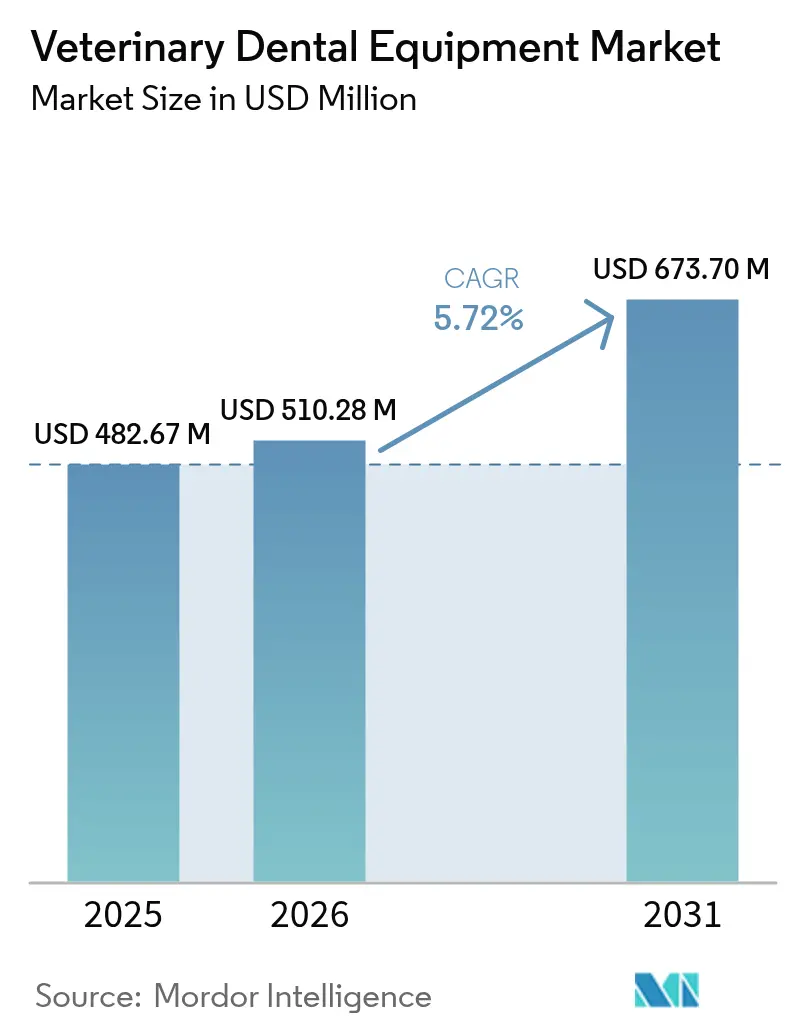
Veterinary Dental Equipment Market size market size in 2026 is estimated at USD 510.28 million, growing from 2025 value of USD 482.67 million with 2031 projections showing USD 673.7 million, growing at 5.72% CAGR over 2026-2031.
Rising pet longevity, growing awareness of periodontal disease, and the normalization of preventive dentistry have created a durable demand funnel that sustains steady equipment sales. Clinics are enlarging chair capacity and adopting workflow-centric layouts, which shortens procedure times and pushes average equipment spend higher. Pet insurance policies that now reimburse cleanings, extractions, and even endodontics are accelerating the replacement cycle for high-value digital radiography and powered handpieces. At the same time, portable field kits aimed at mass vaccination initiatives in emerging markets widen the intake pipeline for first-time buyers.
Key Report Takeaways
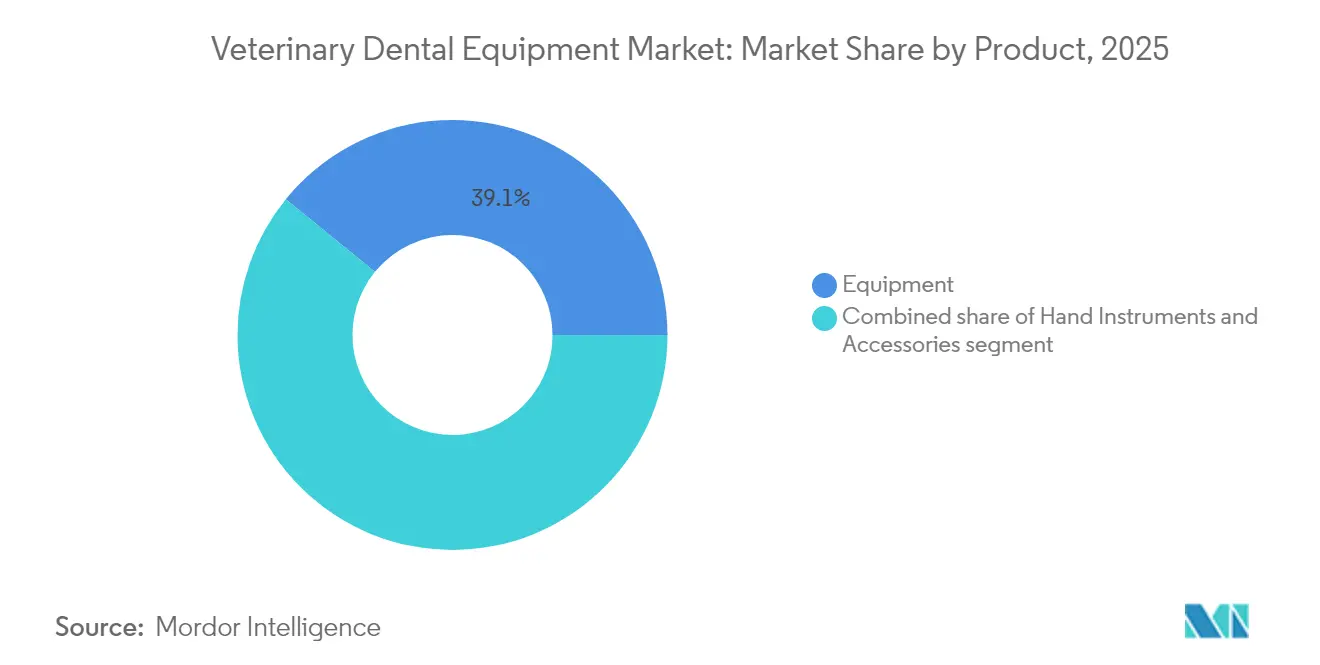
- By product type, hand instruments captured 39.12% of the veterinary dental equipment market share in 2025 and are forecast to grow at a 6.72% CAGR through 2031, outpacing all other categories.
- By procedure, diagnostic imaging commanded 33.45% of the 2025 veterinary dental equipment market size and is projected to expand at 6.21% CAGR to 2031.
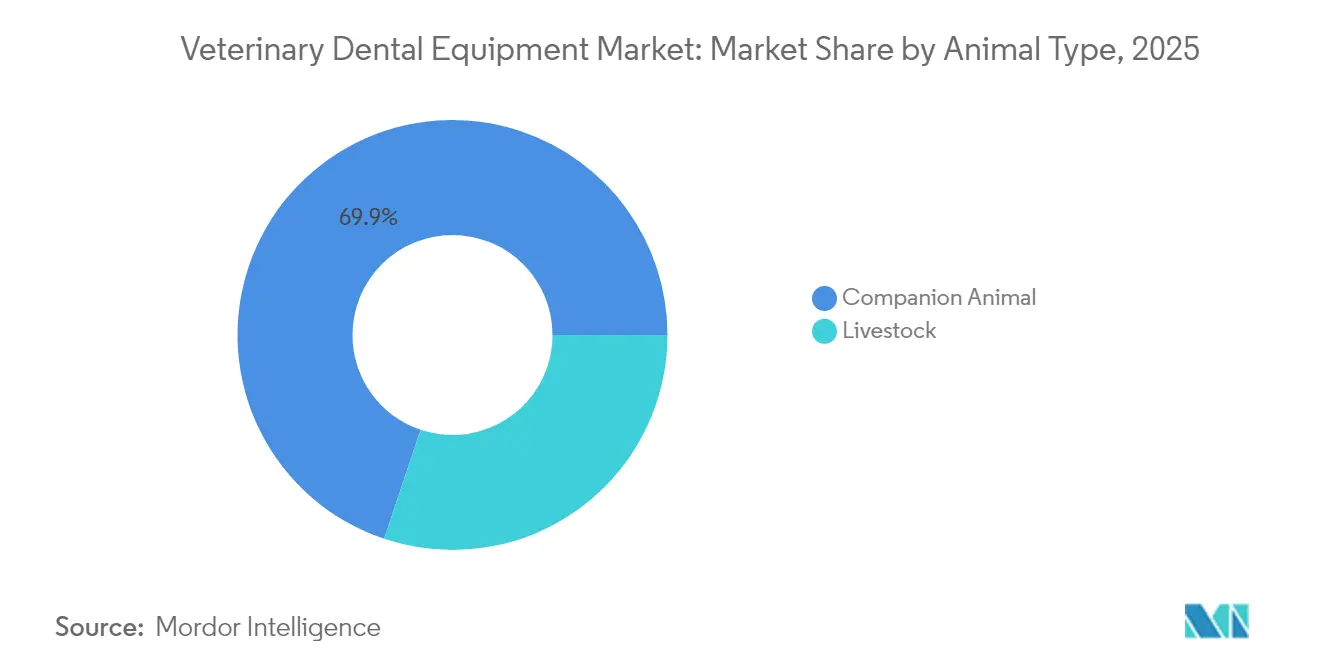
- By animal type, companion animals held 69.85% revenue share of the veterinary dental equipment market in 2025, while the livestock segment is projected to post the fastest growth at 6.45% through 2031.
- By end user, veterinary clinics accounted for 52.55% of the veterinary dental equipment market size in 2025; the “others” category (academia, mobile units, dental-only practices) is expected to advance the quickest at 6.52% CAGR to 2031.
Note: Market size and forecast figures in this report are generated using Mordor Intelligence’s proprietary estimation framework, updated with the latest available data and insights as of 2026.
Market Trends and Insights
Drivers Impact Analysis of Veterinary Dental Equipment Market*
| Driver | (~) % Impact on CAGR Forecast | Geographic Relevance | Impact Timeline |
|---|---|---|---|
| Surge in Board-Certified Veterinary Dentistry Practices | +1.2% | North America & Europe | Medium term (2-4 years) |
| Rising Uptake of Digital Dental Radiography in Equine Hospitals | +0.8% | Global, with concentration in North America & Europe | Short term (≤ 2 years) |
| Expansion of Pet Insurance Policies Covering Dental Procedure | +1.5% | North America, Europe, developed APAC | Medium term (2-4 years) |
| Government-Sponsored Mass Rabies Drives Triggering Routine Oral Check-ups | +0.7% | Latin America, Asia-Pacific, Africa | Long term (≥ 4 years) |
| Growth of Tele-Dentistry Triage Platforms for Rural Companion-Animal Clinics | +0.9% | Global, with emphasis on rural regions | Medium term (2-4 years) |
| Source: Mordor Intelligence | |||
Surge in Board-Certified Veterinary Dentistry Practices
Regional clusters of American Veterinary Dental College diplomates surpassed 220 in 2024, multiplying referral flows that incentivize general practices to upgrade imaging and high-speed instrumentation. Corporate suppliers integrate hands-on workshops with equipment bundles, creating a virtuous loop where clinical mastery fuels hardware demand. The driver’s impact is strongest in secondary cities, where early adopters quickly influence five to seven neighboring clinics to follow suit, gradually lifting the veterinary dental equipment market.
Rising Uptake of Digital Dental Radiography in Equine Hospitals
Direct digital plates engineered for large skulls enable immediate diagnostics and lower retake rates, encouraging equine practices to retire film systems. A 2025 study showed artificial-intelligence software reached high inter-rater agreement with board-certified dentists when identifying common lesions. Although sensitivity still trails human expertise, the technology enriches treatment planning and shortens reading times, raising utilization of digital sensors and consoles within the veterinary dental equipment market.
Expansion of Pet Insurance Policies Covering Dental Procedures
Average dental cleaning costs of USD 170-350 are now routinely reimbursed by North American and Nordic policies, lifting client acceptance of advanced treatments and shrinking payback periods on capital items. Clinics report procedure approval rates climbing 30-40% after policy upgrades, driving a direct uptick in handpiece, suction, and X-ray sales and reinforcing the growth trajectory of the veterinary dental equipment market.
Government-Sponsored Mass Rabies Drives
Canada’s 2025 rabies vaccination guideline recommends full-mouth inspections during each inoculation, formalizing preventive dentistry in public-health settings. Portable LED lights, mouth gags, and battery-run polishers are now adapted for field use, opening incremental channels for suppliers targeting first-time users in emerging economies.
Restraints Impact Analysis of Veterinary Dental Equipment Market*
| Restraint | (~) % Impact on CAGR Forecast | Geographic Relevance | Impact Timeline |
|---|---|---|---|
| High Up-Front Cost of CBCT & Advanced Imaging in Emerging Markets | -0.9% | Asia-Pacific, Latin America, Middle East & Africa | Medium term (2-4 years) |
| Shortage of Diplomate Veterinary Dentists Beyond Tier-1 Cities | -1.3% | Global, particularly acute in developing regions | Long term (≥ 4 years) |
| Grey-Market Imports & Non-Certified Equipment in Latin America | -0.8% | Latin America, with spillover to other developing regions | Medium term (2-4 years) |
| Limited Reimbursement for Equine Dental Services in the Nordics | -0.4% | Nordic countries (Sweden, Norway, Denmark, Finland) | Short term (≤ 2 years) |
| Source: Mordor Intelligence | |||
Shortage of Diplomate Dentists Beyond Tier-1 Cities
Limited specialist presence outside metropolitan hubs curbs exposure to advanced techniques, slowing adoption of premium units. Research on geographic access indicates significant care gaps that suppress equipment uptake in semi-urban clinics. Suppliers respond with simplified controls and remote coaching, but sustained specialist scarcity still drags on the broader veterinary dental equipment market.
Grey-Market Imports & Non-Certified Equipment
Price discounts of 30-50% entice Latin American buyers toward counterfeit handpieces and cloned sensors, undermining certified vendors. Legitimate manufacturers deploy holograms and online serial checks to protect brand equity. While education campaigns gradually steer customers back, persistent grey-channel leakage moderates growth rates in affected sub-regions of the veterinary dental equipment market.
*Our forecasts treat driver/restraint impacts as directional, not additive. The impact forecasts reflect baseline growth, mix effects, and variable interactions.
Veterinary Dental Equipment Market Segment Analysis
By Product:
Precision Hand Instruments Extend Clinical ReachHand instruments represent 39.12% of the veterinary dental equipment market and are advancing at a 6.72% CAGR as practitioners adopt color-coded scalers, curettes, and winged elevators for species-specific pathology. Over 80-90% of dogs older than three years present periodontal lesions, making fine-tip instruments indispensable. Vendors now offer ergonomic silicone handles that reduce operator fatigue, prompting clinics to replace legacy sets more frequently. Lighting and magnification tools maintain robust incremental demand due to the migration of microsurgical techniques from human dentistry, while waste-management accessories enjoy regulatory tailwinds as infection-control standards tighten across the veterinary dental equipment market.
Digital X-ray consoles, sensors, and positioning aids comprise roughly one-quarter of revenue and benefit from steady conversion of film users. The shift accelerates where pet insurance and specialist referrals overlap, underscoring the linked nature of procedural complexity and imaging investment. Recent launches of veterinary-specific intra-oral sensors hardened against bite pressure amplify confidence in long-term durability, fostering repeat purchases in the veterinary dental equipment market.

By Procedure:
Imaging-Led Diagnosis Reshapes Care PathwaysDiagnostic imaging accounts for 33.45% of 2025 revenue, with clinics integrating chairside monitors that allow real-time owner consultations. The feedback loop drives higher acceptance of periodontal therapy, which retains the largest case volume because canine prevalence exceeds 80% in adult dogs. Extraction kits featuring power elevators and precision burs deliver less trauma and faster healing, encouraging broader use even among general practitioners. Preventive polishing heads, fluoride gels, and sealants add recurring consumable revenue, anchoring long-term client retention within the veterinary dental equipment market.
Restorative and endodontic procedures, once confined to referral centers, gain traction as training materials demonstrate reliable outcomes. Composite syringes and light-curing handpieces adapted from human dentistry allow tooth-saving therapies that align with owner sentiment. Exotic-animal dentistry underscores the need for specialized micro-burs; a 2024 rabbit study cited 41% complication rates during intra-oral surgeries, highlighting equipment gaps that innovators now target. Each of these sub-segments keeps broadening the scope of services that underpin the veterinary dental equipment market.
By Animal Type:
Companion Animals Dominate, Livestock AccelerateCompanion animals deliver 69.85% of 2025 revenue in the veterinary dental equipment market, reflecting owner willingness to approve elective dental care. Insurance reimbursement and consumer financing reduce price sensitivity, stimulating sales of premium handpieces and implant-grade kits. Pediatric dentistry for brachycephalic breeds is a rising niche that requires fine diamond burs and magnification loops, ensuring repeat purchases.
Livestock and equine applications together capture the remaining share yet exhibit a 6.45% CAGR through 2031. Dental pathologies hamper feed conversion and performance; a 2023 survey found 95% of miniature horses had clinically significant findings, pushing equine practitioners to acquire field-portable power floats. Durable casings, splash-resistant consoles, and battery longevity dominate buying criteria in this cohort of the veterinary dental equipment market.
By End User:
Clinics Anchor Demand, Mobile Units Expand ReachVeterinary clinics hold 52.55% of the veterinary dental equipment market size and treat dentistry as a key revenue driver that raises per-visit spend. Modern design philosophy allocates a dedicated dental table, wall-mounted X-ray generator, and automated suction to maximize throughput. Hospitals and referral centers add anesthesia monitors and separate airflow systems to support longer, specialist-level procedures, reinforcing the high-value end of the veterinary dental equipment market.
Mobile services, dental-only practices, and academic labs collectively form the fastest-growing end-user block. Unit shipments to mobile operators rise as customized vans ship with built-in compressors and handheld radiography devices, allowing access to underserved ZIP codes. Academic institutions refresh high-fidelity models and simulation suites frequently, validating novel tools before they reach commercial channels. This cross-pollination accelerates the diffusion curve across the veterinary dental equipment market.
Geography Analysis
North America Veterinary Dental Equipment Market
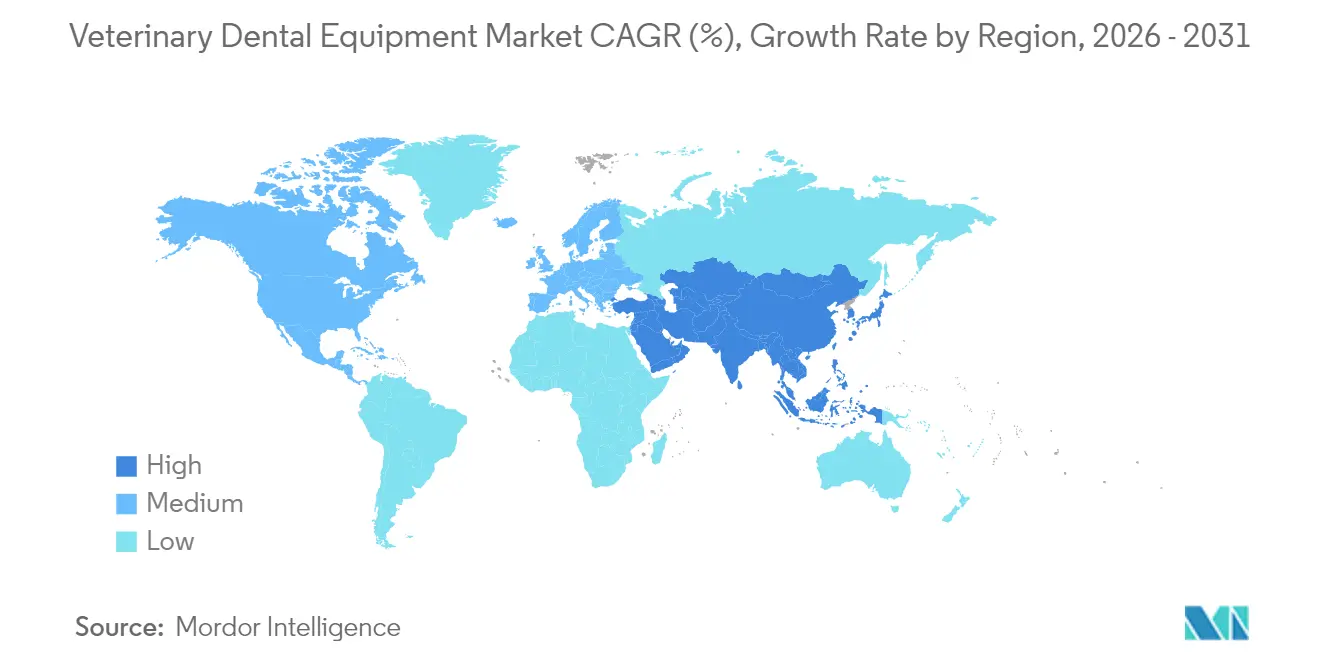
North America retains leadership with 41.85% revenue share and records above-average equipment density per practice. Specialist clusters, widespread insurance coverage, and mandatory device certifications create a favorable demand profile. Technician enrollment in dental post-certificates is projected to climb 20% from 2021-2031, adding skilled labor that justifies expanded operatory footprints. Clinics upgrade from single to dual chairs, effectively doubling capacity without enlarging real estate, which boosts capital investment in the veterinary dental equipment market.
APAC Veterinary Dental Equipment Market
Asia-Pacific posts the fastest growth, at a 7.01% CAGR, propelled by rising disposable incomes and rapid urbanization that concentrates pet ownership in megacities. China, Japan, and South Korea anchor premium purchases, while India and Southeast Asian nations exhibit first-wave adoption of portable kits suited to mixed-practice environments. Government-funded rabies campaigns integrate oral screenings, exposing field veterinarians to equipment benefits. This experience seeds future private-sector demand, expanding the veterinary dental equipment market.
EMEA and LATAM Veterinary Dental Equipment Market
Europe remains a mature yet innovation-oriented region where stringent safety standards favor certified suppliers. Price transparency varies: a 2024 multi-country study recorded wide fee swings, affecting payback models for new hardware. Clinics in higher-fee territories adopt premium imaging sooner, while lower-fee zones phase in gradually. Latin America and the Middle East-Africa collectively hold a modest share but display pockets of high growth in urban hubs. Counterfeit penetration and uneven enforcement temper expansion in Latin America, whereas infrastructure limitations constrain many African sub-markets, though elite owners sustain small clusters of demand. Collectively, these dynamics underscore the varied maturity levels across the global veterinary dental equipment market.
Regulatory Landscape
In the United States, the US Food and Drug Administration (FDA), Center for Veterinary Medicine (CVM) oversees animal medical devices under the Federal Food, Drug, and Cosmetic Act, with enforcement focused on misbranding, mislabeling, and adulteration rather than a dedicated premarket pathway. For veterinary-only dental equipment, there is no formal FDA PMA or 510(k) clearance track, so manufacturers and distributors carry more responsibility for substantiating safety and performance claims through testing, documentation, and accurate labeling, particularly for higher-value imaging and powered systems used under anesthesia.
In Europe, the EU Medical Device Regulation (EU) 2017/745 applies to devices intended for human use and does not cover veterinary dental equipment, leaving veterinary dental devices subject to a fragmented, country-by-country compliance environment. National authorities may publish their own guidance for devices used for animals (for example, the Danish Medicines Agency provides direction), and suppliers operating across EMEA often standardize to widely recognized quality and safety practices (such as ISO-aligned processes) to simplify multi-market distribution and reduce the risk of product disputes and grey-market substitution.
Value Chain Analysis
The value chain starts with upstream inputs such as stainless steel and titanium alloys for hand instruments, piezoelectric elements for ultrasonic scalers, sensors and electronics for digital radiography, and compressors and suction components for dental stations. These feed precision machining, assembly, and calibration at OEM/ODM manufacturers, followed by validation and packaging, where consistent labeling and traceability are increasingly used to counter counterfeit and non-certified equipment leakage noted in parts of Latin America.
Go-to-market is shaped by multi-line distributors and integrated supply networks that bundle equipment, financing, consumables, and service. Large platforms such as Patterson Companies and Henry Schein function as key distribution and service nodes in North America. Manufacturers also depend on training-led pull-through, such as programs attached to imaging bundles, and aftersales support for uptime (installation, preventive maintenance, repair parts), which becomes a differentiator for clinics moving from film to digital imaging and adopting higher-throughput dental operatory layouts.
Competitive Landscape
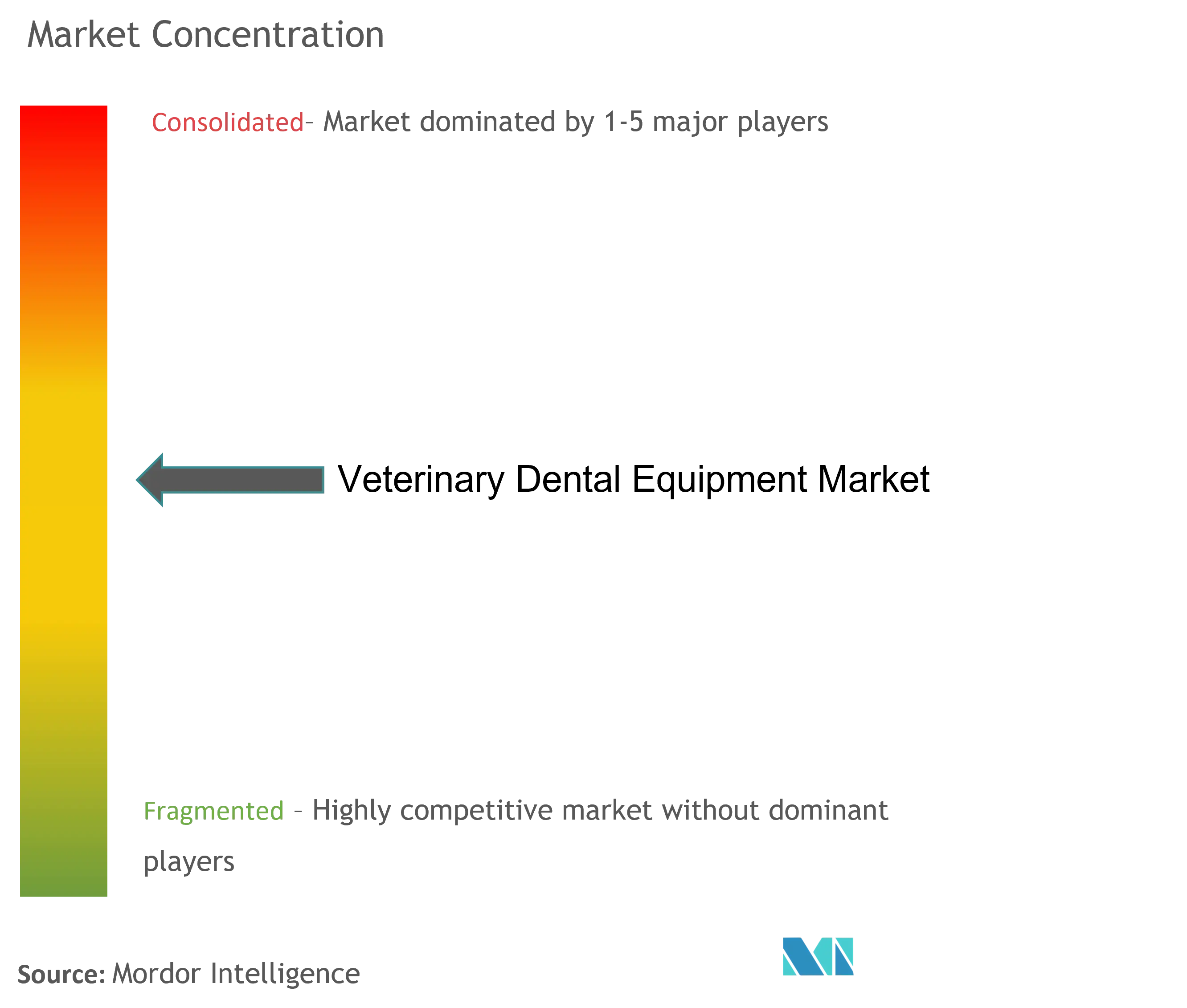
The veterinary dental equipment market shows moderate concentration: the top five suppliers collectively account for more than half of global revenue. Diversified distributors such as Patterson Companies provide financing and broad catalogs, while specialist innovators like iM3 focus exclusively on dental units and training. Midmark’s academy program doubled dental revenue share for participating practices, demonstrating how education augments product pull-through.
Convergence with human dentistry hastens product iterations. Companies transfer sensor patents, LED light technology, and ergonomic handle designs, shortening development timelines within the veterinary dental equipment market. The 2024 acquisition of iM3 by Vimian Group for EUR 87.5 million underscores sustained investor appetite for highly specialized product lines that pair consumable yield with capital uptime.
Artificial-intelligence overlays represent a potential pivot: a 2025 peer-reviewed study shows software achieving human-level accuracy on several lesion types, hinting at subscription-based models that bundle hardware and analytics. Smaller players differentiate through species-specific instrumentation—such as micro-burs for birds and rodents—carving out defensible niches in the wider veterinary dental equipment market.
Veterinary Dental Equipment Industry Leaders
-
Midmark Corporation
-
MAI Animal Health
-
Dentalaire, International
-
iM3Vet Pty Ltd
-
Dispomed ltd
- *Disclaimer: Major Players sorted in no particular order
Veterinary Dental Equipment Market Companies Covered in this Report
- iM3 Veterinary Dentistry
- Midmark
- Henry Schein
- Dentalaire International
- Patterson Companies
- Acteon Group Ltd.
- Planmeca
- Integra LifeSciences Holdings Corp.
- Jørgen Kruuse A/S
- Eickemeyer Veterinary Equipment
- B. Braun
- Covetrus
- Dispomed
- Heska
- DRE Veterinary
- Summit Veterinary Pharmacy
- Accesia AB
- Avante Health Solutions
- Cislak
- VetDent
Market Opportunities and Future Outlook
Workflow-centric packages that combine imaging, delivery units, sterilization, and on-site training represent a clear whitespace for general practices expanding chair capacity and trying to standardize dentistry across multi-site operations. Recent vendor actions reinforce this direction, including Midmark bundling installation and training into dental imaging programs (2025) and introducing new dental sensors and operatory solutions (2026), which reduces adoption friction for clinics moving into digital radiography and higher-frequency dental procedures.
There is also opportunity at the intersection of diagnostics and software as AI-assisted approaches gain clinical relevance in veterinary dentistry. In 2026, an AI tool highlighted for early warning of canine dental disease and peer-reviewed work around digital planning and advanced workflows point to demand for better detection, documentation, and owner communication, which supports higher utilization of digital imaging and compatible sensors. Separately, government-sponsored public health touchpoints that incorporate oral checks, such as Canada’s 2025 rabies vaccination guideline recommending full-mouth inspections during inoculation, support demand for portable lighting, basic instrumentation, and field-ready polishing solutions that can seed first-time equipment adoption in emerging-market settings.
Recent Industry Developments in Veterinary Dental Equipment Market
- July 2026: Midmark launched its 2026 Midmark Dentistry Promotion, offering time-bound rebates across select veterinary imaging and dental delivery systems through October 31, 2026. The promotion supports accelerated upgrade decisions for practices transitioning from film to digital and standardizing operatory equipment across multiple rooms or sites.
- February 2026: Midmark introduced a next-generation digital dental sensor for the animal health market. New sensor options strengthen the replacement and upgrade cycle tied to diagnostic imaging, a major procedure segment, and help clinics raise throughput by reducing retakes and streamlining chairside image review.
- December 2024: Patterson Companies agreed to a USD 4.1 billion take-private deal with Patient Square Capital. The transaction can reshape capital allocation and operating priorities for a major veterinary distributor, with implications for equipment financing, catalog strategy, and service coverage that influence dental equipment access for clinics.
Veterinary Dental Equipment Market Report Scope and Research Methodology
Market Definition and Coverage
This market covers revenue generated from veterinary-use dental equipment and consumables used for animal oral examination, diagnosis, cleaning, extraction, and related dental procedures across clinics, hospitals, and other care settings.
Scope exclusions: This sizing does not count general veterinary surgery tools that are not used for dental work, routine drugs, or service revenue from dental procedures.
Segments Covered in This Report
- By Product
- Equipment
- Dental X-ray Systems
- Dental Stations & Delivery Units
- Ultrasonic & Piezo Scalers
- High- & Low-Speed Handpieces
- Electrosurgical & Laser Units
- Other Equipment (Intra-oral Cameras, Compressors)
- Hand Instruments
- Extractions (Elevators, Luxators)
- Periodontal Instruments (Scalers, Curettes, Probes)
- Restorative Instruments
- Orthodontic Instruments
- Adjuvants/Accessories
- Instrument Cassettes & Sterilization Trays
- Lighting & Magnification Systems
- Waste Management & Suction Accessories
- Equipment
- By Animal Type
- Companion Animals
- Canines
- Felines
- Equines
- Other Companion Animals
- Livestock
- Bovines
- Swine
- Companion Animals
- By End User
- Veterinary Hospitals
- Veterinary Specialty & Referral Centers
- Veterinary Clinics
- Academic & Research Institutes
- By Geography
- North America
- United States
- Canada
- Mexico
- Rest of Asia-Pacific
- China
- Japan
- India
- South Korea
- Australia
- Rest of Asia-Pacific
- Europe
- Germany
- France
- United Kingdom
- Italy
- Spain
- Rest of Europe
- South America
- Brazil
- Argentina
- Rest of South America
- Middle East and Africa
- GCC
- South Africa
- Rest of Middle East and Africa
- North America
Data Sources, Market Sizing, and Validation
Desk Research
Desk research was used to set the foundation for the model and to ensure the sizing assumptions match real-world veterinary care delivery. We reviewed public health and animal care statistics, then converted them into dental procedure readiness and equipment demand signals.
Common inputs came from sources such as the USDA and related animal health publications, the US FDA device and safety communications where relevant, the AVMA for veterinary practice indicators, the World Organisation for Animal Health (WOAH) for broader animal health context, and the World Bank and UN Comtrade series for macro and trade direction checks. We also used annual reports, investor presentations, reputable press coverage, and a paid subscription for company financials and news to cross-check product presence and revenue commentary. These examples are not exhaustive, and other public sources were used for data collection, validation, and clarification.
Primary Interviews and Surveys
Primary inputs were gathered through expert interviews and structured surveys with veterinary clinicians, practice managers, distributors, and product specialists who see day-to-day ordering and usage patterns. We covered major demand regions across APAC, EMEA, and the Americas so adoption differences (for example, imaging availability and prophylaxis frequency) could be reflected in the assumptions, then verified again during final checks.
Distribution of primary research fieldwork respondents
| Company type | Respondent position | Region |
|---|---|---|
| Top tier: 32% | CXOs: 13% | APAC: 45% |
| Mid tier: 54% | Functional/Unit leaders: 40% | EMEA: 30% |
| Smaller Players: 14% | Managers: 47% | Americas: 25% |
Market-Sizing & Forecasting
The sizing starts with a top-down demand-pool build that links veterinary dental equipment needs to the number of treatable animals and the practical rate of dental procedures across care settings. That demand pool is then translated into expected equipment placements and recurring consumables use. Selective bottom-up approximations were used to corroborate totals, using sampled price points, channel checks, and supplier and distributor revenue signals to adjust outliers.
Key model inputs included the companion animal population trend, veterinary clinic and hospital throughput, dental procedure mix (cleaning versus extraction and imaging-led workups), equipment replacement cycles for stations and powered units, and average selling price movement for high-ticket systems such as dental X-ray and lasers. For forecasting, scenario analysis was used around procedure adoption and capital spending cycles, and the final curve was kept consistent with interview-led views on utilization and upgrade timing. Where country-level data was thin, gaps were handled by using regional proxies tied to clinic density and procedure propensity, and then re-checked with local interview feedback.
Data Validation & Update Cycle
Outputs were validated through multiple checks so the numbers stay aligned with observable market signals. We compared results against independent indicators such as trade direction, company commentary on veterinary and dental portfolios, and shifts in procedure volumes reported by practitioners, and then ran variance checks across regions to catch unrealistic jumps.
Before sign-off, assumptions and calculations go through a multi-step analyst review, and follow-up calls are triggered when a key input moves materially or when interview feedback conflicts with desk findings. Reports are refreshed annually, and interim updates are made when major events occur that can change demand, pricing, or supply. Right before delivery, a final review pass is completed so clients receive the most current view.
Mordor Intelligence's Veterinary Dental Equipment Market Estimate Compared With Other Published Estimates
Published figures for veterinary dental equipment often differ because each publisher draws the product list differently, and each one selects its own base year and forecast window. Even small shifts in what counts as equipment versus adjacent dental care items can change the total, especially when high-value systems are involved.
Some estimates expand the scope to include broader dental adjuvants and a wider set of hand instruments beyond core equipment and routine consumables, and they may also assume faster ASP increases over long horizons. In Mordor Intelligence, the market total is counted only for defined dental stations, imaging, powered units, lasers, electrosurgical units, and dental consumables used in veterinary procedures, which keeps the number tied to equipment placement and replacement timing instead of a broader oral-care basket.
Benchmark comparison
| Source | Market Size | Gaps in Research Methodology |
|---|---|---|
| Mordor Intelligence | USD 510.28 M (2026) | |
| Global Consultancy A | USD 457.61 M (2025) | Uses a different base year and a longer forecast window, and it appears to fold in a wider mix of product groupings that can shift totals when converted into equipment revenue. |
| Industry Publisher B | USD 441.30 M (2025) | Includes additional categories such as adjuvants and a broader hand-instrument set, and the 2025 anchor year can lower the reported level versus a 2026 starting point. |
The spread across the table mainly comes from scope expansion into adjacent product buckets and from using different anchor years before compounding growth. By keeping the model linked to procedure-driven demand, equipment placement, and recurring dental consumables, the final number stays explainable and can be repeated with the same inputs over time.
Key Questions Answered in the Report
What drives current demand in the veterinary dental equipment market?
Demand is propelled by preventive-care normalization, expanded pet-insurance coverage for dental work, and technology migration from human dentistry that boosts clinical outcomes.
How is artificial intelligence influencing veterinary dentistry?
AI-based radiographic software now matches human readers on common lesions, cutting interpretation time and enhancing owner communication, thereby encouraging clinics to upgrade to digital imaging.
Which region is growing the fastest?
Asia-Pacific leads with a forecast CAGR of 7.01% thanks to rising urban pet ownership and veterinary-infrastructure build-out.
Why are hand instruments gaining share?
High prevalence of periodontal disease and growing procedure specialization make precision scalers, curettes, and elevators indispensable daily tools. High prevalence of periodontal disease and growing procedure specialization make precision scalers, curettes, and elevators indispensable daily tools.