
United States Lawn Care Market Size and Share
Market Overview
| Study Period | 2021 - 2031 |
|---|---|
| Forecast Data Period | 2026 - 2031 |
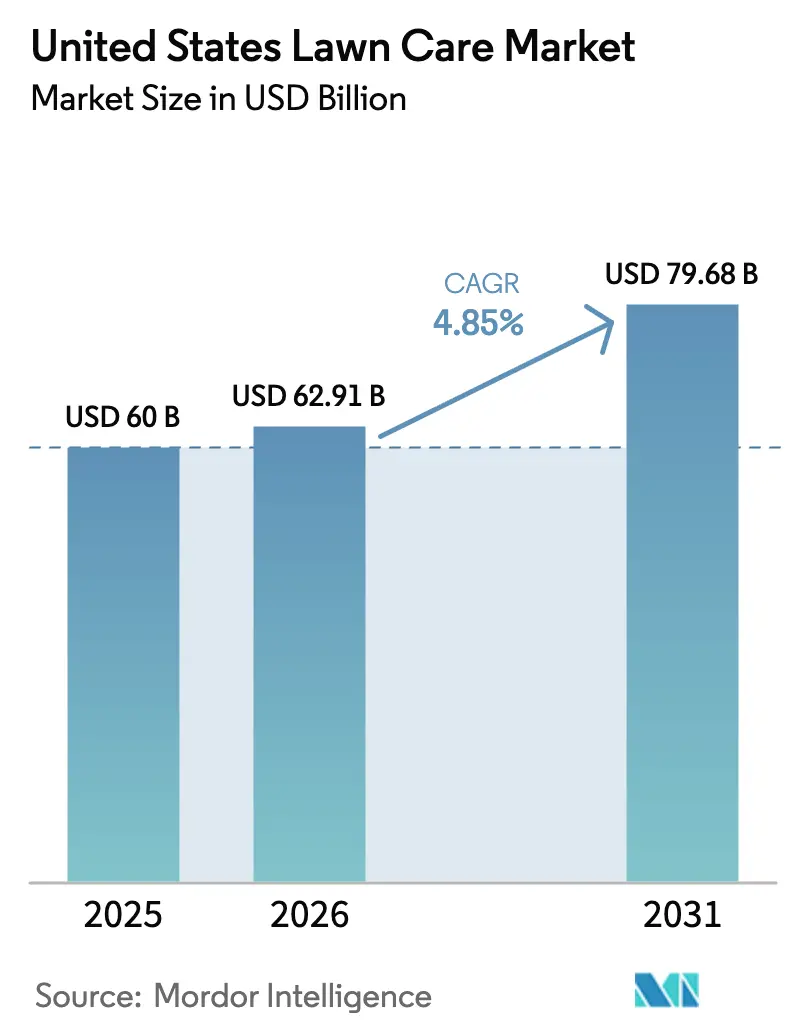
| Base Year Market Size (2025) | USD 60.0 Billion |
| Market Size (2026) | USD 62.91 Billion |
| Market Size (2031) | USD 79.68 Billion |
| Growth Rate (2026 - 2031) | 4.85 % |
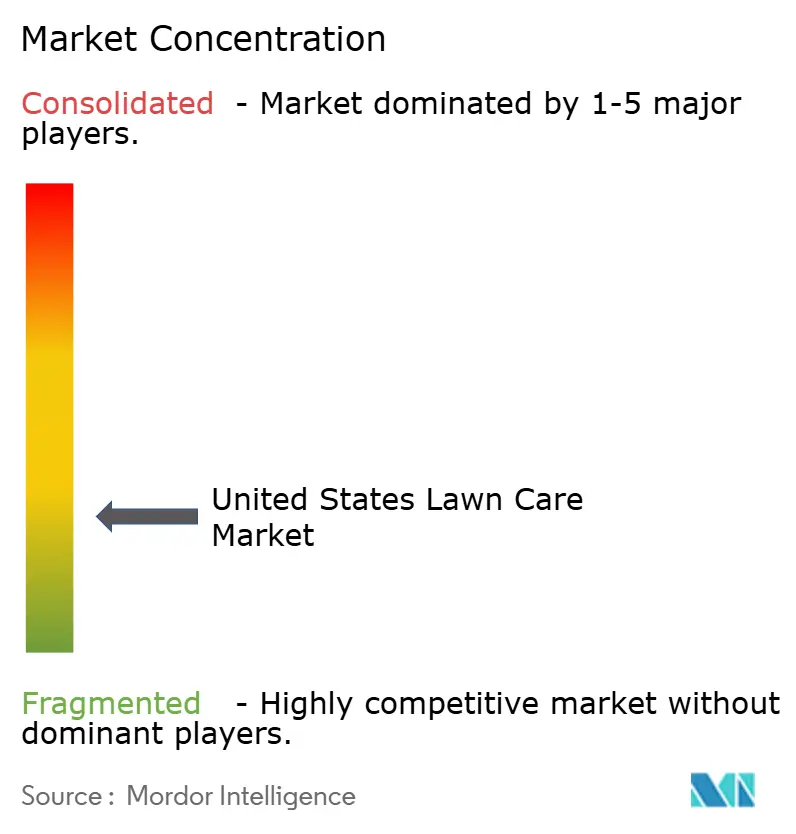
| Market Concentration | Low |
Major Players *Disclaimer: Major Players sorted in no particular order Image © Mordor Intelligence. Reuse requires attribution under CC BY 4.0. | |
United States Lawn Care Market Analysis by Mordor Intelligence
The United States lawn care market size was valued at USD 60.0 billion in 2025 and estimated to grow from USD 62.91 billion in 2026 to reach USD 79.68 billion by 2031, at a CAGR of 4.85% during the forecast period (2026-2031). Population growth in Sun Belt states, increasing adoption of professional services over do-it-yourself approaches, and adoption of smart and autonomous equipment drive spending on lawn maintenance, design, and related services. Commercial and industrial clients generate over 50% of market revenue as companies outsource grounds maintenance operations. Service providers improve profit margins through route optimization technology, digital booking systems, and efficient irrigation solutions, despite rising fuel and labor costs. The market remains highly fragmented, presenting opportunities for consolidation, while specialized service providers maintain competitive advantages through expertise and environmental certifications.
Key Report Takeaways
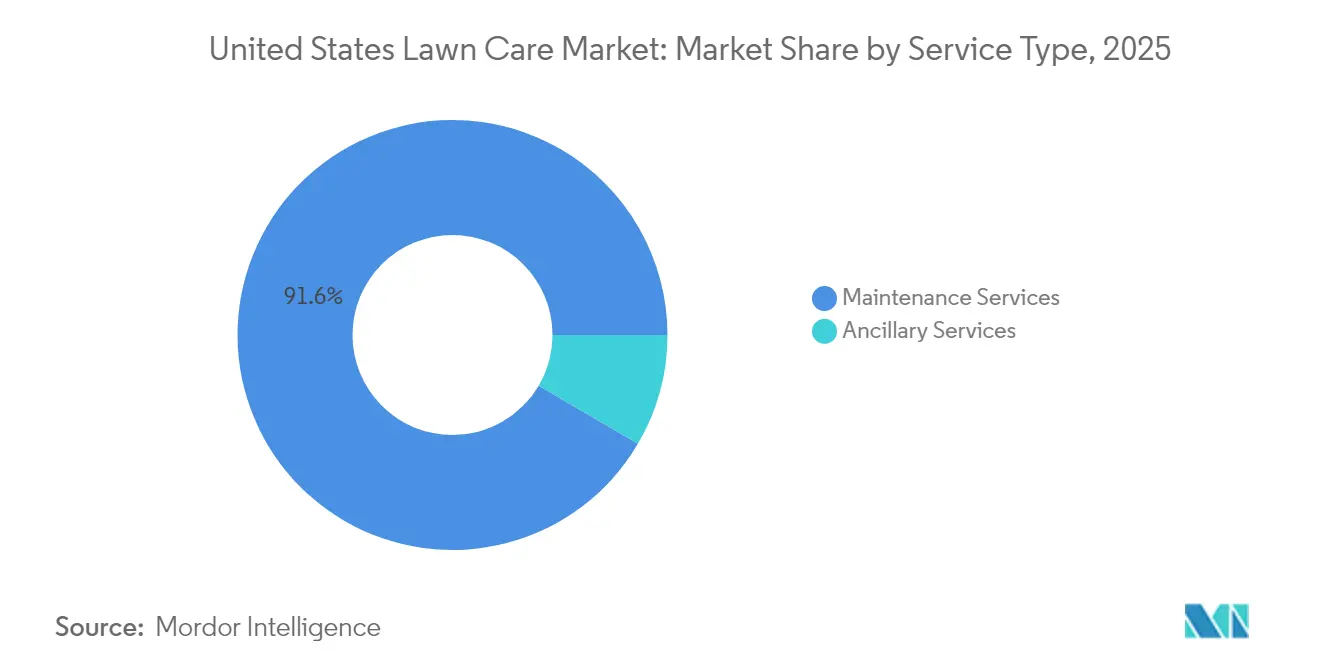
- By service type, maintenance captured 91.55% of the United States lawn care market share in 2025, and is projected to expand at a 5.18% CAGR to 2031, outpacing all other service categories.
- By application, commercial and industrial sites led with 53.72% revenue share in 2025; golf courses and sports facilities are forecast to grow at a 10.05% CAGR through 2031.
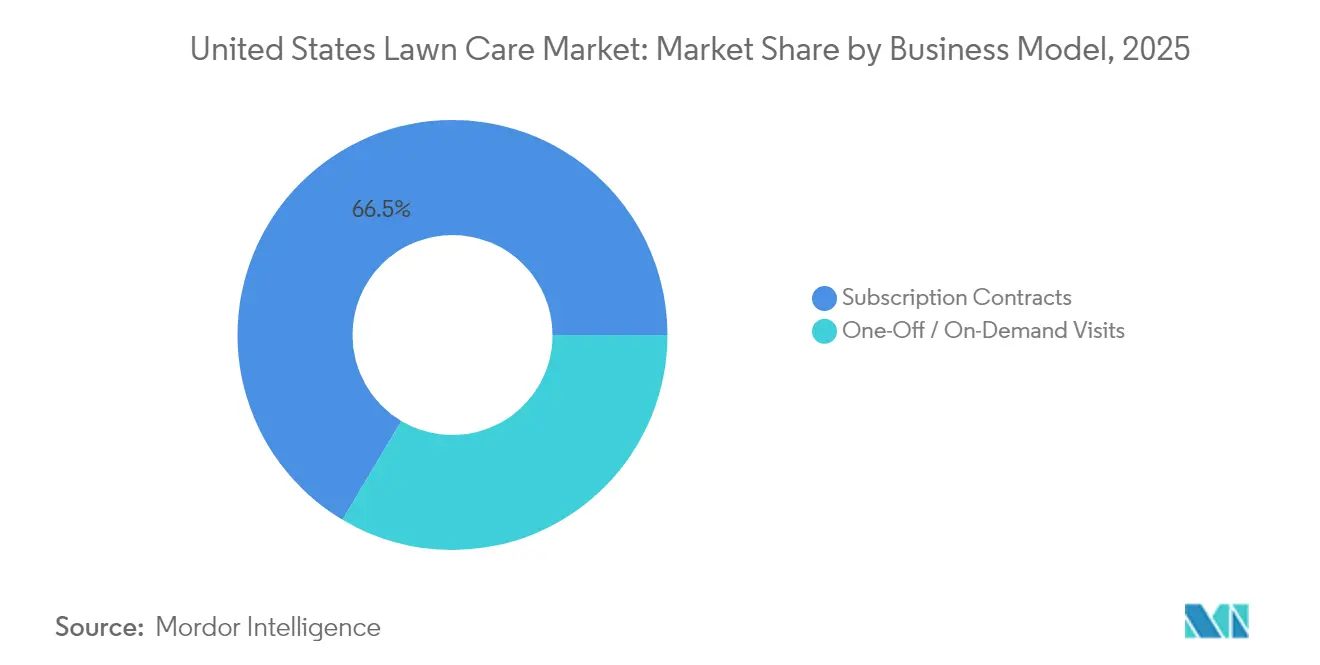
- By business model, subscription contracts held 66.45% of the United States lawn care market size in 2025, while one-off and on-demand visits are projected to record the highest CAGR at 10.22% from 2025 to 2031.
- By distribution channel, direct in-house teams accounted for a 58.63% share of the market size in 2025, whereas online marketplaces are advancing at an 10.94% CAGR.
- BrightView Holdings, Inc., The Davey Tree Expert Company, TruGreen Limited Partnership, Ruppert Landscape, Inc., and Gothic Landscaping, Inc. are major players in the landscaping services market, operating in a highly fragmented and competitive environment.
Note: Market size and forecast figures in this report are generated using Mordor Intelligence’s proprietary estimation framework, updated with the latest available data and insights as of 2026.
United States Lawn Care Market Trends and Insights
Drivers Impact Analysis*
| Driver | (~) % Impact on CAGR Forecast | Geographic Relevance | Impact Timeline |
|---|---|---|---|
| Ongoing migration to Sun Belt states increasing lawn footprints | +0.8% | Southeast and Southwest | Medium term (2-4 years) |
| Growth in golf course renovations and new short-course formats | +0.6% | Nationwide, affluent metros | Long term (≥ 4 years) |
| DIY-turned-DIWM (Do-It-With-Me) consumer trend | +0.9% | Nationwide, millennial-dense metros | Short term (≤ 2 years) |
| Rapid adoption of robotic and autonomous mowing equipment | +0.5% | Commercial settings, premium residential | Medium term (2-4 years) |
| Rising millennial home-ownership and outdoor living upgrades | +0.7% | Suburban Sun Belt markets | Short term (≤ 2 years) |
| Landscaping tax incentives in water-stressed municipalities | +0.4% | California and broader Southwest | Long term (≥ 4 years) |
| Source: Mordor Intelligence | |||


Ongoing Migration to Sun Belt States Increasing Lawn Footprints
The southern United States gained 1.8 million new residents in 2024, marking the region's fastest population growth in over two decades[1]Source: Ramsey Archibald, “Southern boom fueled fastest U.S. growth in decades, new Census estimates show,” AL.com, al.com.. This demographic shift generates increased demand for lawn care services through new residential construction, retail developments, and municipal projects. The expansion of commercial facilities, including corporate campuses and logistics centers, further strengthens market growth by requiring comprehensive grounds maintenance in regions with year-round growing seasons. Service providers operating in Texas, Florida, and adjacent growth markets benefit from sustained revenue opportunities linked to population expansion and employment growth. Infrastructure development in Sun Belt metropolitan areas requires landscaping services for government projects, business complexes, and mixed-use properties.
Growth in Golf Course Renovations and New Short-Course Formats
Golf course renovation projects and entertainment venues require specialized turf design, precise mowing specifications, and premium hardscape elements. Golf operators focus on attracting younger players through short courses and entertainment facilities that combine visually appealing landscapes with high-maintenance requirements. The Hermann Park Golf Course plans a USD 30 million renovation in August 2025, led by the Astros Golf Foundation. The project aims to enhance community facilities, expand the driving range to increase revenue, install a stormwater recapture and irrigation system, and construct a new clubhouse. Short courses and entertainment venues incorporate extensive landscaping features, including decorative components, lighting systems, and specialized turf varieties that need regular professional maintenance. This market segment enables landscaping companies to develop technical expertise and secure premium projects that set them apart from standard maintenance service providers.
DIY-Turned-DIWM (Do-It-With-Me) Consumer Trend
The household outsourcing of lawn maintenance increased significantly, driven by homeowners seeking convenience and consistent property aesthetics. Millennials, who represent the largest homebuyer segment, frequently use mobile applications to schedule mowing, fertilization, and design services, strengthening digital revenue streams. Service providers benefit from recurring maintenance contracts that increase customer lifetime value, while peer referrals reduce customer acquisition costs. The market extends beyond basic lawn care to include landscape design, seasonal planting services, and outdoor living space improvements, enabling providers to expand their service offerings and implement premium pricing strategies.
Rapid Adoption of Robotic and Autonomous Mowing Equipment
Research indicates that autonomous mowers improve turf density and cut quality while reducing labor requirements by up to 30%[2]Source: P. Agustin Boeri, “Autonomous Compared with Conventional Mower Use on St. Augustinegrass Lawn Quality,” HortTechnology, journals.ashs.org. Commercial landscaping companies use autonomous mower fleets to address labor shortages and enable continuous operation with reduced noise and emissions. This allows companies to shift workers to specialized tasks such as landscape design, installation, and client management while maintaining competitive maintenance service rates. Companies that implement autonomous mowing technology gain competitive advantages and develop integrated service offerings that combine automation with conventional landscaping services.
Restraints Impact Analysis*
| Restraint | (~) % Impact on CAGR Forecast | Geographic Relevance | Impact Timeline |
|---|---|---|---|
| Acute seasonal labor shortages despite H-2B visa caps increases | −0.6% | Nationwide, agriculture-heavy regions | Short term (≤ 2 years) |
| Escalating fuel and equipment costs squeezing margins | −0.4% | Nationwide, rural service areas | Medium term (2-4 years) |
| Rising liability insurance premiums for contractors | −0.3% | Nationwide, high-risk services | Long term (≥ 4 years) |
| Fragmented regulatory codes across states inflating compliance cost | −0.2% | Multi-state operators, California | Long term (≥ 4 years) |
| Source: Mordor Intelligence | |||
Acute Seasonal Labor Shortages Despite H-2B Visa Caps Increases
Despite the approval of 64,716 additional visas for 2025, the demand for seasonal workers exceeds 200,000 positions, resulting in understaffing during peak growth periods[3]Source: U.S. Citizenship and Immigration Services, “DHS, DOL Make Nearly 65,000 Additional H-2B Visas Available for Fiscal Year 2025,” uscis.gov. Small operators with limited administrative resources struggle to navigate visa processes, forcing them to either restrict service expansion or increase wages at the expense of profit margins. Processing delays affect scheduling, increase customer turnover risk, and push larger companies toward automation investments. The labor shortage compels businesses to constrain service growth, raise wages for domestic worker recruitment, and implement labor-saving technologies that require significant capital investment.
Escalating Fuel and Equipment Costs Squeezing Margins
Fluctuating diesel prices and equipment costs strain cash flows, particularly for companies operating in single markets. These cost pressures significantly affect smaller operators who cannot achieve economies of scale in equipment purchases and fuel procurement. Larger companies gain competitive advantages through volume-based discounts and investments in fuel-efficient equipment. California's upcoming zero-emission equipment regulations in 2024 introduce additional financial burdens, requiring companies to adopt higher-priced battery-powered equipment while maintaining service standards[4]California Air Resources Board, Public Hearing to Consider Proposed Amendments to the Small Off-Road Engine Regulations: Transition to Zero Emissions, arb.ca.gov . Large enterprises further strengthen their market position by utilizing scale purchasing and telematics to control fuel consumption, increasing the cost differential with local independent operators.
*Our forecasts treat driver/restraint impacts as directional, not additive. The impact forecasts reflect baseline growth, mix effects, and variable interactions.
Segment Analysis
By Service Type: Maintenance Dominates Revenue Streams
Maintenance services accounted for 91.55% of the United States lawn care market share in 2025, providing stable recurring revenue through residential and commercial client contracts. Subscription-based service packages combining mowing, fertilization, weed control, aeration, and irrigation maintenance help companies reduce customer acquisition costs while improving route efficiency. The segment's high margins, particularly in fertilization and weed control services, stem from specialized chemical expertise and licensing requirements that create entry barriers. Regular mowing services provide frequent customer contact opportunities, enabling providers to expand revenue through seasonal plantings and hardscape maintenance. The growing adoption of smart irrigation controllers that optimize water usage and detect system issues aligns with environmental sustainability requirements. The maintenance segment is projected to grow at a CAGR of 5.18% during 2026-2031, driven by increased professional service outsourcing, demographic shifts, and technological improvements in service delivery.
Ancillary services demonstrate accelerated growth as residential customers seek enhanced outdoor living features, including fire pit installations, landscape lighting, and pollinator gardens. This service diversification helps providers reduce seasonal revenue fluctuations and offset increased labor costs, supporting the expansion of comprehensive service providers.


By Application: Commercial Leadership with Golf Surge
Commercial and industrial sites contributed 53.72% of the United States lawn care market share in 2025, as organizations outsource grounds maintenance to focus on their primary operations. Multi-property portfolios prefer service providers who offer standardized maintenance levels, sustainable landscaping, and Environmental, Social, and Governance (ESG)- aligned performance reporting. Golf courses and sports facilities, though a smaller market segment, are projected to grow at a 10.05% CAGR through 2031, driven by new entertainment formats and facility renovations targeting younger demographics. These properties require specialized turf management, precise maintenance, and integrated lighting systems, enabling premium pricing and long-term contracts.
The residential segment maintains steady demand, with millennials viewing lawn care services as a fundamental household expense similar to cleaning services. This market diversification helps service providers maintain stability during economic fluctuations. Municipal contracts provide consistent revenue but involve public bidding processes and wage requirements that may reduce profit margins compared to private sector work.
By Business Model: Subscriptions Drive Stability
Subscription contracts accounted for 66.45% of the United States lawn care market share in 2025, providing predictable cash flows that support equipment financing and workforce scheduling. Customers benefit from fixed monthly invoices that facilitate budgeting and access to multiple services through a single provider. The subscription model allows landscaping companies to optimize routes and resource allocation, reducing operational costs and improving service efficiency compared to traditional on-demand services. Regular customer interactions foster trust relationships that facilitate expansion into additional services such as landscape design, hardscaping, and seasonal maintenance. Digital platforms enhance subscription management through automated scheduling, service customization, and customer communication features that improve service delivery and satisfaction.
On-demand services, facilitated by mobile applications, are growing at a 10.22% CAGR as customers schedule specific services such as aeration, leaf clean-up, or holiday lighting without long-term commitments. This flexible model attracts new customers and serves as an entry point for recurring service upsells, despite higher revenue variability. Companies that implement both subscription and on-demand models effectively serve diverse customer segments while balancing seasonal fluctuations.
By Distribution Channel: Direct Teams Maintain Control
In-house crews account for 58.63% of the market revenue in 2025. This operational model enables companies to maintain high service quality, a strong brand reputation, and healthy customer relationships. Centralized training programs ensure consistent safety protocols and horticultural practices, reducing liability risks. The direct in-house approach enables companies to exert control over service delivery, customer interactions, and pricing, thereby helping to build strong market positions and foster customer retention.
Online marketplaces are growing at a 10.94% CAGR, simplifying service discovery for homeowners and small businesses through price transparency and customer reviews. Independent operators utilize these platforms to optimize route efficiency, while larger companies develop proprietary applications to safeguard customer data and capitalize on additional sales opportunities. The distribution channels continue to adapt as customers increasingly demand instant scheduling and digital payment options. Franchise systems facilitate geographic expansion with reduced capital investment while ensuring consistent brand standards and operational procedures across regions. This evolution in distribution channels creates growth opportunities for companies that combine efficient digital customer acquisition with reliable service delivery to gain market share from traditional competitors.
Geography Analysis
The Southeast commands the majority of the United States lawn care market share due to population growth, diverse industries, and climate conditions, enabling continuous service delivery. The relocation of corporate headquarters to Texas and Florida generates substantial commercial contracts with strict maintenance requirements, benefiting large-scale providers capable of comprehensive grounds maintenance services.
The Southwest region shows the highest projected growth rate. Business relocations to Phoenix and Las Vegas, along with water conservation mandates, drive demand for drought-resistant landscaping, efficient irrigation systems, and artificial turf. Contractors specializing in desert landscaping and understanding local rebate programs have an advantage, as municipalities encourage alternatives to traditional grass lawns. The presence of regional sports facilities increases service requirements, necessitating advanced turf management expertise.
The Northeast and Midwest maintain steady growth through established residential areas, educational institutions, and healthcare facilities requiring specialized maintenance and comprehensive service contracts, including leaf and snow removal. Boston and New York suburban areas sustain premium pricing as homeowners prioritize aesthetic maintenance but lack time and resources for self-maintenance. In California, environmental regulations drive demand for electric equipment and water-efficient designs, requiring service providers to modernize equipment and adapt plant selections. The Pacific coast's high property values and environmental awareness support investment in native plants and efficient irrigation systems, despite seasonal limitations in specific areas.
Regulatory Landscape
The United States lawn care services industry operates under Occupational Safety and Health Administration (OSHA) oversight for landscaping activities (NAICS 561730, formerly SIC 0782). Contractors are required to run workplace safety programs that address common field hazards such as machinery operation, chemical handling and exposure, and ergonomic and heat-related risks. Enforcement is handled through OSHA general industry standards for maintenance work, and through construction standards when projects involve building activities.
Compliance requirements can vary by jurisdiction because OSHA-approved State Plans may enforce rules that are stricter than federal standards. That can increase complexity for multi-state operators. Providers also frequently align operating procedures and training with voluntary consensus standards used by commercial clients and insurers, including ANSI A300 (Tree Care Operations) and ANSI B71.4 (Commercial Turf Type Equipment), to reduce incident risk and support bid qualification on institutional and municipal contracts.
Competitive Landscape
The market remains highly fragmented, with the five largest firms - BrightView Holdings, Inc., The Davey Tree Expert Company, TruGreen Limited Partnership, Ruppert Landscape Inc., and Gothic Landscaping Inc. - collectively holding a smaller share of the United States lawn care market in 2024. BrightView Holdings maintains its market leadership through multi-state branch networks, enabling the company to secure long-term corporate and municipal contracts. In August 2024, the Davey Tree Expert Company expanded its market presence through strategic acquisitions, including VanCurren Service and Midwest Land Clearing. TruGreen focuses on residential lawn fertilization and weed control programs, supported by its national call center infrastructure.
Private equity firms maintain a significant interest in the lawn care market, attracted by consistent cash flows and consolidation opportunities. Platform companies pursue acquisitions to increase operational capacity, expand geographic coverage, and enhance service offerings in tree care and pest management. Technology adoption creates competitive advantages, as demonstrated by BrightView's implementation of autonomous mowers and AI-based scheduling systems, reducing labor dependencies. Medium-sized independent operators adapt by implementing digital solutions for route optimization, customer interfaces, and performance tracking, which improve customer retention and pricing accuracy.
Environmental responsibility has become a key competitive factor in the market. Customers increasingly demand carbon footprint assessments, electric equipment options, and native landscaping solutions that minimize water and chemical usage. Companies that demonstrate quantifiable sustainability results gain advantages, particularly in institutional and municipal contract bids. The market's fragmented nature continues to drive consolidation, with well-capitalized companies positioned to increase market share through operational improvements and strategic acquisitions.
United States Lawn Care Industry Leaders
BrightView Holdings, Inc.
The Davey Tree Expert Company
TruGreen Limited Partnership
Ruppert Landscape Inc. (Knox Lane LP)
Gothic Landscaping Inc.
- *Disclaimer: Major Players sorted in no particular order

Market Opportunities and Future Outlook
Commercial and industrial clients already account for more than half of market revenue (53.72% share in 2025). Annual contract values in commercial maintenance can be materially larger than typical residential tickets, which gives providers room to prioritize multi-site portfolios, standardized service levels, and reporting. BrightView's reported return to year-over-year land maintenance revenue growth in Q2 2026 (4.0%) is a current proof point that large-account demand and retention can translate into top-line improvement when route density and service execution stabilize.
Digitization and operating model shifts also create whitespace. Subscription contracts represented 66.45% of the market in 2025, while one-off/on-demand visits were the fastest-growing business model within the study context. Given market fragmentation and active consolidation strategies, including bolt-on acquisitions and branch-network expansion by large platforms and growth from independent operators such as Ruppert Landscape and The Davey Tree Expert Company, operators that can integrate acquisitions, expand service menus beyond mowing into irrigation maintenance and chemical programs, and use scheduling and route optimization may protect margins amid labor constraints.
Recent Industry Developments
- May 2026: TruGreen Limited Partnership partnered with PGA TOUR golfer Jason Day for a digital marketing campaign on Facebook Marketplace to promote lawn care services. Consumer lawn care demand signals show up through targeted marketing. It enhances residential service uptake and brand reach in key markets through influencer-driven campaigns.
- March 2026: The Davey Tree Expert Company announced five expansions of its Residential/Commercial operations in multiple regions to grow local market presence. Expansion of service footprint in household lawn care markets. It strengthens geographic coverage and service capacity for residential and commercial lawn care services.
- February 2026: BrightView Holdings, Inc. expanded its golf course management partnership with The Villages to manage a majority of golf holes. Expansion of institutional contract in high-value recreational market. It increases the contracted revenue base and scale in municipal and recreational facilities, signaling a strategic focus on high-margin contracts.


Research Methodology Framework and Report Scope
Market Definition and Coverage
For this study, the United States lawn care market is defined as spending on recurring and project-based services that keep turf healthy and presentable for residential and commercial properties, including routine mowing and treatment-type work when it is purchased as a service.
Scope exclusions: We exclude hardscape construction, full landscape design-build, and irrigation equipment installation where it is sold primarily as a construction project instead of a lawn care service.
Segmentation Overview
- By Service Type
- Maintenance Services
- Mowing
- Fertilization and Weed Control
- Irrigation System Maintenance
- Pest Control
- Ancillary Services
- Landscape Design and Installation
- Hardscaping Services
- Snow Removal
- Maintenance Services
- By Application
- Residential
- Commercial and Industrial
- Golf Courses and Sports Facilities
- Municipal and Government
- By Business Model
- Subscription Contracts
- One-Off / On-Demand Visits
- By Distribution Channel
- Direct In-House Teams
- Franchise Network
- Online Marketplaces
Data Sources, Market Sizing, and Validation
Desk Research
Desk work starts with building a clean demand and supply outline for lawn care services in the United States, and then mapping it to measurable signals that can be refreshed every year. We rely on public datasets such as the US Census Bureau (County Business Patterns and Nonemployer Statistics), Bureau of Labor Statistics wage and employment series, and Bureau of Economic Analysis price and consumption indicators to understand industry scale and cost pressure.
To keep the scope aligned with real lawn inputs and constraints, we also reference sources such as USDA and land use publications, EPA pesticide and environmental guidance, and association and extension materials that explain service practices and seasonality by climate zone. Company annual reports, investor presentations, and credible trade press are used to cross-check revenue mix, branch footprint, and acquisition activity, and then a paid subscription database for company financials and a shipment-level import-export database are used selectively where disclosures are thin. The desk sources listed above are illustrative, and many additional public documents and data series were used for clarification, validation, and gap filling.
Primary Interviews and Surveys
Primary interviews and short surveys are used to pressure-test the desk model, mainly on what is actually bundled into a typical lawn care contract and how pricing moves by region and customer type. We spoke with operators, distributors, commercial buyers, and industry specialists across major US climate zones, so assumptions on service frequency, labor intensity, and add-on attach rates could be adjusted when the desk signals were too broad.
Distribution of primary research fieldwork respondents
| Company type | Respondent position |
|---|---|
| Top tier: 31% | CXOs: 13% |
| Mid tier: 51% | Functional/Unit leaders: 39% |
| Smaller Players: 18% | Managers: 48% |
Market-Sizing & Forecasting
Market sizing is built using top-down and bottom-up logic in a practical way, where the top-down view starts from the addressable pool of serviced properties and typical service bundles, which are then translated into annual spend per property. That spend is shaped using inputs such as service frequency by season, share of customers using professional providers versus DIY, average ticket size for mowing and treatment add-ons, labor and fuel cost passthrough, and the mix shift between residential and commercial contracts.
Once that total is formed, it is checked through selective bottom-up approximations, including sampled provider revenue run-rates, route density and crew capacity logic, and observed pricing for common packages multiplied by local volume proxies. When company breakouts are missing, gaps are handled by using peer ranges, climate-driven seasonality adjustments, and conservative weighting so one outlier does not drive the national total.
For forecasting, scenario analysis is used with a base case anchored to macro and housing signals and then tuned using primary feedback on near-term pricing and retention. Variables that most often move the forecast include single-family housing additions, HOA coverage and compliance pressure, drought restrictions affecting service mix, fertilizer and chemical input costs, and labor availability that changes how quickly providers can add routes.
Data Validation & Update Cycle
Validation is done in layers so the final numbers do not depend on one dataset or one interview group. Model outputs are compared against independent signals like industry employment, average wage movement, business counts, and publicly visible pricing, and then variances are reviewed until the drivers are understood.
Before sign-off, another analyst reviews the scope logic, math links, and assumption notes, and follow-up calls are triggered when a key variable shifts or a conflict shows up between sources. The report is refreshed annually, with interim updates when there is a material change such as a major policy shift, a sharp input cost move, or a large consolidation event. Right before delivery, a final pass is completed so clients receive the most current view available at that time.
Mordor Intelligence's United States Lawn Care Market Sizing Compared With Other Published Estimates
It is normal to see different market sizes for US lawn care because publishers do not always count the same work as lawn care, and the line between recurring lawn services and broader landscaping is not fixed. Differences also come from the year chosen as the base, the way inflation is applied to service pricing, and whether the estimate is built from property demand or from provider revenues.
By tracking contract-level service bundles, pricing refresh points, and climate-linked seasonality checks, Mordor Intelligence keeps the market boundary centered on lawn care services and avoids pulling in full landscape construction revenue that can inflate totals.
Benchmark comparison
| Source | Market Size | Gaps in Research Methodology |
|---|---|---|
| Mordor Intelligence | USD 60.00 B (2025) | |
| Industry Report A | USD 55.00 B (2024) | Uses an earlier base year and appears to lean heavily on service-provider revenue groupings, which can undercount add-on treatments and commercial contract upsells when they are not broken out cleanly. |
| Trade Media B | USD 188.80 B (2025) | This figure aligns more with a broader lawn and landscaping umbrella and likely includes design-build and other non-lawn activities, so the total rises well beyond lawn-focused maintenance and treatment services. |
The spread in estimates is mainly explained by what gets included around landscaping, plus how the model converts service activity into dollars for a given year. When scope is kept to lawn-focused services and the pricing and seasonality assumptions are made explicit, the resulting market size is easier to trace, repeat, and update as conditions change.


Key Questions Answered in the Report
How large is the United States lawn care market in 2026?
The United States lawn care market is valued at USD 62.91 billion in 2026 and is projected to reach USD 79.68 billion by 2031.
Which segment holds the highest United States lawn care market share?
Maintenance services dominate with 91.55% of revenue in 2025.
What is driving the rapid growth of golf course and sports facility lawn care?
Renovation cycles and entertainment-focused short-course formats are pushing this segment to a 10.05% CAGR through 2031.
How are labor shortages being addressed by lawn care providers?
Companies are combining higher wages, H-2B visa hiring, and accelerated adoption of autonomous mowing technology to mitigate workforce gaps.
Why are subscription contracts popular among commercial and residential clients?
Subscriptions provide predictable monthly costs, consistent service quality, and enable providers to optimize routing and resource utilization.
Page last updated on:




