
Vanillin Market Size and Share
Market Overview
| Study Period | 2021 - 2031 |
|---|---|
| Market Size (2026) | USD 1.21 Billion |
| Market Size (2031) | USD 1.79 Billion |
| Growth Rate (2026 - 2031) | 8.09 % |
| Fastest Growing Market | Asia-Pacific |
| Largest Market | Europe |
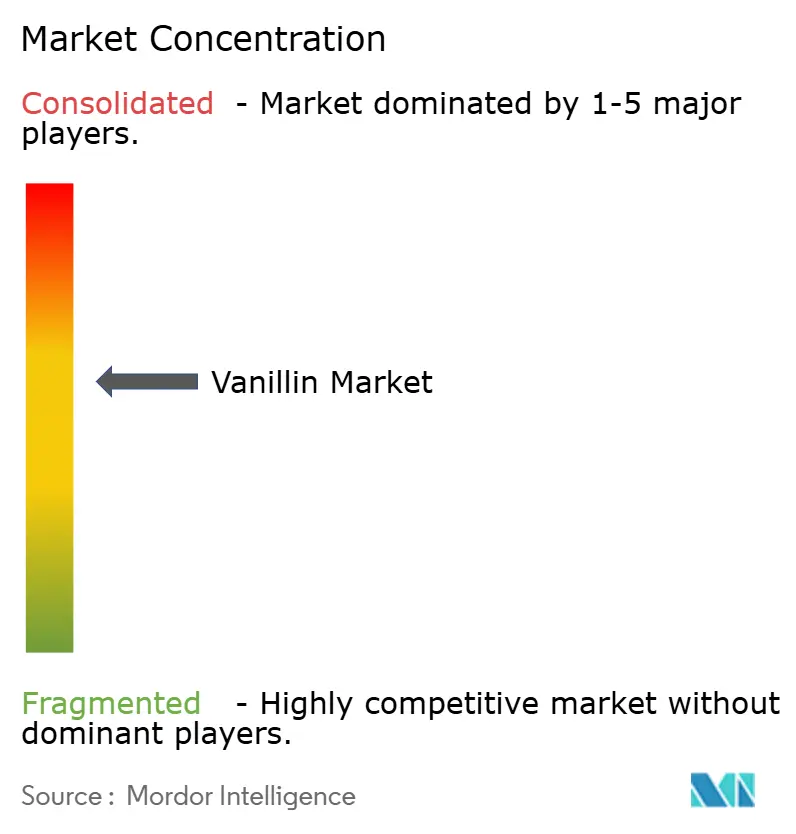
| Market Concentration | Medium |
Major Players *Disclaimer: Major Players sorted in no particular order Image © Mordor Intelligence. Reuse requires attribution under CC BY 4.0. | |
Vanillin Market Analysis by Mordor Intelligence
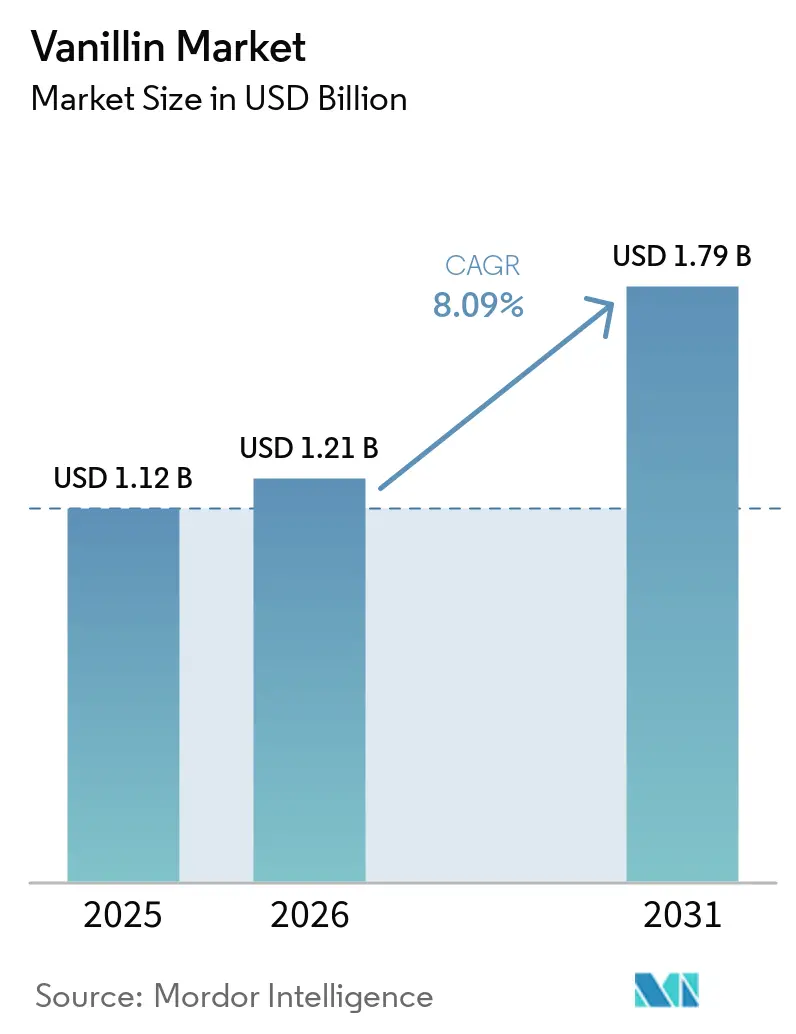
The vanillin market size was valued at USD 1.12 billion in 2025 and estimated to grow from USD 1.21 billion in 2026 to reach USD 1.79 billion by 2031, at a CAGR of 8.09% during the forecast period (2026-2031). Strong demand from food, beverage, pharmaceutical, and personal care manufacturers anchors today’s volume, while biotechnology-driven cost reductions in natural production widen future applications. Intensifying clean-label adoption, regulatory clarity around natural versus synthetic classifications, and breakthroughs in lignin-based fermentation strengthen the commercial case for natural offerings. Trade policies—from antidumping duties on Chinese shipments to stricter additive standards in Canada—reshape sourcing decisions and accelerate geographic diversification. Producer strategies cluster around vertical integration, feedstock innovation, and direct partnerships with downstream brands seeking secure, sustainable supply.
Key Report Takeaways
- By type, synthetic variants accounted for 56.35% vanillin market share in 2025. Natural vanillin is forecast to expand at an 8.42% CAGR between 2026 and 2031.
- By form, liquid formulations held 52.05% of the vanillin market size in 2025 and are expected to grow at an 8.22% CAGR through 2031.
- By application, food and beverage contributed 66.10% revenue in 2025, whereas pharmaceuticals will post a 10.18% CAGR to 2031.
- By Geography, Europe captured 31.10% regional revenue in 2025, while the Asia Pacific is set to post a 9.30% CAGR to 2031.
Note: Market size and forecast figures in this report are generated using Mordor Intelligence’s proprietary estimation framework, updated with the latest available data and insights as of 2026.
Market Trends and Insights
Drivers Impact Analysis of Vanillin Market*
| Drivers | (~) % impact on CAGR Forecasts | Geographic Relevance | Impact Timeline |
|---|---|---|---|
| Rising demand for natural ingredients in food, beverages, and personal care | +1.8% | Global, with strongest impact in North America & EU | Medium term (2-4 years) |
| Advancements in biotechnology and fermentation | +1.5% | Global, led by developed markets with R&D capabilities | Long term (≥ 4 years) |
| Increase in clean-label and organic product adoption | +1.2% | North America & EU primarily, expanding to APAC | Medium term (2-4 years) |
| Rising use as preservative and antioxidant in pharmaceutical formulations | +0.9% | Global, concentrated in major pharmaceutical markets | Long term (≥ 4 years) |
| Product innovations and customized flavor blends | +0.7% | Global, with innovation centers in developed markets | Short term (≤ 2 years) |
| Growth of packaged and processed foods | +0.6% | APAC core, spill-over to MEA and Latin America | Medium term (2-4 years) |
| Source: Mordor Intelligence | |||
Rising demand for natural ingredients in food, beverages, and personal care
As consumers increasingly prefer natural products over synthetic ones, opportunities for premium pricing in bio-vanillin production are emerging. Thanks to biotechnological advancements, companies can now produce vanillin labeled as "natural" through fermentation processes, allowing them to charge around USD 700 per kilogram. In contrast, synthetic vanillin retails at just USD 15 per kilogram. Researchers at Tokyo University of Science have bioengineered enzymes that transform ferulic acid, sourced from agricultural waste, into vanillin in a single step. This innovation not only addresses sustainability and supply concerns but also ensures the product retains its "natural" classification under FDA regulations. With this breakthrough, manufacturers can tap into the lucrative price gap of USD 1,200-4,000 per kilogram between natural vanilla extracts and their synthetic counterparts, all while adhering to major market regulations for natural labeling.
Advancements in biotechnology and fermentation
Genetic engineering and fermentation technologies are revolutionizing vanillin production economics by enabling scalable natural production without reliance on agriculture. Engineered microbial systems, particularly Saccharomyces cerevisiae and Escherichia coli, have demonstrated commercial feasibility in producing natural vanillin from renewable feedstocks such as eugenol, ferulic acid, and lignin derivatives. Lignin-based processes achieve a 6.2% yield by weight, providing a sustainable alternative to petroleum-based synthetic vanillin while addressing waste management issues in the pulp and paper industry. These innovations position biotechnology companies to capture a significant market share by delivering cost-effective natural vanillin that meets the increasing environmental sustainability expectations of major food and beverage manufacturers.
Increase in clean-label and organic product adoption
Clean-label product adoption drives fundamental shifts in vanillin sourcing strategies as manufacturers respond to consumer demands for recognizable, natural ingredients. Food companies increasingly specify natural vanillin in product formulations to achieve clean-label positioning, despite cost premiums of 40-50 times synthetic alternatives. Major brands, including Nestlé, committed to natural flavor sourcing, coinciding with significant vanilla bean production declines that elevated prices and accelerated biotechnological production investments. Regulatory frameworks support this transition, with the FDA and EFSA maintaining distinct classifications for natural versus synthetic vanillin, enabling premium positioning for biotechnology-derived products that meet natural labeling requirements, according to the Alcohol and Tobacco Tax and Trade Bureau data[1]Alcohol and Tobacco Tax and Trade Bureau, “Artificial versus Natural Vanillin,” ttb.gov.
Rising use as preservative and antioxidant in pharmaceutical formulations
Vanillin's therapeutic properties are driving growth in the pharmaceutical market, as research highlights its significant antioxidant, anti-inflammatory, and neuroprotective effects. Clinical trials confirm vanillin's effectiveness in addressing neurodegenerative diseases such as Alzheimer's and Parkinson's by inhibiting acetylcholinesterase and preventing amyloid aggregation. The FDA's "Generally Recognized as Safe" (GRAS) designation has facilitated its inclusion in pharmaceutical formulations, where it functions as both an active ingredient and a preservative. Additionally, patent filings demonstrate vanillin's antimicrobial synergy with isothiocyanate compounds for food preservation, expanding its market potential from traditional flavoring to functional ingredient applications.
Restraints Impact Analysis of Vanillin Market*
| Restraints | (~) % Impact on CAGR Forecast | Geographic Relevance | Impact Timeline |
|---|---|---|---|
| Volatile supply of natural vanilla beans | -1.4% | Global, with highest impact on natural vanillin segment | Short term (≤ 2 years) |
| Stringent regulatory compliance for food additives and synthetic products | -0.8% | North America & EU primarily, expanding globally | Medium term (2-4 years) |
| High production costs for natural/bio-vanillin | -0.6% | Global, particularly affecting emerging market adoption | Long term (≥ 4 years) |
| Competitive pressure from alternative flavoring agents | -0.4% | Global, with regional variations in flavor preferences | Medium term (2-4 years) |
| Source: Mordor Intelligence | |||
Volatile supply of natural vanilla beans
Madagascar's dominance in vanilla bean production creates systemic supply risks that cascade through natural vanillin markets, with climate events and political instability generating extreme price volatility. Uganda's emergence as the second-largest vanilla producer with over 600 metric tonnes exported in 2024 provides limited supply diversification, earning USD 16.6 million while achieving vanillin content exceeding 4%. Price bubble analysis identifies five distinct volatility periods linked to cyclones, market speculation, and regulatory changes, with recommendations for direct company-farmer negotiations to enhance stability. Natural vanillin production requires approximately 500 kilograms of vanilla pods per kilogram of vanillin, corresponding to pollination of 40,000 flowers, highlighting the agricultural intensity that constrains supply scalability and drives biotechnological alternatives.
Stringent regulatory compliance for food additives and synthetic products
Stringent food additive regulations across major markets create compliance costs that disproportionately impact smaller producers while favoring established manufacturers with regulatory expertise. FDA[2]U.S. Food and Drug Administration, “21 CFR 182.60 — Synthetic Flavoring Substances and Adjuvants,” ecfr.gov regulations under 21 CFR Parts 169 and 182 specify detailed identity standards for vanilla products and synthetic flavoring substances, requiring extensive documentation for GRAS status maintenance. Canadian regulatory amendments effective December 2024 modernize food additive frameworks while maintaining strict compositional standards that require ongoing compliance investments. EFSA evaluations establish acceptable daily intake levels and impurity limits that necessitate continuous monitoring and testing protocols, creating barriers for market entry while ensuring product safety and quality standards across European markets.
*Our forecasts treat driver/restraint impacts as directional, not additive. The impact forecasts reflect baseline growth, mix effects, and variable interactions.
Vanillin Market Segment Analysis
By Type:
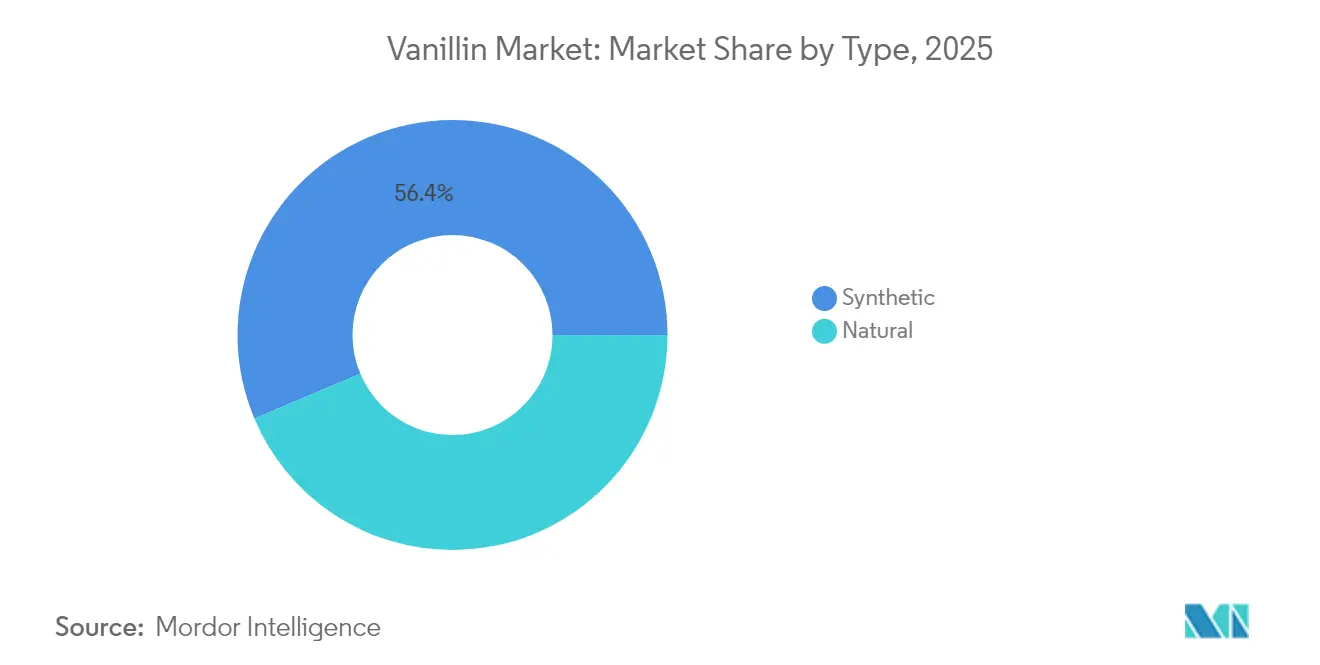
Natural Segment Gains Despite Synthetic DominanceSynthetic offerings supplied 56.35% of 2025 volume thanks to petro-based guaiacol economics. This segment delivered steady cash flows as the vanillin market size crossed USD 1.12 billion in 2025. Natural variants, however, recorded the highest 8.42% CAGR and will rise from niche to mainstream by 2031 as fermentation costs dip below USD 300 per kg. Borregaard’s lignin route, operational since 1993, exemplifies first-mover advantage; newer entrants now mimic the model with higher yields from electrochemical depolymerization. Clean-label mandates in bakery and premium dairy accelerate adoption even at premium price points.
Consumer studies show willingness to pay up to 15% retail premium for “naturally flavored” chocolate, transferring cost absorption from manufacturer to end-user. As a result, natural volumes are expected to represent 25.60% of the vanillin market share by 2031. Synthetic producers respond by licensing biotech IP or retrofitting guaiacol lines for bio-feedstock compatibility, creating a hybrid supply environment.



By Form:
Liquid Applications Drive Processing EfficiencyIn 2025, liquid vanillin holds a dominant position in the market with a 52.05% share and the highest growth forecast, projected at an 8.22% CAGR through 2031. This leadership is primarily due to its processing benefits in the industrial food and beverage sector. Liquid formulations excel by enabling precise dosing, uniform mixing, and lower handling costs. These advantages are particularly significant in large-scale beverage and dairy production, where faster dissolution rates enhance efficiency. Conversely, powder forms are tailored for specialized uses, such as baking and confectionery, where dry blending necessitates solid formulations. Crystal forms, on the other hand, are preferred for premium applications that demand high purity and extended shelf life.
Advancements in processing are improving the performance of liquid vanillin. For example, β-cyclodextrin encapsulation enhances aqueous solubility while protecting the vanillin from oxidation during storage and use. Additionally, optimizing the crystallization process has achieved up to 80% yield for stable polymorphic forms through controlled cooling and evaporation techniques, with melting points specified at 82.6°C for Form I and 81.0°C for Form II. Market trends increasingly favor liquid formulations as manufacturers focus on improving operational efficiency and reducing costs in high-volume applications. However, demand for powder and crystal forms remains steady in specialty segments due to their specific functional advantages.
By Application:
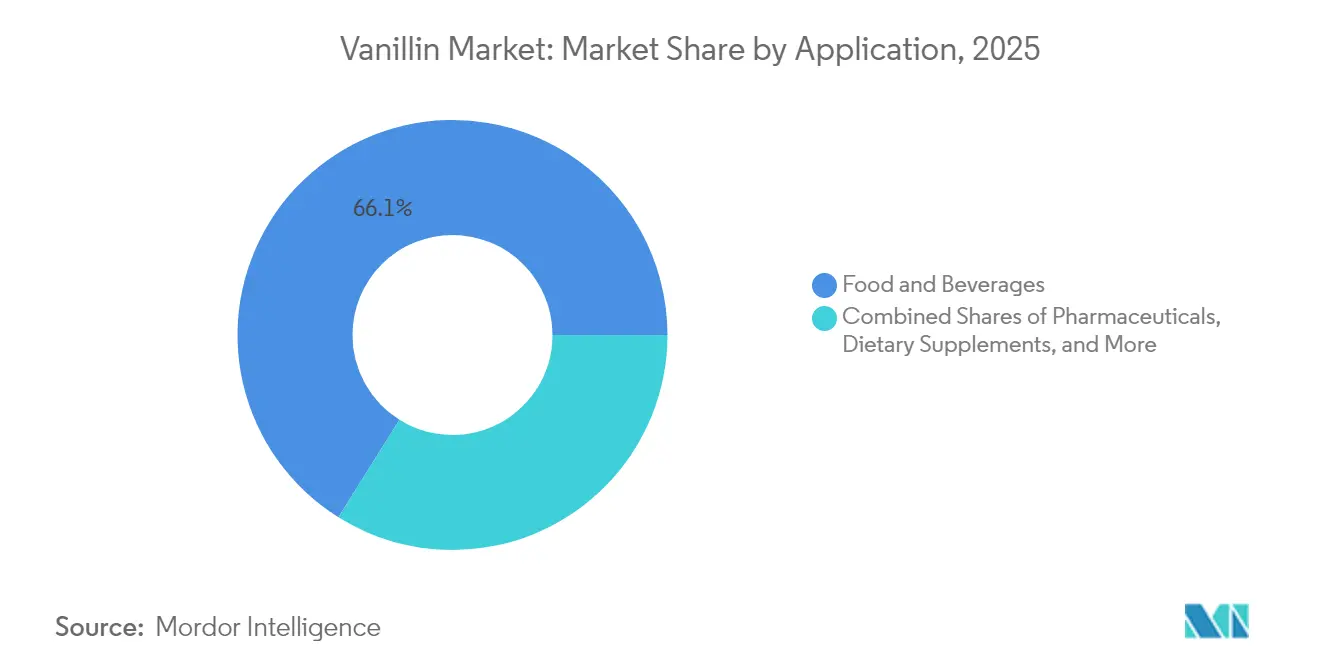
Pharmaceutical Growth Outpaces Food DominanceIn 2025, food and beverage applications hold a leading 66.10% market share, covering bakery, confectionery, dairy, and beverage sectors, which collectively drive global vanillin demand. At the same time, the pharmaceutical sector, supported by expanding therapeutic applications and regulatory approvals for vanillin's bioactive properties, emerges as the fastest-growing segment with a projected 10.18% CAGR through 2031. Vanillin is also gaining traction in personal care and cosmetics due to its antioxidant properties and increasing consumer preference for natural ingredients. Furthermore, the dietary supplements and sports nutrition segments are capitalizing on vanillin's positioning as a functional ingredient.
Research highlights vanillin's therapeutic potential, extending beyond traditional flavoring to include neuroprotection, cancer treatment, and anti-inflammatory applications. Studies have demonstrated its efficacy against multidrug-resistant bacteria and in addressing oxidative stress conditions. The animal feed sector presents new opportunities, utilizing vanillin's antimicrobial properties to improve livestock health and preserve feed. In industrial applications, vanillin is increasingly used in polymer production as a renewable building block for sustainable materials. Regulatory approvals, such as FDA's GRAS status and EFSA's endorsements, are driving the pharmaceutical market's growth. Additionally, patent protections for therapeutic applications provide a competitive advantage to innovative companies developing vanillin-based drug formulations.
Geography Analysis
Europe Vanillin Market
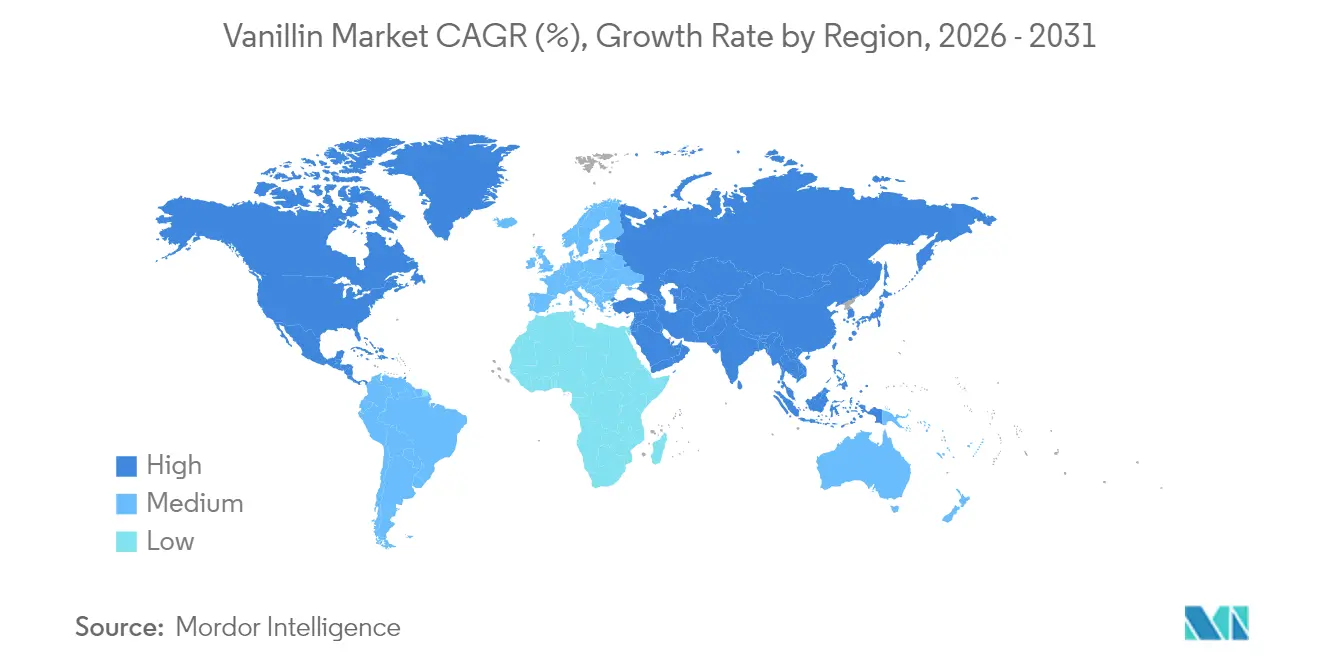
In 2025, Europe holds a leading 31.10% market share, supported by its strong manufacturing infrastructure, strict quality standards, and high demand from the food, pharmaceutical, and personal care industries. European producers capitalize on regulatory distinctions between natural and synthetic vanillin, enabling premium positioning for biotechnology-derived products. Key markets such as Germany, France, the Netherlands, and the UK feature advanced supply chains and high-value applications, though regulatory compliance costs pose challenges for smaller competitors. The European market exhibits mature demand patterns, with steady growth driven by clean-label trends and the expansion of pharmaceutical applications.
APAC Vanillin Market
Asia Pacific is the fastest-growing region, with a 9.30% CAGR projected through 2031. This growth is driven by the region's expanding food processing industries, rising consumer spending, and increasing consumption of packaged foods in countries like China, India, Japan, and Australia. However, trade tensions significantly influence regional dynamics, as U.S. antidumping duties of 190.15% to 379.87% on Chinese vanillin imports reshape supply chains and create opportunities for alternative suppliers, according to the Federal Register. While China faces regulatory challenges as a major vanillin producer, India and Southeast Asian markets show strong growth potential, fueled by urbanization and shifting dietary preferences.
The Americas and EMEA Vanillin Market
North America represents a mature market with well-established regulatory frameworks and strong demand across food, pharmaceutical, and personal care applications. Meanwhile, South America and the Middle East & Africa present emerging growth opportunities, driven by economic development and the expansion of food processing industries. Uganda, as Africa's second-largest vanilla producer, exported over 600 metric tonnes in 2024, highlighting the continent's potential in natural vanillin supply chains. With vanillin content exceeding 4%, Uganda is increasing its market share in the U.S. and EU markets, emphasizing Africa's growing role in global vanillin supply chains. Regional growth trends reflect economic development, regulatory changes, and supply chain optimization as manufacturers seek cost-effective production locations while maintaining quality standards.

Regulatory Landscape
Vanillin is regulated as a flavoring substance and food additive under established frameworks across major consuming regions. In the United States, FDA provisions under 21 CFR 182.60 and 21 CFR 182.90 govern synthetic flavoring substances and adjuvants, alongside GRAS pathways, including FDA GRAS Notice (GRN) 1230 for a fermentation-derived vanillin preparation that received a no-questions outcome (closed June 11, 2025, with an FDA portal update showing 06/01/2026). In Europe, EFSA provides the scientific and safety backbone for food additive oversight, and in Great Britain, vanillin remains authorized under the assimilated Regulation (EC) No 1334/2008 as a flavoring (Authorised FL No 05.018). China regulates vanillin under GB 1886.16-2015.
Trade measures became a central regulatory variable in 2025 for global sourcing and pricing. The European Union imposed definitive anti-dumping duties on imports of vanillin originating from China, effective June 11, 2025, via Commission Implementing Regulation (EU) 2025/1151. In the United States, the Department of Commerce published final affirmative determinations for antidumping and countervailing duty investigations on June 6, 2025, and issued AD/CVD orders on July 21, 2025, covering broad vanillin categories (including natural, synthetic, biovanillin, ethylvanillin, and multiple forms). The change tightened importers' documentation and compliance requirements and accelerated supplier diversification.
Competitive Landscape
Market leaders like Merck KGaA, BASF SE, and Givaudan SA capitalize on their scale advantages and long-standing customer relationships. In contrast, biotechnology firms such as Evolva Holding SA and niche producers like Borregaard AS carve out their space through innovation and premium market positioning. The competitive landscape is shaped by strategic moves towards vertical integration, a commitment to sustainable production, and a deep expertise in navigating regulatory challenges.
Companies are increasingly turning to technology adoption as a means of standing out in the crowded vanillin market. Investments are being funneled into biotechnological production methods, enzyme engineering, and the use of sustainable feedstocks, all aimed at capturing the more lucrative market segments. However, not all players are thriving: Syensqo, previously known as Solvay, faced a setback with a hefty €114 million impairment loss in its Aroma unit, a direct consequence of dwindling demand for synthetic vanillin and mounting competition. This underscores the pressures traditional producers are grappling with.
White-space opportunities are surfacing in areas like pharmaceutical applications, sustainable production technologies, and tapping into emerging markets. However, the intricate maze of regulatory compliance poses challenges, creating a protective barrier that benefits established players. These industry veterans possess the regulatory know-how and the financial muscle to adeptly navigate the complex approval processes that span multiple jurisdictions.
Vanillin Industry Leaders
Jiaxing Zhonghua Chemical Co Ltd.
Merck KGaA
Borregaard AS
Camlin Fine Sciences (CFS)
PRINOVA GROUP LLC
- *Disclaimer: Major Players sorted in no particular order
Vanillin Market Companies Covered in this Report
- Merck KGaA
- Evolva Holding SA
- Camlin Fine Sciences Ltd
- Borregaard AS
- Jiaxing Zhonghua Chemical Co Ltd
- Syensqo (ex-Solvay)
- Prinova Group LLC
- FoodChem International Corp.
- Lesaffre Et Compagnie
- Veda Oils
- BASF SE
- Givaudan SA
- International Flavors & Fragrances (IFF)
- Sensient Technologies
- Kerry Group
- Symrise AG
- Fujian Xinhua Co Ltd
- Hubei Shuntian Chemical
- Anhui Bayi Chemical
- Beijing Youjiale Flavor

Market Opportunities and Future Outlook
Clean-label reformulation and the widening cost and supply gap between vanilla-bean-derived inputs and scalable alternatives keep demand focused on vanillin that can be positioned as natural, especially for bakery, dairy, and confectionery applications. A commercialization signal came with Lallemand's March 2026 launch of Hevani, a yeast-based precision-fermentation natural vanillin intended for EU and US use, marketed as not requiring GMO labeling. This expands the addressable group of brand owners that specify natural flavoring while seeking more stable supply than vanilla beans. Regulatory familiarity with fermentation-derived ingredients also supports follow-on bio-based vanillin preparations, including pathways linked to FDA's completed GRAS review cycle for GRN 1230.
Anti-dumping actions in the EU and US in mid-2025 also altered the economics for imported Chinese material, increasing the value of regional production resilience. That shift created room for capacity additions and restarts outside China. Indesso's December 2024 soft launch of a second vanillin facility in Ungaran, Central Java (USD 20 million investment) reflects expansion of clove oil-derived supply, while Syensqo's September 2025 reopening of its Saint-Fons, France synthetic vanillin facility after an idle period since May 2024 shows manufacturers adjusting footprints to new trade conditions and customer continuity needs. Together, these moves support multi-origin sourcing programs, tighter producer-brand partnerships, and differentiated portfolios spanning synthetic, natural, and bio-based vanillin across food, personal care, and higher-value functional uses such as pharmaceuticals.
Recent Industry Developments in Vanillin Market
- April 2026: Merck KGaA announced the launch of a bio-based solvent portfolio for high-performance liquid chromatography using renewable feedstocks. While not vanillin-specific, the move reinforces Merck's broader push into bio-based chemistry and laboratory-grade sustainability, which aligns with rising procurement preference for lower-carbon ingredient and reagent supply chains across food, pharma, and personal care value chains.
- July 2025: Antidumping and countervailing duty orders on vanillin imports from the People's Republic of China were issued by the U.S. Department of Commerce, following the June 2025 final affirmative determinations published in the Federal Register. These orders broaden compliance and landed-cost considerations for importers and accelerate qualification of alternative sources and regional production strategies.
- December 2024: Indesso soft-launched a second vanillin production facility in Ungaran, Central Java, backed by a USD 20 million investment and designed to double capacity for clove oil-derived vanillin. The added supply supports downstream manufacturers seeking diversification away from constrained vanilla-bean-linked availability and trade-exposed supply routes.


Vanillin Market Report Scope and Research Methodology
Market Definition and Coverage
For this study, the market is defined as the value of vanillin sold for use as a flavoring and aroma ingredient across end-use industries, counted at the point where the product is commercially supplied into the market within the covered geographies.
Scope exclusions: We exclude internal transfers within integrated groups and any double counting across different forms of the same vanillin volume.
Segments Covered in This Report
- By Type
- Natural Vanillin
- Synthetic Vanillin
- By Form
- Powder
- Crystal
- Liquid
- By Application
- Food & Beverage
- Bakery and Confectionery
- Beverages
- Dairy and Frozen Products
- Other
- Pharmaceuticals
- Personal Care & Cosmetics
- Dietary Supplements and Sports Nutrition
- Animal Feed
- Others
- Food & Beverage
- By Geography
- North America
- United States
- Canada
- Mexico
- Rest of North America
- Europe
- Germany
- France
- United Kingdom
- Netherlands
- Italy
- Rest of Europe
- Asia Pacific
- China
- India
- Japan
- Australia
- Rest of Asia Pacific
- South America
- Brazil\
- Argentina
- Rest of South America
- Middle East and Africa
- Saudi Arabia
- South Africa
- Rest of Middle East and Africa
- North America
Data Sources, Market Sizing, and Validation
Desk Research
Desk research was used to frame the demand pool and the main pricing signals before assumptions were taken into the model. We typically relied on public sources such as customs and trade statistics, food additive and labeling guidance from regulators, agriculture and commodity publications, peer reviewed papers on flavor ingredients, and association releases linked to flavors and fragrances.
Along with that, we reviewed company annual reports, investor presentations, product catalogs, and reputed news coverage to understand capacity expansions, sourcing shifts, and portfolio mix between natural and synthetic vanillin. A paid subscription for company financials and another for shipment level import export checks were used selectively to cross verify revenue direction and trade movement by major routes. The desk sources listed here are illustrative and not exhaustive, and many other references were also used to collect data, validate assumptions, and clarify open questions.
Primary Interviews and Surveys
Primary interviews and surveys were run with manufacturers, distributors, and large end users in food and beverage, personal care, and pharma to stress test the demand build and the price progression used in the model. For a global market like vanillin, we also ensured coverage reflected different sourcing patterns and labeling preferences across APAC, EMEA, and the Americas, and then we revisited assumptions when answers diverged by application or form.
Distribution of primary research fieldwork respondents
| Company type | Respondent position | Region |
|---|---|---|
| Top tier: 35% | CXOs: 15% | APAC: 40% |
| Mid tier: 44% | Functional/Unit leaders: 25% | EMEA: 36% |
| Smaller Players: 21% | Managers: 60% | Americas: 24% |
Market-Sizing & Forecasting
Sizing started with a top-down build where application level demand was reconstructed using known consumption intensity in key end uses, adjusted by regional processing activity and trade flows for flavor ingredients. Once the demand pool was formed, it was translated into value using an ASP ladder by type and form, then corrected for mix shifts between natural and synthetic supply.
To keep the totals realistic, we corroborated them with selective bottom-up approximations, such as sampled supplier revenue ranges, channel checks on bulk pricing, and a volume times price cross check for major consuming regions. Inputs used in the model included the split between natural and synthetic vanillin, form preference (powder, crystal, liquid), usage growth in packaged foods and beverages, natural labeling adoption that changes mix, and import export movement that signals supply availability. Forecasting leaned on scenario analysis with a short set of drivers, and the final path was aligned to expert views on pricing cycles, natural supply ramp ups, and substitution behavior across applications. Where bottom-up gaps existed, proxies were applied using nearby regions or similar applications and then normalized back to observed totals.
Data Validation & Update Cycle
Outputs were checked in more than one step so the final number is not driven by a single assumption. We compared modeled value growth with independent signals such as trade direction, reported price ranges, and end use production indicators, and then outliers were reviewed again before sign-off.
If large variances showed up by region, type, or form, follow-up calls were triggered to recheck the ASP steps and the mix assumptions, and then the model was rerun. Reports are refreshed annually, with interim updates when there are material events such as sharp price moves, major capacity changes, or regulatory shifts that affect labeling and demand. Before delivery, a final analyst pass is completed so clients receive the latest updated view.
Mordor Intelligence's Vanillin Market Sizing Compared With Other Published Estimates
Published market values for vanillin can look far apart because the time window and the pricing mechanics are not always aligned, even when the product name sounds the same. In practice, gaps show up when one source uses an older base year, blends natural and synthetic prices too tightly, or applies one currency conversion point even when prices move during the year.
A refresh-led gap is also common in this market because ASPs can change with feedstock conditions and with mix shifts between forms, and some estimates do not revalidate those steps against current trade and channel signals. By keeping currency timing aligned to the stated base year and rechecking the form-level ASP ladder during the final review cycle, Mordor Intelligence reduces drift that can build up when earlier assumptions are carried forward.
Benchmark comparison
| Source | Market Size | Gaps in Research Methodology |
|---|---|---|
| Mordor Intelligence | USD 1.21 B (2026) | |
| Global Consultancy A | USD 0.63 B (2022) | Uses an earlier base year and a different forecast window, so price levels and mix assumptions for natural versus synthetic are anchored to a lower starting point that may not reflect later ASP steps. |
| Industry Publisher B | USD 0.85 B (2024) | Applies a separate base year with broader channel assumptions and limited clarity on how form-level pricing is averaged, which can compress ASP differences between powder, crystal, and liquid products. |
Overall, the spread across figures is mainly explained by base-year choice and how often price and mix inputs are refreshed. When scope boundaries are held steady and the ASP path is validated with current market checks, the result is easier to trace back to clear demand and pricing steps.


Key Questions Answered in the Report
How large is the vanillin market in 2026?
The vanillin market size stands at USD 1.21 billion in 2026 with an 8.09% CAGR outlook to 2031.
Which segment grows fastest over 2026-2031?
Natural vanillin shows the highest 8.42% CAGR as fermentation technology scales and clean-label demand rises.
What drives the shift toward liquid vanillin?
Immediate solubility and 14% shorter batch cycles in beverage plants position liquid formulations for an 8.22% CAGR.
Why are antidumping duties relevant to vanillin buyers?
U.S. tariffs of up to 379.87% on Chinese vanillin increase costs and drive buyers to diversify sourcing within ASEAN and Europe.
Page last updated on:


 Your data is secure and never sold or shared.


