
Market Overview
| Study Period | 2020 - 2031 |
|---|---|
| Forecast Data Period | 2026 - 2031 |
| Base Year Market Size (2025) | USD 10.31 Billion |
| Market Size (2026) | USD 11.17 Billion |
| Market Size (2031) | USD 16.65 Billion |
| Growth Rate (2026 - 2031) | 8.32 % |
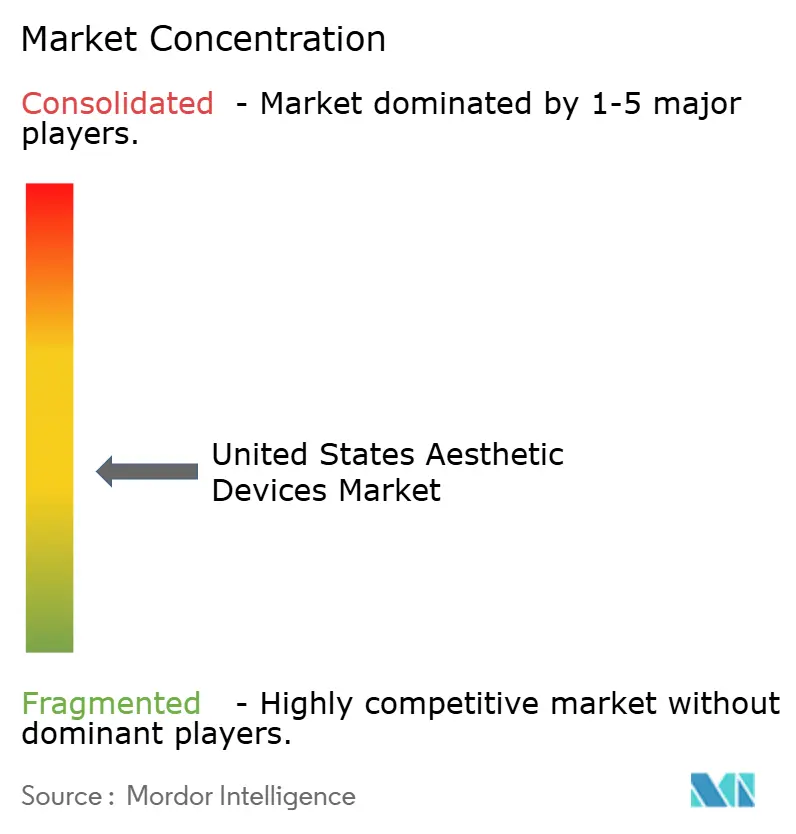
| Market Concentration | Medium |
Major Players *Disclaimer: Major Players sorted in no particular order Image © Mordor Intelligence. Reuse requires attribution under CC BY 4.0. | |
United States Aesthetic Devices Market Analysis by Mordor Intelligence
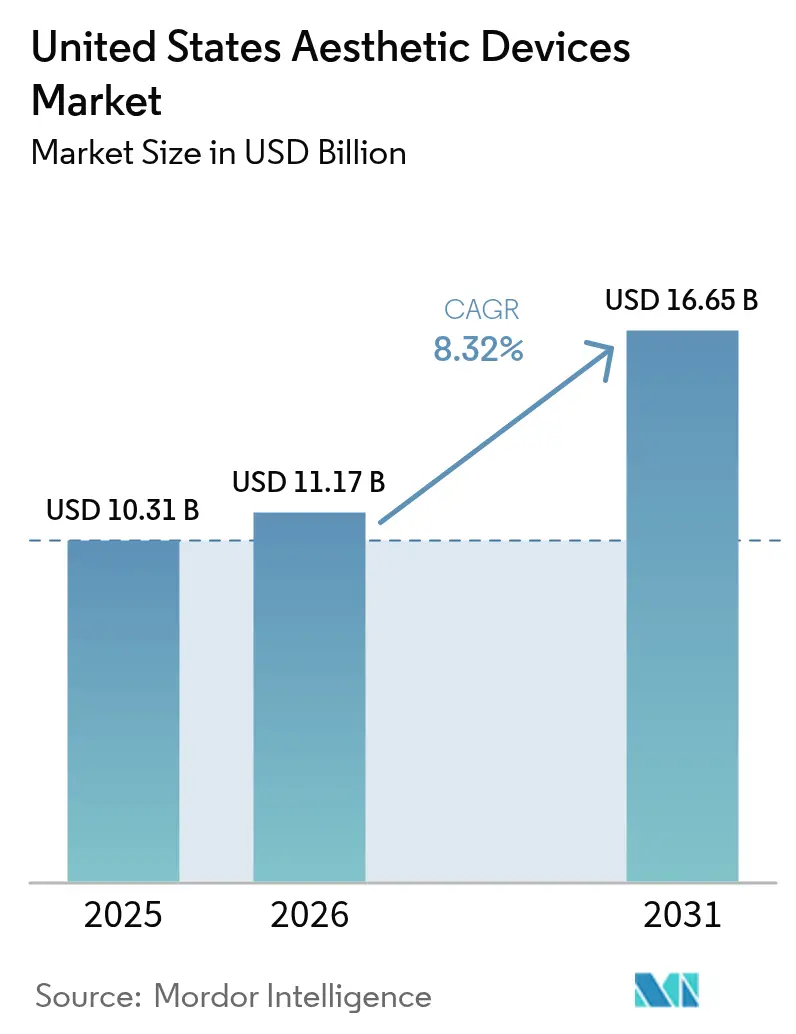
United States Aesthetic Devices market size in 2026 is estimated at USD 11.17 billion, growing from 2025 value of USD 10.31 billion with 2031 projections showing USD 16.65 billion, growing at 8.32% CAGR over 2026-2031.
Accelerated private-equity consolidation, faster FDA clearances for energy-based platforms, and rising demand for minimally-invasive procedures place the United States aesthetic devices market on a strong growth trajectory. Device makers are bundling artificial-intelligence (AI) software with radio-frequency and laser systems, enabling clinics to deliver surgical-level results without incisions. Home-use technologies are moving toward over-the-counter Class II status, widening consumer access and further expanding the United States aesthetic devices market. Meanwhile, semiconductor supply-chain vulnerabilities and new state-level scope-of-practice bills introduce operational complexity that manufacturers must navigate to protect margins and sustain innovation pipelines.
Key Report Takeaways
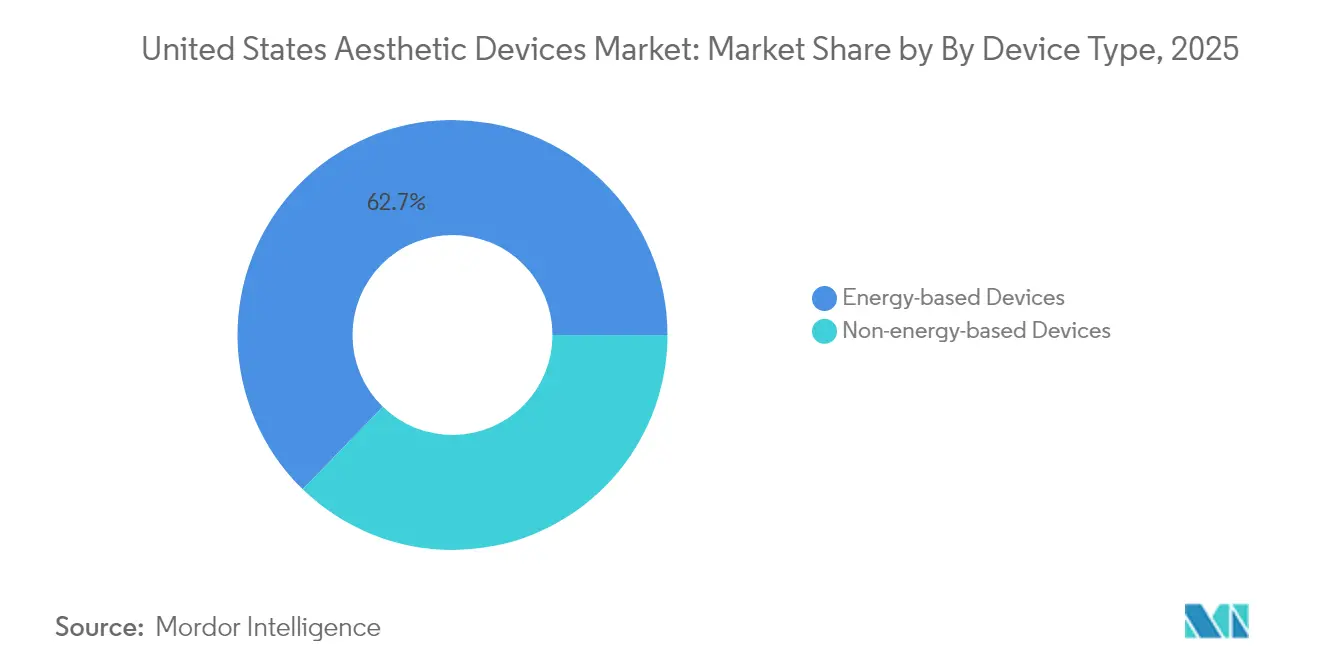
- By device type, energy-based platforms held 62.74% of the United States aesthetic devices market share in 2025, and the radio-frequency-based segment is poised for an 10.78% CAGR to 2031.
- By application, hair removal held 28.55% of the United States aesthetic devices market share in 2025 and body contouring and cellulite reduction are poised for a 9.74% CAGR to 2031, the highest growth across treatment categories.
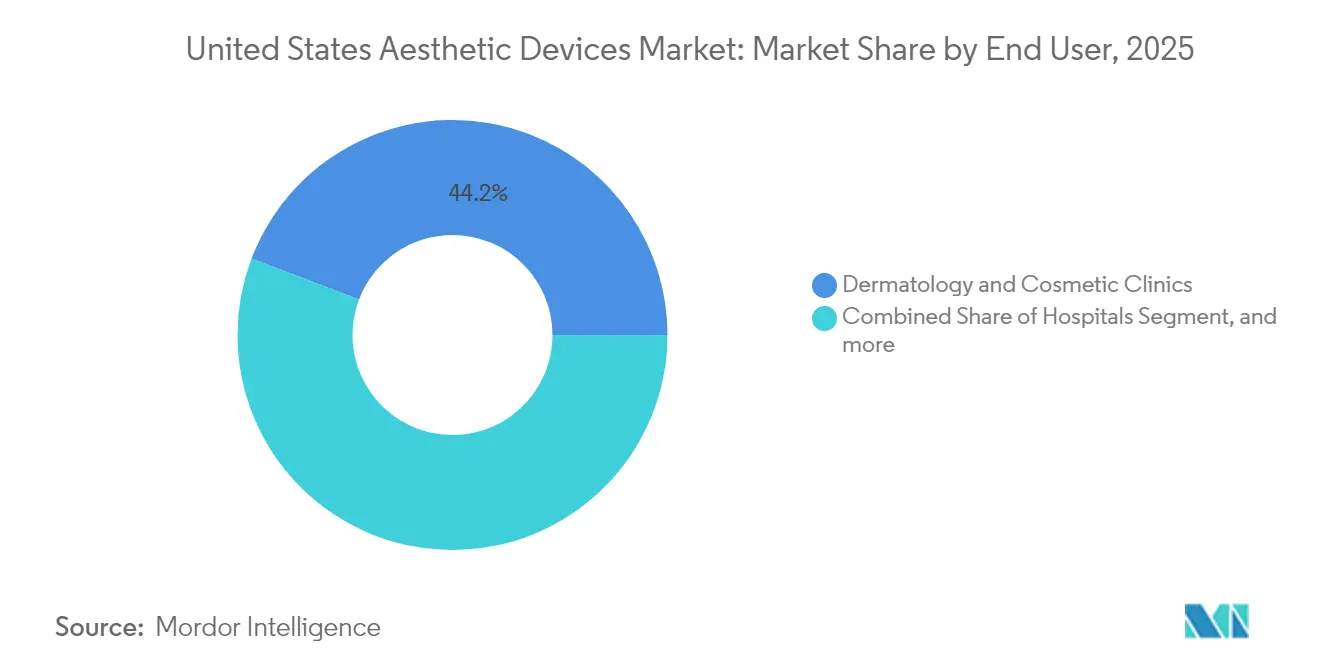
- By end user, dermatology & cosmetic clinics held 44.22% of the United States aesthetic devices market share in 2025 home-use settings are advancing at a 8.95% CAGR through 2031, the fastest among all delivery channels.
Note: Market size and forecast figures in this report are generated using Mordor Intelligence’s proprietary estimation framework, updated with the latest available data and insights as of 2026.
United States Aesthetic Devices Market Trends and Insights
Drivers Impact Analysis*
| Driver | (~) % Impact on CAGR Forecast | Geographic Relevance | Impact Timeline |
|---|---|---|---|
| Minimally-invasive procedure preference | +2.1% | Nationwide, heightened in West & Northeast | Medium term (2-4 years) |
| Obesity-linked body-contouring demand | +1.8% | National, strongest in South & Midwest | Long term (≥ 4 years) |
| Energy-device technological advances | +1.5% | National, R&D hubs on West Coast | Medium term (2-4 years) |
| Male consumer adoption | +1.2% | Nationwide metro clusters | Long term (≥ 4 years) |
| AI-driven personalization | +0.9% | Tech-forward regions | Short term (≤ 2 years) |
| Private-equity med-spa chains | +0.7% | High-density urban markets | Medium term (2-4 years) |
| Source: Mordor Intelligence | |||
Rising Demand for Minimally-Invasive Procedures
American Society of Plastic Surgeons data show non-surgical treatments outpacing surgeries, propelling clinics to favor devices that deliver lift, tightening, or pigment correction without incisions.[1] FDA clearance of AI-guided radio-frequency platforms, such as Candela’s Matrix, illustrates regulatory encouragement for technologies that minimize downtime while matching surgical outcomes. Manufacturers are shortening redesign cycles to embed thermal sensors and impedance feedback that protect epidermal layers. Patient satisfaction now exceeds 94% for new radio-frequency microneedling protocols, encouraging cross-sell of add-on treatments at medical spas. The United States aesthetic devices market therefore benefits from wider patient pools, including working adults who previously avoided aesthetic enhancement because of recuperation concerns.
Increasing Obese Population Driving Body-Contouring Demand
The pharmaceutical surge in glucagon-like peptide-1 (GLP-1) weight-loss agents has created downstream demand for non-surgical skin-tightening and fat-reduction devices.[2] Clinics are forming integrated pathways that begin with semaglutide prescriptions and culminate in cryolipolysis or ultrasound sessions to manage residual adiposity and laxity. FDA approvals for next-generation ultrasound body-shaping systems reposition these treatments from cosmetic to functional wellness, strengthening insurance-preauthorization debates. Practitioners in the South and Midwest report two-digit case-volume gains, aligning with regional obesity prevalence. Consequently, body-contouring revenues are forecast to outstrip hair-removal gains within the United States aesthetic devices market, signaling a structural shift toward comprehensive weight-management ecosystems.
Technological Advancements in Energy-Based Devices
Breakthrough 1,726 nm lasers achieve 70% clearance in inflammatory acne after four sessions, illustrating performance leaps that expand patient indications. InMode’s FDA-cleared Morpheus8 adds fractional radio-frequency microneedling for soft-tissue contraction, pushing platform utility beyond resurfacing into remodeling.[3] Real-time thermal mapping and closed-loop impedance monitoring now safeguard Fitzpatrick skin types IV–VI, overcoming historic energy-device adoption barriers among diverse populations. Combination platforms integrate Dynamic Muscle Stimulation to treat muscle laxity concurrently with adipose reduction, maximizing device ROI in high-volume clinics. These advances reinforce the premium pricing power that sustains the United States aesthetic devices market even during macroeconomic cooling.
Growing Awareness & Adoption Among Male Consumers
Male clientele now accounts for roughly 22% of U.S. clinic visits, driven by workplace age-bias concerns and social acceptance of aesthetic upkeep. Marketing campaigns underscore minimally invasive treatments and quick return-to-work timelines, resonating with professional males. Devices offering discrete recovery, such as transdermal radio-frequency or focused ultrasound, are preferred. Clinics in New York, Los Angeles, and Miami report double-digit male booking growth, prompting targeted product lines like “bro-tox” bundles. This demographic shift expands the United States aesthetic devices market beyond its historical female base, broadening the payer mix and device utilization rates.
Restraints Impact Analysis*
| Restraint | (~) % Impact on CAGR Forecast | Geographic Relevance | Impact Timeline |
|---|---|---|---|
| Social stigma & safety concerns | -1.4% | Nationwide cultural variance | Long term (≥ 4 years) |
| Lack of reimbursement | -1.1% | Universal, all socioeconomic tiers | Long term (≥ 4 years) |
| Counterfeit & gray-market devices | -0.8% | Online marketplaces | Short term (≤ 2 years) |
| Semiconductor shortages | -0.6% | All U.S. manufacturers | Medium term (2-4 years) |
| Source: Mordor Intelligence | |||
Social Stigma & Safety Concerns
FDA adverse-event files cite burns and pigmentation issues linked to unregulated home-use lasers, fueling negative media narratives. High-profile lawsuits against national surgery chains spotlight practitioner training gaps, undermining public confidence. The absence of a centralized cosmetic-procedure injury registry hinders transparent risk communication. Social media amplifies isolated complications, disproportionately affecting millennial and Gen-Z uptake. Although clinical evidence shows low complication rates in certified settings, stigma lingers, tempering growth potential within segments of the United States aesthetic devices market.
Lack of Reimbursement for Aesthetic Treatments
Because aesthetic services remain predominantly cash-pay, middle-income patients often delay or down-trade procedures during economic slowdowns. Physicians pivot toward aesthetic add-ons to offset declining insurance reimbursements in core medical specialties, but consumer discretionary spending elasticity can limit conversion rates. Financing programs and subscription models ease upfront costs but introduce credit-risk exposure for clinics. Without third-party payer support, the United States aesthetic devices market relies on steady economic conditions to sustain momentum.
*Our forecasts treat driver/restraint impacts as directional, not additive. The impact forecasts reflect baseline growth, mix effects, and variable interactions.
Segment Analysis
By Device Type: Energy Platforms Dominate Innovation
Energy-based platforms held 62.74% of the United States aesthetic devices market in 2025, and the category is projected to expand at a 10.78% CAGR through 2031. This dominance rests on technological elasticity: lasers, radio-frequency, ultrasound, and intense pulsed light (IPL) can each be fine-tuned for multiple indications, generating recurring revenue streams for clinics that invest in stackable handpieces. Radio-frequency leads grow because they penetrate dermal layers with minimal melanin interaction, reducing post-inflammatory hyperpigmentation risks for darker skin types. Laser-based subsegments remain strong, buoyed by 1,726 nm acne-targeting systems that achieve 70% lesion clearance rates. Ultrasound-assisted lipolysis has advanced via cavitation-controlled algorithms that preserve connective tissue, improving downtime metrics. Cryolipolysis technology fights competitive pressure by integrating pre-heating stages that boost adipocyte susceptibility to cold-induced apoptosis. Collectively, these engineering improvements anchor premium pricing and keep capital equipment upgrades flowing throughout the United States aesthetic devices market.
Non-energy devices, including botulinum toxin injectables and dermal fillers, still generate high procedure volumes but exhibit slower equipment replacement cycles. Innovative hybrid fillers, such as calcium-hydroxylapatite blended with hyaluronic acid, now deliver scaffold and hydration benefits in a single syringe, supporting moderate revenue gains. Micro-needling pens, mechanical microdermabrasion units, and chemical-peel applicators fill entry-level niches but confront saturation. Although implantable aesthetics, like silicone chin implants, secure clinical success rates above 90%, regulatory audits on device sterility and long-term biocompatibility restrain their momentum. Overall, non-energy segments add breadth but not breakout velocity to the United States aesthetic devices market.

By Application: Body Contouring Accelerates Growth
Hair-removal systems retained a 28.55% share of the United States aesthetic devices market in 2025, thanks to stable demand for diode lasers and IPL devices targeting both female and male consumers. However, body contouring and cellulite reduction are predicted to log a 9.74% CAGR, the steepest among all indications, propelled by GLP-1 weight-loss therapies that amplify post-diet skin laxity concerns. Cryolipolysis, high-intensity focused electromagnetic (HIFEM) muscle stimulators, and monopolar radio-frequency treatments converge to offer fat apoptosis, muscle toning, and dermal tightening in bundled sessions. Such combination protocols lift ticket sizes by 20%–30% on average, making body-shaping the profit engine of the United States aesthetic devices market.
Skin-resurfacing and tightening devices leverage fractional CO₂ lasers that achieve 45% texture improvement after a single pass, complemented by non-ablative erbium filters that shrink pores without downtime. Tattoo-removal lasers tuned to picosecond pulse widths extend efficacy to stubborn green and blue inks. Acne and scar-management applications ride on energy platforms delivering 70% lesion reduction, while pigment-specific wavelengths like 532 nm tackle melasma. Breast and intimate rejuvenation procedures form emergent niches, aided by temperature-controlled radio-frequency handpieces. Together, these diverse indications maximize device utilization rates, sustaining clinic profitability even as competitive entrants join the United States aesthetic devices market.
By End User: Home Settings Drive Disruption
Dermatology and cosmetic clinics controlled 44.22% of United States aesthetic devices market revenue in 2025, benefiting from specialist skill sets and access to multi-modality platforms. Medical-spa chains leverage private-equity capital to standardize service menus and negotiate volume discounts on equipment, boosting EBITDA margins. Hospitals maintain relevance in complex reconstructive or combination surgical-energy procedures that require anesthesia support.
Home-use systems, however, advance at a 8.95% CAGR through 2031 as FDA guidance on over-the-counter aesthetic devices crystallizes. IPL handsets now feature skin-tone sensors that lock pulses if melanin thresholds are exceeded, reducing burn risks. Consumer preferences for privacy and convenience spur Amazon and pharmacy-chain distribution partnerships. Nevertheless, the spread of unregistered imports has spurred the FDA to authorize port-of-entry destruction, signaling a regulatory balance between accessibility and safety. Professional settings maintain competitive high-intensity energy levels and combination therapy expertise that remain out of reach for consumer gadgets. Thus, while home units enlarge the total addressable population, clinics preserve premium treatment tiers within the United States aesthetic devices market.
Geography Analysis
California, New York, and Florida anchor the West and Northeast corridors, contributing major share of national device sales because of high disposable-income cohorts and dense provider networks. Silicon Valley’s proximity to R&D hubs accelerates prototype-to-market cycles and helps sustain the United States aesthetic devices market with continual software updates and AI-driven imaging add-ons. State boards in California have enacted detailed laser-operator credentialing that has become a de facto standard nationwide. New York’s metro concentration supports flagship training centers where manufacturers host physician-education symposia, augmenting brand loyalty.
Southern states, led by Texas and Florida, log the fastest volume growth, benefiting from population influx and high obesity prevalence, driving body-contouring demand. Texas debates around limiting aesthetic practice to physician-supervised settings could reshape nurse-practitioner-led med-spa models, injecting some policy risk into regional expansion strategies. Florida’s more permissive environment fuels med-spa franchising, with both domestic and Latin American clientele boosting off-season patient flows. The United States aesthetic devices market therefore, gains a diversified geographic revenue base that buffers state-specific regulatory swings.
The Midwest shows growing adoption in Chicago, Minneapolis, and Columbus, supported by hospital-affiliated aesthetic centers seeking ancillary cash-pay income. Equipment vendors deploy tiered pricing to fit lower per-capita income profiles while offering AI-assisted safety features that shorten practitioner learning curves. State governments like Michigan have expanded the esthetician scope to include light-therapy devices, unlocking new buyer segments for entry-level lasers. Simultaneously, North Dakota’s advanced license requirements could restrict device use to highly trained operators, underscoring the regulatory mosaic that characterizes the United States aesthetic devices market.
Regulatory Landscape
In the United States, aesthetic and cosmetic devices fall under the U.S. Food and Drug Administration (FDA) medical device framework, with many products commonly used in aesthetic clinics regulated within 21 CFR Part 878 (General and Plastic Surgery Devices). Most energy-based platforms and microneedling-type systems commercialize through the 510(k) premarket notification pathway, where manufacturers must demonstrate substantial equivalence to a legally marketed predicate device and comply with applicable labeling and promotional rules for cosmetic indications.
A significant compliance shift is the FDA transition from the legacy Quality System Regulation (21 CFR Part 820) to the Quality Management System Regulation (QMSR), effective February 2, 2026, incorporating ISO 13485:2016 by reference and tightening expectations for harmonized quality documentation and audit readiness. Enforcement and classification can be more stringent for certain laser cosmetic uses; FDA Compliance Policy Guide (CPG) Sec. 393.200 addresses lasers marketed for cosmetic claims (such as facelift and wrinkle removal), reinforcing the need for appropriate regulatory authorization. Separately, trade-policy activity in 2026 introduced supply-chain uncertainty: in April 2026, the White House referenced Section 232 actions that included investigations into medical devices and equipment, and in July 2026 the American Hospital Association submitted comments to the Office of the U.S. Trade Representative seeking exemptions for medical devices from proposed tariffs to avoid availability and cost disruptions.
Competitive Landscape
Cynosure and Lutronic finalized their merger in 2024, creating a top-three revenue player with distribution in 130 countries and a deep energy-platform pipeline. AbbVie’s Allergan Aesthetics unit remains the overall leader, leveraging a diversified portfolio of neurotoxins, fillers, and energy devices, plus newly opened training centers in Orange County, Austin, and Atlanta that sharpen physician loyalty. Venus Concept reduced debt by 47% amid revenue softness, illustrating mid-tier pressures when economic cycles tighten device spending.
Private-equity funds drove 55 U.S. aesthetic deals in 2023, intensifying roll-up activity among med-spa chains and small device manufacturers. Consolidators negotiate favorable equipment leases and require bundled maintenance, fostering predictable revenue streams for suppliers within the United States aesthetic devices market. Emerging disruptors deploy AI-first architectures and subscription-based software analytics to differentiate, challenging incumbents that traditionally led with hardware. In response, established firms embed software-as-a-service dashboards that track treatment outcomes and calibrate settings remotely, complementing capital-equipment sales with recurring revenue.
Strategic pivots include InMode’s software-controlled consumable tips that lock after preset pulse counts, lifting razor-and-blade margins. Lumenis introduced OptiLIFT, which pairs Dynamic Muscle Stimulation with infrared skin contraction, capturing lower-lid laxity treatments that previously lacked non-surgical options. Cutera emerged from Chapter 11 reorganization in March 2025, shedding USD 400 million in debt and retaining its core truSculpt and xeo franchises, signaling that balance-sheet repair can restore competitiveness even after market share erosion. Overall, technology depth, financial agility, and practitioner education form the three pillars that define competitive advantage within the United States aesthetic devices market.
United States Aesthetic Devices Industry Leaders
-
Lumenis
-
Bausch Health Companies Inc. (Solta Medical Inc.)
-
Cynosure
-
AbbVie (Allergan Aesthetics)
-
Alma Lasers (Sisram Medical)
- *Disclaimer: Major Players sorted in no particular order
Market Opportunities and Future Outlook
Product whitespace is shifting toward platforms and indications that expand utilization per installed system, particularly in high-throughput dermatology, cosmetic clinic, and med-spa settings where capital ROI drives purchasing decisions. Multi-modality systems show how manufacturers are packaging new revenue streams into one footprint, including Lumenis commercially launching triLIFT 2.0 in March 2026 with Dynamic Muscle Stimulation and related skin-tightening technologies that clinics can apply across face and body workflows. Installed-base momentum for monopolar RF also points to demand for premium tightening solutions, along with compatible consumables and training programs, with Cynosure Lutronic reporting in June 2026 that its XERF platform surpassed 2,000 installed units globally after its North American launch in June 2025.
Regulatory clearances and label expansions in 2026 support a near-term opportunity for clinically validated, anatomy-specific claims and inclusive treatment populations, particularly across varied Fitzpatrick skin types where energy safety has historically limited adoption. SkinHealth Systems received FDA clearance in July 2026 for SkinStylus microneedling for improvement of periorbital wrinkles in adults aged 22 and older across all Fitzpatrick skin types, while Apyx Medical obtained expanded FDA 510(k) clearance in May 2026 for the AYON Body Contouring System to include power liposuction. On the operating model side, the February 2026 QMSR transition to an ISO 13485:2016-aligned framework increases the value of regulatory-grade design controls, software validation, and post-market quality infrastructure, which can favor suppliers that support faster, compliant iteration cycles as clinics and chains standardize protocols across expanding footprints.
Recent Industry Developments
- July 2026: SkinHealth Systems Inc. received U.S. FDA clearance for its SkinStylus microneedling device for the improvement of periorbital wrinkles in adults aged 22 and older across all Fitzpatrick skin types. The clearance broadens patient inclusion and gives practices an additional option to position microneedling for a high-demand anatomical area with a defined regulatory claim.
- June 2026: Allergan Aesthetics (AbbVie) received U.S. FDA approval for SKINVIVE by JUV\bDERM for improvement of neck appearance, expanding use beyond the face into a specific new anatomical indication. The approval adds breadth for injectable-led practices and increases competitive pressure on manufacturers pursuing differentiated hyaluronic acid indications.
- March 2026: Lumenis commercially launched triLIFT 2.0, integrating Dynamic Muscle Stimulation and related technologies for face and body applications. The platform approach consolidates multiple treatment goals into a single system, supporting clinic efficiency and encouraging bundled protocol adoption.
Research Methodology Framework and Report Scope
Market Definition and Coverage
For this study, the market covers revenue generated from aesthetic devices used in the United States for cosmetic procedures across clinical and home-use settings, including energy-based platforms and non-energy device categories.
Scope exclusions: We exclude pharmaceuticals, topical skincare products, and procedure service fees charged by providers (only the device and related consumable value is counted).
Segmentation Overview
- By Device Type
- Energy-based Devices
- Laser-based
- Light-based (IPL)
- Radio-frequency-based
- Ultrasound-based
- Cryolipolysis & Plasma-based
- Non-energy-based Devices
- Botulinum Toxin
- Dermal Fillers & Threads
- Chemical Peels
- Microdermabrasion
- Implants
- Mesotherapy & Others
- Energy-based Devices
- By Application
- Skin Resurfacing & Tightening
- Body Contouring & Cellulite Reduction
- Hair Removal
- Tattoo & Pigmentation Removal
- Breast Augmentation
- Acne & Scar Treatment
- Other Applications
- By End User
- Hospitals
- Dermatology & Cosmetic Clinics
- Medical Spas
- Home-use Settings
- By Region
- Northeast
- Midwest
- South
- West
Data Sources, Market Sizing, and Validation
Desk Research
Desk research was used to set the market boundary and to build starting points for demand and supply assumptions. We relied on public sources such as CDC health statistics, FDA databases (device clearances and safety communications), U.S. Census and trade statistics, and procedure trend publications from medical associations, along with peer-reviewed clinical journals that track adoption and outcomes for common aesthetic treatments.
On the supply side, company filings, annual reports, investor presentations, reputable press coverage, and association websites helped us map the device landscape, typical pricing direction, and key product launches. We also used a paid subscription for company financials and a separate paid subscription for patent and innovation signals, then aligned those signals with what was heard in interviews to cross-check product pipelines and revenue exposure. The desk sources listed here are illustrative only, and we reviewed many other public documents and databases to collect, validate, and clarify data points.
Primary Interviews and Surveys
Primary work focused on validating what is actually being purchased and used across the United States, including hospitals, dermatology and cosmetic clinics, and medical spa settings, plus distributors and service partners that see ordering patterns. We used these discussions to confirm device utilization, replacement cycles, price movement, and mix shifts by procedure type, and to pressure-test any desk-based assumptions that looked too high or too conservative.
Distribution of primary research fieldwork respondents
| Company type | Respondent position |
|---|---|
| Top tier: 37% | CXOs: 12% |
| Mid tier: 48% | Functional/Unit leaders: 41% |
| Smaller Players: 15% | Managers: 47% |
Market-Sizing & Forecasting
Sizing starts with a top-down build that reconstructs the United States demand pool from procedure volumes and device adoption patterns, then converts that activity into annual device and consumable value using realistic pricing and replacement assumptions. To keep the totals grounded, we corroborate the results with selective bottom-up approximations, including sampled average selling price (ASP) x unit volumes for common device categories and channel checks that reflect how purchases flow through providers and distributors.
Inputs that materially move the model include the split between energy-based and non-energy categories, procedure mix (for example skin resurfacing and tightening, hair removal, body contouring, tattoo removal, and breast augmentation related device demand), utilization rates by setting (clinic, hospital, medical spa, and home use), typical replacement cycles for capital equipment, and ASP progression based on product refreshes and discounting behavior. Where bottom-up visibility is weaker, we handle gaps using conservative penetration bands anchored to interview feedback, followed by sensitivity checks so the model does not overreact to a single assumption.
Forecasting is run using scenario analysis that links procedure growth and provider capacity expansion to device demand, then applies measured ASP changes rather than a flat inflation factor. Scenario weights are agreed through expert inputs, and the cases are stress-tested against known regulatory and reimbursement realities that influence patient throughput and provider purchasing timing.
Data Validation & Update Cycle
Outputs are validated through multiple checks that connect the model back to independent signals, then issues are reviewed before sign-off. We compare category totals against procedure trend indicators, import and shipment directionality, and company revenue exposure patterns, and then investigate any variance that falls outside expected ranges.
A multi-step review is followed, where assumptions are re-tested and outliers are traced back to the exact driver, such as a utilization rate, an ASP step change, or a replacement cycle. Reports are refreshed annually, and interim updates are triggered when a material event occurs, such as a major product recall, a large regulatory change, or a meaningful shift in procedure demand. Before delivery, a final analyst pass is completed so clients receive the most current view available.
Mordor Intelligence's USA Aesthetic Devices Market Estimate Compared With Other Published Estimates
Published market values for US aesthetic devices can look far apart even when the topic sounds the same, because the market boundary and counting rules are often set differently. The biggest swings usually come from what is counted as a device market versus a broader medical aesthetics spend pool, along with how pricing and replacement are treated for capital equipment.
Procedure volume direction, provider utilization feedback, and category-level revenue exposure checks are the evidence points that keep Mordor Intelligence's estimate tied to device demand rather than mixed-in service revenue, which is a common reason other figures land higher or lower.
Benchmark comparison
| Source | Market Size | Gaps in Research Methodology |
|---|---|---|
| Mordor Intelligence | USD 10.31 B (2025) | |
| Industry Publisher A | USD 6.82 B (2025) | This estimate appears to apply a narrower device scope and tends to separate implants and several non-energy categories more strictly, which reduces the counted value for the same year. |
| Industry Publisher B | USD 8.67 B (2022) | This figure is anchored to an earlier base year and a different forecast window, and it can shift the total because pricing steps and newer device adoption are not captured with the same timing. |
Taken together, the spread is mainly explained by scope boundaries and timing choices, not by a disagreement that the market is growing. By keeping the market definition centered on device and consumable revenue, and by forcing each assumption to connect back to observable demand signals, the final value stays traceable and repeatable for planning use.
Key Questions Answered in the Report
What is the current value of the United States aesthetic devices market?
The market stands at USD 11.17 billion in 2026 and is forecast to climb to USD 16.65 billion by 2031.
Which application is expanding fastest?
Body contouring and cellulite reduction are projected to grow at a 9.74% CAGR through 2031, driven by rising post-weight-loss skin-tightening demand.
How significant are home-use aesthetic devices?
Home settings hold a small share today but are advancing at 8.95% CAGR as FDA guidance for over-the-counter devices matures.
Which device technology commands the largest share?
Energy-based platforms, spanning lasers and radio-frequency systems, account for 62.74% of national revenue.
How is private equity influencing competitive dynamics?
Fifty-five medical-aesthetic deals closed in 2023, creating capitalized chains that negotiate bulk equipment purchases and drive throughput.
What regulatory trend should manufacturers monitor?
Semiconductor supply-chain shocks and new state scope-of-practice bills will shape manufacturing lead times and provider usage rights over the next four years.