
United Kingdom Pharmaceutical Logistics Market Size and Share
Market Overview
| Study Period | 2020 - 2031 |
|---|---|
| Forecast Data Period | 2026 - 2031 |
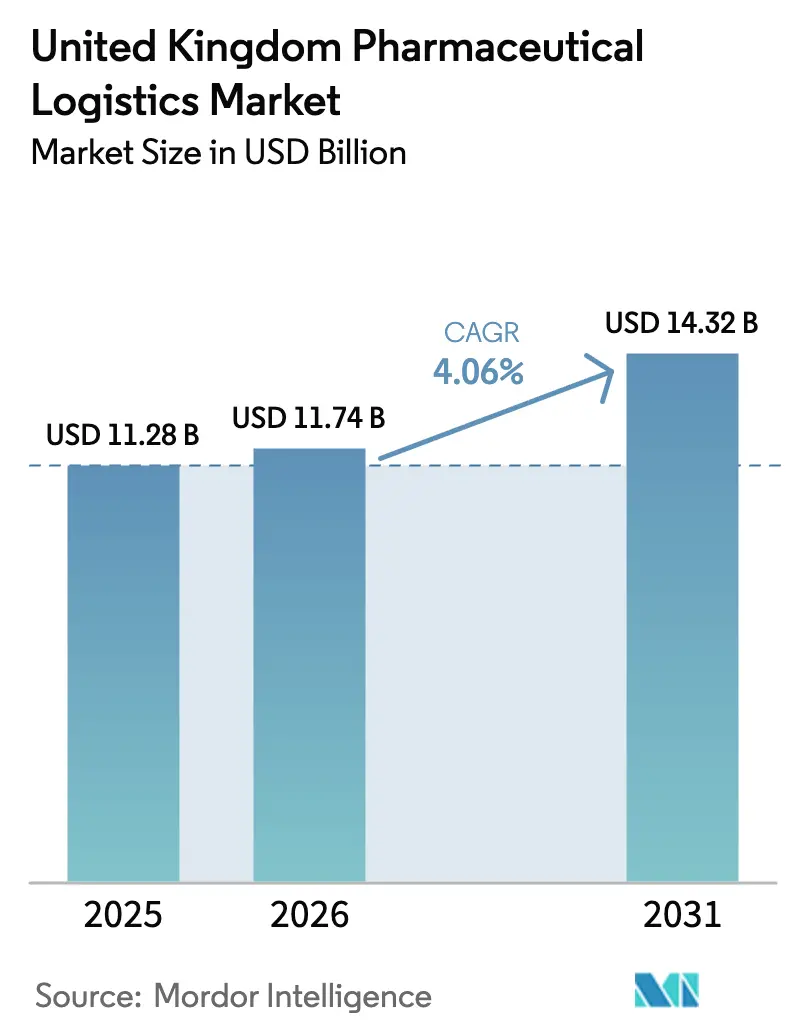
| Base Year Market Size (2025) | USD 11.28 Billion |
| Market Size (2026) | USD 11.74 Billion |
| Market Size (2031) | USD 14.32 Billion |
| Growth Rate (2026 - 2031) | 4.06 % |
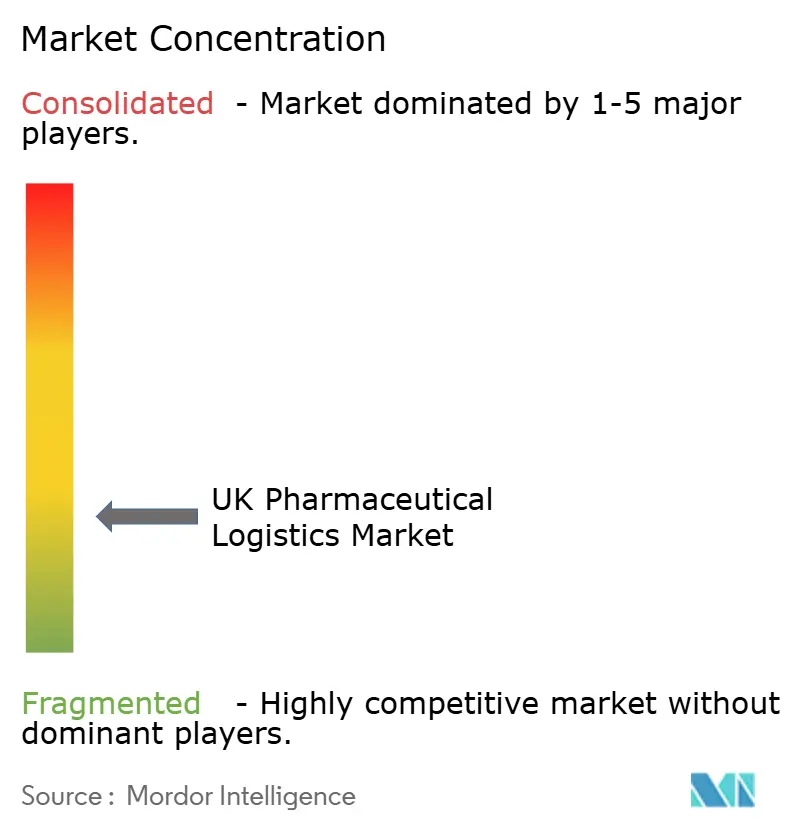
| Market Concentration | Low |
Major Players
*Disclaimer: Major Players sorted in no particular order Image © Mordor Intelligence. Reuse requires attribution under CC BY 4.0. |
|
United Kingdom Pharmaceutical Logistics Market Analysis by Mordor Intelligence
The United Kingdom Pharmaceutical Logistics market size is expected to grow from USD 11.28 billion in 2025 to USD 11.74 billion in 2026 and is forecast to reach USD 14.32 billion by 2031 at 4.06% CAGR over 2026-2031.
Sustained demand for advanced therapy medicinal products (ATMPs), rapid digitalization of National Health Service (NHS) prescription fulfillment, and Brexit-driven supply-chain localization underpin growth, while persistent talent shortages and energy cost inflation temper operating margins. Domestic logistics investment has accelerated since the Windsor Framework mandated UK-wide marketing authorizations and stricter safety declarations for medicines imported from the European Union, prompting carriers to upgrade customs-handling and compliance systems[1]“UK-Wide Licensing for Human Medicines,” UK Government, GOV.UK. Cold-chain capacity additions continue across England and Scotland to support cell and gene therapy pipelines, and integrated digital platforms have emerged as competitive differentiators by providing end-to-end shipment visibility for NHS stakeholders.
Key Report Takeaways
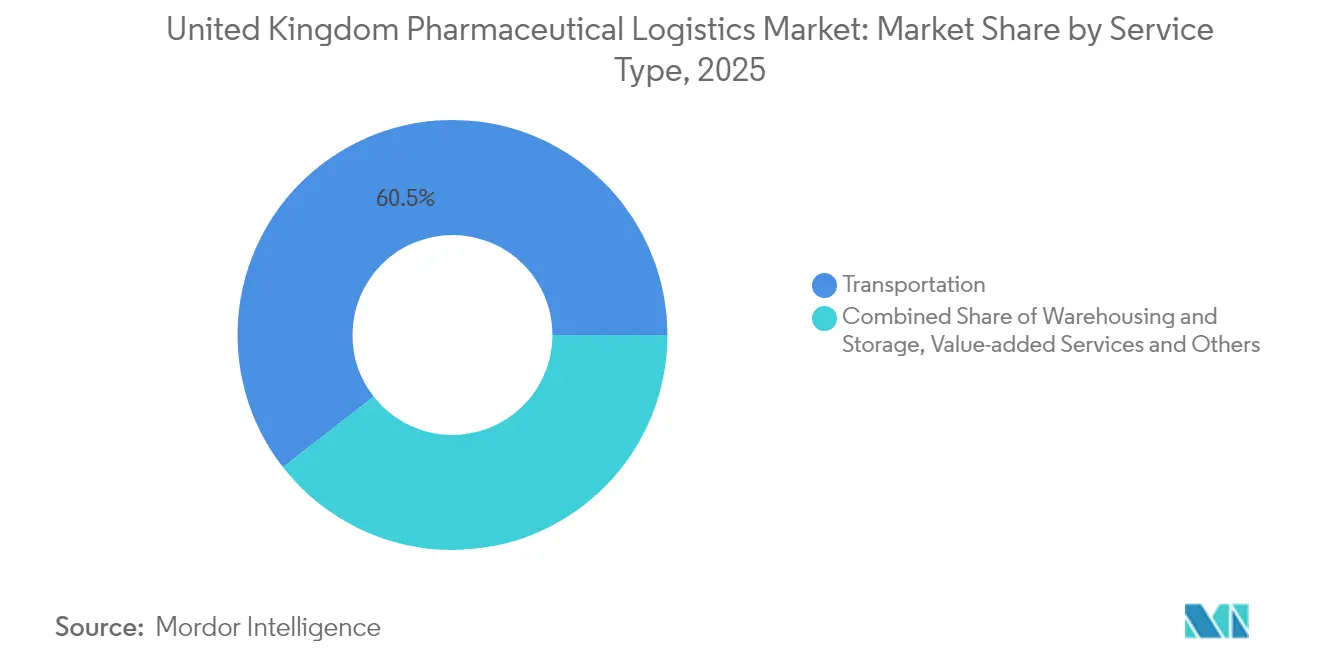
- By service type, transportation captured 60.55% of the UK pharmaceutical logistics market share in 2025; value-added services are advancing at a 4.78% CAGR through 2031.
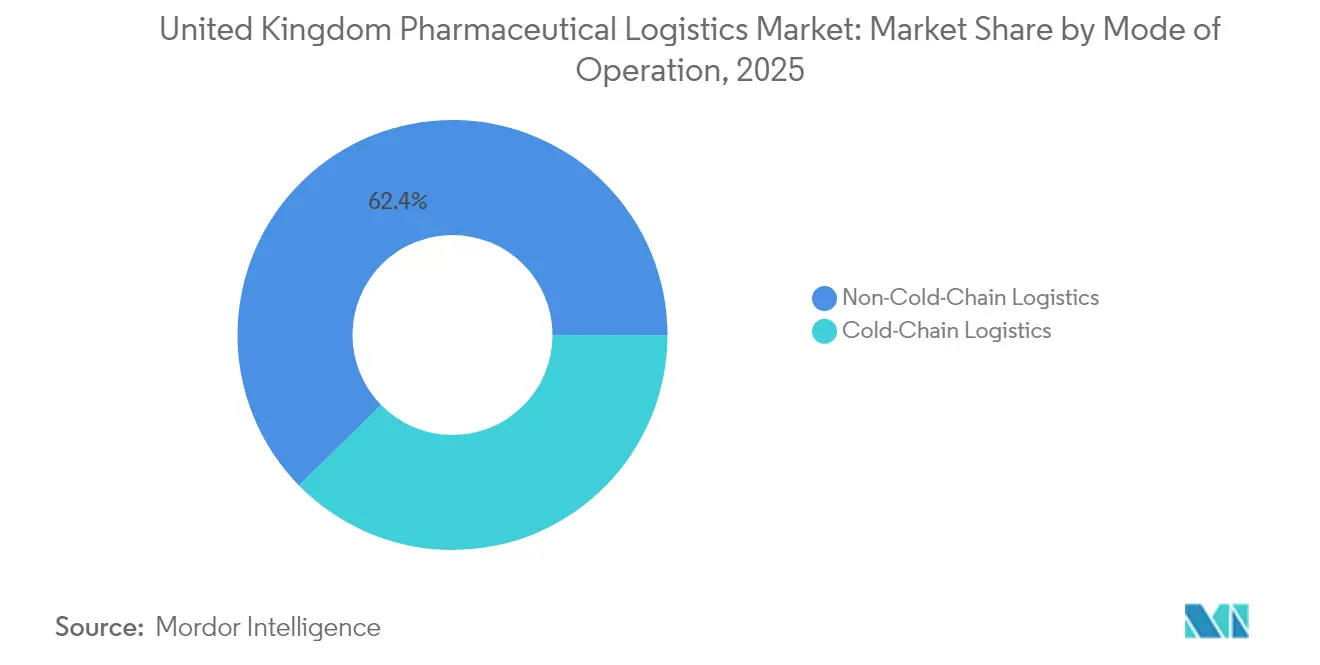
- By mode of operation, non-cold-chain services held 62.35% of the UK pharmaceutical logistics market size in 2025, while cold-chain is forecast to grow at 5.62% CAGR between 2026 and 2031
- By product type, prescription drugs accounted for 36.65% share of the UK pharmaceutical logistics market in 2025 and cell and gene therapies are projected to expand at a 4.36% CAGR through 2031.
- By geography, England remained the dominant revenue contributor in 2025, whereas Northern Ireland is expected to register the fastest growth as dual-market access capabilities mature under the Windsor Framework.
Note: Market size and forecast figures in this report are generated using Mordor Intelligence’s proprietary estimation framework, updated with the latest available data and insights as of 2026.
United Kingdom Pharmaceutical Logistics Market Trends and Insights
Drivers Impact Analysis*
| Driver | % Impact on CAGR Forecast | Geographic Relevance | Impact Timeline |
|---|---|---|---|
| Growing online pharmacy & e-commerce growth | +0.8% | UK-wide; urban centers | Medium term (2-4 years) |
| Strict MHRA GDP compliance | +0.6% | UK-wide | Short term (≤ 2 years) |
| NHS personalised-medicine initiatives | +0.7% | UK-wide; pilot programs in England | Medium term (2-4 years) |
| Brexit-driven domestic logistics investment | +0.9% | UK-wide; emphasis on Northern Ireland | Long term (≥ 4 years) |
| Growth in ATMP clinical trials (ultra-cold chain) | +0.5% | England and Scotland research hubs | Long term (≥ 4 years) |
| Expansion of NHS pharmacy home-delivery services | +0.4% | UK-wide; rural areas priority | Short term (≤ 2 years) |
| Source: Mordor Intelligence | |||
Growing Online Pharmacy and E-commerce Growth
NHS partnerships with Uber and Royal Mail illustrate a systemic pivot toward direct-to-patient delivery, enabling real-time prescription tracking and cutting dispensing errors through electronic verification[2]“Soft Market Research for an Electronic Medicines Tracking System,” UK Government, GOV.UK. AI-assisted demand forecasting now underpins stock-replenishment cycles, shrinking inventory buffers and freeing warehouse space for higher-value biologics. These digital workflows elevate data-security requirements, pushing carriers to integrate secure APIs and two-factor authentication for patient data interchange. Last-mile complexity is rising because controlled drugs and temperature-sensitive biologics must meet both security and GDP parameters during doorstep hand-off. The result is growing uptake of IoT-enabled lockboxes and time-stamped delivery validation tools, making digitally native logistics providers attractive partners for NHS trusts pursuing home-care expansion.
Strict MHRA GDP Compliance
Brexit has ended automatic recognition of EU GDP certificates, obliging every inbound shipment to demonstrate UK compliance documentation and triggering systems retrofits among carriers. Transition from Parallel Distribution Notices to Parallel Import Licences requires data-capture upgrades across warehouse management systems, adding near-term cost but sharpening competitive advantages for large operators with mature quality-management frameworks. MHRA’s point-of-care manufacturing guidance furthers complexity; logistics firms must add validated clean-room transfer protocols to carry freshly compounded personalized doses directly from hospital labs to bedside within narrow stability windows. Compliance spend is cascading into workforce training, with carriers expanding GDP curricula to include cyber-security and data-integrity modules that address electronic chain-of-custody mandates.
NHS Personalised-Medicine Initiatives
The NHS 10-Year Plan integrates pharmacogenomic testing and electronic prescribing, requiring logistics nodes to interoperate with ePMA systems for patient-specific inventory pulls. Hospital-at-home pilots in England rely on scheduled courier visits equipped with temperature-validated pouches for biologics infusion kits, intensifying demand for trained staff in secure last-mile execution. Sample-collection logistics add reverse-flow challenges, as genomic swabs must meet 2-8 °C thresholds en route to sequencing labs. These personalized-medicine pathways spawn micro-fulfillment facilities near clinical clusters, allowing 24-hour cycle times from prescription to delivery. Consequently, integrated digital twins that model time-temperature exposure are becoming a procurement criterion in NHS contract tenders.
Brexit-Driven Domestic Logistics Investment
The Windsor Framework’s customs reforms incentivize in-country storage and regional fulfillment centers, particularly around Belfast and Liverpool, to minimize clearance delays[3]“Government Ramps Up Work to Secure Supplies of Medicines,” UK Government, GOV.UK. Pharmaceutical manufacturers are colocating secondary packaging lines with distribution hubs, trimming cross-channel lead times and lowering spoilage risks for high-value biologics. The Critical Imports and Supply Chains Strategy directs GBP 400 million (USD 509.21 million) to logistics digitalization, unlocking grants for automated document-scrubbing and AI-enabled risk screening. Carriers able to self-declare consignments via new Safety & Security declarations gain two-hour clearance privileges at Dover and Felixstowe, improving on-time performance metrics. Over the long run, these nearshoring moves are expected to raise baseline domestic freight volumes by mid-single digits annually.
Restraints Impact Analysis*
| Restraint | % Impact on CAGR Forecast | Geographic Relevance | Impact Timeline |
|---|---|---|---|
| Talent shortage of GDP-compliant drivers | -0.3% | UK-wide; acute in Scotland and Wales | Short term (≤ 2 years) |
| Rising energy & fuel costs | -0.4% | UK-wide; cold-chain operations most affected | Medium term (2-4 years) |
| Limited pharmaceutical cargo capacity at regional airports | -0.2% | Northern England, Scotland, Wales | Short term (≤ 2 years) |
| Cyber-security risks in connected cold-chain systems | -0.15% | UK-wide; high in urban fulfillment nodes | Medium term (2-4 years) |
| Source: Mordor Intelligence | |||
Talent Shortage of GDP-Compliant Drivers
Immigration curbs post-Brexit reduced the heavy-goods-vehicle workforce pool, and GDP qualifications add an extra training layer of 6-12 months, delaying talent replenishment. Salary premiums for certified drivers rose 14% year-over-year in 2024, squeezing smaller carriers that operate thin margin refrigerated fleets. Rural pharmacies report missed delivery windows during seasonal peaks, compelling NHS trusts to engage multi-stop consolidation services that lengthen lead times. While apprenticeship grants have been introduced, uptake remains modest due to long qualification pathways. Over time, semi-autonomous truck pilots could mitigate dependency, yet regulatory hurdles push commercial deployment beyond the forecast horizon.
Rising Energy & Fuel Costs
Diesel and electricity tariffs climbed 30-40% between 2024 and 2025, inflating cold-chain cost structures where refrigeration can represent 45% of total operating expense. Logistics UK has lobbied for fuel-duty relief, but fiscal headroom remains tight. Some carriers retrofit trailers with solar panels to offset auxiliary-power-unit draw; payback periods, however, exceed five years under current price regimes. Ultra-low-temperature freezers consume up to 20 kWh daily per unit, forcing warehouses to renegotiate power contracts or pass surcharges to shippers. Energy hedging tools are gaining traction, yet volatility risks persist, prompting carriers to prioritize high-margin biologics lanes over commoditized ambient freight.
*Our forecasts treat driver/restraint impacts as directional, not additive. The impact forecasts reflect baseline growth, mix effects, and variable interactions.
Segment Analysis
By Service Type: Transportation Services Anchor a Digitally Evolving Portfolio
Transportation maintained 60.55% share of the UK pharmaceutical logistics market in 2025, translating to a UK pharmaceutical logistics market size contribution of USD 6.83 billion. Road freight leads due to its geographic reach across 1,250+ NHS hospital and community-pharmacy delivery points, allowing same-day replenishment cycles for critical medicines. The sub-segment leverages GPS-enabled telematics that feed shipment-status data directly into NHS Electronic Prescription Service dashboards, heightening transparency. Value-added services, albeit smaller, are rising at a 4.78% CAGR as clients seek inventory optimization analytics, relabeling, and returns-management functions within one contract, notably under NHS digitalization mandates.
Technology investments continue to reshape service-type economics. AI-driven route-optimization trims average empty mileage by 8%, offsetting fuel-cost volatility. Air freight, though <8% of value, is pivotal for ATMP imports from the United States and rapid vaccine deployment, but runway curfews at regional airports constrain uplift. Warehousing, particularly temperature-controlled space, experiences single-digit growth as sterile-manufacturing expansion pads demand for validated clean-storage chambers. The convergence of transportation and value-added services into platform models signals an evolving competitive dynamic where carriers monetize data as much as miles traveled.



By Mode of Operation: Cold-Chain’s Rapid Catch-Up
The non-cold-chain segment contributed 62.35% of the UK pharmaceutical logistics market share in 2025, yet cold-chain’s 5.62% CAGR narrows the gap toward 2031. Within cold-chain, dry-ice and liquid-nitrogen shippers dominate ATMP lanes, requiring validated weight-loss monitoring during transit. Enforced digital lane mapping for cryogenic consignments has catalyzed investment in IoT probe networks, an arena where integrated platforms confer service reliability advantages. Non-cold-chain operators increasingly retrofit assets with passive insulation kits to extend service portfolios and mitigate seasonality.
Rising biologics penetration fuels cold-store real-estate demand, driving pre-let transactions near Oxford-Cambridge life-science clusters. High power density designs become standard, featuring redundancy in HVAC and backup generators to secure GDP compliance amid grid instability. Conversely, ambient networks digitize inventory controls to hold service parity, employing barcode and RFID scanning that sync with NHS stock-replenishment portals. The boundary between cold-chain and ambient operations blurs as predictive analytics inform lane assignments based on seasonal risk profiles, making hybrid skill sets a hiring priority.
By Product Type: Prescription Drugs Steady, ATMPs Ascendant
Prescription drugs preserved a 36.65% slice of the 2025 UK pharmaceutical logistics market size, driven by chronic-disease volumes under NHS prescriptions. Service levels remain high, with next-day delivery expectations for 95% of tracked SKUs. Cell and gene therapies posted the highest 4.36% CAGR outlook, albeit from a low volume base, underscoring the intensifying need for ultra-cold supply chains linked to academic hospitals. Over-the-counter drugs benefit from click-and-collect and mail-order channels, yet margin compression persists because e-commerce giants negotiate bulk rates.
Biologics and biosimilars command premium pricing that justifies dedicated 2-8 °C lanes equipped with dual-probe validation. Vaccine logistics stabilizes post-pandemic but remains strategically significant as the UK maintains stockpiles for future outbreaks. Clinical trial materials expand alongside the MHRA’s streamlined regulatory regime, which is expected to cut start-up timelines by 40% and therefore elevate shipment frequency. Medical devices and diagnostics see modest but consistent growth, correlated with telehealth uptake that shifts distribution closer to households. Collectively, product-type diversification compels carriers to cultivate multi-temperature capabilities and nuanced regulatory acumen.
Geography Analysis
England dominated the UK pharmaceutical logistics market in 2025, supported by dense healthcare infrastructure and proximity to Heathrow, which handles over 50% of the nation’s pharma air cargo. London–South-East corridors integrate extensive warehouse parks equipped with cross-dock cold rooms that funnel ATMP imports to specialist hospitals in under six hours. The UK pharmaceutical logistics market share concentration in this region is reinforced by AstraZeneca’s GBP 650 million (USD 827.46 million) expansion in Liverpool and Cambridge, which adds regional freight volumes across biologics lanes.
Scotland represents the second-largest cluster, buoyed by government life-science grants and university partnerships in Glasgow and Edinburgh that lure ATMP trial sponsors. Cold-chain infrastructure near Edinburgh Airport is scaling through modular freezer farms that integrate renewable-energy micro-grids to mitigate power-cost risk. Wales exhibits smaller absolute volumes but the highest per-capita e-commerce penetration for medicines, spurring last-mile couriers to pilot electric vans across hilly rural routes. Regional NHS digital-health initiatives also stimulate warehousing demand for telehealth kits.
Northern Ireland’s dual-access status positions it as a strategic logistics bridge. Belfast Harbor invests in GDP-certified container handling to streamline EU inbound flows, yet complex customs declarations under the Windsor Framework extend paper-processing times. Carriers that install automated declaration engines secure faster throughput and capture share. Ireland-to-Great Britain lanes carry increased ambient payloads for generics, but cold-chain expansion lags until infrastructural upgrades at Belfast International Airport conclude. Overall, geographic diversification strategies hinge on balancing infrastructure readiness, regulatory frictions, and demand density.
Regulatory Landscape
The Medicines and Healthcare products Regulatory Agency (MHRA) oversees pharmaceutical distribution in the United Kingdom through the Human Medicines Regulations 2012 (as amended) and applies Good Distribution Practice (GDP) expectations for storage, handling, and transport. GDP requirements, reflected in UK guidance on good manufacturing practice and good distribution practice, place responsibility on Wholesale Distribution Authorisation (WDA) holders to qualify and control outsourced transport activities, including temperature management, security, and returns handling for refrigerated medicines.
Post-Brexit continuity has been supported by incorporating key EU-derived quality and distribution requirements into UK law via the Human Medicines (Amendment etc.) (EU Exit) Regulations 2019, but UK-specific compliance documentation and inspection readiness raise the operational bar for cross-border lanes. Alongside MHRA oversight, supply continuity policy instruments from the Department of Health and Social Care (DHSC), including medicine supply management processes and resilience-focused guidance, reinforce expectations for risk-based inventory positioning, disruption notification, and auditable chain-of-custody across NHS-facing distribution networks.
Value Chain Analysis
The UK pharmaceutical logistics value chain begins with manufacturers and importers releasing finished products to WDA-holding wholesalers and specialist distributors. From there, products move through 3PL warehousing and transport networks into NHS procurement channels, hospitals, community pharmacies, and expanding homecare and direct-to-patient (DTP) services. In England, national coordination sits with NHS England teams such as Medicines Procurement and Supply Chain (MPSC), while disruption management and escalation are supported by the DHSC DaSH portal, which has been operational since late 2020 for reporting potential supply disruptions.
Logistics execution covers ambient and multi-temperature storage, pick-pack, secondary packaging and kitting for trials, and GDP-qualified road and air movements. Last-mile handoffs increasingly incorporate digital proof-of-delivery and temperature evidence for patient-facing transfers. Differentiation also shows up in large, validated footprints such as Cencora’s East Midlands 3PL network (including sites in South Normanton, Sutton-in-Ashfield, and Derby), which supports multiple storage regimes (+15C to +25C, +2C to +8C, controlled drugs, hazardous products, and -20C). Specialist couriers further support hospital-at-home, clinical trial, and ATMP workflows.
Competitive Landscape
The UK pharmaceutical logistics market features moderate concentration. DHL Supply Chain integrates robotics-enabled pick-and-pack lines in its Rugby hub, trimming cycle times for biologics shipments and integrating directly with NHS e-procurement portals. UPS Healthcare’s 2024 acquisition of Frigo-Trans added 430 specialized trailers, enhancing cold-chain reach from Germany to Northern England and elevating the firm’s cross-border compliance offerings. Kuehne Nagel deploys an AI-enhanced Control Tower in East Midlands that visualizes real-time lane performance and carbon footprints, aligning with NHS net-zero targets.
Specialists such as Movianto target clinical-trial logistics, operating GMP-compliant secondary packaging suites that add value in blinded-trial material preparation. Cool Cargo and Life Couriers UK focus on last-mile cryogenic transport, using small-format liquid nitrogen shippers and hand-carry protocols for autologous cell therapies. Digital entrants deploy platform models that match pharmacy demand with spare courier capacity, tapping into crowdsourced fleets under stringent onboarding checks.
Price competition remains rational due to high regulatory entry barriers. Integrated service portfolios and proven GDP audit histories differentiate incumbents, while cyber-security capabilities now factor into bidding scores for NHS tenders. Strategic partnerships proliferate; for instance, DHL and AstraZeneca signed a multi-year pact to co-develop ultra-cold storage pods colocated at manufacturing sites. Looking ahead, consolidation is likely as mid-tier players seek scale to absorb compliance and technology costs.
United Kingdom Pharmaceutical Logistics Industry Leaders
-
DHL Supply Chain
-
Life Couriers UK (Formerly Vision Logistics)
-
Kammac
-
Cencora, Inc.
-
UPS
- *Disclaimer: Major Players sorted in no particular order

Market Opportunities and Future Outlook
Public programs focused on supply resilience and domestic capability create whitespace for GDP-compliant warehousing, controlled-temperature transport, and integrated quality-data services. One clear demand catalyst is the UK government investment of GBP 75 million into four new NHS aseptic medicines production hubs opening across 2025 to 2026, designed to increase capacity for injectable medicines by 2.5 million doses per year. This shifts requirements toward reliable inbound raw-material flows, validated local distribution, and rapid replenishment to NHS sites.
Procurement activity and capacity build-outs also point to opportunities around generics resilience and multi-temperature infrastructure. In May 2026, NHS England published a National Generics Pharmaceuticals Supply Chain Resilience tender, with contracts running from September 2026 to May 2028 and extension options to 2030. That framework reinforces demand for compliant storage, serialization-ready handling, and dependable national distribution coverage. At the same time, large 3PL operators continue to scale UK footprints and temperature capabilities, evidenced by Cencora reporting 1,703,000 square feet of UK 3PL space and a planned tenth facility in South Normanton that supports further specialization in cold chain, controlled drugs, and clinic-to-home service models.
Recent Industry Developments
- June 2026: DHL Supply Chain launches a 194,000 sq ft automated healthcare logistics hub at Infinity Park Derby with multi-temperature capabilities for life sciences and healthcare customers. The launch expands UK cold-chain capacity, supporting diverse temperature profiles for complex therapies. The capacity addition strengthens UK pharmaceutical logistics resilience and GDP-compliant operations in the Midlands.
- March 2026: Life Couriers UK (Formerly Vision Logistics) opens a 27,231 sq ft depot at Fareham Reach, Gosport to extend Direct-to-Patient logistics network. The expansion broadens UK DTP warehousing and pharma distribution. It enhances last-mile and clinical-trial material handling capabilities within the NHS-focused supply chain.
- February 2026: DHL Group expands global Airfreight Cold Chain Network to connect more than 30 GDP-compliant aviation hubs for temperature-sensitive pharmaceuticals and cell/gene therapies. The expansion strengthens global cold-chain capacity impacting UK imports/exports. It bolsters UK pharmaceutical supply chain access, compliance, and cross-border logistics capabilities.


Research Methodology Framework and Report Scope
Market Definition and Coverage
This market covers paid logistics services used to move, store, and handle pharmaceuticals within the United Kingdom, including ambient and temperature-controlled activities that support distribution from manufacturers to wholesalers, hospitals, pharmacies, and clinical sites.
Scope exclusions: We exclude in-house logistics done fully by drug manufacturers, pure packaging manufacturing, and last-mile pharmacy retail margins that are not logistics service revenue.
Segmentation Overview
-
By Service Type
-
Transportation
- Road Freight
- Air Freight
- Sea Freight
- Rail Freight
- Warehousing and Storage
- Value-added Services and Others
-
Transportation
-
By Mode of Operation
- Cold-Chain Logistics
- Non-Cold-Chain Logistics
-
By Product Type
- Prescription Drugs
- OTC Drugs
- Biologics and Biosimilars
- Vaccines and Blood Products
- Clinical Trail Materials
- Cell and Gene Therapies
- Medical Devices and Diagnostics
- Veterinary Medicine
- Others
Data Sources, Market Sizing, and Validation
Desk Research
We start by mapping the UK pharma supply chain and the logistics touchpoints that generate billable revenue, then we align them to how transportation, warehousing, and value-added services are typically contracted. We anchor demand signals and operating context using Office for National Statistics trade and production series, NHS supply chain and procurement publications, MHRA GDP guidance and enforcement updates, and UK Department for Transport freight statistics.
Next, we use company annual reports and investor presentations to understand service mix and major lane patterns, and we cross-check with association and regulator materials such as industry cold chain guidance and customs documentation rules. Paid subscriptions for company financials and intelligence, news and financials, patent databases, and shipment-level import and export records are used selectively to verify timelines and directional changes where public data is not granular enough. The desk sources listed here are illustrative only, and we used additional public and paid references to fill gaps and test assumptions.
Primary Interviews and Surveys
To convert broad signals into a workable market model, we run expert interviews and structured surveys with logistics operators, warehouse managers, quality and compliance leads, and shipper-side supply chain teams across the United Kingdom. The discussion focuses on cold chain penetration, service bundling, lane mix, and how GDP validation and monitoring requirements change cost-to-serve by product type.
Responses are used to confirm the reasonableness of price ranges, utilization patterns, and step-changes from shortages, capacity expansions, and compliance tightening. This helps us adjust assumptions that desk research cannot resolve cleanly.
Distribution of primary research fieldwork respondents
| Company type | Respondent position |
|---|---|
| Top tier: 33% | CXOs: 14% |
| Mid tier: 53% | Functional/Unit leaders: 28% |
| Smaller Players: 14% | Managers: 58% |
Market-Sizing & Forecasting
Sizing is built by reconstructing the UK demand pool from pharmaceutical distribution activity and the logistics intensity behind it, where trade flows, domestic manufacturing output, and channel throughput are translated into serviceable volumes for transport and storage. The model is then split into cold-chain and non-cold-chain activity so that different handling rules, monitoring needs, and service pricing can be applied before totals are rolled back up.
Key inputs include the share of temperature-sensitive SKUs, the mix of biologics, vaccines, and clinical trial materials, average shipment and storage profiles (time in warehouse, required temperature bands), and typical add-ons such as packaging, labeling, and track-and-trace services. A top-down build is corroborated with selective bottom-up checks, such as sampled price-per-pallet or price-per-shipment ranges multiplied by inferred activity levels from major corridors and warehouse footprints, with gaps handled through conservative ranges agreed with interviewees.
For forecasting, scenario analysis is used so that changes in biologics growth, NHS procurement rhythm, and compliance driven cost-to-serve can be tested without over-fitting. We then apply smoothing on stable sub-lines (for example, ambient warehousing) while allowing step changes where respondents confirm capacity additions, lane shifts, or monitoring upgrades that alter pricing.
Data Validation & Update Cycle
Validation is done through repeated checks across independent signals, and then the logic is reviewed by another analyst before sign-off. Outliers are flagged when growth rates, implied service prices, or cold-chain shares drift away from what is supported by public indicators and interview feedback, and those points trigger re-checks of the underlying assumptions.
The model outputs are compared with related metrics such as pharma trade direction, freight activity, and disclosed logistics or distribution cost trends, and then variances are resolved through follow-up questions when needed. Reports are refreshed annually, with interim updates when material events occur, and a final pre-delivery review is completed so the numbers reflect the latest available data cut.
Mordor Intelligence's United Kingdom Pharmaceutical Logistics Market Estimate Compared With Other Published Estimates
Published market sizes for UK pharmaceutical logistics can differ a lot, even when they appear to cover the same topic, because the revenue boundary is not always treated consistently. The biggest differences usually come from whether the estimate covers all pharma logistics services or only a narrower slice such as biopharma or cold chain transport.
A second driver is how pricing and timing are handled, since exchange-rate timing, inflation pass-through, and the way value-added services are priced can move the total up or down in a single year. By refreshing price curves and re-checking cold-chain shares with GDP-focused interviews close to the base-year cut, the figure used by Mordor Intelligence is less likely to mix older rate cards with newer volume patterns.
Benchmark comparison
| Source | Market Size | Gaps in Research Methodology |
|---|---|---|
| Mordor Intelligence | USD 11.28 B (2025) | |
| Industry Publisher A | USD 7.53 B (2024) | This estimate focuses on biopharmaceutical logistics, which narrows the demand pool and can exclude parts of OTC and broader prescription distribution, making the total smaller. Differences in base year and service bundle assumptions (transport only versus transport plus warehousing and add-ons) also shift the value. |
| Global Publisher B | USD 5.20 B (2024) | This figure is framed around cold chain pharma transport, which typically leaves out ambient distribution and most warehousing and storage revenue. It can also understate totals when value-added services like packaging, monitoring, and compliance handling are not counted as separate paid lines. |
The spread across sources is mainly explained by scope boundaries and the year used for pricing, rather than a disagreement on direction of growth. When the service basket is clearly defined and the base-year inputs are refreshed and rechecked, the resulting market size becomes easier to trace back to repeatable variables and practical checks.


Key Questions Answered in the Report
What is the projected value of the UK pharmaceutical logistics market in 2031?
The market is forecast to reach USD 14.32 billion by 2031, growing at a 4.06% CAGR.
Which service type leads UK pharmaceutical logistics revenues?
Transportation services dominate with 60.55% share as of 2025, reflecting the criticality of nationwide road-freight coverage.
How fast is the cold-chain segment expanding?
Cold-chain logistics is expected to grow at 5.62% CAGR from 2026 to 2031, the fastest among operation modes.
What factor most constrains UK pharma logistics capacity? A shortage of GDP-qualified drivers remains the principal bottleneck, negatively impacting CAGR by 0.3%.
A shortage of GDP-qualified drivers remains the principal bottleneck, negatively impacting CAGR by 0.3%.
Which product category is rising quickest?
Cell and gene therapies, though still niche, are forecast to expand at 4.36% CAGR through 2031, propelled by ATMP clinical trials.
How does Brexit influence logistics investment?
Regulatory independence under the Windsor Framework has spurred domestic warehousing and customs-automation spending, supporting long-term network resilience.
Page last updated on:





