
Market Overview
| Study Period | 2021 - 2031 |
|---|---|
| Market Size (2026) | USD 5.96 Billion |
| Market Size (2031) | USD 9.76 Billion |
| Growth Rate (2026 - 2031) | 10.36 % |
| Fastest Growing Market | Asia |
| Largest Market | Europe |
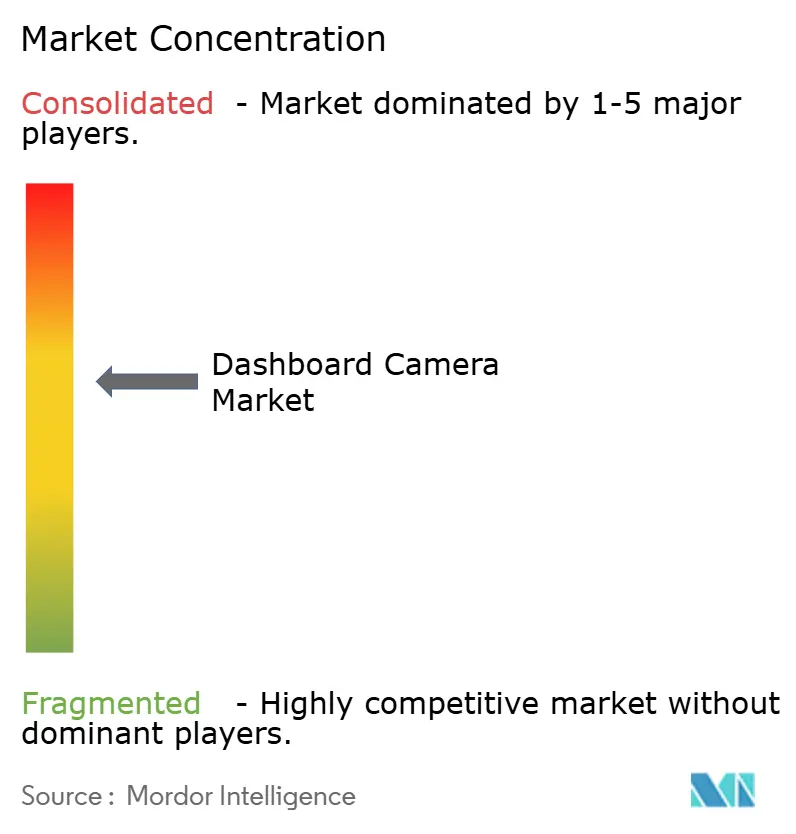
| Market Concentration | Medium |
Major Players *Disclaimer: Major Players sorted in no particular order Image © Mordor Intelligence. Reuse requires attribution under CC BY 4.0. | |
Dashboard Camera Market Analysis by Mordor Intelligence
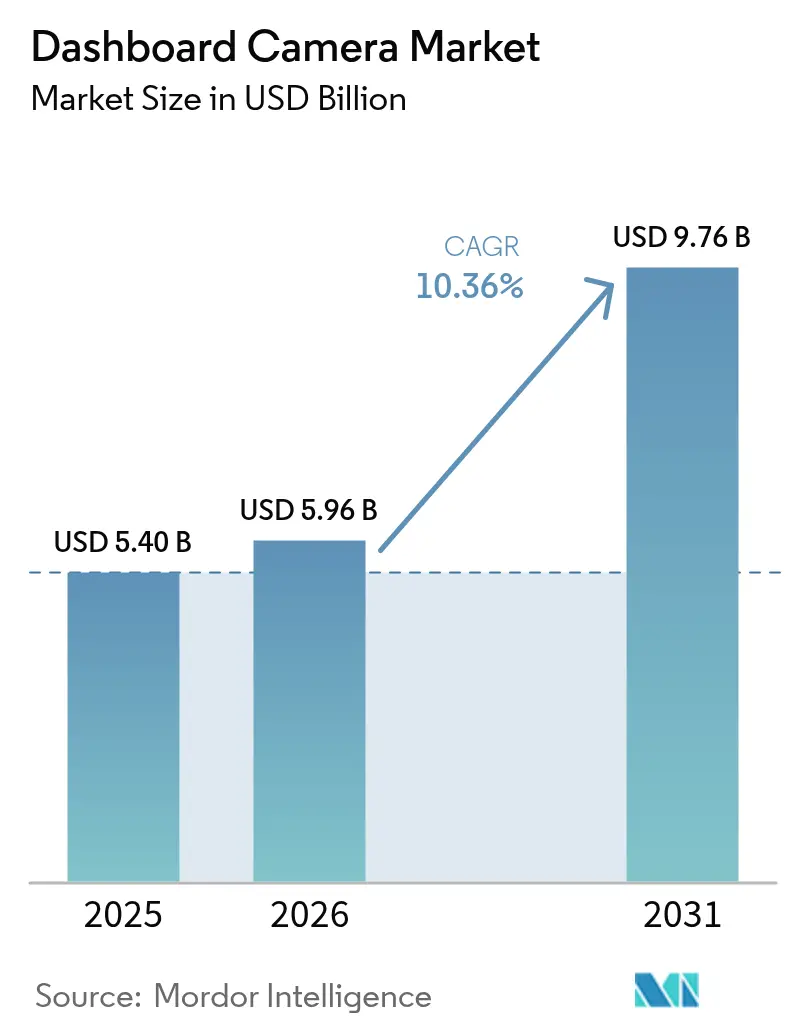
The dashboard camera market size was valued at USD 5.40 billion in 2025 and estimated to grow from USD 5.96 billion in 2026 to reach USD 9.76 billion by 2031, at a CAGR of 10.36% during the forecast period (2026-2031). This expansion stems from compulsory in-vehicle data recorders in Europe, expanding insurance telematics programs in North America, and rapid AI integration that raises perceived value among fleet operators. Europe’s firm regulatory stance has positioned factory-fit units as the new norm, while Asia’s thriving automotive production base and telematics-friendly insurers underpin the fastest regional growth momentum. Technological differentiation has pivoted from hardware to software; cloud-connected analytics, GDPR-compliant storage, and heat-resistant designs now determine brand preference. Competition is intensifying as aftermarket specialists, fleet telematics vendors, and OEMs converge on the same connected-video opportunity, prompting new partnerships and white-label supply models.
Key Report Takeaways
- By technology, basic models retained 57.40% of the dashboard camera market share in 2025; smart/AI-integrated units are projected to expand at a 11.83% CAGR to 2031.
- By product architecture, single-channel systems led with 71.30% revenue share in 2025, whereas dual-channel configurations are growing at 10.78% CAGR through 2031.
- By video quality, SD and HD accounted for 60.20% of the dashboard camera market size in 2025; 4K/UHD formats are advancing at a 12.74% CAGR.
- By application, personal vehicles represented 65.20% of the dashboard camera market size in 2025, while commercial fleets exhibit the highest projected CAGR at 10.92% to 2031.
- By distribution channel, in-store retail held 59.10% share in 2025; online sales are rising at 11.60% CAGR.
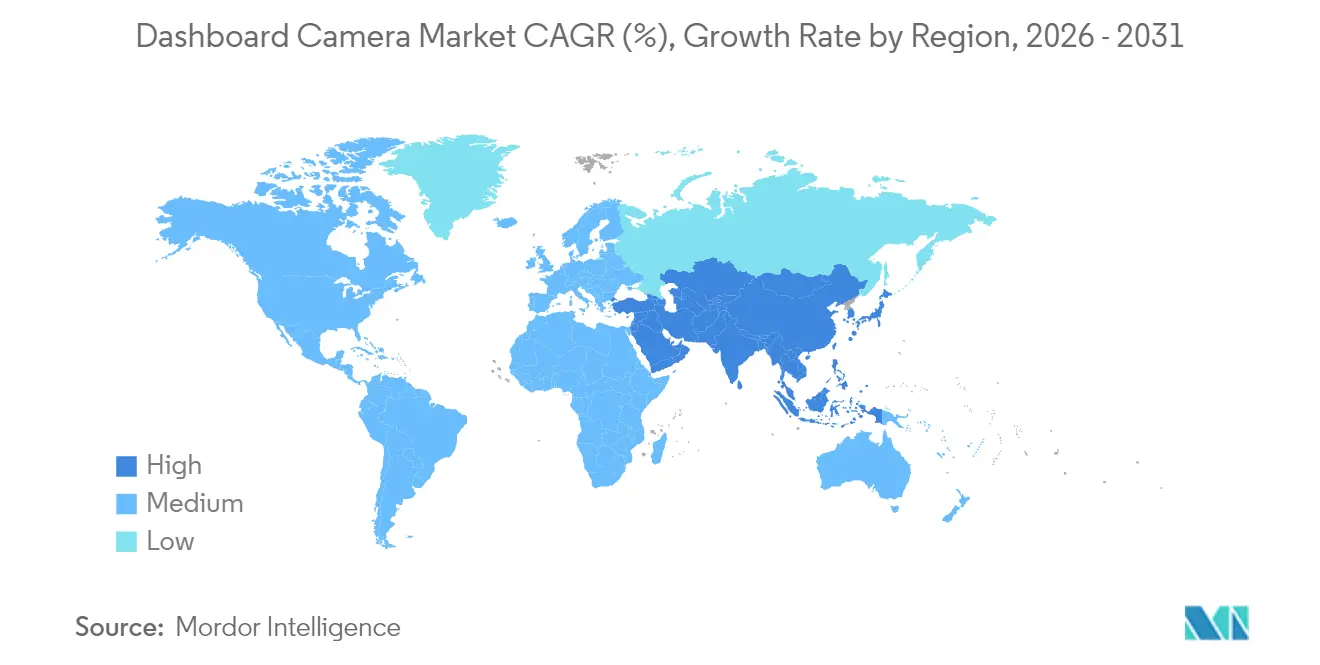
- By geography, Europe commanded 34.60% share in 2025; Asia is the fastest-growing region with an 11.25% CAGR through 2031.
Note: Market size and forecast figures in this report are generated using Mordor Intelligence’s proprietary estimation framework, updated with the latest available data and insights as of 2026.
Market Trends and Insights
Drivers Impact Analysis of Dashboard Camera Market*
| Driver | (~) % Impact on CAGR Forecast | Geographic Relevance | Impact Timeline |
|---|---|---|---|
| European eCall-Event Data Recorder Mandate Driving Factory-Fit Dashcams | +2.10% | Europe, spill-over to North America | Short term (≤ 2 years) |
| AI-Enabled Fleet Video Telematics Adoption in US and UK Logistics | +1.80% | North America and EU, expanding to APAC | Medium term (2-4 years) |
| OEM-Installed Dashcams by Tesla, BMW and Hyundai Accelerating APAC Uptake | +1.50% | APAC core, spill-over to global markets | Medium term (2-4 years) |
| Insurance Telematics Discounts in Canada and South Korea | +1.20% | North America and APAC, selective EU adoption | Long term (≥ 4 years) |
| Government Commercial Fleet Video Evidence Regulation (e.g. India 2026 Regulation) | +0.90% | India, expanding to Southeast Asia | Long term (≥ 4 years) |
| Insurer-driven 4K/UHD video-quality adoption for claim clarity | +0.60% | Global commercial fleets | Medium term (2-4 years) |
| Source: Mordor Intelligence | |||
European eCall-Event Data Recorder mandate driving factory-fit dashcams
The July 2024 regulation obliges every new passenger vehicle in the EU to store crash-related data, making video capture a logical extension that OEMs are embedding at the production line [1]. Manufacturers gain a compliance differentiator, suppliers secure long-term platform volume, and aftermarket brands must pivot toward dealer accessories and fleet retrofits. German Tier-1 electronics firms have moved quickly with GDPR-ready firmware and encrypted storage, giving them an edge as global platforms export EU-validated technology to other markets.
AI-enabled fleet video telematics adoption in US and UK logistics
Large carriers have transitioned from incident review to predictive coaching. AI analytics automatically flag tail-gating, distraction, or fatigue, enabling safety managers to intervene early, cut claims, and negotiate lower premiums [2]. Scalable cloud review reduces manual footage trawling and makes enterprise deployments feasible across thousands of tractors and vans. Vendors that own proprietary computer-vision stacks now command strategic partnerships with telematics integrators eager for video-first differentiation.
OEM-installed dashcams by global automakers accelerating APAC uptake
Mainstream brands are standardizing integrated dashcams on high-trim variants, bundling over-the-air upgrades that improve features post-sale. The strategy secures subscription revenue for cloud storage, limits aftermarket cannibalization, and heightens customer loyalty. Asian consumers, accustomed to factory infotainment and ADAS packages, are particularly receptive, pushing regional suppliers into white-label manufacturing for vehicle platforms launching from 2025.
Insurance telematics discounts in Canada and selected APAC markets
Usage-based insurers are rolling out 5-10% premium reductions for vehicles equipped with certified video units. Canadian pilots show lower fraud incidence and quicker claim settlement when footage is available, encouraging wider carrier adoption. The incentive underscores a cost–benefit narrative that accelerates household uptake beyond core tech-savvy drivers.
Restraints Impact Analysis of Dashboard Camera Market*
| Restraint | (~) % Impact on CAGR Forecast | Geographic Relevance | Impact Timeline |
|---|---|---|---|
| GDPR-Driven Recording Restrictions in Germany and Austria | -1.40% | Europe, potential expansion to other privacy-focused regions | Short term (≤ 2 years) |
| Cyber-Vulnerability Disclosures in Connected Dashcams | -1.10% | Global, particularly North America and Europe | Medium term (2-4 years) |
| Heat-Induced Device Failures (e.g., Middle-East >15% RMA) | -0.80% | Middle East and Africa, expanding to other hot climates | Medium term (2-4 years) |
| Installation complexity and privacy hesitancy for dual/in-cabin cameras | -0.50% | Global retail consumers | Short term (≤ 2 years) |
| Source: Mordor Intelligence | |||
GDPR-driven recording restrictions in Germany and Austria
Loop recording, anonymization, and minimal retention periods are compulsory, raising firmware complexity and cost. The Austrian traffic authority enforces fines up to EUR 20 million (USD 21.8 million) for non-compliance. Legal clarity improved after Germany’s Federal Court allowed dashcam evidence in lawsuits, but hardware vendors still need region-specific SKUs, eroding economies of scale.
Heat-induced device failures in Middle East markets
Ambient temperatures above 50°C accelerate component ageing; failure rates in pilot studies have topped 15%. Firms now design heat-dissipating housings, higher-temperature NAND, and capacitor-based power backups, yet these add material cost and delay feature parity with temperate-climate models. Fleets in the Gulf countries defer deployment until proven ruggedized solutions reach scale, moderating near-term volumes.
*Our forecasts treat driver/restraint impacts as directional, not additive. The impact forecasts reflect baseline growth, mix effects, and variable interactions.
Dashboard Camera Market Segment Analysis
By Technology:
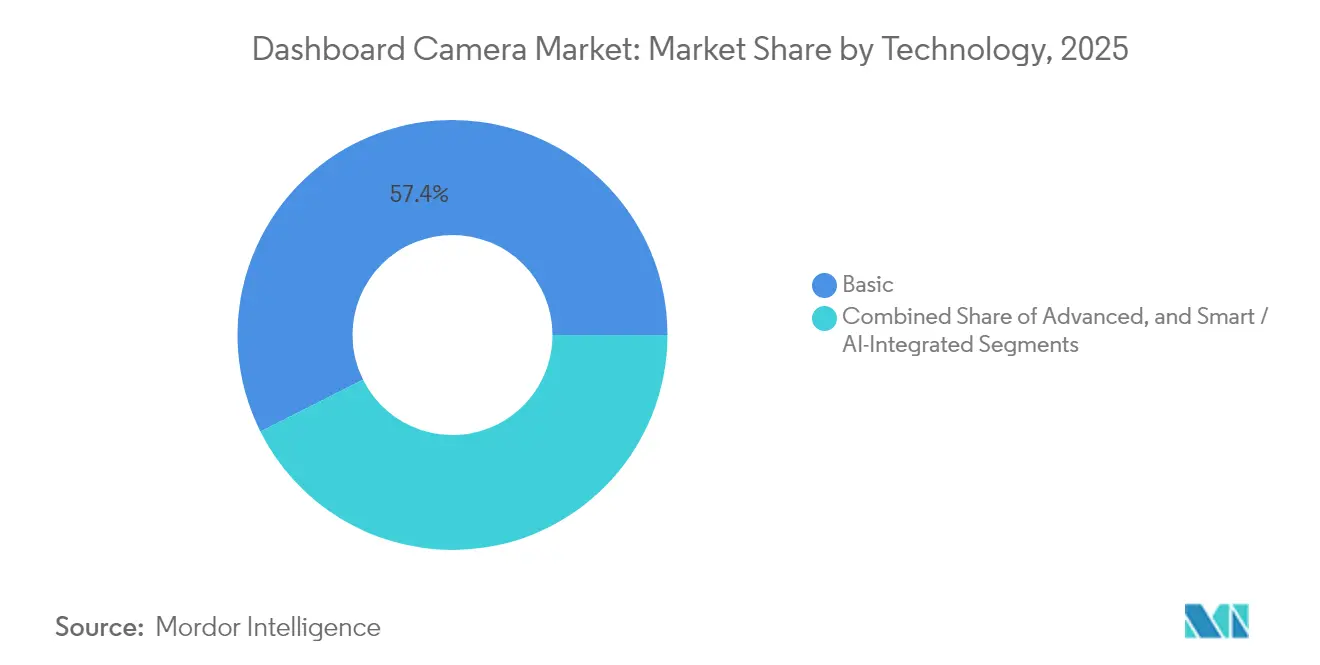
AI migration redefines product valueBasic dashcam technology retained the largest 57.40% market share in 2025, while smart/AI-integrated units register the fastest 11.83% CAGR through 2031. Smart models convert video into coaching alerts, helping fleets cut claims and negotiate lower premiums. Personal users still buy basic units for cost-effective evidence, yet upscale buyers increasingly choose app-linked devices with cloud uploads. Suppliers that control computer-vision IP secure recurring subscription revenue, buffering hardware commoditization within the dashboard camera market.
Concurrently, insurers cite AI-generated risk profiles when negotiating premiums, reinforcing demand from both carriers and self-insured corporates. Personal vehicle owners remain price-focused, yet upscale buyers gravitate to app-enhanced devices offering emergency upload and remote-viewing peace of mind. As over-the-air updates become commonplace, firmware road-maps rather than optics will anchor brand stickiness within the dashboard camera market.

By Product Architecture:
dual-channel momentum in liability-sensitive fleetsSingle-channel designs led with 71.30% revenue share in 2025, but dual-channel systems are growing at an 10.78% CAGR on the strength of fleet demand for forward-plus-cabin evidence. Logistics firms report 30% faster dispute resolution when interior footage is available, validating higher capital spend. Ride-hailing drivers and parents form a niche retail audience for multi-view kits, whereas OEMs integrate existing park-assist sensors to trigger selective cabin recording, merging privacy compliance with expanded coverage.
Consumer adoption of rear-plus-cabin views is slower; installation complexity and privacy hesitancy dampen uptake. Nonetheless, ride-hailing drivers and parents are niche segments willing to pay for 360° coverage. OEMs are experimenting with leveraging existing park-assist sensors to trigger selective interior recording, blending safety with privacy compliance.
By Video Quality:
4K becomes the fleet evidence benchmarkSD and HD formats held the largest 60.20% share of shipments in 2025, yet 4K/UHD units post the top 12.74% CAGR as insurers stipulate high-resolution proof for plate legibility. Falling storage costs and better compression unlock broader adoption, though higher bit-rates still strain mobile data budgets. Vendors add AI frame selection that discards redundant scenery to keep file sizes manageable while meeting evidentiary standards.
Yet, higher bit-rates strain mobile data budgets. Providers now bundle AI compression that retains evidentiary frames, discarding redundant scenery to halve file sizes. Regulatory bodies may codify minimum resolution requirements, mirroring aircraft black-box standards, further institutionalizing 4K as the commercial default.
By Application:
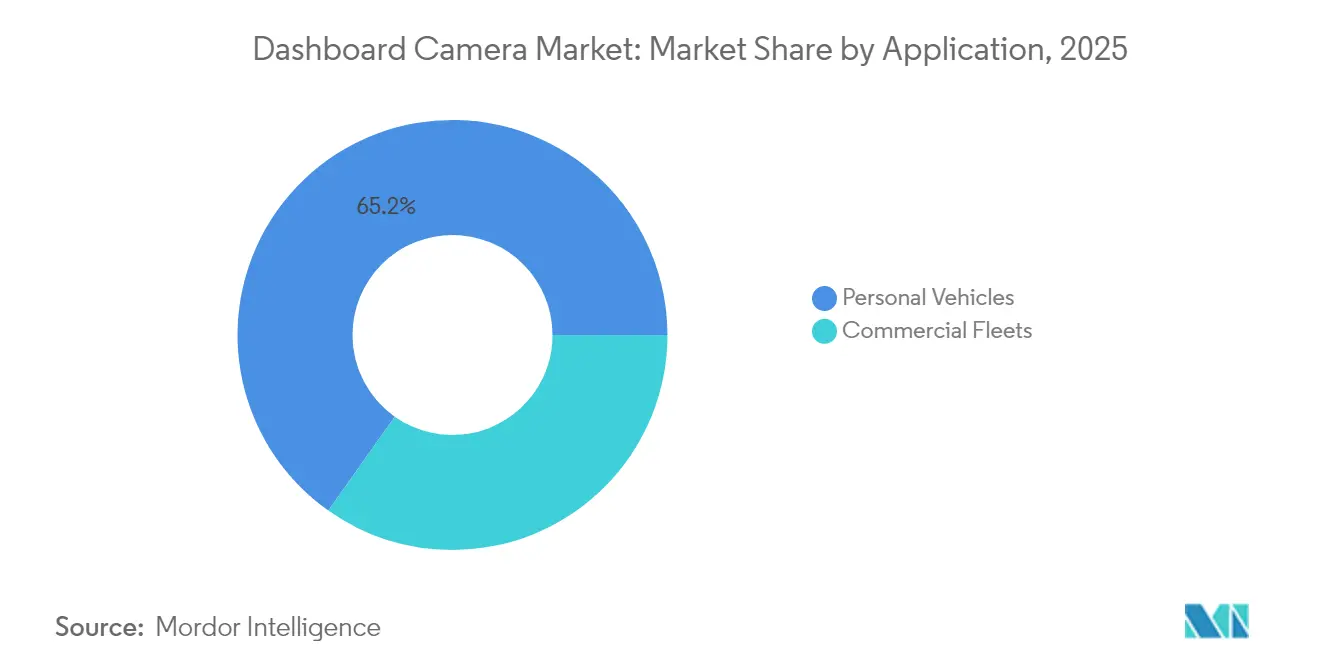
fleet telematics unlocks enterprise ROIPersonal vehicles accounted for the greatest 65.20% share of units in 2025, whereas commercial fleets deliver the steepest 10.92% CAGR to 2031. Carriers integrate video with ELD data to diagnose root causes of accidents and fuel waste, merging safety with efficiency. India’s 2026 ADAS rule accelerates multi-camera demand in heavy trucks . Passenger-car growth steadies as early adopters saturate, but insurer rebates could extend penetration to mainstream drivers.
Personal vehicle penetration remains a volume bulwark, lifted by word-of-mouth sharing of incident exonerations. Subsidies from insurers and ride-share platforms could nudge uptake further, though the growth curve flattens after early-adopter saturation. Long replacement cycles in passenger cars maintain steady but modest refresh demand.
By Distribution Channel:
e-commerce scales direct engagementIn-store retail captured the leading 59.10% share in 2025, but online sales expand at a 11.60% CAGR as brands bundle cloud storage and firmware updates at checkout. Physical outlets retain relevance through professional installation services and same-day swaps. Hybrid click-and-collect models combine digital discovery with local fitment, ensuring broad reach across distinct buyer personas in the evolving dashboard camera market.
Subscription renewals, firmware updates, and accessories like thermal housings generate continuous online interactions post-sale. Traditional car-audio shops diversify into fleet retrofits, leveraging installation expertise to offset traffic lost to virtual storefronts. This omnichannel convergence ensures broad reach across divergent buyer personas in the dashboard camera market.
Geography Analysis
Europe Dashboard Camera Market
Europe led with 34.60% share in 2025, anchored by the eCall-Event Data Recorder mandate that institutionalized video evidence. Northern markets exhibit above-average attach rates as insurers embrace footage for claims triage. Privacy safeguards such as automatic face blurring are now baseline specifications, adding development complexity yet raising consumer trust.
APAC Dashboard Camera Market
Asia posts the fastest 11.25% CAGR to 2031. China benefits from scale manufacturing economies and municipal smart-city grants that endorse connected cameras. South Korea’s insurers offer structured telematics credits, accelerating household adoption. India’s 2026 commercial ADAS requirement positions the country as a major demand catalyst; localized suppliers already pilot rugged units tuned for monsoon humidity under guidelines from the Ministry of Road Transport and Highways.
North America and MEA Dashboard Camera Market
North America shows robust fleet momentum. Carriers integrate video with existing ELD and route-optimization stacks, while progressive insurers and risk-management pools endorse camera evidence to curb litigation costs. Extreme-heat regions of the Southwest, alongside Middle-Eastern and African climates, remain constrained by hardware reliability issues; vendors investing in thermal-resistant designs stand to unlock latent potential as validated field data emerges.
Regulatory Landscape
In Europe, vehicle recording and connected-video deployments sit at the intersection of in-vehicle safety data rules and privacy governance. The EU Event Data Recorder requirement that took effect in July 2024 for new passenger vehicles has reinforced OEM focus on crash-related data capture, while European Data Protection Board (EDPB) guidance on video devices shapes how dashcams should be configured around purpose limitation, transparency, and data minimization (including DPIAs where processing is high risk). In the United Kingdom, the Information Commissioner’s Office (ICO) provides guidance for organizations using CCTV and dashcams, emphasizing a documented lawful basis (Article 6 UK GDPR), clear purpose definition, and DPIA decisions ahead of deployment when risks are elevated.
Cybersecurity requirements are increasingly affecting connected dashcams and cloud-video offerings that integrate with managed service or cloud ecosystems. The EU NIS2 regime applies from 18 October 2024, with Commission Implementing Regulation (EU) 2024/2690 (published 17 October 2024) setting technical and methodological requirements for cybersecurity risk management measures and incident significance specifications for relevant entity types, including certain digital infrastructure and service providers used in video telematics stacks. Separately, audio capture and access controls can trigger additional compliance considerations in the United States when products record communications, making configurable audio handling, retention, and access logging important design levers for cross-jurisdiction deployments.
Value Chain Analysis
The dashcam value chain starts with semiconductor and optics inputs (CMOS image sensors, AI-capable SoCs/NPUs, DRAM/NAND, lenses, and power management), then flows through ODM/OEM manufacturing, firmware and mobile app development, and integration with cloud storage and analytics platforms for smart or AI-integrated products. High-volume assembly is concentrated in Asia, with a large share of ODM/OEM production anchored in China manufacturing clusters. Brands differentiate through computer-vision models, ISP tuning, and subscription software layers (cloud review portals, incident tagging, and coaching workflows) that sit on top of the hardware.
Downstream, distribution splits between retail and online sales for consumer units, and direct-to-fleet plus telematics-integrator channels for enterprise deployments. OEM and dealer accessory programs also provide a parallel route for factory-fit or dealer-installed devices. Key bottlenecks include supply allocation for automotive-grade image sensors and AI SoCs, along with removable storage economics for 4K devices, where microSD and NAND pricing and endurance requirements affect total system cost and warranty outcomes. As connected video expands, the ecosystem also adds compliance and security controls (encryption, access governance, retention tooling) and service partners that support installation, calibration, and device management at scale for fleets.
Competitive Landscape
The field remains moderately fragmented: the top five vendors collectively command under 35% revenue, giving new entrants headroom. Garmin and Thinkware capitalise on brand equity and installed service networks. Fleet-centric vision-analytics specialists partner with telematics majors to penetrate enterprise accounts. Component makers such as Gentex leverage automotive OEM relationships to embed cameras into mirror assemblies, shifting revenue upstream.
Strategic thrusts cluster around three themes. First, AI algorithm ownership becomes a moat as inference accuracy drives insurance acceptance. Second, cloud ecosystems convert one-time hardware sales into recurring revenue; companies now quote annualised run-rate metrics to investors. Third, region-specific compliance solutions—from GDPR filters to desert-grade cooling—create defensible niches. M&A activity is set to rise as firms seek end-to-end stacks spanning optics, silicon, and SaaS in the expanding dashboard camera market.
Dashboard Camera Industry Leaders
-
Garmin Ltd
-
Nextbase Ltd.
-
Thinkware Corporation
-
Panasonic Corporation
-
Xiaomi Corp.
- *Disclaimer: Major Players sorted in no particular order
Dashboard Camera Market Companies Covered in this Report
- Garmin Ltd.
- Nextbase
- Thinkware Corporation
- Cobra Electronics (Cedar Electronics)
- Pittasoft Co. Ltd. (BlackVue)
- Xiaomi Corp.
- DOD Tech
- HP Inc.
- Lukas (Qronetek)
- Kenwood Corp. (JVC Kenwood)
- Philips N.V. (Dashcam Line)
- Steelmate Automotive
- Papago Inc.
- RoadHawk UK
- AsusTek Computer Inc.
- Vantrue
- Viofo Ltd.
- Panasonic Corporation
Market Opportunities and Future Outlook
Commercial fleets are a clear whitespace for standardized, policy-compliant video evidence capture tied to measurable operating outcomes and new rules. In Canada, British Columbia passed Bill M217, the Dashboard Cameras in Commercial Vehicles Act, setting specifications such as road-facing 1080p capture, defined storage duration, and night-vision capability for commercial vehicles. That policy establishes a compliance-driven replacement and retrofit pathway for fleet-grade devices and managed video programs. Fleet platform vendors also use quantified ROI narratives in procurement, as reflected in Samsara’s January 2026 research highlighting reduced claims and faster investigations for agencies running dashcams across sizable vehicle pools.
Platformization is expanding the addressable opportunity beyond standalone recording units into data and services, including connected street-level imagery and analytics. Nextbase’s January 2026 unveiling of the InSight platform at CES 2026 shows how dashcam networks can be positioned as a street-level vision layer for infrastructure and mapping users, broadening monetization beyond driver and insurer use cases. Product roadmaps are also opening niche premium segments through differentiated sensing and edge AI, including thermal capability for low-visibility driving and multi-channel expandability for liability-sensitive operations. Privacy-by-design (DPIA-ready workflows, configurable retention, and anonymization features) remains a gating factor for scaling deployments in strict data protection markets.
Recent Industry Developments in Dashboard Camera Market
- April 2026: Thinkware launched the iNavi Z1 two-channel black box with smartphone connectivity and OTA update support, positioned around higher-resolution front capture and expansion options. The release reinforces vendor focus on connected services and upgrade paths that move products from one-time hardware purchases toward longer device lifecycles with feature enablement.
- January 2026: Nextbase announced a partnership with Mitsubishi Motors North America to offer Nextbase dash cams through Mitsubishi dealers as part of the automaker's accessory program, including installed and warranted delivery. The shift places demand capture closer to OEM-adjacent channels, where financing, installation, and warranty bundling can lift attach rates.
- September 2024: Garmin introduced the Dash Cam X series lineup, including models positioned up to 4K video, expanding its evidence-capture portfolio across multiple price tiers. The update supported continued feature tiering around optics and resolution, aligning with insurer and fleet requirements for clearer incident documentation.
Dashboard Camera Market Report Scope and Research Methodology
Market Definition and Coverage
This market covers revenue generated from dashboard camera hardware sold for in-vehicle video recording, across personal vehicles and commercial fleets, through online and in-store channels, and across major geographies.
Scope exclusions: Excludes adjacent in-car video systems that are not sold as dashboard cameras (for example, dedicated rear-view camera-only parking kits).
Segments Covered in This Report
- By Technology
- Basic
- Advanced
- Smart / AI-Integrated
- By Product Type
- Single-Channel
- Dual-Channel
- Rear-View/Surround
- By Video Quality
- SD and HD
- Full-HD
- 4K / UHD
- By Application
- Personal Vehicles
- Commercial Fleets
- By Distribution Channel
- In-store
- Online
- By Geography
- North America
- United States
- Canada
- Mexico
- South America
- Brazil
- Argentina
- Rest of South America
- Europe
- Germany
- United Kingdom
- France
- Italy
- Spain
- Nordics (Sweden, Norway, Denmark, Finland)
- Rest of Europe
- Asia Pacific
- China
- Japan
- India
- South Korea
- ASEAN (Indonesia, Thailand, Malaysia, Vietnam, Philippines)
- Rest of Asia Pacific
- Middle East and Africa
- Middle East
- Saudi Arabia
- United Arab Emirates
- Turkey
- Rest of Middle East
- Africa
- South Africa
- Nigeria
- Rest of Africa
- Middle East
- North America
Data Sources, Market Sizing, and Validation
Desk Research
Desk research was used to build the starting structure of the market and to anchor assumptions that can be checked later in primary work. We relied on public and official sources such as road safety agencies and transport departments, customs and trade statistics portals, standards and regulatory repositories, and peer-reviewed journals covering vehicle electronics and imaging sensors.
On top of that, company annual reports, investor presentations, and reputable press were reviewed to track product launches, pricing moves, and channel shifts in the dashboard camera value chain. Patent databases were also referenced to follow where features are moving (for example, safety-function enablement and higher resolution imaging). These sources are not exhaustive, and additional public documents were used for data collection, validation, and clarification during the study.
Primary Interviews and Surveys
Primary interviews and surveys were used to pressure-test demand signals and pricing logic that are hard to confirm from public data alone. We spoke with a mix of manufacturers, component ecosystem participants, channel partners, fleet-related stakeholders, and informed buyers across APAC, EMEA, and the Americas, then used the input to refine penetration assumptions and forecast variables used in the model.
Distribution of primary research fieldwork respondents
| Company type | Respondent position | Region |
|---|---|---|
| Top tier: 26% | CXOs: 13% | APAC: 38% |
| Mid tier: 57% | Functional/Unit leaders: 30% | EMEA: 37% |
| Smaller Players: 17% | Managers: 57% | Americas: 25% |
Market-Sizing & Forecasting
Sizing starts with a top-down build where the demand pool is reconstructed from vehicle parc and usage patterns, then filtered through attach rates for dashboard cameras across personal vehicles and commercial fleets. The totals are corroborated with selective bottom-up approximations, such as sampled average selling price by resolution class (Full-HD and 4K/UHD), multiplied by implied unit volumes from channel checks, before final adjustments are applied.
Key inputs in the model include new vehicle and used vehicle activity trends, road safety enforcement and evidence requirements that influence adoption, and the mix shift toward dual-channel and rear-view/surround products. We also modeled the channel weight between online and in-store sales, plus price movement by video quality tier. Where country-level splits were not directly observable, we filled gaps using proxy indicators such as vehicle population, e-commerce readiness, and fleet density, and then rechecked them through expert feedback.
For forecasting, we ran scenario analysis around adoption speed and pricing progression, since penetration can move quickly with regulation, insurance behavior, and consumer awareness. These scenarios were kept grounded by interview-based consensus on realistic attach-rate ceilings and timing, which then rolls up into the final 2026 to 2031 trajectory.
Data Validation & Update Cycle
Outputs are validated through triangulation across independent signals, and the logic is reviewed in more than one step before sign-off. We check for year-to-year jumps that do not match known market events, and we also compare the results against related indicators such as vehicle population trends, channel mix changes, and typical price bands by product type.
When a major variance shows up, the assumptions are reworked and respondents can be re-contacted to confirm what changed and why. Reports are refreshed annually, with interim updates when material events occur, and a final pre-delivery pass is completed so clients receive the most current view available at the time of publication.
Mordor Intelligence's Dashboard Camera Market Size Measured Against Other Published Estimates
Published market values for dashboard cameras can vary even when they appear to cover the same product category, because the scope and counting rules are often not identical. Differences usually come from which product families are included, which year is used as the base, how pricing is averaged across quality tiers, and how frequently assumptions are refreshed.
Rear-view camera-only parking systems sit outside Mordor Intelligence's dashboard camera scope, which can make some broader in-car camera estimates look larger even when underlying demand trends are similar. Gaps also show up when a source assumes very fast adoption across all regions at once, or when currency conversion timing and inflation adjustments are not clearly explained, which then changes the stated current-year value and the growth curve.
Benchmark comparison
| Source | Market Size | Gaps in Research Methodology |
|---|---|---|
| Mordor Intelligence | USD 5.96 B (2026) | |
| Global Publisher A | USD 6.65 B (2024) | Uses an earlier base year and pairs it with a long-horizon forecast window, which can amplify growth when adoption and ASP uplift are assumed to accelerate across most segments at the same time. |
| Syndicated Report B | USD 7.00 B (2024) | Reported as annual sales value in 2024 with a different time window, and the pricing mix across basic versus smart units is not transparently tied to country-level channel and product-type splits. |
Overall, the spread is mainly explained by base-year choice, product adjacency, and how quickly penetration and pricing are assumed to move by tier and region. By keeping the variables tied to observable vehicle and channel indicators, then checking them through primary feedback, the final number stays traceable to simple steps that can be repeated as the market evolves.
Key Questions Answered in the Report
What is the current size of the dashboard camera market?
The dashboard camera market is valued at USD 5.96 billion in 2026.
How fast is the dashboard camera market expected to grow?
The market is forecast to expand at a 10.36% CAGR, reaching USD 9.76 billion by 2031.
Which region is growing the fastest?
Asia is projected to advance at an 11.25% CAGR through 2031, driven by expanding vehicle production and supportive insurance programs.
Why are fleets adopting AI-enabled dashcams?
AI analytics cut review time, flag risky behaviour in real time, and enable insurers to offer premium reductions, delivering measurable ROI.