
Ultra High Performance Concrete (UHPC) Market Size and Share
Market Overview
| Study Period | 2021 - 2031 |
|---|---|
| Market Size (2026) | USD 620.59 Million |
| Market Size (2031) | USD 918.20 Million |
| Growth Rate (2026 - 2031) | 8.15 % |
| Fastest Growing Market | Asia Pacific |
| Largest Market | North America |
| Market Concentration | Medium |
Major Players *Disclaimer: Major Players sorted in no particular order Image © Mordor Intelligence. Reuse requires attribution under CC BY 4.0. | |
Ultra High Performance Concrete (UHPC) Market Analysis by Mordor Intelligence
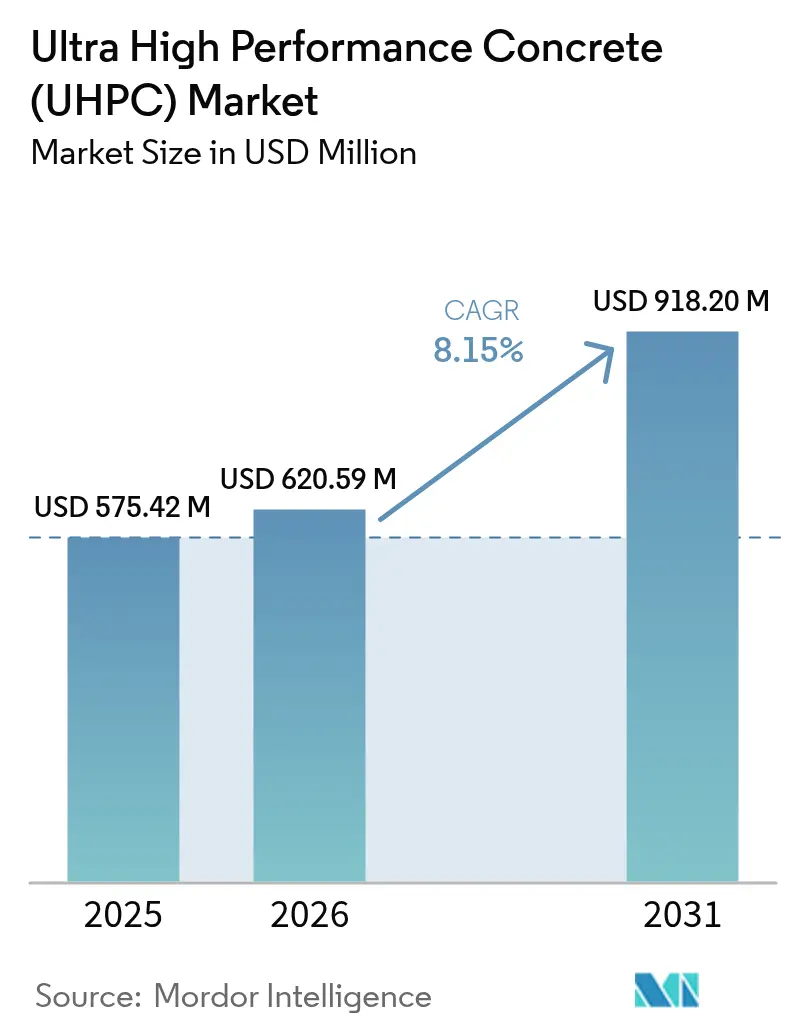
The Ultra High Performance Concrete Market size is projected to be USD 575.42 million in 2025, USD 620.59 million in 2026, and reach USD 918.20 million by 2031, growing at a CAGR of 8.15% from 2026 to 2031. Project pipelines funded by the U.S. Infrastructure Investment and Jobs Act, the European Union’s 50-year cost-of-ownership mandate, and China’s Belt and Road bridges are driving volume gains, while offshore-wind foundations and blast-mitigation barriers widen the application base. Supply bottlenecks for ultra-fine silica fume and steel micro-fibers tightened after European ferrosilicon plant closures and Chinese export curbs, inflating raw-material costs and elongating lead times. Patent filings for self-healing chemistries and novel fiber geometries surged 40% in 2025, indicating that materials science is outrunning global standardization, complicating cross-border approvals. Competitive intensity remains moderate because global cement majors bundle UHPC with engineering support, yet nimble regional specialists preserve margin by targeting architectural finishes and rapid-cure mixes.
Key Report Takeaways
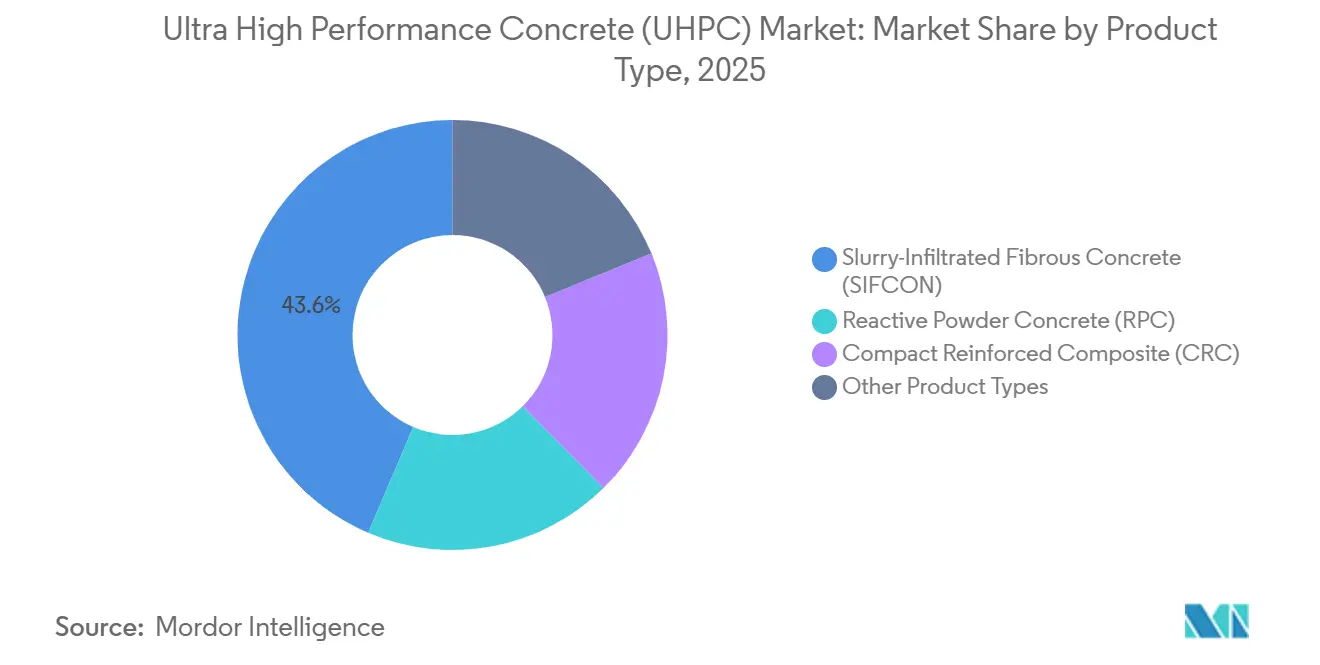
- By product type, slurry-infiltrated fibrous concrete captured 43.59% of the ultra-high-performance concrete market share in 2025; reactive powder concrete is projected to expand at an 8.60% CAGR through 2031.
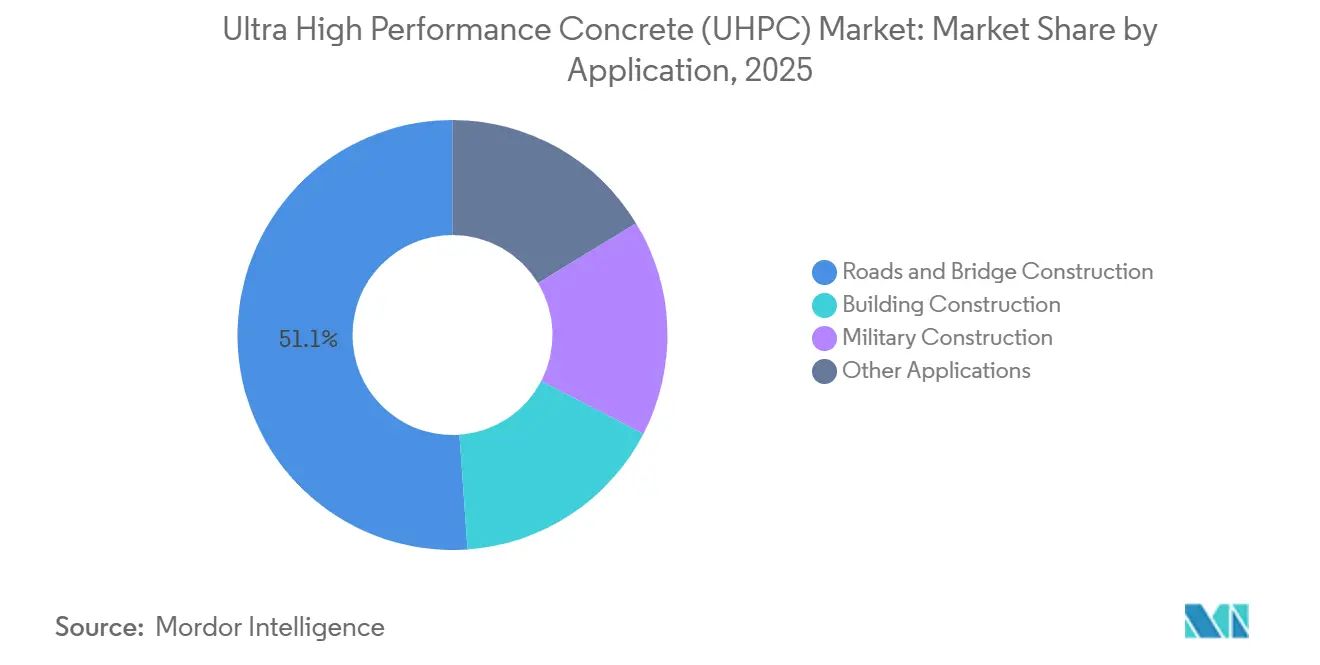
- By application, roads and bridge construction accounted for 51.12% share of the ultra-high-performance concrete market size in 2025, while building construction is forecast to expand at an 8.86% CAGR to 2031.
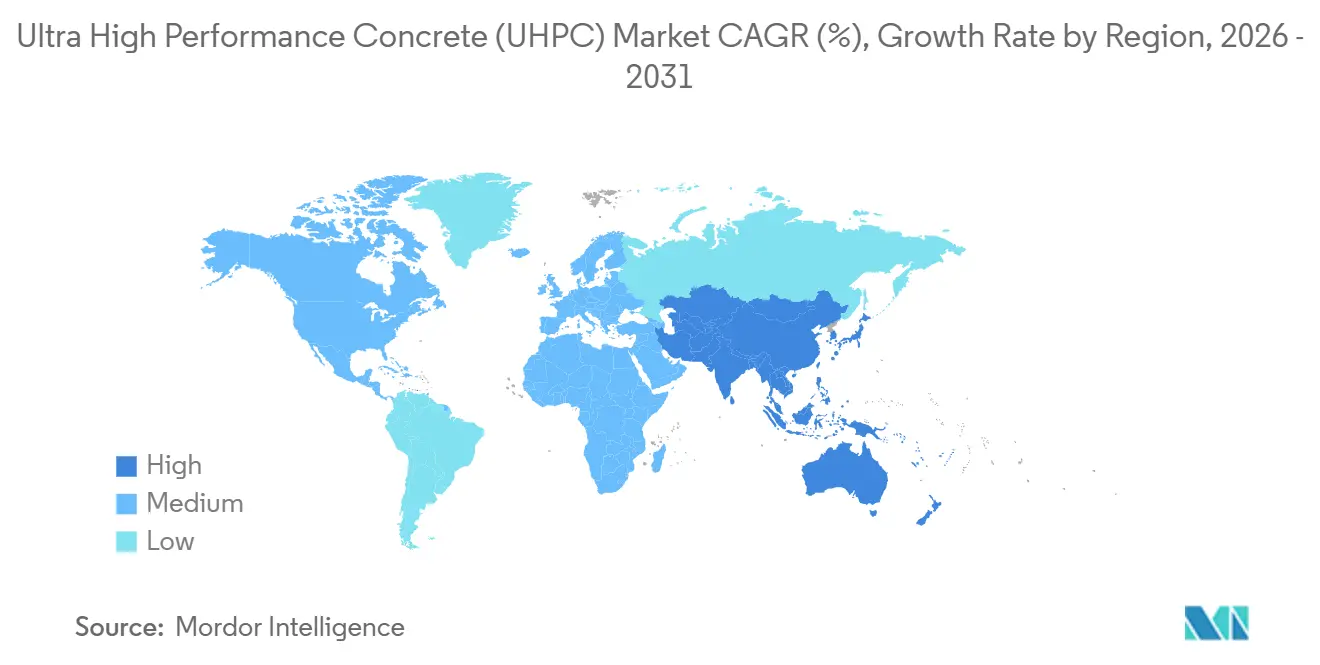
- By geography, North America led with 31.99% ultra-high-performance concrete market share in 2025, while Asia-Pacific records the fastest projected CAGR at 8.65% through 2031.
Note: Market size and forecast figures in this report are generated using Mordor Intelligence’s proprietary estimation framework, updated with the latest available data and insights as of 2026.
Market Trends and Insights
Drivers Impact Analysis of Ultra High Performance Concrete (UHPC) Market*
| Driver | (~) % Impact on CAGR Forecast | Geographic Relevance | Impact Timeline |
|---|---|---|---|
| Rising demand for durable bridge & transport infrastructure | +2.1% | Global, with concentration in North America, Europe, and APAC core (China, India, Japan) | Medium term (2-4 years) |
| Growth of prefabricated and modular construction | +1.8% | North America, Europe, ASEAN nations | Short term (≤ 2 years) |
| Government mandates for low-lifecycle-cost public assets | +1.6% | North America, EU, Middle East (Saudi Arabia, UAE) | Long term (≥ 4 years) |
| Adoption in offshore-wind turbine foundations | +1.4% | Europe (North Sea), APAC (Taiwan, Japan, South Korea), emerging in U.S. East Coast | Medium term (2-4 years) |
| Defense sector shift to blast-mitigating UHPC barriers | +1.3% | North America, Middle East, select APAC markets (South Korea, India) | Short term (≤ 2 years) |
| Source: Mordor Intelligence | |||
Rising Demand for Durable Bridge and Transport Infrastructure
Structurally deficient bridges in the United States, elevated-expressway contracts in India, and Japan’s coastal-highway repairs are moving UHPC from pilot status to programmatic adoption[1]American Society of Civil Engineers, “Infrastructure Report Card 2025,” infrastructurereportcard.org. The elimination of expansion joints, 60-year design lives, and slimmer cross-sections that reduce seismic mass underpin procurement decisions. China Railway Construction Corporation installed UHPC track slabs that promise ballast-free longevity. Despite jurisdiction-specific mix approvals slowing knowledge transfer, market momentum is now sustained by national funding rather than isolated demonstrations. The ultra-high-performance concrete (UHPC) market, therefore, aligns with long-duration infrastructure programs instead of discrete projects.
Growth of Prefabricated and Modular Construction
Off-site fabrication halves installation time for façade panels and bathroom pods, mitigating skilled-labor shortages in mature economies[2]Holcim, “Annual Report 2025,” holcim.com. New York State reopened Interstate 87 within 72 hours after installing precast UHPC deck panels. Singapore’s housing authority credits UHPC pods with 40% wet-trade labor savings. Standardized connection details from the Precast/Prestressed Concrete Institute have eased designer hesitation. As fabricators scale robotic finishing lines, the ultra-high-performance concrete (UHPC) market gains production repeatability that lowers cost variance and encourages broader specification.
Government Mandates for Low Lifecycle Cost Public Assets
The European Union’s 50-year maintenance-cost rule, Saudi Arabia’s NEOM directive, and the FHWA’s Every Day Counts initiative embed durability in bid evaluations. Australia’s benchmarks show 60% lower total ownership cost over 75 years for UHPC bridge decks despite quadruple upfront material prices. Larger contractors with stronger balance sheets absorb the initial premium, leading to a bifurcated market structure. These mandates institutionalize long-term value analysis, reinforcing the ultra-high-performance concrete (UHPC) market trajectory through public-sector procurement cycles.
Adoption in Offshore-Wind Turbine Foundations
Ørsted, Taipower, and Japan’s NEDO specify UHPC grouts and pontoons that deliver 50-year durability in chloride-rich seas. The U.S. Bureau of Ocean Energy Management added UHPC to Atlantic lease guidelines to future-proof 30 gigawatts of planned capacity. Although the material cost exceeds USD 2,000 per cubic meter, the mitigation of mid-life retrofits offsets capital expenditure. Performance requirements of permeability below 10⁻¹⁴ m/s and fiber contents above 2% accelerate material innovation, enlarging the ultra-high-performance concrete (UHPC) market beyond land-based structures.
Restraints Impact Analysis of Ultra High Performance Concrete (UHPC) Market*
| Restraint | (~) % Impact on CAGR Forecast | Geographic Relevance | Impact Timeline |
|---|---|---|---|
| High material and processing cost | -1.7% | Global, acute in cost-sensitive markets (South America, Africa, Southeast Asia) | Short term (≤ 2 years) |
| Low contractor familiarity & skills gap | -1.2% | North America, Europe, emerging APAC markets | Medium term (2-4 years) |
| Tight supply of ultra-fine silica fume & specialty fibers | -0.9% | Europe, North America, select APAC regions | Medium term (2-4 years) |
| Source: Mordor Intelligence | |||
High Material and Processing Cost
Material inputs represent up to 70% of delivered cost versus 30% for standard concrete, with steel micro-fibers adding USD 450-1,250 per cubic meter. Specialized high-shear mixers extend batch energy consumption by 40%. Brazilian agencies deferred UHPC bridges after 2024 fiscal reforms despite lifecycle gains. European silica-fume prices rose 18% after emissions rules shuttered Norwegian smelters. Local pozzolan substitution trials cut compressive strength to 80% of silica-fume UHPC, limiting structural use. Elevated capex, therefore, restrains the ultra-high performance concrete (UHPC) market in price-sensitive regions.
Low Contractor Familiarity and Skills Gap
Only 14% of US ready-mix producers offered UHPC in 2025. Germany certified fewer than 500 UHPC technicians by 2024, inadequate for autobahn demand. Japan’s shrinking construction workforce exacerbates the shortage. Sika introduced self-compacting mixes that remove vibration, but adoption reached just 25% of European precast plants by late 2025. Training scale-up lag delays broader ultra-high-performance concrete (UHPC) market penetration.
*Our forecasts treat driver/restraint impacts as directional, not additive. The impact forecasts reflect baseline growth, mix effects, and variable interactions.
Ultra High Performance Concrete (UHPC) Market Segment Analysis
By Product Type SIFCON Leads, RPC Gains on Offshore Momentum
SIFCON commanded 43.59% revenue in 2025, reflecting its dominance in blast-mitigation and seismic-retrofit niches where energy absorption trumps cost. Fiber contents of 6–20% by volume deliver ductility that outperforms other UHPC variants, but high labor input confines use to defense and critical infrastructure. RPC, expanding at an 8.60% CAGR, benefits from offshore-wind and architectural-precast demand; compressive strengths above 200 MPa and near-zero permeability suit marine harshness. Compact Reinforced Composite garners attention for ultra-thin pedestrian bridges yet lacks production scale. ASTM C1856 offers testing baselines, though many proprietary mixes exceed the thresholds, complicating benchmarking. Patent growth of 35% in RPC self-healing formulations underscores an innovation tilt that will enlarge the ultra-high-performance concrete (UHPC) market size for high-value offshore components.
The ultra-high-performance concrete (UHPC) industry differentiates through tailored performance rather than one-size commodity grades. SIFCON retains leadership in military and seismic-zone projects, whereas RPC’s versatility across bridges, façades, and monopiles fuels faster share gain. Regional precasters with fiber-orientation automation can monetize RPC’s rapid-strength gain, while global majors leverage brand portfolios to supply both SIFCON and RPC, balancing market risk across civil and defense spending cycles.



By Application Roads and Bridges Dominate, Building Construction Accelerates
Roads and Bridges represented 51.12% of 2025 revenue as agencies used UHPC to remove expansion joints and extend deck lives to 75 years. China mandated UHPC for new expressway bridges over 500 m from 2025. Building Construction, advancing at an 8.86% CAGR, leverages prefabricated UHPC façades and floor systems that cut on-site labor by up to 40% while meeting net-zero mandates. Military Construction remains smaller but steady as NATO standards codify UHPC in perimeter defenses. Other niches, including tunnel linings and industrial flooring, slowly expand as abrasion resistance gains recognition.
The ultra-high-performance concrete (UHPC) market size for Building Construction expansion reflects accelerated adoption of lightweight cladding and high-thermal-mass envelopes in high-rise towers. Conversely, Roads and Bridges will likely hold the majority Ultra high performance concrete (UHPC) market share through 2031, supported by North American rehabilitation funding and Asian expressway buildouts. Skill-training and standard connections remain prerequisites for wider application diffusion.
Geography Analysis
North America Ultra High Performance Concrete (UHPC) Market
North America contributed 31.99% of revenue in 2025 after the Infrastructure Investment and Jobs Act directed USD 110 billion toward resilient bridges. Thirty-eight state DOTs reference UHPC in accelerated-bridge standards, and Canadian cold-climate guidelines unlocked deployments in Ontario and Quebec. Mexico specified UHPC viaducts on the Tren Maya rail, targeting 100-year tropical durability. Contractor skill shortages, however, slow project throughput, creating backlog in the ultra-high-performance concrete (UHPC) market pipeline.
APAC Ultra High Performance Concrete (UHPC) Market
Asia-Pacific posts the fastest 8.65% CAGR, propelled by China’s high-speed rail, India’s expressways, and Japan’s tsunami-zone coastal repairs. ASEAN metro expansions in Bangkok and Manila amplify demand, while offshore-wind foundations in Taiwan and South Korea consume RPC volumes. Domestic consumption trimmed Chinese silica-fume exports, tightening regional supply and nudging prices, yet robust public-funded pipelines sustain growth momentum for the ultra-high-performance concrete (UHPC) market.
EMEA and South America Ultra High Performance Concrete (UHPC) Market
Europe leverages lifecycle-cost mandates and offshore-wind initiatives to sustain share. Germany’s autobahn-rehabilitation and France’s Grand Paris Express specify UHPC for accelerated construction. The UK’s HS2 tunnels adopted UHPC joints to lower leakage risk. Norwegian smelter closures shrank fume supply, but Nordic offshore-wind projects still privilege locally sourced UHPC. South America grows modestly due to fiscal austerity, though Argentina’s shale-gas pipelines open corrosion-resistant UHPC orders. Middle East projects, led by Saudi Arabia’s NEOM coastal defenses, inject high-margin volume that offsets African budget constraints, rounding out the global Ultra high performance concrete (UHPC) market landscape.

Value Chain Analysis
The UHPC value chain begins with binders and specialty inputs, mainly cement, ultra-fine silica fume (a by-product from silicon and ferrosilicon production), polycarboxylate superplasticizers, and high-tensile steel (or synthetic) fibers. Supply risk is most concentrated around silica fume and specialty fibers, where constrained metallurgical output and cross-border logistics can tighten availability and extend lead times, lifting delivered mix costs and encouraging dual-sourcing and nearshoring.
Midstream, UHPC is formulated by cement and admixture suppliers and produced as bagged premixes, ready-to-cast batches, or in precast plants with controlled mixing, fiber dosing, and curing regimes. Because placement quality and curing control drive performance, technical service, training, and field support are typically part of commercialization, and sales often run direct to infrastructure owners, EPCs, and precast fabricators. Downstream distribution is usually regional due to practical service-radius limits for fresh material and the need for onsite execution expertise, which supports licensed regional precasting, temporary site batch plants for major bridge programs, and closer alignment with DOT and highway authority procurement workflows (including U.S. accelerated bridge construction use cases).
Competitive Landscape
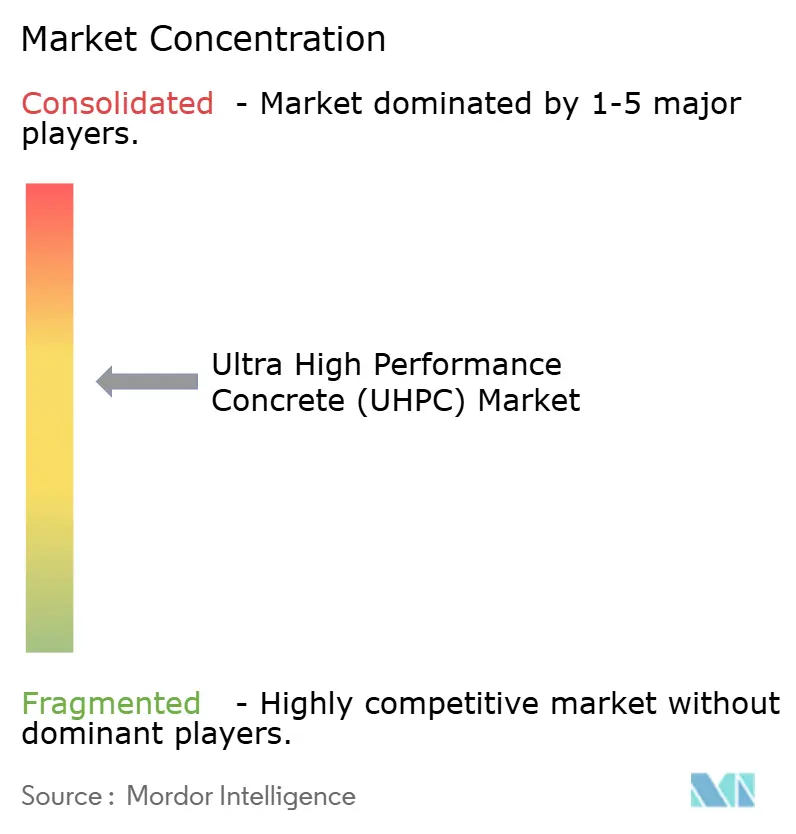
The Ultra High Performance Concrete (UHPC) market is moderately concentrated. Global cement leaders Holcim, Cemex, and Sika AG leverage distribution scale and engineering services to anchor the ultra-high-performance concrete (UHPC) market, while regional specialists TAKTL, UHPC Solutions North America, and ELO Beton capture premium margins through bespoke mixes and architectural finishes. Overall innovation and supply-chain control as the primary competitive axes in the ultra-high-performance concrete (UHPC) market.
Ultra High Performance Concrete (UHPC) Industry Leaders
ceEntek
Sika AG
Holcim
Cemex
Gulf Precast
- *Disclaimer: Major Players sorted in no particular order
Ultra High Performance Concrete (UHPC) Market Companies Covered in this Report
- Antica Ceramica LLP
- ceEntek
- Cemex
- Cor-Tuf
- ELO Beton
- Gulf Precast
- Holcim
- Illinois Tool Works Inc.
- Metrostav
- RAMPF Holding GmbH & Co. KG
- Sika AG
- TAKTL
- UHPC Solutions North America
Read Analysis of Ultra High Performance Concrete (UHPC) Companies

Market Opportunities and Future Outlook
A whitespace remains in scaling UHPC from project-by-project qualification to repeatable programs, especially for accelerated bridge construction connections, deck overlays, and joint-free rehabilitation packages where owners want shorter closures and long service lives. In the United States, this opportunity is tied to continued field adoption on bridge replacements and repairs; SmartUp UHPC, for example, supplied about 140 cubic yards for the State Highway 100 bridge replacement over the Tenkiller Dam in Oklahoma with Kiewit Infrastructure as prime contractor (June 2026). Beyond bridges, offshore wind and marine works continue to pull performance-led specifications (durability in chloride exposure), while architectural precast and modular construction support demand for consistent finish quality and faster installation.
Two enabling opportunity areas stand out. First, standardization and certification pathways that reduce bespoke testing burdens can help expand addressable projects across jurisdictions, with ASTM C1856/C1856M and newer technical documents supporting this direction while leaving gaps in global prescriptive rules for mix proportioning, fiber orientation control, and structural design. Second, cost and carbon reduction pathways are drawing active R&D, including alternative supplementary cementitious materials (for example, research into biomass ashes such as rice husk ash and sugarcane bagasse ash) and mix-design approaches aimed at reducing material intensity while maintaining mechanical performance. This creates room for suppliers to industrialize lower-CO2, performance-based UHPC systems with predictable constructability.
Recent Industry Developments in Ultra High Performance Concrete (UHPC) Market
- June 2026: SikaFiber Force obtained CE marking, supporting its use as a certified fiber for structural reinforcement in regulated construction markets. The certification can ease specification and procurement for UHPC and fiber-reinforced applications where conformity marking is required, strengthening supplier positioning in infrastructure and precast channels.
- November 2025: National Cement announced domestic production of SmartUp UHPC in the United States Southeast to serve accelerated bridge construction demand. Local production shortens supply lines for time-critical bridge closures and shifts competitiveness toward suppliers that can pair manufacturing footprint with field support.
- August 2025: ceEntek supplied nano-engineered UHPC2.0 for a BHP rail bridge deck project in Australia, reporting load-bearing strength achieved in 33 hours. Rapid strength gain supports compressed construction windows and highlights the premium placed on curing performance for transport and heavy-industry assets.


Ultra High Performance Concrete (UHPC) Market Report Scope and Research Methodology
Market Definition and Coverage
For this study, the UHPC market covers the value of ultra high performance concrete supplied for construction uses, where mixes are engineered to deliver very high strength and durability, and are placed as premix, precast, or cast-in-place solutions.
Scope exclusions: This sizing does not count conventional high-strength concrete grades that do not meet UHPC performance thresholds, and it excludes broader cement, aggregates, and standard admixtures sold for non-UHPC mixes.
Segments Covered in This Report
- By Product Type
- Slurry-Infiltrated Fibrous Concrete (SIFCON)
- Reactive Powder Concrete (RPC)
- Compact Reinforced Composite (CRC)
- Other Product Types
- By Application
- Roads and Bridge Construction
- Building Construction
- Military Construction
- Other Applications
- By Geography
- Asia-Pacific
- China
- India
- Japan
- South Korea
- ASEAN Countries
- Rest of Asia-Pacific
- North America
- United States
- Canada
- Mexico
- Europe
- Germany
- United Kingdom
- France
- Italy
- Russia
- NORDIC Countries
- Rest of Europe
- South America
- Brazil
- Argentina
- Rest of South America
- Middle East and Africa
- Saudi Arabia
- South Africa
- Rest of Middle East and Africa
- Asia-Pacific
Data Sources, Market Sizing, and Validation
Desk Research
Desk work started by mapping where UHPC demand shows up first, which is usually in bridges, repairs, precast elements, and defense-related structures. We used public infrastructure and construction statistics such as US Census construction put-in-place data, Eurostat construction indicators, and national transport agency and public works pipelines where available. Standards and technical adoption were also checked using bodies such as ACI and ASTM publications, along with papers in peer-reviewed civil engineering journals that discuss UHPC mix design and field performance.
On the supply side, we reviewed company annual reports, investor presentations, product brochures, and press releases to confirm where capacity additions and channel priorities were moving. Import and export checks were supported through customs and trade statistics sources, and we reviewed patents through a paid patent database subscription to understand where mix innovations and fiber use are heading. The desk source list is illustrative, and we also used other public documents to close gaps and validate assumptions during the research.
Primary Interviews and Surveys
Primary discussions were carried out with UHPC material suppliers, precast producers, contractors, structural engineers, and project consultants who influence specification choices. To reduce a single-region bias, we tested assumptions across APAC, EMEA, and the Americas, then reconciled differences on pricing, typical mix designs, and where UHPC is selected over alternatives.
Distribution of primary research fieldwork respondents
| Company type | Respondent position | Region |
|---|---|---|
| Top tier: 30% | CXOs: 12% | APAC: 48% |
| Mid tier: 56% | Functional/Unit leaders: 33% | EMEA: 29% |
| Smaller Players: 14% | Managers: 55% | Americas: 23% |
Market-Sizing & Forecasting
Sizing was built using a top-down approach where infrastructure and building activity indicators were translated into an addressable UHPC demand pool, then filtered through realistic adoption levels by application. After forming that market envelope, we stress-tested it with selective bottom-up checks, such as sampled supplier volumes, precast throughput signals, and typical selling price ranges, so totals could be adjusted when a clear mismatch appeared.
Key inputs that shaped the model included public infrastructure budgets and tender pipelines, bridge and roadway rehabilitation intensity, precast usage trends in large projects, typical fiber and silica fume availability constraints, and application-level price premiums versus standard concrete. Once the market envelope is anchored to where UHPC is actually specified and poured, the picture becomes more consistent with project activity rather than broad construction growth.
For forecasting, scenario analysis was used to reflect how quickly standards acceptance, project approvals, and capacity expansions can move, then the scenarios were aligned to expert consensus from interviews on adoption timing and price movement. Where bottom-up data was thin in smaller countries, we used proxy indicators (such as comparable infrastructure spend and similar construction codes) and kept assumptions conservative until follow-up calls confirmed the direction.
Data Validation & Update Cycle
Outputs were validated by cross-checking implied UHPC volumes against independent signals, including major project counts, precast installation activity, and realistic usage rates in bridge decks and repairs. Variances were reviewed through multiple steps, and outliers were traced back to either a scope mismatch, a price assumption, or a timing issue in project starts. When a gap could not be explained, respondents were re-contacted to confirm whether it was a local pricing effect, a specification shift, or a one-off project.
The report is refreshed annually, and interim updates are triggered when material events occur, such as a major standards change, a large capacity announcement, or a sharp input cost swing affecting UHPC pricing. Before delivery, we complete a final analyst pass so the latest public data points and interview learnings are reflected in the numbers clients receive.
Mordor Intelligence's Ultra High Performance Concrete Uhpc Market Size Compared With Other Published Estimates
It is normal to see different UHPC market values across publications because the boundary of what counts as UHPC is not always handled the same way. Differences also come from how each study treats pricing, the year used as the anchor, and whether application adoption is tied to real project activity or broad construction growth.
By tracking application-level adoption rates and refreshing key inputs through project pipeline checks, Mordor Intelligence keeps the UHPC total aligned to structures where UHPC is actually specified, rather than mixing in adjacent high-strength concrete demand. Some estimates lean more on a single base-year figure and apply a smoother growth curve, which can understate short-term supply constraints such as fiber availability and silica fume tightness. Others use wider product boundaries or different currency timing, which can shift the stated market size even if underlying demand is similar.
Benchmark comparison
| Source | Market Size | Gaps in Research Methodology |
|---|---|---|
| Mordor Intelligence | USD 575.42 M (2025) | |
| Industry Publisher A | USD 688.90 M (2024) | Uses a different base year and applies a longer forecast window, which can lift the near-term value if average pricing and adoption are assumed to normalize earlier across regions. |
| Data Provider B | USD 527.28 M (2024) | Relies on a narrower starting-year valuation and may apply different currency timing and product boundary choices, which can reduce the counted value where UHPC is embedded inside broader concrete categories. |
The spread in the table mainly comes from base-year choice, boundary definitions around UHPC versus adjacent mixes, and how quickly adoption is assumed to move in infrastructure and building uses. Our approach stays traceable because the market is tied back to project activity signals, practical adoption rates by application, and price ranges checked with industry participants, which makes the result easier to replicate and explain.


Key Questions Answered in the Report
How big will the Ultra high performance concrete (UHPC) market be by 2031?
It is projected to reach USD 918.20 million by 2031, expanding at an 8.15% CAGR from 2026-2031.
Which segment currently leads in revenue?
Roads and Bridges accounted for 51.12% of 2025 revenue owing to extensive rehabilitation programs.
What drives rapid growth in Asia-Pacific?
China’s Belt and Road bridges, India’s expressways, and Japan’s coastal repairs underpin an 8.65% regional CAGR.
Why is Reactive Powder Concrete gaining share?
Offshore-wind and architectural-precast demand favor RPC’s 200 MPa strength and near-zero permeability, yielding an 8.60% CAGR.
What is the main barrier to wider UHPC adoption?
High material cost, particularly silica fume and steel fibers, raises delivered prices to USD 1,200-2,500 m³.
Page last updated on:





